Film Review: The Butterfly Effect 2 (dir by John R. Leonetti)


http://www.youtube.com/watch?v=jHg7L35MLqY

“Hey, everyone!  Let’s remake The Butterfly Effect, just without any of the goofiness that made the first film so enjoyable!”

That would seem to be the logic behind 2006’s The Butterfly Effect 2.  Since the first Butterfly Effect was a minor hit (I saw it in the theaters!), it was inevitable that there would be a sequel.  And since the first Butterfly Effect is currently on Netflix, it’s also inevitable that the sequel would follow it.

Anyway, Butterfly Effect 2 is just like Butterfly Effect except, instead of a guy trying to fix his entire screwed-up childhood, the sequel is about an office worker named Nick (Eric Lively) who has just had a really bad year.  His girlfriend and his two best friends were killed in a traffic accident.  He lost a big promotion at work.  His apartment is a mess and he keeps having these hella icky nosebleeds.  Agck!  Nick, however, discovers that if he stares at an old picture, he can be transported back to the moment that the picture was taken.

Since Nick obviously didn’t see the first movie, he proceeds to start changing the past.  He prevents the deaths of all of his friends but now, in the new timeline, he actually has to work with them and this results in him getting fired.  He then goes back in the past to keep a jerk from getting a promotion but this leads to Nick getting the promotion instead, breaking up with his girlfriend, and becoming an ennui-stricken bachelor.  Apparently, being a wealthy bachelor means doing business with organized crime because Nick soon has people trying to kill him.  Maybe there’s no way to create a perfect present, the film suggests.

And the film might be right but that doesn’t make it any less boring to sit through.  The Butterfly Effect 2 is just never as much fun as the first film.  It lacks the goofy charm of Ashton Kutcher and most of the timeline changes are rather dull.  The sequel never matches the glory of Ashton Kutcher waking up to discover that he’s gone from being a disheveled psych major to being a clean-cut, sweater-wearing frat boy.

The Butterfly Effect 2 was directed by John Leonetti, who would later direct the genuinely creepy Annabelle.  Of course, he also directed the absolutely awful Wolves at the Door.  As for The Butterflyn Effect 2, it’s not creepy but it’s also not awful enough to be memorable.  More than anything, it’s a bland movie.  It’s just kind of there, floating in direct-to-video, Netflix limbo.

Film Review: The Butterfly Effect (dir by Eric Bress and J. Mackye Gruber)


How many different ways can Ashton Kutcher fuck up time and space?

That’s the question asked in the gloriously silly The Butterfly Effect, a film that was a minor hit back in 2004.  Ashton plays Evan Treborn, a disheveled college student who is studying how memory works.  All through his life, Evan has suffered from seizures that are triggered by stress.  Evan has a lot of stress because apparently, there’s not a single bad thing that didn’t happen to him when he was a child.

Crazy father who tried to strangle Evan before being gunned down in front of his son’s terrified eyes?  Yep.

Sexual molestation at the hands of a suburban drunk?  Yep.

A best friend who blew up not only a mailbox but also a mother and a baby?  Yep.

A dog that was set on fire by a neighborhood bully?  Yep.

Another friend who was driven into a catatonic state by all the madness around him?  Yep.

A girlfriend who, due to family tragedy, had to move away?  Yep.

However, things seem to be getting better for Evan.  Now, he’s a psychology major with a bright future.  His professors love him.  He’s even got a roommate named Thumper (played, somewhat inevitably, by Ethan Suplee).   And, as he’s soon to discover, he possesses a special power.  All he has to do is read his old journals and, for a limited time, he can go into the past and change his history.

Of course, it turns out that changing history is a lot more complicated than it looks.  Evan goes back into the past and confronts the pervy suburban drunk.  He then goes back to the present and discovers that he’s now a shallow frat boy who is hated by both his professors and Thumper!  Even worse, he eventually ends up in prison for killing a man.  Going back into the past and saving his dog leads to his friend Lenny (Elden Hansen) spending the rest of his life imprisoned.  Another trip to the past results in Evan waking up as a double amputee.  Depending on what Evan does, his friend Kayleigh (Amy Smart) either becomes a shallow sorority princess or a drug-addicted prostitute.  Meanwhile, Kayleigh’s brother (William Lee Scott) goes from being a psychotic murderer to a clean-cut religious guy.

Thumper never changers, though.  Thumper endures.

This, of course, is a lot of pressure to put on any character played by Ashton Kutcher and soon, Evan is having nosebleeds and migraines.  Every time he changes the past, his brain is flooded with 20 years worth of new memories.  His brain might explode before he can fix all the damage that he’s done….

Watching The Butterfly Effect is an odd experience because, on the one hand, the premise is genuinely intriguing but, on the other hand, the film stars the reliably goofy Ashton Kutcher.  Ashton grows a beard and doesn’t wash his hair for the first half of the movie, which is the film’s way of letting us know that we’re meant to take him seriously but it doesn’t change the fact that he’s still Ashton Kutcher.  Even when playing the most dramatic of scenes, Ashton tends to deliver every line as if it’s the set up for a punch line.  It’s not surprising that the best part of The Butterfly Effect is when Ashton wakes up and discovers that he’s now a frat boy.  Those scenes are intentionally funny and they take advantage of what Ashton Kutcher is actually good at.

At the same time, it’s hard not to get into The Butterfly Effect.  It’s a mess but it’s a likable mess and it’s undeniably enjoyable to see how everyone’s life changes as a result of Ashton’s constant meddling.  (William Lee Scott especially has fun, switching between being full-blown psycho and full-blown religious.)  The Butterfly Effect may be dumb but it’s fun.  It’s a film that’s best watched with your snarkiest friends.

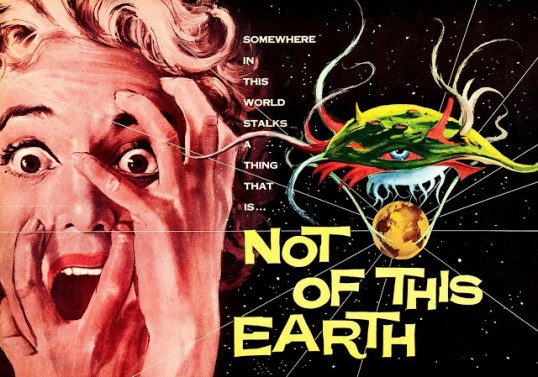
Film Review: Not Of This Earth (dir by Roger Corman)


Originally released in 1957, Roger Corman’s Not Of This Earth is about a man named Mr. Johnson (played, in a nicely creepy performance, by Paul Birch).

At first glance, Mr. Johnson may look like your typical dark-suited, 1950s businessman but, on closer examination, there’s definitely something off about him.  Why does he always wear those dark sunglasses?  Why is he so sensitive to loud noise?  Why does he move stiffly, as if he’s still getting used to his ody?  And when he speaks, why is his tone always so formal and correct?  Never trust anyone who doesn’t use a contraction or two.  Why is it that Mr. Johnson seems to spend all of his time in his mansion, only venturing outside so that he can visit the local blood banks?

Could it be that Mr. Johnson is …. not of this earth!?

Well, yes, of coursem he’s an alien.  I mean, it says so right in the title of the movie!  It turns out that Mr. Johnson comes from a planet called Davanna.  The inhabitants of Davanna are dying of a mysterious blood disease so he’s been sent to Earth so that he can run tests on human blood.  Needless to say, Mr. Johnson is under constant pressure from his bosses back home.  They expect Johnson to find a cure but there’s only one problem.  Human blood is sometimes hard to come by.

Oh sure.  Johnson can always go to the local doctor (William Roerick) and get a transfusion.  But, unfortunately, Johnson is often forced to deal with his need for blood by murdering anyone who happens to be near the house, whether it be a teenager or a vacuum cleaner salesman.  Like a vampire, Johnson drains them of their blood before retreating to the safety of his mansion.

Paul Birch gives a wonderfully odd performance in the role of Mr. Johnson, playing him in such a way that suggests that Mr. Johnson is still not quite comfortable with his human disguise.  When he starts speaking with his stilted and awkward syntax, he’s like a man who has just learned how to speak another language.  On the one hand, it’s tempting to feel sorry for Mr. Johnson because he’s desperately trying to save his people.  On the other hand, he does end up killing a lot of people.

Beverly Garland and Morgan Jones play Nadine and Harry, a nurse and a policeman who stumble across the truth of Mr. Johnson’s origins.  Beverly Garland was one of those confident, no-one-is-going-to-conquer-my-planet actresses who could elevate any film by her presence alone and, as this film shows, if you’re trying to stop the aliens from stealing all of Earth’s blood, Beverly Garland was someone who you would want on your side.

With the exception of a scene featuring Dick Miller as a slick salesman, director Roger Corman plays the material straight and the end result is a quickly paced and, at times, genuinely creepy little sci-fi/horror hybrid.  Corman makes good use of his low-budget and even the film’s cheap look ultimately works to its advantage.  The stark black-and-white cinematography perfectly captures the harshness of Mr. Johnson’s mission.  This an effective and enjoyable B-movie.

Finally, since this is a Roger Corman production, be sure to look for all of the usual suspects.  As mentioned above, Dick Miller plays a salesman.  (Before becoming an actor, Miller actually did work as a door-to-door salesman and he ad libbed the majority of his dialogue.)  Jonathan Haze appears as one of Mr. Johnson’s servants.  And, of course, the film was written by Corman’s longtime collaborator, Charles B. Griffith.  Three years after making Not Of This Earth, Corman, Haze, Miller, and Griffith would collaborate on the somewhat more light-hearted Little Shop of Horrors.

http://www.youtube.com/watch?v=ESiPZwKgIuQ

Film Review: This Is Not A Test (dir by Fredric Gadette)


This Is Not A Test opens with Deputy Dan Colter (played by Seamon Glass) out on patrol.  Suddenly, an alert comes across the radio.  Missiles have been launched.  They’re heading for the United States.  War is imminent.  This is not a test.

Deputy Colter proceeds to set up a road block.   Every motorist who approaches is ordered to pull over to the side of the road and not go anywhere.  Among those who pull over to the side of the road are a young woman and her grandfather, a truck driver, a couple who have a small dog, and a nervous young man in a suit.  Colter explains to them what’s going on.  He tells them that they can’t leave.  He has his orders.  This is not a test.  This is a real emergency.  And since Colter is the only available man in uniform, that means that he’s in charge.  When the young woman expresses some doubts to her grandfather, the old man tells her that they have to do what they’re told.

Colter has a plan for surviving the war.  He says that they can all get in the back of the truck driver’s big rig.  He estimates that they’ll have to stay there for two weeks or so.  Under his orders, everyone starts to unload the truck.  Of course, not everyone thinks that the truck is going to provide adequate protection but there aren’t any other options available.  A few people get upset when Colter announces that, for reasons of safety, they can’t take any alcohol into the truck.  Of course, considering that one of the people at the road block is a psychotic, knife-wielding murderer, the alcohol might be the least of their concerns.

As the group tries to create a shelter, they’re also forced to deal with not only a group of rather mild-mannered looters but also the fact that Colter, himself, doesn’t seem to be particularly stable.  Colter is enjoying his authority a bit too much, especially when it comes to judging whether they have room in the truck for the couple’s dog or not.  One almost gets the feeling that Colter’s looking forward to being the sole man in charge after the bombs drop….

Over the police radio, reports continue to come in.  The missiles are getting closer.  This is not a test….

This Is Not A Test is an extremely low-budget film from 1962.  It was cast with unknown, largely amateur actors and the whole film has a grainy, almost dream-like feel to it.  (It would appear that this night-set film was actually filmed at night, which means that the visuals are often as dark as the film’s storyline.)  The film gets off to a rough start, with a lot of clumsy dramatics but, as things progress, the film develops a very convincing atmosphere of impending doom.  The film emphasizes the fact that no one has the slightest idea what to do and Deputy Colter soon proves himself to be an aspiring dictator.  Though most of the actors give rather stiff performance, Seamon Glass makes the aspiring fascist into a very believable and recognizable character.

The low-budget and the amateurish acting aside, This Is Not A Test deserves a lot of credit for following its dark storyline through to its natural conclusion.  There is no exit.  There is no escape.  This is not a test.


Song of the Day: Candy (by Red Velvet)


Red Velvet Candy

Just a day before that hallmark of all Hallmark days. Usually there’ll be a flood of Valentine’s related postings and this latest Song of the Day will not be an exception.

Today’s Song of the Day: K-Pop Edition sees the return of one of my favorite K-Pop girl groups: Red Velvet. Seen by many K-Pop fans as the younger SM Entertainment sister group to SM’s main girl group, Girls Generation (aka SNSD), Red Velvet has managed to forge their own success with a unique sound that balances their dual concept of girl crush (Red) and sultry, mature (Velvet).

The previous two Red Velvet entries as Song of the Day sees example of the group under both concepts. There’s “Be Natural” which is their first “Velvet” concept. Then a little later there’s “Ice Cream Cake” which is them in their “Red” aka girl crush concept.

With today’s Song of the Day, we have Red Velvet’s lush ballad from their Ice Cream Cake mini-album: “Candy.”

It’s a track that’s well-suited for all the happenings today and for the rest of the week as even the most jaded will try to find a semblance of romance, if just for a couple days or so. A song that talks about both the effect that love has on couples. An emotion that’s both heartwarming and bittersweet as the emotional aspect of love can also lead to an overwhelming fear of that attachment fading that ultimately leads to separation.

“Candy” being the title is the group’s play on words as the whole Ice Cream Cake mini-album’s songs has done. The title may be about something sweet and enjoyable, but the lyrics definitely shows that it is a bit more than a sweet confection.

Film Review: Ladybug Ladybug (dir by Frank Perry)


Long before he played the long-suffering Mr. Feeney on Boy Meets World, William Daniels made his film debut as another school principal in the 1963 film, Ladybug Ladybug.

In Ladybug Ladybug, Daniels plays Mr. Calkins and he’s got a lot more to worry about than just some unstable student with an unhealthy fixation on a girl that he’s gaslighted into loving him.  No, Mr. Calkins has to deal with the very real possibility that a nuclear war might break out at any second.  One day, when an imminent nuclear attack warning signal goes off, no one can be sure whether or not it’s real or if it was an accident.  However, Mr. Calkins takes no chances.  He dismisses school for the day and tells all of the students to go home.

However, there’s a problem.  The school is in a rural area and most of the students live several miles away.  Because it’s early in the day, there aren’t any school buses running.  The children will have to walk home.  To make sure that the kids get to safety, they’re divided into groups.  A teacher is assigned to each group, tasked with keeping the children calm and making sure they reach their houses.

It’s a long walk and the countryside is deathly quiet.  Some of the children talk about what’s going to happen if there really is a war.  Others, being too young to understand the seriousness of the situation, treat it all like a game.  As each child reaches their house, they have to deal with parents who are more concerned about why their child has come home early than the fact that there might be a war about to break out.

Back at the school, Mr. Calkins and a few remains teachers wait.  One teacher tries to clean up her classroom, all the while realizing that there’s a chance that the classroom will never be used again.

And we, the viewers, keep waiting for a bomb to drop or, at the very least, some sort of clarification about what’s really happening.  We wait in vain.  The film’s ending is harrowing but, at the same time, ambiguous.  Is the world ending or are the children going to wake up in the morning and head back to school?  It all depends on how you interpret the film’s final few moments.

Of course, by the time we reach that ending, a group of children has already taken cover in a bomb shelter.  Unfortunately, their self-appointed leader has decided that there’s not room for all the children, which means that one girl ends up getting kicked out.  Wandering around outside, she finds an old refrigerator to hide in.  Your heart sinks as you watch her climb in and close the door behind her….

Ladbybug Ladybug is a grim film.  At times, it runs the risk of being a bit too grim.  The film definitely gets across its point but it’s so relentlessly depressing that it’s a bit difficult to sit through.  Of course, Ladybug Ladybug was filmed around the same time as the Cuban Missile Crisis so, for many viewers in 1963, the film was less an allegory and more just a record of the feelings and fears that they had to deal with every single day.  Towards the end of the film, when one of the children desperately starts to yell, “Stop!  Stop!  STOP!,” he was undoubtedly speaking for an entire generation that grew up under the shadow of mutually assured destruction.

Ladybug Ladybug was one of the many nuclear war-themed films to be released in the early 60s.  One could easily imagine it as being a companion piece to Fail Safe.  While President Henry Fonda is debating whether or not to sacrifice New York, the children are simply trying to get home.

Film Review: Like A Country Song (dir by Johnny Remo)


So, stop me if this sounds familiar.

You’ve got an old country boy named Bo (played by Billy Ray Cyrus) who, years ago, reacted to a family tragedy by abandoning his wife and son.  He’s spent the last decade on the road, drinking and doing drugs and basically being totally irresponsible.  Now, he’s returned home and he’s trying to be sober and he’s hoping that he might even be able to reconnect with his family.

And then you’ve got Jake (played by Joel Smallbone), who is an up-and-coming country music star.  He’s cocky.  He’s arrogant.  He’s still in love with his ex.  He’s returned home because he’s lost.  He’s also Bo’s son.  Years ago, his mother (Jennifer Taylor), told him that Bo was dead.

So, now, Bo and Jake are both wandering around the same town.  Do you think there’s a chance that Bo and Jake might meet each other?  And maybe Bo’s going to see that Jake is heading down the exact same bad road that Bo’s spent the last few years traveling?

Does that sound just like a country song?

Superficially, yes.  However, there are a few differences.  For one thing, 2014’s Like A Country Song was rated PG-13 and clearly made for a family audience.  That means there’s far less sex in this movie than you’ll find in the average country song.  This is one of those films were characters are described as being wild but they’re also rather chaste.  Jake’s ex (and perhaps future) girlfriend, Becca (Kerry Knuppe), is too busy volunteering to feed the homeless to spend much time doing anything else.

Also, since this is a faith-based film, there’s considerably less cursing to be found here than in the mildest of country music.  I may be mistaken but I don’t think I even heard a single “damn” in the film.  Trust me, I’ve spent a lot of time around country folk and even the most religious of them can turn profanity into an art form.  If you really want to attend a symposium on creative ways to use the f-word in casual conversation, go hang out with a bunch of retirees in Arkansas.

Traditionally, this would be the point of the review where I write about how, despite being from Texas, I’m not a huge fan of country music but actually the music in Like A Country Song isn’t that bad.  Say what you will about Billy Ray Cyrus, he can sing.  So can Joel Smallbone, for that matter.  Neither one is a bad actor, either.  They’re believable as father and son, except for a few instances where Smallbone’s native Australian accent breaks through.

Anyway, this is one of those films that won’t surprise you but it deserves some points for 1) being exceedingly pleasant and 2) not being as preachy as some of the other faith-based films out there.  Though the film was made on an obviously low-budget, it makes good use of its country setting and the cast does their best to bring some life to the material.  It’s a good-natured movie and sometimes, that’s enough.


Film Review: Extremities (dir by Robert M. Young)


The 1986 film, Extremities, begins with a woman named Marjorie (Farrah Fawcett) getting into her car and getting attacked by a masked rapist named Joe (James Russo).  Though Marjorie manages to escape, Joe grabs her purse.  Later, we watch as Marjorie gets no help from the police while Joe goes home to his loving family.

One week later, Marjorie is alone at her house when Joe lets himself inside.  At first, Joe pretends that he just needs to use the phone.  When Marjorie lies that her husband is taking a nap upstairs, Joe starts to call for him to come downstairs.  As Joe reveals, he’s been stalking Marjorie for days.  He knows that she’s not married and he knows that her roommates will not be home for a few hours.

However, what Joe doesn’t know is that Marjorie has a can of bug spray and, as soon as Joe lets his guard down, she sprays it in his eyes and his mouth.  When the stunned and temporarily blinded Joe stumbles back, Marjorie pushes him into the fireplace and ties him up.  Realizing that he may have ingested toxic chemicals, Joe begs to be released but Marjorie has other plans….

And I was all for it!  I was really looking forward to watching Marjorie torment her attacker.  Unfortunately, Marjorie’s two roommate show up before Marjorie can really get started.  Terry (Diana Scarwid) is shocked when Marjorie explains that she’s planning on burying Joe alive but, as a rape survivor, Terry also knows that, even after all of this, the police will still not be of any help.  Meanwhile, Pat (Alfre Woodard) is a social worker, which means that she has to be the tedious voice of moderation.  She’s the one who says that they can’t kill Joe and that Joe might not even actually be the man who attacked Marjorie….

And that, right there, is one of the main problems with Extremities.  We spend a lot of time listening to Pat argue that it’s not right to torture anyone and that Marjorie might be mistaken and maybe Joe really was just some innocent guy who needed to use the phone.  However, we know that Marjorie’s right, Pat’s wrong, and Joe’s the attack.  As a result, it’s impossible not to get annoyed when Pat keeps going on and on.  We know exactly who Joe is and what we want is to see Marjorie get both justice and her revenge.  We want to see Joe suffer.  What we don’t want to do is spend 30 minutes listening to two thinly drawn characters debate the ethics of what Marjorie’s doing.  Perhaps if the film had begun with Pat and Terry coming home and discovering Joe already trapped in the fireplace, Pat’s concerns would have carried more weight.  There would have been a hint of ambiguity and we’d have to decide if we believed the word of the obviously traumatized Marjorie or the obviously desperate Joe.   But we already know that Marjorie’s right about who Joe is so who cares what Pat thinks?

If you didn’t already know that Extremities was based on a stage play, you’d be able to guess it after watching the movie.  With the exception of the film’s opening scenes, Extremities plays out in one location and, as a result, the film feels very stage-bound.  While the late Farrash Fawcett gives a brave and emotionally raw performance as Marjorie, Alfre Woodard, Diana Scarwid, and James Russo all give overly mannered performances that add to the film’s staginess.

In both its visual aesthetic and its cultural outlook, Extremities is very much a film of its time.  With the exception of Fawcett’s harrowing performance, Extremities feels like a relic of the past.  If the film were made today, there’d be no question that Joe would end up dying in that fireplace.  The only suspense would  be rather Pat or Terry would be the one to dig the grave.

http://www.youtube.com/watch?v=trhDAL-3V78

Film Review: I Was A Teenage Serial Killer (dir by Sarah Jacobson)


A 27-minute underground film from 1992, I Was A Teenage Serial Killer tells the story of Mary (Kristin Calabrese).  Mary has killed 19 men, one for each year of her life.  To some, that may sound extreme but, as Mary explains it, she had a good reason for every one of them.  When a character identified as Asshole Drug Dealer (Jeff Stein) suggests that maybe Mary shares some of the blame, Mary yells at him, “It’s not my fault!”

Of course, since it’s a short film, we only get to see a handful of those 19 victims.  One guy tries to force himself on her and gets stabbed to death.  Her bother complains about Mary’s nosering and gets shot.  Another man, who we’ve just seen saying goodbye to his girlfriend, catcalls Mary and then demands that he thank her for telling her that she has a “nice ass,” which results in Mary pushing him in front of a truck.  Briefly, Mary lives with another serial killer.  He swears to her that he only kills straight men but he soon turns out to be a liar.  When he brings home a woman for them to kill, Mary demands to know why all men lie and then beats him to death….

Director Sarah Jacobson reportedly made this movie with equipment and volunteers from the San Francisco Art Institute.  The film’s final budget was $1,600 though the end result is intentionally designed to look cheaper.  The black-and-white cinematography is harsh and sometimes so overexposed that it’s hard to look at.  The cast was made up of amateurs, the majority of whom stiffly deliver their lines.  The gore effects are (deliberately, I assume) over-the-top and cartoonish.  The film’s rough aesthetic is mirrored in the character of Mary.  Both of them are deliberately challenging.  Neither one of them cares what you think.

It’s a satirical film, one that is designed to provoke.  After decades of films that sought to entertain audiences with scenes and images of women being stalked, attacked, and murdered by men, I Was A Teenage Serial Killer dares to flip the script and treats men the way that movies have traditionally treated women.  Whatever legitimate complaints can be made against the acting and the cheapness of the production, there’s something deeply cathartic about Mary’s revenge.  When Mary tosses that catcalling stranger out into the middle of incoming traffic, she’s simply doing what thousands of women fantasize about doing every day.  When Mary is shocked to learn that her boyfriend lied to her about only killing heterosexual men, she’s feeling the shock of every woman who has ever been betrayed by someone who claimed to love her.

This is an unapologetically angry film and perhaps not for everyone.  For students of underground and experiment cinema, however, it’s a must see.  Unfortunately, it’s not particularly easy to see, though it does occasionally air on TCM Underground.  Sadly, Sarah Jacobson went on to only complete two more films — a feature and a short documentary — before passing away, at the age of 32, in 2004.

Film Review: The Basketball Diaries (dir by Scott Kalvert)


When exactly did Leonardo DiCaprio become a good actor?

That may seem like a strange question because, today, Leonardo DiCaprio is often and rightfully described as being one of the greatest actors around.  He regularly works with the best directors in Hollywood, including Martin Scorsese.  His performances in The Aviator, The Wolf of Wall Street, and The Revenant should be viewed by any aspiring actor.

And yet, it’s easy to forget that Leonardo DiCaprio has been around forever.  Long before he was Martin Scorsese’s go-to actor, he was appearing in movies like Critters 3.  He started his career when he was 14 years old and spent a few years appearing in commercials and sitcoms before making his film debut in 1991.  (He was 17 when he made his first movie but, as anyone who has seen any of his early movies can attest, he looked much younger.)  When you watch those early DiCaprio films, you’re left with the impression of an actor who had some talent but who definitely needed a strong director to guide him.  Watching those early DiCaprio films, it’s always somewhat amazing to see both how good and how bad DiCaprio could be, often in the same movie.  If a scene called for DiCaprio to be quiet and introspective, he was a wonder to behold.  But whenever a scene called for big dramatic moment or gesture, DiCaprio would often become that shrill kid who made you cringe in your high school drama class.  I think that part of the problem is that the young DiCaprio was often cast as a passionate artist and, when you’re a certain age, you tend to assume that being a passionate artist means that you spend a lot of time yelling.

Take a film like 1995’s The Basketball Diaries, for instance.  In this film, Leonardo DiCaprio plays a real-life poet named Jim Carroll.  The film deals with Carroll’s teenage years, which were basically made up of going to Catholic school, writing poetry, playing basketball, committing petty crimes, and eventually getting hooked on heroin.  It’s pretty dramatic stuff and, with his face that’s somehow angelic and sardonic at the same time, the young DiCaprio certainly looks the part of a teenager who split his time between private school and the streets.  Though the young DiCaprio was way too scrawny to be believable as a star basketball player, he’s convincing in the scenes where he’s writing out his thoughts and his poems.

But then, Jim’s best friend (played by Michael Imperioli) dies of leukemia and a despondent Jim goes from pills and inhalants to heroin and both the film and DiCaprio’s performance quickly goes downhill.  Playing drug addiction (and, even worse, drug withdrawal) tends to bring out the worst instincts in even the best actors and that’s certainly the case with DiCaprio’s performance in The Basketball Diaries.  Suddenly, Leo is shaking and yelling in that shrill way that he used to do and, when he has gets emotional, he overplays the emotions to the extent that you can actually hear the snot being sorted back up his nostrils and you, as the viewer, start to get embarrassed for him.  As soon as Jim starts screaming at his mother (played by Lorraine Bracco), you really wish that the director or the writer or maybe the other actors had stepped in and said, “Leo …. dial it down a little.”  If you need proof that DiCaprio’s a far better actor today than he was in 1995, just compare Leo on drugs in The Basketball Diaries to Leo on drugs in The Wolf of Wall Street.

When The Basketball Diaries does work, it’s usually because of the actors around DiCaprio.  In one of his earliest roles, Mark Wahlberg has such an authentic presence that you kinda wish he and DiCaprio had switched roles.  (Yes, there was a time when Mark Wahlberg was a better actor than Leonardo DiCaprio.)  Bruno Kirby is chilling in a few cringey scenes as Jim’s basketball coach.  Ernie Hudson bring some welcome gravitas to the role of an ex-junkie who tries to help Jim straight out.  And then there’s poor Lorraine Bracco, bringing far more to the role of Jim’s underappreciated mother than was probably present in the script.

The Basketball Diaries is one of those films that seems profound when you’re like 15 and you come across it playing on TBS at like 2 in the morning.  Otherwise, it’s mostly interesting as evidence that, over the past 20 years, Leonardo DiCaprio has certainly grown as an actor.