Playing Catch Up With The Films of 2017: The Glass Castle (dir by Destin Daniel Cretton)


The Glass Castle, which some people expected to be an Oscar contender until they actually sat through the damn thing, is a film that nearly inspired me to throw a shoe at my television.

Seriously, I was curled up on the couch and watching the movie on TV.  On the screen, Woody Harrelson was playing an obnoxious, selfish alcoholic who resented both his daughter’s success and her boyfriend.  According to the alcoholic who was living in a trash-strewn hovel with his wife, success meant selling out and money was the root of all evil and blah blah blah.  Anyway, the drunk ended up punching his son-in-law.  The very next scene featured the son-in-law whining about getting punched and that’s when I realized that the film somehow expected us to be on the side of the drunken asshole.

I reached down and picked a shoe up from the floor.  I was just about to throw it at the television when my sister Erin reached out from behind me and grabbed my hand.

“Lisa Marie,” she said, “you are not throwing your shoe at the TV.”

“But Errrrrrrrin,” I whined, “this movie really sucks!”

“Well, then write a review about how much it sucks.  But you’re not going to throw another shoe at the TV.”

Reluctantly, I dropped the shoe.  Though I may have been annoyed at the time, I see Erin’s point.  The Glass Castle is not worth losing a shoe over.

The Glass Castle is based on a powerful memoir by Jeannette Wells.  It tells the story of how she and her siblings were raised by an alcoholic father and an artist mother.  It’s a story that’s full of adventure and pathos and everything else that you could hope for from a family memoir.  It’s also a memoir that works because Walls refuses to idealize her life.  Though she writes about how her childhood seemed like a grand adventure when she was actually living it, she’s also very honest about the fact that it really wasn’t.  Though her love for her family comes through on every page, she never shies away from the darker aspects of growing up as American vagabonds.

The film largely takes the opposite approach to the material.  As played by Woody Harrelson and Naomi Watts, Walls’s parents are portrayed as being somewhat lovable eccentrics.  Early on, when her mother’s carelessness leads to young Jeannette being burned and permanently scarred in a fire, there’s a scene where Harrelson compares it to the fire that burns inside of the entire family.  When I realized that we were supposed to be moved by this asinine comparison, I ended up rolling my eyes so hard that the world literally looked like it was upside down for five minutes.  “ARE YOU FUCKING KIDDING ME!?” I yelled at the movie.

This was followed by another scene where, at a public pool, Harrelson attempts to teach Jeanette to swim by repeatedly tossing her into the deep end and nearly drowning her.  And while the film acknowledged that this wasn’t exactly the best parenting technique, it was hard not to feel that we were supposed to think that Harrelson had a point when he said that he was preparing Jeannette to be a strong and independent person who would be able to survive being plunged into the deep end of existence.  “NO!”  I shouted at the TV, “YOU JUST NEARLY DROWNED YOUR DAUGHTER, YOU PRICK!”

(Full disclosure: My Dad once tried the same thing with me.  Fortunately, he only nearly drowned me once — as opposed to Jeannette’s father who just keeps dunking her in the deep end.  Still, it was frightening enough to not only leave me with with an obsessive fear of drowning but it also kept me from ever really learning how to swim.)

When Jeannette grows up, she’s played by Brie Larson, who does a passable Virginia accent and gives about as good a performance as anyone could, considering the script and the direction.  Her husband, David, is played by Max Greenfield.  David is a good, responsible person who doesn’t drink much and who makes a lot of money.  Jeannette’s father looks down on him for those two reasons and the film seems to expect us to do so as well.  But why?  David hasn’t done anything wrong.  He’s certainly not the one who tried to drown his own daughter or who came up with some bullshit explanation about why it was a good thing that she was allowed to burst into flame.  But, if we accept that David’s not a bad guy then we also have to accept that Jeannette’s father is being an asshole.  The film’s not sure how to handle that so instead, we’re just supposed to laugh at David because he gets the worst lines in the script.

It’s a very dishonest film.  Unlike the memoir on which it’s based, it has no interest in honestly examining what it’s like to grow up with an alcoholic.  Instead, it’s too busy giving us Woody Harrelson playing yet another redneck with a drinking problem.  Harrelson does a good enough job but fuck it.  If I want to spend time watching a drunk Woody Harrelson, I’ve got The Hunger Games on Blu-ray.

The Glass Castle ends with footage and pictures of Jeannette’s actual family and, as I watched them, it occurred to me that I would happily watch a documentary about the Walls family.  That would presumably have the honesty that is so lacking in The Glass Castle.

12 Days of Random Christmas Song: “White Christmas” by Bing Crosby & Marjorie Reynolds (from HOLIDAY INN)


gary loggins's avatarcracked rear viewer

Irving Berlin’s beloved Christmas classic was first introduced in the 1942 film HOLIDAY INN, starring Bing Crosby, Fred Astaire, Marjorie Reynolds, and Virginia Dale. Bing and Marjorie (dubbed by radio singer Martha Mears) croon the perennial yuletide tune by the fire, which forever became associated with Crosby. Though many have covered it, nobody sings “White Christmas” like Bing! Enjoy “White Christmas”, and Merry Christmas to all!:

View original post

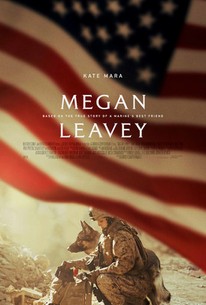
Playing Catch-Up With The Films of 2017: Megan Leavey (dir by Gabriela Cowperthwaite)


One of the best (and, in my opinion, overlooked) films of 2017 was Megan Leavey.

Based on a true story, Megan Leavey tells the true story of … well, Megan Leavey.  When the film starts, Megan (played, in one of the best performances of 2017, by Kate Mara) is living a somewhat directionless life in upstate New York.  Her parents are divorced and she’s closer to her father (Bradley Whitford) even though she has more contact (and shares a much more strained relationship) with her mother (Edie Falco).  Speaking as a child of divorce, the scenes of Megan trying to navigate the mine field between her parents rang painfully true at times. I spent the entire movie waiting for Megan and her parents to have some sort of big moment where, in typical artificial movie fashion, all conflicts would be solved and everything would suddenly be okay.  To the film’s credit, that moment never comes.

Instead, Megan enlists in the Marines.  She finds herself assigned as a Military Police K9 handler.  What that means is that Megan finds herself in Iraq, working with a dog named Rex.  Rex’s job is to sniff out explosives and other threats.  One wrong move by either Megan or Rex will result in not only their deaths but also the deaths of everyone around them.  Remember how tense some of the scenes in The Hurt Locker were?  Well, that’s nothing compared to the intensity of the bomb-sniffing scenes in Megan Leavey.  After all, in The Hurt Locker, we only had Jeremy Renner to worry about.  Megan Leavey, however, features a truly adorable dog.

When Megan returns home from serving two tours in Iraq, she struggles with PTSD and the adjustment to civilian life.  Rex is assigned to a different handler and continues his duties, leaving Megan without the one creature that she felt she could trust.  And again, Megan Leavey deserves a lot of credit for not offering up any easy or pat solutions for Megan’s difficulties to adjusting to life back in the States.  It’s too honest a film and has too much respect for it audience to cheapen its narrative with easy or manipulative sentiment.

When Rex develops facial paralysis, he is retired from active duty.  With the help of her U.S. Senator, Megan adopted Rex and gave him a home until he passed away in 2012.  That senator was Chuck Schumer and thankfully, Megan Leavey resisted the temptation to cast Chuck Schumer as himself.  Instead, when Megan approaches her Senator on the Capitol steps, the senator is played by a professional-looking character actor who looks and sounds absolutely nothing like Chuck Schumer.  By making this simple casting decision, the film keeps the focus off of the politicians and on Megan and Rex, where it belongs.

Did Megan Leavey make me cry?  You better believe it did.  However, it earned every one of these tears.  This is a wonderfully sweet and moving film, one that works largely because it refuses to overemphasize the sentimental aspects of the story.  Instead, Megan Leavey always remains rooted in reality.  It’s a gritty film about a dog and a soldier who survived being sent to one of the most dangerous places n the world.  It’s the story of how Rex saved Megan’s life and how Megan returned the favor by saving Rex’s.  It’s a sweet, straight forward story that can be appreciated even by people, like me, who prefer cats.

Playing Catch-Up With The Films of 2017: Paris Can Wait (dir by Eleanor Coppola)


Anne (Diane Lane) is the wife of Michael (Alec Baldwin).  Michael is an internationally renowned film producer.  As is established early on, their marriage is not perfect.  Michael is consumed with work and, at one point, Anne spots him deep in conversation with a young actress.  Anne’s reaction tells us all we need to know about Michael’s history as a husband.  While Michael obsesses on making the latest deal, Anne takes pictures of inanimate objects.  None of the pictures are particularly good but everyone in the movie raves about them.  I imagine that has something to do with the fact that Anne is based on Eleanor Coppola, who wrote and directed Paris Can Wait.

When the film opens, Anne and Michael are at Cannes.  Michael has spent the entire festival making deals but he’s promised Anne a Paris vacation afterward.  However, the day that they’re vacation is supposed to begin, Michael gets a call!  He’s needed in Budapest!  And Anne can’t fly because she has an ear infection…

No worries!  Their friend Jacques (Arnaud Viard) is willing to drive Anne to Paris and keep her company while she waits for Michael to return.  And so, while Michael flies off to Budapest, Anne and Jacques head off for Paris.  However, Anne soon finds herself questioning Jacques’s intentions.  Is he being flirtatious or is he just French?  When he stops off at every restaurant along the way and uses Anne’s credit card to pay the exorbitant bills, is he taking advantage of her or is he just being French?  When Anne isn’t doubting Jacques’s intentions, she’s questioning her marriage.  Is Michael really in Budapest to work on a movie or is he having an affair?

One of the good things about being rich is that you occasionally get to make a movie about how difficult it is to be rich.  That certainly seems to be the case with Paris Can Wait, which was written and directed by Eleanor Coppola, the wife of Francis Ford Coppola and the mother of Sofia and Roman Coppola.  Paris Can Wait is said to be autobiographical, which would seem to suggest that Eleanor and Francis aren’t particularly interesting human beings.

There are some positive elements to the film, of course. Diane Lane gives about as good a performance as one can when you’re playing an idealized version of a film’s director.  Also, Alec Baldwin manages to make it through the entire movie without bellowing.  In fact, Baldwin’s barely in the movie and that’s not a bad thing.  The French countryside looks beautiful but, quite frankly, it’s impossible for the French countryside not to look beautiful.  On the negative side, it just doesn’t add up to much.  You never really care whether or not Michael and Anne stay together.  You’re just thankful that you’ll never get stuck beside them on an airplane.

I think the main problem is that, as a director, Eleanor Coppola doesn’t really seem to know what she’s trying to say with her film.  For instance, I could imagine Sofia Coppola taking the exact same material and creating a movie that would be achingly poignant and full of ennui.  But, with Eleanor, it’s just another travelogue to nowhere.

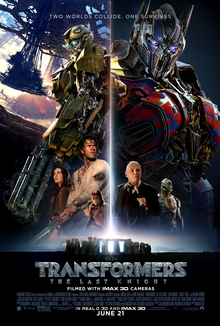
Playing Catch-Up With The Films of 2017: Transformers: The Last Knight (dir by Michael Bay)


So, I’m just going to be honest here.

I did watch Transformers: The Last Knight.  I didn’t see it at the theaters, of course.  To date, I’ve only seen one Transformers movie on the big screen.  It was the fourth one and not only did I get motion sick but when I left the theater, I discovered that I was having trouble hearing.  Even though I watched Transformers: The Last Knight on a small screen, I still made sure to take some Dramamine beforehand.  That may have been a mistake because this movie somehow drags things out for 2 hours and 30 minutes.  That’s a lot of time to spend trying to stay awake while watching something that doesn’t even try to make sense.

So, yes, I did watch Transformers: The Last Knight but I’m not really sure what I watched.  I know that there was a lot of camera movement.  There was a lot of stuff blowing up.  Robots would fly into space.  Robots would return to Earth.  Robots turned into cars.  All of the robots spoke in these gravelly voices and half the time, I couldn’t really understand what they were saying.  Mark Wahlberg was around and he spent the entire movie with this kind of confused look on his face.  His Boston accent really came out whenever he had to deliver his dialogue.  One thing I’ve noticed about Wahlberg is that the less he cares about a movie, the more likely he is to go full Boston.  To be honest, if I just closed my eyes and listened to Wahlberg’s accent and tuned out all of the explosions and robot talk, I probably would have thought I was watching Manchester By The Sea.

Anthony Hopkins was also in the movie, playing a character who might as well have just been named “Esteemed British Person.”  It’s always fun to see Hopkins in a bad movie, just because he knows that his deserved reputation for being a great actor isn’t going to suffer no matter how much crap he appears in.  He always goes through these movies with a slightly bemused smirk on his face.  It’s almost as if he’s looking out at the audience and saying, “Laugh all you want.  I’ll still kick anyone’s ass when it comes to Shakespeare…”  Anyway, Hopkins is mostly around so that he can reveal that the Transformers have been on Earth since time began.  Why, they even saved King Arthur!

The plot has to do with a powerful staff that can be used to bring life back to the Transformers’s home planet.  The problem is that using the staff will also destroy all life on Earth or something like that.  So, of course, the good Transformers are trying to save Earth and the bad Transformers are like, “Fuck Earth, let’s blow stuff up.”  Or something like that.  The main good Transformer — Optimus Prime, I guess — gets brainwashed into becoming an evil Transformer.  Of course, since Anthony Hopkins is in the movie, the majority of the film takes place in England and that can only mean a trip to Stonehenge!

And…

Look, I’ve exhausted myself.  I’m not going to say that Transformers: The Last Knight is a terrible movie because, obviously, someone out there loves this stuff.  I mean, they’ve made five of these movies so someone has to be looking forward to them.  They’re not for me, though.

Some day, I hope Micheal Bay directs a Fifty Shades of Grey movie.  I look forward to watching Christian and Ana discuss consent while the world explodes behind them.

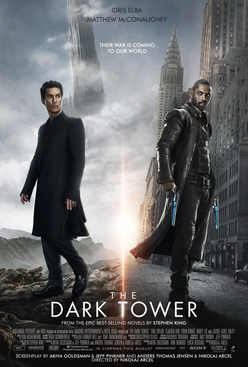
Playing Catch-Up With The Films of 2017: The Dark Tower (dir by Nikolaj Arcel)


What the Hell was The Dark Tower about, anyway?

It’s a legitimate question.  I know that the film was technically a continuation of Stephen King’s overrated Dark Tower books.  Matthew McConaughey was Walter, the Man in the Black, the man who is kidnapping psychic children so that he can weaponize their powers and destroy The Dark Tower.  Idris Elba was Roland, the last of the gunslingers, who is obsessed with killing Walter because Walter killed his father.  And Tom Taylor is Jake, an eleven year-old boy who lives in New York City and who keeps having visions of the Tower, Walter, and Roland.  Walter wants Jake.  Roland wants Walter.  Jake wants to understand it all…

And that’s pretty much the entire movie.  Jake switches back and forth between his world and Roland’s world.  Walter occasionally pops up in New York so that he can kill Jake’s family and assure that Jake won’t have any reason not to continue traveling with Roland at the end of the movie.  It all basically feels like the pilot for a television series and, to be honest, it probably wouldn’t be that bad of a show.  For one thing, if The Dark Tower was a tv show, there would be more of an opportunity to develop the characters of Roland, Walter, and Tom.  The Dark Tower movie only last 95 minutes and the majority of those minutes feel very rushed.

Obviously, if you’ve read Stephen King’s Dark Tower books, this film will be easier for you to follow than it will be for people who have never had to suffer through them.  I know I’m in the minority as far as this is concerned but I find The Dark Tower series to be King at his most pretentious.  Interestingly enough, a little bit of pretension probably would have helped the film version of The Dark Tower.  As it is, The Dark Tower is almost too workmanlike and straight-forward.  It could have really used a pointless Stephen King-style soliloquy about faith, innocence, and horror.  At the very least, they could have had someone in the background, droning on about politics in a Maine accent.

I have to admit that I really, really, really wanted to like The Dark Tower.  I love Idris Elba.  I love Matthew McConaughey.  Even more importantly, I love being a contrarian.  Whenever a film gets as many negative reviews as The Dark Tower, my natural instinct is always to assume that it has to be a secret masterpiece.  I mean, seriously, who trusts critics?  I really wanted to watch The Dark Tower and then write a 1,000-word defense of it.  I was hoping that, much like The Counselor, it would turn out to be a masterpiece that only I could recognize.

Sadly, that didn’t turn out to be the case.  I will say that Matthew McConaughey seemed to be having a sincerely good time playing the bad guy.  And Idris Elba had just the right mix of weariness and compassion to play Roland.  But otherwise, the movie just felt so pointless.

Overall, this has been a pretty good year for Stephen King film adaptations.  It deserves to be nominated for an Oscar, though it won’t be.  Gerald’s Game made people thankful for Netflix.  The Dark Tower, though, will be quickly forgotten.

Playing Catch-Up With The Films of 2017: Fist Fight (dir by Richie Keen)


While I wouldn’t begin to argue that it’s been a great year for movies, there were still some really good movies released in 2017.

Unfortunately, there were also some really bad ones.

Which do you think Fist Fight was?

If you answered really bad, congratulations!

Actually, I don’t think anyone was expecting Fist Fight to be a classic or anything like that.  Basically, the film is about a conflict between two teachers, a conflict that seems destined to end with the event promised by the title.  The two teachers are played by Ice Cube and Charlie Day.  Of course, in the movie, they have different name but it doesn’t matter.  Neither character has an identity outside of the actor who plays him.  Charlie Day is nerdy and quick to yell.  Ice Cube is tough and intimidating and not the type to back down from a fight.

Now, at the risk of losing all credibility, I’m going to be honest about something.  When I first saw the trailer for Fist Fight, I thought it might not be as bad as it turned out to be.  Charlie Day is hilarious on It’s Always Sunny In Philadelphia.  One of the more appealing things about Ice Cube is his willingness to poke fun at his tough guy image.  More often than not, I tend to like movies about teachers acting like children because, when I was in school, I always suspected that was the way teachers actually behaved when they were safely in the teacher’s lounge.  Charlie Day desperately running around the school, hyperventilating while Ice Cube pops up to remind him that they have a fist fight scheduled?  Seriously, it sounded like it could be funny in a dumb way.

Well, I was wrong.  Fist Fight is one of the most painfully unfunny films that I’ve ever seen.  This is a movie that should have been focused on one thing: the fist fight at the end of the day.  The entire movie should have been Charlie Day preparing for a fight that he knows he can’t possibly win.  Instead, the movie kept getting distracted with unnecessary subplots.  For instance, because it’s the last day before summer, all of the students are pulling pranks on their teachers.  In fact, the entire student body is out-of-control.  But who cares?  We’re here to see Charlie Day try to throw a punch at Ice Cube.  We don’t care about a bunch of obnoxious students pulling pranks that seem like they were directly lifted from a Crown International high school movie.  If we want to see that, we can rewatch The Pom Pom Girls or Joy of Sex.  And if we want to watch a teacher stand up to his students, we can watch Class of 1984.

The film is full of funny people but it never really takes advantage of them.  Actors like Tracy Morgan, Kumail Nanjiani, and Christina Hendricks pop up but just as quickly disappear.  Charlie Day does his best but the level of writing never rises to the level of It’s Sunny In Philadelphia.  (I personally would love to see “The Gang Gets In A Fist Fight With Ice Cube.”)  Compared to Fist Fight, even something like Horrible Bosses looks like nuanced and subversive humor.  There’s a lot of screeching in Fist Fight but very little of it is funny.

A visit from St. Nicholas: By Clement Clarke Moore


‘Twas the night before Christmas, when all through the house
Not a creature was stirring, not even a mouse;
The stockings were hung by the chimney with care,
In hopes that St. Nicholas soon would be there;

The children were nestled all snug in their beds,
While visions of sugar-plums danced in their heads;
And mamma in her ‘kerchief, and I in my cap,
Had just settled down for a long winter’s nap,

When out on the lawn there arose such a clatter,
I sprang from the bed to see what was the matter.
Away to the window I flew like a flash,
Tore open the shutters and threw up the sash.

The moon on the breast of the new-fallen snow
Gave the lustre of mid-day to objects below,
When, what to my wondering eyes should appear,
But a miniature sleigh, and eight tiny reindeer,

With a little old driver, so lively and quick,
I knew in a moment it must be St. Nick.
More rapid than eagles his coursers they came,
And he whistled, and shouted, and called them by name;

“Now, DASHER! now, DANCER! now, PRANCER and VIXEN!
On, COMET! on CUPID! on, DONNER and BLITZEN!
To the top of the porch! to the top of the wall!
Now dash away! dash away! dash away all!”

As dry leaves that before the wild hurricane fly,
When they meet with an obstacle, mount to the sky,
So up to the house-top the coursers they flew,
With the sleigh full of toys, and St. Nicholas too

And then, in a twinkling, I heard on the roof
The prancing and pawing of each little hoof.
As I drew in my hand, and was turning around,
Down the chimney St. Nicholas came with a bound.

He was dressed all in fur, from his head to his foot,
And his clothes were all tarnished with ashes and soot;
A bundle of toys he had flung on his back,
And he looked like a peddler just opening his pack.

His eyes — how they twinkled! his dimples how merry!
His cheeks were like roses, his nose like a cherry!
His droll little mouth was drawn up like a bow,
And the beard of his chin was as white as the snow;

The stump of a pipe he held tight in his teeth,
And the smoke it encircled his head like a wreath;
He had a broad face and a little round belly,
That shook, when he laughed like a bowlful of jelly.

He was chubby and plump, a right jolly old elf,
And I laughed when I saw him, in spite of myself;
A wink of his eye and a twist of his head,
Soon gave me to know I had nothing to dread;

He spoke not a word, but went straight to his work,
And filled all the stockings; then turned with a jerk,
And laying his finger aside of his nose,
And giving a nod, up the chimney he rose;

He sprang to his sleigh, to his team gave a whistle,
And away they all flew like the down of a thistle.
But I heard him exclaim, ere he drove out of sight,
HAPPY CHRISTMAS TO ALL, AND TO ALL A GOOD-NIGHT!

Wishing all of my #TSL family a safe and happy Christmas and a blessed New Year!

Merry Christmas from the Folks of Through the Shattered Lens


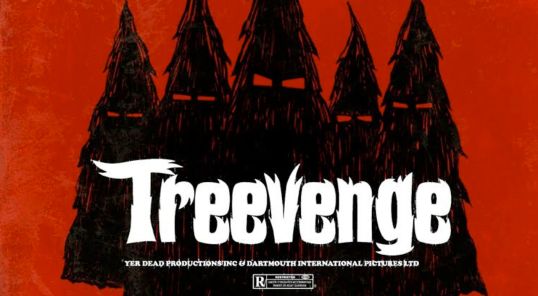
TreevengeIt’s a yearly tradition to celebrate the birth of this particular site by reintroducing it’s readers (introducing those new to the site) to the greatest film ever made. It’s the greatest Christmas film and the greatest feel good film. In the end, it’s just the greatest film ever made and anyone who thinks otherwise is just misguided and wrong.

Treevenge has everything one should ever want and probably didn’t even know they needed or wanted. It has romance. Nostalgia for those who fondly remember getting to choose their first Christmas tree. It’s a family film where we see families celebrate the traditions of the holidays.

It even has moments of scandalous scenes that may make one go “OH MY!”. I know that many of the original contributors past and present look forward to this yearly TSL tradition. I may not have been as active this year as I have been year’s past, but this was one day I wouldn’t missed for all the world.

MERRY CHRISTMAS, ONE AND ALL!