Lisa Marie Finally Gets Around To Reviewing Cedar Rapids (dir. by Miguel Arteta)


So, in my review of The Beaver, I talked about the annual Hollywood Black List and how the movies that are always listed at the top of the black list usually turn out to be vaguely disappointing.  Well, in that review, I failed to mention that The Beaver was not the only Black List film that I’ve seen (so far) in 2011.  A few months ago, I saw the film that topped last year’s list, Cedar Rapids(The Cedar Rapids screenplay, by the way, was written by Phil Johnston.)

Now, Cedar Rapids (which is scheduled to be released on DVD in June) actually had a pretty good run down in here in Dallas.  Unlike Austin, Dallas is not a film-crazed city and — with only four theaters currently specializing in indie and art films — it’s usually a case of “you snooze, you lose” when it comes to seeing anything out of the mainstream.  We’ll have a few hundred theaters all showing something like Avatar for half a year but a film like James Gunn’s Super will usually sneak in, play in one theater for two weeks, and then just as quickly vanish.

Cedar Rapids, however, stuck around for about a month and a half, playing exclusively at the Dallas Angelika.  It took me a while to actually find the time to go see it (and, perhaps because of the whole Black List thing, I just didn’t feel much enthusiasm for seeing it) and, in fact, I ended up seeing it the last day it played at the Angelika. 

As for why I wanted to see it — well, it had gotten some very positive reviews from critics who traditionally don’t give comedies good reviews so that piqued my interest.  I knew that the film featured three of my favorite character actors — John C. Reilly, Stephen Root, and Thomas Lennon.  The film was also being touted as a comeback for Anne Heche whose autobiography Call Me Crazy was a favorite book of a former roommate of mine.  Finally, I wanted to see the film because it starred Ed Helms, who, at the time, I thought seriously might end up as the new boss on The Office.

Helms, in case you don’t know for some reason, plays Cornell graduate Andy Bernard on The Office.  When he first appeared during the show’s third season, he was portrayed as an incredibly obnoxious preppy with an anger management problem and I loved how Helms so thoroughly threw himself into making Andy just the most annoying human being ever.  Andy was eventually sent to anger management classes and, upon returning, the character has become less obnoxious and just more buffoonish and, in my opinion, a lot less entertaining.  As well, with Jim and Pam now safely married, Andy ended up as the focus of some of the Office’s weakest episodes.  In fact, Andy was the center of so many episodes earlier this season that I found myself wondering if the show’s producers weren’t perhaps trying to see how the audience would react to Ed Helms becoming the new star of the show.  Since I had mixed feelings about that prospect, I felt that maybe Cedar Rapids would provide me with an answer.

In Cedar Rapids, Ed Helms plays Tim Lippe, an almost impossibly innocent insurance agent who is sent by his boss (Stephen Root, who appears to be the go-to guy when you need someone to play a friendly but vaguely threatening manager) to a regional conference in Cedar Rapids, Iowa.  Tim is ordered to conduct himself well, to go out of his way to impress the conference president (Kurtwood Smith), and to win the prestigious “Two Diamonds” Award.  (The award has been won for the company in the past by Helms’ rival at the company who, at the beginning of the film, accidentally kills himself while practicing autoerotic asphyxiation.  The rival is played by Thomas Lennon and I’m kinda sorry that Lennon didn’t have more scenes because seriously, he always makes me smile.)

After saying goodbye to his much older girlfriend (Sigourney Weaver, who is wasted in her cameo), Helms heads off for Cedar Rapids.  This is a big deal for him because he’s the type of movie innocent who has never even been on a plane before.  Helms arrives at Cedar Rapids determined to do the right thing but he soon discovers that he is rooming with Dean Ziegler (John C. Reilly), a loud, crude, and cynical agent who indulges in every vice that Helms has been ordered to avoid.  Needless to say, Helms initially tries to resist being drawn into Reilly’s orbit but soon, he finds himself being corrupted and enjoying it.  Through Reilly, he meets yet another insurance agent (played by Anne Heche) that he soon finds himself falling in lust with.  All this happens, of course, under the disapproving eye of Kurtwood Smith and Helms soon learns just how far he is expected to go to win that Two Diamonds Award…

As it might be obvious from the above description, Cedar Rapids is one of those films that attempts to be both a wild comedy and a poignant coming-of-age drama.  And it succeeds very well at being a comedy and it does pretty good job of being a drama but it never manages to do both at the same time.  The end result is an entertaining but wildly uneven film that never feels like it’s quite as good as it should be. 
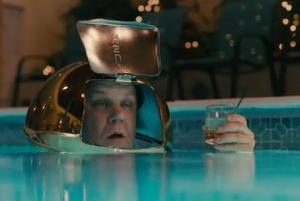
The film is at it’s best when it’s just Helms, Reilly, Heche, and Isiah Whitlock, Jr. (playing another insurance agent) hanging out and BSing.  Those scenes ring well and all four of these actors have a real ensemble chemistry together.  You really do end up believing that Reilly, Heche, and Whitlock truly do care about their new friend and you just as strongly believe that Helms really is falling in love with Heche.  These are the best scenes in the movie. 

The film is less effective when it tries to be something more than just an ensemble comedy.  It’s in these scenes — with Kurtwood Smith quoting bible verses and the Two Diamonds Award becoming a metaphor for all sorts of things — that the film gets heavy-handed and a bit boring.  I also have a feeling that these scenes are probably the reason why so many Hollywood readers went nuts of the Cedar Rapids screenplay because these scenes are the least challenging in the film.  These are the scenes that pat you on the back for watching the movie.  Anyone who has ever seen a movie knows that Kurtwood Smith’s character is going to turn out to be a hypocrite because when was the last time that you see a movie in which the guy who talked about Jesus didn’t turn out to be a hypocrite?  Therefore, it’s kinda hard to buy into Helms’s shock when he discovers that Smith isn’t all that he’s cracked up to be.  I mean, I can force myself to buy that the Helms character has never been on a plane before but my God, has he never seen a movie or an episode of Law and Order before either?  Seriously, the character isn’t a Mennonite.  He’s just from the midwest.

In the lead role, Ed Helms is a lot like the movie.  He’s great when he’s just a member of the ensemble but sometimes seems to struggle a bit in the more dramatic scenes.  To a large extent, the problem is that the film goes so out of it’s way to present Helms as being some sort of man-child that it’s hard to take him seriously once he suddenly starts to think for himself.  As I previously stated, the supporting cast is uniformly strong.  Reilly is a drunken, foul-mouthed force of nature while Heche steals every scene that she’s in and, in the end, proves herself to really be the heart and soul of the film.

So, in the end, I guess I would say that Cedar Rapids, as uneven and as frustrating as it occasionally turned out to be, is worth seeing once it comes out on DVD in June.

Lisa Marie Gets Super (dir. by James Gunn)


Super, a very dark and very Catholic comedy that pretends to just be your standard issue super hero movie, played for about three weeks down here in Dallas.  Despite a cast that included Kevin Bacon, Liv Tyler, Ellen Page, and Rainn Wilson, it kinda came and went like a ship in the night.  It got a few vaguely confused reviews from the local critics and the audience that I saw the film with seemed to be pretty confused as to what they were watching.  Which is a shame because if you give the film a chance, you’ll discover one of the best films of 2011.

In Super, Rainn Wilson plays a short order cook who, at various points in his life, has had visions in which he believes God has spoken to him.  When his wife, an ex-drug addict played by Liv Tyler, leaves him for a sleazy club owner and low-level drug dealer (Kevin Bacon), Wilson sinks into a deep depression until finally he has a vision in which God sends a bunch of hentai-style tentacles to cut off the top of Wilson’s head and literally place an idea in there.  That idea is for Wilson to become a costumed super hero and fight “evil.”

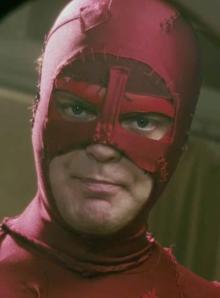
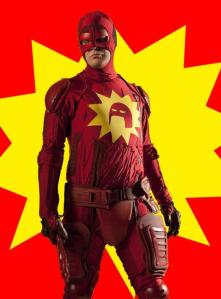
So, that’s what Wilson does, dressing up in what looks like a low-rent Halloween costume, and taking on all those who he considers to be evil and/or doing the wrong thing.  This could be anything from dealing drugs to cutting in line at the movies.  (And this is a big reason why I loved Super because it asked the same question that I always wonder when I see a super hero movie — i.e., who is to say what’s wrong and what’s right?)  Calling himself The Crimson Bolt, Wilson soon becomes a cult figure in the city but he still finds himself incapable of getting Tyler away from Bacon. 

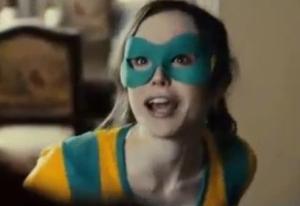
Eventually, he finds himself saddled with a sidekick.  Ellen Page, giving a performance just as award-worthy as her more acclaimed role in Juno, plays Libby, who works in the local comic book store.  She is the only person who figures out that Wilson is actually the Crimson Bolt and she quickly decides that they should work together.  Calling herself Boltie, Page quickly turns out to be just as zealous in the pursuit of “justice” as Wilson.  Unlike Wilson, who sees himself as being on a holy mission, Page appears to just be happy to have an excuse to kill people.

It all leads to the expected final confrontation with the bad guys and a surprisingly poignant ending which forces the viewer to reconsider what they thought they knew about every character in the film.

Super’s low-budget is obvious in almost every frame of the film but it works to the movie’s advantage, creating an almost defiantly gritty atmosphere.  The film is also full of good performances.  I already mentioned Page but, in the lead role, Rainn Wilson is perfectly cast.  For those of us who love him on The Office, it’s sometimes hard to realize that Wilson is not Dwight Shrute, he’s just an actor playing a role.  However, with Super, Wilson proves himself to be a charismatic actor who, if given the right role, can easily carry the film.  Towards the end of the film, one of the bad guys taunts Wilson for concerning himself with seemingly minor things like people cutting in line.  Wilson shouts, “You shouldn’t cut!” with such righteous fury that it becomes clear  that he’s not talking about cutting in line as much as he talks about living in a world where people just no longer seem to care about doing the right thing.  It’s an unexpectedly effective scene and line and Wilson handles it perfectly.

Super is the latest film from a genius named James Gunn.  Now, I should admit that I am like crazy in lust with James Gunn.  Seriously, he’s handsome, he’s funny, he’s talented, he’s hot, he’s vulnerable, he’s dangerous, he’s Irish, and he comes from a Catholic background, which is pretty much a perfect description of my dream man.  Plus, he talked to me once on twitter and as a result, I got all giggly and red-faced and I sent him all of these gushy tweets which he never responded to, probably because I was like totally coming across like some sort of psycho stalker type.  So, some people are probably saying, “Well, gee, Lisa Marie, are you sure you’re not just letting your damp panties review this film as opposed to your unbiased judgment as a film watcher?”  And to those people, I say, “Shame on you and watch your mouth.  And speaking of mouths, guess where my mouth would be if I ever met James Gunn…”

Mon amour James Gunn

But let’s get back SuperSuper has been frequently compared to Kick-Ass (even though Super actually went into production first) and, on the surface, they do appear similar.  It’s only when you dig and look under the surface that you discover that Super and Kick-Ass have about as much in common as I do with that overly friendly girl who always takes our tickets at the Angelika.  (She’s the same girl who needs to stop smiling so much at Jeff every time we try to get popcorn.  Seriously, not kidding.)  While Kick-Ass was undeniably violent, it was also one of those films where the violence was rarely lingered over.  Super is not only incredibly violent but it’s also incredibly bloody.  Gunn doesn’t just show us the violence but he shows us the end results of the violence as well and, as a result, the audience is forced to consider how much we love to see people getting shot in the head just as long as we don’t have to worry about seeing the body afterwards.  Whereas Kick-Ass’s Aaron Johnson was portrayed as being a comic book fan who got to live out his fantasy, Rainn Wilson in Super is specifically portrayed as not being a comic book fan as much as he’s just a genuinely unstable guy who becomes a super hero in order to maintain the delusional black-and-white morality of his worldview.  Whereas Chloe Grace Moretz’s Hit Girl was portrayed as having been raised to kill, Ellen Page’s Boltie kills simply because she now suddenly has the opportunity to do so.  Finally, Kick-Ass actually ended up fighting true evil doers whereas the villains played by Kevin Bacon and Michael Rooker, in Super, are probably the most stable and sensible characters in the entire film.

In short, Super is that perfect rarity — a truly transgressive work of popular entertainment.

Yes, Super is one of those films that delights in challenging and even ticking off the audience.   The common filmgoer watches and asks, “If it’s a drama, then why is it so funny?  If it’s a comedy, then why does Rainn Wilson’s heartbreak seem so real and sincere?  If Rainn Wilson and Ellen Page are the good guys, why does the film suggest that they both might be sociopathic?  If Kevin Bacon’s the bad guy, why is he so likable here?”  As a result, the common filmgoer probably walked out of Super feeling confused and slightly annoyed that things didn’t work out the way they were expecting. 

Well, you know what?  The common filmgoer sucks.  The common filmgoer is responsible for every bad thing that has ever happened in the history of the world.  The common filmgoer is wasting oxygen that you, my deeply enlightened friends, could make much better use of.  This is not the site for the common filmgoer and if you’re still reading, then you’re not a common filmgoer either.

Super was made with you in mind.

Trailer: Real Steel


I’ve been hearing about this film called Real Steel for some time now and a trailer had even come out a couple months earlier, but it’s only with today’s release of the latest trailer that I’ve stopped to actually check it out.

From what I can see in the trailer this looks like a live-action, big-budget adaptation of that classic toy called “Rock’em, Sock’em Robots”. This being Dreamworks who have already turned one classic toy franchise into a major blockbuster film franchise then why not another toy. It stars Hugh Jackman who looks much slimmer and not as bulky as his former Wolverine self. Real Steel looks to be a father-son story that has been done so many times before, but this time with big giant boxing robots.

Further research on this film had me discovering that it’s actually based on a Richard Matheson short story called “Steel”. That story was actually a much darker, colder dystopia tale. Script changes since the screenplay and project was bought by Dreamworks in 2003 has toned down the dystopia and instead the project going more for a form of Americana nostalgia. I’m not sure if those changes were necessary. In fact, I wouldn’t have minded seeing this film go the original Matheson route.

I have feeling that despite my doubts about this film it will do quite well in the box-office. It’s a heartwarming tale with fighting robots and fathers will be taking their young sons to see this in droves. Well, except those fathers who happen to also be on-line film bloggers who may think this film not the kind of drivel and tripe to be showing to their young boys.

Real Steel is set for an October 7, 2011 release date.

Lisa Marie Talks About The Beaver (dir. by Jodie Foster)


So, there’s this thing in Hollywood that they call the Black List.  The Black List comes out at the end of each year and basically, it’s a list of the “best” unproduced screenplays of the year.  The reason I put best in quotation marks is because the list is 1) determined by studio people and studio asskissers and we all know that those people are toadsuckers, 2) film is not a writer’s medium so the best screenplay in the world can still be ruined if the wrong director gets involved with it, and 3) the films made from the scripts on the blacklist always seem to end up sucking like I did during my sophomore year of high school.  Seriously, that was a lot of sucking.

The Beaver (written by Kyle Killen) was at the top of the Black List in 2008 and now, 3 years later, it’s finally been made by Jodie Foster and released to mixed reviews and indifferent box office.  I saw The Beaver on Saturday.  So does, the Beaver continue the tradition of disappointing movies being produced from Hollywood’s “best” screenplays?  Well, yes and no.  The final 20 minutes of the Beaver are incredibly effective and almost moving.  Unfortunately, they’re not effective enough to make up for the wildly uneven 90 minutes that come before.

One thing that films that top the Black List tend to have in common is that they almost always try to tell a very traditional, rather obvious story by using some quirky gimmick that becomes less and less clever the more you think about it.  The Beaver continues that tradition.  Mel Gibson plays a guy named Jerry who runs a toy company and who has become clinically depressed.  After a unsuccessful attempt to commit suicide, he comes up with a novel solution to deal with his inability to communicate his feelings.  He starts to walk around with a beaver hand puppet and whenever he has to talk to his estranged wife (Jodie Foster) or his angry son (Anton Yelchin), he does so through the puppet.  And, as long as he has that beaver puppet, he has the strength to be a good husband and a good father.  At first, Foster is happy — if confused — but soon she finds herself growing frustrated with always having to talk to the Beaver as opposed to speaking to her husband.  However, Gibson has now grown so dependent on the Beaver that he can’t give it up, even though the Beaver has now started to insult Gibson whenever there’s no one else around.

Eventually, this leads Gibson to doing something very shocking and quite disturbing and it’s once that happens that The Beaver actually starts to work as a film.  Unfortunately, by that point, there’s only 20 minutes left in the film and we’ve had to sit through a whole lot of subplots, none of which seem to belong in the same movie. 

On the one hand, we have Gibson reviving his company by launching a toy line based on the Beaver.  These scenes are probably the weakest in the film.  Gibson shows up at work and tells everyone that the Beaver hand puppet is in charge and nobody quits.  Apparently, nobody calls up the tabloids to tell them that CEO of a major toy company has apparently had a nervous breakdown.  Instead, work goes on as normal.  Every time I saw Gibson’s character sitting in his office with that hand puppet, I wondered, “Does this company not have shareholders?”

Meanwhile, Yelchin is dealing with the beginning stages of the same clinical depression that has crippled Gibson and (its implied) led to his grandfather killing himself years earlier.  A high school senior, Yelchin has a lucrative career writing other students papers for them.  He’s hired by Jennifer Lawrence who asks him to write her graduation speech.  It also turns out that Lawrence is not only a popular cheerleader who is graduating at the top of her class but she’s also a graffiti artist as well who has a convenient family tragedy that she needs help getting through.  Now, that’s not as impossible as it may sound because my sister Erin’s a truly talented artist who was also a cheerleader  in high school but that doesn’t change the fact that Lawrence’s character still basically came across as just being a typical male fantasy, the nurturing madonna figure who only exists to justify and/or excuse the behavior of an obviously autobiographical male figure.  Still, Lawrence and Yelchin’s subplot is probably the most compelling part of the movie. 

As you can probably guess, the main problem with the movie is that it’s essentially about a guy walking around with a Beaver puppet.  Neither Kellen’s screenplay nor Foster’s direction seems to be sure just how seriously we should take that beaver and as a result, it just comes across as being a really cutesy idea that never really works as well as the movie seems to think that it does.  As well, it’s hard to take anything seriously once the word Beaver is introduced into the conversation.  For instance, as we watched Gibson bonding with his employees, my friend Jeff suggested that all Gibson needed to do in order to feel better about his life was to “stick his hand up a beaver and move his fingers.”  However, I have to admit that the worst beaver joke was made by me and it happened about halfway through the film when we see Gibson and Foster having sex, with Gibson keeping that beaver on his hand.  After they finish, Foster turns her back to him and Gibson caresses her face with — yes, you guess it — the beaver.  “I bet that’s not the first time she’s had a beaver in her face,” I said.  All of this could have been avoided if the film just hadn’t been made in the first place.

Still, The Beaver is not a complete failure and when the film does work, it works so well that it makes it even more frustrating that the movie, as a whole, doesn’t.  Even before the final 20 minutes, the film has the occasional intelligent line or knowing detail that indicates that, if not for the whole beaver thing, this could have been a very touching film about the pain of mental illness.  Perhaps the film’s greatest strength is that it features a quartet of excellent performances.  Yelchin and Lawrence have a real chemistry and watching them, you kinda wish that the movie would have just focused on them.  Foster also does a good job as Gibson’s confused wife and, it must be admitted, that Mel Gibson is perfectly cast in the lead role.  He looks like hell here and there’s next to no vanity to be found in his performance here.  He actually probably gives the best performance of his career here but, I do have to admit, it was difficult to watch him onscreen without imagining some alcohol-soaked voice ranting and raving and spewing out a lot of anti-Semitic hate.

We saw the Beaver at the Plano Angelika and I have to admit that, even if the film didn’t really work, at least we had a good time seeing the film.  On the Saturday afternoon that we went to see it, the Shops at Legacy (where the Plano Angelika is located) were having a street fair with live music and booths and everything.  So, at the very least, I got to literally dance in the street both before and after seeing The Beaver.

That was fun.

AMVs of the Day: SugardanSen & Attack of the Otaku


Today, I couldn’t make up my mind which amv to pick for the latest “AMV of the Day” so being the co-founder of the site I decided to use my God-like powers and picked the two which caught my eye. I mean if I couldn’t abuse my God-like powers over the site then why have them…right? So, instead of one AMV we have two and they’re from the same creator and definitely have the same vibe and feel to them. I guarantee that like these AMV’s or not you’re feet will tap to the beat or maybe your head begin to bob to it.

The first AMV is titled “SugardanSen” and takes the “Caramelldansen” meme to a new level through creator Chiikaboom’s editing of scenes from 50 different anime to create one of the most catchy and sugary AMVs I’ve ever had the pleasure to watch and listen to. The part of the video that comes on at the 1:03 mark always brings about a huge grin to my face. It’s really not needed for me to describe this video other than those prone to seizures due to extreme flashes of light and rapid image editing should avoid it.

The same goes for the second AMV which also shares the same happy and pop sugary tempo and tone. It only includes scenes from three anime series but what it lacks in numbers it more than makes up for less seizure inducing video (though not by much). This video uses the “The Game Of Love (E=MC2 Mix)” by Jenny Rom (yeah, never heard of her either but she sings a catchy tune) and Chiikaboom has done a better job of editing the scenes to match the lyrics.

Both AMVs must been seen one right after the other. I always end up watching both whenever I feel down and on the way to depress mode. It’s hard to not feel better (at least by a bit) once I’ve these AMVs.

Attack of the Otaku

Anime: The Melancholy of Haruhi Suzumiya, Lucky*Star, Ouran High School Host Club

Song: The Game Of Love (E=MC2 Mix) by Jenny Rom

Creator: Chiikaboom

SugardanSen

Anime: 50+ too many to list..click link for the list

Song: “Caramelldansen (Speedycake Remix) by Caramell

Creator: Chiikaboom

Scenes I Love: Henry V


With the release of Kenneth Branagh’s Thor (love the film or not) there should be a new interest from younger film fans to know more about what Branagh has done in the past. I pretty much grew up watching his films and made me rediscover and love Shakespeare once more. His grasp of the the Bard’s work has always been both respectful to traditions, but also with an eye and ear towards the common man of this era. He made Shakespeare film adaptations a must-see during the 1990’s.

The latest “Scenes I Love” comes from his very first film and was released in 1989. The film I speak of is his film adaptation of Henry V. I remember clearly the first time I saw this film. It was during my sophomore year in high school and it was during a school field trip arranged by my English teach to see this film at the local arthouse theater. I was still young and didn’t care much for the plays of Shakespeare (as did most of my classmates), but once the light dimmed and the film began I was hooked.

The scene I still consider my favorite from this film is Branagh in the role of King Henry V (he starred, wrote and directed the film) giving the speech on St. Crispin’s Day to his gathered troops as they prepare themselves for the upcoming battle (the Battle of Agincourt) against a numerically superior French force. This speech I didn’t understand half of what was being said but the way Branagh handled this monologue made it easy to understand the meaning even if the words themselves were lost.

I still get chills whenever I watch this scene and would more than be willing to take up arms against the French once it was over.

Review: Game of Thrones Ep. 04 “Cripples, Bastards and Broken Things”


We’ve now come to the fourth episode of HBO’s very ambitious and expensive medieval fantasy series based on author George R.R. Martin’s “A Song of Ice and Fire” saga of which the first  book make’s up the first season. The first three episodes have done a great job at not just setting up the rules which govern this fantasy world of Martin’s but has deftly handled the many characters both main and supporting. It’s always been one of the many trepidations by fans of the books that the show may dumb down and simplify all these personalities both big and small for the tv screen. Luckily, for both fans and non-fans of the book the writers of the show have kept much of these characters intact.

“Cripples, Bastards and Broken Things” is quite an apt title for this latest episode as it deals with exactly just that. The show explores those three subjects. We begin with both cripple and bastard finding a common ground as Tyrion (Peter Dinklage in what could only be an Emmy-winning performance as the Lannister Imp) shows compassion instead of pity to the crippled Bran Stark despite his very own suspicion as to the cause of Bran’s fall. It’s also in these scene where we see the appearance of fan favorite Hodor (Kristian Nairn). Hodor’s introduction is one of several instances which has allayed my concerns that such minor characters would be trimmed from the book as it makes its way onto the show. While I’m sure the show will not introduce every name from the book at least they’ve taken a deep understanding as to which of the supporting cast in the book must remain even if they are quite minor.

The rest of this episode really deals with the “Broke Things” of the title. We see just how broken the situation has become not just in Castle Black with the Night’s Watch but all across the Seven Realms of Westeros. The king’s insistence in holding a tourney for his newest Hand has led to more debt as more people flood into King’s Landing to witness this event. We see the broken relationships between family members in the houses of Stark, Lannister and Targaryen. It’s these cracks which has led to corruption and intrigue which could only lead to tragedy for the current holder of the Iron Throne and for all of the Westeros.

Even some of the characters themselves show signs of being broken things with the most visible being Jaime Lannister (Nikolaj Coster-Waldau) whose cocky and self-absorbed personality shows hints of humanity. He sees what his king has been doing to hurt not just the kingdom he serves but to his sister Cersei whom he loves. There’s a brief hint in his expression as he stands guard outside Robert’s bedroom as whores attend his brother-in-law knowing he cannot do anything to fix it without living up once more to his infamous moniker of Kingslayer.

This episode introduces several new characters that should have some impact in the coming weeks as the show leads to it’s climactic season finale. One character which should please fans and make non-fans of the book lean with interest is the “Mountain”. Gregor Clegane is aptly named and comes in as Sandor “The Hound” Clegane’s (Joffrey Bieber’s personal guard with the half0burned face) older and much more brutal brother. We don’t hear him speak, but his entrance and what he does during the jousting tournament looms large in that sequence. It helps that Petyr Baelish (Aidan Gillen great in the role) gives Sansa a brief tale concerning the “Mountain” and the “Hound” which adds some mystery to the two siblings which the writers will hopefully explore further as the series moves along this season and the next.

The other new character that gets some major time in this episode was one of the stronger ones in terms of portrayal. Samwell Tarly (John Bradley-West sticking the role almost perfectly) is the latest recruit to don the black of the Night’s Watch and he’s as far from the ideal candidate for the black as any this show has shown. He’s fat, cowardly and almost effeminate in his behavior, but the character comes in as a broken thing. He’s forced to join the only thing he knows would accept him despite his shortcomings and the only haven from the suffering he has endured from his own family. At first it seems like pity that forces Jon Snow to take Sam under his wing for protection, but as he learns more of Sam’s background from Sam himself the more he sees similarities between the two of them. Only the turn of the fate having put Jon in the compassionate care of Eddard Stark has made him into the young man he is and becoming. It’s this growing rapport between Jon and Sam which really governs the Night’s Watch part of Game of Thrones.

But the show is not all about cripples, bastards and broken things. We see the beginning of the inner fires in both Daenerys Targaryen and Catelyn Stark in this episode. With the former we see how much she continues to grown into the role of Khaleesi of the Dothraki Horde. The confrontation between her and her older brother Viserys should begin to allay fears fans have had about how the writers have been handling the Daenerys character. Yes, the first three episodes haven’t really shown Daenerys being strong and kickass, but even in the book she wasn’t written to be such a character right from the onset. In both book and show her growing confidence still takes time. It just happens that the show just made her quite pliable and weak to start off with. I think that by the time this season ends Daenerys will grow into the confident character fans have been waiting to see.

With Catelyn Stark the situation has been a bit more complex as her character has been given several more layers of complexities with her book counterpart didn’t have. In the book she’s almost Ned Stark’s equal in almost everything, but lost in that was an emotional core which the show has given her. It’s this emotional layer which has added a loving motherly aspect to the character. It sometimes came off as helplessness in the previous episodes, but what mother wouldn’t feel so frozen with worry and inaction for the tragedy to have struck one of her sons. The fire that fans have been waiting for begins to fan as Catelyn sees herself confronting one of the very Lannister’s who she believes had a hand in the assassination attempt on her crippled son, Bran. Her reciting the many different bannermen who are loyal to her house and to her husband’s house was very inspiring and just a hint of what will come next as a storm of swords and a clash of kings loom over the horizon of Westeros.

Overall, “Cripples, Bastards and Broken Things” continues a streak of excellent episodes in the premiere season for Game of Thrones. We see more intrigue and machiavellian machinations than action, but it’s entertaining and thrilling nonetheless. This show has shown that fantasy, especially on TV, doesn’t have to be always about battles and bloodshed (though the spearing of the knight at the joust was done bloody well enough). It’s the political maneuverings and intrigues which will ultimately drive this show towards the very battles and bloodshed fans of these type of shows end up craving for.

Next week’s episode will be “The Wolf and The Lion”.


PS: It was great to see Jon Snow’s direwolf finally appear in its grown form. We’ve already it as an albino pop, but not grown like we’ve already seen with Summer, Nymeria and Lady. Ghost will soon become a favorite with the show’s fans the more he appears. The only one’s we haven’t seen are Robb Stark’s Grey Wind and Rickon Stark’s Shaggydog.

Review: Thor (dir. by Kenneth Branagh)


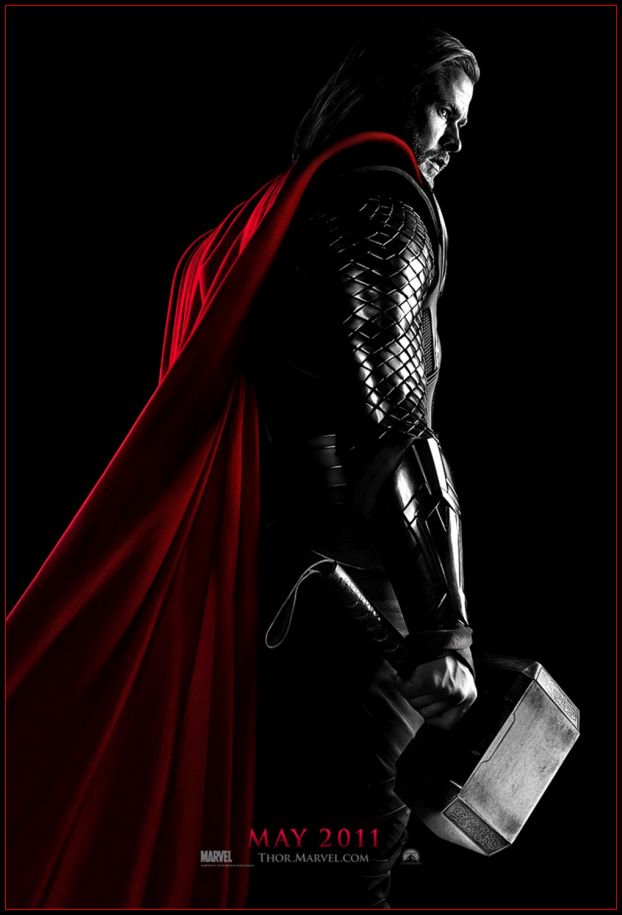
Marvel Comics has had a much better success in bringing their 2nd-tier characters over onto the big-screen than DC Comics and they’ve made the risky decision to tie-in every film they make into one shared universe. Comic book fans have begun to call this the Marvel Film Universe since it contains the same characters and backgrounds as those of their comic book counterparts but also with enough changes to make them stand-out on their own. They’ve already begun this with the first two Iron Man films and a recent reboot of the Incredible Hulk. With the X-Men, Spider-Man, Daredevil and Fantastic Four film rights still under the control of other film studios it left Marvel (now Disney) to use other characters in their control to fill out the rest of this shared universe. The next one to get their turn on the bigscreen is the live-action adaptation of Marvel’s Asgardian God of Thunder. The studios picked British filmmaker Kenneth Branagh to handle this adaptation and his background in bringing Shakespeare to the big-screen has made Thor a flwed but very entertaining superhero film.

To start off, it has to be said that Thor was always going to be the most difficult of all the characters that will make up The Avengers film to bring to the bigscreen. While all these Marvel films do have their fantastic elements due to each character’s superhero nature it was even more fantastic with the character of Thor. This character is in effect a being who has been worshipped by humans in the past as one of their deities. God-like characters have always been tough to make human and relatable in stories and film. It’s a testament to Branagh’s handle of the Asgard characters such as Thor, Odin and Loki that we don’t end up with just all-powerful beings, but individuals whose impulses and motivations definitely are human. It’s this dynamic between Thor, his father Odin and his brother Loki which drives the Shakespearean angle of the film’s storyline. It’s where Branagh’s history of making Shakespeare accessible to the general film audience that makes their story easy to follow and understand.

The film actually begins with the human characters of Dr. Jane Foster (played by Natalie Portman) and her colleagues (Stellan Skarsgard and Kat Dennings)  driving around in the New Mexico desert at night looking for atmospheric disturbances which should validate Foster’s theories on the Einstein-Rosen Bridge aka wormholes. What they end up running to instead is Thor himself arriving on Earth (Midgard in Asgardian terms) to begin his banishment from his homeworld. Yes, I say homeworld as the film has turned one of the more difficult aspects of Thor’s background into something that makes sense for the audience not steeped and learned from decades of Thor comic books. Thor’s home of Asgard is just one of nine worlds around the galaxy of which Earth is one.

It’s right after this scene that we go back to what started Thor’s banishment. The film does a great job explaining the role the Asgard’s played in Earth’s past history and the consequences of their war against the Frost Giants of the world of Jotunheim (one of the nine worlds). It’s through the narration by Odin himself (Anthony Hopkins) that we learn of the origins of the Gods and myths of Norse culture. This intro scene also shows Odin showing his two young sons in Thor and Loki the relic he had taken to end the wars between Asgard and the Jotunheim. For an origin sequence it was able to set up the rules of this fantastical world of Asgard and it’s Nine Realms. It’s the sequence right after which would lead to Thor’s banishment from Asgard and the stripping of his all-powerful hammer, Mjolnir, and his powers.

For some, and I would have to agree, this sequence which takes Thor, his brother Loki, childhood friends Sif and Warriors Three to the icy world of Jotunheim made up the best action setpiece for the film. The battle which begins between Thor’s forces and those of King Lauhey (Colm Feore under some very elaborate make-up effects) of the Frost Giants. This scene shares some similar qualities with an earlier action setpiece in the first Iron Man film in that it surpasses all other setpieces which would occur later in their respective films. This is not to say that the other action scenes were boring or just simple fare. They were exhilirating and full of energy, but that very first one in the beginning just had even more energy and action that it might’ve been better saved for the climax of the film.

Once the banishment occurs we finally catch up to the film’s first scene and the film begins to go back and forth between Asgard and Earth. With the former we see the machiavellian side of Loki finally assert itself. While Loki’s character is never truly shown to be evil his mischievious streak does show to have a cruel side to it. The bombshell of a news from Odin about his true origins was a nice touch, but it doesn’t lead to the sort of evil character turn we’re used to. In fact, I would say that Loki’s character (played with Iago-like relish by Tom Hiddleston) ends up becoming like the son who does the wrong things for the right reasons. He’s a nice contrast to the more open-faced Thor who does what he says instead of dancing around the subject even to the detriment of his standing with his father.

The scenes on Earth itself is where the comedic aspect of the film comes in. Most of the comedy comes at the expense of Thor’s “fish out of water” reaction to the new world around him. It’s helped much by some great comedic timing by Jane’s assistant Darcy (Kat Dennings who steals the film from Portman whenever they’re on together). It is also the time on Earth where some of the flaws in the film really become apparent. First and foremost would be Portman’s Jane Foster character who seem to be so uneven. She goes from brilliant astrophysicist one moment then giggling schoolgirl the next whenever she’s in close proximity to Thor. While Portman and Hemsworth do make quite the radioactively beautiful couple there’s a sense of untapped chemistry between the two that might have been left on the editing floor. It’s a shame really since so much could’ve been done with the Foster character to really give reasons to why Thor ends up valuing the lives of said mortals to earn his God of Thunder status once again.

Thor really does entertain despite some character and storytelling (really most of it on the Earth side of things) flaws which could’ve sunk the film right from the start. I believe that it’s director Branagh’s handling of the Shakespearean tragedy on the Asgard side of the film that holds the film together. This is one reason and the other being a star-turning turn by Chris Hemsworth as Thor himself. His performance goes from cocky, brash young man on the cusp of leadership to lost, confused and rudderless once banished then back again to a maturing prodigal son who finally learns the lessons his father has been trying to teach him. It would interesting to see Hemsworth’s Thor truly interact with Downey’s Tony Stark and Chris Evans’ Steve Rogers when The Avengers comes out in 2012.

The riskiest part of Marvel’s attempt to create their Marvel Cinematic Universe succeeds where most seem to think it will fail. It’s not as strong an origin film as Favreau’s first Iron Man, but it does add a sense of wonder that film could never grasp through two films. Even the controversial casting choices to put non-white actors to play Asgard roles (Tadanobu Asano as Hogun and Idris Elba as Heimdall) comes off well that the audience shouldn’t even wonder why a black and Asian person were playing characters written originally as white.

From the look of things there’s no official word whether there will be a second Thor film, but I wouldn’t be surprised if there was no matter how the film does boxoffice-wise. There’s just too much great stories to tell about Thor, Asgard and the rest of the Asgard Nine Realms now that the foundation has been laid down with this first film. I do hope that Branagh returns for those sequels if they do happen. One thing which Branagh has proven was his handling of action sequences. They weren’t amazing, but they were handled with enough skill that I believe a second time around we’d get even better action from a director known more for serious dramatic films.

A final thing to mention would be the Easter Egg final scene which occurs once the end credits finish their run at the end of the film. For those who stayed to see this scene it should be a nice treat for Marvel and comic book fans. It shows a certain artifact that should tie Thor to the upcoming Captain America film later this summer. All I can say for those who didn’t stay to see it and knows their Marvel trivia are two words: Cosmic and cube.

PS: An Avenger member makes a cameo appearance halfway in the film that doesn’t look tacked on despite what some of the more “glass half-empty” film bloggers on the net would make you think…Also, it’s safe to forgo seeing Thor in 3D. It’s not a bad post-conversion but it doesn’t really add to the film. See it in 2D to save yourself a few bucks on the ticket price.

AMV of the Day: Fairy Tail Teenage Dream


Well, for the latest AMV of the Day I have picked one which includes one of my favorite anime of late (also a favorite manga) and a song that I didn’t care for to be honest. But when combined together they make for an awesome anime music video. I’m talking about the mashup that is “Fairy Tail Teenage Dream”.

Fairy Tail is one of those anime that one just ends up loving whether they want to or not. It shares similar character designs as the long-running and uber-popular anime series, One Piece, and they even share similar-sounding storylines. The song “Teenage Dreams”  by Katy Perry I’ve always caught on the radion or used in some ad campaign, but it’s always been too sugary pop for my taste. It’s very catchy to listen to and I can understand why it’s become so popular. It only took pairing that song to this anime and how the creator of said AMV edited the whole video for me to actually like the song.

Will I listen to “Teenage Dream” when not in this AMV form? Most likely not, but at least I’ve come to appreciate said song and not completely dismissed it. Another reason why when AMV’s are done well they open up the viewer to a whole new realm of music possibilities not to mention anime ones.

Anime: Fairy Tail

Song: “Teenage Dream” by Katy Perry

Creator: Getsusekai Studios

Quick Review: In the Mouth of Madness (dir. by John Carpenter, 1995)


In the Mouth of Madness is one of those films that in essence seems like a good idea, but later becomes strange and unwieldily to the point that you have to ask yourself “What am I watching, and why did I do so?”

Jumping right of of Memoirs of an Invisible Man, In the Mouth of Madness reunites Sam Neill (Jurassic Park) with Carpenter. Neill plays John Trent, an Insurance Investigator whose latest case deals with a horror writer named Sutter Cane (Jurgen Prochnow). Cane’s novels have the strange ability to affect anyone who reads them. After Cane’s own agent/publicist falls his influence and is abruptly killed, Trent is sent to find Cane (who is missing) and help bring back his latest story , “In the Mouth of Madness” to the agency. When he sets off on his mission, he slowly finds his sense of reality unraveling.

If Neill’s character is the Scully, Julie Carmen (Fright Night Part II) plays the Mulder in this equation. Sent along with Trent, her character witnesses more of the horror than he does. She’s the audience witness for a while and proves Trent wrong when he’s ready to disbelieve what’s occurring. She good here, but her reactions, mixed with Trent’s had me slapping my forehead. I’ll get to that in a moment.

I’m told that the film is something of a homage to H.P. Lovecraft’s stories. While I’ve never read Lovecraft, I’m somewhat familiar with the Cthulhu myths and there does seem to be some tentacled beasts near the last third of the film.  Overall, some of those references escape me. The movie’s fun in a Donnie Darko mind bending way and it’s that strangeness that actually helps the film a little.

I hate the fact that Sam Neill’s character simply  won’t accept that what’s happening is real. I’m not a big fan of stuffing square pegs into round holes. If it doesn’t fit – you’re being told “This is how it goes”, and you’re seeing that’s how it’s happening – then why in the world are you still holding on to the same train of thought that isn’t working / fitting the situation? I found that extremely annoying. It’s almost the opposite of Slither, where it didn’t take long for the characters to recognize that:

1.) People were becoming zombies.

-And-

2.) It just wasn’t normal for the situation. Accept and adjust. Cover your mouth.

Overall, it was okay, but it really needed something. I’m just not sure what.