A couple weeks back I posted an article about Warner Home Video and Madhouse (anime studio) collaborating to adapt the very popular CW supernatural series Supernatural into anime. The series will comprise of 22-episodes and has a tentative release date in Japan around January 2011. More news has since come down the pipeline that the 22-episode season will see a DVD release with English-subtitles a couple months later.
From the preview trailer which has come out since it looks like the anime keeps the core theme of the show with the two Winchester Brothers fighting not just through demons, monsters-of-the-week and other supernatural problems, but also their own familial issues. The animation by Madhouse should appeal to non-anime fans since it skews more towards a realistic style instead of the hyper-kinetic wide-eyed animation style many non-fans think all anime looks like. I like to compare the animation to this series to a classic supernatural action anime which came out during the early 1990’s, Ninja Scroll.
The use of deep blacks to shade the character animations and give some definition to their faces gives the whole animation style quite the fleshy, rounded look instead of the angular, almost mechanical style of current anime. The incorporation of typical anime-style monsters was a nice touch. That was definitely tentacles coming out of that monster/demon. Though I must say that I’d be surprised if this series used said tentacles in other ways other than to be an instrument of destruction and bloodletting. I don’t think Supernatural the Animation will have much hentai qualities in it.
Anime horror usually don’t come out as often and when they do they’re usually of the hentai variety. If the folks at Madhouse even do half a good job in adapting the original tv series then this is one anime series I will have on my must-see list.
….And yes, that is a Japanese band cover of Kansas’ classic rock song, “Carry On Wayward Son“, which has become the tv series’ unofficial theme song.
In 2008 a little film from Sweden swept through the film festivals and earned a rightful and well-deserved place in many film critics and film circles “best of 2008” and “top ten” lists. This was Swedish filmmaker’s film adaptation of the John Ajvide Lindqvist vampire novel, Let The Right One In. It was a vampire film that appealed not just to horror genre fans hungry for a vampire film that was the polar opposite of the current “Twilight” vampire craze. Horror fans wanted something that wasn’t watered down and emasculated to better appeal to the tween girl set. So, Alfredson’s vampire film was embraced by these horror fans and when news came that the rights to the novel was licensed by British-studio Hammer Film and an American-remake was set for production the reaction was decisively negative.
Fans of the original Swedish film were quite protective of the film and saw any plans to remake it for the North American audience as a cynical cash-grab. Their argument was that the original film was such a great one that there should be no need to remake it. Why fix something that wasn’t broken was another point made. It didn’t help the side of those supporting the remake that Matt Reeves was chosen to direct the remake. Reeves was better known as J. J. Abrams friend (some would say Reeves owes his success to Abrams and that he was coattailing the successful producer-director) and the director of the POV monster film, Cloverfield.
As strident fans of the original continued to vent and complain about the remake already failing (despite not an inch of film being shot) the producers were gradually filling the roles in the remake with some very interesting names. Fresh off her break-out performance in Kick-Ass was Chloe Grace Moretz taking on the role of Abby (the vampire child in the original was named Eli) with Kodi-Smit McPhee (The Road) taking on the role of the young boy Owen who befriends her. One name after the other filled out the cast with some very good veteran actors from Elias Koteas to Richard Jenkins (taking on the role of Abby’s Renfield).
Matt Reeeves’ version of Lindqvist novel from Alfredson comes from using the novel itself as the base for the screenplay Reeves himself wrote for the remake. While Let Me In shares many similarities in characters and situations from the original Swedish film, Reeves film does use more of the themes and details from the novel than Alfredson did for his adaptation. Let Me In definitely has enough about it which will distinguish itself from its Swedish counterpart and stand on its own.
The film switches locales from a suburb of in Sweden to a snowy Los Alamos, New Mexico (yes, it does snow in New Mexico). We learn quickly that Owen has become quite the loner due to the constant bullying by classmates. He spends time alone in the plaza area of the apartment complex he lives in with his mother (played by Carla Buono who we never fully see). He fantasizes of getting back at those who have and still bullying him even to the point that he buys a small pocketknife and practices his retribution on one of the trees in the plaza. It’s during one of his nighttime practices with the pocketknife that he first encounters Abby. There’s a certain wariness during their encounter with Abby proclaiming that Owen will not become a friend. But in time the two do become friends with Abby becoming quite protective of Owen once learning about the bullying he has to endure on a daily basis.
The change in Abby’s relationship with Owen doesn’t sit well with Abby’s Renfield. He asks Abby never to see Owen again as he goes out to procure Abby more fresh blood (a previous attempt goes awry forcing Abby to go out into the night to hunt). It’s in the scenes between Abby and Jenkins character that we see more of the duo’s relationship mirroring the novel’s. The novel explores the theme of pedophilia and while Reeves adaptation wasn’t quite obvious about it there are clues and small character interactions which hint at this pedophilic relationship which the Swedish original never really touched upon.
It’s in these small character interactions that Reeves’ film begins to differentiate itself from Alfredson’s version. The narrative between the two films still remain the same, but Reeves’ version explores the darker themes in the novel source while Alfredson concentrates more on the growing relationship between the two primary characters. These differences could be seen in how Reeves films Abby’s attacks while hunting her prey to be more animalistic (though at times the CGI seems too apparent when Abby attacks) and Abby’s subtle manipulation of Owen. I say manipulation because Abby seems very intent on trying to befriend and put Owen at ease despite the earlier comment that they will never be friends. Not to mention her Renfield admitting to Abby that he has gotten tired of what he has done to keep Abby safe and that maybe he wants to get caught to just end it all.
The film moves along quite leisurely but with a sense of growing dread not just between Owen and his bullies, but between Abby, her Renfield and those suspecting the duo. Owen gets caught in the lives of these two newcomers and soon gets confronted by Abby’s true nature and his own reaction to this. It’s a reaction that at first shows Owen fearing Abby and wanting to escape the growing bond between the two of them, but seeing how Abby’s been nothing but helpful to Owen he chooses to remain at her side. Abby rewards Owen’s protective nature by saving Owen from a near-deadly encounter with the school bullies at the school swimming pool.
This is the one sequence in Reeves’ film which many fans scrutinized to no end. The original film shot the scene with an almost arthouse eye despite the obvious violence involved. It was a scene where Alfredson filmed it as “less is more” and let the audience’s imagination run wild. Reeves’ does the same but adds his own stylistic touches to the sequence. not too much to make it so different from Alfredson’s version, but enough that it’s not a shot-for-shot copy. Again Reeves’ chose to show Abby’s violent predator aspect in this scene, but still keeps the focus of the scene on Owen as he struggles underwater. It’s only once he is out that we see — just as he does — the aftermath of Abby’s promise to protect Owen.
The question remains whether this American-remake stands up to the original. In terms of storytelling it more than holds it own from the original film and at times actually surpasses Alfredson’s version. This Reeves version journeys through the darkside more than the original film. It definitely strips away much of the arthouse sensibilities of Alfredson’s film which made it such a beauty to watch even if at times the narrative became more than too slow to keep one’s attention. Reeves’ adaptation doesn’t ramp up the pacing of the film, but keeps it moving forward even if at a gradual pace. When violence does occur in the remake it happens quickly and with a sense of brutality that the original film fails to deliver. The remake doesn’t linger on the gore and violence, but does show enough of it to remind everyone in the audience that this is a horror film first and foremost.
If there was one quibble to be made about this remake its that Reeves relies too much on CGI to show Abby at her most dangerous. Each attack made by Abby was shot at a wide-angle and we see every move but with each move done using CGI which gives it too much of an artificial look to it. It’s a testament to Moretz’ performance as she switches from a friendly Abby when interacting with Owen during their time together at night to one of a predator older than anyone in the film doing what was necessary to attain the blood needed to survive. Reeves could definitely have used less CGI and went for a more natural approach using sudden edits to show the ferocious nature of Abby’s attacks.
The film’s cast does a great job with the roles given to them. While it was Moretz’s and McPhee’s performances as Abby and Owen that keeps the audience’s attention and keeps it from wavering it’s the supporting cast around them which provides the glue. Koteas as the detective who begins to suspect Abby as having to do more with the attacks than previously mentioned was very good, but in the end it was Richard Jenkins in the Renfield role who would steal every scene he’s in. His character’s fatalistic acceptance of his role when it came to Abby was palpable. We watch him do horrible things to people and to himself, but we also get a sense that he couldn’t stop on his own if he wanted to. He has been doing the role of blood procurer for Abby for so long that he doesn’t know what else to do. I will say that Jenkin’s with the garbage bag mask when out hunting for victims will be the images that will stick to people’s minds long after they’ve left the theater. Some will even unconsciously check the back seat of their cars at night before getting in.
In the end, this remake of Let The Right One In doesn’t feel, look and sound like the cash-grab that cynical fans of the original have proclaimed it to be. Matt Reeves does a great job in adapting more of the novel in his version and using some of the darker themes in that source to allow his film to stand on its own when compared next to Alfredson’s version. The performances by everyone involved was wonderful and keeps the story’s slow pacing from losing the audience. While this remake doesn’t have the arthouse quality of the original film it does have a certain grittiness to its look which lends quite well in pointing out how brutal the narrative really was not just in physical violence but in how one of the two leads manipulates the situation to benefit it’s survival even if there was some genuine affection between Abby and Owen. In the end, Abby gets everything and continues to exist for another boy’s lifetime.
Fans so vocal of their negative attitudes towards this film will not have their minds changed, but those keeping an open-mind will be rewarded with one of the better horror films of the year. If the original Swedish adaptation never existed I’m quite sure that all the accolades heaped on Tomas Alfredson’s film would be given to Matt Reeves instead. A remake should never be discounted because its one of an original that’s already lauded for its quality. There’s been bad remakes but thankfully Let Me In is not one of them.
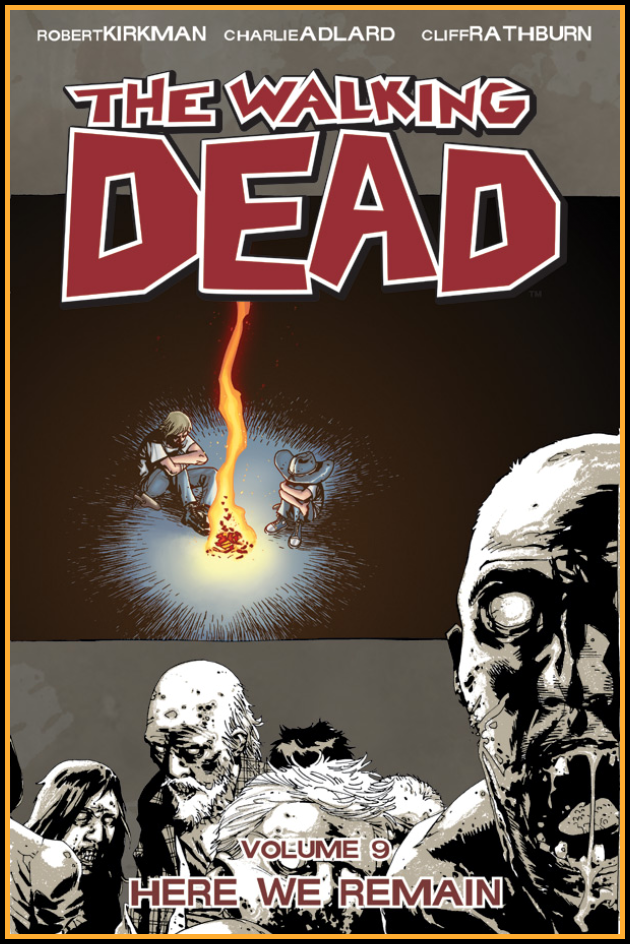
Volume 9 of Robert Kirkman’s critically-acclaimed and award-winning comic book series continues right after the bloodbath of Volume 8’s “Made to Suffer”. The last volume ended what had been a major story-arc which had lasted for almost over two years. It changed the series in ways that would be felt for years to come (Kirkman has stated that he plans to continue writing The Walking Dead for as long as there’s more stories to tell and he sees countless more to come). This follow-up volume, aptly titled “Here We Remain”, look at the aftermath of the events in the battle for the prison.
The group led by series’ protagonist Rick Grimes have gotten smaller as Kirkman made good at his statements in the past that deaths would come to the group unexpectedly and take those fans have grown to like. While Rick Grimes still remains (so far, the story remains in his point-of-view and his telling there’s a sense that even he doesn’t seem exempt from being killed off in the future) and others of the group gradually come back with him throughout the volume the sense of sadness for those who didn’t make it after the Woodsbury attack on the prison hang over the whole story-arc.
We see how the zombie apocalypse and all the events Rick has had to go through to this point has finally affected his mental state to some degree. While he hasn’t gone completely over the deep end, the scenes with Rick and an unplugged phone found in an abandoned home hits home very hard. Here’s a man who tried to do what he thought was best not just for his family and the rest of the group he led, but also tried to keep a semblance of humanity while doing so. Doubts and regrets about his decision begin to creep in and the unplugged phone becomes a focus for Rick to air out his internal struggles with the voice in the other end. This new side to Rick definitely feel like a logical progression for the one character in the whole series who has suffered the most while at the same time trying to keep an outward face of calmness and leadership.
This volume also gives Rick’s son Carl some time on his own (on his own to a certain degree) time to show how much he also has changed his he was introduced in the first volume. While he still acts like the kid that he is there’s definite signs that he has changed to the situation the world is in now. At time in this volume Carl sounds way older than his age and that has bothered some fans and critics of the series. While in any other type of situation that would be a criticism that would be a deal-breaker for me in this case I say it actually shows just how traumatizing the world has become to even the younger set. One either gives up and live in a fantasy world inside their mind or grow up fast in order to survive. It looks like Carl has chosen the latter.
Some critics of the book has pointed out that Kirkman’s handle on dialogue is actually not that great. I wouldn’t disagree as he’s prone to too much exposition, but the fact that he still pulls in the reader with what he’s writing tells me that he’s found a way to tap into what interests the reader while keeping his vision for the book alive. With the book already in its 12 volume (should get to that 12th one right before the premiere of the first season tv series) I can’t see Kirkman changing his writing style anytime soon or if he ever will. This is the path he has chosen on how to write
Hentai: slang for the Japanese term “hentai seiyoku” which literally means sexual perversion. A word used by Western fans of anime to signify anime/manga as being of the pornographic variety.
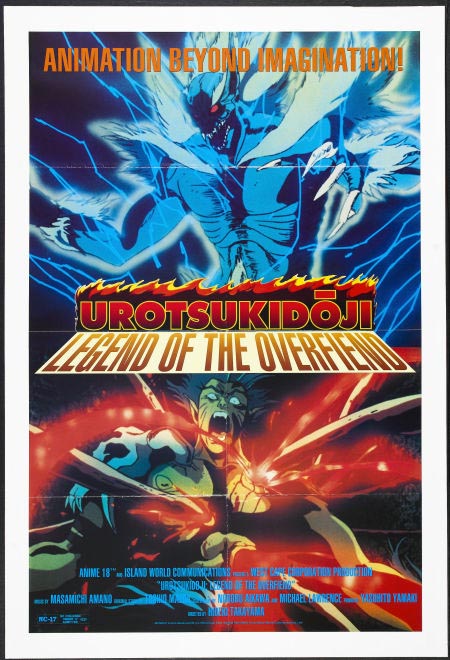
In 1990, during my junior year of high school, I was introduced to a form of animation unlike anything I had known before—the darkly imaginative and transgressive world of hentai. While explicit Japanese media had existed long before, the particular title that marked my first encounter with the genre was Chōjin Densetsu Urotsukidōji. The work did not simply define hentai; it transformed how adult animation would be viewed by audiences in both Japan and the West.
Prior to its release, erotic or explicit manga had long circulated quietly within Japan, often categorized separately from mainstream entertainment. Yet when mangaka Maeda Toshio’s Chōjin Densetsu Urotsukidōji was adapted into animation by director Takayama Hideki in the late 1980s, something shifted. The result was a film that combined the grotesque, the apocalyptic, and the erotic into a single overwhelming experience. Takayama’s adaptation was not content to merely illustrate Maeda’s ideas—it amplified them into a fever dream of violence and desire that pushed the medium into territory rarely explored in animation.
This era in Japanese media was also defined by strict obscenity laws. Direct depictions of genitalia or explicit intercourse were prohibited, both in live-action and animation. To circumvent these limitations, artists employed mosaics or invented visual metaphors. Takayama approached the problem with disturbing creativity: he replaced human anatomy with monstrous, tentacle-like appendages. These served a dual purpose—they satisfied censors while reinforcing the story’s occult and otherworldly atmosphere. Inadvertently, this gave rise to one of the most infamous tropes in hentai culture: “tentacle rape.” What began as a method of evading censorship evolved into a symbol of perversion, horror, and fascination.
Though Maeda initially regarded Takayama’s interpretation as excessively cruel and sadistic, he expressed admiration for the director’s ability to explore the darker undercurrents of his story. In time, Maeda’s own works would adopt similar motifs, blending eroticism with the supernatural. His later projects—including Yōjū Kyōshitsu Gakuen, Adobenchā Kiddo, and the enduring Injuu Gakuen La Blue Girl—refined the sensibilities born from Urotsukidōji, mixing violence, humor, and demonic imagery. These works often shifted in tone but never strayed far from the genre’s defining combination of horror and sexual excess.
Chōjin Densetsu Urotsukidōji can best be described as a collision of disparate influences: the mythic nihilism of H. P. Lovecraft, the explicit confrontational style of Larry Flynt, and the occult transgression of Aleister Crowley, all underscored by the philosophical cruelty associated with the Marquis de Sade. The film’s narrative combines apocalypse with pornography, constructing a universe where gods, demons, and humans become locked in violent and erotic cycles of destruction and rebirth. It is both a nightmare and a spectacle, a work that examines desire as an extension of cosmic chaos.
Watching the OVA as a seventeen-year-old was an experience of shock and bewilderment. Nothing in my understanding of animation prepared me for it. The optimism and adventure of series like Robotech, Starblazers, and Voltron stood in stark contrast to the nihilistic intensity of Urotsukidōji. If such a term had been common at the time, “culture shock” would have described it perfectly. Yet beyond my initial disorientation, I recognized something compelling beneath the shock value—a strange vision that treated eroticism not as mere indulgence but as a reflection of human fear and fascination.
Takayama’s film succeeded because it used obscenity as both spectacle and metaphor. The sexualized violence was horrifying, but it also emphasized the collapse of moral order within its world. The boundaries between sensuality and monstrosity blurred, suggesting that both sprang from the same primal source. In this way, Urotsukidōji transformed its limitations into aesthetic strength. Censorship forced invention, and invention created symbolism: the tentacle became an image of corruption, domination, and inhuman desire.
When Urotsukidōji began circulating in the West through VHS imports in the early 1990s, it acquired immediate notoriety. For many international viewers, the notion that animation could contain such extreme imagery was almost unthinkable. Western audiences, accustomed to animation as a medium for children or adolescent adventure, suddenly encountered a work that combined cinematic brutality with mythology and eroticism. Owning or viewing it became an act of curiosity and defiance. Accessing such media often meant seeking imported tapes or attending small conventions—a process that only heightened its sense of exclusivity and taboo.
Not everyone perceived Urotsukidōji as art. Its reputation became divisive; for some, it represented the most exploitative and grotesque tendencies of Japanese culture, while to others, it was a bold exercise in creative freedom. Regardless of one’s stance, its influence was undeniable. The film inspired countless imitators, establishing a visual and thematic template for subsequent hentai and “erotic horror” animation. Even as later works diversified into comedy, fantasy, and romance, the long shadow of Urotsukidōji remained.
There is also a deeper irony in its legacy. The same adaptation Maeda once criticized expanded the reach and visibility of his creation beyond what any manga publication could have achieved. The collaboration between artist and director—however fraught—produced a convergence of imagination that shaped both the erotic and horror dimensions of modern anime. In a broader sense, it demonstrated that the animated form could explore the same depths of transgression, myth, and existential dread that live-action cinema often reserved for its most daring auteurs.
Seen through this lens, Urotsukidōji becomes more than a piece of pornographic shock cinema. It emerges as a cultural artifact—one that reflects how desire, repression, and fantasy intersect within specific historical and artistic contexts. The work exposes how censorship and creativity can collide to produce unexpected invention, and how audiences, whether through fascination or outrage, help define a genre’s legacy.
For those of my generation, encountering Urotsukidōji was a defining moment that reshaped perception. It suggested that animation could express not only beauty and adventure but also the darker instincts of the human psyche. What began as disbelief evolved into a kind of reluctant respect for its ambition. Beneath the grotesque imagery lay a thematic depth that continues to invite examination—questions about power, violation, and the thin line separating horror from desire.
Today, both Maeda Toshio’s manga and Takayama Hideki’s adaptation occupy a controversial yet essential place in the history of Japanese media. They are remembered not only for their sensational content but for their cultural and aesthetic audacity. The story of Chōjin Densetsu Urotsukidōji endures because it refuses simplification—it is at once abhorrent and visionary, obscene yet strangely philosophical.
From the most ardent anime historian to the casual viewer, its reputation persists. Whether reviled or revered, Urotsukidōji remains the ultimate symbol of hentai’s origins and its infamous reach. It stands as both a warning and a testament: that art, when unfettered by convention and driven by instinct, can explore places society dares not name.
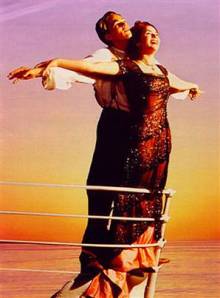
Recently, I tried to rewatch an obscure art film from 1997 called Titanic. From the time I was 12 until I was 16, I watched this movie a lot and, without fail, I cried and cried at the movie’s end. (Admittedly, it was pretty easy to make me cry back then.) I decided to rewatch it because I was curious as to whether or not Titanic could still make me cry.
For those of you who aren’t into art films, here’s a quick synopsis and review of Titanic.
The film’s plot: Bill Paxton and an obnoxious fat guy are held hostage on a submarine by a senile old biddy who insists on telling them the story of how she lost her virginity 98 years ago.
Meanwhile, in London, Leonardo DiCaprio steals some poor kid’s sketch book and then sneaks onto a cruise ship where, pretending to be an artist, he seduces and murders lonely widows.
Also on the cruise ship is Kate Winslet. Kate’s engaged to Billy Zane but she’s unhappy about it because — well, there’s some men you fuck and there’s some men you marry and let’s just say that you don’t marry Billy Zane. Once the boat sets sail, Kate decides to jump overboard. However, just before she can jump, she’s spotted by Leo. Leo quickly tosses a burlap sack containing the corpse of Lady Astor into the Atlantic and then rescues Kate.
Kate rewards him by taking him down to her cabin and showing him a painting by Someone Picasso. (Early on in the film, Billy correctly says that Someone Picasso will never amount to anything and that’s true. Someone was always overshadowed by his older brother Pablo.) Leo looks at the painting and says, “Look at what he does with color here.” As a former Art History major, that line made me smile. That’s the type of statement that is regularly uttered by people who can’t think of anything else to say. When a guy looks at a painting and says, “Look at what he does with color here,” what he’s actually saying is, “Look, babe, I went to the damn art museum with you so there better be a blow job in my immediate future.”
Leo has dinner with Billy and Kate. Leo says, “I’m just a tumbleweed blowing in the wind.” Over at the next table, a shifty young man named Bob Dylan overhears and thinks, “That would make a good song. But the little man must die so nobody knows I stole that line from him…”
Anyway, Leo eventually slips Kate a rohypnol, convinces her to pose naked while he secretly tapes her for Youtube, and then proceeds to have sex with her in the back seat of a car. Afterward, Kate says, “Do you want to hang out tomorrow?” Leo replies, “Uhmm…I might be busy. I’ll call you.” “My God,” I said as I watched all this, “it’s like reliving my freshman year of college all over again.”
Anyway, 8 more hours pass. All the rich passengers on the ship do rich things while all the poor passengers get drunk and trash the lower levels of the boat. Suddenly, without warning, the boat is besieged by the living dead. Billy Zane insists that they would be safer in the basement. Leo disagrees while Kate says, “So, you think you can just fuck me and leave!? No way!”
12 more hours pass. The living dead manage to rip a hole in the side of the boat. Billy chases Leo and Kate around the Titanic as it sinks. “I hope you’ll be very happy together!” he screams. Meanwhile, up top, two rich guys put on tuxedos and one of them says something like, “We’re going to die like gentlemen.” Which I guess is what they end up doing though, honestly, it sounds to me like the guy’s just being a smartass.
Eventually, Kate and Leo end up sitting on an iceberg together. Kate wonders if this is a dream. Leo proceeds to spin a top on the ice to find out. Suddenly, Bob Dylan floats by in a rowboat. “This machine kills fascists!” he shouts as he shoots Leo with a crossbow. Leo sinks into the water. Bob Dylan smirks. “How does it feel to be on your own?” he asks.
The end.
A quick review: I guess the easiest way to review Titanic is to answer my original question. Does the film still make me, at the age of 24, cry like it did when I was 12? No, it does not. To be honest, the only tears that I shed while rewatching Titanic were tears of shame and boredom. This is the movie that I once thought was the greatest thing ever? True, I was young and stupid but still…
On the plus side, Kate Winslet gives a good performance even if her character is basically just a sexist male fantasy. Billy Zane is also a lot of fun as her jilted suitor.
On the negative side, there’s everything else. The script — written by Someone Cameron — is full of laughably bad lines and plotwise, the film has all the depth of a lanced boil. The romantic elements of the plot made me cry back when I was 12 because I didn’t have a whole lot of real world experience to compare Titanic’s fantasy against. Now, at the age of 24, I’ve actually had to deal with my fair share of guys who say actually do make dumbfug statement about things like being a tumbleweed blowing in the wind (not to mention being king of the world). I’m not saying that a good movie can’t present a romantic idealization of reality. I’m just saying that a good movie can do that without insulting the viewer’s intelligence like Titanic does.
One last note — Leo DiCaprio has become a great actor. But, in Titanic, he just comes across like a shrill poseur.
I Learned Something Today Conclusion: Just because you and a million others think that a movie is great today, that doesn’t mean that the movie’s going to be anywhere near as good 12 years later. In this age of Avatar and the Social Network, that’s a lesson that I think many self-appointed film “gurus” would do well to consider before they throw a hissy fit just because a complete stranger on the Internet disagrees with them.
If there ever was a song one should live their life by it would be this song. A song written by singer-songwriter Paul Anka whose melody was based off of the French song “Comme d’habitude” by French musicians Claude François and Jacques Revaux, but in the end popularized by the Chairman of the Board himself, Frank Sinatra. I speak of the classic song, “My Way” and it’s my pick for the latest song of the day.
The song was released in 1969 from Sinatra’s album of the same name. It became Sinatra’s signature song and has become a staple of karaoke bars everywhere and the one song guys are more than willing to belt out sober or not (though the more alcohol consumed the louder and more forceful the singing which always adds to the effect). The lyrics and theme of the song speak about a man (or one can also say woman as well) looking back at his life at the tail end of his days and liking what he’s seen and how he’s lived.
It’s a song so beloved by many music lovers that it’s been covered by so many musicians from so many differing musical backgrounds. From Elvis Presley, Nina Simone and Nina Hagen and even punk and symphonic metal versions by Sid Vicious and Northern Kings, respectively. There’s nothing about this song that doesn’t speak to a man about how one should conduct themselves through their life. And this is perfectly pointed out by this particular lyric in the song which also happens to be my favorite: “Regrets, I’ve had a few; But then again, too few to mention.”
So, this very early October morning of 2010, the latest song of the day also happens to be my favorite song ever. Long live Ol’ Blue Eyes.
My Way
And now, the end is near;
And so I face the final curtain.
My friend, I’ll say it clear,
I’ll state my case, of which I’m certain.
I’ve lived a life that’s full.
I’ve traveled each and ev’ry highway;
And more, much more than this,
I did it my way.
Regrets, I’ve had a few;
But then again, too few to mention.
I did what I had to do
And saw it through without exemption.
I planned each charted course;
Each careful step along the byway,
But more, much more than this,
I did it my way.
Yes, there were times, I’m sure you knew
When I bit off more than I could chew.
But through it all, when there was doubt,
I ate it up and spit it out.
I faced it all and I stood tall;
And did it my way.
I’ve loved, I’ve laughed and cried.
I’ve had my fill; my share of losing.
And now, as tears subside,
I find it all so amusing.
To think I did all that;
And may I say – not in a shy way,
“Oh no, oh no not me,
I did it my way”.
For what is a man, what has he got?
If not himself, then he has naught.
To say the things he truly feels;
And not the words of one who kneels.
The record shows I took the blows –
And did it my way!
Welcome to the latest installment of Lisa Marie’s Grindhouse Trailers. Since I’ve been battling a pretty bad cold for about a week now, I thought I would use this installment to highlight a few trailers that prove that the rest of the world is just as sick.
I’ve read so much about this 1976 film but — for whatever reason — it has never officially been released on DVD (though there all bootlegs out there as well as an “all-regions” DVD that apparently is not “all-regions.”) From what I’ve read, this is apparently a political satire disguised as a high school revenge film. The trailer has an oddly off feel to it. Maybe it’s just the exploding locker…
I first saw this film (directed by Mark Lester) on DVD about three years ago. I was expecting to see a silly, urban vigilante film from the early 80s so imagine my surprise when I discovered that Class of 1984 is a seriously dark and oddly disturbing movie. Tim Van Patten (he’s the one going, “I am the future…”) is now a pretty succesful television commercial. He actually gives a pretty good performance in this film, something that’s not necessarily obvious from this trailer.
Yes, another high school revenge film. In this one, Linda Blair’s sister is raped so Linda tracks and down and kills the Class of 1985. Usually, this is where I’d make my standard argument that this is a case of exploitation serving to empower. Honestly, though, it would be more empowering if the film’s villains weren’t so silly and stupid (you get the feeling that they’re all going to die soon anyway regardless of what Linda does) and if the avenging angel was played by someone other than Linda Blair.
For extra fun, imagine the “gang” from Savage Streets trying to fight any of the gangs in this trailer.
5) Sweden: Heaven and Hell (not available from Amazon.com)
The previous trailers paint a pretty grim picture of America. According to the “documentary” Sweden: Heaven and Hell, the best thing about America is that it wasn’t Sweden.
Sweden: Heaven and Hell is actually an Italian mondo film, a rather vile form of “documentary” that was big from the mid-60s up until Ruggero Deodato did the world a favor and satirized the genre out of existence with Cannibal Holocaust. It was released in the States in 1968 (I think). This is one of those movies that I know by reputation as I’ve never actually seen the actual film. However, the trailer is grindhouse tackiness at its absolute best. Everything from the narrator’s leering tone to the “shocking” footage (a woman dancing with another woman — gasp!) makes this trailer a perfect time capsule of the Grindhouse Era.
6) Skatetown USA (not available in any format on Amazon. com — how odd)
But, as sick as Sweden apparently was, can it possibly be sicker than whatever it was that was going on at Skatetown, USA? Seriously, what was wrong with this country in the 70s? That said, I do like this ludicrous trailer if just for the sight of a young and dangerous Patrick Swayze. Plus, how can you dislike any trailer that claims to be advertising “the greatest story ever rolled?”
Seriously, what was the deal with people roller skating at a disco? Is that what passed for fun back in the 70s? Weird. Maybe it was all the cocaine. I came across this trailer while I was downloading the Skatetown USA preview and I just had to include it. Not only is the movie called Roller Boogie but it’s directed by the director of Class of 1984 and it stars the star the Savage Streets. So, everything ties together.
8 ) Finally, since I hate to end things on an odd number, here’s a silly little trailer that I made for my DVD collection.
In 2009 a little film coming out of France gained a buzz from on-line film bloggers. The film wasn’t the latest arthouse attempt to relive the glory days of French New Wave. It wasn’t a film that’s become part of the extreme French horror that’s becme all the rage in the horror circles in the past decade or so. This film was an action-thriller starring Irish actor Liam Neeson with an ensemble cast of actors from the US, UK, France and Albania. The film I am talking about is Taken by French filmmaker Pierre Morel (his previous film, District 13 with it’s parkour action scenes would make it a cult hit) and produced by his mentor Luc Besson.
Taken at its most basic core is a film about a father’s love for his daughter who has gotten herself kidnapped by Albanian sex-traffickers while on vacation in Paris, France. Liam Neeson’s character gets introduced as a retired government worker and divorcee whose attempt to reconnect with Kim his teenage daughter (played by Maggie Grace of Lost). His attempts to impress his daughter and make her happy gets upstaged by his ex-wife’s richer husband and stepfather to his daughter. It doesn’t help that Neeson’s character Bryan Mills has skillsets not easily translated to the civilian sector. He’d take an offer of a bodyguard gig from one of his former co-workers and it’s during this security job that we get a clue as to what sort of government employee Bryan Mills was before his decision to retire.
Moving forward we finally get past the introductions of the characters (Famke Janssen as Mills’ ex-wife really comes across as a major harridan who seems intent on punishing Mills for selfish reasons). Mills learns of a trip Kim will be taking with her friend Amanda (Katie Cassidy) to follow U2’s European concert tour. Mills, the clearheaded parent, doesn’t like this plan to have his daughter galavanting across Europe without adult supervision, but his guilt for having neglected Kim while he was working for the government plus his ex-wife’s insistence that Kim take the trip makes him relent, but not without giving her some advice to stay safe.
To say that Kim and Amanda get into a heap of trouble right as soon as they arrive in Paris would be an understatement. The two get kidnapped while staying at the luxury apartment of Amanda’s cousin. Before Kim is taken by the masked intruders (who’ve already taken Amanda) she’s able to make a desperate phone call to her father. Calm, collected and knowing that her daughter’s abduction was an inevitability, Mills instructs his daughter to relay to him as much information as possible about those abducting her. With that information in hand Mills heads to Paris to find his daughter (and to punish those who dare kidnap her).
From then on Taken becomes an action-thriller which barely gives the audience a chance to take a breather. Mills knows his time frame when it comes to finding his daughter gets shorter and shorter thus goes about his job searching for her in a deadly efficient manner. Mills becomes Jack Bauer and Jason Bourne rolled into one. There’s no witty, debonair Bond in this character. Mills goes about his business of interrogating, killing and gathering information with cold, calculating efficiency which leaves no room for Bondesque dialogue. The story moving forward once Mills arrive in Paris becomes almost an extension of Mills’ character. Writers Besson and fellow collaborator Robert Mark Kamen keep the dialogue to the barest minimum. We learn more about Neeson’s character through his actions more than we do during character interactions with other players in the film.
The film hinges on the audience buying Liam Neeson as a deadly, ex-CIA operative who manages to survive every violent encounter throughout the film (some by his own doing and others just trying to survive through it). From how people have reacted to this film and Neeson’s character I would say that it’s a big definitive yes that we buy Neeson as someone akin to Bauer and Bourne. In fact, I would say that Neeson’s Bryan Mills would be the more dangerous of the three. He has no compunction about using torture to gather information and barely breaks a sweat when killing those involved in some way in his daughter’s abduction. He has no bouts of guilt about what he has done in the past (probably killing as a secret agent) , what he’s doing in the present (killing to find his daughter) and what he’ll be doing in the future (probably thinking killing thoughts about anyone who will look at his daughter funny). Neeson’s Bryan Mills is a cold, efficient killing machine who doesn’t use fancy moves to take out his opponents and willing to shoot them in the back if it ends the fight in his favor.
The action sequences in Taken has some parkour influences, but not enough to make it distracting. There were no Michael Bay-style skewed camera angles, slo-mo shots and ADHD-style editing. Morel actually keeps the frenetic editing that made the Jason Bourne fight scenes so dynamic to a minimum. There’s just enough of it to make the fight scenes look brutal and painful, but not enough to make people nauseous. The climactic action sequence on the yacht of a rich buyer of sex-slaves goes by so quickly yet was more entertaining than half the prolonged action scenes from Bay’s Transformers sequel.
The rest of the cast barely keep up with Neeson in the film. They become tertiary characters whose job were to give Neeson’s character the motivations he needs to get the job done. I will say that Maggie Grace as Kim was believable as a teenager even down to the spoiled teen she starts off in the beginning. But again her character was just there to motivate Neeson’s character to go back to doing what he did well and that’s kick ass (he’d probably do it just as well while chewing bubble gum).
In the end, Taken was an action-thriller which more than surprised many people. It cemented Liam Neeson as one badass dude in the same league as Kiefer Sutherland’s Bauer and Matt Damon’s Jason Bourne. The film became a showcase for people to witness Neeson kickass and do it believably while Morel does just enough to keep the film from becoming too ridiculous. While Taken won’t herald the coming of another era of French New Wave, it does succeed in doing what it set out to do and that’s entertain, thrill and just give the audience some kickass escapist fare that some big-budgeted Hollywood studio titles never seem to do.
This rather lengthy sequence comes towards the end of Walter Hill’s 1981 action film, Southern Comfort. Two national guardsmen (played by Keith Carradine and Powers Boothe), after spending the majority of the movie being chased through the Louisiana bayou by “bad” Cajuns, find a few moments of fleeting peace with “good” Cajuns. While I love the way Hill builds up the tension in the scene, it’s the authentic atmosphere that makes this sequence memorable. Hill filmed this sequence with nonprofessional extras who pretty much just did their thing.
(As a sidenote: I’m fluent in French but less so in Cajun.)
Be warned: two hogs are gunned down and gutted about halfway through this scene. Since this film was made by Walter Hill and not Umberto Lenzi, I doubt the hogs were specifically murdered just for the movie. To be honest, as a former farm girl who has spent more than a little time down around the bayous, I find it diffilcult to cry too hard over a hog. Trust me, they’re nothing at all like Babe.
The music here, by the way, was performed by the legendary Dewey Balfa.
Hi there. Lisa Marie here. I know that usually when I show up on this site, it’s too either toss up 6 more exploitation trailers or to present a review of a film that’s been unfairly dismissed (or foolishly overpraised) by the mainstream media. It’s what I love doing and I hope everyone gets at least a little occasional pleasure out of it. (If you don’t — well, please don’t tell me. I’m surprisingly sensitive.)
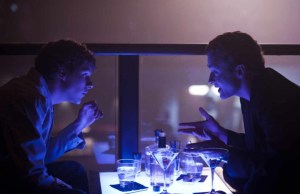
Last week, I expected that, at this time, I would have posted a review (probably negative) of the mainstream’s latest attempt to make an art film — David Fincher’s The Social Network.
Unfortunately, life in general — and my body in specific — had other plans. I’ve been sick since Wednesday and, for the first time in over a year, I did not spend my weekend at the movies. It’s enough to make a girl cry.
(That said, I did spend most of the weekend lounging about in various states of undress so maybe concentrating on that image will help to lessen the sting of no Social Network review…)
However, while I may not be able to give you my Social Network review, I do feel that I can give you my Social Network pre-viewing review.
Just based on the evidence presented to me so far, the Social Network sucks.
Consider the evidence:
1) Peter Travers of Rolling Stone says that the Social Network will make me “believe in film again.” Excuse me? Francios Truffaut coming back from the dead — or at least Jean-Luc Godard making one more vaguely entertaining movie before dying– will make me believe in film again. I refuse to join a religion based on a movie about fucking Facebook. Sorry, Mr. Travers.
2) Andrew O’Heir at Salon.com has compared The Social Network to — wait for it — Citizen Kane. Hopefully, when the zombie apocalypse comes, Zombie Orson Welles will eat Andrew O’Heir first.
3) According to Rotten Tomatoes — the web’s greatest resource of Mainstream Opinion — The Social Network is the best-reviewed film of 2010 so far. For a film to be that loved, it must be really needy. And what do needy things do? They manipulate, they lie, and they go out of their way to beg you to like them. A great film doesn’t give a fuck what you think.
4) The movie stars Jesse Eisenberg who has already been in 3 great movies — The Squid and the Whale, Adventureland, and Zombieland. Sorry, Jesse but only Giovanni Lombardo Radice is allowed to appear in four great films in just four years.
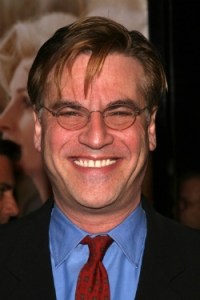
5) The movie is written by Aaron Sorkin. This movie is being advertised as the “defining” movie as my generation. Sorry, but the defining movie of my generation isn’t going to be written by some smug, 50 year-old, male, sexist, crackhead.
6) The movie is directed by David Fincher which normally would be a good sign except all the reviews are concentrating on Aaron Sorkin. So, is our Mr. Fincher so needy for an Oscar that he’s basically abandoned his own vision in the service of some smug, 50 year-old, male, sexist, crackhead?
7) Apparently, this movie celebrates rich kids getting richer. Just what America needs right now. Yes, let’s celebrate the dumbfug toadsuckers of the world while the guy flipping your burger over at McDonald’s loses his health insurance.
8 ) The Social Network is apparently number one at the box office after this weekend and apparently has gotten great word of mouth. You know who else got great word of mouth at one time? Adolf Hitler, that’s who. Up until it was no longer socially acceptable, the mainstream loved him too.
9) The Social Network has a really crappy, first draft title. Seriously, that’s the name of the movie?
10) Sasha Stone, over at Awardsdaily.com, loves this fucking movie and to me, that’s reason enough to assume it’s going to be an overrated piece of foolishness. Seriously, Awardsdaily.com is a great site if you want to keep up with all the Oscar buzz but — when it comes to reviews — Sasha Stone, Ryan Adams, and the rest of the site are all so middle class and predictable. (Of course, what do you expect from a site that regularly quotes William Goldman?)
So, that’s my pre-viewing review of The Social Network. Hopefully, I’ll see it next weekend and be able to post an actual review. Then we’ll be able to see if the film simply conformed to my own biases or if it truly is worthy of all the hype.
Until then, I’d love to hear your thoughts on The Social Network and the growing chorus of mainstreamers who insist that this is the greatest film of all time. Am I being too hard on it or is this yet another example of the mainstream emperor wearing no clothes?





 Through the Shattered Lens