The Walking Dead finally gets it’s Rick Grimes


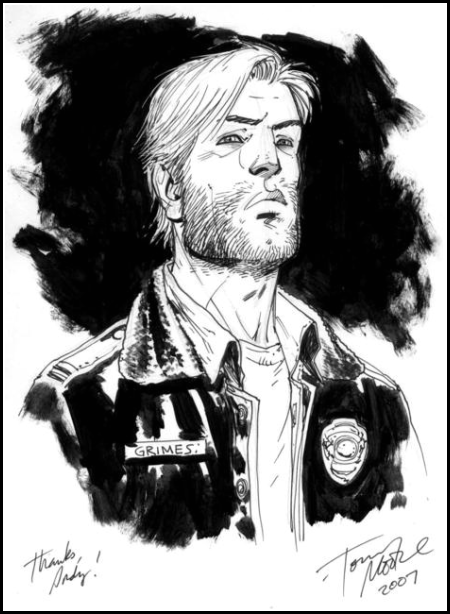
The good folks over at The Hollywood Reporter have reported that Frank Darabont’s tv series adaptation of Robert Kirkman’s award-winning comic book, The Walking Dead, have finally found the actor to play the series’ lead protagonist, Rick Grimes. The actor chosen came out of left field as his name was never even one people were clued in on. Fan favorites like Peter Krause and Mark Pellegrino were not even seen or heard having tried out for the lead role. Other names like Jamie Bamber (Battlestar Galactica’s Lee “Apollo” Adama) and Johnny Lee Miller (Eli Stone and Hackers) were also mentioned as having tried out for the role with the latter seen as the front-runner.

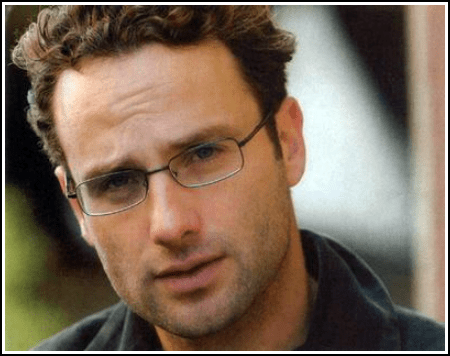
So, it’s seen as a surprise by many following the production of The Walking Dead to see the name Andrew Lincoln come up as the actor chosen to play Rick Grimes. The UK actor has worked in mostly shows and films in his native UK w/ Love Actually being the more recognizable of those he’s worked on. I think the choice was, and is, a good one. This is literally an unknown actor to US audiences so it will be easier for suspension of disbelief to be achieved for those watching.

While the reaction to this news is mostly one of guarded optimism there’s a very tiny but vocal group that seem to cry foul at this choice just for the fact that Andrew Lincoln will be a British-actor playing an American from the South. I think fans at times just think that dream choices for roles in their favorite stories should be the only ones chosen to play those roles whether they actually want to take on the role or not, or if they’re even good for the role.

For the detractors I say give the man a chance to get into the role before you put the man down. Oh yeah, one other thing…just be glad the show is actually being down and with strong creative people behind it. Put the fanboy/girl hat into storage.

Source: THR

My Top Ten Books About The Movies


I love movies and I love books so I guess it would stand to reason that I love books about movies the most of all.  (I also love movies about books but there are far fewer of those, unfortunately.)  Below are my personal favorites.  I’m not necessarily saying that these are the ten greatest film books ever written.  I’m just saying that they’re the ones that I’m always happy to know are waiting for me at home.

10) Soon To Be A Major Motion Picture by Theodore Gershuny — This is one of the great finds of mine my life.  I found this in a used bookstore and I bought it mostly because it only cost a dollar. Only later did I discover that I had found one of the greatest nonfiction books about the shooting of a movie ever written!  Gershuny was present during the filming of a movie called Rosebud in the early 70s.   I’ve never seen Rosebud but, as Gershuny admits, it was a critical disaster that managed to lose a ton of money.  The book provides a fascinating wealth of backstage gossip as well as memorable portraits of director Otto Preminger and actors Robert Mitchum (who was originally cast in the lead role), Peter O’Toole (who took over after Mitchum walked off the set), and Isabelle Huppert.   If nothing else, this book should be read for the scene where O’Toole beats up critic Kenneth Tynan.

9) Suspects by David Thomson — A study of American cinema noir   disguised as a novel, Suspects imagines what would happen if George Bailey from It’s a Wonderful Life fell in love with Laura from the movie of the same name.  Well, apparently it would lead to Sunset Boulevard’s Norma Desmond having an affair with Chinatown’s Noah Cross and to one of George’s sons, sensitive little Travis, getting a job in New York City as a Taxi Driver.  And that’s just a small sampling of what happens in this glorious mindfuck of a novel.

8 ) Profondo Argento by Alan Jones — Long-time fan Alan Jones examines each of Dario Argento’s films (even Argento’s obscure historical comedy The Five Days of Milan) and proceeds to celebrate and (in many cases) defend Argento’s career.  Jones also interviews and profiles several of Argento’s most frequent collaborators — Daria Nicolodi, Asia and Fiore Argento, Simon Boswell, Claudio Simonetti, Keith Emerson, George Romero, Lamberto Bava, Michele Soavi, and many others.  Jones’ sympathetic yet humorous profile of Luigi Cozzi is priceless.

7)  Spaghetti Nightmares by Luca Palmerini — Spaghetti Nightmares is a collection of interviews conducted with such Italian filmmakers as Dario Argento, Ruggero Deodato, Umberto Lenzi, Lucio Fulci, and others.  Among the non-Italians interviewed are Tom Savini (who, as always, comes across as appealingly  unhinged) and David Warbeck.  (Sadly, both Warbeck and Fulci would die shortly after being interviewed.)  What makes this interesting is that, for once, Argento, Fulci, et al. are actually being interviewed by a fellow countryman as opposed to an American accompanied by a translator.  As such, the subsequent interviews turn out to be some of the most revealing on record.

6) Sleazoid Express by Bill Landis and Michelle Clifford — Landis and Clifford’s book is both a history and a defense of the old grindhouse theaters of New York City.  Along with describing, in loving and memorable detail, some of New York’s most infamous grindhouses, they also write about some of the more popular movies to play at each theater.  Along the way, they also offer up revealing profiles of such legendary figures as David Hess and Mike and Roberta Findley.  Reading this book truly made me mourn the fact that if I ever did find myself in New York City, I won’t be able to hit the old grindhouse circuit.

5) Beyond Terror: The Films of Lucio Fulci by Stephen Thrower — Fulci has always been a terribly underrated director and, indeed, it’s easy to understand because, in many ways, he made movies with the specific aim of alienating and outraging his audience.  It requires a brave soul to take Fulci on his own terms and fortunately, Stephen Thrower appears to be one.  Along with the expected chapters on Fulci’s Beyond Trilogy and on Zombi 2, Thrower also devotes a lot of space to Fulci’s lesser known works.  Did you know, for instance, that before he became the godfather of gore, Fulci specialized in making comedies?  Or that he also directed two very popular adaptations of White Fang?  Thrower also examines Fulci’s often forgotten westerns as well as his postapocalyptic sci-fi films.  And, best of all, Thrower offers up a defense of the infamous New York Ripper that, when I read it, actually forced me to consider that oft-maligned film in a new light.  That said, Thrower does admit to being as confused by Manhattan Baby as everyone else.

4) Immoral Tales by Cathal Tohill and Pete Toombs — Tohill and Toombs offer an overview of European “shock” cinema and some of the genre’s better known masters.  The book contains perhaps the best critical examination of the work of Jean Rollin ever written.  The authors also examine the work of Jesus Franco and several others.  This is a great book that reminds us that the Italians aren’t the only ones who can make a great exploitation film.
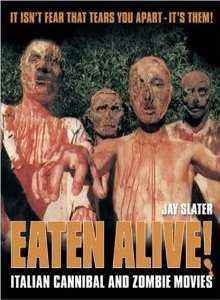
3) Eaten Alive by Jay Slater — This book offers an overview of the Italian film industry’s legendary cannibal and zombie boom.  Along with reviewing every Italian movie to feature even the slightest hint of cannibalism or the living dead (this is one of the few books on Italian cinema that discusses both Pasolini and Lucio Fulci as equals), Eaten Alive also features some very revealing interviews with such iconic figures as Catriona MacColl, Ian McCullough, and especially Giovanni Lombardo Radice.  Radice, in fact, also contributes a memorable “guest” review of one of the movies featured in the book.  (“What a piece of shit!” the review begins.)  Memorable reviews are also contributed by Troma film founder Lloyd Kaufman who brilliantly (and correctly) argues that Cannibal Holocaust is one of the greatest films ever made and Ramsey Campbell who hilariously destroys Umberto Lenzi’s infamous Nightmare City.

2) The Book of the Dead by Jamie Russell — If, like all good people, you love zombies then you simply must do whatever it takes to own a copy of this book.  Starting with such early masterpieces as White Zombie and I Walked With A Zombie, Russell proceeds to cover every subsequent zombie film up through George Romero’s Land of the Dead.  Russell offers up some of the best commentaries ever written on Romero’s Dead films, Fuci’s Beyond Trilogy, Rollin’s Living Dead Girl, and Spain’s Blind Dead films.   The pièce de résistance, however, is an appendix where Russell describes and reviews literally ever zombie film ever made.

1)  All The Colors Of the Dark by Tim Lucas  — This is it.  This is the Holy Grail of All Film Books.  If you’ve ever asked yourself if any book is worth paying close to 300 dollars, now you have your answer.  This one is.  Tim Lucas offers up the most complete biography of director Mario Bava ever written.  In fact, this may be the most complete biography of any director ever written!  Lucas examines not only Bava’s life but also every single movie that Bava was ever in any way connected to, whether as a director or as a cameraman or as the guy in charge of the special effects.  This is 1,128 pages all devoted to nothing but the movies.  This is the type of book that makes me thankful to be alive and I owe a huge debt of gratitude to Tim Lucas for writing it.
AMC’s The Walking Dead gets KNB EFX


It looks like Frank Darabont’s TV adaptation of Robert Kirkman’s award-winning comic book title, The Walking Dead, just got closer to it’s production start. Shock Till You Drop has confirmed with Greg Nicotero of KNB EFX will be part of the AMC horror tv series. Nicotero (w/ co-founder Howard Berger) and the KNB visual effects house has done many of the horror, sci-fi and action films of the past decade. They last worked with Frank Darabont in the 2007 film-adaptation of Stephen King’s novella, The Mist. They’ve also been the premiere visual effects house when it comes to bringing the classic Romero zombie look and gore on the big-screen. Romero’s last three zombie films having  been done by KNB.

This news makes me even more hyped to see how The Walking Dead translates onto the small-screen. With zombie films starting to reach a plateau when it comes to quality (Romero’s latest Survival of the Dead being mediocre at best) it will be interesting how a series centered around a zombie apocalypse and the travails of the survivors would be seen by the general audience. Having KNB EFX will at least appease the zombie fans who will flock to see this series. The question now is whether AMC will allow enough of the graphic violence from the comic book series to be shown. I’m guessing they will if their other critical-darling drama series Breaking Bad is a way to measure how far AMC will go.

Here are some of the films KNB EFX have worked on.

  • Kill Bill, Vol. 1-2
  • Land of the Dead
  • Hostel
  • Chronicles of Narnia: The Lion, The Witch and The Wardrobe
  • Bubba Ho-Tep
  • Vanilla Sky
  • The Faculty
  • Sin City
  • The Cell
  • Men in Black
  • Ray
  • Casino
  • Pulp Fiction
  • Reservoir Dogs
  • Serenity
  • From Dusk til Dawn
  • Dances with Wolves

Source: Shock Till You Drop

Review: Zombie (dir. by Lucio Fulci)


1979 saw the release of a film titled Zombi 2. It was suppose to be an unofficial sequel to Romero’s own Dawn of the Dead which was released in Italy under the title of Zombi. many thought this pseudo-sequel was a way to cash-in on the success of Romero’s film in Italy. This wasn’t true for the fact that it’s director and producers had already been working on their own zombie film as Romero started on Dawn of the Dead. It was by coincidence that both were released within the same year and in order to try and tie the two films together their titles reflected it.

Lucio Fulci’s Zombi 2 (or just plain Zombie in the US) has no connection whatsoever with Romero’s own Dawn of the Dead except for the zombies and the rules governing their destruction. This is not to say that Fulci’s Zombi 2 wasn’t good. In fact, I would say that Zombi 2 was, and still a great horror movie that’s been unfairly compared with Romero’s ultimate zombie classic. The two films tell different type of stories even when sharing similar plot devices and rules. Where Romero used the backdrop of the zombie epidemic as a damning visual commentary on the growing consumerism culture in the United States, Fulci’s film eschews any such social observations and goes for pure horror instead.

Zombi 2 helped begin the Italian cinema’s love of zombie movies and Fulci’s film still stands as the best of the lot. Starring Tisa Farrow as Ann, the daughter of a missing doctor working in the Carribean, and Ian McCulloch as reporter Peter West who helps Ann try to solve the mystery of her father’s disappearance in one of the Carribean Islands. The only clue they have being the mysterious reappearance of a boat belong to Ann’s father. A drifting yacht which, when inspected by NY Harbor Patrol, a disfigured, obese man violently attacks one of the patrolmen before falling overboard into the city harbor. From that moment on, Ann and Peter head off to her father’s last location on the Carribean island of Matool. Once on Matool, Ann and Peter discover that one of her father’s colleagues, a Dr. Manard, has been trying to solve the mysterious disease, or curse as the native islanders call it, which her father became afflicted with. A disease which seem to kill those it infects and then return them to life to attack the living.

These two are soon joined by a vacationing couple who seem to have arrived on Matool at the worst time. Ann and Peter soon enlist the aid of Brian and Susan, but before they could solve the island’s deadly mystery the island’s dead, both past and recent, rise up from their resting place and doom the remaining inhabitants. One sequence involving these zombies has gone down in horror history as one of the most cringe-inducing scenes on film. It involves the torturously slow sequence where a woman’s head is dragged forward toward a door splinter aimed directly at the woman’s eye. This gore-sequence in addition to the scenes of the zombies attacking and feeding on the visiting Westerners and the remaining living islanders were very well done and all due to make-up FX master Giannetto de Rossi. There’s even a spectacular sequence where a zombie tries to attack and feed on a live shark. Even to this day I still marvel at whichever stuntman volunteered for that action shot.

Zombi 2 has been called a dumbed down attempt to capitalize on Dawn of the Dead. I wholeheartedly disagree with this obeservation. Zombi 2 was never meant to be socially relevant, but one whose only goal was the scare, disgust and disturb its audience with scenes of extreme violence and gore. In this respect Fulci succeeded with the final cut of Zombi 2. The acting itself was very well done considering that half the cast spoke in English as their natural language while the other half were saying their lines in Italian. The dubbing of the Italian-spoken lines were done particularly well. A rarity when it comes to dubbed films.

The final few minutes of Zombi 2 where the Matool survivors make it back to New York through its harbor makes for a great ending. With a city radio station recounting the growing zombie crisis which seemed to have begun while Ann and Peter were on Matool, the final shot of zombies walking on the pedestrian level of the Brooklyn Bridge with cars below them seeming to be rushing out of the city to escape the crisis still makes for a haunting scene. Lucio Fulci’s Zombi 2 might not have been the iconic, cultural and societal masterpiece that was Romero’s Dawn of the Dead, but it more than holds its own when seen as a pure horror film.

Trailer: Pride and Prejudice and Zombies Prequel


I rather enjoyed the literary classic and genre mash-up that was Seth Grahame-Smith’s Pride and Prejudice and Zombies. That mash-up soon spawned other copycats and imitators from Sense and Sensibilities and Sea Monsters right up to Adventures of Huckleberry Finn and Zombie Jim. There’s actually even more classics which have been mashed-up with genre staples such as zombies, vampires, werewolves and even steampunk. Writer Seth Grahame-Smith even follow’s up his best-selling Austen collab with a historical what-if to be titled, Abraham Lincoln: Vampire Hunter.

With Grahame-Smith busy with that book Quirk Books turned to Steve Hockensmith to write the prequel to Pride and Prejudice and Zombies. This prequel will keep the original’s title with the additional title tag of Dawn of the Dreadfuls. This prequel will explain how the Bennett girls from the original novel were such good zombie-hunters and killers. This prequel will be a major detailing of the backstory of the existence of zombies in Austen’s literary world.

There’s already a film adaptation of Pride and Prejudice and Zombies in the works with Natalie Portman headlining the cast. This trailer for the prequel novel just gives a gory and quite awesome glimpse at just how awesome (did I say awesome twice because it definitely is) the film adaptation would look.

Some have been saying that all these literary classics being mashed up with zombies is getting old. I say those people do not know what fun is when it kicks them in the groin. I, for one, think zombies added to anything makes them better in the long run.

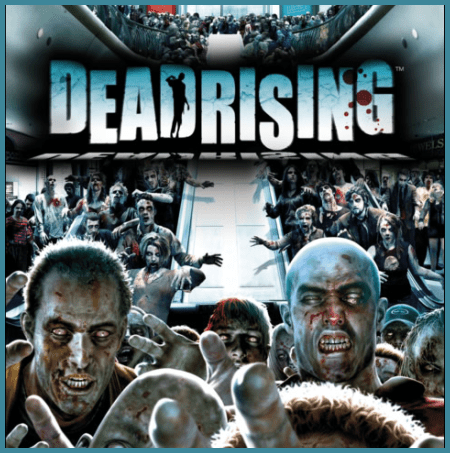
Review: Dead Rising


Capcom’s Dead Rising stands as one of the most fun titles to come out for the Xbox 360 since its initial release in late 2005. From the makers of the Resident Evil series for past console systems, Capcom has taken a new approach in adding to their growing library of zombie titles. Dead Rising is a semi-freeroaming action-horror game which takes the classic premise of George A. Romero’s Dawn of the Dead — survivors trapped in the mall teeming with flesh-eating zombies — and makes a fun and exciting game.

The game takes place Willamette, Colorado, population 53,594 where nothing exciting happens in town outside of visiting the local mega-mall which seems to dominate the entire town. Dead Rising uses a time-based mission system and the intro cutscene in the beginning of the game hints at this. You play as freelance photojournalist Frank West, who never fails to mention that he’s covered riots, wars, and all sorts of dangerous events, who gets a tip from an unknown source that something big is happening in little old Willamette. The intro both introduces Frank West, flying over the town to bypass the military blockade and cordon of the town, and the controls for the photography mechanics of the gameplay. It’s in this hands-on tutorial part of the intro that we see a bird’s eye view of the crisis that has befallen Willamette. From there you’re dropped onto the roof of the Willamette Mall where you meet one of the few survivors of the town. The rest of the game moves on from there at a very frantic pace.

It’s the game itself that shines for Dead Rising. Despite a save system that could’ve been done much better (more on that later), Dead Rising‘s gameplay mechanics has quite a bit in common with Rockstar’s Grand Theft Auto series. From the get-go the player as Frank can just go down into the mall and begin killing zombies left and right, and everyway from Monday through Sunday. All manner of items stocked in the mall walkways and stores can be picked up and used either as a weapon, a change in clothing attire, and/or food. This is where Dead Rising will get most of its mention for being fun. When Capcom programmers decided to allow the player to use anything that could be picked up as a weapon they meant it. There’s over 200 useable items to be picked up as a weapon. These items range from the gore-inducing lawnmower (an homage to Peter Jackson’s Dead Alive zombie film), chainsaws, and excavators (a garden tool that has one of the bloodiest and funniest killing animation) to the ridiculously funny use for CDs, shower-heads, novelty masks, teddy bears and skateboards. There’s also the more traditional weapons such as a pistol, shotgun, submachine gun, machine-gun, swords and axes. Being a game developed by Capcom, Dead Rising has more than a few wink-wink acknowledgement to other Capcom games such as Mega Man and Resident Evil.

One could spend all their time just killing zombies, but the strict time-based missions in the game might make zombie-killing take a backseat to actually solving the mystery of what’s caused the zombie outbreak in the town. There’s two types of missions Frank could try solving. There’s the mandatory “Case Missions” which deal directly with him trying to solve the mystery within the 72-hour time limit. Each case mission must be solved in a linear order to open up the next case. The second set of missions are named “Scoops” and act more as sub-missions that can be taken on and accomplished or ignored. They really don’t affect the availability of further case missions. What they do give Frank are prestige points that can go a long way to levelling him up to gain more skills and abilities. Most scoop missions usually entail finding scattered survivors within the mall and leading them back to the safety of the security office near the roof. Some survivors could be armed with extra weapons Frank carries and defend themselves when attacked, and some survivors are so incapacitated that Frank must carry them to safety. While carrying a survivor Frank will be unable to use a weapon so this type of mission usually takes several tries before the player figures out the best path to safety. Like most game AI, the survivors need a bit of constant attention from the player to make sure they’re actually following you and not stopping every second to fight the closest zombie. It’s not a gamebreaker but the survivor AI could’ve used some more tweaking to make them follow much better.

As mentioned above, Frank can level up to a level cap of 50 by acquiring prestige points (called PP in the game). Prestige points can be acquired through many different ways within the game. Taking pictures of different nature and quality will give Frank prestige points as high as several tens of thousand. Shots with poses that follow a certain genre gives more points than those that are just generic poses. Such genres that shots can be taken of are shots of burtality, horror, outtakes, drama and erotica. Erotica shots are pretty much just photographs taken of survivors and zombies (creepy) in sexually-suggestive poses. Brutality shots are usually pictures where extreme violence and fighting poses are framed and photographed. Horror is pretty much self-explanatory. Drama shots usually involve pictures with survivors and main npc characters in dramatic poses. Outtakes usually entail photographs taken of survivors and zombies involved in any sort of funny situations. Usually them slipping and falling down or wandering around aimlessly with novelty masks over their heads.

Other ways to gain prestige points will be to finish case missions and scoop missions. The PP reward for finishing part or all of each mission usually range from several thousand to as high as 50,000 PP. The high amount of PP reward for taking on and accomplishing these two types of missions go a long way to levelling up Frank. The most fun way of getting PP, though not as much and takes a long time, will be to kill zombies. For every 50 zombies killed Frank gets 500 PP and everytime Frank reaches 1000 zombies killed he gains 20,000 PP. It’s a much slower path to gaining PP but it’s surely the most fun of the three ways.

The main storyline in Dead Rising is actually a very good one. Like most games outside of the role-playing game genre, storylines were usually the weakest of all the games had to offer. In Dead Rising, Capcom was able to create an intriguing storyline that didn’t rip-off the Dawn of the Dead story that the game will always be compared to. There’s conspiracies, betrayals and just outright weirdness to help tie together the mystery of why Willamette, Colorado has suddenly gone zombiefied and why the U.S. military and government were quick to quarantine the whole area.

The game itself leans more towards comedic horror than outright horror. There were some cutscenes and plot developments that were downright creepy and scary, but most of the time you’ll just laugh in glee at all the carnage you’re causing within the mall. The characters of Frank West and those npcs he has to deal with in the context of the case missions were pretty well drawn both in animation and personality. As the game progressed and certain characters were put in danger it was hard not to feel saddened by such tragic events. It helps that the voice-acting in Dead Rising was pretty high quality. The spoken dialogue during the cutscenes were pretty well done and one could sense that Capcom wanted to really capture the cinematic tone they were going for with Dead Rising.

Now to the one glaring negative in Dead Rising. The save system in this game could be called unforgiving and that’s saying it lightly. The game only allows for one save per memory unit. This means that you can only save the game once if you only have the 360 HDD as your memory unit. This means that once you save over a previous save then thats it. If you’re current save doesn’t give you the chance to finish your current case mission then you pretty much have to start the game over. This would sound terrible if not for one saving grace. Dead Rising allows the player to start the game over with all skills, abilities, levels and PP acquired to be transferred over to the new game. This lessens the impact of having to start the game over. It also helps in power-levelling Frank to a level high enough that you can breeze through the case missions. Starting the game over and over with stats and skills included also gives the player a chance to try different methods of solving a case until finding the one thats easiest to do. I know of players who have done nothing but just kill zombies and try on a few case and scoop missions to gain PP to level up then start the game over then repeat the cycle again. This makes the game much easier in the long run, but also takes time.

The graphics in Dead Rising is good to above-average. Capcom went away from making the best-looking graphics and instead opted to go for just good with most of the 360’s power under the hood set aside for the zombies. The game has lots and lots of zombies on-screen and when I say lots I mean in the hundreds, if not thousands. There’s barely any slowdown in frame-rate as the action on the screen gets heavy and crowded. The look of the mall itself was also well done. Each store and utilitarian room has their own unique look with most items rendered with enough detail to be recognized as either weapon, sustenance, etc.

Overall, Capcom has created a great game with their action-horror/comedy Dead Rising. With a choice to either play the game in the free-roaming style of Grand Theft Auto to a more time-based, linear mission-style of an action game this game more than makes up for unforgiving save system its developers decided to give it. Outside of the save system which keeps this game from reaching excellent status, Dead Rising is a great and fun game that should remain fun to pick up long after the player has finished its main mission. With a sequel already set to be released on the tail-end of summer 2010, this game is a good way for one to reacquiant themselves with some zombie-killing.

Dead Meat: E-Serial Novel (by Chris and Patrick Williams)


Like zombies films, stories and novels about our friendly neighborhood hungry undead are full of bad examples. Stories and novels with little or no sense of a narrative outside of trying to out-gore and gross their fellow writers and readers. One really has to weed out the crap and chaff in order to find quality zombie stories and tales. Those who have been good enough to publish their work usually bring something new or, at the very least, take the tried-and-true zombie story and make it seem new.

The e-serial zombie novel Dead Meat by Chris and Patrick Williams falls somewhere between the two. While the story is a straight-out zombie survival tale told from the point of view of a normal guy trying to get home the story adds a bit of paranoia about government conspiracy/culpability in regards to the zombie situation in addition to keeping the setting of the story very localize.

What I like about this particular zombie serial is the fact that the creators of the novel don’t try to get too complicated in trying to explain the main story-arc. Outside of calling the zombies the characters encounter “Bee’s” they follow the standard George A. Romero rules of zombie fiction. There’s nothing worse than an author trying to over-explain the plot of their zombie story or, even worse, trying to be clever in adding new rules in how zombies operate. I like my zombie entertainment simple and straight to the point.

Dead Meat is still on-going and from what I’ve read so far there’s more chapters to be told. The story is updated regularly, but even when the time between updates extend it’s never too infrequent that one gets frustrated waiting for the next chapter. So, to my fellow zombie genre fans this is one site and e-serial you all need to check out.

Official Site: Dead Meat – An E-Serial Novel

Manga of the Day: Highschool of the Dead


Manga (Japanese comic books) has become a major form of entertainment for me. This wasn’t too surprising being that I have been a huge fan and reader of comic books both American and European. While my own collection of comic books have waned in the last decade my appetite for manga has increased in its place. I find them to be actually cheaper to buy and collect than American comics nowadays.

One of the current manga titles (unfortunately not licensed to be translated and sold in the US…yet) is the very popular zombie apocalypse title from Monthly Dragon Age (a monthly manga magazine similar to the Western comic magazine Heavy Metal). This zombie apocalypse manga is known quite appropriately as Highschool of the Dead. The series (was on hiatus for a little over a year, but has started up once more) was started in September 2006 by mangaka Daisuke Sato and Shouji Sato (the former doing writing duties while the latter the illustrations).

The manga takes the usual zombie conventions begun by George A. Romero and expanded by many others since and wraps it with a heavy dose of ecchi. For the uninitiated the Japanese term ecchi is commonly used for manga and anime which contains very sexualized (though not to mean full nudity and explicit sex) imagery and characterization. Let’s just say that the artists of manga and anime with ecchi themes will liberally use panty shots, huge bouncy breasts and scantily clad women in almost every other scene.

Highschool of the Dead can almost be the manga version of the cheesy Troma zombie films which combined horror with scantily-clad women running and bouncing every which way. While the manga is quite violent and gory the black and white illustrations keep it from becoming gratuitious. I can’t say the same for the boobs and panty shots. The fact that the manga is published through a manga magazine aimed at teenage boys and young adult males wasn’t an accident. The author and illustrator really know who their readers are and more than glad to give them what they want.

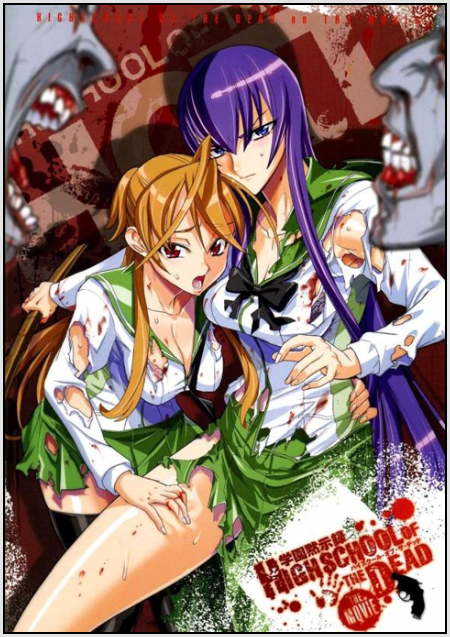
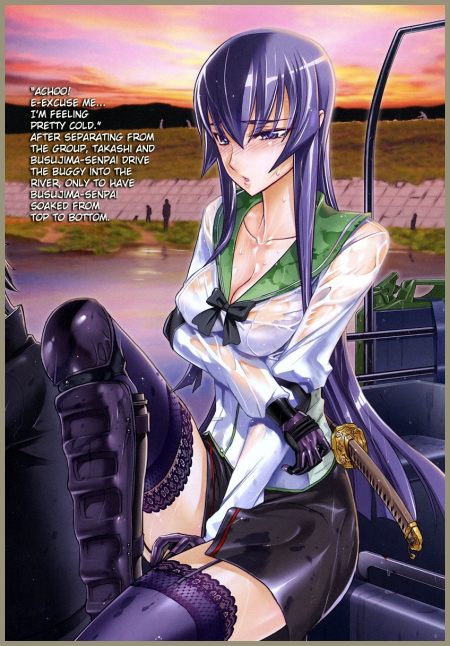
Some of the sample full-color pin-up illustrations should really emphasize my point.

News was made just recently that the manga was going to be adapted into an anime series. The anime was to make it’s premiere episode available to Japanese tv around early February of 2010. Here’s to hoping that the anime doesn’t abandon what made the manga series so popular. I am also hoping and confident that one of the licensing companies who brings over manga and anime to the US shores will do the same for Highschool of the Dead. Until that happens the only way to experience this series is to buy the original manga magazine issues each chapter of the series has shown up in and read it in Japanese. Or one can read unofficial scanlated versions (the last resort since it is not actually kosher to do so). If one was to settle on the latter then only one site really do the series justice with its translation and that is the site [XLG].

So, I highly recommend this manga. For those who will be interested enough to check it out I hope you enjoy it as much as I have. I mean what’s not to like: zombies, guns, boobs and even more boobs.

Reference: Highschool of the Dead on Wikipedia

Flash Game: Class 3 Outbreak


CLASS 3 OUTBREAK

This is one flash game I just came across this morning and felt it necessary to share with all my fellow future zombie apocalypse survivors. It’s a simple little flash game from the guys over at Binary Space Games making use of Google Maps. It’s still in early development but from the look of it the game is already pretty cool. There are settings to make the game easier or harder. The game pretty much has less to do about surviving til the end but how long the section of the city will hold out before all it’s inhabitants have been devoured and/or turned into zombies themselves.

I like the accompanying sounds of zombies moaning, the gunfire and the screams of people as they die. It’s pretty fun and quite addictive. There is a creepy aspect to it in that the small map shows the zombies as red dots. Seeing the mass of red dots slowly move forward until it fills the whole map can creep even a hardcore horror and zombie like myself.

So, just click the title above or the source link below to start your own outbreak and see how long you last before you finally go down with the rest.

Official Site: Class 3 Outbreak – Zombie Outbreak Sim

A.D. – CG Animated Zombie trailer


I must begin this entry by thanking Phil Edwards over at Live for Films for introducing me to this particular piece of awesome. Check out his very extensive blog on practically anything about films. It was there that I first saw this trailer for a zombie film that’s stuck between concept and development. The trailer is for A.D. and while it hasn’t been made into a feature-lenght film this trailer should convince studio heads everywhere to seriously make this into one. If 9 can go from a short cgi-animated film into a full blown feature-leght one then I definitely think A.D. should get the same chance. I mean it’s CGI zombie apocalypse and does it ever look great.

The only thing I hope doesn’t happen is for a place like Lionsgate to end up as the studio to get this film up and running. They may like horror and genre films, but they’ve been very sloppy in handling those same types of film (ex: Midnight Meat Train and Punisher: War Zone). I think A.D. is definitely the type of project Peter Jackson’s production company could get behind on.

So, all horror and genre fans need to spread the word concerning A.D. This is a film that needs to get made and he sooner the better.

Source: Zombie Info and Live for Films