Film Review: Tobor The Great (dir by Lee Sholem)


Last week, along with my friends and fellow members of the Late Night Movie Gang, I watched the 1954 sci-fi film, Tobor The Great.

As you can probably tell by looking at the top of this review, Tobor came with a really great poster.  It’s a poster that promises all sorts of sci-fi thrills and chills.  It screams, “B-movie masterpiece!”  You look at that poster and you think to yourself, This film is probably extremely silly but I absolutely have to watch it!

Of course, if you know anything about the B-movie aesthetic of the 50s and 60s, you won’t be shocked to learn that the poster has next to nothing to do with the actual film.  True, there is a robot is featured in the film.  The poster is honest about that.  And Tobor actually looks just as good in the movie as he does on the poster.  And there is a subplot about space travel but, at no point, do we see Tobor walking across the surface of Neptune or Jupiter or wherever it is that Tobor is supposed to be in this poster.  Maybe he’s on one of the moons of Saturn.  Who knows?

Also, at no point, does Tobor carry around a woman.  In fact, Tobor is pretty much a film for kids.  The main character, other than Tobor, is an 11 year-old boy named Gadge (Billy Chapin).  I can only imagine how audiences reacted when they went into the film expecting to see the scene in the poster and instead, they were confronted with a movie about a little boy and his robot.

Tobor is one of those films that opens with several minutes of stock footage.  Rockets take off.  The stars shine in the sky.  Scientists and engineers do stuff.  It all looks pretty impressive but, of course, none of it was actually shot for this film.  In fact, the use of all that stock footage mostly serves to highlight how cheap the rest of the movie looks.

As for the film’s plot, it has apparently been determined that it’s too dangerous to send humans into space.  So, Professor Nordstrom (Taylor Holmes) and Dr. Harrison (Charles Drake) build a robot that is specifically designed to fly an interstellar craft.  They name their creation Tobor, because that’s robot spelled backwards.  (Tobor even points out that his name is robot spelled backwards.)  In order to help Tobor explore the universe, they design him to be able to simulate human emotions.  In fact, they’re so successful at it that Tobor ends up befriending Nordstrom’s grandson, the aforementioned Gadge.

The press and the military are all very impressed with Tobor.  Unfortunately, it’s the 1950s and that means that the communists are impressed by Tobor as well!  Can the scientists and their families keep Tobor from getting abducted by a bunch of Russian agents!?  Let’s hope so because there’s a lot of space that needs to be explored….

Anyway, Tobor The Great is silly but kind of fun.  It has its slow spots but it also has a really cool robot and it’s always fun to watch the commies get thwarted.  It’s a real time capsule film, one that not only reflects the decade in which it was made but which also has a somewhat charming innocence to it.  If nothing else, it’s nice to think that, in the days before CGI, the filmmakers actually had to make a Tobor of their own.  Apparently, Tobor is currently in a private collection and I hope whoever has him is treating him well.
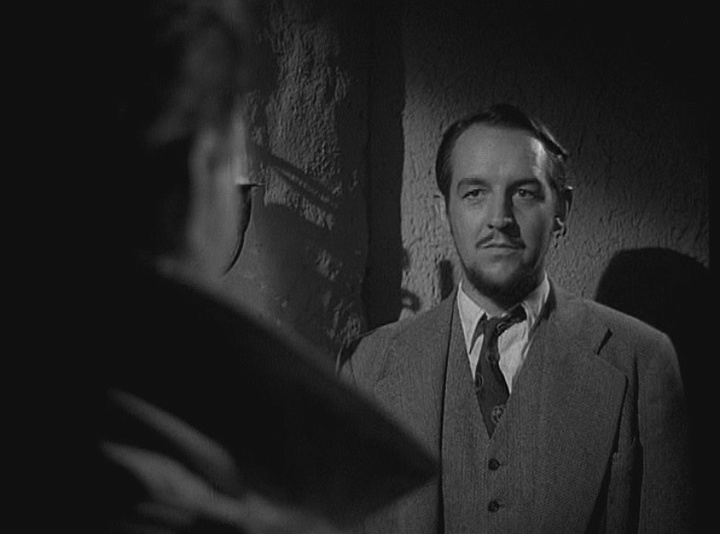
Horror on TV: The Twilight Zone 1.23 “Shadow Play” (dir by Paul Lynch)


For tonight’s trip into the world of televised horror, we have an episode from a 1986 attempt to revive The Twilight Zone.

This episode is a remake of one of my favorite episodes of the original series, Shadow Play.  That’s the one where the guy is on death row but he says he’s not worried about being executed because he knows he’s just having a reoccuring nightmare.  Of course, this kind of freaks out some of the people around him because, if he’s just having a dream, what happens to them when the dream ends?

While the remake is nowhere near as good as the original, it’s still fairly well done.  Plus, it’s on YouTube and the original isn’t.

This episode was directed by Paul Lynch, the Canadian director who also directed the original Prom Night.

Enjoy!

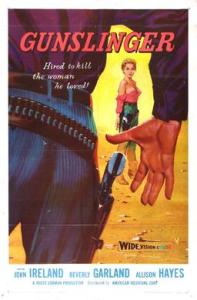
A Movie A Day #64: Gunslinger (1956, directed by Roger Corman)


gunslinger_posterWelcome to Oracle, Texas.  It’s a dusty little town in the old west.  Marshal Scott Hood (William Schallert) may uphold the law but everyone knows that the town is actually run by Erica (Allison Hayes), the owner of the local saloon.  Erica knows that a railroad may be coming to town so she comes up with a plan to buy all the land around Oracle.  She sends her lackey, Jake (Jonathan Haze), to each landowner.  Jake buys the land then murders the landowner so that he can get the money back.
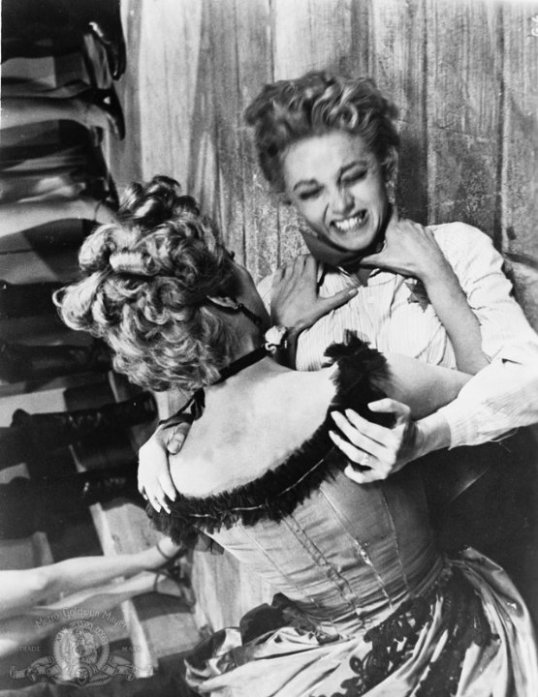
When Scott is gunned down by two outlaws, his widow, Rose (Beverly Garland), takes over as temporary marshal.  Rose has two weeks until the new marshal arrives but that is just enough time for nearly everyone in town to get killed.  It starts when Rose orders Erica to close her saloon at three in the morning.  Erica loses the epic catfight that follows so she hires her former lover, Cane Miro (John Ireland), to come to town and kill Rose.  Cane is more interested in killing the town’s mayor (Martin Kingsley), a former Confederate who abandoned Cane and his brothers to Union forces during the Civil War.  Even more complications arise when Cane and Rose fall in love.

Roger Corman has described Gunslinger as being his most miserable experience as a director.  He filmed it in six days and it rained for five of them, causing cameras and lights to sink into the mud.  Both Allison Hayes and Beverly Garland were injured during filming, with Hayes breaking her arm after falling off a horse and Garland spraining her ankle while running down the stairs of the saloon.  During the filming of an outdoor love scene, both Ireland and Garland were attacked by fire ants.

Gunslinger is usually savaged by reviewers and it was featured on an early episode of Mystery Science Theater 3000.  But how can any film be that bad if it features an epic cat fight between Beverly Garland and Allison Hayes?  Gunslinger is proof that Beverly Garland and Allison Hayes were actress who could make something entertaining out of even the least inspiring material. Garland gives a serious, heartfelt performance while Hayes goes all out as evil Erica.  Years before he played Seymour in Corman’s Little Shop of Horrors, Jonathan Haze is intensely weird as Jake. As with many Corman films, part of the fun is watching for members of the Corman stock company, like Dick Miller and Bruno VeSota, in small roles.   Gunslinger may not be a classic but I like it.

9ae25d8b1273fa14bdeb9fa58ff79235

In Praise of William Schallert


gary loggins's avatarcracked rear viewer

schal1

“Hey, isn’t that whatsisname?” Chances are, if you’ve watched classic movies and TV shows, you know William Schallert. The actor, who died today at the ripe old age of 93, was never a star, but contributed many fine supporting performances in over 300 films and television episodes. He was one of those guys that, if you didn’t know the name, you certainly recognized the face.

schal2

Schallert’s career stretches back to the late 40’s, with an uncredited role in THE FOXES OF HARROW, starring Rex Harrison and beautiful Maureen O’Hara. The young actor also popped up in MIGHTY JOE YOUNG, the first of his many science fiction films. Schallert had a meaty part as greedy Dr. Mears in Edgar G. Ulmer’s 1951 THE MAN FROM PLANET X , and appeared in GOG, THEM, THE INCREDIBLE SHRINKING MAN, and THE MONLITH MONSTERS. He would return to the genre later in his career in…

View original post 165 more words

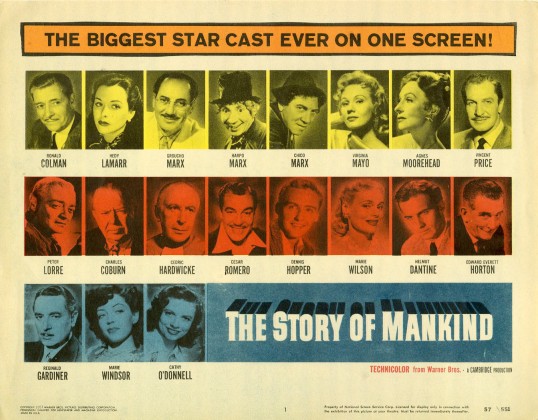
Insomnia File #1: The Story of Mankind (dir by Irwin Allen)


Story of Mankind

What’s an Insomnia File?  You know how some times you just can’t get any sleep and, at about three in the morning, you’ll find yourself watching whatever you can find on cable?  This feature is all about those insomnia-inspired discoveries!

If, last night, you were suffering from insomnia at 3 in the morning, you could have turned on TCM and watched the 1957 faux epic, The Story of Mankind.

I call The Story of Mankind a faux epic because it’s an outwardly big film that turns out to be remarkably small on closer inspection.  First off, it claims to the tell the story of Mankind but it only has a running time of 100 minutes so, as you can imagine, a lot of the story gets left out.  (I was annoyed that neither my favorite social reformer, Victoria C. Woodhull, nor my favorite president, Rutherford B. Hayes, made an appearance.)  It’s a film that follow Vincent Price and Ronald Colman as they stroll through history but it turns out that “history” is largely made up of stock footage taken from other movies.  The film’s cast is full of actors who will be familiar to lovers of classic cinema and yet, few of them really have more than a few minutes of screen time.  In fact, it only takes a little bit of research on the imdb to discover that most of the film’s cast was made up of performers who were on the verge of ending their careers.

The Story of Mankind opens with two angels noticing that mankind has apparently invented the “Super H-Bomb,” ten years ahead of schedule.  It appears that mankind is on the verge of destroying itself and soon, both Heaven and Hell will be full of new arrivals.  One of the angels exclaims that there’s already a housing shortage!

A celestial court, overseen by a stern judge (Cedric Hardwicke) is convened in outer space.  The court must decide whether to intervene and prevent mankind from destroying itself.  Speaking on behalf on humanity is the Spirit of Man.  The Spirit of Man is played by Ronald Colman.  This was Colman’s final film.  In his heyday, he was such a popular star that he was Margaret Mitchell’s first choice to play Rhett Butler in Gone With The Wind.  However, in The Story of Mankind, Colman comes across as being a bit bored with it all and you start to get worried that he might not be the best attorney that mankind could have hired.

Even more worrisome, as  far as the future of mankind is concerned, is that the prosecutor, Mr. Scratch, is being played by Vincent Price.  Making his case with his trademark theatrics and delivering every snaky line with a self-satisfied yet likable smirk on his face, Vincent Price is so much fun to watch that it was impossible not to agree with him.  Destroy mankind, Mr. Scratch?  Sure, why not?  Mankind had a good run, after all…

In order to make their cases, Mr. Scratch and the Spirit of Man take a tour through history.  Mr. Scratch reminds us of villains like the Egyptian pharaoh Khufu (John Carradine) and the Roman Emperor Nero (Peter Lorre, of course).  He shows how Joan of Arc (Hedy Lamarr) was burned at the stake.  The Spirit of Man argues that, despite all of that, man is still capable of doing good things, like inventing the printing press.

And really, the whole point of the film is to see who is playing which historical figure.  The film features a huge cast of classic film actors.  If you watch TCM on a semi-regular basis, you’ll recognize a good deal of the cast.  The fun comes from seeing who tried to give a memorable performance and who just showed up to collect a paycheck.  For instance, a very young Dennis Hopper gives a bizarre method interpretation of Napoleon and it’s one of those things that simply has to be seen.

And then the Marx Brothers show up!

They don’t share any scenes together, unfortunately.  But three of them are present!  (No, Zeppo does not make an appearance but I imagine that’s just because Jim Ameche was already cast in the role of Alexander Graham Bell.)  Chico is a monk who tells Christopher Columbus not to waste his time looking for a quicker way to reach India.  Harpo Marx is Sir Isaac Newton, who plays a harp and discovers gravity when a hundred apples smash down on his head.  And Groucho Marx plays Peter Miniut, tricking a Native American chief into selling Manhattan Island while leering at the chief’s daughter.

And the good thing about the Marx Brothers is that their presence makes a strong argument that humanity deserves another chance.  A world that produced the Marx Brothers can’t be all bad, right?

Anyway, Story of Mankind is one of those films that seems like it would be a good cure for insomnia but then you start watching it and it’s just such a weird movie that you simply have to watch it all the way to the end.  It’s not a good movie but it is flamboyantly bad and, as a result, everyone should see it at least once.