Medfield College has a problem. No one takes the college seriously. Maybe if the college could win the big college quiz show, people would finally stop laughing at Medfield but the students are not academically talented. Professor Quigley (William Schallert) thinks that the college needs to finally buy a new-fangled device called a computer. The Dean (Joe Flynn) says that there’s no way any college can afford something as expensive as that! Luckily, businessman and gangster A.J. Arno (Cesar Romero) is willing to donate one of his computers. It takes several students to move the computer into the lab because the computer is huge.
Medfield finally has a computer but are the students smart enough to win that quiz show? Popular jock Dexter Riley (Kurt Russell) happens to be in the lab during a freak thunderstorm. When both he and the computer get struck by lightning at the same time, it leads to Dexter becoming a human computer. He suddenly knows everything. He can speak any language and solve any equation. He can answer any question/ Whenever anyone shines a light into Dexter’s ear, they see circuit boards. No one really cares that none of this makes sense. Medfield is going to win that quiz show for sure! But first, Dexter is going to have to escape from Arno, who fears Dexter now knows all the details about his gambling ring.
Watching this Disney film was a real eye-opener for me. Computers are such a part of my everyday life that it was strange seeing a college making such a big deal about getting one. The computer that Medfield got looked more like the type of computer that NASA used to go to the moon than the ones that were in my high school computer lab. I was worried that no one seemed to care that Dexter had a circuit board in his head. Not even Dexter seemed to care. It was also funny to me that all he had to do was get struck by lightning while standing near a computer and suddenly, he knew how to speak every language and solve every problem. I use a computer everyday and I can still only speak English and Spanish. I feel like I’m getting cheated.
The whole movie was absolutely ludicrous but I did enjoy watching this movie. It was too sweet, innocent, and good-natured not to enjoy. There was nothing realistic about the movie but it was nice to imagine a world where everyone gets along, the bad guys are all too buffoonish to really be dangerous, and a serious knock on the head leads to thing returning to normal instead of permanent brain damage. Kurt Russell was only 18 when he made The Computer Wore Tennis Shoes but he could already carry a movie.
Carl Archer (Charles Aidman) is a recovering alcoholic who returns home after an extended stay in a rehab. His wife (Julie Adams, of Creature of the Black Lagoon and The Last Movie fame) is skeptical about whether or not Carl has really sobered up and is prepared to be a responsible father to their son, Steve (Charles Herbert). When Steve gets trapped in a cave, will Carl be able to use their psychic connection to find and rescue him?
Can you prove this didn’t happen!?
This episode originally aired on February 24th, 1959.
Welcome to Retro Television Reviews, a feature where we review some of our favorite and least favorite shows of the past! On Sundays, I will be reviewing the made-for-television movies that used to be a primetime mainstay. Today’s film is 1974’s Death Sentence! It can be viewed on YouTube!
There’s been a murder!
A young woman has been strangled in her own home. The nosy neighbor (Hope Summers) testifies that the woman often argued with her woman and that she heard the woman yelling on the night of the murder. The husband, John Healy (Nick Nolte), is found in a neighborhood bar and, when he’s brought back to his house, his drunken reaction to seeing his dead wife doesn’t do much to keep him from looking totally guilty.
However, the viewer knows that John is innocent because the viewer has already seen that the woman was murdered by Don Davies (Laurence Luckinbill), the man with whom she was having an affair. She demanded that he leave his wife for her and Don, realizing that his cheating was about to revealed, responded by strangling her.
Don’s wife is Susan Davies (Cloris Leachman), who knows that she and Don have been going through a rough patch but who certainly had no idea that Don was cheating on her. Shortly after the murder, Susan is called up for jury duty. She’s placed on the jury and told that she will be an important part of a major trial. As a result, she and the other jurors will be sequestered in a hotel….
And who is the defendant in this trial? John, of course!
As opposed to the other members of the jury, who are ready to convict John even before the first bit of testimony is heard, Susan pays attention to what is said in the courtroom. She listens to Lubell (Alan Oppenheimer), the prosecutor. She listens to Tanner (William Schallert), the defense attorney. She comes to believe that John is innocent but will she be able to hold her own against the rest of the jury? And will she ever figure out that the murder was actually committed by her husband?
It’s an intriguing premise, even if it is a bit far-fetched. I mean, it really is an amazing coincidence that Susan just happened to end up on the jury for a case involving a murder that was actually committed by her husband. However, this is a made-for-television movie and, as soon as “Produced by Aaron Spelling” appears on the screen, most viewers should be savvy enough to know what they’re getting into. Instead, the main problem with the film is that it opens by showing us who the murderer is. Therefore, there’s really zero suspense as to who actually committed the crime. Instead, the viewer spends the entire movie waiting for Susan to catch up. Since the majority of the film takes place in court, it’s a very talky film but there’s no joy to be found in paying close attention to every word said and picking up on the details that will allow you to solve the crime for yourself. This is a case where the film spoils its biggest twist and, despite good performances from Leachman and Luckinbill, it’s a bit dull.
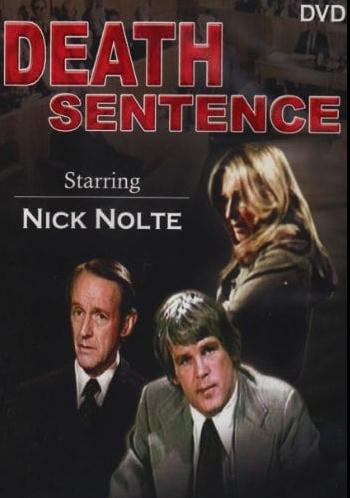
(Nick Nolte, for his part, spends most of the movie silently sitting in the courtroom. He’s not bad and his look of anguish is believable but it’s hardly a starring role, regardless of what the film’s video packaging might otherwise claim.)
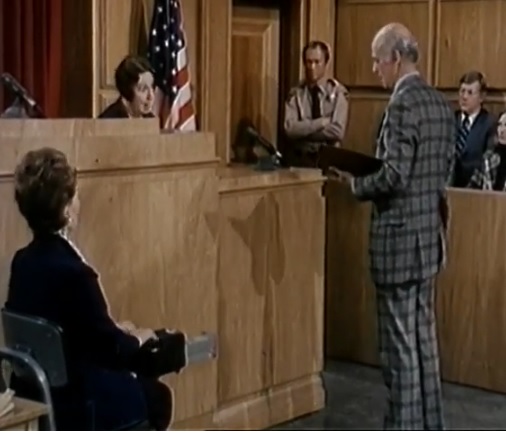
In the end, what I’ll mostly remember about Death Sentence were the atrocious fashion choices made by the prosecutor. Seriously, would you trust a man wearing this suit?
Welcome to Retro Television Reviews, a feature where we review some of our favorite and least favorite shows of the past! On Sundays, I will be reviewing the made-for-television movies that used to be a primetime mainstay. Today’s film is 1976’s Dawn: Portrait of a Teenage Runaway! It can be viewed on YouTube!
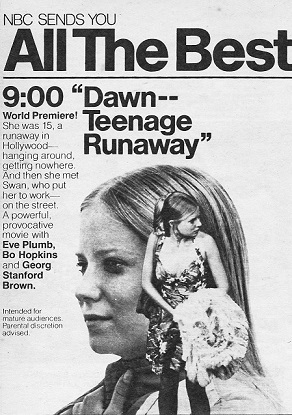
Dawn Wetherby (Eve Plumb) is fifteen years old. She’s naive. She’s innocent. She’s …. well, let’s just be honest and admit that she’s not particularly bright. Sick of being embarrassed by her alcoholic mom (Lynn Carlin), Dawn decides to hop on a bus and travel to Hollywood. Maybe she can make a new life for herself in California.
Of course, it doesn’t take long for Dawn to discover that Los Angeles is not a city where dreams magically come true. It’s a tough and harsh town and it’s not like Dawn has any money or any particular skills. When she tries to get a job, she’s told that she’s too young. When she tries to rent a room, she’s told that ten dollars is not enough to cover two weeks rent. When she gives a dollar to a boy who says that he needs it, he responds by mugging her for the rest of her cash. A prostitute named Frankie Lee (Marguerite DeLain) takes some sympathy on Dawn and tells her to call if she ever wants to make some money.
Eventually, a nasty cough leads to Dawn going to the free clinic. That’s where she meets Alexander (Leigh McCloskey). Alexander is a teen runaway, just like Dawn. However, Alexander also can somehow afford an apartment and food to eat. Alexander invites Dawn to live with him and Dawn, realizing she has no where else to go, agrees. Alexander offers to look after her but, after Dawn discovers that Alexander makes his money by working as a male prostitute, Dawn decides that she needs a job of her own.
It’s time to call Frankie Lee! And it’s time for Frankie Lee to introduce Dawn to Swan (Bo Hopkins), a pimp who lives in a nice house and who offers to put Dawn to work….
Dawn: Portrait of a Teenage Runaway is an earnest film that was obviously made with the best of intentions and which actually did have something say, in its melodramatic way, about the dangers of running away from home and trying to make it on your own when you’re not even old enough to drive. That said, I imagine that most people who go through the effort to track down this film will do so because it stars The Brady Bunch‘s Eve Plumb as an underage runway who ends up walking the streets and taking men back to her motel room. The movie might as well be called Jan Brady Goes Bad, because Eve Plumb does essentially give the same performance that she gave when she was playing the whiniest member of the Brady Bunch. There’s nothing tough or streetwise about her, which works for the first half of the film but not during the second half. Once Dawn has been on the streets for a bit, you would expect her to toughen up a bit but she still comes across like she’s mad at Greg and Bobby for tying up the phone. Dawn goes through a lot and becomes a bit jaded as a result but, every time she speaks, you expect her to exclaim, “Why does Marcia get to runaway from home but I don’t? It’s not fair!” Far more impressive are the performances of Bo Hopkins and, in the role of Dawn’s probation officer, George Stanford Brown. William Schallert also has a good bit as Dawn’s first client, who ends up feeling so sorry for Dawn that he just give her twenty dollars and then tells her to go back home.
Dawn: Portrait of a Teenage Runway is one of those film that was obviously designed to make parents worry about their kids. It seems to be asking, “Do you know where your children are tonight?” In 1976, I imagine they were busy watching Jan Brady try to make it on the mean streets of Hollywood.
Welcome to Retro Television Reviews, a feature where we review some of our favorite and least favorite shows of the past! On Sundays, I will be reviewing the made-for-television movies that used to be a primetime mainstay. Today’s film is 1986’s Under the Influence! It can be viewed on YouTube!
Noah Talbot (Andy Griffith) is an upstanding member of the community. He owns a hardware store. He has a large family. He’s known as a gruff but folky storyteller. He’s a deacon in his church and helps to collect the offering every Sunday.
He’s also a drunk and a bit of a bully. His family walks on eggshells around him, fearful of setting him off on one of his benders. He occasionally spends the night in jail, arrested for trying to drive drunk. Even when he gets bailed out, his first instinct is to go back to the bar. The folks at the bar love him, don’t you know. The people at the bar are always happy to see him and never bother him about whether he’s had too much. The people at the bar never let him down the way that he feels his family has left him down.
The members of his family each cope in their own individual way. Noah’s wife (Joyce Van Patten) is in denial and spends a lot of her time popping pills. His oldest daughter, Ann (Season Hubley), is driven to succeed at work and spends all of her time both hating her father and desperately hoping for his approval. (When she tells him that she got a raise at work, he berates her for only getting a 6% increase in her salary. “That’s just a cost of living increase!” he snaps at her.) His eldest son, Stephen (Paul Provenza), fled to Los Angeles and is trying to make a career as stand-up comedian. (“You’re no David Letterman,” Noah tells him.) His youngest daughter, Terri (Dana Anderson), secretly replaces Noah’s liquor with water and food-coloring. And his youngest son, Eddie (Keanu Reeves), is becoming an alcoholic himself.
Having read all that, you may be wondering just how exactly Keanu Reeves could be the son of Andy Griffith and it’s a fair question. This was one Keanu Reeves’s first acting roles and he does a pretty good job in the role of Eddie. That said, he looks so totally different from both Andy Griffith and Joyce Van Patten and the actors playing his siblings that I was half-expecting someone to mention that Eddie had been adopted. Then again, Paul Provenza doesn’t really bear much of a resemblance to the actors playing his parents either. Dana Anderson and Season Hubley do, at least, look like sisters.
Lack of family-resemblance aside, all of the actors in Under the Influence do a good job of inhabiting their characters. For those who are used to seeing Andy Griffith playing friendly Southerners in reruns of The Andy Griffith Show and Matlock, it’s shocking and a little disturbing to see him playing an abusive, alcoholic jerk in Under the Influence. Noah is someone who would not only destroy his own family to get a drink but who would then blame them for it happening in the first place. Noah may be under the influence of alcohol but the entire family is suffering because they’re under the influence of Noah. By the time Noah is spitting up blood and demanding that his youngest son sneak liquor into his hospital room, the viewer knows there is no hope for Noah but hopefully, his family will escape.
It doesn’t make for a particularly happy movie but, speaking as someone who grew up in an alcoholic household, I can attest that it does make for an honest portrayal of what addiction does not just to the addict but also to the people around the addict. I cringed in sympathy through nearly the entire film, especially as I watched three of the four children react in the same ways that I did. (Unlike Eddie, I never became much of a drinker and instead developed an aversion to alcohol in general.) It’s a film that feels real and one’s heart aches for the entire family. If it could happen to Andy Griffith, it could happen to anyone.
Welcome to Retro Television Reviews, a feature where we review some of our favorite and least favorite shows of the past! On Sundays, I will be reviewing the made-for-television movies that used to be a primetime mainstay. Today’s film is 1985’s Gidget’s Summer Reunion! It can be viewed on Tubi!
Back in the 1970s, when the rest of the country was worrying about political corruption, inflation, and an out-of-touch president with an embarrassing family, Gidget, Jeff, and their friends were carefree California teenagers who spent all of their time either hanging out on the beach or running into the ocean with a surfboard. It was a time when they had not a care in the world and, obviously, it couldn’t last forever.
Nearly 10 years later, Gidget (Caryn Richman) and Jeff (Dean Butler) are now married and their surfboards have been safely stored away in the garage. Jeff works as an architect and it’s obvious that his new boss, Anne (Mary Frann), wants to make their professional relationship into something personal. Gidget, meanwhile, owns her own travel agency and, apparently, it’s a success even though Gidget rarely seems to spend much time at the office. Gidget is hyperactive and a bit self-absorbed and, as such, she usually only shows up at work long enough to tell her employees about her latest problems before then running out of the office in an impulsive attempt to fix everything.
What problems do Gidget and Jeff have? Well, for one thing, they live in a giant house despite the fact that they’re nearly broke. They’re both workaholics and, as a result, they don’t spend as much time together as they used to. They got married and then they became strangers. It’s been years since they last went down to the beach. When Gidget’s niece, Kim (Allison Barron), wants to learn how to surf, it doesn’t even occur to her to ask her aunt or her uncle. Instead, she ends up hanging out with a sleazy, beer-drinking surfer named Mickey (Vincent Van Patten).
Fear not! Gidget has a plan! Jeff’s birthday is coming up and Gidget decides that it would be a great idea to use her travel agent powers to get the entire gang back together again. She wants to bring all of the old surfers back to help celebrate Jeff’s big day. The only problem is that the old gang isn’t entirely easy to find. Plus, one of Gidget’s tour guides has to drop out of leading a tour in Hawaii. Gidget is forced to go in his place. Can she get back from Hawaii in time to save Jeff from Anne and Kim from Mickey? And even more importantly, will she ever be able to track down the old gang? Will the movie end with a bunch of balding guys surfing while the Beach Boys play on the soundtrack? Can you guess the answer?
The best thing that can be said about Gidget’s Summer Reunion is that the beach looked nice and the Hawaii scenes reminded me of the wonderful summer that my family and I spent in Hawaii. And the film is correct when it points out that adulthood is never as easy as we expected it to be when we were teenagers. However, the film suffers from the fact that a lot of Gidget’s problems could have been solved by Gidget actually taking a few minutes to think before acting. It’s one thing to be free-spirited and impulsive. It’s another thing to totally lack common sense. For instance, Gidget and Jeff’s old surfboards are stolen out of the back of Gidget’s convertible and, while you can certainly feel bad for Gidget’s loss, you do have to wonder what she was expecting when she basically just left them out in the open, where anyone could get their hands on them. Jeff isn’t off the hook either, as it was pretty much obvious to everyone but him that Anne was trying to get him to cheat on his wife. Gidget and Jeff are a cute couple but they don’t seem to have a brain cell between them.
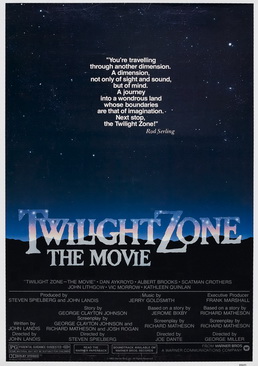
1983’s Twilight Zone: The Movie is meant to be a tribute to the classic original anthology series. It features four “episodes” and two wrap-around segments, with Burgess Meredith providing opening and closing narration. Each segment is directed by a different director, which probably seemed like a good idea at the time.
Unfortunately, Twilight Zone: The Movie is a bit of a mess. One of the episodes is brilliant. Another one is good up until the final few minutes. Another one is forgettable. And then finally, one of them is next too impossible to objectively watch because of a real-life tragedy.
With a film that varies as wildly in tone and quality as Twilight Zone: The Movie, the only way to really review it is to take a segment at a time:
Something Scary (dir by John Landis)
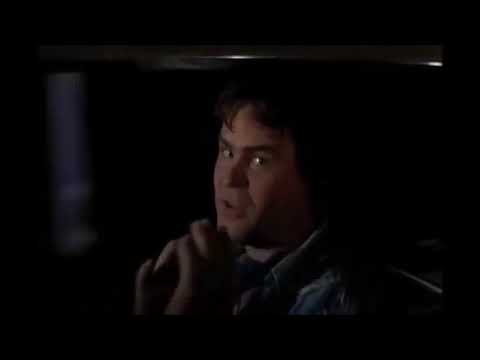
Albert Brooks and Dan Aykroyd drive through the desert and discuss the old Twilight Zone TV series. Brooks claims that the show was scary. Aykoyd asks if Brooks wants to see something really scary. This is short but fun. It’s tone doesn’t really go along with the rest of the movie but …. oh well. It made me jump.
Time Out (dir by John Landis)
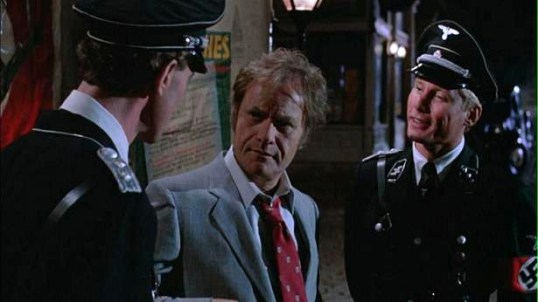
Vic Morrow plays a racist named Bill Connor who, upon leaving his local bar, finds himself transported to Nazi-occupied France, the deep South, and eventually Vietnam.
How you react to this story will probably depend on how much you know about its backstory. If you don’t know anything about the filming of this sequence, you’ll probably just think it’s a bit heavy-handed and, at times, unintentionally offensive. Twilight Zone often explored themes of prejudice but Time Out just seems to be using racism as a gimmick.
If you do know the story of what happened while this segment was being filmed, it’s difficult to watch. Actor Vic Morrow was killed during filming. His death was the result of a preventable accident that occurred during a scene that was to involve Morrow saving two Vietnamese children from a helicopter attack. The helicopter crashed, killing not only Morrow but the children as well. It was later determined that not only were safety protocols ignored but that Landis had hired the children illegally and was paying them under the table so that he could get around the regulations governing how many hours child actors could work. It’s a tragic story and one that will not leave you as a fan of John Landis’s, regardless of how much you like An American Werewolf in London and Animal House.
Nothing about the segment feels as if it was worth anyone dying for and, to be honest, I’m kind of amazed that it was even included in the finished film.
Kick The Can (dir by Steven Spielberg)
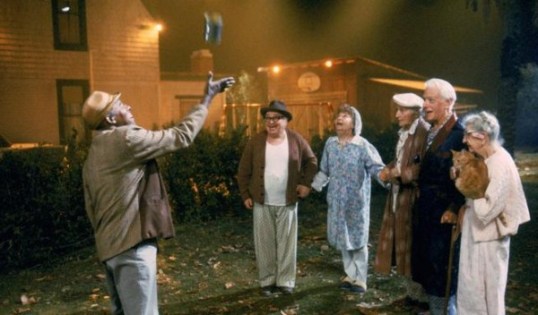
An old man named Mr. Bloom (Scatman Crothers) shows up at Sunnyvale Retirement Home and encourages the residents to play a game of kick the can. Everyone except for Mr. Conroy (Bill Quinn) eventually agrees to take part and, just as in the episode of the Twilight Zone that this segment is based on, everyone becomes young.
However, while the television show ended with the newly young residents all running off and leaving behind the one person who refused to play the game, the movie ends with everyone, with the exception of one man who apparently became a teenager istead of a kid, deciding that they would rather be old and just think young. That really doesn’t make any damn sense but okay.
This segment is unabashedly sentimental and clearly calculated to brings tears to the eyes to the viewers. The problem is that it’s so calculated that you end up resenting both Mr. Bloom and all the old people. One gets the feeling that this segment is more about how we wish old people than how they actually are. It’s very earnest and very Spielbergian but it doesn’t feel much like an episode of The Twilight Zone.
It’s A Good Life (dir by Joe Dante)
A teacher (Kathleen Quinlan) meets a young boy (Jeremy Licht) who has tremendous and frightening powers.
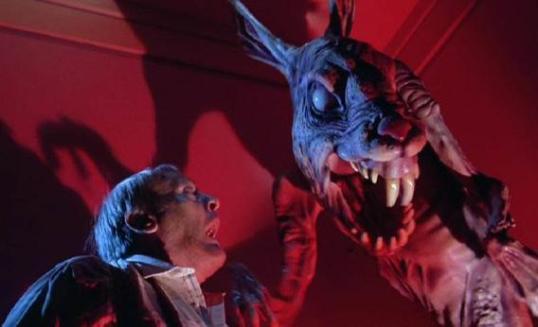
This is a remake of the classic Twilight Zone episode, It’s A Good Life, with the difference being that young Anthony is not holding an entire town hostage but instead just his family. This segment was directed by Joe Dante, who turns the segment into a cartoon, both figuratively and, at one point, literally. That’s not necessarily a complaint. It’s certainly improvement over Spielberg’s sentimental approach to the material. Dante also finds roles for genre vets like Kevin McCarthy, William Schallert, and Dick Miller and he provides some memorably over-the-top visuals.
The main problem with this segment is the ending, in which Anthony suddenly reveals that he’s not really that bad and just wants to be treated normally, which doesn’t make much sense. I mean, if you want to be treated normally, maybe don’t zap your sister in a cartoon. The teacher agrees to teach Anthony how to be a normal boy and again, what the Hell? The original It’s A Good Life worked because, like any child, Anthony had no conception of how adults felt about him. In the movie version, he’s suddenly wracked with guilt and it’s far less effective. It feels like a cop out.
Still, up until that ending, It’s A Good Life worked well as a satire of the perfect American family.
Nightmare at 20,000 Feet (dir by George Miller)
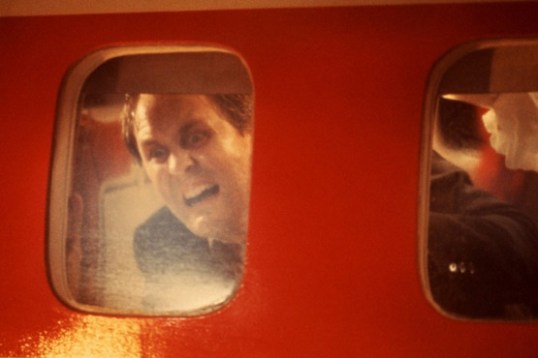
In this remake of Nightmare at 20,000 Feet, John Lithgow steps into the role that was originally played by William Shatner. He plays a man who, while attempting to conquer his fear of flying, sees a gremlin on the wing of his airplane. Unfortunately, he can’t get anyone else on the plane to believe him.
Nightmare at 20,000 Feet is the best of the four main segments. It’s also the one that sticks closest to its source material. Director George Miller (yes, of Mad Max fame) doesn’t try to improve on the material because he seems to understand that it works perfectly the way it is. John Lithgow is also perfectly cast in the lead role, perfectly capturing his increasing desperation. The one change that Miller does make is that, as opposed in the TV show, the gremlin actually seems to be taunting John Lithgow at time and it works wonderfully. Not only is Lithgow trying to save the plane, he’s also trying to defeat a bully.
Something Scarier (dir by John Landis)
Dan Aykroyd’s back as an ambulance driver, still asking his passenger if he wants to see something really scary. It’s an okay ending but it does kind of lessen the impact of Nightmare at 20,000 Feet.
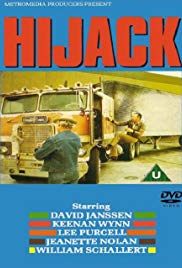
Jake (David Janssen) is a down-on-his-luck trucker who is offered job by a mysterious man named Kleiner (WIlliam Schallert). If Jake agrees to transport a cargo across the country, he will get not only $6,000 but Kleiner will also pull some strings get Jake back in the good graces of the trucking company. If Jake takes the job, he will be given a slip of paper with a phone number on it and, according to Kleiner, that piece of paper will get him out of any trouble that he runs into along the way. The only condition is that Jake is not allowed to know what he’ll be transporting. Jake agrees and soon, he and his partner Donny (Keenan Wynn) are driving the truck through the desert. They are also being followed by a group of men who will stop at nothing to steal the cargo.
This made-for-TV movie is called Hijack! but no one ever gets hijacked. Instead, with the exception of a brief romantic interlude between Jake and a truck stop waitress (Lee Purcell), this is a nonstop chase movie but the chase itself is never exciting enough to justify that exclamation mark in the title. It was probably made to capitalize on the success of Steven Spielberg’s made-for-TV classic, Duel, but it never come close to capturing the nerve or intensity of that film. There’s one good scene where the bad guys come after the truck in a helicopter but otherwise, this is a pretty anemic stuff. Even the eventual reveal of what Jake and Donny are hauling across the desert is a let down.
David Janssen specialized in playing grizzled loners and Keenan Wynn specialized in playing eccentric old coots so both of them are adequate in the main roles. The bad guys are largely forgettable and, as she did in so many other TV movies in the 70s, Lee Purcell brings what life that she can to an underwritten role.
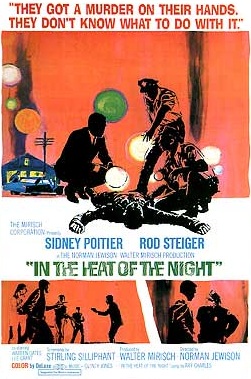
The 1967 film, In the Heat of the Night, tells the story of two very different men.
Chief Gillespie (Rod Steiger) is the police chief of the small town of Sparta, Mississippi. In many ways, Gillespie appears to the epitome of the bigoted Southern cop. He’s overweight. He loses his temper easily. He chews a lot of gum. He knows everyone in town and automatically distrusts anyone who he hasn’t seen before, especially if that person happens to be a black man or from the north.
Virgil Tibbs (Sidney Poitier) is a black man from the north. He’s a detective with the Philadelphia Police Department and he’s as cool and controlled as Gillespie is temperamental and uncouth. Tibbs has no patience for the casual racism that is epitomized by lawmen like Chief Gillespie. When Gillespie says that Virgil is a “fancy name” for a black and asks what people call Virgil in Philadelphia, Virgil declares, “They call me Mister Tibbs!,” with an authority that leaves no doubt that he expects Gillespie to do the same.
Together …. THEY SOLVE CRIMES!
For once, that old joke is correct. When a Chicago industrialist named Phillip Colbert is discover murdered in Sparta, Chief Gillespie heads up the investigation and, assuming that the murderer must be an outsider, orders Deputy Wood (Warren Oates) to check out the train station for any suspicious characters. When Wood arrives at the station, he discovers Virgil standing on the platform. Virgil is simply waiting for his train so that he can get back home to Philadelphia. However, Wood promptly arrests him. Gilespie accuses him of murdering Colbert, just to discover that Virgil’s a police detective from Philadelphia.
Though neither wants to work with the other, that’s exactly what Gillespie and Virgil are forced to do as they investigate Colbert’s murder. Colbert was planning on building a factory in Sparta and his wife (Lee Grant) makes it clear that, if Sparta wants the factory and the money that comes with it, Virgil must be kept on the case. Over the course of the investigation, Gillespie and Virgil come to a weary understanding as both of them are forced to confront their own preconceived notions about both the murder and life in Sparta. In the end, if it’s impossible for them to truly become friends, they do develop a weary respect for each other. That is perhaps the best that one could have hoped for in 1967.
I have to admit that it took me a few viewings before I really appreciated In the Heat of the Night. Though this film won the Oscar for Best Picture of 1967, it’s always suffered when compared to some of the films that it beat. One can certainly see that the film was superior to Doctor Dolittle and Guess Who’s Coming to Dinner. But was it a better film than The Graduate or Bonnie and Clyde? Did Rod Steiger really deserve to win Best Actor over Dustin Hoffman and Warren Beatty? (Amazingly, Poitier wasn’t even nominated.)
To be honest, I still feel that In The Heat of the Night was probably the 3rd best of the 5 films nominated that year, superior to the condescending Guess Who’s Coming To Dinner but nowhere near as groundbreaking as Bonnie and Clyde or The Graduate. The first time I watched In the Heat of the Night, I thought Steiger blustered a bit too much and the film’s central mystery didn’t really hold together and, to a large extent, I still feel like that.
But, at the same time, there’s a lot to appreciate about In the Heat of the Night. On subsequent viewings, I came to better appreciate the way that director Norman Jewison, editor Hal Ashby, and cinematographer Haskwell Wexler created and maintained an atmosphere that was so thick that you can literally feel the Mississippi humidity while watching the film. I came to appreciate the supporting cast, especially Warren Oates, Lee Grant, Scott Wilson, Anthony James, and Larry Gates. (Gates especially makes an impression in his one scene, playing an outwardly genteel racist who nearly cries when Tibbs reacts to his slap by slapping him back.) I also came to appreciate the fact that, while the white cop/black cop partnership has subsequently become a bit of a cliche, it was new and even controversial concept in 1967.
And finally, I came to better appreciate Sidney Poitier’s performance as Virgil. Poitier underplays Virgil, giving a performance of tightly controlled rage. While Steiger yells his way through the film, Poitier emphasizes that Virgil is always thinking. As in the same year’s Guess Who’s Coming To Dinner, Poitier plays a dignified character but, here, that dignity is Virgil’s way of defying the demands and expectations of men like Gillespie. When Virgil does strike back, it’s a cathartic moment because we understand how many times he’s had to hold back.
In the Heat of the Night may not have been the best film of 1967 but it’s still one worth watching.
A bunch of strangers sit in a bar. On the television, a blandly handsome anchorman delivers the news. He talks about foreign wars. He talks about domestic conflicts. One of the bar patrons asks the bartender to turn off the news. Who cares about all of that stuff? All he wants to do is have a nice drink before heading home to his cattle ranch. Can’t he just do that in peace? The bartender agrees and turns off the news…
That’s a scene that gets played out a lot nowadays. No one wants to watch the news. Certainly not me. I guess we all know that we should because it’s important to know what’s going on in the world and blah blah blah. But seriously, people who spend all of their time watching the news inevitably seem to end up going insane and ruining twitter. I’ve got no interest in doing that.
Here’s the thing, though. Invasion U.S.A. may open with a contemporary scene but it’s hardly a contemporary movie. Instead, it was made in 1952 and it serves as proof that we’re not the first Americans to get sick of watching the news and that our current crop of politically minded filmmakers are not the first to try to change our mind with heavy-handed propaganda.
Everyone at the bar has a complaint. The Arizona rancher resents having to pay high taxes just to support the defense department. The Chicago industrialist is upset that the government wants to use his factories to build weapons. Congressman Haroway (Wade Crosby) is a drunk. Socialite Carla Sanford (Peggie Castle) worked in a factory during World War II but she no longer follows the news. Newscaster Vince Potter (Gerald Mohr) is a cynic. Tim the Bartender (Tom Kennedy) is too busy selling cocktails to worry about the communists.
Only the mysterious Mr. Ohman (Dan O’Herlihy, who would later play Conal Cochran in Halloween III) seems to care. While holding a conspicuously oversized brandy glass, Mr. Ohman explains that he’s a forecaster. What’s a forecaster? A forecaster is … oh wait! There’s no time to explain it because the communists have invaded!
Everyone sits in the bar and watches as the news reports on the invasion of the U.S.A. (Everyone except for Mr. Ohman, who has mysteriously vanished.) In the tradition of all low-budget B-movies, the invasion is represented through stock footage. Lots and lots of stock footage. Planes drop bombs. Soldiers run out of a barracks. Cities burn.
When everyone leaves the bar, they discover that America has been crippled by people like them, people who never thought it would happen. Some of our bar patrons die heroically. (Not Tim the Bartender, though. He’s still making dumb jokes and cleaning beer mugs when the bomb drops.) Some of our patrons regret that they didn’t care enough when it would have actually made a difference. The industrialist discovers that, because he wouldn’t let the government take over his factory, he now has to take orders from sniveling little Marxist. The rancher discovers that taxis get really crowded when everyone’s fleeing the Russians. And others discover that better dead than red isn’t just a catch phrase. It’s a way of life.
Of course, there’s a twist ending. You’ll guess it as soon as you see Mr. Ohman with that brandy glass…
Invasion U.S.A. is often cited as one of the worst films ever made but I have to admit that I absolutely love it. I have a soft spot for heavy-handed, over the top propaganda films and they don’t get more heavy-handed than Invasion, U.S.A. There’s not a subtle moment to be found in the entire film. You have to love any film that features character authoritatively declaring that something will never happen mere moments before it happens. Best of all, you’ve got Dan O’Herlihy, playing Mr. Ohman with just a hint of a knowing smile, as if he’s as amused as we are.
Politically, this film is a mixed bag for me. The film argues that you should trust the government and basically, shut up and follow orders. I’m a libertarian so, as you can imagine, that’s not really my thing. At the same time, the villains were all communists and most of the communists that I’ve met in my life have been pretty obnoxious so I enjoyed the part of the film that advocated blowing them up. The only thing this film hates more than communists is indifference.
In the end, Invasion U.S.A. is a real time capsule of a film, one that shows how different things were in the past while also reminding us that times haven’t changed that much. Though the film’s politics may be pure 1952, its paranoia and its condemnation of apathy feels very contemporary.
(For the record, apathy is underrated.)
Seen today, what makes Invasion U.S.A. memorable is its mix of sincerity, paranoia, and Dan O’Herlihy. Unless the communists at YouTube take down the video, you can watch it below!