Late Night Retro Television Review: Pacific Blue 2.8 “Undercover”


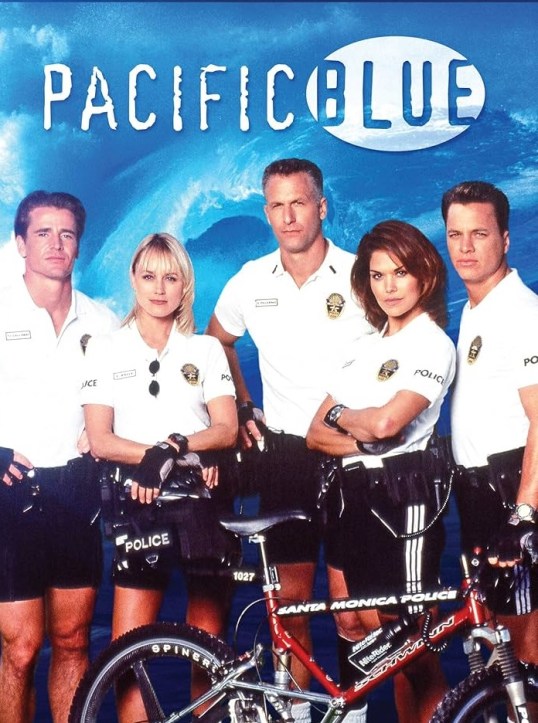
Welcome to Late Night Retro Television Reviews, a feature where we review some of our favorite and least favorite shows of the past! On Tuesdays, I will be reviewing Pacific Blue, a cop show that aired from 1996 to 2000 on the USA Network!  It’s currently streaming everywhere, though I’m watching it on Tubi.

This week, Chris goes undercover.

Episode 2.8 “Undercover”

(Dir by Terrence H. Winkless, originally aired on October 13th, 1996)

A smarmy detective wants Chris to go undercover to help investigate a suspected money launderer, Tim Wakefield (Scott Plank).  Palermo argues that Chris doesn’t have enough experience to work undercover but the detective asks Chris, “What do you want to do?  You ready to get out of those bicycle shorts and do some real police work?”

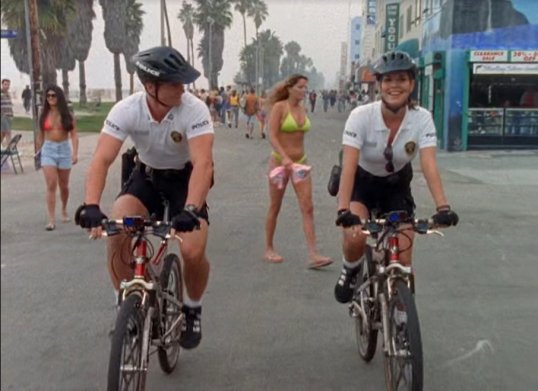
I have to admit that line cracked me up.  It really made the whole episode.  Palermo got offended, as he always does whenever anyone points out that bike cops look silly with their shorts and their crisp white shirts.  What was great about the line was that it was true.  The detective may have been smarmy but he was right about Chris being invited to do “real police work” and he was right about bike cops not being real policemen.  Everyone know it’s true!  Seriously, if a bicycle cop ever tries to pull you over, just slam down on the accelerator.  What are they going to do?  Chase you when you’re going over 30 mph?  I think not!

(Seriously, two seasons in and the show is still trying to convince us that bike cops are real cops.  Sorry, Palermo, it’s not going to happen!)

That said, this episode’s main plot still ended up falling flat because Chris is not a very interesting character and her whole undercover thing wasn’t particularly credible.  When she went undercover, she still came across as being just as stiff, humorless, and unlikable as when she’s riding her bike and threatening people with arrest.  Tim Wakefield, of course, fell for her and Chris was supposed to be attracted to him and conflicted about her assignment and I never bought it for a second.

(As for Wakefield, he turned out to be not as bad of a guy as everyone assumed.  He was arrested but his lawyer got him off and the episode ended with him sending Chris a postcard from some tropical beach.  I think Chris was supposed to be wistful as she looked at the postcard but, since Darlene Vogel was apparently only capable of one facial expression, who knows for sure?)

Meanwhile, Cory dealt with being stalked by a mentally unstable ex-boyfriend,  Wasn’t it just last week that Cory’s partner was being stalked by a mentally unstable woman?  This show certainly does enjoy repeating itself.  While Palermo worried about Chris, TC and Victor chased some roller-blading teens who were shooting random tourists with paintballs.  The roller-blading scenes were kind of exciting but, unfortunately, they had to share space with all of the awkward bicycle scenes.

This episode had its moments.  The roller-blading was cool.  The detective making fun of Palermo was gratifying.  Overall, though, the fact that the show centers around bicycles continues to be a flaw that simply cannot be overcome.  There’s simply no way to make anyone riding a bicycle look impressive, I don’t care how serious they try to look.

Sorry, Pacific Blue.

Retro Television Review: Fantasy Island 6.20 “What’s The Matter With Kids/Island of Horror”


Welcome to Retro Television Reviews, a feature where we review some of our favorite and least favorite shows of the past!  On Tuesdays, I will be reviewing the original Fantasy Island, which ran on ABC from 1977 to 1984.  Unfortunately, the show has been removed from most streaming sites.  Fortunately, I’ve got nearly every episode on my DVR.

This week, it’s zombie time!

Episode 6.20 “What’s The Matter With Kids/Island of Horror”

(Dir by Don Weis, originally aired on April 16th, 1983)

Dr. Stuart Wharton (Steve Allen) is a tightass stick-in-the-mud who has come to Fantasy Island to give a lecture on how to raise the perfect child.  His wife, Margaret (Jayne Meadows Allen), is sick of Dr. Wharton telling people how to live their lives and basically threatens to leave his condescending ass if he doesn’t allow her to adopt Andy (Justin Henry), who is not perfect but who is still better than any of the imaginary perfect children that Dr. Wharton has written and lectured about.  This fantasy was predictable and kind of boring.  Jayne Meadows Allen actually wrote the script so it’s interesting that the whole fantasy is basically her telling off her husband and accusing him of being a pompous jackass.

There is one interesting scene where Mr. Roarke talks about Stuart’s idea of the perfect child and the kid suddenly appears out of thin air.  Mr. Roarke also makes the kid disappear.  Mr. Roarke is all-powerful!

(So, you may be wondering, why Roarke doesn’t just use his God-like powers in every episode?  I think he wants his guests to sometimes lean a lesson on their own.  I always hate it when people try to make me learn something.  Sorry, Roarke.)

Meanwhile Erica Nelson (Gayle Hunnicutt) goes to a neighboring island in search of her missing fiancé, Dr. Richard Yates (Christopher Connelly).  Uh-oh!  The Island’s controlled by a mad scientist named Dr. Christophe (Jared Martin)!  And Dr. Christophe is into voodoo!

That’s right, there are zombies all over the place!  And one of the zombies is Erica’s husband!  Fortunately, it turns out that zombification is not a permanent condition and Erica is eventually able to cure her husband while the remaining zombies descend upon Dr. Christophe.

I liked this fantasy.  The island was atmospheric and, by Fantasy Island standards, the zombies were actually pretty effective.  The scene of them rising from their graves was surprisingly well-done and I also appreciated that Jared Martin totally embraced the melodrama in the role of Dr. Christophe.  This fantasy also featured a great moment where Roarke appeared on the Island to inform Erica that the zombies were coming and then he promptly vanished.  I love it when Roarke does that

(Of course, I don’t think that Erica was ever in any real danger.  I mean, this episode established that Roarke can conjure people out of thin air.  I’m sure he could have just snapped his fingers and made all the zombies vanish.  But, in typical Roarke fashion, he wanted Erica to learn a lesson.)

The orphan fantasy was annoying but I like zombies!  This was a good trip to the Island.

Late Night Retro Television Review: CHiPs 3.24 “Dynamite Alley”


Welcome to Late Night Retro Television Reviews, a feature where we review some of our favorite and least favorite shows of the past!  On Mondays, I will be reviewing CHiPs, which ran on NBC from 1977 to 1983.  The entire show is currently streaming on Prime!

This week, season 3 comes to an end.

Episode 3.24 “Dynamite Alley”

(Dir by Bruce Kessler, originally aired on March 30th, 1980)

After testifying in a trial in Bakersfield, Bonnie (Randi Oakes) is driving back to Los Angeles when, somehow, she ends up flipping her squad car.  In the hospital, Bonnie swears that she had to swerve suddenly to avoid a truck that came out of nowhere.  The only witness to Bonnie’s accident is a pre-adolescent named Corey (Bryan Scott), who was watching as Bonnie drove by his house.  Corey says that he saw the truck but Ponch and Jon come to suspect that he might be lying because he doesn’t want Bonnie to get in trouble.  Meanwhile, Grossman is writing an article on how tired drivers can hallucinate seeing other vehicles and he comes to suspect that this is what happened to Bonnie.

And he’s right!  It’s interesting that, just last season, CHiPs did an entire episode about proving that Sindy Cahill was not responsible for a crash she was involved with.  Meanwhile, this season ends with an episode that’s all about Bonnie being a menace on the streets.  Of course, event though Bonnie flipped her car after imagining seeing a truck in front of her, she gets to keep her job and everyone has a good laugh about it.

My main issue with this episode is that Corey was 1) portrayed as having a stutter and 2) nicknamed Blabbermouth by everyone he knew, even the characters who were supposed to be sympathetic to him.  When he showed up in the hospital to confess that he didn’t really see a truck push Bonnie off the road, Bonnie replies, “Oh, Blabbermouth.”  Even Jon and Ponch call him Blabbermouth.  As a former stutterer, this episode really annoyed me.

As for our B-plot, the “funny car show” is in town.  All sorts of weird vehicles show up on the streets.  One man tries to drive a tank to the show and people start throwing bottles at him.  When Baker and Ponch show up to investigate the tank, Baker nearly gets hit by a glass bottle that’s thrown at him by two kids.  Ponch grabs one of the kids but then just laughs and lets him leave.  Really, Ponch?  BAKER COULD HAVE LOST AN EYE!

And that’s how the third season ended, with Bonnie crashing her squad car because she had a hallucination and a poor kid with a stutter being called “Blabbermouth” by the police.  That’s not the best way to end a season.

Season 4 starts next week!

Retro Television Review: Miami Vice 4.8 “Like A Hurricane”


Welcome to Retro Television Reviews, a feature where we review some of our favorite and least favorite shows of the past!  On Mondays, I will be reviewing Miami Vice, which ran on NBC from 1984 to 1989.  The entire show can be purchased on Prime!

Crockett gets married!  Huh?

Episode 4.8 “Like a Hurricane”

(Dir by Colin Bucksey, originally aired on November 20th, 1987)

Crockett is upset when he’s assigned to serve as a bodyguard to singer Caitlin Davies (Sheena Easton).  Caitlin is a witness to the criminal activity of music industry executive Tommy Lowell (Xander Berkeley) and the Vice Squad is worried that he might send someone to kill her.  Crockett doesn’t have much use for celebrities and Caitlin doesn’t have much use for a cop continually telling her what to do.  But after Crockett saves Caitlin’s life multiple times, they fall in love and the episode ends with Crockett and Caitlin getting married.

Wow, Crockett got married!

I mean, is Caitlin going to live on his boat?  Is the crocodile going to be okay with this?  For that matter, wouldn’t the fact that he just married a celebrity make it difficult for Crockett to continue his undercover work as Sonny Burnett?  I mean, I imagine there was a lot of press coverage of the marriage.  Caitlin, we’re told, is a pretty big deal.

Honestly, Crockett getting married should have been a big moment but this episode just fell flat.  The main problem is that Don Johnson and Sheena Easton didn’t have much romantic chemistry so their sudden love for each felt as if it came out of nowhere.  Sonny getting married that quickly seemed a bit out-of-character for him.  This episode, like much of season 4, felt like it was mostly the result of the writers grasping at straws to find something new to do with the show.  Last week, Trudy got kidnapped by aliens.  This week, Crockett got married.  Maybe next week, Tubbs will take on the Yakuza.  Who knows?  At this point, it all feels random.

We’ll see what happens.  For now, here’s Sheena Easton performing one of my favorite Bond songs.

Late Night Retro Television Review: Degrassi High 2.7 “The All Nighter”


Welcome to Late Night Retro Television Reviews, a feature where we review some of our favorite and least favorite shows of the past!  On Sunday, I will be reviewing the Canadian series, Degrassi High, which aired on CBC and PBS from 1989 to 1991!  The series can be streamed on YouTube and Tubi

This week, it’s drugs and poker!

Episode 2.7 “The All Nighter”

(Dir by Eleanore Lindo, originally aired on December 16th, 1990)

This week’s episodes tells the story of several all-nighters.

Alex, who is now apparently a major character, pulls an all-nighter to write a last-minute essay, one that he was assigned over a month ago.  Hey, we’ve all been there!  Luckily, he gets it written.  Because this episode aired at the end of the 80s, he has write on an old timey typewriter.  I like old typewriters.  I can’t imagine writing with one — seriously, how did people correct typos back then? — but I do like the look and the sound of them.

Luke, Yick, Joey, and Arthur play poker at Luke’s house.  (Apparently, everyone’s forgiven Luke for giving Shane the LSD that caused Shane to plunge to his near death last year.)  At first, Luke doesn’t want to invite Arthur  but Yick talks him into it.  Arthur turns out to be a poker hustler and soon, he’s made over $15 in dimes.  Myself, I don’t think I’ve ever won a hand at poker.  I’m good at blackjack, though!

Finally, the most important all-nighter is the one that Maya, Melanie, Caitlin, and Kathleen hold for Diana’s birthday!  Woo hoo!  Birthday all-nighter’s are the best!  However, in this case, Kathleen decides to bring two joints to the party.  Kathleen explains that she and Scott used to smoke weed all the time.  (Uhmm….okay.  I remember Scott and he really didn’t seem like a stoner.)  Luke made the mistake of trying to hide his stash in the tampon machine in the girl’s bathroom, which is how Kathleen got her hands on it.

Everyone, except for Caitlin, plays truth or dare while passing around the joint.  Uh-oh, can you see where this is going?  While Diana complains that she’s not feeling anything, Melanie decides that she’s stoned enough to reveal that she read Kathleen’s diary and that Kathleen has anorexia, an alcoholic mother, an abusive boyfriend, and a therapist.  Kathleen gets upset and runs outside.  Caitlin comforts her while Melanie giggles inside.

And again, I think just about everyone has been there.  From my own high school experiences, weed drama usually didn’t involve people who were actually stoned as much as it involved inexperienced smokers who were trying to convince themselves that they were stoned and who inevitably ended up doing something stupid as a result.  Melanie, for instance, I don’t think was anywhere near as stoned as she was trying to act.  For someone who has never smoked weed before, it apparently only took Melanie a few minutes to start talking about “the munchies.”  Her giggly betrayal of Kathleen was more about her thinking she was “so high” other than actually being high.  Still, the damage was done.  This episode ends with Melanie apologizing to Kathleen and Kathleen walking away without saying a word.

(While we’re on the subject of weed, I have to admit that I kind of lost interest in it once it started getting legalized and became socially acceptable.)

Anyway, this was a good episode.  I appreciated that it didn’t go for any of the usual melodrama that teen shows usually resort to when it comes to people experimenting with drugs.  Degrassi High’s strength is its nonjudgmental attitude and that was on display in this episode.

Next week, Wheels wears out his welcome at Joey’s house …. again!

Retro Television Review: Homicide: Life On The Street 3.14 “Dead End”


Welcome to Retro Television Reviews, a feature where we review some of our favorite and least favorite shows of the past!  On Sundays, I will be reviewing Homicide: Life On The Street, which aired from 1993 to 1999, on NBC!  It  can be viewed on Peacock.

This week, the elusive Glenn Holton is captured but is really the shooter?  Read on and find out!

Episode 3.13 “Dead End”

(Dir by Whitney Ransick, originally aired on February 3rd, 1995)

There’s a truly remarkable moment in this week’s episode of Homicide.

Glenn Holton (Steve Hofvendahl) has finally been arrested and is sitting in the Box.  Holton is the pedophile who is suspected of murdering a child.  Last week, Felton, Bolander, and Howard were all shot while trying to serve a warrant for his arrest.  Bayliss and Pembleton are interviewing him, attempting to get him to confess to shooting the detectives.

At first, Holton is adamant that he did not shoot anyone.  But as Pembleton and Bayliss shout at him and tell him about all the things that are going to happen to him as a sex offender in prison, Holton’s demeanor starts to change.  He becomes desperate and confused and suddenly, he confesses to shooting the detectives.  The only problem is that the story Holton comes up with doesn’t match the facts of the case.  He claims that he shot the detectives on the roof of his apartment building.  He claims they were coming at him.  When asked what type of gun he used, Holton says it was just some gun that he bought on the street.  The more Holton talks, the more obvious it becomes that, while he did murder the child, he didn’t shoot the detectives.

It’s an interesting scene because it shows just how easy it could be to get a false confession out of a suspect.  It’s left ambiguous as to whether or not Holton was lying because he preferred to be sent to prison for shooting a cop instead of killing a kid or if maybe Holton actually had deluded himself into thinking he was the shooter.  If Bayliss and Pembleton hadn’t asked him follow-up questions about the shooting, Holton probably would have been charged with the shooting.  He did, after all, confess.

Holton’s going to jail for murder but the shooter is still out there.  Who fired the gun?  I suspect I know, just because next week’s episode features a special guest star.  But we’ll talk about that next week!

The interrogation scene was the highlight of this week’s episode.  Still, I enjoyed the scenes of Munch working with Bolander’s ex-partner Mitch and struggling to hide his jealousy.  (Bolander is always complaining that Mitch was a far better partner than Munch.)  I was a bit less interested in this week’s Russert plot.  Megan was told to investigate whether or not Giardello was at fault for the detectives going to the wrong apartment.  She discovered Giardello did approve and initial the warrant without double-checking the address.  Giardello  was prepared to take the blame but Russet instead lied and claimed that, because of budget cuts, she and Giardello were both often rushed into signing things without getting a chance to fully examine them.  I’m not sure that’s a particularly good excuse but it worked.

At the hospital, Howard woke up from her coma.  Bolander is still in his coma and was not present during this episode.  (From what I’ve read, Ned Beatty was apparently not happy with the whole shooting storyling, feeling that it went against the realism that was supposed to be Homicide’s calling card.)  Lewis and Felton had a heart-to-heart about what it’s like to lose one’s partner.  It was an effective scene, even if Felton has become a bit of a one-note character.

This was a good episode and a marked improvement on last week.  I look forward to seeing how things conclude (or if they even do conclude) in the next episode.

Late Night Retro Television Review: Check it Out! 3.19 “Losing It”


Welcome to Late Night Retro Television Reviews, a feature where we review some of our favorite and least favorite shows of the past!  On Saturdays, I will be reviewing the Canadian sitcom, Check it Out, which ran in syndication from 1985 to 1988.  The entire show is currently streaming on Tubi and Peacock!

This week, Howard and Leslie go into business together!

Episode 3.19 “Losing It”

(Dir by Alan Erlich, originally aired on January 30th, 1988)

After Howard refuses to give Leslie a raise and suggests that Leslie instead explore other ways to make extra money, Leslie ends up inviting Howard to a franchise convention.  Howard agrees and, one scene later, Howard and Leslie are in charge of a weight loss franchise!

Howard is thrilled, especially after a group of overweight individuals comes to the store for a meeting.  Howard can’t wait to start making money off of them but Leslie is concerned.  He’s worried that the diet and the dietary supplements that come with it are a sham.  He doesn’t want to cheat anyone.  Leslie shares a story about being sent to the “husky” department when he was a teenager looking for a jacket.  Howard comes to realize that he doesn’t have it in him to cheat the people who are coming to the store in hopes of losing weight.  At the next meeting, Howard announces that the product is a sham.  The group forgives him and they decide to continue meeting at the store in order to give one another moral support.

Awww!

Listen, when I saw that Check It Out! was going to do an episode about weight loss, I was expecting the worst.  Check It Out! has rarely dealt sensitively with body issues.  But I have to say that this was really a heartfelt and surprisingly sweet episode.  The jokes were not mean-spirited and the show’s message was one of acceptance and empowerment.  I was stunned!

A lot of the credit goes to Aaron Schwartz, who was often underused on this show but who always shined whenever he was given a chance.  The scene where Schwartz, as Leslie, talked about the insecurity that he felt over his teenage weight was beautifully acted.

This was a good episode.  As I’ve said before, as uneven as this series often is, the third season has been a marked improvement over the two that came before.  This episode was a perfect example of that.

Only three more episodes to go!

Retro Television Review: The American Short Story #3 “The Jolly Corner”


Welcome to Retro Television Reviews, a feature where we review some of our favorite and least favorite shows of the past!  On Saturdays, I will be reviewing The American Short Story, which ran semi-regularly on PBS in 1974 to 1981.  The entire show can be purchased on Prime and found on YouTube and Tubi.

This week, we have an adaptation of a Henry James short story.

Episode #3 “The Jolly Corner”

(Dir by Arthur Barron, originally aired in 1975)

In 1906, Spencer Brydon (Fritz Weaver) returns to America from Europe, where he’s spent the majority of his adult life.  Brydon has specifically returned to oversee some properties that he has inherited, including his childhood home and an adjacent building that’s going to be turned into an apartment complex.  The middle-aged Brydon reconnects with his old friend, Alice Shaverton (Salome Jens), and finds himself wondering what type of man he would have come if he had stayed and worked in America as opposed to living a life of leisure in Europe.

Soon, Spencer comes to feel that his alternate “American” self is actually haunting his childhood home, his so-called “Jolly Corner.”  His American self haunts him like a ghost, a menacing shadow that continually forces him to ask “what if?”  He becomes obsessed with both his former home and his shadowy alter ego.  But is this American version of Spencer Brydon real?  And if it is real, what does it want from the Spencer Brydon who went to Europe?

This was a really well-done adaptation of a Henry James short story, one that was full of gothic atmosphere and which featured a compelling lead performance from Fritz Weaver.  As directed by Arthur Barron, this episode did a good job of portraying the story’s horror elements while also reminding us that James’s story, for all of its talk of ghosts and alternate realities, is ultimately a portrait of a really bad midlife crisis.  Spencer did what a lot of rich Americans do.  He went to Europe to escape the responsibilities of his home country.  And now, in middle-age, he’s asking himself, “Is this all there is?”

If nothing else, watching this episode might inspire the viewer to read more Henry James.  That’s a good thing.


Late Night Retro Television Review: Friday the 13th: The Series 3.16 “My Wife As A Dog”


Welcome to Late Night Retro Television Reviews, a feature where we review some of our favorite and least favorite shows of the past! On Fridays, I will be reviewing Friday the 13th: The Series, a show which ran in syndication from 1987 to 1990. The entire series can be found on YouTube!

This week, it’s all about a man and his dog.

Episode 3.16 “My Wife As A Dog”

(Dir by Armando Mastroianni, originally aired on February 19th, 1990)

I knew I was going to dislike this episode as soon as I saw the title.

While Johnny and Micki spend their time trying to get the store up to code so that it can pass a fire inspection (and good luck doing that when there’s a literal portal to Hell located in the basement), Jack searches for a cursed leash.  Jack has no idea what the leash does.  He just knows that it’s cursed.  However, the leash’s owner — fireman Aubry Ross (Denis Forest, making his fourth appearance on the show) — has figured out that, by using the leash to strangle people, he can transport the mind of his dying dog into the body of his estranged (but not dying) wife.

Or something like that.  To be honest, I had a hard time following the particulars of this curse.  Fortunately, so did Jack.  This is the first episode that I can think of where Jack admits that he has no idea how a cursed objects works.  Even when he retrieves the leash at the end of the episode, he admits that he’s still not sure what Aubry actually did with it.  Jack being confused made me feel a little bit less dumb so I was happy with that.  The episode ends with Aubry in jail, being visited his panting wife.  She brings him his slippers because she’s now a dog in a human body.

Ugh.  This was an attempt to do a light-hearted episode and I respect the show for trying to do something different.  At the same time, it also featured four murders and a woman, who simply wanted to get a divorce from her creepy husband, being transformed into a dog.  Our regulars were barely in this episode and, when they did appear, we had to suffer through some awkward flirting between Johnny and Micki.  Denis Forest did a good job as Aubry but otherwise, this was an episode that I could just as soon forget.

Retro Television Review: St. Elsewhere 2.3 “Newheart”


Welcome to Retro Television Reviews, a feature where we review some of our favorite and least favorite shows of the past! On Fridays, I will be reviewing St. Elsewhere, a medical show which ran on NBC from 1982 to 1988.  The show can be found on Hulu and, for purchase, on Prime!

This week, things get dark.

Episode 2.3 “Newheart”

(Dir by Mark Tinker, originally aired on November 9th, 1983)

What a depressing episode!

It doesn’t start out on a particularly depressing note.  It opens with a bachelor part for Dr. Vijay Kochar, who is about marry a woman that he’s never actually met.  (It’s an arranged marriage.)  The bachelor party, which appears to have been held in Fiscus’s apartment, is a bust.  Dr. White shows up with a sex doll.  Victor Ehrlich shows up with a short film called “Sally Takes a Ride,” which turns out to be not the pornography he was expecting but instead, a short film about astronaut Sally Ride.  Vijay mentions that he’s a virgin and soon, with the help Dr. White and Nurse Daniels, the news is all over the hospital.  Kathy Martin decides to give Vijay an early wedding gift by having sex with him.

Since this episode aired in 1983, there’s a random aerobic class being held in the hospital, which leads to a lengthy scene of spandex and dancing.  It’s a bit of a silly scene for what was, for the first half hour, shaping up to be a silly episode.

Fran and Jerry Singleton finally check out of the hospital.  Fran has regained the ability to speak and can stiffly walk.  Jerry has learned to stop being such an overbearing jerk.  Dr. Morrison is not there to say goodbye to the Singletons because….

…. and here’s where things start to get dark….

….his wife is in another hospital!  Jack Morrison’s wife has an offscreen cerebral hemorrhage and, as evidenced by Morrison’s tears at the end of the episode, she does not survive.  At the same time that she’s dying, Dr. Craig gets a call telling him that there is finally a heart available for the transplant.  And, though it wasn’t explicitly stated, it seems pretty obvious that the heart in question belonged to Morrison’s wife.

AGCK!

Seriously, how much more depressing can one episode get?  And for all this to happen to Jack Morrison, who is probably the most decent character on the show, it’s just not fair!  I mean, he was literally the only married intern who had a happy marriage.  He has a newborn son.  And now, he’s going to have to balance being a single father with being a resident.

Poor guy!  I hope next week finds some sort of relief for him.