Welcome to Retro Television Reviews, a feature where we review some of our favorite and least favorite shows of the past! On Mondays, I will be reviewing Miami Vice, which ran on NBC from 1984 to 1989. The entire show can be purchased on Prime!
Retro television reviews returns with Miami Vice!
Episode 5.9 “Fruit of the Poisoned Tree”
(Dir by Michelle Manning, originally aired on February 3rd, 1989)
Crockett and Tubbs are trying to take down a drug dealer named Enriquez (Jeffrey Meek) but every time that they think they’ve got the guy, his shady lawyer, Sam Boyle (Stephen McHattie), is able to use a technicality to get the case tossed. Even sending Gina in undercover backfires as Gina’s cover gets blown and a bomb meant for her kills an innocent 13 year-old instead.
Crockett thinks that Sam and his associate, Lisa Madsen (Amanda Plummer), have evidence that could put Enriquez away. Crockett puts pressure on Lisa to become a confidential informant but Lisa is devoted to Sam. Lisa’s father was a crusading anti-drug prosecutor who was stabbed to death and Sam has promised that he will do everything within his power to prove that her father was actually assassinated by a drug cartel.
Of course, there’s some things that Lisa doesn’t know. Sam is heavily involved in the drug trade himself and he’s currently in debt to gangster Frank Romano (Tony Sirico, bringing some nicely realistic menace to his role). Sam plots to double cross Enriquez to get the drugs necessary to pay off Frank. Plus, it also turns out that Sam is the one who had Lisa’s father killed.
When Lisa (and hey, that’s my name!) finds out the truth, she uses her legal training to seek her own revenge. Enriquez has been arrested due to evidence that Lisa gave Crockett. But when Lisa reveals herself to have been Crockett’s informant, the case is tossed because Lisa violated attorney/client privilege. This frees up Enriquez to kill Sam right before Sam gets onto a private plane that would have taken him to freedom. The episode ends with Enriquez getting arrested yet again and Lisa staring down at Sam’s dead body.
This was a pretty good episode, especially considering that it aired during the final season. It feels like a throwback to the first two seasons, where the morality was always ambiguous and pretty much no one got a happy ending. Lisa may have gotten revenge for the killing of her father but she did it by arranging the murder of a man who she had spent years worshipping. The Vice Squad takes down a drug dealer but not before an innocent boy is murdered. The only reason that they’re going to a conviction this time is because they actually witnesses Enriquez killing Sam Boyle. Otherwise, the case probably would have gotten thrown out again.
Miami Vice was always at its strongest when it examined futility of the war on drugs. There’s a lot of money to found in the drug trade and there’s always someone willing to step up and replace anyone who the Vice Squad actually manages to take down. This episode may end with Enriquez defeated but there’s no doubt that someone else will step into his shoes.
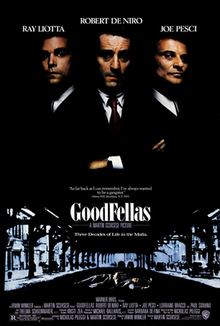
First released in 1990 and continuously acclaimed ever since, Goodfellas did not win the Oscar for Best Picture.
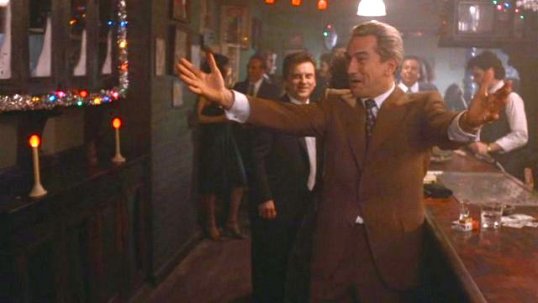
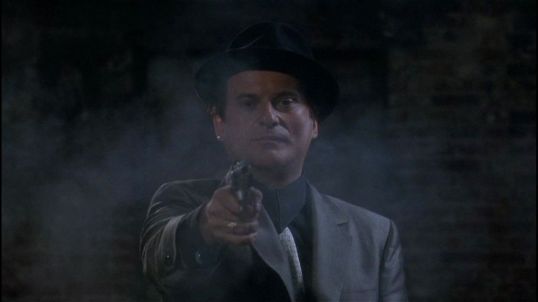
I’m always a bit surprised whenever I remember that. Goodfellas didn’t win Best Picture? That just doesn’t seem right. It’s not the other films nominated that year were bad but Goodfellas was so brilliant that it’s hard to imagine someone actually voting for something else. Seriously, it’s hard to think of a film that has been more influential than Goodfellas. Every gangster film with a soundtrack of kitschy tunes from the 6os and 70s owes huge debt to Goodfellas. Every actor who has ever been cast as a wild and out-of-control psycho gangster owes a debt to Joe Pesci’s performance as Tommy DeVito. When Ray Liotta passed away two years ago, we all immediately heard him saying, “I always wanted to be a gangster.” Robert De Niro’s Jimmy Conway remains the epitome of the ruthless gangster. For many, Paul Sorvino’s neighborhood godfather redefined what it meant to be a crime boss. Lorraine Bracco made such an impression as Karen Hill that it somehow seemed appropriate that she was one of the first people cast in The Sopranos, a show that itself would probably have not existed if not for Goodfellas. Frank Sivero, Samuel L. Jackson, Tobin Bell, Debi Mazer, Vincent Gallo, Ileana Douglas, Frank Vincent, Tony Sirico, Michael Imperioli, Tony Darrow, Mike Starr, Chuck Low, all of them can be seen in Goodfellas. It’s a film that many still consider to be the best of Martin Scorsese’s legendary career. Who can forget Robert De Niro smoking that cigarette while Sunshine of Your Love blared on the soundtrack? Who can forget “Maury’s wigs don’t come off!” or “Rossi, you are nothing but whore!?” Who can forget the cheery Christmas music playing in the background while De Niro’s Jimmy Conway grows more and more paranoid after pulling off the biggest heist of his career?
Plus, it’s a Christmas movie!
And yet, it did not win Best Picture.
Myself, whenever I’m sitting behind a garbage truck in traffic, I immediately start to hear the piano coda from Layla. For that matter, whenever I see a helicopter in the sky, I flash back to a coke-addled Henry Hill getting paranoid as he tries to pick up his brother from the hospital. Whenever I see someone walking across the street in the suburbs, I remember the scene where Henry coolly pistol-whips the country club guy and then tells Karen to hide his gun. I always remember Karen saying that she knows that many of her best friends would have run off as soon as their boyfriend gave them a gun to hide but “it turned me on.” It would have turned me on as well. Henry might be a gangster and his friends might be murderers but he doesn’t make any apologies for who he is, unlike everyone else in the world.
But it did not win Best Picture.
How many people have imitated Joe Pesci saying, “How am I funny?” How many times did Pesci and Frank Vincent have to listen to people telling them to “go home and get your fucking shinebox?” A lot of people remember the brutality of the scene where Pesci and De Niro team up to attack Vincent’s crude gangster but I always remember the sound of Donavon’s Atlantis playing on the soundtrack.
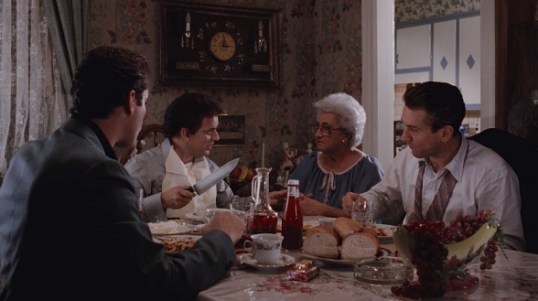
And then there’s Catherine Scorsese, showing up as Tommy’s mom and cooking for everyone while Vincent struggles to escape from the trunk of a car. “He is content to be a jerk,” Tommy says about Henry Hill. Just a few hours earlier, Tommy was apologizing to Henry for getting blood on his floor.
Goodfellas is a fast-paced look at organized crime, spanning from the 50s to the early 80s. Ray Liotta plays Henry Hill, who goes from idolizing gangsters to being a gangster to ultimately fearing his associates after he gets busted for dealing drugs. It’s a dizzying film, full of so many classic scenes and lines that it feels almost pointless to try to list them all here or to pretend like whoever is reading this review doesn’t remember the scene where the camera pans through the club and we meet the members of the crew. (“And then there was Pete The Killer….”) Goodfellas is a film that spend two hours showing us how much fun being a gangster can be and then thirty minutes showing us just how bad it can get when you’re high on coke, the police are after you, and you’ve recently learned that your associates are willing to kill even their oldest friends. No matter how many times I watch Goodfellas, I always get very anxious towards the end of the film. With the music pounding and the camera spinning, with Henry looking for helicopters, and with all of his plans going wrong over the course of one day, it’s almost a relief when Bo Dietl points that gun at Henry’s head and yells at him, revealing that Henry has been captured by the cops and not the Gambinos. Karen desperately running through the house, flushing drugs and hiding a gun in her underwear, always leaves me unsettled. It’s such a nice house but now, everything is crashing down.
There’s a tendency to compare Goodfellas to The Godfather, as their both films that re-imagine American history and culture through the lens of the gangster genre. I think they’re both great but I also think that they are ultimately two very different films. If The Godfather is sweeping and operatic, Goodfellas is the film that reminds us that gangsters also live in the suburbs and go to cookouts and that their wives take care of the kids and watch movies while the FBI searches their home. If The Godfather is about the bosses, Goodfellas is about the blue collar soldiers. The Godfather represents what we wish the Mafia was like while Goodfellas represents the reality.
Goodfellas is one of the greatest films ever made but it lost the Best Picture Oscar to Dances With Wolves, a film that left audiences feeling good as opposed to anxious. To be honest, Martin Scorsese losing Best Director to Kevin Costner feels like an even bigger injustice than Goodfellas losing Best Picture. One can understand the desire to reward Dances With Wolves, a film that attempts to correct a decades worth of negative stereotypes about Native Americans. But Scorsese’s direction was so brilliant that it’s truly a shame that he didn’t win and that Lorraine Bracco didn’t win Best Supporting Actress. It’s also a shame that Ray Liotta wasn’t nominated for playing Henry Hill. At least Joe Pesci won an Oscar for redefining what it meant to be a gangster.
Goodfellas is proof that the best film doesn’t always win at the Oscars. But it’s also proof that a great film doesn’t need an Oscar to be remembered.
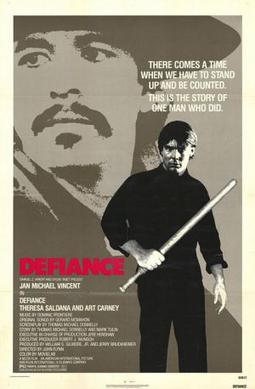
Serving out a six-month suspension, Merchant Seaman Tommy Campbell (Jan-Michael Vincent) rents an apartment on New York’s Lower East Side and passes the time painting and trying to learn Spanish in hope of getting assigned to a ship that is heading to Panama.
Tommy just wants to be left alone but he finds himself being drawn into the close-knit neighborhood. He becomes friends with Carmine (Danny Aiello) and more than friends with his upstairs neighbor (Theresa Saldana). He becomes a mentor to a street kid (Fernando Lopez) who lives with a punch-drunk boxer named called Whacko (Lenny Montana). Abe (Art Carney), who owns the local bodega, agrees to let Tommy use his phone.
Tommy also finds himself drawing the attention of Angel Cruz (Rudy Ramos), head of the local street gang. Tommy doesn’t want to get involved in any trouble. He just wants to serve his suspension and sail to Panama. But with Angel and his gang terrorizing the neighborhood and even robbing a church bingo game, Tommy and his friends finally stand up to the gang.
Defiance is more intelligent and realistic than many of the other urban vigilante movies that came out in the 70s and 80s. Tommy never becomes a cold-blooded killer, like Charles Bronson did in the Death Wish films. Instead, he spends most of the film trying to stay out of trouble and, when he does stand up for himself and the neighborhood, he does so realistically. He fights the gang members but he doesn’t set out to the kill them. About as deliberately destructive as he and Carmine get is that they destroy Angel’s car. Rather than being a typical vigilante movie, Defiance is a portrait of a neighborhood where everyone takes care of everyone else. Angel and his gang mistake the neighborhood’s kindness for weakness. The neighborhood proves them wrong.
Defiance stars two actors who never quite got their due. Theresa Saldana’s promising career was derailed when she was attacked and nearly killed by a deranged stalker in 1982. Though she recovered and went on to do a lot of television, she never became the star that she should have. Jan-Michael Vincent did become a star in the 70s and 80s but he later became better-known for his struggles with drugs and alcohol. Both of them are very good in Defiance and leave you thinking about the careers that they could have had if things had just gone differently.
Sometimes, you see a film that is just so weird and incoherent that you can’t help but love it.
Of course, it also helps if the film has a once-in-a-lifetime cast of actors who you would never expect to see acting opposite each other.
For me, that’s certainly the case with 1990’s Backtrack. Directed by Dennis Hopper, Backtrack is a film about an artist (Jodie Foster, channeling Jenny Holzer) who witnesses a mob murder committed by Joe Pesci, Dean Stockwell, Tony Sirico, and John Turturro. An FBI agent played by Fred Ward suggests that the artist should go into the witness protection program but she doesn’t want to give up her life as a New York sophisticate who creates challenging LED displays and who can eat Sno Balls whenever she gets the craving for one. (Yes, this is a plot point.) Turturro and Sirico break into the artist’s apartment and kill her boyfriend, who is played by a wide-eyed Charlie Sheen. The artist puts on a blonde wig and goes on the run, eventually getting a job in advertising.
Realizing that his men can’t get the job done, mob boss Vincent Price decides to hire a legendary hitman played by Dennis Hopper (who also directed this film) to track down the artist. However, the hitman becomes fascinating with the artist’s work, finds pictures of her posing in black lingerie, and immediately falls in love with her. Not only does he wants to save her life but he wants her to wear the same lingerie exclusively for him. (Yes, this is a pretty big plot point.) At first, the artist refuses and views the hitman as being some sort of pathetic perv. But then she discovers that he’s covered her bed with Sno Balls….
Meanwhile, a young Catherine Keener shows up as the girlfriend of a trucker who briefly considers giving the artist a ride to Canada.
And then Bob Dylan shows up, handling a chainsaw.
And there’s Helena Kallianiotes, the outspoken hitch-hiker from Five Easy Pieces, yelling at Joe Pesci!
And there’s Dennis Hopper’s The Last Movie co-star, Julie Adams! And there’s Toni Basil! And there’s director Alex Cox!
Dennis Hopper not only starred in Backtrack but he also directed and it’s obvious that he placed a call into just about everyone he knew. In fact, one could argue that the only thing more shocking than Vincent Price showing up as a mob boss is that Peter Fonda, Karen Black, Elliott Gould, Robert Walker Jr., and Kris Kristofferson are nowhere to be found in the film. Hopper’s first cut of Backtrack was reportedly 3 hours long but the studio cut it down to 90 minutes, renamed it Catchfire, and Hopper insisted on being credited as Alan Smithee. Later, Hopper released a two-hour version with the Backtrack title and his directorial credit restored.
Regardless of which version you see, Backtrack is an odd film. It’s hardly the first film to be made about a hit man falling for his target. What distinguishes this film is just how bizarre a performance Dennis Hopper gives in the role of the hitman. It’s as if Hopper gave into every method instinct that he had and the end result was a mix of Blue Velvet‘s Frank Booth and the crazed photojournalist from ApocalypseNow. Jodie Foster’s cool intelligence makes her the ideal choice for a conceptual artist but it also makes it hard to believe that she would fall for a jittery hitman and, in her romantic scenes with Hopper, Foster often seems to be struggling to resist the temptation to roll her eyes. Somehow, their total lack of romantic chemistry becomes rather fascinating to work. They are two talented performers but each appears to be acting in a different movie. What’s interesting is that I think a movie just about Hopper’s spacey hitman would be interesting (and, if you’ve ever seen The American Friend, it’s hard not to feel that such a movie already exists) but I think a movie about just about Foster’s artist and her life in New York would be just as fascinating. Taken as individuals, the artist and the hitman are both compelling characters. Taken as a couple, they don’t belong anywhere near each other.
But let’s be honest. This is a film that most people will watch for the parade of character actors delivering quirky dialogue. Even if one takes Hopper and Foster out of this mix, this is an amazingly talented cast. One need only consider that John Turturro did Do The Right Thing before appearing in this film while Joe Pesci and Tony Sirico did Goodfellas immediately afterwards. This film features a once-in-a-lifetime cast, made up of actors who were apparently told to do whatever they felt like doing. Turturro plays up the comedy. Sirico plays his role with cool menace. Stockwell barely speaks above a whisper. Fred Ward plays the one sane man in a world of lunatics. Vincent Price delivers his line as if he’s appearing in one of Roger Corman’s Poe films and somehow, it makes sense that, in the world of Backfire, an Italian gangster would have a snarky, mid-Atlantic accent.
It’s an odd little film, an example of 80s filmmaking with a 70s sensibility. While it’s not touched with the lunatic genius that distinguished Hopper’s The Last Movie, Backtrack is still something that should be experienced at least once.
As some of our regular readers undoubtedly know, I am involved in a few weekly live tweets on Twitter and Mastodon. I host #FridayNightFlix every Friday, I co-host #ScarySocial on Saturday, and I am one of the five hosts of #MondayActionMovie! Every week, we get together. We watch a movie. We tweet our way through it.
Tonight, at 10 pm et, #FridayNightFlix has got 1990’s Backtrack, an enigmatic thriller starring Jodie Foster, Dean Stockwell, Joe Pesci, John Turturro, Vincent Price, Fred Ward, Charlie Sheen, Tony Sirico, Bob Dylan, and Dennis Hopper (who also directed).
If you want to join us this Friday, just hop onto twitter, start the movie at 10 pm et, and use the #FridayNightFlix hashtag! It’s a friendly group and welcoming of newcomers so don’t be shy.
Backtrack is available on Prime and Tubi! See you there!
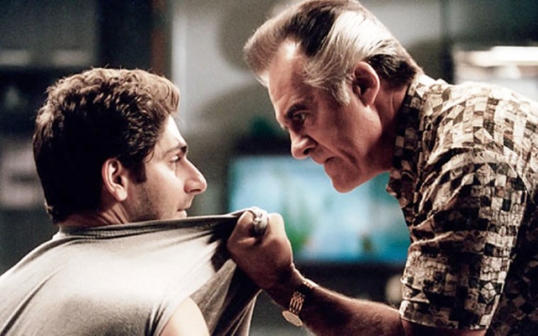
Perusing the imdb, I saw that today was the birthday of the late Tony Sirico. Sirico was a former mob associate who, after serving a term in prison, reinvented himself as an actor. Because of his background, he was often typecast as gangsters but he also proved himself to be an intelligent performer with perfect comedic timing. For a lot of us, he will always be remembered for playing Paulie on The Sopranos.
Today scene that I love comes from The Sopranos and it features excellent work from the entire cast, especially Tony Sirico. In this scene from the 2002 episode “The Strong, Silent Type,” the Sopranos and their associates stage an intervention for Christopher Moltisanti and it goes about as well as you might expect. In just five minutes, this scenes manages to capture everything that The Sopranos was about, as well as giving each member of the cast a chance to shine. Since this is Sirico’s birthday, I’ll just recommend that viewers especially watch Paulie’s facial expressions while Adriana reads her letter to Christopher.
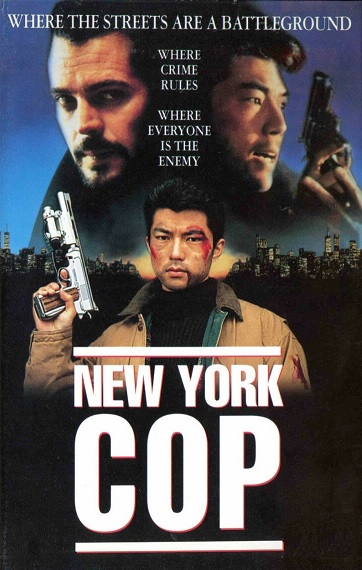
Toshi (Tôru Nakamura) is a tough New York cop who is assigned to work undercover in the East Village because, according to his boss, no one will suspect that a Japanese man is actually a cop. Disguising himself as a homeless gambling addict who has connections with the Tongs, Toshi infiltrates the Brotherhood. He becomes friends with the gang’s leader, Hawk (Chad McQueen), and he even falls in love with Hawk’s sister, Maria (Mira Sorvino!). Hawk is buying guns from a mobster named Mr. C (Tony Sirico!!) and Mr. C’s main assassin, Ferrara (Andreas Kastsulas), is driving around New York in a taxi cab and killing undercovers. Can Toshi take down Mr. C without compromising his relationship with Maria and revealing that he’s actually an undercover cop? The short answer is no.
New York Cop works best when it focuses on action. Tôru Nakamura is convincing in the fight scenes but he’s less convincing whenever he has to show emotion or have a conversation with anyone. The idea that the NYPD would send a Japanese cop undercover to infiltrate a Hispanic gang never makes makes much sense, as Toshi himself points out when the idea is first brought up. Toshi never makes much of an effort to disguise the fact that he is a cop, which makes Hawk look incredibly stupid for not seeing through him. The main appeal for most people will probably be the chance to see Tony Sirico and Mira Sorvino in early roles. Sirico, the former gangster-turned-actor, is convincing as Mr. C and gets all of the film’s best lines. As for Mira Sorvino, this was only her second or third film role and the script doesn’t give her much to work with. There are a few scenes where she gets to bring some genuine New York attitude to her character, telling off both her brother and Toshi. But otherwise, there’s little about her performance that suggests the actress that she would become. Fortunately, films like Barcelona and Sweet Nothing were right around the corner.
As far as New York cops go, nothing has yet to beat the episode of Barney Miller where Christopher Lloyd vandalizes the station house.
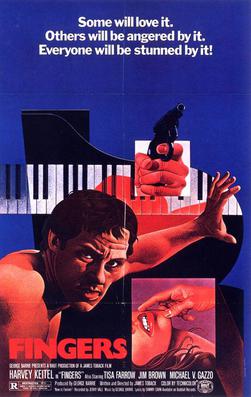
The 1978 film, Fingers, tell the story of Jimmy “Fingers” Angelilli (Harvey Keitel). Jimmy is a creep who works as a debt collector for his father, a small-time loan shark named Ben (Michael V. Gazzo). Jimmy is violent and brutal and often wanders around with a disturbingly blank-look on his face but we’re supposed to like him because he’s a talented pianist and he’s got a recital interview coming up at Carnegie Hall. Jimmy carries a radio with him wherever he goes and he’s obsessed with the song Summertime. He’s the type who will sit in a crowded restaurant and play the song and then get upset when someone tells him to turn off his radio. By the end of the movie, I was really hoping that someone would take Jimmy’s radio and smash into a hundred pieces.
Jimmy is in love with Carol (Tisa Farrow, who was a far better actress than her sister Mia and who would later appear in Lucio Fulci’s classic, Zombi 2), who doesn’t really seem to all that into him. Despite being in love with Carol, Jimmy still hits on every woman that he meets and, because this is a 70s films, he’s constantly getting laid despite being kind of a charmless putz.
Jimmy meets a former boxer named Dreems (Jim Brown). Carol is apparently one of Dreems’s mistresses. Jimmy silently watched while Dreems knocks two women’s heads together. Jimmy stands there with his little radio and a blank expression on his face. Is anything going on inside of Jimmy’s head? It’s hard to say.
Eventually, Jimmy finds out that a gangster (Tony Sirico) owes his father money but is refusing to pay. It all leads to violence.
As a film, Fingers is pretty much full of shit but that shouldn’t come as a surprise because it was the directorial debut of James Toback and there’s no American filmmaker who has been as consistently full of shit as James Toback. Fingers has all of Toback’s trademarks — gambling, crime, guilt, classical music, and a juvenile view of sexuality that suggests that James Toback’s personal development came to a halt when he was 16 years old. It’s a pretentious film that really doesn’t add up too much. Again, you know what you’re getting into when James Toback directs a film. Don’t forget, this is the same director who made a documentary where he was apparently shocked to discover that no one wanted to finance a politically-charged remake of Last Tango in Paris starring Alec Baldwin and Neve Campbell.
Fingers is a bit of an annoying film and yet it’s not a total loss. For one thing, if you’re a history nerd like I am, there’s no way that you can’t appreciate the fact that the film was shot on location in some of New York’s grimiest neighborhoods in the 70s. While I imagine it was more of a happy accident than anything intentional on Toback’s part (because, trust me, I’ve seen Harvard Man), Fingers does do a good job of creating an off-center, dream-like atmosphere where the world constantly seems to be closing in on its lead character. Jimmy is trying to balance his life as violent mobster with being a sensitive artist and the world around him is saying, “No, don’t count on it, you schmuck.”
As well, Harvey Keitel gives a …. well, I don’t know if I would necessarily say that it’s a good performance. In fact, it’s a fairly annoying performance and that’s a problem when a film is trying to make you feel sympathy for a character who is pretty unsympathetic. That said, there’s never a moment in the film where Keitel is boring. In Fingers, Keitel takes the method to its logical end point and, as a result, you actually get anxious just watching him simply look out of a window or sit in a corner. Even though Jimmy eyes rarely shows a hint of emotion, his fingers are always moving and, just watching the way that he’s constantly twitching and fidgeting, you get the feeling that Jimmy’s always on the verge of giving out a howl of pain and fury. It doesn’t really make Jimmy someone who you would want to hang out with. In fact, I spent the entire movie hoping someone would just totally kick his ass and put him in the hospital for a few weeks. But it’s still a performance that you simply cannot look away from. Watching Keitel’s performance, you come to realize that Fingers is essentially a personal invitation to visit a Hell that is exclusively populated by method actors who have gone too far.
Anyway, my feelings about Fingers were mixed. Can you tell? It’s an interesting movie. I’ll probably never watch it again.
Garrison, New Jersey is a middle class suburb that is known as Cop Land. Under the direction of Lt. Ray Donlan (Harvey Keitel), several NYPD cops have made their home in Garrison, financing their homes with bribes that they received from mob boss Tony Torillo (Tony Sirico). The corrupt cops of Garrison, New Jersey live, work, and play together, secure in the knowledge that they can do whatever they want because Donlan has handpicked the sheriff.
Sheriff Freddy Heflin (Sylvester Stallone) always dreamed of being a New York cop but, as the result of diving into icy waters to save a drowning girl, Freddy is now deaf in one ear. Even though he knows that they are all corrupt, Freddy still idolizes cops like Donlan, especially when Donlan dangles the possibility of pulling a few strings and getting Freddy an NYPD job in front of him. The overweight and quiet Freddy spends most of his time at the local bar, where he’s the subject of constant ribbing from the “real” cops. Among the cops, Freddy’s only real friend appears to be disgraced narcotics detective, Gary Figgis (Ray Liotta).
After Donlan’s nephew, Murray Babitch (Michael Rapaport), kills two African-American teenagers and then fakes his own death to escape prosecution, Internal Affairs Lt. Moe Tilden (Robert De Niro) approaches Freddy and asks for his help in investigating the corrupt cops of Garrison. At first, Freddy refuses but he is soon forced to reconsider.
After he became a star, the idea that Sylvester Stallone was a bad actor because so universally accepted that people forgot that, before he played Rocky and Rambo, Stallone was a busy and respectable character actor. Though his range may have been limited and Stallone went through a period where he seemed to always pick the worst scripts available, Stallone was never as terrible as the critics often claimed. In the 90s, when it became clear that both the Rocky and the Rambo films had temporarily run their course, Stallone attempted to reinvent his image. Demolition Man showed that Stallone could laugh at himself and Cop Land was meant to show that Stallone could act.
For the most part, Stallone succeeded. Though there are a few scenes where the movie does seem to be trying too hard to remind us that Freddy is not a typical action hero, this is still one of Sylvester Stallone’s best performances. Stallone plays Freddy as a tired and beaten-down man who knows that he’s getting one final chance to prove himself. It helps that Stallone’s surrounded by some of the best tough guy actors of the 90s. Freddy’s awkwardness around the “real” cops is mirrored by how strange it initially is to see Stallone acting opposite actors like Harvey Keitel, Robert De Niro, and Ray Liotta. Cop Land becomes not only about Freddy proving himself as a cop but Stallone proving himself as an actor.
The film itself is sometimes overstuffed. Along with the corruption investigation and the search for Murray Babitch, there’s also a subplot about Freddy’s unrequited love for Liz Randone (Annabella Sciorra) and her husband’s (Peter Berg) affair with Donlan’s wife (Cathy Moriarty). There’s enough plot here for a Scorsese epic and it’s more than Cop Land‘s 108-minute run time can handle. Cop Land is at its best when it concentrates on Freddy and his attempt to prove to himself that he’s something more than everyone else believes. The most effective scenes are the ones where Freddy quietly drinks at the local tavern, listening to Gary shoot his mouth off and stoically dealing with the taunts of the people that he’s supposed to police. By the time that Freddy finally stands up for himself, both you and he have had enough of everyone talking down to him. The film’s climax, in which a deafened Freddy battles the corrupt cops of Garrison, is an action classic.
Though the story centers on Stallone, Cop Land has got a huge ensemble cast. While it’s hard to buy Janeane Garofalo as a rookie deputy, Ray Liotta and Robert Patrick almost steal the film as two very different cops. Interestingly, many members of the cast would go on to appear on The Sopranos. Along with Sirico, Sciorra, Patrick, and Garofalo, keep an eye out for Frank Vincent, Arthur Nascarella, Frank Pelligrino, John Ventimiglia, Garry Pastore, and Edie Falco in small roles.
Cop Land was considered to be a box office disappointment when it was released and Stallone has said that the film’s failure convinced people that he was just an over-the-hill action star and that, for eight years after it was released, he couldn’t get anyone to take his phone calls. At the time, Cop Land‘s mixed critical and box office reception was due to the high expectations for both the film and Stallone’s performance. In hindsight, it’s clear that Cop Land was a flawed but worthy film and that Stallone’s performance remains one of his best.




 Through the Shattered Lens