Insomnia File #44: Cat Run (dir by John Stockwell)


What’s an Insomnia File? You know how some times you just can’t get any sleep and, at about three in the morning, you’ll find yourself watching whatever you can find on cable? This feature is all about those insomnia-inspired discoveries!

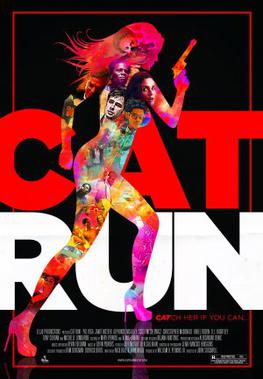
If you were having trouble getting to sleep at 3 in the morning, you could have turned over to Showtime and watched the 2011 action film, Cat Run.

So, here’s what you get when you watch Cat Run.  You get:

  1. A few beach scenes
  2. Some stylish action sequences
  3. A nearly incoherent plot
  4. Lots of naked people
  5. Two bumbling heroes
  6. A prostitute with a heart of gold, a young child, and an encrypted hard drive
  7. A cold-as-ice female assassin played by a distinguished, Oscar-nominated performer
  8. Massive and sudden changes in tone as the film goes from comedy to action to comedy again
  9. Sex
  10. Violence

In other words, Cat Run is a John Stockwell film.  As a director, Stockwell specializes in making unpretentious films, ones that usually feature beautiful people doing stuff on the beach.  He makes the type of films that will probably never win an Academy Award (though Kirsten Dunst perhaps deserved a nomination for her performance in Stockwell’s Crazy/Beautiful) but which are still occasionally entertaining if you’re in the right mood for them.  (Seriously, just watch Stockwell’s In The Blood and then ask yourself why he could make the perfect Gina Carano film while Steven Soderbergh couldn’t.)

Cat Run takes place is Montenegro.  The prostitute is named Cat (Paz Vega).  The encrypted hard drive contains footage of a politician (Christopher McDonald) killing a woman at an orgy.  The two bumbling detectives who help her out are named Julian (Alphonso McAuley) and Anthony (Scott Mechlowicz) and they occasionally get a funny line or two.  The assassin who is sent to take care of Cat is Helen and she’s played by Janet McTeer.  Helen is coldly efficient and ruthless killer but she has a difficult time tracking down Cat.  That’s the way it always goes, isn’t it?  The bad guys are always super competent until the movie begins, at which point they suddenly can’t shoot straight.

Anyway, Cat Run is not a particularly memorable movie but it has its entertaining moments.  It’s hyper stylish and the cast seems to be having a good time.  At the very least, you get the feeling that everyone probably enjoyed spending their days off in Montenegro and good for them!  McTeer, not surprisingly, steals the film but Paz Vega has some good moments too.  All in all, this is an enjoyable film that doesn’t have a hint of ambition.  It is what it is and what’s wrong with that?
Previous Insomnia Files:

  1. Story of Mankind
  2. Stag
  3. Love Is A Gun
  4. Nina Takes A Lover
  5. Black Ice
  6. Frogs For Snakes
  7. Fair Game
  8. From The Hip
  9. Born Killers
  10. Eye For An Eye
  11. Summer Catch
  12. Beyond the Law
  13. Spring Broke
  14. Promise
  15. George Wallace
  16. Kill The Messenger
  17. The Suburbans
  18. Only The Strong
  19. Great Expectations
  20. Casual Sex?
  21. Truth
  22. Insomina
  23. Death Do Us Part
  24. A Star is Born
  25. The Winning Season
  26. Rabbit Run
  27. Remember My Name
  28. The Arrangement
  29. Day of the Animals
  30. Still of The Night
  31. Arsenal
  32. Smooth Talk
  33. The Comedian
  34. The Minus Man
  35. Donnie Brasco
  36. Punchline
  37. Evita
  38. Six: The Mark Unleashed
  39. Disclosure
  40. The Spanish Prisoner
  41. Elektra
  42. Revenge
  43. Legend

Outlaw King Official Trailer


Outlaw King

Who here has seen Braveheart?

I’m quite sure that a huge number of people have seen Mel Gibson’s second film as director which won him two Oscars: for Best Director and Best Film. While his career has seen it’s major up’s and down’s, he still has done some great work behind the camera as a director.

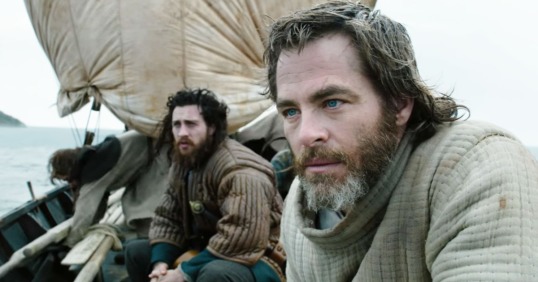
Now, what does this all mean to this new Netflix Original film coming out this year called Outlaw King? The answer is not much other than both film share a particular historical character in the Scottish king Robert the Bruce. In Gibson’s film he’s a supporting character whose motivations could be seen as very pragmatic and bordering on the villainous.

Outlaw King, by Scottish director David MacKenzie (who directed the great Hell or High Water), will tell the story of the legendary Scottish king Robert the Bruce who won Scotland’s independence from England where William Wallace ultimately failed to do.

I am going on a hunch that Outlaw King will treat Robert the Bruce in a more sympathetic light than how Gibson’s film portrayed him. This time around we have Chris Pine in the role of Robert the Bruce.

As seen in the trailer, it looks like Netflix’s several billion dollar spending spree has come not just luring prominent filmmakers and producers to the streaming site but also allow them the resources to make a film as lush and beautiful as any made under the remaining big studios.

Let’s hope Outlaw King is more on the level of Mudbound and less like Bright.

Playing Catch Up With The Films of 2016: Race (dir by Stephen Hopkins)


race

Do you remember Race?

It came out in February of this year and it was kind of a big deal for a week.  I think everyone was expecting it to be a big hit, just because there’s never much competition in February.  Race is a biopic of Jesse Owens, the African-American runner who sets world records and won gold medals at the 1936 Berlin Olympics, defeating a legion of Aryan athletes while Adolf Hitler watched from the stands.  Not only is that a compelling story but 2016 was also an Olympic year.  Eddie The Eagle had already been a success due to the Olympic connection.  Add to that, Focus Features promoted the Hell out of this film.  In they weeks leading up to its release, I saw commercials for it on a nearly hourly basis.  The reviews, when the came, were mixed but generally positive.

I’m not really sure how Race did at the box office.  According to Wikipedia, on its opening weekend, it was sixth at the box office.  Apparently, the film only had a budget of five million and ultimately made a profit of $20,000,0000.  I guess that would make it a success.  All I know is that it seems like, for all the hype, Race just kind of came and went.

In fact, I didn’t see Race until about two months ago.  It’s one of those films that’s not really great but it’s certainly not bad.  It’s pretty much the epitome of being adequate.  It was well-made and generally well-acted.  Director Stephen Hopkins occasionally struggled to maintain a consistent pace (Race is over 2 hours long and feels longer) but he still did a good job filming the scenes of Owens of running and competing.  In the role of Jesse Owens, Stephan James was well-cast.  You not only believed him in the dramatic scenes but he was also believable as a record-setting athlete.  He had some great scenes with Jason Sudekis, who was surprisingly believable in the role of Jesse’s coach.

With all that in mind, why didn’t Race make more of an impression?  I think that, too often, Hopkins allowed the film’s focus to wander away from Jesse and the inner conflict he felt as he won medals for a country where he was treated like a second-class citizen.  There were too many random scenes of Jeremy Irons and William Hurt, playing Olympic officials and debating whether or not to boycott Hitler’s Olympics.  During the second half of the film, Leni Riefenstahl (Carice van Houten) showed up and we got a few scenes of her trying to film Jesse’s triumph at the Olympics despite the interference of Nazi propaganda minister, Joseph Goebbles (Barnaby Metschurat).  All of these extra scenes are supposed to set Jesse’s struggle in a historic context but they’re unnecessary and distracting.  All the context that the film needs can be found in the fact that Jesse was a black man living in America in the 1930s.

For the most part, Race is uneven but occasionally the film delivers a powerful scene or two.  One of the most powerful parts of the film comes when Jesse, after setting world records and being proclaimed as a hero across the world, is informed that he still can’t enter a New York club through the front door.  As well, the scenes depicting Jesse’s friendship with German jump Luz Long (David Kross) are poignant.  In fact, they’re so poignant that I initially assumed that they were fictionalized for the film but actually, Jesse and Luz Long did become good friends during the 1936 Olympics.

Race is uneven but it’s not bad.  Stephan James gives a good performance as Jesse and, if nothing else, the film provides a worthy history lesson.

Horror Film Review: The Presence (dir by Tom Provost)


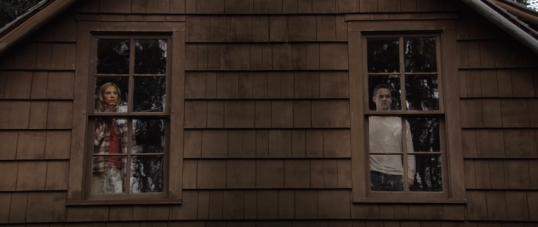
The Presence opens with nearly 20 minutes of near-silence.  We watch as an unnamed and emotionally unstable woman (Mira Sorvino, who is literally listed in the credits as having played The Woman) arrives at an isolated cabin.  As she settles in for what is obviously a very needed vacation, she goes about her business without saying a word.  This is because she believes herself to be alone.  However, those of us watching know that this isn’t true.  She is sharing her cabin with a silent and initially passive ghost (Shane West) and, though she can’t see him, those of us in the audience can.

Eventually, the silence is broken as other visitors come to the cabin.  There’s the boatman, Mr. Browman (Muse Watson).  There’s the woman’s boyfriend (Justin Kirk)  who unexpectedly shows up to ask the woman to marry him, a proposal which visibly upsets the ghost. Finally, there’s the Man In Black (played by Tony Curran).   Though the woman cannot see the Man In The Black, she can hear him when he whispers dark thoughts into her ear.

The ghost, however, can see the Man in Black.  The Man In Black offers the ghost a proposition.  If the ghost kills the woman’s boyfriend, the Man In Black will allow the ghost to leave the cabin.

First released back in 2010, The Presence is a film that got (and gets) next to no love from the critics and from the type of people who specialize in leaving snarky comments over at the imdb.  However, I rather like it.  Director Tom Provost makes the risky choice to emphasize atmosphere over easy scares.  The end result is a film that is full of striking images but which requires a bit more patience than most audiences are probably willing to give.  When I think about The Presence, I think about the sight of Shane West passively watching Mira Sorvino, obviously wishing he could reach out but knowing that he cannot.  It’s a haunting image, one that perfectly captures both the fear and the pathos of a good ghost story.

And that, ultimately, is what The Presence is.  It’s a good ghost story and what better time for a good ghost story but Halloween?

presence3

Review: The Midnight Meat Train (dir. by Kitamura Ryuhei)


There’s a certain number of books when I was much younger that I thought would’ve made for some great horror films. They were the early works by Clive Barker. Short stories collected into several volumes aptly dubbed his Books of Blood. While several short stories from these volumes were adapted to film in the intervening years most were not worth the time to watch them. So, lo and behold that when I finally saw the latest short story adapted from these collections I was genuinely surprised at how well-made and entertaining it turned out to be. The Midnight Meat Train by Japanese filmmaker Kitamura Ryuhei was a fine piece of horror filmmaking that dripped in atmosphere and a growing sense of existential dread right up to it’s very surprising end.

The Midnight Meat Train is quite a simple story when one really breaks it down to it’s component parts. It’s a crime thriller wrapped in the bloody layers of an extreme horror film. There’s a certain noirish quality to it’s storytelling as we see the film’s protagonist in Leon (Bradley Cooper). He’s a photographer struggling to find the inspiration for his next set of photographs and decides to wander the train stations at midnight to find that inspiration. It’s during one visit at night that he begins to suspect that he might’ve come across one of the latest missing persons who might’ve become a victim of the so-called “Subway Butcher”. The film shows his growing obsession in finding out if the urban legend of this so-called serial killer is actually true.

His mental state only deteriorates as the reality about the “Subway Butcher” (Vinnie Jones in one of his best roles to date) catches up to the truth on one midnight ride on the subway train. His witnessing of the killer at work brings him into a hidden world the rest of the city seems unaware or incapable of acknowledging despite the hundreds of people who go missing year in and year out for almost a hundred years. His girlfriend Maya (Leslie Bibb) and best friend Jurgis (Roger Bart) soon become drawn into Leon’s nightmarish situation and must confront the very boogeyman who has begun to haunt Leon’s waking life.

The film is Kitamura Ryuhei’s first Hollywood film and it doesn’t diminish the talent for some creative visuals he earned while directing horror and genre films in his native Japan. He makes great use of the nighttime setting and the stark environs of the subway trains at midnight to give The Midnight Meat Train an almost black and white look punctuated by vivid splashes of visceral red during the many inventive killings by Vinnie Jones’ mute Mahogany character. Kitamura showed that he was able to squeeze as much as was possible from a script that was average at best. Especially considering that the script had to adapt one of Barker’s shorter tales.

The performances by the ensemble group led by Bradley Cooper ranged from good to excellent with the aforementioned Vinnie Jones leading the pack. Even Bradley Cooper as the tormented protagonist Leon handled the role well. I’ve never warmed to Cooper as an actor as he always came across as a smirking douchebag in almost every role he played prior to this one. He quickly shed some of that reputation for me with his performance in this film and continues to do so with every one since this film. The smirk is still there but he has managed to drop the douchebag aspect of it. I also must point out a nice turn by veteran genre actor Tony Curran as the train conductor who exuded a sense of the otherworldly and a character who held the answers to the questions brought up by the film.

Since this is a horror film one must mention it’s horrofic aspects and this film fills it’s quota of horror. The scenes where Jones’ Mahogany dispatches the unwary last riders of the train at midnight were shot extremely well and with some visual flairs Kitamura has gained a reputation for. There’s nothing cartoony about these kills unlike other slasher films of it’s type. The kills are done in a brutal fashion as meat tenderizers smash into skulls and backs. Then there are the dressing of the kills which gives meaning to the film’s title. The only part of this film which seemed so out of place, but was necessary in the film’s overall narrative was the make-up effects in the end of the dead-end tunnel where Leon finally sees the truth of why Mahogany has been killing passengers on the subway train. It’s here that the film’s budget shows. At least Kitamura was smart enough to film these scenes in very low light to hide some of the zippers and laces on the costuming.

Overall, The Midnight Meat Train was one horror film in 2008 that deserved to have been seen by more people. It’s a shame that the handling of this film’s distribution by Lionsgate bordered on the criminal as it failed to be screened  by many theaters which led to it’s failure in the box-office. This was a horror film that delivered on the goods without pandering to the torture porn crowd who had begun to dominate the scene due to the popularity of the Saw franchise. Kitamura’s first work in America showed that he brings a fresh new voice to Western horror. The film also ends up becoming the best of all the Books of Blood short story adaptations and shows that Barker’s earlier grand guignol writing phase could be adapted well to the bigscreen.

Here’s to hoping that the failure of this film in the box-office (Again, I say fuck you Lionsgate) doesn’t keep other up-and-coming horror filmmakers from tapping into Barker’s volumes of short stories for their projects. There’s horror gold to be found there and Kitamura’s The Midnight Meat Train was one gleaming example of it.

Scenes I Love: 13th Warrior


Cavatica didn’t know where I borrowed and changed the chant in the beginning of my ThunderCats post previous to this one so I decided what better way to answer his question than using one of Lisa Marie’s favorite past features in the blog. I always did enjoy her “Scenes I Love” posts since it showed that even a bad film could have a redeeming quality with that one perfect scene that redeems the rest. Or it could be a scene that just reinforces just how great the rest of the film truly is.

So, my first attempt at “Scenes I Love” happens to be from the final battle in John Mctiernan’s epic tale of an Arab chronicler becoming sword-brothers with a band of Viking warriors and their king, Buliwfy. I love this scene for the reciting of the Viking Death Prayer by the few defenders left at the end of the film. Buliwfy, the Viking king, begins the prayer to be followed by the rest then finished by Ahmed Ibn Fadlan (Antonio Banderas) just in time to stand fast against a charge of the inhuman “Eaters of the Dead” (really just a remnant tribe of neanderthals).

That prayer is very powerful and with Jerry Goldsmith’s rousing music providing a proper background it’s definitely hard for one not to pick up a sword or axe and stand fast against the incoming horde.

The original Viking Death Prayer

Lo, there do I see my Father..
Lo, there do I see my Mother
And my Sisters and my Brothers..
Lo, there do I see the line
Of my people back to the beginning..
Thay do bid me to take my place among them..
In the Halls of Valhalla,
Where the Brave may live forever.