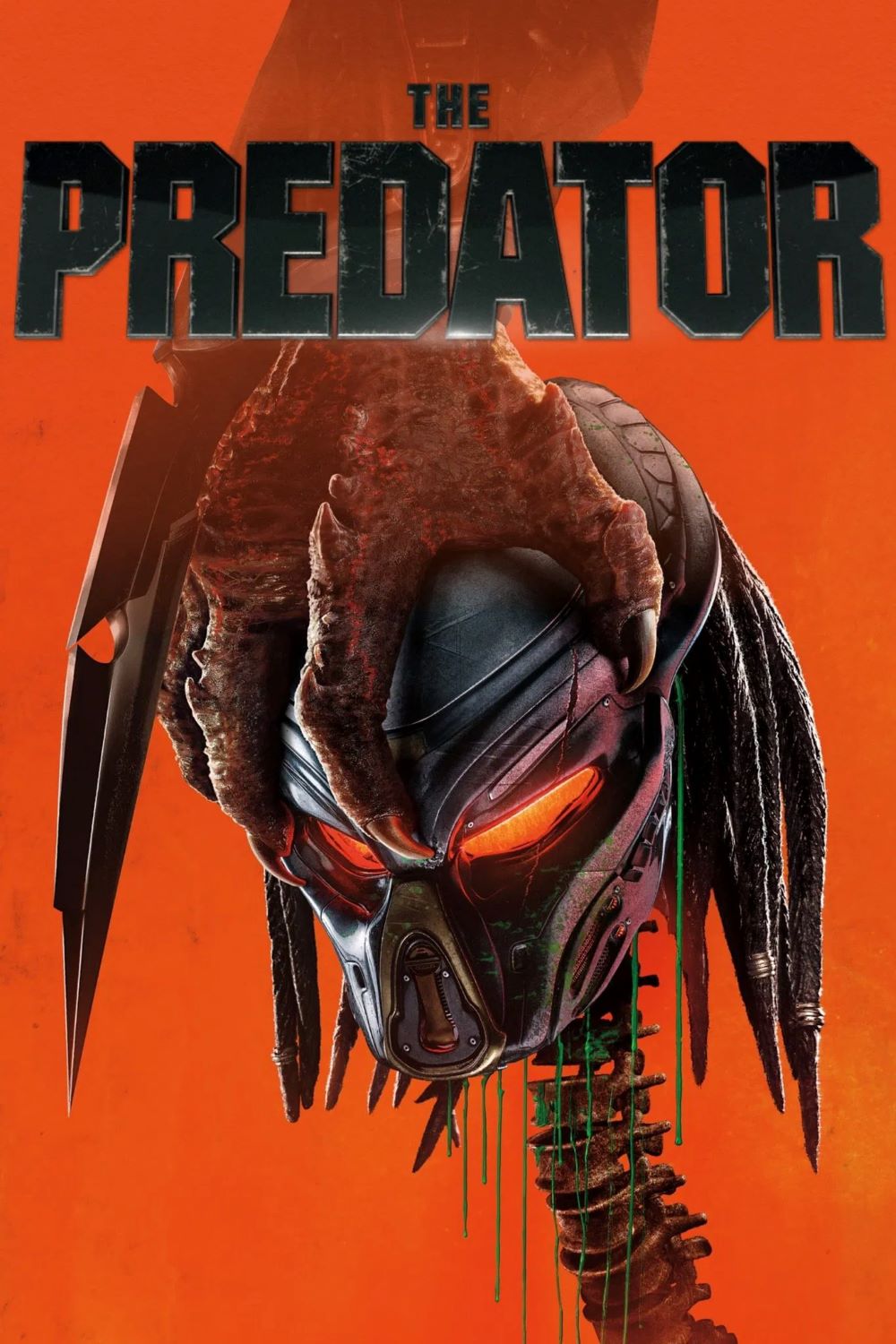
Review: The Predator (dir. by Shane Black)


“Gentlemen, remember… they’re large, they’re fast, and fucking you up is their idea of tourism.” — Traeger

Shane Black’s The Predator (2018) lands with a bang, offering a spectacle heavy on action, gore, and the signature snarky humor Black is known for. If you come looking for a suspenseful, tightly wound survival story in the tradition of the original 1987 film, you’re in for something very different—a gonzo mashup of nostalgia, R-rated slapstick carnage, and creature-feature excess that leans gleefully into genre absurdity.

The plot barrels forward with almost reckless energy. Boyd Holbrook stars as Quinn McKenna, a sniper whose mission goes haywire when a Predator spaceship crashes to Earth. Through a sequence of provocatively silly events, McKenna’s autistic son, Rory (Jacob Tremblay), ends up with the alien’s high-tech gear, unwittingly drawing attention from both the government and the technologically advanced Predators themselves. McKenna teams up with a ragtag bunch of soldiers, each with their own collection of quirks and psychological scars, plus Olivia Munn’s biologist Casey Bracket. This time, the hunt spills out of the jungle and into suburbia, with the chaos quickly escalating as a souped-up, genetically upgraded Predator enters the mix.

Where the 1987 original thrived on tension and jungle-stalking suspense, Black’s take is more about velocity, bloody spectacle, and loud, rapid-fire banter. The tone is set early, never letting up: The jokes fly thick and fast, the action is relentless, and there’s barely a lull for actual character development. The chemistry among “the Loonies,” McKenna’s loose-cannon squad, is the highlight—Keegan-Michael Key and Thomas Jane, in particular, deliver a mix of comic relief and bruised pathos that provides Black with fertile ground for his trademark dialogue. Sterling K. Brown chews the scenery as Traeger, the government antagonist, with a kind of joyous villainy that’s hard not to enjoy, even when the narrative slides into pure chaos. Olivia Munn starts strong as a scientist thrown into the deep end but is ultimately brushed aside by the film’s mayhem-heavy set pieces.

The film’s comedic pulse is strong, sometimes to its own detriment. Shane Black fills out every moment with his specific brand of irreverence, which works best in the banter between the Loonies but can undercut the menace of the Predators themselves. The violence is over-the-top, with practical splatter and digital effects combining for set pieces that are more monstrous brawls than hunting sequences. The movie rarely worries about internal logic—kids instantly deciphering alien technology and scientists surviving actions that would doom most is par for the course here. For fans of the previous films, there are enthusiastic callbacks and plenty of Easter eggs, though these are delivered more as punchlines than as foundations for new franchise mythology.

One of the film’s major issues is its kitchen-sink approach: it tries to be a throwback action movie, a gory sci-fi thriller, and a self-aware parody all at once. The result is a film constantly threatening to come apart at the seams—some viewers will find the tonal whiplash exhausting, with jokes about mental illness and disability that are more dated than daring. The narrative bounces between subplots and characters so quickly that plot armor and convenient twists abound, while the stakes themselves grow ever more implausible. If you’re looking for slow-burn tension or the primal fear that powered John McTiernan’s or even Stephen Hopkins’ installments, you’ll find yourself unmoored by the gleeful chaos and genre self-parody that Black serves up.

Still, for all its messiness, The Predator is never boring. It’s an action movie that refuses to slow down, boldly swapping iconic mud-soaked hunting for suburban street battles, and musclebound brawn for damaged, wise-cracking outcasts. It is, in its own profane, ADD-addled way, a love letter to the kind of big, dumb, fun genre movies that Black himself helped define in the late ’80s and ’90s.

Ultimately, The Predator isn’t a triumphant reinvention of the franchise nor a true return to the original’s nerve-shredding simplicity. Fans looking to see a return to the franchise’s glory days will be sorely disappointed. However, taken on its own merits and not dragged down by the expectations brought by the franchise, the film does entertain with its wild, unruly, blood-spattered romp that wears its flaws on its sleeve and dares the audience to laugh along with the carnage. If you’re in it for straight-up monster mayhem, creative kills, and a barrage of one-liners, you’ll have a blast. If you’re looking for restraint, genre evolution, or old-school suspense, you’ll probably end up shaking your head—grinning, maybe, but shaking it all the same.
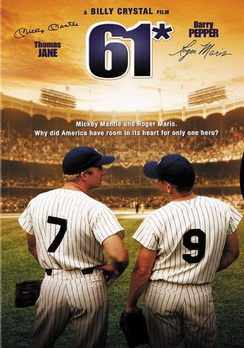
I Watched 61* (2001, Dir. by Billy Crystal)


61* is about two baseball player and two friends who couldn’t seem to be more different.

Roger Maris (Barry Pepper) is an introverted family man who doesn’t like it when reporters show up at his house in search of a story or a quote.  He’s a good ball player, one of the best, but he doesn’t want to be a celebrity.  Mickey Mantle (Thomas Jane) is a larger-than-life personality, a beloved figure on the field and in the dugout.  Mickey loves being famous and the fans love him.  Both Maris and Mantle are members of the New York Yankees.  Because Mantle is struggling with his drinking, he becomes Maris’s roommate when they’re on the road.  In 1961, the two friends both go after Babe Ruth’s record of 60 home runs in a season.  The press presents their season as a battle, a race to see who will be the first to hit the sixty-first home run of the season.  Mantle and Maris, though, are just swinging the bat and making plays.

I really enjoyed 61*, which is a baseball film made by and for people who love baseball.  I liked the contrast between the quiet Maris and the charismatic Mantle.  Even though Maris is a hard worker and a good ballplayer, Mantle is the fan favorite and the one that people actually want to break the record.  I appreciated that Maris and Mantle remained friends even when the press tried to turn them into rivals.  That’s what teamwork is all about.  Barry Pepper and Thomas Jane were great as Maris and Mantle and the movie showed how each man dealt with the stress of possibly breaking Babe Ruth’s record.

(Why is there an asterisk in the title?  Babe Ruth set his record in a season that only had 154 games.  The 1961 baseball season was 8 games longer.  The asterisk was added as a reminder that Maris and Mantle had 8 more games than Ruth did to try to break the record.  Baseball fans understand how important accurate statistics are to a player’s career and a team’s season.)

61* celebrates the way baseball used to be, a game played by athletes who had to depend on skill and teamwork instead of performance enhancing drugs.  The movie opens with Maris’s family watching as Mark McGuire closes in on breaking the record.  McGuire would only briefly hold the record.  He would lose it, for 48 minutes, to Sammy Sosa and then, three years after winning it back, he would lose it a second time to Barry Bonds.  Of course, Roger Maris won the record without using steroids so, as far as I’m concerned, it still belongs to him.

If you’re a baseball fan, 61* is a film that you have to see.

Icarus File No. 21: Reach Me (dir by John Herzfeld)


The 2011 film, Reach Me, opens with a rapper named E-Ruption (Nelly) appearing on a morning show and talking about how, while he was serving a prison sentence, he read a self-help book called Reach Me.  It asked him to consider whether or not his childhood self would be happy with his adult self.  The book was written by a mysterious man named Teddy Raymond.  No one knows who this Teddy Raymond is.  He’s never appeared in public.  People film themselves reading the book online and then upload to YouTube as a way of sharing Teddy’s wisdom.  I honestly can think of nothing more annoying and boring than watching someone else read a self-help book but whatever.  I live in Texas.  The movie takes place in California.

Tabloid editor Gerald (Sylvester Stallone) takes a break from action painting to order one of his reporters, Roger King (Kevin Connolly), to track down Teddy Raymond.  Roger wants to write the great American novel.  He doesn’t care about self-help.  He meets Teddy’s associates, Wilson (Terry Crews) and Kate (Lauren Cohan) and Wilson talks about how Teddy magically cured Kate’s stutter.  Roger then wanders around the beach, asking random people, “Teddy Raymond?  Are you Teddy Raymond?”  Oh look!  There’s a guy named Teddy (Tom Berenger) who reluctantly cures Roger of his smoking addiction by ordering Roger to yell at the ocean …. over and over and over again.

Collette (Kyra Segdwick) has just been released from prison.  Reading Teddy’s book has inspired her to try to become a fashion designer.  Collette’s daughter, Eve (Elizabeth Henstridge), is an aspiring actress who was earlier groped by a sleazy star named Keating (Cary Elwes).  Collette and Eve literally crash their car into a car being driven by Wolfie (Thomas Jane), a sociopathic undercover cop who enjoys killing people and who goes to confession after every shooting.  (At the start of the movie, he guns down Danny Trejo.)  The alcoholic priest, Father Paul (Danny Aiello), refuses to hear any more of his confessions.

Meanwhile, wannabe mob boss Frank (Tom Sizemore) is upset because another mob boss, Aldo (Kelsey Grammer), doesn’t treat him with any respect.  Frank sends two of his hitmen, Thumper (David O’Hara) and Dominic (Omari Hardwick), to kill a man who owes him money and to also shoot the man’s dog.  Thumper has been reading Teddy Raymond’s book and doesn’t want to shoot the dog.  Dominic realizes that his heart isn’t into the mob life so, taking the book’s message to heart, he calls Frank and says, “My heart’s not in it.”

(Don’t try that with any real mobsters.)

Eventually, all of the characters do come together.  They don’t exactly come together in a plausible manner but they do all end up at the same location so let’s give the film credit for that.  Let’s also give this film credit for leaving me seriously confused.  I have no idea whether this film was meant to a parody or a celebration of the self-help industry.  At first, I suspected that it meant to be a parody because all of Teddy Raymond’s advice was painfully shallow and the type of basic crap that anyone could come up with.  I actually found myself losing respect for the people who claimed that Teddy had changed their lives.  But at the movie progressed, I realized that I was supposed to take Teddy and his advice seriously.  This was a film that I guess was meant to have something to say but who knows what exactly that was.

That said — hey, everyone’s in this movie!  Director John Herzfeld was a former college roommate of Sylvester Stallone’s and, once Stallone agreed to appear, that apparently convinced a lot of other “name” actors to take the risk as well.  There’s a lot of talent in this film but little of it is used correctly.  Kelsey Grammer as an Italian mobster instead of the editor?  Sylvester Stallone as the editor instead of the Italian mobster?  Thomas Jane as a sociopath who has a girlfriend by the end of the movie, one who smiles and tells him, “Try not to shoot anyone?”  Kyra Sedgwick as an ex-con?  These are all good actors but just about everyone, with the exception of the much-missed Danny Aiello, is miscast.

It’s a true Icarus File.  It was a just a little more self-aware, this would have been a Guilty Pleasure.  But, in the end, self-help cannot help itself.

Previous Icarus Files:

  1. Cloud Atlas
  2. Maximum Overdrive
  3. Glass
  4. Captive State
  5. Mother!
  6. The Man Who Killed Don Quixote
  7. Last Days
  8. Plan 9 From Outer Space
  9. The Last Movie
  10. 88
  11. The Bonfire of the Vanities
  12. Birdemic
  13. Birdemic 2: The Resurrection 
  14. Last Exit To Brooklyn
  15. Glen or Glenda
  16. The Assassination of Trotsky
  17. Che!
  18. Brewster McCloud
  19. American Traitor: The Trial of Axis Sally
  20. Tough Guys Don’t Dance

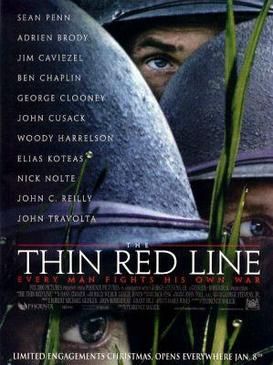
Lisa Marie Reviews An Oscar Nominee: The Thin Red Line (dir by Terrence Malick)


Based on a novel by James Jones (and technically, a sequel of sorts to From Here To Eternity), 1998’s The Thin Red Line is one of those Best Picture nominees that people seem to either love or hate.

Those who love it point out that the film is visually stunning and that director Terrence Malick takes a unique approach to portraying both the Battle of Guadalcanal and war in general.  Whereas Steven Spielberg’s Saving Private Ryan told a rather traditional story about the tragedy of war (albeit with much more blood than previous World War II films), The Thin Red Line used the war as a way to consider the innocence of nature and the corrupting influence of mankind.  “It’s all about property,” one shell-shocked soldier shouts in the middle of a battle and later, as soldiers die in the tall green grass of the film’s island setting, a baby bird hatches out of an egg.  Malick’s film may have been an adaptation of James Jones’s novel but its concerns were all pure Malick, right down to the philosophical voice-overs that were heard throughout the film.

Those who dislike the film point out that it moves at a very deliberate pace and that we don’t really learn much about the characters that the film follows.  In fact, with everyone wearing helmets and running through the overgrown grass, it’s often difficult to tell who is who.  (One gets the feeling that deliberate on Malick’s point.)  They complain that the story is difficult to follow.  They point out that the parade of star cameos can be distracting.  And they also complain that infantrymen who are constantly having to look out for enemy snipers would not necessarily be having an inner debate about the spirituality of nature.

I will agree that the cameos can be distracting.  John Cusack, for example, pops up out of nowhere, plays a major role for a few minutes, and then vanishes from the film.  The sight of John Travolta playing an admiral is also a bit distracting, if just because Travolta’s mustache makes him look a bit goofy.  George Clooney appears towards the end of the film and delivers a somewhat patronizing lecture to the men under his command.  Though his role was apparently meant to be much larger, Adrien Brody ends up two lines of dialogue and eleven minutes of screentime in the film’s final cut.

That said, The Thin Red Line works for me.  The film is not meant to be a traditional war film and it’s not necessarily meant to be a realistic recreation of the Battle of Guadalcanal.  Instead, it’s a film that plays out like a dream and, when viewed a dream, the philosophical voice overs and the scenes of eerie beauty all make sense.  Like the majority of Malick’s films, The Thin Red Line is ultimately a visual poem.  The plot is far less important than how the film is put together.  It’s a film that immerses you in its world.  Even the seeming randomness of the film’s battles and deaths fits together in a definite patten.  It’s a Malick film.  It’s not for everyone but those who are attuned to Malick’s wavelength will appreciate it even if they don’t understand it.

And while Malick does definitely put an emphasis on the visuals, he still gets some good performances out of his cast.  Nick Nolte is chilling as the frustrated officer who has no hesitation about ordering his men to go on a suicide mission.  Elias Koteas is genuinely moving as the captain whose military career is ultimately sabotaged by his kind nature.  Sean Penn is surprisingly convincing as a cynical sergeant while Jim Caviezel (playing the closest thing the film has to a main character) gets a head start on humanizing messianic characters by playing the most philosophical of the soldiers.  Ben Chaplin spends most of his time worrying about his wife back home and his fantasies give us a glimpse of what’s going on in America while its soldiers fight and die overseas.

The Thin Red Line was the first of Terrence Malick’s films to be nominated for Best Picture and it was one of three World War II films to be nominated that year.  However, it lost to Shakespeare In Love.

Film Review: Vendetta (dir by Jared Cohn)


It’s a dangerous world out there, make no doubt about it.

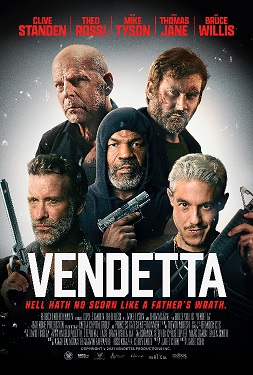
William Duncan (Clive Standen) thought that his days of violence were behind him.  Sure, he did a tour of duty in the military.  And yes, he was trained how to kill a man.  In fact, he was trained how to kill dozens of men and he did just that as a part of his patriotic duty.  But that was the past.  Now, William lives in the suburbs of Atlanta and he’s got a pretty nice life.

Unfortunately, one day, William’s life falls apart, shortly after he picks up his 16 year-old daughter, Kat (Maddie Nichols), from softball practice.  William’s plan is to pick up his daughter, grab some food for dinner, and then head home.  Unfortunately, a gang led by Rory Fetter (Theo Rossi) has a different idea.  The time has come for Rory’s younger brother, Danny (Cabot Badsen), to be initiated into the gang.  At first, it seems like Danny doesn’t even want to join the gang but still, when he’s ordered to murder a random bystander, he does so.  That bystander happens to be Kat.

Danny’s arrested for the murder but he’s released due to the influence of his father, a powerful gangster named Donnie (Bruce Willis).  Having been failed by the legal system, William decides to put his military training to good use and get his vengeance.  At first, he’s armed with only his dead daughter’s softball bat.  Later, he joins up with an arms dealer named Dante (Thomas Jane) and the war truly begins.

It should also be noted that Dante is friends with a shady garage owner named Roach.  Roach is played by Mike Tyson.  Yes, that Mike Tyson.  Tyson doesn’t really get to do much as Roach.  His garage does serve as one of the film’s many battlegrounds but, for the most part, Tyson is something of a bystander.  It’s easy to see that the main reason he was included in the film was because it would inevitably cause at least a few potential viewers to say, “Hey, Mike Tyson’s in this!  Let’s watch!”  That said, even with his limited screen time, Mike Tyson has a surprisingly likable screen presence.  I don’t think that anyone will ever mistake Tyson for being an actor of great range but he does a good enough job here that it would be foolish for someone not to cast him in a bigger role in a future low-budget action flick.

As for Vendetta, it’s about as pulpy as pulp can get.  It’s an action/revenge flick that makes no excuse for being an action/revenge flick and, as a result, it’s difficult not to be entertained by it.  The story moves quickly, there aren’t really any slow spots, and the cast does well with their roles.  That includes Bruce Willis.  This, of course, is one of Willis’s final films.  Watching the films that were released after Willis revealed that he was retiring due to aphasia can feel a bit awkward as it’s obvious that the Willis who appeared in these films was quite a bit different from the Willis who appeared in Die Hard.  That said, Willis is effectively intimidating in Vendetta.  Even if he doesn’t display the wiseguy charm that was his trademark, Willis still has enough of his streetwise, tough guy screen presence that the viewers will be able to buy him as being a feared crime boss.

As far as 2022’s collection of Bruce Willis films go, Vendetta isn’t bad.  It’s maybe a smidgen below Gasoline Alley (which, as of this writing, is the best Willis film of 2022) but it’s a hundred times better than American Siege and A Day To Die.

The Films of 2020: Money Plane (dir by Andrew Lawrence)


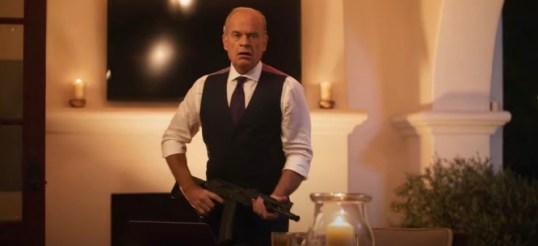
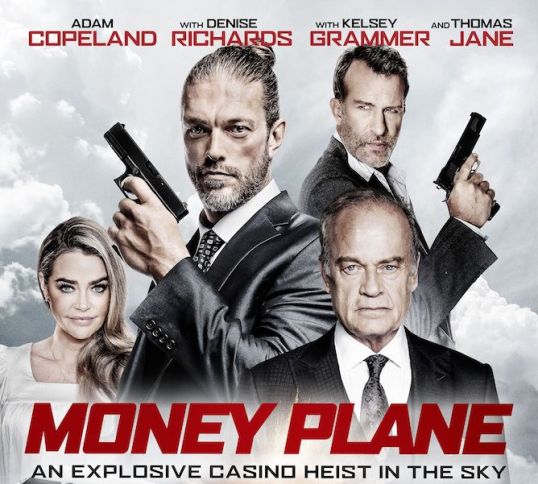
Yes, that’s Kelsey Grammer holding a machine gun in the picture above.  This is a screenshot from a film called Money Plane, which is about a plane where people gamble on everything from Texas Hold ‘Em to Russian Roulette to how long it will take a man to die after being bitten by a cobra.  A group of thieves are recruited to rob the money plane.  Grammer plays the man who ordered the robbery, a total psycho who is named Darius Grouch III but who prefers to be called The Rumble.

And listen, there’s a lot of things that you can say about Money Plane.  Does the plot always make sense?  Of course not.  Heist films aren’t supposed to make much sense.  Does the film look cheap?  You bet.  This isn’t a Hollywood blockbuster.  This film is closer to be a mockbuster.  But, dammit, any movie that features Kelsey Grammer loudly announcing, “I’m the baddest motherfucker around!” in that voice of his is automatically going to be one of the best of the year.

Well, maybe not the best.  As I said, Money Plane is a low-budget action movie and, watching it, you get the feeling that the film was largely made as a lark.  It’s a silly movie but, when taken on its own very undemanding terms, it’s actually pretty fun.  Unlike a lot of action films, Money Plane has a sense of humor and one gets the feeling that the cast and crew were in on the joke.  One could imagine a director like Steven Soderbergh taking this material and ruining it by trying to pretend as if there was more going on underneath the surface of the film than there actually was.  Money Plane, on the other hand, makes no apologies and doesn’t pretend to be anything that it isn’t.

Here’s a few things I liked about Money Plane:

1) One of the thieves was played by Katrina Norman and she got to beat up some sleazy men.  That’s always fun to watch.

2) The great Thomas Jane had a small but key role as the best friend of the main thief (who was played by former wrestler Adam Copeland).

3) I couldn’t help but be amused by the fact that the famous Money Plane was just an ordinary airplane, as opposed to some sort of gigantic floating fortress.

4) I also found myself strangely amused by the fact that the inside of the plane appeared to be significantly bigger than the outside.

5) When it was announced that the next game would be “Texas Hold ‘Em,” a dude wearing a cowboy hat stood up and was like, “This is my game!”

6) Jackson Pollock and several other painters are referred to as being “a bunch of bitches,” which amused me as an art history major.

7) Adam Copeland’s ex-wife is played Denise Richards, who once again proves that she’s a better actress than she’s frequently given credit for.

8) And, of once again, how can you not love a film that has Kesley Grammer cursing up a storm and running around with a machine gun?

I recommend Money Plane.  It’s enjoyably silly.


Music Video of the Day: Try by Michael Penn (1997, dir by Paul Thomas Anderson)


I was going to do one of the videos that Paul Thomas Anderson directed for Haim today but I changed my mind at the last minute.  That’s nothing against Haim or the video.  Haim’s great and their videos — particularly the ones directed by Anderson — are frequently brilliant.  It’s just, for whatever reason, I knew that today was not the day to write about their video for The Steps.  That day will come soon.

Instead, I wrote about the video for Michael Penn’s Try.

Try was the very first music video to be directed by Paul Thomas Anderson.  He directed it while he was editing Boogie Nights.  Michael Penn, of course, did the score for both Boogie Nights and Anderson’s earlier Hard Eight.  He can also be spotted in Boogie Nights, playing Nick in the recording studio and incredulously reacting to the efforts of Dirk Diggler and Reed Rothschild to record their own album.

When watching this video, pay attention to the blonde gentleman wearing the Planet of the Apes t-shirt.  He shows up twice and, at one point, holds the microphone into which Penn is singing.  If he looks familiar, that’s because he’s actor Philip Seymour Hoffman!  When I first saw the video, I honestly didn’t recognize him.  I just thought he was some random crew person who got the job because he could run fast enough to keep up with Penn.  Of course, once I learned that Hoffman was in the video and I rewatched it, I immediately spotted him.  I think it says something about what a good actor Hoffman was that, even in something like this, he could be so convincing that, despite being one of the most recognizable actors in the world, he still became somewhat anonymous.  He disappeared into the role.

Thomas Jane and Melora Waters (who played Todd and Jessie St. Vincent in Boogie Nights) are also in this video, standing at the end of a a long line of exhausted dancers.  (This was meant to be a reference to the film, They Shoot Horses, Don’t They?)  There’s one other Boogie Nights reference, which is kind of interesting considering the fact that he and Anderson supposedly didn’t get along during filming.  Keep an eye out for door with a purple 9 on it.  That’s a reference to Burt Reynolds, who wore the number 9 when he played college football.

Enjoy!

Horror Film Review: Buffy the Vampire (dir by Fran Rubel Kuzui)


Watching this movie was such a strange experience.

Now, of course, I say that as someone who grew up watching and loving the television version of Buffy the Vampire Slayer.  Back when Buffy was on TV, I was always aware that the character had first been introduced in a movie but every thing I read about Buffy said that the movie wasn’t worth watching.  It was a part of the official Buffy mythology that Joss Whedon was so unhappy with what was done to his original script that he pretty much ignored the film when he created the show.

So, yes, the 1992 movie version of Buffy the Vampire Slayer showed how Buffy first learned that she was a slayer, how she fought a bunch of vampires in Los Angeles, and how her first watcher met his end.  But still, Joss Whedon was always quick to say that the film should not be considered canonical.  Whenever anyone on the TV show mentioned anything from Buffy’s past, they were referencing Joss Whedon’s original script as opposed to the film that was eventually adapted from that script.  (For instance, on the tv series, everyone knew that Buffy’s previous school burned down.  That was from Whedon’s script.  However, 20th Century Fox balked at making a film about a cheerleader who burns down her school so, at the end of the film version, the school is still standing and romance is in the air.)  In short, the film existed but it really didn’t matter.  In fact, to be honest, it almost felt like watching the movie would somehow be a betrayal of everything that made the televisions series special.

Myself, I didn’t bother to watch the film version of Buffy the Vampire Slayer until several years after the television series was canceled and, as I said at the start of the review, it was a strange experience.  The movie is full of hints of what would make the television series so memorable but none of them are really explored.  Yes, Buffy (played here by Kristy Swanson) has to balance being a teenager with being a vampire slayer but, in the film, it turns out to be surprisingly easy to do.  Buffy is just as happy to be a vampire slayer as she is to be a cheerleader.  In fact, one of the strange things about the film is just how quickly and easily Buffy accepts the idea that there are vampires feeding on her classmates and that it’s her duty to destroy them.  Buffy’s watcher is played by Donald Sutherland and the main vampire is played by Rutger Hauer, two veteran actors who could have played these roles in their sleep and who appear to do so for much of the film.  As for Buffy’s love interest, he’s a sensitive rebel named Oliver Pike (Luke Perry).  On the one hand, it’s fun to see the reversal of traditional gender roles, with Oliver frequently helpless and needing to be saved by Buffy.  On the other hand, Perry and Swanson have next to no chemistry so it’s a bit difficult to really get wrapped up in their relationship.

I know I keep coming back to this but watching the movie version of Buffy is a strange experience.  It’s not bad but it’s just not Buffy.  It’s like some sort of weird, mirror universe version of Buffy, where Buffy starts her slaying career as a senior in high school and she never really has to deal with being an outcast or anything like that.  (One gets the feeling that the movie’s Buffy wouldn’t have much to do with the Scooby Gang.  Nor would she have ever have fallen for Angel.)  Kristy Swanson gives a good performance as the film version of Buffy, though the character is not allowed to display any of the nuance or the quick wit that made the television version a role model for us all.  Again it’s not that Buffy the movie is terrible or anything like that.  It’s just not our Buffy!

The Predator (Final Trailer)


The Predator

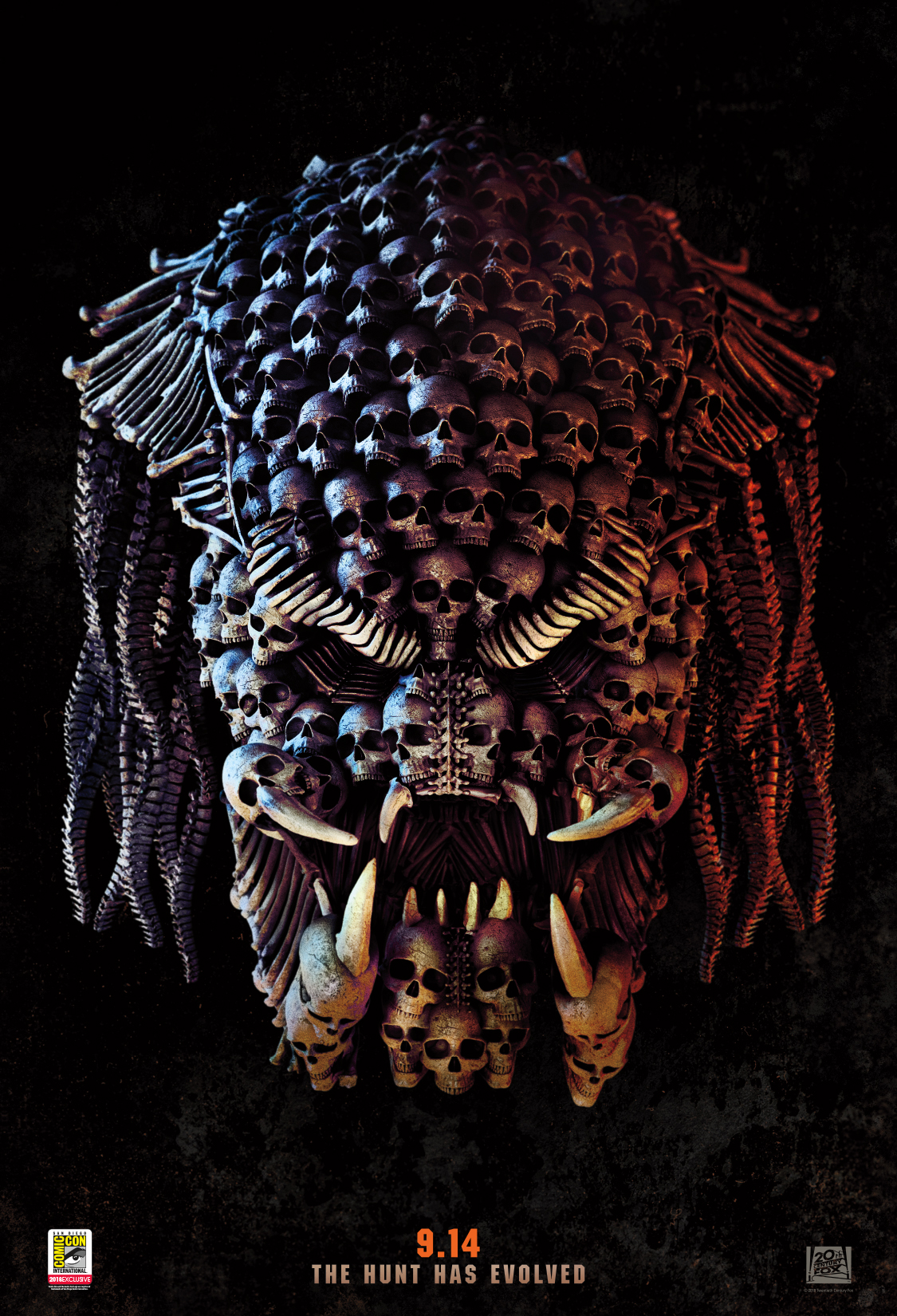
The teaser trailer for this Shane Black production didn’t wow me, at all. Then the first trailer came out and a red band one at that. That one was an upgrade but I was still on the fence. They’ve released more teasers, international trailers and tv spot and, once again, I was still not fully sold on the film.

Today 20th Century Fox drops the final trailer for The Predator just two weeks from it’s release date of September 14. This just days after the studio confirmed that the film will be a very hard R-rating raised my interest level.

It is this final trailer (again another red band trailer) is what finally sold me on this film as a must-see. We still know only bits and pieces of what the film will be about but the trademark Shane Black quips and smartass attitude shows up much more clearly with this last trailer.

I actually enjoyed the last Predator film and I hope this one continues the trend and just entertains it’s audience.

Film Review: Deep Blue Sea (1999, dir by Renny Harlin)


Since I’m going to be watching Deep Blue Sea 2 on the SyFy network later tonight, I figured that I should rewatch the first Deep Blue Sea beforehand.

This 1999 shark attack film takes place on a laboratory that’s floating out in the middle of the ocean.  It’s the weekend so the majority of the people who work at the lab are gone.  Only a skeleton crew, made up of recognizable actors, remains.  There’s Susan McAlester (Saffron Burrows) and Jim Whitlock (Stellan Skarsgard), two brilliant scientists.  (Susan is passionate and committed.  Jim is drunk and cynical.)  There’s a marine biologist named Jan (Jacqueline McKenzie), who is such a positive presence that, from the minute she first shows up, you know that there’s no way she’s going to be alive at the end of the movie.  Tom (Michael Rapaport) is an engineer.  Brenda (Aida Turturro) is in charge of communicating with the outside world.  Preacher (LL Cool J) is a chef who acts a lot like LL Cool J.  And then there’s Carter Blake (Thomas Jane), the shark wrangler with a past.  Carter is obviously going to be our hero because, with a name like Carter Blake, there’s no way that he couldn’t be.

Finally, there’s Russell Franklin (Samuel L. Jackson).  Russell is the businessman who has been funding all of the research at the lab.  Even though he doesn’t quite understand what Susan and Jim are doing, he’s been very generous.  However, after a shark escapes and nearly eats four generic teens, Russell decides that he better find out what exactly is being done with his money.

Jim and Susan are trying to develop a cure for Alzheimer’s.  Susan says that, if their experiments are successful, one pill will be able to reverse the disease.  They’ve been running tests on sharks and … well, let’s just say that Susan and Jim haven’t exactly been honest or ethical about their experiments.  (Movie scientists always cut corners, don’t they?)  Basically, they’ve been genetically engineering the sharks to increase the size of their brain.

The end result?

SUPER SHARKS!

To paraphrase the film’s poster, these sharks are big, fast, smart, and mean!  And needless to say, they’re sick of being held captive.  Soon, the lab is besieged by angry sharks and no one is safe!

That includes Samuel L. Jackson.  Deep Blue Sea is best known for the scene where Samuel L. Jackson gives a rousing speech, in which he exhorts everyone to keep fighting and not give up, right before a shark jumps out of the water and eats him.  It’s a great scene, one that makes brilliant use of Samuel L. Jackson.  I mean, let’s be honest.  You don’t expect Samuel L. Jackson to get eaten by a shark and, as soon as he’s gone, you look at the survivors and you think to yourself, “So, now you’re depending on LL Cool J and Thomas Jane to save you?  Y’all are so screwed…”

And yet, it’s also significant that the only scene from Deep Blue Sea that people really remember is that shark eating Samuel L. Jackson.  With the exception of the one moment, Deep Blue Sea is an incredibly predictable movie.  From the minute you see that Jim is played by Stellan Skarsgard, you know that he’s doing something wrong with the sharks.  The dialogue is often cringe-worthy and the characters are all thinly drawn.  The sharks are occasionally impressive but the movie doesn’t really do enough with the idea of them of being super smart.  Was I hoping for scenes of the sharks talking to each other?  I guess I was.

That said, as I watched Deep Blue Sea, I was surprised to discover that I had forgotten just how likable and efficient the movie was.  Director Renny Harlin doesn’t waste any time trying to convince us that we’re watching anything more than just a slightly silly shark movie.  Wisely, Harlin unapologetically embraces Deep Blue Sea’s B-movie roots and, with the help of a game cast, the end result is a film that is enjoyably unpretentious and straight forward.  Samuel L. Jackson was not devoured in vain.