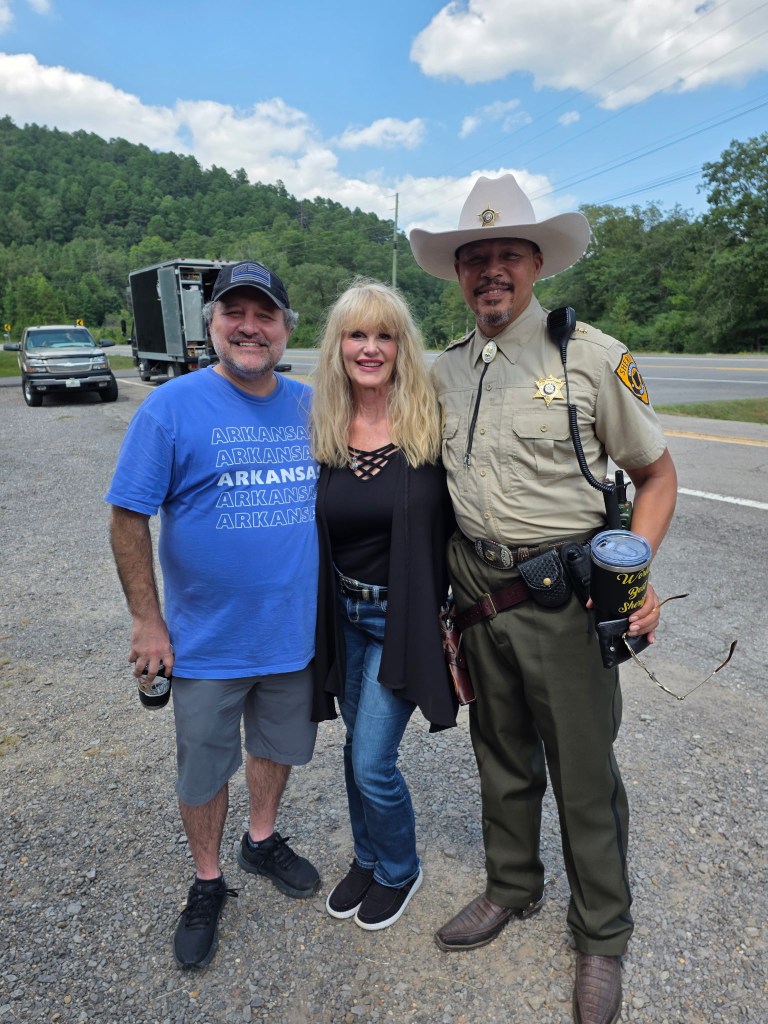
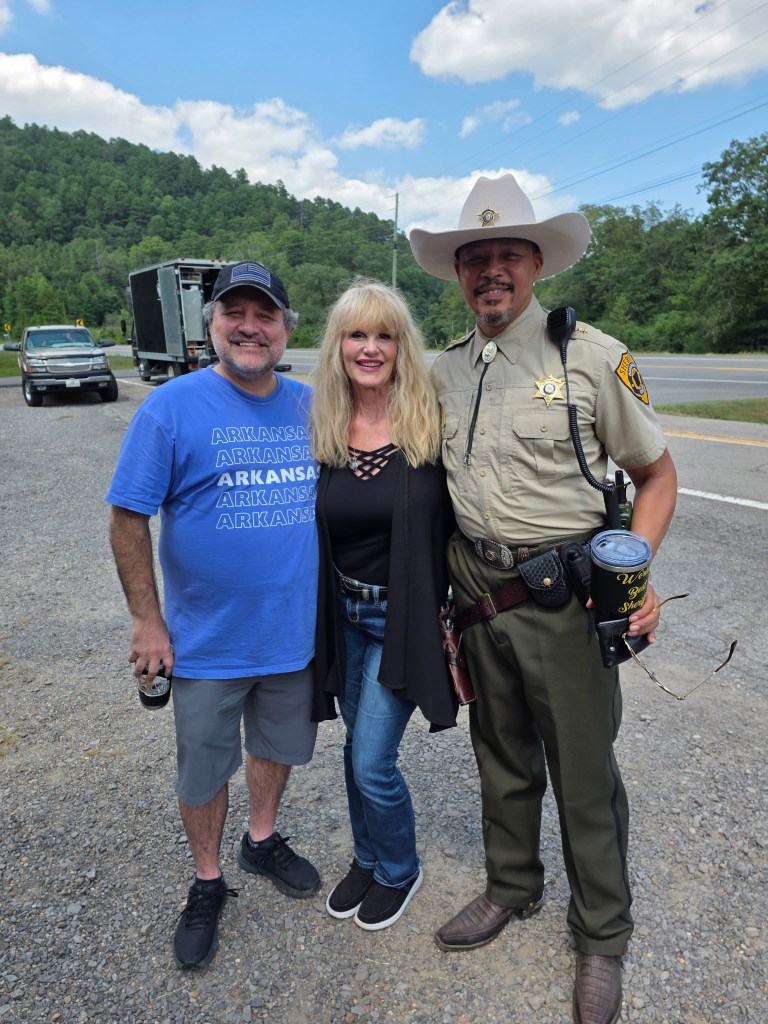
One of the most enjoyable days of my life was spent watching Director Sean McEwen film his movie TURNBUCKLE this past summer. And the highlight of the day was getting to meet actor Terrence Howard. He was so gracious with his time and so friendly to me and my wife. I can’t wait to see the movie, and I’ll always have great memories from that magical day!
My dad grew up in the Ouachita Mountains of central Arkansas. Some folks would surely call them hills, and they’d probably be right, because I come from a family of hillbillies. And there’s no place I like to go back to more often than those hills in Perry County, Arkansas. It’s probably been 35 years ago now that dad found a beautiful patch of land in the Ouachita National Forest that runs along the South Fourche River, just a few miles from where he spent his summers with his Grandpa and Grandma Crain, mostly working their farm, but also fishing and hunting anytime he could. This started a journey of patience when dad went to the county courthouse, found out who owned the property (an older lady who lived out of state), and wrote his first letter to see if she was interested in selling. She responded to that first letter and said that she was saving the property for her children to have as an inheritance. A few years later, dad wrote again. Still not interested, the lady kindly turned down dad’s offer and thanked him for his interest. Fast forward a few years later, about 8 years after dad’s first letter, and a man contacted my dad this time. It was the lady’s son, who had found my dad’s letters as he was going through his mother’s house after she had passed away. He wanted to sell, and dad made him an offer that he couldn’t refuse. Now owning the land of his dreams, dad and mom proceeded to build a cabin. When I say they built the cabin, I don’t mean that they hired someone else to build the cabin, I mean that they built the cabin from the ground up. For the longest time, the only power they had was the generator that he brought with him to the location. Now fast forward 25 years later, and it’s the place we have spent all of our holidays together for the last couple of decades. It’s truly my happy place, the place I go when I need to disconnect from the stresses of life and reconnect with my wife, my family, and nature itself. I took this picture a few feet off of the back deck a few moments ago.
My wife and I will spend this weekend sipping coffee off the back deck, listening to the sounds of the river rolling by, and then watching movies when the sun goes down. I’ll go see my brother this morning, who owns the local convenience store in the area, and I’ll work his cash register as he makes the best fried bologna sandwiches in central Arkansas. My brother bought the store five years ago, continuing a family tradition that started in 1940 when our great grandparents bought the store. It’s been in our family ever since. One of the coolest experiences in my life took place at the store a few months ago. The store has the perfect, old-timey, backwoods country store look, something even Hollywood noticed. In early August, the store was used as a filming location for a movie with major Hollywood talent. For a guy who’s been obsessed with movies since we got our first VCR in the 80’s, I asked my brother if my wife and I could come over and watch them film. I spent the day watching them film, visiting with a producer, visiting with the director, even taking a picture or two with the actors filming that day. It was truly one of the most awe-inspiring days of my life. My wife and I were able to get the picture below on that day. I can’t lie, the beauty of my wife is probably what allowed this to happen!
Have a wonderful weekend, my friends. I hope all of you get to spend part of it in your own happy place.
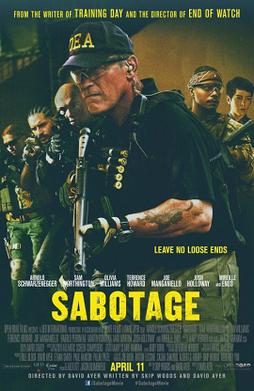
Atlanta Homicide detective Caroline Brentwood (Olivia Williams) and her partner, Darius Jackson (Harold Perrineau), are the primaries on the murder of a former DEA agent. Their investigation leads them to an elite special operations team led by “Breacher” Wharton (Arnold Schwarzenegger). Wharton and his crew were previously suspended for six months while the FBI investigates their last raid and why there was a $10 million dollar discrepancy between the amount of money the team reporter and the amount of money the FBI was expecting to be recovered. Someone is murdering the members of Breacher’s team one-by-one. Breacher and Brentwood investigate the murder and what happened to the money but they both discover that they can’t trust anyone.
Sabotage has got a cast that is full of talent and familiar faces, including Sam Worthington, Mireille Enos, Terrence Howard, Joe Manganiello, Martin Donavon, and Josh Holloway. It also has one truly great action scene, a violent chase down a busy Atlanta street that comes to sudden and very bloody conclusion. The film’s final scene takes Sabotage into western territory, with Schwarzenegger dominating the screen like a larger-than-life Sergio Leone hero. It’s just too bad that the rest of the movie isn’t as a good as its final shot or that one chase scene. Unfortunately, most of the film feels repetitive and half-baked, with way too much time being wasted on supporting characters who tend to blend together.
Arnold Schwarzenegger gives one of his better performances. When he made Sabotage, he was no longer a governor and he was also no longer an automatic box office draw and there’s a tired weariness to his performance. Unfortunately, the rest of the cast is either miscast (Olivia Williams) or stuck playing one-dimensional characters (everyone else). There’s enough good action sequences to keep Sabotage watchable and Schwarzenegger shows that he can actually be a very good actor but it’s also easy to see why this film didn’t reignite his his career.
In 1972, a New York Congressperson named Shirley Chisholm made history when, in January of that year, she announced that she would be a candidate for the Democrat presidential nomination. Chisholm, who had already made history when she became the first Black woman to be elected to Congress, was also the first Black woman to run for a major party’s presidential nomination.
(For the record, U.S. Senator Margaret Chase Smith of Maine and the Rev. Channing Phillips were, respectively, the first woman and the first Black to run for a major party’s presidential nomination. Smith lost the Republican nomination to Barry Goldwater in 1964. In 1968, Phillips was the first Black to have his name officially put into nomination at a major party political convention.)
Of course, Chisholm did not win in 1972. She was one of many liberal candidates who declared that they were running as an alternative to the presumed front runner, U.S. Sen. Edmund Muskie. When Muskie’s campaign stalled in New Hampshire, it was George McGovern (and not Shirley Chisolm, John Lindsay, Eugene McCarthy, or Fred Harris) who benefitted. For the most part, the media viewed Chisholm as being a protest candidate, one who had a small but loyal activist base but which couldn’t compete with candidates like McGovern and Hubert Humphrey. Still, Chisholm went into the convention with a handful of delegates and, with McGovern not having enough pledged delegates to win outright, it was expected that Shirley Chisholm would at least be able to get some concessions from him in return for her support.
Political conventions being what they are, things didn’t work out that way. Due to several backroom deals, George McGovern was able to secure the nomination during the first round of voting. McGovern went on to suffer a landslide defeat and for years, his general election campaign would be held up as an example of how not to run for President. Chisholm returned to the U.S. Congress, where she served for another ten years.
Featuring Regina King in the title role, Shirley is a dramatization of that primary campaign. In many ways, it’s a typical Netflix docudrama. It’s well-made and it’s tasteful and occasionally, it’s a little bit boring. Political junkies will enjoy it, particularly if they’ve studied the 1972 presidential election. My inner history nerd was thrilled as largely forgotten historical figures were casually mentioned in the dialogue. Who would have guessed that a film released in 2024 would have featured characters talking about the presidential campaigns of Sam Yorty, John Lindsay, and Walter Fauntroy? Sadly, no mention is made of Patsy Mink. While Shirley Chisholm was making history as the first Black woman to run for president, U.S. Rep. Patsy T. Mink of Hawaii was doing the same as the first Asian-American woman to run.
It’s an uneven film, one that takes it time getting started. Filmmaker John Ridley is a better writer than director. Some of the scenes, like the ones of Chisholm mentoring a young Barbara Lee (Christina Jackson), felt a bit too much on the nose. (That said, Barbara Lee did start her career as a volunteer with the Chisholm campaign and, while in Congress, she regularly cited Chisholm as an inspiration.) But then there were other scenes that worked wonderfully, like Chisholm visiting segregationist George Wallace (W. Earl Brown) after Wallace had been shot. The film is at its best when it reaches the Democrat Convention and Chisholm goes from being elated to disappointed as one of her strongest allies goes from supporting her to announcing that it’s time for all the black delegates to line up behind McGovern. Regina King’s performance, especially towards the end of the film, captures both Shirley Chisholm’s strength and her vulnerability. It’s not always easy being a trailblazer.
Finally, if you want to learn more about Shirley Chisholm’s 1972 presidential campaign, I suggest the 2005 documentary, Shirley Chisholm ’72: Unbought and Unbossed.
In 1969, Anthony (Larenz Tate) graduates from high school in the Bronx and shocks his family by announcing that he will not be following in his brother’s footsteps by enrolling in city college but that he will instead be enlisting in the Marines and going off to fight in Vietnam. While his friends taunt him for choosing to fight in a “white man’s war,” Anthony thinks that serving in the Marines will make him a man. His two biggest heroes, his father and the local numbers boss, Kirby (Keith David), both served in Korea. Kirby’s even lost his his leg in the war but he can still keep order in the neighborhood.
Vietnam doesn’t turn out to be what Anthony was expecting. He serves two tours of duty and becomes an efficient killing machine but he is also forced to do things that will haunt him long after the war is over. When Anthony finally returns to the Bronx in 1971, the old neighborhood has changed. Crime, drugs, and poverty are destroying the community and Anthony struggles to support his girlfriend (Rose Jackson) and his daughter.
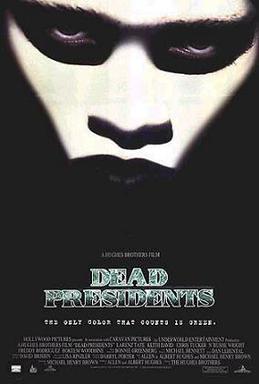
Finally, with no other opportunities available and feeling as if his country has abandoned him, Anthony agrees to take part in an armored car robbery. Working with him are a few friends from the old days and a few members of the revolutionary Nat Turner Cadre. Anthony thinks that he has the robbery planned out perfectly but nothing ever goes as planned.
In 1993, The Hughes Brothers made their directorial debut with Menace II Society, an incendiary film that holds up as one of the best feature debuts of any filmmaker. Their follow-up to Menace II Society was Dead Presidents. While Dead Presidents operates on a more epic scale than Menace II Society, it’s also a far more uneven film. While the first part of the film (which follows Anthony and his friends during their final days of high school) is strong, things start to fall apart once the action moves to Vietnam. The Hughes Brothers tried to recreate the Vietnam War on a Grenada Invasion budget and the action never feels credible. When Anthony returns to the Bronx, Dead Presidents regains some of its footing but the eventual armored car heist is never as exciting as it could be.
Still, Dead Presidents has enough good moments that it’s always watchable. Larenz Tate gives a good performance as Anthony and he’s surrounded by the some of the best black character actors of the 90s. Keep an eye out for a young and incredibly obnoxious Terrence Howard, playing an aspiring gangster and getting a deserved beating at the hands of Anthony. Though the movie often bites off more than it can chew, it does do a good job of seriously dealing with the issues that returning vets have to contend with when they come back home. Anthony suffers from PTSD, which is something that a lot of people didn’t talk about in 1995, and the Hughes Brothers deserve much credit for their sensitive handling of the topic. Dead Presidents may not be perfect but it’s impossible not to admire the film’s ambition.
This is a case where I like the song more than the music video. This video was actually filmed three years after Johnny Cash’s death. As far as “official” music videos are concerned, I always feel like a musician should have some sort of say into how their music is visually interpreted. Obviously, Johnny Cash wasn’t around to have anything to say about the video for God’s Gonna Cut You Down.
Since Cash wasn’t available, director Tony Kaye filled the video with cameos from other actors and musicians, a few of whom (though not many) were previous Cash collaborators. Among the celebs who make an appearance in this video: David Allan Coe, Patricia Arquette, Travis Barker, Peter Blake, Bono, Sheryl Crow, Johnny Depp, the Dixie Chicks, Flea, Billy Gibbons, Whoopi Goldberg, Woody Harrelson, Dennis Hopper, Terrence Howard, Jay-Z, Mick Jones, Kid Rock, Anthony Kiedis, Kris Kristofferson, Amy Lee, Adam Levine, Shelby Lynne, Chris Martin, Kate Moss, Graham Nash, Busy Philipps, Iggy Pop, Lisa Marie Presley, Q-Tip, Corinne Bailey Rae, Keith Richards, Chris Rock, Rick Rubin, Patti Smith, Sharon Stone, Justin Timberlake, Kanye West, Brian Wilson, and Owen Wilson. Some of the celebs — like Dennis Hopper and Kris Kristofferson — seem like they naturally belong there. Others seem so out-of-place that you’ll want to throw something. You know how that works,
God’s Gonna Cut You Down is a traditional folk song. I’ve heard countless versions of it. I prefer Cash’s version to the more traditional gospel arrangement but, then again, I tend to find gospel music to be dull in general. Cash’s arrangement brought new life to an old song.
In 1994, shortly after O.J. Simpson was charged with the murders of Nicole Brown Simpson and Ron Goldman, Fox rushed The O.J. Simpson Story into production. It was one of many “true life” stories that showed up as television movies during the 90s. There was a movie about Woody Allen and Mia Farrow’s divorce. There was a movie about David Koresh and the Branch Davidians, which actually aired while the siege in Waco was still ongoing. There were three movies about Amy Fisher. So, of course, O.J. would get a movie.
Though the movie was produced in 1994, it was not allowed to air in 1995 so that it would not prejudice any of the jurors in the case. (After all, they might have done something crazy like ignore all of the DNA evidence and let O.J. go free.) I think the legal authorities may have been giving The O.J. Simpson Story too much credit. There were many bad made-for-TV movies made in the 90s but The O.J. Simpson Story may very well be the worst. The only thing it could prejudice some against is television.
Opening with the discovery of the murders in Brentwood, The O.J. Simpson Story mixes scenes of O.J. (played by Bobby Hosea, who shows not a hint of O.J.s famous charisma) talking to the police and his lawyer, Bob Shapiro (Bruce Weitz, slightly more credible than John Travolta was in The People vs. O.J. Simpson) with flashbacks to O.J.’s youth, first marriage, and his relationship with Nicole (blandly played by Jessica Tuck, who, beyond the color of her hair, looked nothing like Nicole). The film also devotes some time to O.J.’s friendship with A.C. Cowlings, who, as a young man, is played by Terrence Howard.
Several of the famous incidents of the case are wanly recreated. The famous bronco chase is there, of course. O.J. is shown beating Nicole in the infamous 1989 incident, which the movie suggests was triggered by Nicole telling O.J. that he would never win an Oscar for appearing in The Naked Gun. But, since the movie was rushed into production before the trial even began, it is remarkable how much is left out. There’s no Mark Furhman finding the black glove. There’s no Kate Kaelin, Faye Resnick, Johnnie Cochran, or even Marcia Clark. Because the movie was made before the trial had even begun, it does not even take a stand on whether or not O.J.’s guilty. Narratively, it is an incomplete movie and evidence of why movies that claim to tell true stories should not be rushed into production before the story itself has been completed.
As for the film’s dialogue, when O.J. first meets Nicole, he asks her, “Any problem with going out with a brother?”
“Yeah,” Nicole says with a smile, “I’m in the Ku Klux Klan.”
Not surprisingly, The O.J. Simpson Story was directed by Alan Smithee, which was the pseudonym used by directors who felt that their movie has been so butchered by outside interference that they should not even be credited with the final result. The O.J. Simpson Story is one of the worst Smithee films that I have ever seen. Compared to The O.J. Simpson Story, Smithee’s work on Let’s Get Harrywas Oscar-worthy.
As for the real life O.J. Simpson, earlier today, he was granted parole from the Nevada Parole Board. He will be released from prison on October 1st. He has said that he hope to be allowed to move to Florida after being released. The real-life O.J. Simpson story continues.
When it comes to the long saga of O.J. Simpson, it seems appropriate to give the last word to MAD Magazine:
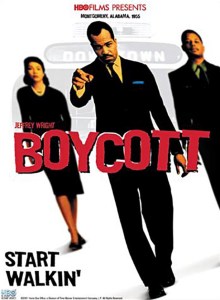
Originally made for HBO, Boycott is one of the best and, unfortunately, least-known films made about the life of Martin Luther King, Jr. Boycott tells the story of the Montgomery Bus Boycott, starting with the arrest of Rosa Parks for refusing to sit in the back of the bus to the eventual integration of the Montgomery public transportation system. Clark Johnson directs Boycott in a semi-documentary, handheld style, which adds an immediacy to the oft-told story.
Boycott focuses on the role that 24 year-old Martin Luther King, Jr. (played by Jeffrey Wright) played as the leader of the Montgomery Bus Boycott and how the boycott’s success turned King into a national figure. Jeffrey Wright does a great job playing the young King and it’s interesting to watch as the initially uncertain King finds both his voice and his strength as a leader. Boycott works as a good companion piece to Selma, not the least because Carmen Ejogo plays Coretta Scott King in both of them.
Also giving a noteworthy performances are Terrence Howard as King’s second-in-command, Ralph Abernathy and Erik Dellums in the role of Bayard Rustin, who was one of King’s closest confidants but, because he was gay, was often left outside of the movement’s inner circle. Before they worked together on Boycott, Dellums, the son of former U.S. Rep. Ron Dellums, co-starred with Clark Johnson on Homicide: Life on the Street.
Boycott is a tribute to not just Martin Luther King but also the entire civil rights movement.
(Lisa recently discovered that she only has about 8 hours of space left on her DVR! It turns out that she’s been recording movies from July and she just hasn’t gotten around to watching and reviewing them yet. So, once again, Lisa is cleaning out her DVR! She is going to try to watch and review 52 movies by the end of Thursday, December 8th! Will she make it? Keep checking the site to find out!)
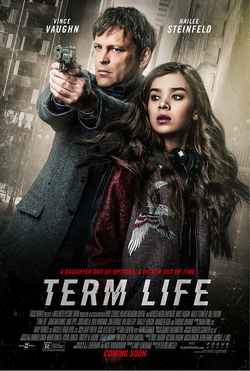
I recorded Term Life off one of the Starz channels on November 13th.
Vince Vaughn co-starred in two movies in 2016 and both of them were a little bit different from the fratty comedies for which he is best known. One of the movies was Hacksaw Ridge, in which Vaughn was cast against type as a tough drill sergeant. Hacksaw Ridge is one of the best films of the year and it features Vaughn’s best work since he appeared in 2007’s Into The Wild. The other film was Term Life, which had a very limited released in April and is now popping up on cable.
In Term Life, Vaughn plays Nick Barrow. Nick is a thief but he doesn’t actually steal anything. Instead, he plots heists and then sells his plans to the highest bidder. However, Nick has somehow managed to get in trouble with the mob, with a corrupt cop (Bill Paxton), and with … well, with everyone. I say somehow because it wasn’t always clear why everyone was so obsessed with killing Nick. They just were.
Knowing that his days are probably numbered, Nick takes out a life insurance policy on himself. He names, as the sole beneficiary, his estranged daughter, Cate (Hailee Steinfeld). With his reluctant daughter accompanying him, he goes on the run. While Nick and Cate finally start to bond and repair their damaged relationship, the very bad men searching for Nick kill a lot of people.
So, this is a weird one. At times, this film is a typical generation gap comedy, with Vaughn playing the former-cool-guy-turned-befuddled-dad who freaks out when he sees Cate’s bra hanging from a shower rod. This part of the film is actually kinda likable. Vaughn and Steinfeld are believable as father-and-daughter and their scenes together are sweet if predictable.
But then you’ve got the rest of the film, which is basically Bill Paxton brutally murdering people. The violence comes on so strong that it feels totally out-of-place when mixed in with scenes of Nick and Cate bonding. It’s such an abrupt tonal shift that it makes it impossible to get into the film.
Term Life has a cobbled together feel to it and it doesn’t help that it features the type of heavy-handed narration that feels as if it was added at the last minute in a desperate attempt to bring some sort of coherent structure to a messy film. On the plus side, both Vaughn and Steinfeld are believable and you occasionally care about their father-daughter relationship. On the negative side, likable characters keep dying.
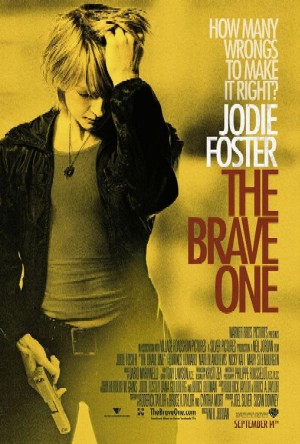
For our next entry in Embracing the Melodrama Part II, we take a look at Jodie Foster in the 2007 film The Brave One. And…
Well, how to put this delicately?
I hate hate hate hate HATE this movie, with every last fiber of my being. I hated it the first time that I saw it and I hated it when I recently rewatched it and right now, I’m hating the fact that I even decided to review this damn film because it means that I’m going to have to think about it. I’m going to try to get this review over with quickly because, with each minute that I think about this film, I doubt my commitment to cinema. That’s how much I hate this movie. If I’m not careful, I’m going to end up joining a nunnery before I finish this review…
So, in The Brave One, Jodie Foster plays Erica Bain. Erica lives in New York and hosts one of those pretentious late night radio shows that are always popular in movies like this but which, in real life, nobody in their right mind would waste a second listening to. Erica spends her time musing about life in the big city and hoping that we can all just love one another and expressing a lot of other thoughts that sound like they’ve been stolen from an automated twitter account.
Erica also has a boyfriend. His name is David and he’s played by Naveen Andrews. That means that he looks good and he has a sexy accent and when he first shows up, you hope that he’ll stick around for a while because otherwise, you’re going to have to listen to move of Erica’s radio monologues. But nope — one night, while walking through Central Park, David and Erica are attacked. David is killed. Erica is raped. And their dog is taken by the gang!
(And the film doesn’t seem to know which it thinks is worse…)
When Erica gets out of the hospital, she is, at first, terrified to leave her apartment. Or, at least, she’s terrified to leave her apartment for about five minutes. But then she does find the courage to go outside and, of course, the first thing she does is buy a gun. At first, she’s buying the gun for her own state of mind but, almost immediately after purchasing her firearms, she happens to stumble across a convenience store robbery.
Bang! Bang! Erica’s a vigilante now!
But, of course, she’s not really sure if that’s what she wants to be. Even though she eventually ends up sitting on a subway and waiting for a guy to approach her so she can shoot him, Erica is still never really that comfortable with the idea of seeking vengeance. And this is why I hated The Brave One. The film is so damned wishy washy about Erica’s motivations. Instead of allowing Erica to get any sort of satisfaction or emotional fulfillment out of her actions, The Brave One has her constantly doubting whether or not violence is the answer. And don’t get me wrong, I’m not saying that violence is the answer. But if you’re going to make a film about a female vigilante who is out looking for vengeance, why don’t you at least allow her to get some sort of empowerment out of her actions? That doesn’t mean that the film itself can’t be ambiguous about what she’s doing. But by having Erica constantly questioning her actions, it makes her into a weak character and it lets the men who raped her and the ones who subsequently threaten to do the same off the hook. It allows them to be seen as victims, as opposed to products of a society where men are raised to believe that women will never fight back.
There’s a far superior New York-set film that has almost the same plot as The Brave One. The title of that film was Ms. 45. It was made for a hundred times less money than The Brave One and, at the same time, it was and remains a hundred times better. (I previously wrote about Ms. 45 and The Brave One in my essay, Too Sordid To Ever Be Corrupted.)
The difference between the two films can be summed up by the film’s tag lines. The Brave One was advertised with, “How many wrongs to make it right?” Ms. 45 was advertised with: “She was abused and violated … IT WILL NEVER HAPPEN AGAIN!” Ms. 45 features a vigilante who never doubts her actions and, as a result, she becomes a symbol not of violence but of empowerment. Meanwhile, Jodie Foster is so constantly wracked with guilt and doubt that the film almost seems to be criticizing her for not staying in her apartment and trusting the police (represented by Terrence Howard and Nicky Katt) to do their job.
Oh! And, of course, at the end of the film, Erica gets her dog back. Because nobody ever permanently loses their dog in a big budget studio film…
And really, that’s why The Brave One is such a failure. It takes a subject that was tailor-made for the grindhouse and attempts to give it the slick and self-important studio approach. And part of that approach is that no one can be offended. This is a film that both wants to celebrate and condemn at the same time.

 Long before
 Through the Shattered Lens