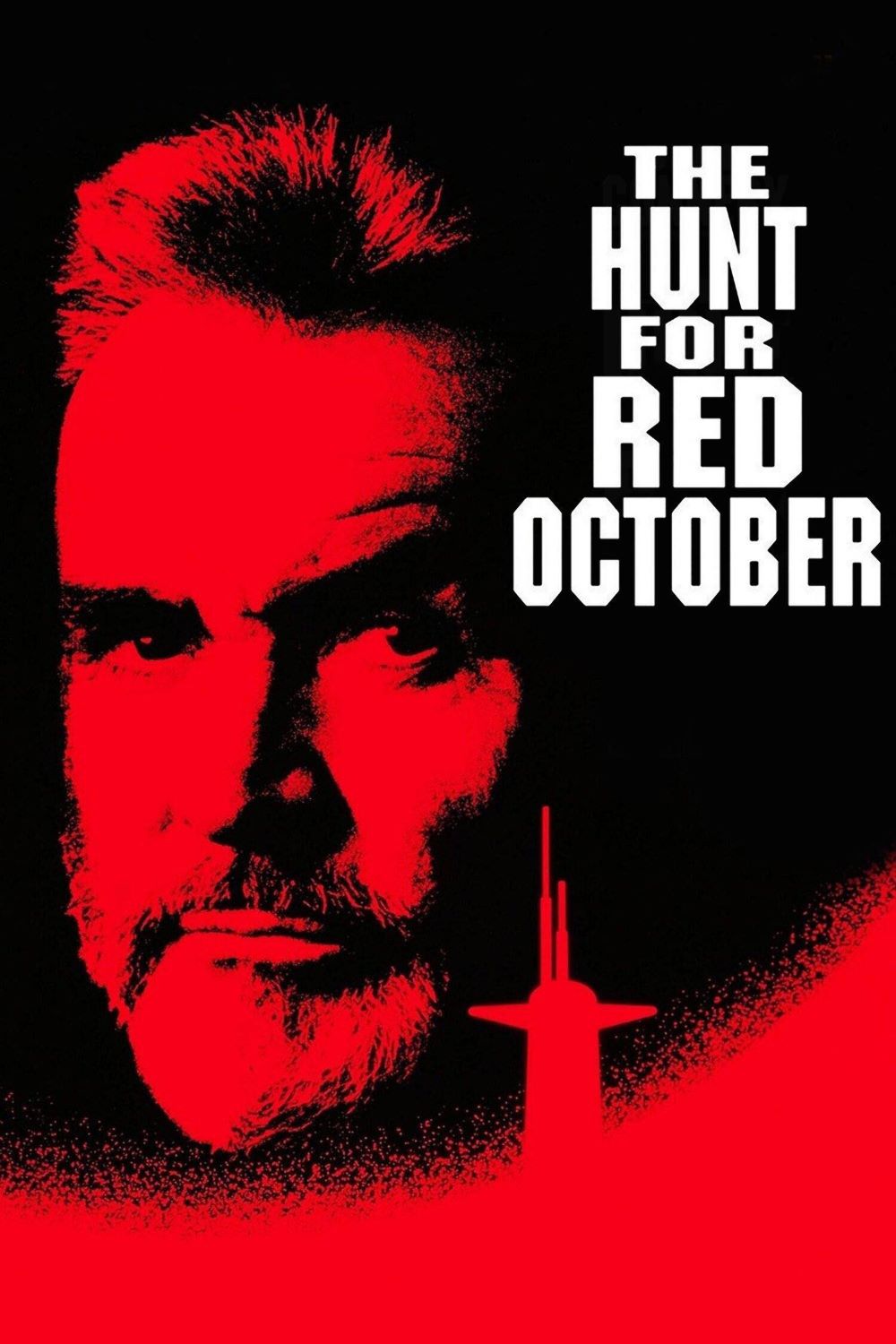
Review: The Hunt for Red October (dir. by John McTiernan)


“I’m a politician. Which means that I am a cheat and a liar, and when I’m not kissing babies, I’m stealing their lollipops.” — Dr. Jeffrey Pelt, National Security Advisor

The Hunt for Red October glides into the tail end of Cold War cinema like a stealthy sub cutting through midnight swells, packing a smart mix of spy intrigue and nail-biting underwater showdowns that keep you locked in from the opening credits. Directed by John McTiernan, fresh from helming Die Hard, this 1990 adaptation of Tom Clancy’s doorstopper novel smartly distills pages of naval geekery into a taut, propulsive thriller where Soviet skipper Marko Ramius—Sean Connery in full brooding mode—pilots the formidable Red October, a behemoth sub with a hush-mode propulsion system that ghosts past detection like a shadow in fog.

McTiernan shines in wrangling the script from Clancy’s tech-heavy tome, slicing through the babble to propel the story with crisp momentum and unrelenting suspense, turning potential info-dumps into pulse-quickening beats that hook casual viewers and sub nerds alike. The premise grabs fast: Ramius’s bold maneuvers ignite a transatlantic frenzy, with U.S. and Soviet forces locked in a paranoid standoff over what looks like an imminent crisis. That ’80s-era distrust simmers perfectly here, crammed into a runtime that pulses with fresh urgency decades later, amplified by those dim-lit sub corridors in steely teal tones that squeeze the air right out of the room.

Alec Baldwin embodies Jack Ryan as the reluctant brainiac from CIA desks, sweaty and green around the gills yet armed with instincts that cut through official noise like a periscope through chop. Pulled from family downtime—teddy bear in tow—he injects everyday stakes into the global chessboard, proving heroes don’t need camo or cockiness, just smarts and stubbornness. Connery’s Ramius dominates as a haunted vet with a personal chip on his shoulder, steering a tight-knit officer corps including Sam Neill’s devoted second-in-command, their quiet bonds hinting at deeper loyalties amid the red menace.

Standouts fill the roster seamlessly: James Earl Jones lends gravitas as the steady Admiral Greer backing Ryan’s wild cards; Scott Glenn commands the American hunter sub with laconic steel; Jeffrey Jones brings quirky spark to the sonar savant whose audio tricks flip the script on silence. The dialogue crackles with shorthand lingo and understated jabs, forging a crew dynamic that’s as pressurized as the hull plates, pulling you into hushed command post vibes without a whiff of cheesiness.

​​

McTiernan elevates the genre by leaning on wits over blasts—thrilling pursuits deliver without dominating, letting mind games and split-second calls drive the dread, all while streamlining Clancy’s minutiae into seamless propulsion. Gadgetry gleams without overwhelming: the sub’s whisper-quiet tech sparks clever cat-and-mouse in hazard-filled depths, ramping uncertainty to fever pitch. Pacing builds masterfully from war-room skepticism—Ryan battling brass skepticism—to heart-in-throat ocean dashes, every frame taut as a bowstring. Practical models and effects ground the peril in gritty tangibility, no digital gloss, evoking Ice Station Zebra‘s frosty traps but streamlined into a relentless machine that dodges the older film’s drag. It’s a clinic in balancing spectacle and smarts, where tension coils from isolation’s cruel math: one ping too many, and it’s lights out.

On the eyes and ears front, the movie plunges into submersed nightmare fuel—consoles pulsing crimson in battle stations, scopes piercing mist-shrouded waves, silo bays looming like sleeping leviathans. McTiernan tempers his action flair for thinker-thrills; Basil Poledouris’s great orchestral score surges with iconic power through the chases—those brooding horns, choral swells, and rhythmic pulses echoing engine throbs have etched into legend, pounding your chest like incoming cavitation and elevating every dive. Audio wizardry seals the immersion: hull groans, ping echoes, bubble roars craft a metallic tomb where errors echo eternally. Flaws peek through—early scenes drag with setup chatter, foes skew broad-stroked—but the core hunt erases them, surging to a sharp, satisfying close that nods to Ryan’s budding legend without overplaying the hand.

’90s tentpole lovers and thaw-era history fans find a benchmark here, as the film plays the long con of trust amid torpedoes, fusing bombast with nuance that reboots chase in vain. It bottles superpower jitters spot-on—frantic commands clashing with strike debates—yet softens adversaries via Connery’s world-weary depth and Neill’s subtle conviction. Endless rewatches uncover gems: crew hints dropped early, sonar hacks foreshadowing real tech leaps. Baldwin’s grounded Ryan—chopper-barfing, suit-clashing, chaos-navigating—earns triumphs the hard way, contrasting Das Boot‘s bleak grind with upbeat ingenuity that feels won, not waved. Poledouris’s motifs linger post-credits, a symphonic anchor boosting replay pulls.

Endurance stems from mastering sub-horror’s essence: solitude sharpening choices, where flubs invite apocalypse. Ramius embodies defector realism—war-weary idealist mirroring history’s turncoats—while Clancy’s specs (sub classes, velocities) anchor without anchoring down. McTiernan sidesteps flags; zero flag-waving, pure operator craft in dodges and climactic finesse that blends brains with boom. Quirks delight—the premier’s bluster, aides’ cool calculus—padding a 134-minute gem that exhales you surfacing, amped. Expands on score’s role too: “Hymn to Red October” choral rise mirrors Ramius’s quiet rebellion, threading emotional undercurrents through mechanical mayhem, a Poledouris hallmark outlasting the film.

Bottom line, The Hunt for Red October captivates via cerebral kick—shadow games in fluid physics, intellect over muscle, audacious plays punking empire folly. Sparks post-view chin-strokes on allegiances and risks. Connery’s gravelly “One ping only, Vasily” endures as gold; storm-watch it, trade sofa for sonar station—raw thrill spiked with savvy. Sub saga staple? This silent stalker nails every target.

Horror on TV: Gargoyles (dir by Bill Norton)


For today’s horror on television, we have a made-for-TV monster movie from 1972, Gargoyles!

What happens when a somewhat condescending anthropologist (Cornel Wilde) and his daughter (Jennifer Salt) head out to the desert?  Well, they stop by a crazy old man’s shack so that they can look at his genuine monster skeleton.  Before Wilde can thoroughly debunk the old man’s claims, the shack is attacked by real monsters!

That’s right!  Gargoyles exist and they apparently live in Arizona!  There’s nothing particularly surprising about the plot but the gargoyles are memorable creations and Bernie Casey gives a good performance as their leader.  The gargoyle makeup was designed by none other than Stan Winston, who won an Emmy for his work here and who went on to win Oscars for his work on Aliens, Terminator 2, and Jurassic Park.

As well, a very young Scott Glenn shows up in the cast.  I like to think that he’s playing the same character in both Gargoyles and Sucker Punch.

Enjoy!

Lisa Marie Reviews An Oscar Nominee: Apocalypse Now (dir by Francis Ford Coppola)


1979’s Apocalypse Now reimagines the Vietnam War as pop art.

Jim Morrison sings The End in the background as slow-motion helicopters pass in front of a lush jungle.  The jungle erupts into flame while in a dingy hotel room, Captain Benjamin Willard (Martin Sheen) gets drunks, practices his karate moves, and smashes a mirror before collapsing to the floor in tears.  The next morning, the hung-over and bandaged Willard ends up at a U.S. military base where he has a nice lunch with Lt. General Corman (G.D. Spradlin) and Col. Lucas (Harrison Ford) and a nearly silent man wearing an undone tie.  Willard is asked if it’s true that he assassinated an enemy colonel.  Willard replies that he did not and that the operation was classified, proving that he can both lie and follow military protocol.  Willard is told that a Col. Walter Kurtz (Marlon Brando) has gone rogue and his mission is to go into Cambodia and terminate his command with “extreme” prejudice.  It’s a famous scene that features G.D. Spradlin delivering a brilliant monologue about good and evil and yet it’s often missed that Willard is getting his orders from Roger Corman and George Lucas.

(Roger Corman was the mentor of director Francis Ford Coppola while the pre-Star Wars George Lucas was Coppola’s business partner.  Indeed, Apocalypse Now was originally somewhat improbably planned to be a George Lucas film.)

Up the river, Willard heads on a patrol boat that is populated with characters who could have come out of an old World War II service drama.  Chief (Albert Hall) is tough and no-nonsense.  Lance (Sam Bottoms) is the goofy comic relief who likes to surf.  Clean (Laurence Fishburne) is the kid who is obviously doomed from the minute we first see him.  Chef (Fredric Forrest) is the overage, tightly-wound soldier who just wants to find mangoes in the jungle and who worries that, if he dies in a bad place, his soul won’t be able to find Heaven.  The Rolling Stones are heard on the boat’s radio.  Soldiers on the other patrol boats moon the boat and toss incendiary devices on the roof.  It’s like a frat prank war in the middle of a war.

Colonel Bill Kilgore (Robert Duvall) is a badass calvary officer whose helicopter raids are legendary amongst the enemy and a dedicated surfer who tries to turn every night into the equivalent of an AIP Beach Party film.  He’s a brilliant warrior who speaks with Malibu accent (“Charlie don’t surf!”) and who doesn’t flinch when a bomb goes off near him.  “I love the smell a napalm in the morning,” he says and, for a few moments, you really wish the film would just abandon Willard so we could spend more time with Kilgore.  “Some day this war is going to end,” he says with a reassuring nod, showing a non-neurotic attitude that is the opposite of Kurtz’s.  Willard says that he could tell Kilgore was going to get through the war without even a scratch and it’s true.  Kilgore doesn’t try to rationalize or understand things.  He just accepts the reality and adjusts.  He’s a true surfer.

The film grows progressively more surreal the closer the boat heads up the river and gets closer to Cambodia.  A USO show turns violent as soldiers go crazy at the sight of the Playboy Bunnies, dressed in denim outfits and cowboy hats and twirling cap guns like the love interest in a John Wayne western.  A visit to a bridge that is built every day and blown up every night is a neon-lit, beautiful nightmare.  Who’s the commanding officer?  No one knows and no one cares.

The closer Willard gets to Kurtz, the stranger the world gets.  Fog covers the jungles.  A tiger leaps out of nowhere.  Dennis Hopper shows up as a photojournalist who rambles as if Billy from Easy Rider headed over to Vietnam instead of going to Mardi Gras.  Scott Glenn stands silently in front of a temple, surrounded by dead bodies that feel as if they could have been brought over from an Italian cannibal film.  Kurtz, when he shows up, is an overweight, bald behemoth who talks in riddles and who hardly seem to be the fearsome warrior that he’s been described as being.  “The horror, the horror,” he says at one point in one of the few moments that links Apocalypse Now to its inspiration, Joseph Conrad’s Heart of Darkness.

Directed by near-communist Francis Ford Coppola and written by the unapologetically right-wing John Milius, Apocalypse Now is actually less about the reality of Vietnam and more about how the images of the war shaped pop culture the world over.  It’s a reminder that Vietnam was known for being the first television war and that counterculture was not just made up of dropouts but also of writers, actors, and directors.  Kurtz may say that Willard’s been sent by grocery store clerks but actually, he’s been sent by the B-movie producers who first employed and mentored the directors and the actors who would eventually become the mainstays of the New Hollywood.  The film subverts many classic war film cliches but, at the same time, it stays true to others.  Clean dying while listening to a tape recording of his mother telling him not to get shot and to come home safe is the type of manipulative, heart-tugging moment that could have appeared in any number of World War II-era films.  And while Coppola has always said the film was meant to be anti-war, Col. Kilgore remains the most compelling character.  Most viewers would probably happily ride along with Kilgore while he flies over Vietnam and plays Wagner.  The striking images of Vietnam — the jungle, the explosions, the helicopters flying through the air — stay in the mind far more than the piles of dead bodies that appear in the background.

It’s a big, messy, and ultimately overwhelming film and, while watching it, it’s hard not to get the feeling that Coppola wasn’t totally sure what he was really trying to say.  It’s a glorious mess, full of stunning visuals, haunting music, and perhaps the best performance of Robert Duvall’s legendary career.  The film is too touched with genius to not be watchable but how one reacts overall to the film will probably depend on which version you see.

The original version, which was released in 1979 and was nominated for Best Picture, is relentless with its emphasis on getting up the river and finding Kurtz.  Willard obsesses on Kurtz and really doesn’t have much to do with the other people on the boat.  It gives the story some much-needed narrative momentum but it also makes Kurtz into such a legendary badass that it’s hard not to be disappointed when Willard actually meets him.  You’re left to wonder how, if Kurtz has been living in the jungle and fighting a brutal and never-ending guerilla war against the communists, he’s managed to gain so much weight.  Brando, who reportedly showed up on set unprepared and spent days improvising dialogue, gives a bizarre performance and it’s hard to view the Kurtz we meet as being the Kurtz we’ve heard about.  As strong as the film is, it’s hard not to be let down by who Kurtz ultimately turns out to be.

In 2001 and 2019, Coppola released two more versions of the film, Redux and The Final Cut.  These versions re-inserted a good deal of footage that was edited out of the original cut.  Most of that footage deals with Willard dealing with the crew on the boat and it’s easy to see why it was cut.  The scenes of Willard bonding with the crew feel out of character for both Willard and the rest of the crew.  A scene where Willard arranges for Clean, Lance, and Chef to spend time with the Playboy bunnies seems to go on forever and features some truly unfortunate acting.  Worst of all, Redux totally ruins Kilgore’s “I love the smell of napalm in the morning” monologue by having Willard suddenly steal his surf board.  Again, it’s out of character for Willard and it actually feels a bit disrespectful to Duvall’s performance to suddenly turn Kilgore into a buffoon.

But then there are moments that do work.  I actually like the lengthy French Plantation scene.  By the time Willard, Lance, and Chef stumble into the plantation,  the journey upriver has gotten so surreal that it makes a strange sort of sense that they would run into a large French family arguing politics while a clown tries to keep everyone distracted.  The new versions of the film are undeniably disjointed but they also shift the focus off of finding Kurtz and place it more on Willard discovering how weird things are getting in Vietnam.  As such, it’s less of a disappointment when Kurtz actually shows up.  Much as with the French Plantation scene, the journey has become so weird that Kurtz being overweight and pretentious feels somehow appropriate.

What all the versions of the film have in common is that they’re all essentially a neon-lit dream of pop cultural horror.  Is Apocalypse Now a horror film?  Critic Kim Newman argued that it owed a lot to the genre.  Certainly, that’s the case when Willard reaches the temple and finds himself surrounded by corpses and and detached heads.  Even before that, though, there are elements of horror.  The enemy is always unseen in the jungle and, when they attack, they do so quickly and without mercy.  In a scene that could almost have come from a Herzog film, the boat is attacked with toy arrows until suddenly, out of nowhere, someone throws a very real spear.  Until he’s revealed, Kurtz is a ghostly figure and Willard is the witch hunter, sent to root him out of his lair and set his followers on fire.  If the post-60s American horror genre was shaped by the images coming out of Vietnam then Apocalypse Now definitely deserves to be considered, at the very least, horror-adjacent.

Apocalypse Now was controversial when it was released.  (It’s troubled production had been the talk of Hollywood for years before Coppola finally finished his film.)  It was nominated for Best Picture but lost to the far more conventional Kramer vs Kramer.  Robert Duvall was the film’s sole acting nominee but he lost the award to Melvyn Douglas’s turn in Being There.  Douglas was very good in Being There and I imagine giving him the Oscar was also seen as a way of honoring his entire career.  That said, Duvall’s performance was amazing.  In his relatively brief screen time, Duvall somehow managed to take over and ground one of the most unruly films ever made.  The Oscar definitely should have gone to him.

As for the film itself, all three versions, flaws and all, are classics.  It’s a film that proves that genius can be found in even the messiest of productions.

SECRETARIAT (2010) – The greatest racehorse of all time?


I’ll admit that I’m not a huge fan of horse racing, although I will periodically go to the Oaklawn Racetrack in Hot Springs, AR, and watch them run. I did enjoy the horse racing movie SEABISCUIT (2003) when I saw it a decade or so ago, and I always enjoy driving past the beautiful horse farms in Lexington, KY, when I’m on my way to see my wife’s family in West Virginia. This weekend was the Kentucky Derby, and I saw a stat that every horse running is a descendant of the 1973 triple-crown winner, Secretariat. I thought that was pretty cool stuff. I told my wife about it, so we decided to watch the movie SECRETARIAT (2010) this morning. 

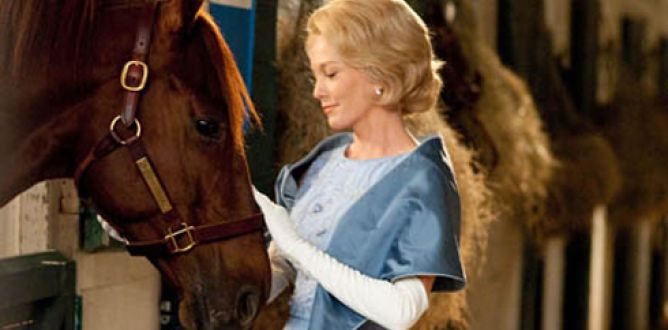
The film centers on Penny Chenery Tweedy (Diane Lane), a Boulder, CO housewife who takes over the management of her dad’s horse stables in Virginia when his health gets so bad that he can no longer handle it himself. The business is facing a lot of financial problems, and her husband just wants her to sell everything and come on back home. But Penny doesn’t want to sell, especially when the stable acquires a young colt that just may have to the right combination of speed and stamina to become a great racehorse. Wanting to see her horse get a chance to run, she hires eccentric trainer Lucien Laurin (John Malkovich) and the aggressive jockey Ron Turcotte (Otto Thorwarth) in order to give “Secretariat” a chance to reach his potential. And boy does he ever, ultimately becoming the first “Triple Crown” winner in 25 years. 

I’ll go ahead and say that I pretty much got exactly what I was expecting with SECRETARIAT. It’s a “feel-good” movie that made me happy at the end. Outside of him being a triple crown winner, I didn’t know much about Secretariat’s story, so it was fun just seeing how dominant he truly was during his legendary run in 1973. And the performances from the leads are very good. Diane Lane is beautiful and convincing as the housewife determined to give every thing she has to make Secretariat a winner. John Malkovich’s eccentric horse trainer is the kind of role he excels in, and he’s both funny and emotionally engaging. I liked Otto Thorwarth and Nelson Ellis as Secretariat’s jockey and groomer, respectively. Each of them had their individual moments to shine. I also wanted to mention how impressive the camerawork is during the racing sequences. For a film like this to be exciting, the races have to be exciting and director Randall Wallace and cinematographer Dean Semler deliver in spades. If I had any complaint about the film, it would probably be the oversimplification of some of the supporting characters. For a film based on a true story, it was odd to see the owner of Secretariat’s primary competition reduced to almost a comic book villain in his behavior. That aside, I enjoyed the film and I’m glad I watched it. 

I’ve include the trailer for SECRETARIAT below:

14 Days of Paranoia #6: The Player (dir by Robert Altman)


1992’s The Player tells the story of Griffin Mill (Tim Robbins).

It’s not easy being Griffin Mill.  From the outside, of course, it looks like he has the perfect life.  He’s a studio executive with a nice house in Hollywood.  He’s young.  He’s up-and-coming.  Some people, especially Griffin, suspect that he’ll be the president of the studio some day.  By day, he sits in his office and listens to pitches from respected screenwriters like Buck Henry.  (Henry has a great idea for The Graduate II!)  During the afternoon, he might attends dailies and watch endless takes of actors like Scott Glenn and Lily Tomlin arguing with each other.  Or he might go to lunch and take a minute to say hello to Burt Reynolds.  (“Asshole,” Burt says as Griffin walks away.)  At night, he might go to a nice party in a big mansion and mingle with actors who are both young and old.  He might even run into and share some sharp words with Malcolm McDowell.

But Griffin’s life isn’t as easy as it seems.  He’s constantly worried about his position in the studio, knowing that one box office failure could end his career.  He fears that a new executive named Larry Levy (Peter Gallagher) is after his job.  Two new screenwriters (Richard E. Grant and Dean Stockwell) keep bugging him to produce their downbeat, no-stars anti-capitol punishment film.  His girlfriend (Cynthia Stevenson) wants to make good movies that mean something.  Even worse, someone is sending Griffin threatening notes.

It doesn’t take long for Griffin to decide that the notes are coming from a screenwriter named Dave Kahane (Vincent D’Onofrio).  Griffin’s attempt to arrange a meeting with Dave at a bar so that Griffin can offer him a production deal instead leads to Griffin murdering Dave in a parking lot.  While the other writers in Hollywood mourn Dave’s death, Griffin starts a relationship with Dave’s artist girlfriend (Great Scacchi) and tried to hide his guilt from two investigating detectives (Whoopi Goldberg and Lyle Lovett).  Worst of all, the notes keep coming.  The writer, whomever they may be, is now not only threatening Griffin but also seems to know what Griffin did.

After spend more than a decade in the industry wilderness, Robert Altman made a critical and commercial comeback with The Player.  It’s a satire of Hollywood but it’s also a celebration of the film industry, featuring 60 celebrities cameoing as themselves.  Everyone, it seems, wanted to appear in a movie that portrayed studio execs as being sociopathic and screenwriters as being whiny and kind of annoying.  The Player both loves and ridicules Hollywood and the often anonymous men who run the industry.  Largely motivated by greed and self-preservation, Griffin may not love movies but he certainly loves controlling what the public sees.  In the end, only one character in The Player sticks to her values and her ideals and, by the end of the movie, she’s out of a job.  At the same time, Griffin has a social life that those in the audience can’t help but envy.  He can’t step out of his office without running into someone famous.

The Player is one Altman’s most entertaining films, with the camera continually tracking from one location to another and giving as a vision of Hollywood that feels very much alive.  Tim Robbins gives one of his best performances as Griffin Mill and Altman surrounds him with a great supporting cast.  I especially liked Fred Ward as the studio’s head of security.  With The Player, Altman mixes melodrama with a sharp and sometimes bizarre comedy, with dialogue so snappy that the film is as much a joy to listen to as to watch.  That said, the real attraction of the film is spotting all of the celebrity cameos.  (That and cheering when Bruce Willis saves Julia Roberts from certain death.)  Altman was a director who often used his films to explore eccentric communities.  With The Player, he opened up his own home.

Previous entries in 2025’s 14 Days Of Paranoia:

  1. The Fourth Wall (1969)
  2. Extreme Justice (1993)
  3. The Lincoln Conspiracy (1977)
  4. Conspiracy (2007)
  5. Bloodknot (1995)

14 Days of Paranoia #2: Extreme Justice (dir by Mark L. Lester)


What type of justice?

Extreme justice, y’all!

In this 1993 film, Lou Diamond Phillips stars as Jeff Powers.  Who is Jeff Powers?  He’s a cop!  He wants to keep the street safe!  Sometimes, he knows that you have to be willing to break the rules!  He’s a cop who does things his way!

Okay, is that enough exclamation points?  I’m not just using them to be obnoxious.  The film is pretty much just one big exclamation point.  The action is hyperintense and the film is full of characters who always seem like they’re just one step away from exploding.  No one in this film is particularly calm or laid back.  From the start, everything is dialed to eleven and it just keeps going higher and higher.

After Jeff is put on probation for roughing up a suspect, he receives an invitation to join an elite squad of detective.  Led by the charismatic Detective Dan Vaughn (Scott Glenn, giving a performance that is so over-the-top that he yells straight at the camera at one point), the Special Investigative Section is the best of the bed.  Upon joining, Jeff finds himself a member of a sacred fraternity of law enforcers.  Working with men like the always amused Detective Larson (Yaphet Kotto) and the somewhat paranoid Angel (Andrew Divoff), Jeff finds himself tracking some of the biggest criminals in the city.

What Jeff also discovers is that SIS does more than just arrest criminals.  The SIS has been given an unofficial license to kill and they end up executing as many people as they take to jail.  Often times, Vaughn will tells the men to allow a crime to be committed so that they can then dispense their own brand of justice.  In the film’s most disturbing scene, the members of SIS wait until after a woman has been raped in an alley before they move to neutralize her attackers.  When Jeff finally decides that he can’t be a part of all this and tries to reveal what’s going on, he discovers that the SIS has some support in some very high places.  Who cares if the SIS is allowing crimes to be committed or if an innocent person occasionally gets caught in the crossfire?  At least they’re taking care of the criminals!

Extreme Justice is a crude and energetic film and one that is based on some of the stories that spread about the LAPD’s RAMPART division in the 90s.  That the film works is a testament to the performances of Phillips, Kotto, and Glenn and also the direction of Mark L. Lester.  An exploitation vet who occassionally made big studio action films as well, Lester keeps the pace moving at breakneck speed and, even more importantly, he allows both sides to have their say.  While Jeff is upset about SIS’s methods, Detective Vaughn is correct when he says that his unit is targeting the worst of the worst.  It makes for an unusually intelligent exploitation film, one that leaves the audience with a lot to consider.  How far would you go to keep your neighborhood safe?

Previous entries in 2025’s 14 Days Of Paranoia:

  1. The Fourth Wall (1969)

The Challenge (1982, directed by John Frankenheimer)


Rick Murphy (Scott Glenn) is a punch-drunk boxer who is hired to return an ancient sword to Japan so that it can be returned to its rightful owner, the honorable Toru (Toshiro Mifune).  Once in Japan, Rick becomes involved in a battle between Toru and his corrupt brother, Hideo (Atsuo Nakamura).  Hideo demands that Rick work as an undercover spy in Toru’s martial arts school or be beheaded.  Rick decides to keep his head and be a spy but he soon finds himself truly wanting to learn the ways of the Bushido.

A martial arts film is the last place most people would expect to find Scott Glenn and considering how miscast Glenn is, that’s understandable.  Scott Glenn feels very out-of-place as both a boxer and a modern-day samurai.  Scott Glenn is a very good actor but the role of Rick Murphy called for someone who could mix comedy with drama and be convincingly desperate.  That’s not Scott Glenn.  Who would have been better in the role?  Tom Berenger was already acting in 1982.  Or maybe even someone like Jan-Michael Vincent.  Vincent was a B-actor but, deep down, The Challenge is a B-movie.

The good thing is that the action often does make up for Glenn’s miscasting.  John Frankenheimer struggled with making the human drama compelling but he knew how to film a good fight.  John Sayles’s script is pulpy without ever being disrespectful to Japanese culture and, as always, Mifune looks like he could battle and defeat the entire world if he wanted to.

One final note: Steven Seagal worked behind-the-scenes on the film but we won’t hold that against it.

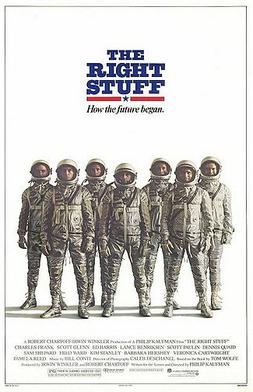
Lisa Marie Reviews An Oscar Nominee: The Right Stuff (dir by Philip Kaufman)


There’s a brilliant scene that occurs towards the end of 1983’s The Right Stuff.

It takes place in 1963.  The original Mercury astronauts, who have become a symbol of American ingenuity and optimism, are being cheered at a rally in Houston.  Vice President Lyndon Johnson (Donald Moffat) stands on a stage and brags about having brought the astronauts to his supporters.  One-by-one, the astronauts and their wives wave to the cheering crowd.  They’re all there: John Glenn (Ed Harris), Gus Grissom (Fred Ward), Alan Shephard (Scott Glenn), Wally Schirra (Lance Henrisken), Deke Slayton (Scott Paulin), Scott Carpenter (Charles Frank), and the always-smiling Gordon Cooper (Dennis Quaid).  The astronauts all look good and they know how to play to the crowd.  They were chosen to be and sold as heroes and all of them have delivered.

While the astronauts are celebrated, Chuck Yeager (Sam Shepard) is at Edwards Air Force Base.  Yeager is the pilot who broke the sound barrier and proved that the mythical “demon in the sky,” which was whispered about by pilots as a warning about taking unnecessary risks, was not waiting to destroy every pilot who tried to go too fast or too high.  Yeager is considered by many, including Gordon Cooper, to be the best pilot in America.  But, because Yeager didn’t have the right image and he had an independent streak, he was not ever considered to become a part of America’s young space program.  Yeager, who usually holds his emotions in check, gets in a jet and flies it straight up into the sky, taking the jet to the edge of space.  For a few briefs seconds, the blue sky becomes transparent and we can see the stars and the darkness behind the Earth’s atmosphere.  At that very moment, Yeager is at the barrier between reality and imagination, the past and the future, the planet and the universe.  And watching the film, the viewer is tempted to think that Yeager might actually make it into space finally.  It doesn’t happen, of course.  Yeager pushes the jet too far.  He manages to eject before his plane crashes.  He walks away from the cash with the stubborn strut of a western hero.  His expression remains stoic but we know he’s proven something to himself.  At that moment, the Mercury Astronauts might be the face of America but Yeager is the soul.  Both the astronauts and Yeager play an important role in taking America into space.  While the astronauts have learned how to take care of each other, even the face of government bureaucracy and a media that, initially, was eager to mock them and the idea of a man ever escaping the Earth’s atmosphere,  Chuck Yeager reminds us that America’s greatest strength has always been its independence.

Philip Kaufman’s film about the early days of the space program is full of moments like that.  The Right Stuff is a big film.  It’s a long film.  It’s a chaotic film, one that frequently switches tone from being a modern western to a media satire to reverent recreation of history.  Moments of high drama are mixed with often broad humor.  Much like Tom Wolfe’s book, on which Kaufman’s film is based, the sprawling story is often critical of the government and the press but it celebrates the people who set speed records and who first went into space.  The film opens with Yeager, proving that a man can break the sound barrier.  It goes on to the early days of NASA, ending with the final member of the Mercury Seven going into space.  In between, the film offers a portrait of America on the verge of the space age.  We watch as John Glenn goes from being a clean-cut and eager to please to standing up to both the press and LBJ.  Even later, Glenn sees fireflies in space while an aborigines in Australia performs a ceremony for his safety.  We watch as Gus Grissom barely survives a serious accident and is only rescued from drowning after this capsule has been secured.  The astronauts go from being ridiculed to celebrated and eventually respected, even by Chuck Yeager.

It’s a big film with a huge cast.  Along with Sam Shepherd and the actors who play the Mercury Seven, Barbara Hershey, Pamela Reed, Jeff Goldblum, Harry Shearer, Royal Dano, Kim Stanley, Scott Wilson, and William Russ show up in roles both small and large.  It can sometimes be a bit of an overwhelming film but it’s one that leaves you feeling proud of the pioneering pilots and the brave astronauts and it leaves you thinking about the wonder of the universe that surrounds our Earth.  It’s a strong tribute to the American spirit, the so-called right stuff of the title.

The Right Stuff was nominated for Best Picture but, in the end, it lost to a far more lowkey film, 1983’s Terms of Endearment.  Sam Shepard was nominated for Best Supporting Actor but lost to Jack Nicholson.  Nicolson played an astronaut.

Silverado (1985, directed by Lawrence Kasdan)


In the old west, a cowboy named Emmet (Scott Glenn) teams up with a reformed outlaw named Paden (Kevin Kline) and they bust Emmet’s wild younger brother, Jake (Kevin Costner), out of jail.  After Mal (Danny Glover) helps the three of them escape from a posse, they all end up going to the town of Silverado, where all four of them have business.  Emmett and Jake want to protect their sister from the corrupt son (Ray Baker) of a cattle baron who was previously killed by Emmett.  Mal wants to save his sister Rae (Lynn Whitfield) from an evil gambler (Jeff Goldblum).  Paden discovers that Cobb (Brian Dennehy), his former partner-in-crime, is now the sheriff of Silverado and working for the cattle barons.  When Paden tries to protect the new settlers (including Rosanne Arquette), it leads to a confrontation with his former partner.

In the 80s, when he wasn’t directing films like The Big Chill and The Accidental Tourist, Lawrence Kasdan specialized in paying homage to the films of Hollywood’s golden age.  He started his directorial career with Body Heat, a modern film noir.  He worked on the screenplays of both Empire Strikes Back and Raiders of the Lost Ark.  With Silverado, Kasdan tried to resurrect the western.

Silverado is a traditional western with a few modern touches, like casting Jeff Goldblum as a gambler and John Cleese as the sheriff who wants to execute Kevin Costner.  Silverado also has more humor than a typical western, largely thanks to Kevin Kline.  Silverado starts out as a comedy before turning serious and grim once the four heroes finally reach Silverado.

Kasdan’s love of the genre is obvious in every frame of Silverado but, in trying to tell multiple stories at once, the movie spreads itself too thin.  I like that Kasdan tried to shake things up by casting actors who most people wouldn’t expect to see in a western but both Kevin Kline and Brian Dennehy seem miscast in their roles and their final confrontation never becomes the epic moment that it needs to be.  Scott Glenn and Kevin Costner are far more believable in their roles.  Danny Glover is also believable but his character is underused.

Silverado was obviously a labor of love for Kasdan and it shows that, if nothing else, Kasdan understood the appeal of the genre and the beauty of the wide open frontier.  The movie has its flaws but fans of westerns will appreciate his effort.

#MondayMuggers – Why NIGHT OF THE RUNNING MAN (1995)?


Every Monday night at 9:00 Central Time, my wife Sierra and I host a “Live Movie Tweet” event on X using the hashtag #MondayMuggers. We rotate movie picks each week, and our tastes are quite different. Tonight, Monday January 6th, we’re watching NIGHT OF THE RUNNING MAN, starring Scott Glenn, Andrew McCarthy, and John Glover.

In a nutshell, this movie is about a Las Vegas cab driver (McCarthy) who discovers a million dollars of stolen money in his cab. He is then tracked by a relentless and cold-blooded assassin (Glenn) sent to retrieve the money.

So why did Sierra pick NIGHT OF THE RUNNING MAN, you might ask? Well I asked her and she said, “I like that guy, Andrew McCarthy.” And that was it! I do remember watching the first hour or so of this movie on cable TV late one night about 25 years ago or so. I remember thinking it was pretty good prior to falling asleep. I’ve always liked Scott Glenn, even though he was a jerk in URBAN COWBOY. He’s a pretty vicious killer here so that should be fun. And John Glover is one of those guys I just enjoy seeing pop up in any movie. His bad guy in 52 PICK-UP is one of my all time favorite villains. Plus, this was directed by Mark L. Lester, the director of TRUCK STOP WOMEN, ROLLER BOOGIE, CLASS OF 1984, and COMMANDO. That’s quite a variety of flicks! And hell, it will be nice for me to see how the movie ends after all these years.

So join us tonight to for #MondayMuggers and watch NIGHT OF THE RUNNING MAN. It’s on Amazon Prime, as well as Tubi and Freevee.