The Film’s of 2024: God’s Not Dead: In God We Trust (dir by Vance Null)


It can be easy to forget just what a big splash God’s Not Dead made when it was released back in 2014.  Today, it’s taken for granted that every year, at least one faith-based movie will be released to terrible reviews and then “shock” everyone by opening up strong at the box office.  However, in 2014, God’s Not Dead was the film that started the whole trend, along with sparking the ongoing debate about whether or not Hollywood has the slightest idea what most Americans want to see.

That’s not to say, of course, that God’s Not Dead was a good film.  It’s not.  It’s a ludicrously simplistic and smug film that, over the course of its overly long run time, promotes the idea that the only reason atheists exist is because they’re either bitter, evil, or both.  (For the record, if a professor truly threatened to fail a paying student solely because of his religious beliefs, the end result would probably be a lawsuit.)  The idea that someone could sincerely disagree with the film’s heroes or even believe differently than them without having an ulterior motive is not one that is entertained in the God’s Not Dead universe.  Indeed, perhaps the most interesting thing about the God’s Not Dead films is that they are just as heavy-handed and often just as condescending as the secular films being churned out by the major studios.

God’s Not Dead has, to date, spawned four sequels.  The second was enjoyably campy and featured an earnest performance from Melissa Joan Hart.  The third, which is the the closest that the franchise has gotten to actually making a good film, was surprisingly even-handed, or at least as even-handed as a film in this franchise can be.  The fourth was way too talky but, because it came out during the COVID lockdowns, its condemnation of government overreach reflected the way that a lot of people were feeling at the time.  Somewhat inevitably, the fifth film finds Reverend David Hill (David A.R. White) running for Congress again the villain from the second film, dastardly atheist Peter Kane (Ray Wise).

The film opens with the death of an incumbent congressman.  His opponent, Peter Kane, tells the press that the congressman was a good man and then proceeds to gloat about his death in private.  Kane is an ultra-liberal atheist.  Usually, the villains in the God’s Not Dead universe have a dead relative to help explain why they’ve lost their faith but Kane is just evil.  (In God’s Not Dead 2, Kane specifically put Melissa Joan Hart on trial for expressing her Christian beliefs and then chortles, “We are going to prove God is dead!”)  With Kane on the verge of being elected to Congress by default, Rep. Daryl Smith (Isaiah Washington) suggests that David Hill, who went viral for denouncing Congress in the fourth film, should be the party’s new nominee.

After some hesitation, Hill agrees.  However, he drives his campaign manager, Lottie Joy (Samaire Armstrong), crazy by basing his campaign on his religious beliefs.  Of course, if you didn’t want a candidate to talk about his religious beliefs in a campaign, why would you nominate a pastor whose fame is totally based on those beliefs?  Add to that, Hill is running for a Congressional seat in Arkansas.  I have family in Arkansas.  Growing up, I occasionally lived in Arkansas.  Sure, there are liberals in Arkansas and there are atheists in Arkansas.  But none of them are going to get elected to Congress anytime soon.  Arkansas is probably one of the few states where Hill’s faith-based campaign wouldn’t be considered controversial.

(That Mike Huckabee has a cameo as himself should be all the reminder that viewers need that Arkansas is not at all hesitant about electing pastors to higher office.)

It’s heavy-handed and cartoonish, which is probably to be expected.  Unfortunately, it’s also rather boring, with not even Ray Wise’s villainy providing much entertainment value.  Outside of arguing that atheists are evil and that separation of church and state is just a catch phrase, the film argues that money is a divisive force in politics and that politicians shouldn’t be bought.  Wow, really!?  It’s a film about politics that has little fresh insight to offer.  David Hill goes from being a media-savvy pastor to being an innocent naïf who is shocked to discover that politics is a dirty business.  God’s Not Dead: In God We Trust makes Billy Jack Goes To Washington seem like a hard-hitting portrayal of American politics.

I will give this franchise some credit for maintaining a surprising sense of continuity.  As I mentioned earlier, Ray Wise returns as the character that he played in the second film.  Paul Kwo is back as Hill’s associate pastor.  Dean Cain returns as the amoral businessman from the first film.  You have to imagine that Kevin Sorbo is kicking himself for allowing his smug professor character to die in the first film.  What’s funny is that the college student who kicked off the franchise by refusing to sign a piece of paper declaring God to be dead has pretty much vanished from the films.  Whatever happened to that kid?

In the end, we all know where this is going.  The next film will undoubtedly feature David Hill running for president.  2028 is right around the corner.

A Blast From The Past: Stoned (dir by John Herzfeld)


In 1980’s Stoned, Scott Baio plays Jack Melon, a teenager with a problem.

Jack is shy, awkward, and can’t escape the shadow of his older brother, Mike (Vincent Bufano).  Mike is champion swimmer.  Jack is someone who can barely walk down a hallway without walking into a wall.  But then Teddy (Jack Finch) gets Teddy hooked on marijuana, the so-called weed with roots in Hell!  Soon, Jack is acting weird, making strange jokes, and getting all of the attention in the world.  Unfortunately, Jack is also alienating those closest to him and his newfound habit leads to a near-tragedy.

Stoned was aired as an ABC Afterschool Special and, while it’s not quite Reefer Madness, it does adhere to the general anti-drug formula.  In record time, Jack goes from being shy and dorky to being goofy and potentially dangerous.  We get all the expected scenes of Jack devouring ice cream, Jack wandering around in a daze, Jack realizing that the girl he likes what’s nothing to do with the new Jack, Jack’s well-meaning teacher (played by the show’s writer and director, John Herzfeld) confronting his students about their drug use, and Jack accidentally hitting his brother with an oar.  Jack thinks that marijuana is opening his brain because, while stoned, he suddenly realizes that a tree looks like “Old Man Eber.”  Stoned goes on to show Jack ruining his life but I have to admit that I spent most of the running time wondering who Old Man Eber was.  (Seriously, Old Man Eber sounds like some sort of Lovecraftian ghoul, waiting in the shadows to drag one to an Arkham cemetery.)  Of course, someone nearly dies as a result of Jack’s marijuana use.  What’s interesting is Jack is able to save the person’s life, even though he’s stoned.  Would non-stoned Jack have been able to do it?

From the fashion choices to the cast to the message that marijuana is the most dangerous thing on the planet, Stoned is one of those TV specials that epitomizes its time.  This was a film that was made at a time when it was inconceivable that there would some day be commercials for edible gummies and it shows.  Watching Stoned is like stepping into a time machine.

Today, of course, Scott Baio is better known for his politics than his acting.  Whenever I see a headline that reads, “This veteran Hollywood star is calling out his industry for not understanding America,” I know the story is inevitably going to be about Scott Baio complaining about his taxes.  That said, Scott Baio is convincing when he’s playing Jack as being awkward and insecure but he definitely goes a bit overboard once Jack starts smoking.  While that probably dilutes the effectiveness of the film’s message (because, let’s be honest, real stoners are going to watch this and easily recognize the fact that Jack is trying way too hard to convince everyone that he’s stoned), it does give this film a certain entertainment value.

Here is Stoned, complete with the commercials that aired when the show was original broadcast on November 12th, 1980:

Retro Television Reviews: Fantasy Island 2.25 “Amusement Park/Rock Stars”


Welcome to Retro Television Reviews, a feature where we review some of our favorite and least favorite shows of the past!  On Tuesdays, I will be reviewing the original Fantasy Island, which ran on ABC from 1977 to 1986.  The entire show is currently streaming on Tubi!
This week, season 2 comes to a close as we take another trip to the other side of the island!

Episode 2.25 “Amusement Park/Rock Stars”

(Dir by Cliff Bole, originally aired on May 13th, 1979)

Oh crap, it’s another Fantasy Island Sunday Special!

Apparently, in 1979, Aaron Spelling wanted to do a Fantasy Island spin-off for children, one that would have aired on Sunday nights.  The spin-off would have taken place on “the other side of the Island,” which was apparently designed to be very family-friendly.  The previous Sunday Special featured Kimberly Beck as Mr. Roarke’s assistant on the other side of the island.  In the second Sunday Special, Kimberly Beck is nowhere to be seen and the hosting duties are handled by Roarke and Tattoo.

As usual, Tattoo starts the episode by revealing his latest scheme.  He’s read a book on Sherlock Holmes and has decided that he wants to be a master of disguise.  He begins the show by disguising himself as Sherlock Holmes.

Later, he sneaks into Mr. Roarke’s office while disguised as a one-eyed, hook-handed pirate.

By the end of the episode, Tattoo has been reduced to dressing up like a chicken.

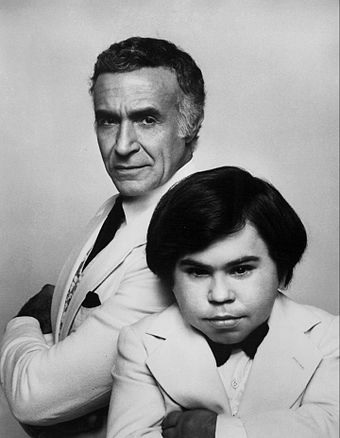
Mr. Roarke sees through all the disguises and, as usual, he comes across as being more annoyed than amused by his assistant.  It’s often been said that Ricardo Montalban and Herve Villechaize could not stand working together on Fantasy Island and, having spent nearly a year watching this show, I can say that it’s pretty obvious that was the case.  Even while trading jokes, there’s an undercurrent of hostility to all of their interactions.

But what about the fantasies?  Well, they’re a bit childish but let’s get to them.  As with the previous Sunday Special, the children arrive via hot air balloon.  No, Tattoo does not yell, “The balloon!  The balloon!”  In fact, the whole thing with the balloon seems to be silly and incredibly impractical.  I mean, where is the balloon taking off from?

Departing from the balloon are the Collins Family.  Robbie (Scott Baio), Willie (Jimmy Baio), Scooter (Keith Coogan), and Jodie (Jill Whelan) have come to the Island because Robbie has a fantasy about all of them becoming rock stars.  Upon arrival, Mr. Roarke tells them that he has already taken the demo that they sent him and turned it into an album.  They’re a big hit in the UK and on Fantasy Island.  But can they impress the American record executive that Mr. Roarke has invited to hear them?

It’s going to be difficult because, as Robbie discovers, the album features a remastered version of their demo, one that makes them sound like better musicians than they actually are.  Robbie panics.  “How are we going to sound like that?”  Mr. Roarke tells them to figure it out.  Robbie’s solution is to just lip-sync to the album.

Now, to be honest, this seems like not only a practical solution but it’s also what a lot of bands do in real life.  But Mr. Roarke is scandalized to discover that the kids paid Tattoo ten dollars to play the album back stage while they pretended to perform.  Robbie’s conscience gets the better of him and he confesses his crime to the record exec.  The record exec doesn’t care.  He hires the kids on a songwriters, because who wouldn’t want a bunch of pre-teen songwriters on the payroll?

However, the Collins Family has another problem.  It turns out that they’re runaways!  After their parents were lost at sea, the Collins kids were sent to four different orphanages.  The kids escaped to Fantasy Island but now, Mrs. Ridges (Joanna Barnes) has come to the Island and is planning on taking the kids back.  Fortunately, Mr. Roarke explains that he is the ruler of Fantasy Island and that the law doesn’t apply in his domain.  Even more fortunately, a telegram suddenly arrives, informing the kids that their parents did not drown but instead washed up on an isolated beach in Mexico.  Their parents have been rescued and the kids are no longer wards of the state!  Yay!

(That’s some incredible Dues ex Machina there, no?)

While this is going on, Darius (Jarrod Johnson) wants to run the Fantasy Island Amusement Park.

Wait …. Fantasy Island has an amusement park?

Yep, and it’s kind of a dump.  Seriously, the park looks like it reeks of spilled beer, stale weed, and lost dreams.  It’s a true nightmare alley.
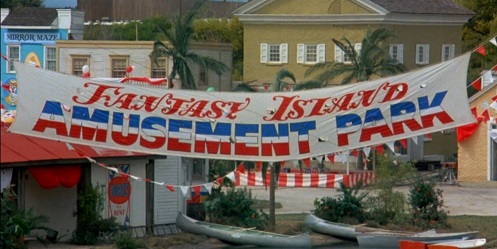
Darius’s main reason for wanting to run the park is so he can give his dad, motorcycle stunt driver The Great Scott (Ted Lange), a job.  The Great Scott is hired to jump over the Fantasy Island lagoon but, when he sees Darius nearly fall off the Ferris wheel, he realizes that it’s more important to be there for his son than to risk his life.  (That said, The Great Scott does risk his life by climbing up the Ferris wheel to save Darius.)  Mr. Roarke then offers The Great Scott a new job, as the manager of the amusement park.  Of course, I watched this whole fantasy thinking to myself that The Great Scott already had a great job, working as a bartender on the Love Boat.

That said, let’s give some credit to Ted Lange, who actually gives a pretty emotional and kind of touching performance as The Great Scott.  Lange may be best known for playing Isaac but he’s also a graduate of London’s Royal Academy and I’ve heard that he was a wonderful Othello on stage.  My point is that, even if he is best known for the way he would point at people while serving drinks, Ted Lange can act and this episode certainly proves that.

Overall, this episode was clearly meant to appeal to kids and, as a result, it felt a bit childish.  This was not only the last episode of season 2 but it was also the last of the Sunday Specials and that’s probably a good thing.

Next week, we start season 3!
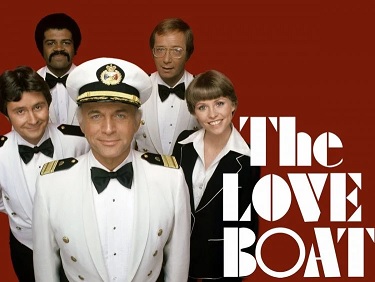
Retro Television Reviews: The Love Boat 1.3 “Ex Plus Y / Golden Agers / Graham and Kelly”


Welcome to Retro Television Reviews, a feature where we review some of our favorite and least favorite shows of the past!  On Wednesdays, I will be reviewing the original Love Boat, which aired on ABC from 1977 to 1986!  The series can be streamed on Paramount Plus!

Love!  Was it exciting and new this week?

Episode 1.3 “Ex Plus Y / Golden Agers / Graham and Kelly”

(Directed by  Adam Rafkin and Stuart Margolin, originally aired on October 8th, 1977)

The third episode of The Love Boat is all about age differences, growing together, and growing apart.

For instance, it’s love at first sight when Julie spots Jim Wright (Charles Frank).  I mean, hey, his name is even “Mr. Wright!”  And it turns out that, even though he looks like he’s 40, Mr. Wright is actually only 30!  And he likes Julie too!  The problem, however, is that Jim has been hired to serve as a tour guide for a group of elderly tourists.  And those tourists (led by Edward Andrews) simply will not leave Mr. Wright alone!  Every time Mr. Wright tries to spend some time alone with Julie, the old people show up.  Obviously, the show means for us to sympathize with Julie and Jim but I think I’m actually on the side of the old people as far as this is concerned.  I mean, they didn’t pay money so that Jim could have a vacation.  They paid Jim to be their tour guide and, unless he’s going to refund their money, that’s what he needs to concentrate on.  He and Julie can fall in love once Jim is off the clock.

While Julie pursues Jim, 12 year-olds Kelly (Kristy McNichol) and Graham (a very young Scott Baio) pursue their own romance.  Or actually, it’s Kelly who pursues the romance.  Graham likes Kelly but he’s also immature and not sure how to talk to girls so he always ends up doing or saying something silly or stupid whenever he and Kelly are on the verge of having a “real” moment.  On the one hand, this was actually a fairly realistic storyline, at least by Love Boat standards.  On the other hand, Baio and McNichol looked so much alike that any scene featuring the two of them was like that picture of the two Spider-Men pointing at each other.  Graham also ended up with a very convoluted backstory to explain why he was traveling with a British grandmother (played by Hermoine Baddeley) despite being a kid from Brooklyn.  It was one of those overly complicated and distracting things that could have been solved by simply not casting a British stage actress as Baio’s grandmother or not casting a very American actor as Baddeley’s grandson.

Finally, Robert Reed and Loretta Swit played a divorced couple who found themselves on the same cruise.  At first, they dreaded seeing each other but then, eventually, they agreed that they still had feelings for each other.  Surprisingly enough, the story did not end with Reed and Swit getting back together.  Instead, they just grew as people and were now ready to let go of the bitterness that was holding them back in their new relationships.  That was actually a pretty good story and I appreciated the realistic resolution.  However, before making peace with his ex-wife, Robert Reed came across as being so angry and so bitter that it was actually kind of scary to watch.  It turns out that the Love Boat has skeet shooting.  If you don’t think the sight of Robert “Mr. Brady” Reed with a rifle wouldn’t be terrifying, this episode is here to prove you wrong!

I have to give this episode a mixed review.  Two of the stories worked better than I was expecting but this episode suffered from the miscasting of some of the passengers.  Still, the ship and the ocean looked as lovely as ever and really, that’s the important thing.

The Boy Who Drank Too Much (1982, directed by Jerrold Freedman)


“He wet his pants on my mother’s rug!”

That’s what happens when you’re the boy who drinks too much.

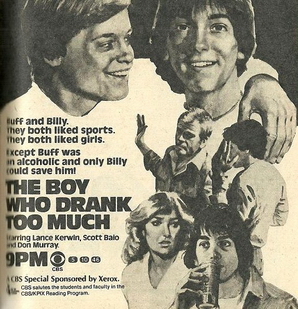
In this made for television social problem film, a young Scott Baio plays Buff Saunders.  Buff is a high school student, a star hockey player, and an alcoholic.  He drinks because he grew up with an alcoholic father (played by Don Murray) and he learned early that drinking could make him feel confident whenever he was feeling insecure.  When Buff’s drinking gets out of control and he starts getting into fights, blowing off school, and seriously injuring himself, he is sent to a rehab center, one that is out of town so that the hockey team doesn’t find out that he’s an alcoholic.  His best friend, Billy (Lance Kerwin), rides the bus every day so that he can be there to support Buff but Buff’s own father cannot bring himself to come down there.  At first, Buff refuses to admit that he has a problem and won’t even speak up in the group meetings.  Eventually, even Billy starts to get tired of Buff’s attitude and his refusal to admit that his drinking has gotten out of control.  When Billy says that he’s not going to spend his birthday watching Buff sulk at rehab, Buff is forced to take a look at what his life has become.

The Boy Who Drank Too Much was basically an after school special that got the primetime movie treatment.  Scott Baio was in a lot of these movies, which is one reason why it is sometimes tempting to laugh at them today.  Baio was never really a bad actor but he was one of those actors who came across as being smarmy even when he was supposed to be playing a sympathetic or sincere character.  That’s especially true in The Boy Who Drank Too Much.  Even when Buff finally seems to be serious about controlling his drinking, you still never believe his sincerity.  When he apologizes for all the harm that his drinking has caused, he still seems like he’s waiting for the chance to grab the flask that he’s hidden somewhere in the room.  For the most part, though, that works for the character.  Baio’s playing an alcoholic who, for the majority of the movie, just tells people what he thinks they want to hear to get them off his back.

The movie does a good job of showing how a problem like alcoholism can be passed down through the generations.  Lance Kerwin and especially Don Murray both give good performances as the two people closest to Buff.  Murray appeared in and helped to produce a lot of social problem films like this one and it’s obvious that his heart was really in his performance here.  Ed Lauter took a break from appearing in every single Charles Bronson film to play Kerwin’s father and the lovely Toni Kalem, who was one of the most underrated actresses of the era, appears as well.  For a television production that’s trying very hard to be socially relevant, The Boy Who Drank Too Much isn’t bad.

Zapped! (1982, directed by Robert J. Rosenthal)


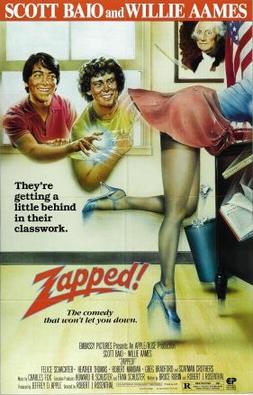
In this painfully dumb high school comedy, Scott Baio is Barney, a teen scientist who experiments on lab mice and grows specially modified orchids for his high school’s principal, Walter Coolidge (Robert Mandan, who played a lot of high school principals back in the day).  When there’s an accident in the lab, Barney develops telekinetic powers.  Barney then falls in love with the class president, Bernadette (Felice Schachter), while his best friend Peyton (Willie Aames) pursues the beautiful but vain Jane (Heather Thomas).  Barney uses his powers to make a ventriloquist act as if it’s possessed and to help Peyton rig a casino-themed frat party.  Meanwhile, Scatman Crothers plays the school’s baseball coach and has a long scene where he gets high and imagines that he’s riding a bicycle with Albert Einstein.  That’s actually kind of cool.

Zapped! is a movie where Scott Baio magically gains the power to move things with his mind and yet the most implausible part of the movie is the idea of Willie Aames being the most popular student at the high school.  Heather Thomas is believable as a cheerleader and Felice Schachter is perfectly cast as the brainy class president.  Even Scott Baio is not terrible as Barney.  But then Willie Aames shows up and we find out that he’s supposed to be a chick magnet and it becomes impossible for those watching to continue to suspend their disbelief.

Not much really happens in Zapped!  Even after he gets his powers, Barney is frustratingly passive character who just does whatever Peyton tells him to do.  Barney uses his powers to help Peyton show up Jane’s college boyfriend and he uses his powers to help Peyton win games at the school carnival and then Barney uses his powers to help out Peyton when Jane’s boyfriend tries to beat him up.  Maybe Barney needs to get new friends.  The only time Barney uses his powers for himself is when he’s playing baseball and he makes the ball stop in mid-air so that he can hit it.  Somehow, no one watching the game seems to find it strange that the baseball stops in mid-air.  The movie ends with a take on Carrie.  Barney uses his powers to blow off everyone’s clothes at prom.  It’s all to help Peyton, of course.

Zapped! supposedly has a cult following, probably composed of people who were 13 when they first saw it and who only remember the sweater scene with Heather Thomas and the final prom scene.  (Or they’re remembering the famous poster, which is a lot more fun than anything that actually happens in the movie.)  Other than that, this is one of the most boring films ever made.  Perhaps the only interesting thing about the movie is that Heather Thomas sued the production when they failed to acknowledge that a body double was used for Jane’s nude scenes.

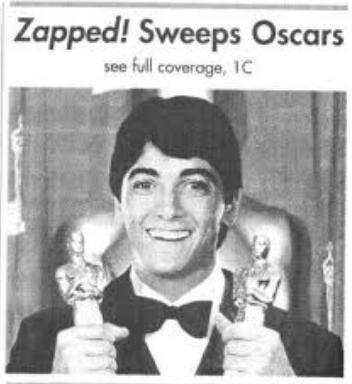
On a positive note, Zapped! did give us this classic Onion headline:


An Offer You Can’t Refuse #15: Bugsy Malone (dir by Alan Parker)


Remember how, a few weeks ago, I said I was going to spend the month of June reviewing 30 gangster movies?  Well, I was doing pretty well but then I got distracted with some things and I ended up falling behind and now, it’s the last day of June and I’ve only reviewed 14 of the 30 films that I was planning on taking a look at.  It’s frustrating but, as any movie blogger can tell you, it happens.  Still, I’m not one to give up so easily!  I promised to review 30 gangster movies and I’m going to keep my word.  Or, at the very least, I’m going to try to…. like, definitely maybe try to….

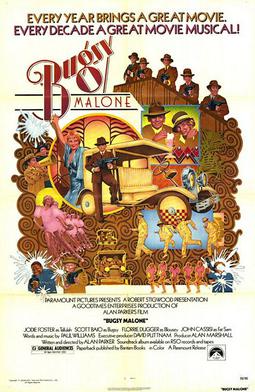
Anyway, let’s get back to it with 1976’s Bugsy Malone!

Bugsy Malone is an homage to the old gangster movies of the 1920s and 30s.  It’s also a musical, featuring a lot of songs about wanting to make a lot of money, fall in love, and go away to Hollywood.  On top of all that, it’s also a children’s film.  Though they may be playing gangsters and going to war over who will control the rackets, the cast is entirely made up of children.  Though the film does feature a lot of guns, none of the guns fire bullets.  Instead, they shoot custard pies.  Once you get cornered by a rival gangster and you get “splurged,” your career in the rackets is over.  You’re humiliated.  You’re nothing.  You’re just another two-bit hood who couldn’t make it in the big leagues.  You’re just….

Well, you get the idea.

Basically, the plot of the film is that Dandy Dan (Martin Lev) and Fat Sam (John Cassissi) are two rival gangsters who want to take over the Lower East Side.  Fat Sam owns a speakeasy, which means that there’s always a lot of dancing and singing going on in the background.  Bugsy Malone (Scott Baio) is a tough boxer who wants Fat Sam to give a job to Blousey Brown (Florrie Dugger), who dreams of going to Hollywood and becoming a big star.  Tallulah (Jodie Foster) is Fat Sam’s gun moll but she used to go out with Bugsy and she still wants him back.  Bugsy get caught up in the middle of the war between Dandy Dan and Fat Sam and it all eventually leads to a big pie fight and a lot of children covered in custard.  “You give a little love,” the children sing as they realize that their lives don’t have to be defined by gang wars, “and it all comes back to you….”

So, I have to admit that I was absolutely dreading watching Bugsy Malone.  I mean, singing children and custard pie guns?  It all sound just unbearably cutesy.  But, to my surprise, Bugsy Malone actually turned out to be a fun and clever little movie, one that was full of smart dialogue, catchy songs, excellent dancing, and wonderfully non-cutesy performances from its cast.  Even though the film may be about a bunch of children dressing up as gangsters, all of the child actors take their characters seriously and director Alan Parker directs the film as if it were an actual gangster film as opposed to just a children’s musical.  The end result is a film that’s cute but never cutesy.  Believe me, there is a huge difference between the two.

To my shock, Bugsy Malone turned out to be an offer that you can’t refuse.

Previous Offers You Can’t (or Can) Refuse:

  1. The Public Enemy
  2. Scarface
  3. The Purple Gang
  4. The Gang That Could’t Shoot Straight
  5. The Happening
  6. King of the Roaring Twenties: The Story of Arnold Rothstein 
  7. The Roaring Twenties
  8. Force of Evil
  9. Rob the Mob
  10. Gambling House
  11. Race Street
  12. Racket Girls
  13. Hoffa
  14. Contraband

Back to School Part II #11: Skatetown U.S.A. (dir by William A. Levey)


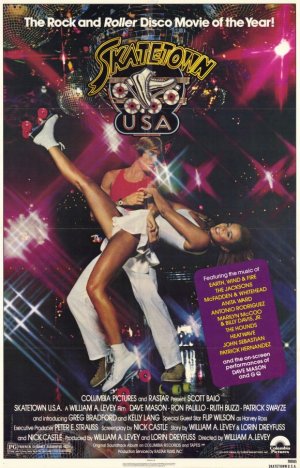
Poster_of_the_movie_Skatetown,_USA

Now that I’ve fully recovered from the trauma of writing about Grease, let me tell you about a little movie from 1979.  It’s a movie about teenagers, love, and competition.  It’s also a movie about disco and some actors who had some extra time on their hands.  It has a great soundtrack and the whole movie is pure 70s.  It even features the debut performance of a future movie star!

What film am I talking about?

SKATETOWN, USA, of course!

But before I talk about the movie, check out the trailer.  This is one of my favorite trailers of all time.  It pretty much tells you everything that you need to know about the movie.  There’s not a deceptive moment to be found in this preview:

Skatetown, U.S.A. is one of those movies that you watch and think, “This could only have been made in the 70s.”  Remember how watching Hollywood High caused me to doubt whether or not the 70s were actually all they were cracked up to be?  Well, Skatetown USA has renewed my faith!  Skatetown is such a 70s film that I personally think someone should send me an honorary coke spoon to reward me for watching it.

(Maureen McCormick, who is best known for playing Marcia Brady and who had a small role in Skatetown, wrote in her autobiography that the main thing she remembers about Skatetown is all the cocaine on the set.)

Skatetown USA doesn’t really have a traditional plot.  Instead, it’s a collection of “comedic” skits mixed in with roller skating performances and a nonstop soundtrack.  There is not a second that music is not playing in the background and, for what appears to be a low-budget film, the soundtrack is truly impressive.  Basically, almost every great disco song from the 1970s is heard at some point during Skatetown USA.  (Even that “Boogie Nights” song that Paul Thomas Anderson was apparently not allowed to actually use in Boogie Nights!  Imagine being the copyright holders who said yes to Skatetown but no to Paul Thomas Anderson…)

The film’s main character appears to be an unnamed DJ (Denny Johnston).  The DJ wears a big white afro wig and is always dancing in his booth.  Occasionally, he shoots a lightning bolt from his middle finger and suddenly, professional roller dancers appear and do a routine.  At the end of the movie, he looks at the camera, says that it’s all a fantasy, and winks.

Skatetown is the most popular disco roller rink in town.  Clean-cut teenager and all around nice guy Stan Nelson (Greg Bradford) wants to win Skatetown’s roller dancing contest.  (The prize is $1,000 and a moped!)  His best friend, Richie (Scott Baio), accompanies him and hopes to win a lot of money by betting on the outcome of the contest.  Stan angrily reprimands him, “This isn’t the streets!  This is Skatetown, U.S.A!”

That’s right — don’t mess with the good name of Skatetown!

Anyway, Stan’s actually a pretty good performer and he does this trick where he rides a skateboard while wearing roller skaters so you would think he would be a sure bet to win.

BUT NO!

The reigning Skatetown champion is Ace Johnson (Patrick Swayze, making his film debut) and we know that Ace is a bad guy because he wears all black and he occasionally snaps a whip while he’s rolling around!  Ace isn’t above cheating to win but really he doesn’t have to cheat!  Ace may be the bad guy but, seriously, he totally kicks ass while wearing roller skates.  As soon as he rolls out there, you understand why he’s the reigning champion.

See, here’s the thing with Skatetown: We’re supposed to be rooting for Stan but Ace really is a hundred times better than him.  There’s a reason why Patrick Swayze went on to have a career after Skatetown while Greg Bradford only has 8 credits on the imdb.  Swayze, even in this silly role, had movie star charisma whereas Bradford — well, he’s comes across as a nice guy but there’s nothing special about him.  Swayze, meanwhile, is dangerous and smoldering.

For instance, when Stan does his routine, his background music is The Village People singing “Macho Man” and you can’t help but snicker a little.  Whereas, when Ace performs, his background music is a slightly menacing cover of Under My Thumb.  Stan is the Village People.  Ace is the Rolling Stones.

Anyway, the film might not be good in the traditional sense but I absolutely loved Skatetown, U.S.A.  Why?  Because it’s a total time capsule! Watching it is such a totally 70s experience that I was even tempted to get a frizzy perm, start wearing bell bottoms, and stop wearing a bra.  Fortunately, the temptation passed but still, I enjoyed getting to use my cinematic time machine.

Add to that, the film itself is just so over-the-top and silly that … well, you can really believe that everyone involved in the movie was snorting mountains of cocaine in between takes.  There’s not a subtle moment to be found in Skatetown, U.S.A.  Instead, it’s all bright neon, loud music, flamboyant characters, silly melodrama, and corny humor.

(My personal theory is that Skatetown, U.S.A. was taking place in the same cinematic universe of A Clockwork Orange and it was showing what normal teenagers were doing while Alex and his droogs were seeking out the ultraviolence.  The over-the-top design of Skatetown reminded me of the similar flamboyance of the Korova Milk Bar and the droogs’s bowlers and oversized codpieces weren’t that different from some of the costumes worn by the cast of Skatetown.)

Anyway, Skatetown is one of those films that everyone should see once.  Unfortunately, because of all the music in the film, it’s never been released on DVD or Blu-ray and it probably never will be because life sucks.  It is on YouTube, though it was recorded off an old VHS tape so the transfer is not the best.

Here’s Skatetown, USA:

One final note: Skatetown, USA was directed by the same William Levey who also directed Blackenstein, Hellgate, and The Happy Hooker Goes to Washington.  It was written Nick Castle, who played Michael Myers in the original Halloween and directed a film that is well-liked by several of the writers here at the Shattered Lens, The Last Starfighter.