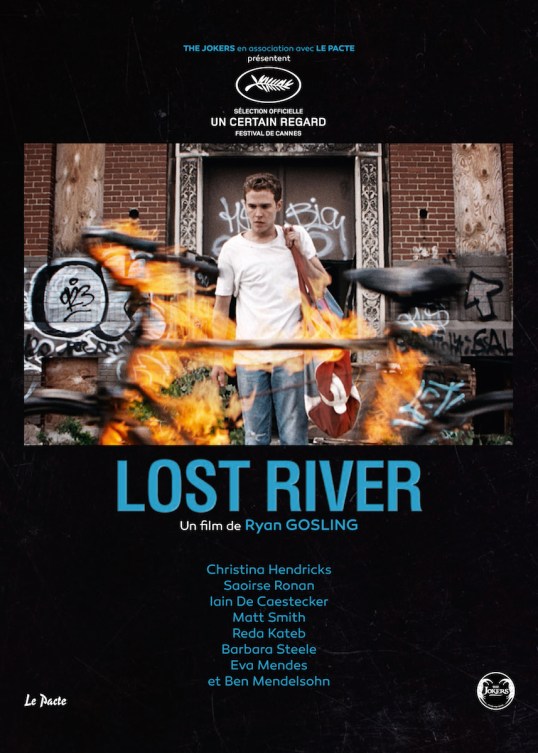
Film Review: Lost River (dir by Ryan Gosling)


Lost River

I had high hopes for Lost River.  Not only is it the directorial debut of one of my favorite actors, Ryan Gosling, but it was also booed at Cannes.  Some of the best and most interesting films ever made have been booed at Cannes.  The reviews that I had read of Lost River indicated that the film was a mess but it was, at the very least, a visually intriguing mess.  I was expecting the film to be pure style over substance but you know what?  I like style.

So, with all that in mind, I finally got a chance to sit down and watch Lost River last night and … bleh.  It’s not a terrible film.  You can watch it and feel that Ryan Gosling does have some promise as a director, if not as a writer.  (Along with directing, he also wrote the film’s screenplay.)  There are some nicely surreal images, though almost all of them appear to have been borrowed from other better films and, as a result, even the strangest of images are rather familiar.  (To be truly impressed by Lost River, it helps to have never seen anything directed by Mario Bava, Dario Argento, David Lynch, or Terrence Malick.)  He gets a memorably unhinged performance from the great Ben Mendelsohn but then again, when hasn’t Mendelsohn given a memorably unhinged performance?

Anyway, Lost River takes place in Detroit, presumably because Detroit features a lot of dilapidated neighborhoods that look interesting on film and allow Gosling to pretend that his film is about America urban decay.  Billy (Christina Hendricks) is on the verge of losing her house but, with the help of sleazy bank manager Dave (Ben Mendelsohn), Billy gets a job working as a performer at a club.  At the club, she and Cat (Eva Mendes) perform elaborate routines which always end with them pretending to die in some excessively brutal and bloody way.  The club’s largely affluent audience loves it.  Dave loves it so much that he’s inspired to sing a song on stage.  Later on in the film, Dave does an elaborate dance because every independent film has to feature an out-of-nowhere elaborate dance.

Meanwhile, Billy’s son, Bones (Iain De Caestecker), is trying to raise money to save the house by stealing copper out of abandoned buildings.  However, this gets him in trouble with Bully (Matt Smith, struggling to speak with an American accent), a psychopath who has declared his section of Detroit to be “Bullytown.”  Bully rides around in a convertible, sitting on a throne that’s been attached to the back seat.  When Bully discovers that Bones has been stealing copper from buildings in Bullytown, Bully declares that Bones must die.

(At some point, you have to wonder if Bully was doomed from the minute that his parents decided to name him Bully.  Maybe if they had named him The Doctor, he could have lived a very different life.)

Living next door to Billy and Bones is Rat (Saorise Ronan, who gives a good performance and deserves better than this role).  Rat is called Rat because she owns a pet rat that’s named Nick.  Got all that?  Rat also lives with her grandmother (Barbara Steele), who never speaks but spends all of her time watching old home movies.  Why would you cast an icon like Barbara Steele and then not allow her to do anything other than sit in a chair and silently stare at a television?

If Lost River was just an exercise in pure style, I probably would have enjoyed it a lot more.  I would much rather a film be too obscure as opposed to being too obvious.  Unfortunately, while Gosling the director is having a lot of fun being as stylish as he can be, Gosling’s the screenwriter proves himself to be heavy-handed and patronizing.  By setting the film in Detroit and having random characters show up to talk about how America is dying and the poor are getting poorer while the rich get richer, Gosling lets us know that Lost River is meant to be more than just an exercise in technique.

The problem is that, as well-intentioned as Gosling may be, you can’t help but get the feeling that he has absolutely no idea what it’s like to be poor or what it’s like to live in a dying American city.  According to the 2010 census, 82.7% of Detroit’s population is African-American.  If you’re making a movie the deals, no matter how strangely, with what it’s like to be poor and desperate in Detroit, why would you decide to exclusively cast affluent-looking Caucasians in all of the main roles?  The few black characters who appear in Lost River are largely there to either comfort or share wisdom with the main white characters before then quickly moving on, never to be seen again after their minute or so of screen time.  It comes across as being condescending in only the way something written by a wealthy white guy can be.

Lost River is a misfire, an attempt by a filmmaker to try to make a statement about something that he really doesn’t seem to know much about.  Judging from the film’s visuals, Gosling has some promise as a director but, in the future, he should probably try to work with a better screenwriter.  If you don’t listen to the dialogue and just consider the film as an exercise in visuals, it’s mildly diverting.  (That said, even the nonstop parade of surreal images gets boring after a while.)  Lost River is not terrible.  It’s just bleh.

Here’s the Teaser Clip For Ryan Gosling’s Lost River!


Here is the teaser clip for Ryan Gosling’s directorial debut, Lost River, which was released ahead of the film’s premiere at Cannes.

So far, the majority of the reviews out of Cannes have been mixed.  The film has been called self-indulgent, incoherent, and pretentious and, perhaps worst of all, it has been compared by more than one reviewer to Richard Kelly’s Southland Tales.

Peter Bradshaw of the Guardian, a reviewer whose opinion I usually respect, writes: “Ryan Gosling’s Lost River is a conceited clunker – and yet there are great images and mad energy.”  That gave me some hope — I can forgive self-indulgence if it’s at least interesting to watch.  But then Jeff Wells had to pop up and start comparing it to Beasts of the Southern Wild.  As usual, Sasha Stone over at Awards Daily has some very strong feelings about the film, despite the fact that — as she readily admits — she hasn’t actually seen it.  (But Sasha’s so much smarter than the rest of us common people, so who are we to question her, right?)

Well, as you can probably guess, I don’t care what the critics think or say.  I’m still going to see it and judge it for myself.  Not only is the film directed by Ryan Gosling but it also stars three of my favorite actresses — Eva Mendes, Saoirse Ronan, and Barbara Steele.  Dr. Who fans will be happy to see Matt Smith while those of you who enjoy Agents of SHIELD can get a chance to apparently see a new side of Iain De Caestecker.

As for the teaser below — well, who knows what the Hell’s going on?  But aren’t you just a little bit intrigued to find out?

The Most Underappreciated Film Of The Year: Joe Wright’s Hanna


Sometimes, it seems like it’s easier for me to write about the films I dislike as opposed to the films that I truly love.  Case in point: I had little trouble writing up my thoughts on Anonymous and Straw Dogs but it’s taken me 8 months to write a formal review of my favorite film of 2011: Joe Wright’s pulp fairy tale, Hanna.

Taking place in a world much like our own but definitely not the same, Hanna opens in the frozen wilderness of Finland where 16 year-old Hanna (Saoirse Ronan) lives in an isolated cabin with her father, Erik (Eric Bana).  In the film’s electrifying opening montage, we see that Hanna’s life revolves around training for combat, memorizing the encyclopedia, and memorizing several “false” back stories that have been prepared for her by her father.  It also quickly becomes apparent that Erik has never allowed his daughter to be exposed to the real world.  Finally, Erik tells Hanna that she is “now ready” to choose whether or not to open up a box containing an old transmitter that well alert the rest of the world of their existence.  When Hanna finally opens the box, Erik promptly disappears and Hanna is left to fend for herself.

It quickly becomes apparent why Erik has spent years training his daughter because, by opening the box, Hanna has given away her presence to a coolly corrupt and ruthless CIA agent named Marissa (Played by Cate Blanchett and one of the most compelling villains in recent film history).  Marissa has her own reasons for wanting both Erik and Hanna and she quickly sends a team to Erik’s cabin.  Hanna is captured and transported to a memorably sterile CIA safehouse.  In a shocking sudden burst of violence, Hanna escapes from the safehouse and finds herself having to survive in the “real world” while being pursued by Marissa. 

Hanna, Marissa, and Erik eventually meet their fates in a desolate theme park that (in a neat bit of symbolism) is dedicated to the Brothers Grimm.  Along the way, Hanna meets and travels with a likable family of English tourists, allowing her to have her first chance to actually experience a “normal” life and Marissa recruits Issacs, one of the creepiest film henchmen ever.  Seriously. Isaacs is played by Tom Hollander and he was just so exquisitely sleazy that my skin crawled just watching him on-screen. 

In many ways, Hanna may sound like a simple action film but, in the best tradition of the French new wave and the better grindhouse filmmakers, Joe Wright both embraces the conventions of the action film while unexpectedly subverting them and using them to tell a more universal story about the struggle to both establish and maintain identity in an increasingly soulless world.  Much as Godard did before he gave up his artistic soul to political ideology, Joe Wright uses his cinematic talents to create a unique world that, while heavily stylized, also comments on our own existence.  The Chemical Brothers, meanwhile, provide the perfect soundtrack to Wright’s pulp vision.

Hanna may be my favorite film of 2011 but it’s also the most underappreciated of the year, at least as far as Oscar season is concerned.  There’s been so mention of the film’s score and a few critics’ groups have tossed a “young artist” mention or two at Saoirse Ronan but otherwise, the film has pretty much been ignored.  I think part of the problem is that Hanna was released in April and not December.  If the films had been released in December, I think Ronan would, at the very least, be a dark horse for best actress. 

The main complaint that most critics seem to come up with when discussing Hanna is that the film is too much of a genre piece.  Yes, it’s well-made and it’s well-acted and yes, it’s a compelling film with an intelligent script but, in the end, it’s just a genre piece.  A fairly typical response comes from the Guardian’s Peter Bradshaw who, after praising all of the film’s virtues, concluded with, “…(I)t ultimately squanders all of them, undone by a lack of subtlety and restraint.” 

To this, I can only respond, “Oh?  Really?”  Seriously.  Amazingly enough, some of the critics who criticized Hanna for a perceived lack of subtlety are the same critics who are now falling over themselves to praise the rehash of The Girl With The Dragon Tattoo.  I suppose the difference here is that The Girl With The Dragon Tattoo was directed by David Fincher and is the product of the American film establishment whereas Hanna was directed by Joe Wright and was produced by outsiders.

Those who claim that Hanna is too genre are missing the simple fact that Hanna is an insightful film that uses the conventions of the action genre as a metaphor for the sometime painful search for identity that every teenager (and especially every teenage girl) has ever had to go through.  Myself, I never had to flee from government agents or battle assassins when I was 16 but I did have to start discovering how to survive in the real world, away from the security and comfort of home.  As opposed to the pretend feminism of Fincher’s film, Hanna is a film that truly celebrates “girl power” and promotes independence and empowerment.  It’s also, as far as I’m concerned, the best film of 2011.

Here Are The 2012 Critics’ Choice Movie Award Nominees


Earlier today, the Broadcast Film Critics Association announced their nominations for the 17th Annual Critics’ Choice Awards.  The BFCA is the largest of the so-called “major” critics’ groups (and, interestingly enough, it’s also the newest and the least prestigious) and it has a fairly good track record of predicting the actual Oscar nominations.  The awards themselves will be handed out on January 12th, 2012 in a self-important, kinda seedy ceremony that will be broadcast on VH-1.   

BEST PICTURE
The Artist
The Descendants
Drive
Extremely Loud & Incredibly Close
The Help
Hugo
Midnight in Paris
Moneyball
The Tree of Life
War Horse

BEST ACTOR
George Clooney – The Descendants
Leonardo DiCaprio – J. Edgar
Jean Dujardin – The Artist
Michael Fassbender – Shame
Ryan Gosling – Drive
Brad Pitt – Moneyball

BEST ACTRESS
Viola Davis – The Help
Elizabeth Olsen – Martha Marcy May Marlene
Meryl Streep – The Iron Lady
Tilda Swinton – We Need to Talk About Kevin
Charlize Theron – Young Adult
Michelle Williams – My Week With Marilyn

BEST SUPPORTING ACTOR
Kenneth Branagh – My Week With Marilyn
Albert Brooks – Drive
Nick Nolte – Warrior
Patton Oswalt – Young Adult
Christopher Plummer – Beginners
Sir Andrew Serkis – Rise of the Planet of the Apes

BEST SUPPORTING ACTRESS
Berenice Bejo – The Artist
Jessica Chastain – The Help
Melissa McCarthy – Bridesmaids
Carey Mulligan – Shame
Octavia Spencer – The Help
Shailene Woodley – The Descendants

BEST YOUNG ACTOR/ACTRESS
Asa Butterfield – Hugo
Elle Fanning – Super 8
Thomas Horn – Extremely Loud & Incredibly Close
Ezra Miller – We Need to Talk About Kevin
Saoirse Ronan – Hanna
Shailene Woodley – The Descendants

BEST ACTING ENSEMBLE
The Artist
Bridesmaids
The Descendants
The Help
The Ides of March

BEST DIRECTOR
Stephen Daldry – Extreme Loud & Incredibly Close
Michel Hazanavicius – The Artist
Alexander Payne – The Descendants
Nicolas Winding Refn – Drive
Martin Scorsese – Hugo
Steven Spielberg – War Horse

BEST ORIGINAL SCREENPLAY
The Artist – Michel Hazanavicius
50/50 – Will Reiser
Midnight in Paris – Woody Allen
Win Win – Screenplay by Tom McCarthy, Story by Tom McCarthy & Joe Tiboni
Young Adult – Diablo Cody

BEST ADAPTED SCREENPLAY
The Descendants – Alexander Payne and Nat Faxon & Jim Rash
Extremely Loud & Incredibly Close – Eric Roth
The Help – Tate Taylor
Hugo – John Logan
Moneyball – Steven Zaillian and Aaron Sorkin, Story by Stan Chervin

BEST CINEMATOGRAPHY
The Artist – Guillaume Schiffman
Drive – Newton Thomas Sigel
Hugo – Robert Richardson
Tree of Life – Emmanuel Lubezki
War Horse – Janusz Kaminski

BEST ART DIRECTION
The Artist – Production Designer: Laurence Bennett, Art Director: Gregory S. Hooper
Harry Potter and the Deathly Hallows Part 2 – Production Designer: Stuart Craig, Set Decorator: Stephenie McMillan
Hugo – Production Designer: Dante Ferretti, Set Decorator: Francesca Lo Schiavo
The Tree of Life – Production Designer: Jack Fisk, Art Director: David Crank
War Horse – Production Designer: Rick Carter, Set Decorator: Lee Sandales

BEST EDITING
The Artist – Michel Hazanavicius and Anne-Sophie Bion
Drive – Matthew Newman
The Girl With the Dragon Tattoo – Kirk Baxter and Angus Wall
Hugo – Thelma Schoonmaker
War Horse – Michael Kahn

BEST COSTUME DESIGN
The Artist – Mark Bridges
The Help – Sharen Davis
Hugo – Sandy Powell
Jane Eyre – Michael O’Connor
My Week With Marilyn – Jill Taylor

BEST MAKEUP
Albert Nobbs
Harry Potter and the Deathly Hallows Part 2
The Iron Lady
J. Edgar
My Week With Marilyn

BEST VISUAL EFFECTS
Harry Potter and the Deathly Hallows Part 2
Hugo
Rise of the Planet of the Apes
Super 8
The Tree of Life

BEST SOUND
Harry Potter and the Deathly Hallows Part 2
Hugo
Super 8
The Tree of Life
War Horse

BEST ANIMATED FEATURE
The Adventures of Tintin
Arthur Christmas
Kung Fu Panda 2
Puss in Boots
Rango

BEST ACTION MOVIE
Drive
Fast Five
Hanna
Rise of the Planet of the Apes
Super 8

BEST COMEDY
Bridesmaids
Crazy, Stupid, Love
Horrible Bosses
Midnight in Paris
The Muppets

BEST FOREIGN LANGUAGE FILM
In Darkness
Le Havre
A Separation
The Skin I Live In
Where Do We Go Now

BEST DOCUMENTARY FEATURE
Buck
Cave of Forgotten Dreams
George Harrison: Living in the Material World
Page One: Inside the New York Times
Project Nim
Undefeated

BEST SONG
“Hello Hello” – performed by Elton John and Lady Gaga/written by Elton John and Bernie Taupin – Gnomeo & Juliet
“Life’s a Happy Song” – performed by Jason Segel, Amy Adams and Walter/written by Bret McKenzie – The Muppets
“The Living Proof” – performed by Mary J. Blige/written by Mary J. Blige, Thomas Newman and Harvey Mason, Jr. – The Help
“Man or Muppet” – performed by Jason Segel and Walter/written by Bret McKenzie – The Muppets
“Pictures in My Head” – performed by Kermit and the Muppets/written by Jeannie Lurie, Aris Archontis and Chen Neeman – The Muppets

BEST SCORE
The Artist – Ludovic Bource
Drive – Cliff Martinez
The Girl With the Dragon Tattoo – Trent Reznor & Atticus Ross
Hugo – Howard Shore
War Horse – John Williams

The BFCA has obviously made a lot of nominations and some of them are interesting but I have to be honest: the BFCA as an organization annoys me with how they’re always bragging about how big they are and how they’re so good at celebrating the conventional establishment wisdom.  So, I’ll just say that its nice to see Hanna getting at least some sort of recognition (even if that recognition is kinda minor.)