“It’s what we do, Rose. We continue.” — Frank Parker
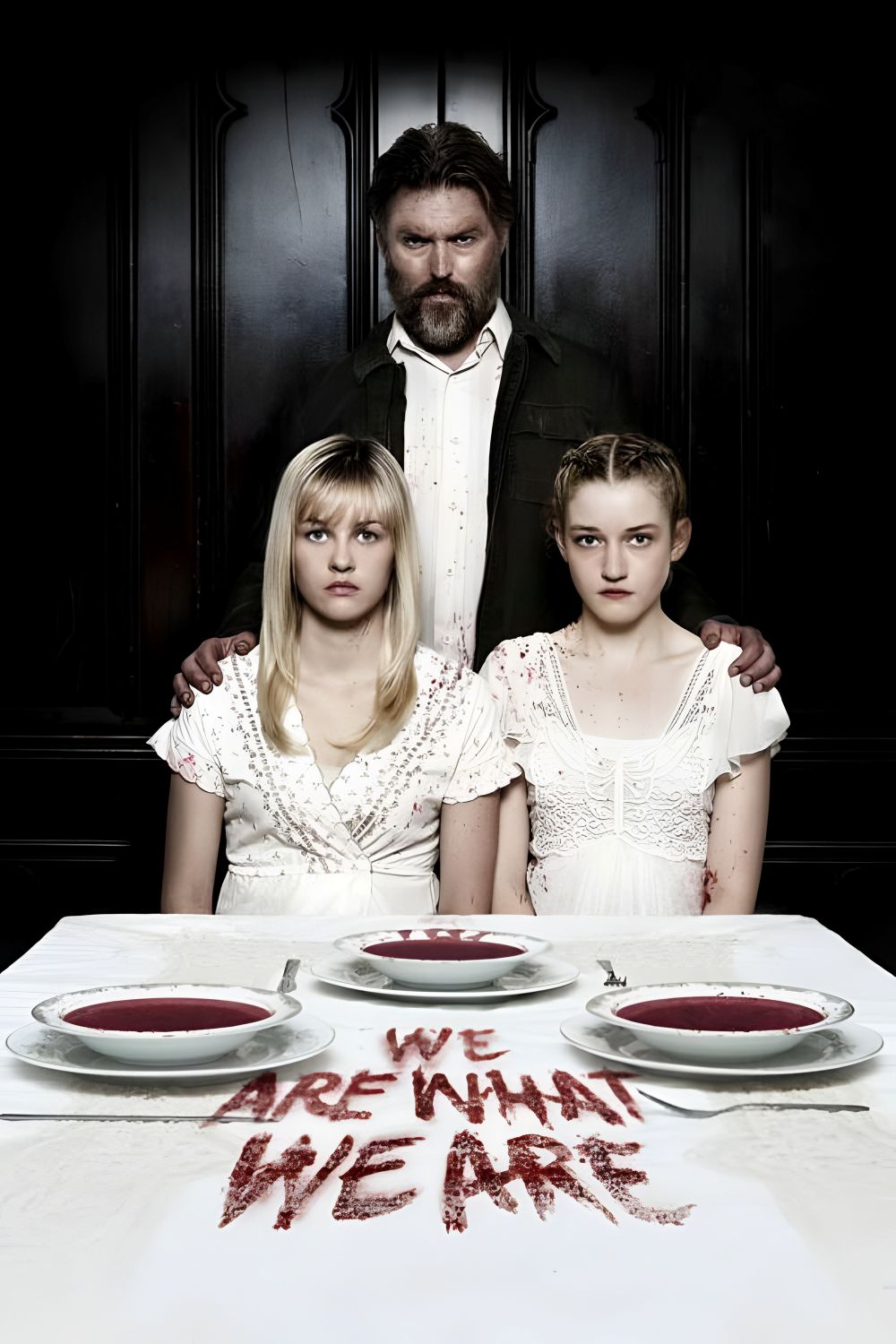
The scariest thing about the Parker family is how much of their cruelty falls under the heading of being a good parent. That’s the ugly little truth running through Jim Mickle’s We Are What We Are, a horror movie where providing for your children and destroying their lives have become practically the same thing. Released in 2013, this loose remake of Jorge Michel Grau’s 2010 Mexican film builds its nightmare around a household that treats cannibalism as an inherited obligation. The premise sounds outrageous, but Mickle approaches it with enough seriousness to make the family’s beliefs feel disturbingly entrenched. The result is less about the shock of what these people eat than the damage done by teaching children that love requires unquestioning obedience.
The Parkers’ carefully insulated existence begins to unravel when their mother suddenly dies, leaving teenage daughters Iris and Rose to take over her responsibilities. Unfortunately, those responsibilities include preparing the family’s annual ritual meal. Their father, Frank, considers maintaining that tradition nonnegotiable, regardless of what his daughters might think or feel. Meanwhile, relentless rain starts bringing evidence of the family’s activities into the open, attracting the attention of local physician Doctor Barrow. It’s a straightforward setup, but the competing pressures work well together: the world outside is getting closer just as life inside the house becomes increasingly unbearable.
What makes the family unsettling is that their behavior follows a recognizable domestic logic. Frank expects his daughters to help around the house, care for their younger brother, Rory, and preserve the values he believes hold them together. Those expectations aren’t inherently sinister. The horror comes from what he has attached to them. Murder and cannibalism have become extensions of household duty, protected from scrutiny by the idea that previous generations knew best. Mickle doesn’t need to make every conversation openly threatening. Once that arrangement becomes clear, even an ordinary instruction carries the possibility of something awful.
Bill Sage makes Frank a convincingly suffocating presence. He isn’t an entertaining monster whose outrageous behavior gives the audience permission to enjoy him. He’s a miserable, controlling father whose certainty leaves almost no room for anyone else. Sage understands how frightening it can be when someone treats his authority as a fact of nature. Frank doesn’t think he needs to win an argument because he barely recognizes that an argument could exist. His grief complicates the performance without excusing him. He has lost his wife, but his response is to force his daughters deeper into the system that shaped her life.
Ambyr Childers and Julia Garner provide the emotional weight as Iris and Rose. Childers gives Iris the worn-down composure of someone being pushed into adulthood before she has had much opportunity to understand herself. Garner makes Rose’s resistance feel less like easy rebelliousness than a growing inability to tolerate what everyone else insists is necessary. Their performances work especially well together because the sisters don’t respond to their circumstances identically. Love keeps them connected, but it doesn’t erase their differences. They’re trying to protect each other while navigating a household that has taught them to confuse protection with participation.
That ambiguity is one of the film’s strongest qualities. Iris and Rose are victims of their upbringing, but they’re also being drawn into perpetuating its violence. Mickle doesn’t flatten that situation into a simple division between innocent children and an evil adult. Instead, he lets the discomfort linger. Understanding why the sisters struggle to resist doesn’t make the consequences disappear. Their affection for Rory adds another painful layer, since caring for him means deciding whether to preserve the only family structure they know or recognize how dangerous that structure has become. The stakes are emotional long before they become physical.
The atmosphere reinforces that feeling of a household slowly poisoning itself. Rain hangs over everything, and the woods surrounding the Parker home offer little sense of freedom. Cinematographer Ryan Samul gives the film a muted, damp beauty that makes the setting feel both natural and faintly diseased. Inside, the worn rooms suggest generations of people living under the same expectations. Nothing needs to announce itself as sinister because the whole place feels burdened by repetition. The house isn’t frightening because it looks unfamiliar. It’s frightening because its familiar domestic spaces have been organized around something nobody is allowed to question.
Mickle’s slow pacing generally suits that approach. He lets silence, routine, and uncomfortable proximity do much of the work, saving explicit violence for moments when it can actually break through the film’s restraint. That patience makes the horror feel embedded in everyday life rather than dropped into it for a quick reaction. Still, there’s a difference between letting tension develop and simply holding a mood, and the movie occasionally drifts toward the latter. A few stretches repeat the same emotional information without finding a fresh angle. The oppressive atmosphere remains effective, but the storytelling doesn’t always move with equal confidence.
The outside investigation is the clearest example of that limitation. Michael Parks brings welcome sadness and gravity to Doctor Barrow, but his search sometimes feels more mechanically plotted than the family drama. We’re waiting for him to establish what the movie has already made clear, which takes some urgency out of his discoveries. The historical flashbacks have a similar drawback. They give the ritual a background, but the explanation is less compelling than watching its influence play out between living people. The film is strongest when it stays close to the sisters and lets inherited belief reveal itself through behavior rather than additional exposition.
When the ending finally tears through that restraint, the violence feels like a release of everything the family has kept buried. It’s messy, startling, and open to debate as a culmination of the sisters’ psychological journey, but it certainly refuses an easy resolution. We Are What We Are has its slow patches and occasionally spells out ideas that are already clear. Even so, its performances and oppressive sense of place make it a strong, deeply unpleasant family horror film. What stays with you isn’t simply the cannibalism. It’s Frank’s conviction that passing his damage on to his children is the most loving thing he can do.