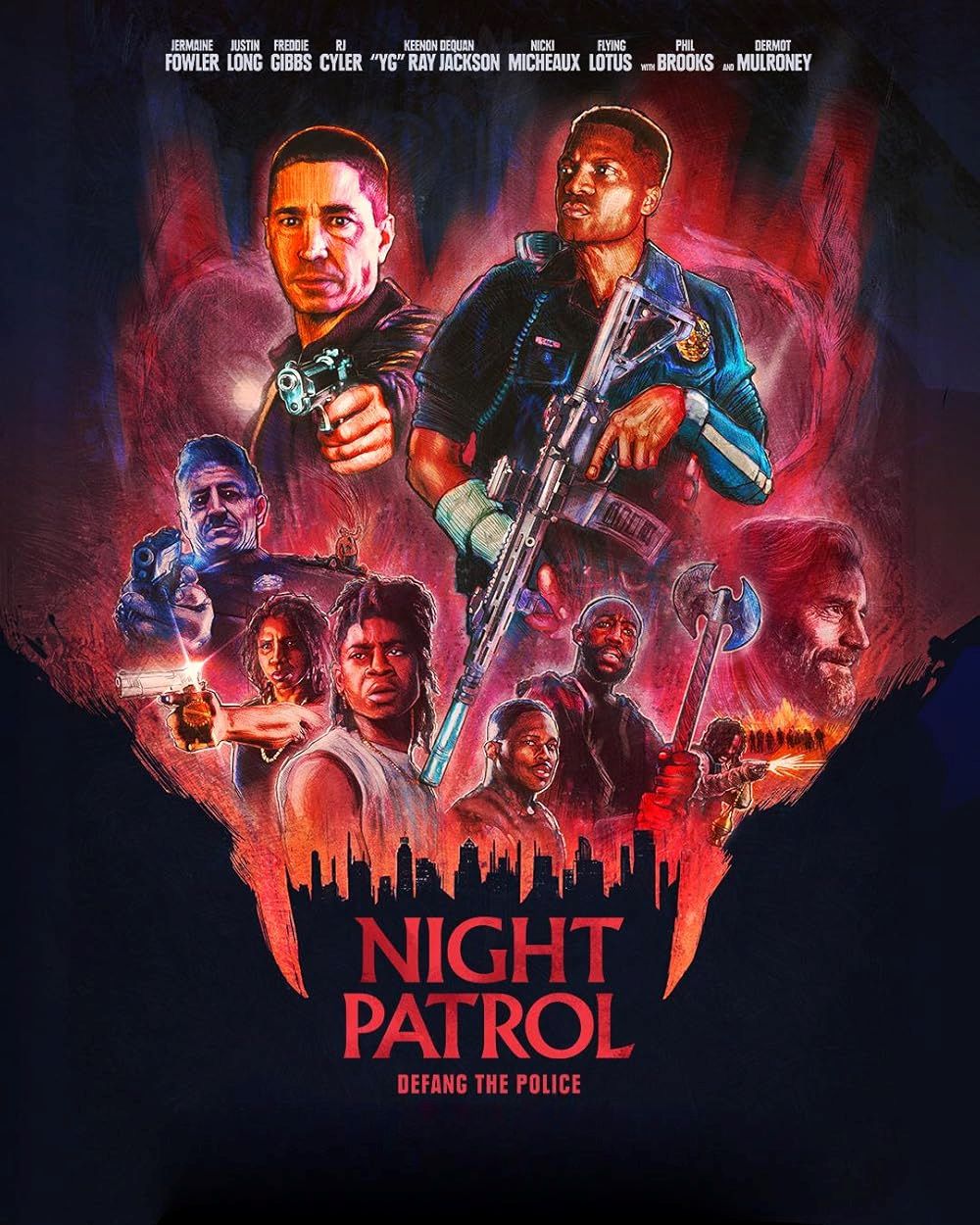
“They vampires. They drink blood!” Bornelius
You know the feeling of digging through a forgotten VHS bin and finding a movie that looks like it was beamed in from a parallel universe where grindhouse cinema never died? That’s Night Patrol in a nutshell. Directed by Ryan Prows, this scrappy, bloody genre mashup has a raw, politically charged energy that mixes social outrage with lurid horror tropes. And honestly, streaming services like Shudder have become the bargain bin of the 21st century—the place where genre films of dubious budget and quality get a new life, or in some cases, their only life. Night Patrol is a perfect example of that ecosystem: too weird for a wide theatrical release, too ambitious to be dismissed outright, and exactly the kind of movie you stumble upon at 1 AM, three scrolls deep into a streaming queue. The core idea is audacious: what if the most elite, secret unit of the LAPD wasn’t just crooked, but was actually a coven of vampires using gang violence as a cover for their midnight snacks? It’s the kind of premise that feels like it was dreamed up at 2 AM after a Super Fly and The Warriors double feature—and I mean that as a high compliment.
If you lean in, you’re in for a bumpy but often thrilling ride. The film centers on two LAPD partners: Ethan (Justin Long) and Xavier (Jermaine Fowler). Ethan is the legacy kid, the son of a legendary cop (Dermot Mulroney), who finally gets the nod to join the secretive “Night Patrol.” Xavier, who grew up in the very housing projects the unit is supposedly “cleaning up,” is left on the outside looking in, suspicious of everything. Naturally, Ethan quickly discovers that his new colleagues aren’t just trigger-happy; they’re literally heartless monsters with metal-plated fangs and a thirst for the residents of the neighborhood Xavier calls home.
Meanwhile, on the streets, Xavier’s brother Wazi (RJ Cyler) and his mother Ayanda (Nicki Micheaux) are realizing that the gang war heating up isn’t just about turf—it’s about survival against the undead. The film’s greatest strength is how it throws these characters into a blender. You have the buddy-cop tension between Long and Fowler, the street-level horror from Cyler’s perspective, and this ancient mystical element brought by Micheaux, who plays a matriarch dabbling in Zulu magic to fight the monsters. It’s a lot, but for the first hour, Prows manages to balance these plates relatively well. There’s a hint of that old-school exploitation energy here: Micheaux’s Ayanda refuses to rely on a broken system and instead arms herself with ancestral power, which gives the film a satisfying underdog-revenge backbone.
Let’s talk about the cast, because this is where Night Patrol either fires on all cylinders or sputters, depending on the scene. Justin Long, our reigning scream king, is perfectly cast as the moral compass who suddenly realizes he’s sold his soul to the corporate office. He plays the “good apple” realizing the whole barrel is rotten with a kind of weary, panicked authenticity. Jermaine Fowler is the secret weapon here; he’s grounded, funny, and provides the emotional anchor the film desperately needs when the visuals go off the rails. Think of him as a reluctant warrior caught between two worlds—the badge he wanted to trust and the community he can’t abandon.
Then, there’s C. M. Punk. The WWE champion plays a vicious white supremacist vampire sergeant, and I have to hand it to him—he’s terrifying. He doesn’t chew scenery so much as he drains it dry of all warmth. He has a physical presence and a cold, dead stare that works perfectly for a monster hiding in a uniform. On the flip side, while rapper Freddie Gibbs and Flying Lotus bring a fun, playful swagger to their gang-heavy roles, some of the other supporting performances—specifically among the vampire coven—feel stiff and amateurish. It creates an uneven texture where one scene feels like a gritty HBO drama and the next feels like a student film. That inconsistency is part of the movie’s scrappy charm, but it also keeps it from feeling fully polished—exactly the kind of rough edge you expect from a bargain bin discovery.
Visually, director Ryan Prows (who previously directed the segment The Subject in V/H/S/94) knows exactly how to make Los Angeles look like a sun-bleached hellscape during the day and a neon-drenched deathtrap at night. The cinematography is gritty and grainy, giving it that ’90s VHS vibe that makes every alleyway feel dangerous. It echoes the cheap, hungry look of independent cinema from decades past, which fits the movie’s B-movie ambitions perfectly. However, style only gets you so far, and Night Patrol hits a serious wall in its final act.
The pacing, which was already a slow burn, starts to drag heavily. There is a lot of talking. A lot of sitting in rooms explaining the “ancient lore” of the vampires, and honestly, the rules get so convoluted that you stop caring who the original evil vampire was and just want to see somebody get staked. The movie tries to have its cake and eat it too—it wants to be a serious critique of the “Thin Blue Line” ideology, an action-horror romp, and a mystical family drama. Usually, it ends up being a muddled version of all three. A tighter script would have known exactly how long to linger on a metaphor before cutting to the chase, but Night Patrol often forgets that lesson. This is where the bargain bin analogy really stings: you can feel the ambition straining against the budget and the runtime, and not every swing connects.
When the action finally does hit in the last twenty minutes, it’s brutally fun. There are guts ripped out, decapitations, and a final boss form for the villains that looks like something out of a heavy metal album cover. It’s just a shame it takes so long to get there. The social commentary is loud and clear—cops as gangs, systemic racism, the failure of the “few bad apples” defense. It’s not subtle, but for a movie where a guy gets thrown through a window in slow motion, subtlety isn’t really the goal. Night Patrol has teeth, and when it remembers to bite, it draws blood. It just spends too much time trying to decide what flavor of juice it wants to suck. And yet, without a service like Shudder, a movie like this probably never sees the light of day. It’s too rough for festivals, too niche for Netflix’s algorithm, and too weird for traditional distributors. Streaming has become the digital equivalent of the $5 DVD barrel outside a video store—full of misfires, hidden gems, and everything in between.
It’s a C+ effort that gets a B+ for sheer ambition, and honestly, in the wasteland of January genre releases, that’s more than enough to warrant a watch—if only to see Justin Long react to C. M. Punk turning into a bat-demon while Jermaine Fowler tries to talk sense into everyone. You can’t get that anywhere else, and that’s exactly why the bargain bin still matters.


