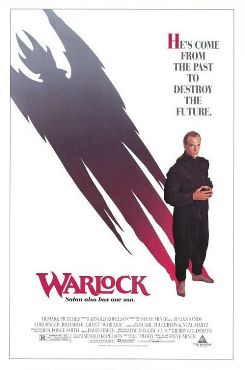
Warlock (1989, directed by Steve Miner)


Before he can be executed in the late 17th century, an unnamed warlock (Julian Sands) is propelled through time by Satan. He ends up in 20th-century Los Angeles, where he seeks the three pieces of the Grand Grimoire, a legendary spellbook that, when reassembled, can undo creation. The Warlock is pursued by Giles Redferne (Richard E. Grant), a witch hunter whose wife was previously killed by the Warlock and who manages to make it through the Warlock’s time portal. Helping Giles navigate the modern world is Kassandra (Lori Singer), a woman who made the mistake of taking the Warlock in and got hit by an aging spell for her trouble. Giles and Kassandra pursue Warlock across the the country as he searches from the three pieces of the book. It’s a quest that takes them from Los Angeles to a Mennonite community and finally to modern-day Massachusetts where the final piece of the Grimoire turns out to be in a very unexpected location.

Warlock definitely benefits from David Twohy’s clever script and Steve Miner’s no-nonsense, energetic direction, but the real secret of its success was the performance of Julian Sands as the Warlock. If you were of a certain age in 1991, Julian Sands will always primarily be the Warlock to you. With his coldly self-amused manner and his unapologetic cruelty, Sands was the epitome of cool evil. The first time I saw Warlock, I was surprised at just how far the film’s villain was willing to go in his quest. Warlock is one of those films where the characters who usually survive do not. No one is safe from the warlock.

The film also benefits from Richard E. Grant taking his role seriously. As for Lori Singer, she’s stuck with a lot of bad old-age makeup and delivers her lines with a lack of enthusiasm. Her performance, though, still doesn’t distract from this surprisingly entertaining film. When I recently rewatched, I recognized Mary Woronov in the role of a psychic. As always when it comes to Mary Woronov, I wished her role had been larger.

Warlock was released in Europe and Australia in 1989 but, because of the financial difficulties of New World Pictures, it didn’t get an American release until 1991. The film did moderately well at the box office and went on to become, for a while, a mainstay on HBO and Cinemax. Julian Sands, who had mostly played young romantic up until that point, was subsequently typecast as a cool, Continental villain. It was followed by two sequels.
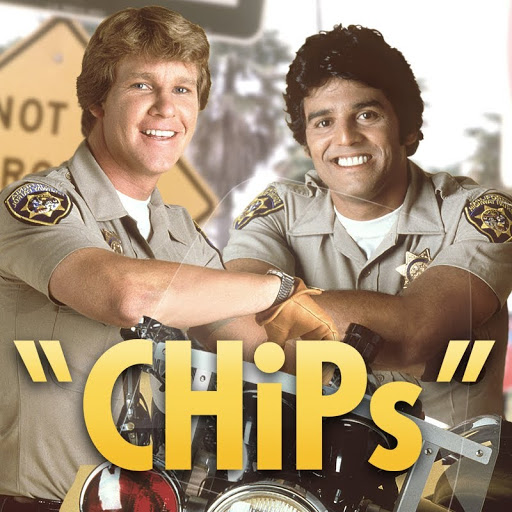
Late Night Retro Television Review: ChiPs 4.2 “Sick Leave”


Welcome to Late Night Retro Television Reviews, a feature where we review some of our favorite and least favorite shows of the past!  On Mondays, I will be reviewing CHiPs, which ran on NBC from 1977 to 1983.  The entire show is currently streaming on Prime!

This week, death comes to California.

Episode 4.2 “Sick Leave”

(Dir by John Florea, originally aired on September 28th, 1980)

Andy (Robert Viharo) is a veteran member of the highway patrol who, when he’s not chasing down bad guys, is a student at the the local college.  He wants to become an archeologist and go to Peru.  Unfortunately, Andy has a brain lesion and may not get the chance.  His behavior is erratic.  His vision is failing.  He refuses to admit that there’s anything wrong.  Can Ponch and Jon get him off the street before he gets someone killed?  Andy says that if he wants to die, he wants to go out saving someone’s life and not sitting behind a desk.  An escalating fraternity prank war makes Andy’s dream come true.  The theft of a fraternity’s prized bird sculpture leads to a high-speed chase and several overturned cars.  Andy manages to save a young woman from a crashed car but, when the car explodes, he ends up with a hunk of shrapnel sticking out of his back.  Ouch!  He dies in Baker’s arms.  If Ponch had been the one holding him, one can only assume that Andy would have been magically healed by the power of Estrada.

This is the rare episode of CHiPs in which someone dies.  In fact, I think this is only the third episode in which a traffic accident has led to a fatality.  It happened once during the pilot.  During the second season, several people were killed in a multi-car pileup.  For the most part, though, CHiPs features people who somehow manage to survive the most horrendous of crashes.  Andy is killed by a sharp hunk of metal but, the show suggests, he would have died anyway from the brain lesions.

Along with a rare death, this episode featured a lot of slo mo of doom.  At the start of the episode, Andy’s reckless driving causes Ponch to crash his motorcycle and we get to watch Erik Estrada’s stunt double fly through the air in slow motion.  Later, when Andy runs away from the exploding car, the entire scene is in slow motion.  It works.  There’s a reason why slow motion is so overused.  It’s incredibly effective.

Overall, this episode had good intentions but a somewhat shaky execution.  Robert Viharo went so overboard with his performance that you couldn’t help but wonder why Ponch and Baker were the only ones who noticed that Andy obviously wasn’t doing well.  Not even Sgt. Getraer seems to notice!  The main problem is that silly scenes of the fraternity prank war (one fraternity even rents a helicopter!) were mixed with scenes of Andy’s mind literally shutting down as we watched.  Tonally, this episode was a mishmash.  CHiPs, with its bass-heavy theme and Erik Estrada’s blinding smile, might not have been the right place to try to pull off a heart-rending drama.