Embracing the Melodrama Part II #80: Bright Lights, Big City (dir by James Bridges)


Bright_Lights_Big_CityThe 1988 film Bright Lights, Big City is one of the many films from the late 80s in which Kiefer Sutherland plays a demonic character.  In this case, his character is so demonic that his name is — seriously, check this shit out — Tad Allagash.  Nobody named Tad Allagash has ever been a good guy!

Tad is the best friend of Jamie Conway (Michael J. Fox), an aspiring writer who has moved to New York City from some middle-America farm state and who now has a job as a fact checker at the New Yorker.  Jamie is still struggling to deal with both the death of his mother (played in flashbacks by Dianne Wiest) and the collapse of his marriage to Amanda (Phoebe Cates).  Tad helps out his depressed little friend by taking him out to the clubs and supplying him with so much cocaine that Jamie literally spends the entire film on the verge of having a geyser of blood shoot out from his powder-coated nostrils.

And the thing is, Tad knows that he’s not a good influence on Jamie’s life but he doesn’t care.  Whenever Jamie starts to get a little bit too wrapped up in his self-pity, Tad is there to make a tasteless joke.  Whenever Jamie tries to argue that he and Amanda aren’t really broken up, Tad is there to remind him that Amanda wants nothing to do with him.  Whenever Jamie starts to think that doing all of this cocaine is potentially ruining his life, Tad is there to cheerfully cut another line.  Tad makes no apologies for being Tad Allagash.  He’s too busy having a good time and it’s obvious that Sutherland’s having an even better time playing Tad.  As a result, Tad Allagash becomes the perfect antihero, the bad guy that you like despite yourself.

Unfortunately, Bright Lights, Big City isn’t about Tad Allagash.  You’re happy whenever Kiefer shows up but he doesn’t show up enough to actually save the film.  No, Bright Lights, Big City is the story of Jamie Conway and that’s why the film is a bit of a pain to sit through.  Despite having a great Irish name, Jamie Conway is one of the whiniest characters that I have ever seen in a film.  From the minute he first appears on screen and starts complaining about the failure of his marriage, you want someone to just tell him to shut up.  When he tells an alcoholic editor (Jason Robards) that his latest short story was autobiographical, you nod and think, “So, that’s why it hasn’t been published.”

Of course, since Jamie is the main character, everyone in the film feels sorry for him but he really is just insufferable.  There’s a lengthy scene where Jamie delivers a drunken monologue to a sympathetic coworker, Megan (played by Swoosie Kurtz).  And while Jamie goes on and on about how he first met Amanda and how their marriage fell apart (and how it was all her fault), poor Megan has to sit there and try to look sympathetic.  Personally, I would have kicked Jamie out of my apartment after the first minute of that whiny diatribe.  Megan has the patience of a saint.

There is some curiosity value to watching Michael J. Fox snort cocaine.  (I wonder if contemporary audiences shouted, “McFly!” as they watched Fox sniffing up the devil’s dandruff.)  But otherwise, Bright Lights, Big City is a relic of 80s cinema that can be safely forgotten.

Embracing the Melodrama Part II #78: American Anthem (dir by Albert Magnoli)


American_anthem_poster

“He’s thrown a tripus!  Steve Tevere has thrown a tripus!  The most outstanding dismount tonight, or any night!” 

— Really Excited Announcer In American Anthem (1986)

Way back in March, I dvr’d a movie called American Anthem off of Encore.  I did this for two reasons.  First off, the film was described as having something to do with gymnastics and that’s always been my favorite part of the Summer Olympics.  Secondly, any film from the 1980s that has the word “American” in the title is sure to be fun or, at the very least, achingly sincere.

When I finally got around to watching American Anthem, I wasn’t expecting much.  The film turned out to be largely what I expected it would be: the story of gymnasts hoping to qualify for the Olympics and find some personal redemption along the way.  All of the stock characters were present.  We had Steve Tevere (Mitch Gaylord), the brooding rebel who had to decide between pursuing his Olympic dreams or working in a garage for the rest of his life.  We had Steve’s girlfriend, Julie (Janet Jones), who had to learn to be humble before she could be great.  We had Kirk (Stacy Maloney), Steve’s best friend and fellow gymnast.  We had kinda bitchy Becky Cameron (Maria Anz), who was Julie’s friend and rival.  And then there was Arthur (Andrew White), Julie’s crippled, musician cousin.  And let’s not forget Tracy Prescott (Jenny Ester), the 12 year-old gymnast with the impressive afro.  And, of course, there was Coach Sarnoff (Michael Pataki) who was tough, compassionate, and Russian.  The majority of the cast was made up of real-life gymnasts and, with the exception of the genuinely charismatic Stacy Maloney, they all gave performances that suggested that they should stick with gymnastics.

And yet, despite all of that, I absolutely loved American Anthem.  Now, don’t get me wrong.  For the most part, I loved it for all the wrong reasons.  My love for the film is not the type of love that would lead to me being quoted on the back of a Blu-ray case.  American Anthem is a thoroughly bad film but it’s also compulsively watchable.  From the minute that I started watching it, I became obsessed with American Anthem‘s bizarre ineptness.  Since that first night in March, I’ve rewatched American Anthem a few dozen times.  I’ve lost track of how many times that I have grimaced at the cutesy music that Sarnoff tried to force Julie to use for her floor routine.  I can imitate Becky’s squeal of pain when she’s tries to compete with an injured knee.  Whenever Julie and the girls start to chant, “Kirk!  Kirk!  Kirk!,” I chant with them.  And don’t even get me started on how much I love hearing, “He’s thrown a tripus!”

American Anthem is pure style.  This is one of the few films that I’ve seen that has absolutely no subtext.  There is literally nothing going on beneath the surface.  It’s almost as if somebody dared director Albert Magnoli to make a film that was just one big montage.  This is one of those films where the camera is always moving, the colors are always bright, and the soundtrack is always soaring.  Hardly anyone in the film can actually act but oh my God, everyone looks so good (in a 1986 sort of way, of course).

The other “great” thing about American Anthem is that there’s not a single cliché that the film doesn’t include and, as a result, you really don’t have to pay that much attention to the film to understand what’s going on.  To its credit, this film doesn’t even pretend to be anything other than a collection of clichés.  It’s almost as if the characters themselves realize that they are in a film and understand that they have no choice but to conform to what the audience has been conditioned to expect.

(Hmmm…I guess American Anthem does have a subtext.  And kind of a disturbing one at that!)

For instance, within minutes of meeting and despite having no chemistry, Steve and Julie are in love.  Why?  Because the only reason that they are in the film is to fall in love.  It has to be done.

Steve fights with his father (John Aprea) and we’re never quite sure why, beyond the fact that all brooding rebels fight with their fathers.  When his father shows up to watch his son compete, the triumphant music soars and it no longer matters that he’s been portrayed as being an abusive rageaholic up until that moment.

All of the characters tell us that Coach Sarnoff is the best, despite the fact that we don’t actually see any evidence of that fact.  But Sarnoff has to be the best because nobody ever makes a movie about athletes training under a merely adequate coach.

When Becky suddenly shows up at the final competition with a bandaged knee, it doesn’t matter that we don’t actually see her get injured beforehand or, for that matter, hear anything about it.  All that matters is that, in films like this, someone has to compete with an injury.  Becky is simply playing her part.

American Anthem.  It’s not a particularly good film but it sure is watchable.  And, as I’ve come to realize while writing this review, it’s a bit of an existential nightmare as well!

I don’t think I’m ever going to erase it from my DVR.

americananthem01

Embracing the Melodrama Part II #77: Quicksilver (dir by Thomas Michael Donnelly)


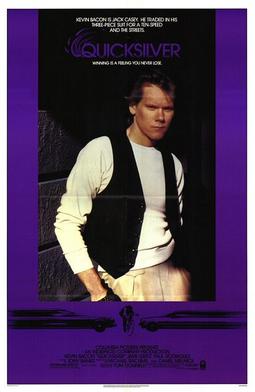
QuicksilverWho doesn’t love Kevin Bacon?

Seriously, I have yet to meet anyone who doesn’t have a positive reaction to seeing Kevin Bacon on screen.  He may not be a star in the way that Bradley Cooper or Bollywood sensation Shah Rukh Kahn are stars but still, he is one of those actors that everyone just seems to instinctively like.

I think, to a large extent, that is because, despite the fact that he’s been around and acting forever, Kevin Bacon himself still comes across as being a normal, blue-collar sorta guy.  Whenever you see him being interviewed, you get the feeling that Kevin Bacon basically shows up, does his job to the best of his ability, and, as opposed to many other actors, he doesn’t take himself or his movies too seriously.  He’s justifiably proud of the good films that he’s appeared in and he’s never had any problem admitting that he’s been in a lot of bad films as well.

In fact, it was Kevin Bacon’s openness about his bad films that led to me discovering 1986’s Quicksilver.  This is the film that, in a 2008 interview, Kevin Bacon referred to as being “the absolute lowest point of my career.”  (Consider, for a minute, that this is being said by the same Kevin Bacon who had an arrow shoved through his throat in the original Friday the 13th and that will give you some clue of how much disdain Kevin seems to have for Quicksilver.)

Naturally, having read that, I knew that I simply had to see Quicksilver.  I’ll admit right now that I was hoping to discover that it was some sort of loss and unappreciated classic.  I wanted this to be the review where I defended the unacknowledged brilliance of Quicksilver.  I wanted to say, “Don’t be so hard on yourself, Kevin!  Give Quicksilver another chance!”

But no.

Quicksilver doesn’t quite suck but it definitely comes close.

At the same time, it is interesting as a classic example of what happens when a filmmaker tries to assign some sort of deeper meaning to or find inherent nobility in an activity or job that really isn’t that interesting.  Often times, this will happen with sports movies.  A director or producer will make the mistake of thinking that just because he’s obsessed with beach volleyball that means that there’s a huge audience out there just waiting for someone to make the ultimate beach volleyball film.  Or, you’ll get a film like 1999’s Just The Ticket, where Andy Garcia is described as being the “world’s greatest ticket scalper” and the audience is supposed to be impressed.

In the case of Quicksilver, it’s all about being a bicycle messenger.  I’m assuming that, one day, director Thomas Michael Donnelly was stuck in traffic and he happened to see a bike messenger rushing down the street, whizzing past all of the stalled commuters.  And Donnelly probably thought, “I wish I was that guy right now!”  Every day after that, whenever Donnelly was stuck in traffic, he thought back to that bike messenger and slowly he grew obsessed.  All of his friends and his family got sick of listening to him talk about how much he envied the freedom of that bike messenger.  Finally, a little light bulb turned on over Donnelly’s head and he said, “I’ve got to make a movie out of this!”

And then the bulb burned out but nobody noticed.

Quicksilver-photo_625px_8col

Kevin Bacon plays Jack Casey.  When we first meet Jack, he’s a successful stock broker and he’s got a really bad, porn-appropriate mustache.  One day, he’s sitting in the back of a cab and he goads his driver into getting into a race with a bike messenger.  The messenger beats the cab.  Jack is amazed!

And then, perhaps the very same day (the film is so poorly edited that it’s hard to tell), Jack not only loses all of his money but all of his parents’ money as well.  Since poor men couldn’t afford facial hair in the 1980s, he shaves off his mustache.  Desperately needing work, Jack applies to be a  — you guessed it! — bicycle messenger.

The rest of the film is basically Jack delivering messages and talking about how he’s free now to live the life that he’s always wanted to live.  And the thing is, you like Jack because he’s being played by Kevin Bacon.  I mean, Kevin Bacon is so inherently likable that audiences even liked him when he was trying to kill Professor X and Magneto in X-Men: First Class.  But, at the same time, you listen to Jack go on and on about how much better his life is now and you just want to say, “Who are you kidding?”

Needless to say, Jack has a group of quirky coworkers.  Of course, by quirky, I mean that they are all quirky in a very predictable Hollywood sort of way.  For instance, there’s the crusty old veteran and the goofy fat guy and the hard-working Mexican guy who wants to start his own business in America and the cocky black guy who is mostly notable for being played by Laurence Fisburne.  One thing they all have in common is that they all love and damn near worship Jack, who has quite the common touch despite having formerly been a super rich stock broker with a bad mustache.

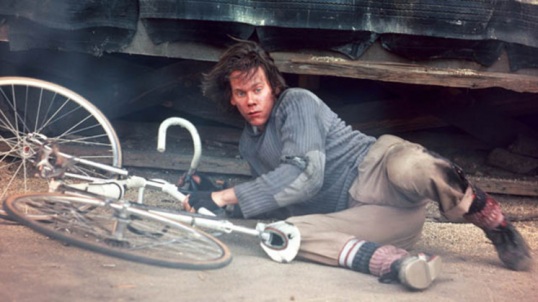
Anyway, Terri (Jami Gertz) also wants to become a bicycle messenger but she’s being used to deliver drugs by Gypsy (Rudy Ramos).  She and Jack fall in love and, along with helping out his quirky coworkers and finding a way to make back his fortune, Jack also has to deal with Gypsy.  It’s all very dramatic (though the drug dealer subplot feels as if it was awkwardly inserted into the film at the last moment) but mostly, the plot is just an excuse for scenes like the one below:

Quicksilver is … well, it’s not particularly good.  It has a few good bike weaving in and out of traffic scenes but it’s definitely no Premium Rush.  But it is kinda fun, in a “Oh my God, look at the 1980s” sorta way.  And, for what it’s worth, it’s a film that proves that Kevin Bacon can be likable in almost anything.

Embracing the Melodrama Part II #76: Children of a Lesser God (dir by Randa Haines)


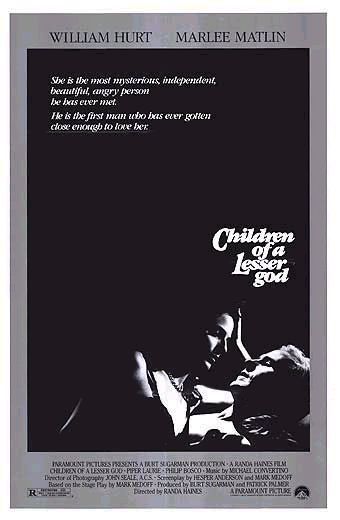
Children_of_a_Lesser_God_film_posterSo, we all know that The Hurt Locker was the first best picture winner to have been directed by a woman.  And we also all know that, when Kathryn Bigelow won her Oscar for that film, she was the first woman to win the Academy Award for Best Director.

But do you know the title of the first film to be both be directed by a woman and to be nominated for best picture?  Well, you probably do now because I’m assuming that you’ve read the title of this post and you’ve seen the picture of the film’s poster above.  But, let’s just pretend that you don’t so I can triumphantly say, “The 1986 film Children of a Lesser God was the first nominee for best picture to be directed by a woman!”

And the name of that director was Randa Haines.  Never heard of her?  You’re probably not alone in that.  After making her feature debut with Children of a Lesser God, Haines only directed three more theatrical films.  Instead, she’s spent most of her career in television and, if not for the nudity and the language, Children of a Lesser God could probably pass for a well-made Lifetime movie.  That’s not necessarily a criticism because I happen to like well-made Lifetime movies.  But still, it’s not surprising that Children of a Lesser God was the only 1986 best picture nominee not to receive a nomination for best director.

(For the record, Platoon won best picture and Oliver Stone won best director.  Nominated in Haines’s place was David Lynch for Blue Velvet.)

As for the film itself, it’s a well-acted and well-made film.  It’s not exactly great in the way that we ideally expect a best picture nominee to be.  It’s directed a bit too much like a television movie and the film ends on a happy note that doesn’t exactly feel earned.  (If any film would have benefitted from a bittersweet conclusion, it would have been Children of a Lesser God.)  Still, at the same time, you can tell why the film was nominated.  It deals with a social issue (in this case, the way that the deaf are marginalized by mainstream society) and it’s a romance between … well, I was going to say mature adults but actually, William Hurt was 15 years older than Marlee Matlin when they played lovers in this film, which adds a perhaps unintentional layer of ambiguity to their relationship.  Children of a Lesser God was also the first film to feature a deaf performer in a lead role and, when Marlee Matlin won the Oscar for Best Actress, she became both the youngest and, to date, the only deaf actress to win.

Ultimately, Children of a Lesser God is more interesting from a historical point of view than a cinematic one.  But the value of history should never be underestimated!  It’s a worthy-enough film and Matlin’s angry performance holds up well.  (As for William Hurt, how you respond to his performance will depend largely on how much tolerance you have for his voice.  Whenever Matlin communicates through sign language, Hurt repeats aloud whatever it is that she’s said.  As a result, the film is basically 2 hours straight of William Hurt talking and, on occasion, it’s a bit too theatrical and distracting.  If the film were made today, the filmmakers would probably just use subtitles.)  Finally, and perhaps most importantly, even if it didn’t lead to bigger things for Randa Haines, Children of a Lesser God did open the door for others to follow.

Embracing the Melodrama Part II #75: Witness (dir by Peter Weir)


Witness_movieLast night, I was lucky enough to watch Witness, a best picture nominee from 1985.

Taking place in Pennsylvania, Witness tells the story of what happens when an Amish widow named Rachel (Kelly McGillis) and her 8 year-old son Samuel (Lukas Haas) decide to take a trip to visit Rachel’s sister.  Traveling on an Amtrak train, Samuel is amazed by his first view of the world outside of the close-knit and insular Amish society.  However, Samuel’s excitement soon turns to horror when they arrive in Philadelphia and he witnesses a man being brutally murdered.

Detective John Book (Harrison Ford, who received his first and, to date, only Oscar nomination for this film) is assigned to the case and arranges for Rachel and Samuel to stay with his sister.  John soon discovers that the murder was committed by two crooked cops, McFee (Danny Glover, who is pure evil in this film) and Ferguson (Angus MacInnes).  John goes to his superior officer, Chief Schaefer (Josef Sommer) with his evidence.  Soon after, McFee attempts to kill and seriously wounds John.  John realizes that Schaefer must be corrupt as well.

Book manages to drive Rachel and Samuel back to their farm in Lancaster County but, after dropping them off, he passes out from blood loss.  Knowing that sending John to the hospital would reveal Rachel and Samuel’s location to Schaefer, Rachel’s father (Jan Rubes) reluctantly allows John to stay at the farm.

And so, while McFee, Ferguson, and Schaefer search for him, John temporarily pretends to be Amish.  He works in the fields.  He helps to build a barn.  He becomes something of a surrogate father to Samuel and he begins a forbidden flirtation with Rachel.

He also goes to town, where he watches as an idiotic local bullies the Amish, knowing that their religion forbids them from fighting back.  John responds by punching a bully, upsetting both the Amish and the a local store owner who yells that this will be terrible for the tourism.  In many ways, the scene is played for laughs and applause but there’s a very serious subtext here, as it would appear that the area’s main appeal to tourists is that you can humiliate the Amish without having to worry about any sort of retaliation.

While we, as viewers, definitely get some satisfaction from seeing John punch that jackass, it also allows Schaefer to discover where he and Rachel are hiding.  One morning, McFee, Ferguson, and Schaefer pull up outside the farm.  They get out of their car and, as the sun rises and with beautiful green fields on either side of them, the three men hold up their shotguns and start to walk down the road….

Witness may technically be a cop film but it’s actually so much more.  It’s a character study of a deeply cynical man who finds himself changed by simple and innocent surroundings.  It’s a love story, with Ford and McGillis illuminating the screen with their chemistry.  It’s a celebration of community, with the harshness of Philadelphia being contrasted with life among the Amish.  It’s a film full of beautiful images and it also features an excellent performance from Harrison Ford.

It’s a good film.  I’m glad that I witnessed Witness.

Embracing the Melodrama Part II #74: Perfect (dir by James Bridges)


PerfectOkay,before reviewing the 1985 film Perfect, I have three things to say.

Number one, I nearly captioned the picture above “John Travolta, Jamie Lee Curtis, and Little Xenu.”  And then I laughed and laughed.  But, in the end, I resisted temptation because I’m an adult now.

Number two, Perfect came out in June in 1985, a few months before I was born.  As a result, I have no idea what the 1985 reviews looked like.  However, it still seems to me that you’re taking a big risk when you give a movie a title like Perfect, especially when the movie itself is far from perfect.  How many reviews opened with, “Perfect fails to live up to its name…”

And finally, as a result of seeing both this film and Staying Alive, I have to say, “What the Hell, John Travolta?”  Seriously, what the Hell was going on?  John Travolta gave a great performance in the 1970s, with Saturday Night Fever.  And then in the 1990s, he was good in Pulp Fiction, Get Shorty, Face/Off, Primary Colors, and a few others.  (For our purposes here, we shall pretend that Battlefield Earth never happened.)  Even though most of Travolta’s recent films have been forgettable, his performances have generally been adequate.

So, seriously, John — what was going on in the 80s?  Because judging from both Perfect and Staying Alive, John Travolta apparently totally forgot how to act during that decade.  When I reviewed Staying Alive, I said that Travolta’s performance managed to create a whole new definition of bad.  But he’s actually even worse in Perfect.  It helped, of course, that in Staying Alive, Travolta’s character was supposed to be stupid.  In Perfect, on the other hand, he’s actually supposed to be a brilliant reporter.

Or, at the very least, he’s supposed to be brilliant by the standards of Rolling Stone.  Travolta plays Adam Lawrence, an award-winning reporter for Rolling Stone.  The magazine, by the way, plays itself and so does its publisher, Jann Wenner (though his character is technically named Mark Roth).  What’s interesting is that the film itself doesn’t necessarily paint a flattering picture of Rolling Stone or Jann Wenner, though admittedly a lot of that is due to the fact that Wenner himself gives a performance that is even worse than Travolta’s.  It’s impossible to watch Perfect without thinking about the fact that Adam is writing for the same magazine that would eventually put Dzokhar Tsarnaev on the cover and publish the UVA rape story.

Anyway, if I seem to avoiding talking about the exact plot of Perfect, that’s because there’s not really much of a plot to describe.  Adam, a hard-hitting investigative journalist, is doing research on a story about how people are hooking up at gyms.  Wenner agrees.  “We haven’t done L.A. in a while!” he says.  Adams joins the a gym called the Sports Connection, which he is soon calling “The Sports Erection” because he’s a super clever reporter.  He falls in love with an aerobics instructor, who is played by Jamie Lee Curtis.  She doesn’t trust reporters but is eventually won over by Travolta’s … well, who knows?  Mostly she’s won over because the plot needs some conflict.  She gets on Adam’s computer and she types, “Want to fuck?”  Adam says sure but then tries too hard to dig into the dark secret from her past.  “You’re a sphincter muscle!” she shouts as him.  Adam writes a compassionate and balanced article about the Sports Connection.  Wenner edits the article and turn it into a sordid hit piece.  (And again, you wonder why Wenner agreed to play himself.)  Feelings are hurt, issues are resolved, and eventually everyone takes an aerobics class.

Honestly, the entire movie is mostly just a collection of scenes of Jamie Lee Curtis and John Travolta working out.  And, in all fairness, Curtis does about as well as anyone could in this terrible film.  Travolta, on the other had … well, just check out the scene below and maybe you’ll understand why I had a hard time concentrating on Travolta’s acting.

Perfect fails to live up to its name.

Film Review: Maggie (dir by Henry Hobson)


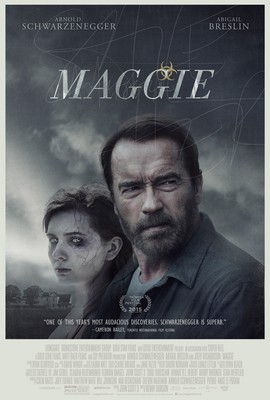
Maggie_(film)_POSTERMaggie is a terrific and sad film about a father who finds himself helpless as his teenage daughter slowly dies.  It’s a thoughtful and heart-rendering film and it’s one of the best of the year so far.  Unfortunately, you wouldn’t necessarily know that from looking at some of the reviews.

Of course, there’s nothing new about a good film getting bad reviews.  I’m actually surprised that anyone even bothers with reviewers anymore, considering just how often they get things wrong.  There are any number of reasons why good films get dismissed.  Some movies are genuinely ahead of their time.  Some critics prefer to judge based on genre than by what they actually see on screen.  Occasionally, a critic feels obligated to like or dislike a movie based on the politics or culture of the moment.  The fact of the matter is that most film critics like to feel important and the easiest way to feel important is to hop onto a bandwagon with all of the other critics.

So, what’s the excuse as far as Maggie is concerned?  Why does Maggie, one of the best films of the year so far, only have a rating of 51% on rotten tomatoes?  In Maggie‘s case, it’s a combination of genre (Maggie is a zombie film and there’s a lot of critics who still feel guilty over liking The Walking Dead) and star.  Maggie has been promoted as being an Arnold Schwarzenegger film, even though his role is essentially a supporting one.  The majority of critics have been willing to admit that Schwarzenegger gives a good performance but they always have to qualify the praise.  As a result, you have critics at both Hitflix and the A.V. Club writing that Schwarzenegger’s performance works because his character is designed to take advantage of Schwarzenegger’s limitations as an actor, as if all good performances aren’t, to some degree, the result of good casting.  In order to make up for praising Schwarzenegger (who is not only an action star but a Republican as well, which is a combination that many reviewers — especially those who work exclusively online — will never be able to see beyond), many critics undoubtedly feel obligated to be overly critical of Maggie.

(What does that 51% mean anyway?  That Maggie is 51% good?)

Maggie_1

As for the film itself, it tells a simple story, one to which a lot of people will undoubtedly relate.  As the film opens, we learn that the zombie apocalypse has already begun.  The world has been hit by a virus.  The infection spreads slowly, forcing the victims and their loved ones to watch as the infected are gradually transformed into mindless and cannibalistic zombies.  However, the U.S. government has reacted with swift and ruthless efficiency.  Martial law has been imposed.  The infected are allowed to say with family up until the disease enters its final stages.  At that point, they’re taken into quarantine and are euthanized.  Though we never actually see a quarantine center, we hear enough about it to know that there is nothing humane about it.  (Indeed, one reason why Maggie is so effective is because we know that the real-life government would probably be even less humane than the film’s government.)  Society has contained the plague but it’s done so at the cost of its own humanity.

College student Maggie (Abigail Breslin) has been infected.  She was bitten by  a zombie and, as a result, she now has a grotesque black wound on her arm.  As the virus moves through her body, her eyes grow opaque.  Her veins blacken.  When she breaks a now dead finger, she reacts by chopping it off with a kitchen knife.  As there is no cure, all Maggie can do now is wait until she is sent to quarantine.

Her father, a farmer named Wade (Schwarzenegger), brings Maggie back to his farm with him so that he can take care of her during her final days.  Wade knows what quarantine is like and he has no intention of forcing his daughter to go through that.  With government doctors and police officers constantly and, in some cases, forcefully demanding the he give her up, Wade protects Maggie as best he can.  He sleeps with a rifle at his side, knowing that eventually he’s going to have to use it on his own daughter.

And I’m crying again.  Between this review and the one I did for Terms of Endearment, my face is going to be a mascara-smeared mess.

arnie-crying-e1427327024932

Maggie is a low-key and thoughtful film, a meditation on life, love, family, and death.  Though the film does feature Schwarzenegger fighting zombies, most of the action happens off-screen.  Instead, we just see the haunting aftermath.  Schwarzenegger doesn’t deliver any one liners in this film and the film deliberately plays down his action hero past.  He’s still got the huge body and the muscles but, in Maggie, they’re not intimidating.  Instead, they’re evidence that Wade has spent his life working the land and they actually emphasize just how helpless Wade is in the face of Maggie’s disease.  Director Henry Hobson makes good use of Schwarzenegger’s heavily-lined and weather-beaten face.  His sad and suspicious eyes communicate everything that we need to know.  When he cries, you don’t consider that you’ve never seen him cry before.  Instead, the moment captures you because the tears and the emotions behind them are real.

Breslin

But really, the film ultimately belongs to Abigail Breslin.  It’s appropriate that the film is named after her character because the film really is her story.  Maggie is about how she deals with knowing that she’s going to die and how she searches for meaning in her final days.  It’s a good and heartfelt performance, one that reminded me of Brigitte LaHaie’s poignant work in Jean Rollin’s Night of the Hunted.

So, ignore the critics.

Ignore that stupid 51% on Rotten Tomatoes.

See Maggie.

Arnold-Schwarzenegger-in-Maggie


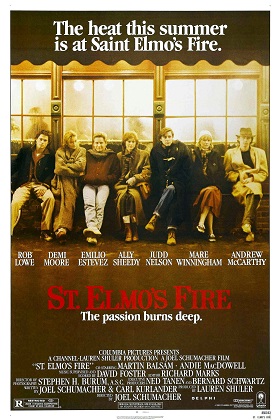
Embracing the Melodrama Part II #73: St. Elmo’s Fire (dir by Joel Schumacher)


St_elmo's_fire

Oh my God!  Aren’t rich, white people just like the worst!?

Actually, usually I would never say something like that.  I usually find class warfare to be tedious and I personally think poor people can be just as annoying as rich people.  I had no interest in the whole Occupy Wall Street thing and I once referred to V For Vendetta as being V For Vapid.

No, I may not be much of a class warrior but then again, that may be because I never met any of the characters at the center of the 1985 film St. Elmo’s Fire.  Seriously, if anything could turn me into a slogan-spouting, window-smashing revolutionary, it would be having to deal with any of the self-centered, entitled characters in St. Elmo’s Fire.

St. Elmo’s Fire is about a group of seven friends, three of whom are played by actors who co-starred in The Breakfast Club.  These friends all met at and are recent graduates from Georgetown University.  St. Elmo’s Fire follows them as they laugh, love, drink, do drugs, and try to figure out what they want to do with the rest of their lives.

For instance, there’s Billy (Rob Lowe), who has big hair and wears one dangling earring.  Billy was in a fraternity and spends most of the movie wishing that he still was.  Billy also plays the saxophone and he has a wife and a kid who he has pretty much abandoned … well, you know what?  I like Rob Lowe.  He seems like a fun guy and his DirectTV commercials were all classics but oh my God, does he ever give a bad performance in St. Elmo’s Fire.  Some of it is because Billy is not a very likable character.  He’s supposed to be the rough-around-the-edges, secretly sensitive rebel type but ultimately, he just comes across as being a loser.

And then there’s Jules (Demi Moore), who does too much cocaine and, as a result, finds herself fearing that she’s on the verge of being sold into a sexual slavery.  Jules doesn’t get to do much other than be rescued by the other characters.  Fortunately, when it looks like the group is drifting apart, Jules attempts to commit suicide and brings everyone back together.  Way to be a plot device, Jules!

Wendy (Mare Winningham) is the sweet but insecure virgin who has a crush on Billy.  Wendy works as a social worker and ends up getting insulted by the very people that she’s trying to help.  Winningham gives one of the film’s better performances but you can’t help but feel that Wendy deserves better friends.

Speaking of good performances, Andrew McCarthy also gives a pretty good one.  McCarthy plays Kevin Dolenz, the idealistic writer who everyone is convinced is gay because he hasn’t had sex in 2 years.  However, Kevin is actually in love with his best friend’s girlfriend.  As written, Kevin runs the risk of coming across as being insufferably moralistic but McCarthy gives a likable performance.  He turns Kevin into the nice guy that we all want to know.

And then there’s the Breakfast Club alumni.

Alec Newberry (Judd Nelson) was the vice-president of the Georgetown Democrats but now, because it pays better, he’s taken a job working for a Republican senator.  Alec’s girlfriend is Leslie (Ally Sheedy).  Alec obsessively cheats on Leslie, claiming that he can’t be loyal to her unless she’s willing to marry him.  The group of friends is largely centered around Alec and Leslie though it’s never really clear why.  Alec and Leslie are boring characters and, as a result, they’re a boring couple.

And then there’s Kirby (Emilio Estevez).  Estevez gives a likable performance but he often seems to be appearing in a different movie from everyone else.  Kirby is working on his law degree and he’s in love with a hospital intern named Dale (Andie MacDowell).  Unfortunately, Dale isn’t as interested in Kirby as he is in her so Kirby responds by stalking her and trying to change her mind.  There’s an earnestness and sincerity to Kirby that makes you like him, even if his behavior is actually rather creepy.

As for the film itself — well, it’s directed by Joel Schumacher and there’s a reason why Schmacher has the reputation that he does.  As a director, Schumacher is good at gathering together an attractive cast but he has close to no idea how to tell a compelling story.  St. Elmo’s Fire plods along, dutifully telling its story but providing little insight or surprise.

If you’ve read some of my previous reviews, you’re probably expecting this to be the point where I argue that St. Elmo’s Fire works as a time capsule.  But, honestly, this film doesn’t have enough insight to really work as a time capsule.  I mean, if you love 80s hair and 80s fashion, you might enjoy St. Elmo’s Fire but, then again, you could always just do a google image search and have the same basic experience.

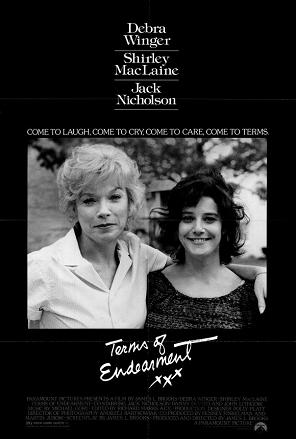
Embracing the Melodrama Part II #72: Terms of Endearment (dir by James L. Brooks)


Terms_of_Endearment,_1983_film

I have to admit that, when I first sat down and watched the 1983 best picture winner Terms of Endearment, I was actually taken by surprise.  Before I actually saw it, I was under the impression that Terms of Endearment was considered to be one of the weaker films to win best picture.  I had read a few reviews online that were rather dismissive of Terms, describing it as being well-made but overrated.

But then, a few weeks ago, I watched Terms of Endearment on Netflix.  The film started with a scene of new mother Aurora Greenwood (Shirley MacClaine) obsessively checking on her daughter, Emma.  Stepping into the bedroom, Aurora is, at first, scared that Emma’s dead.  Without bothering to take off her high heels, Aurora nearly climbs into the crib to check on her.  Fortunately, Emma starts to cry.

And I laughed because I’ve been told about how my mom used to obsessively check in on me when I was a baby.  And, while my mom was never the type to wear high heels around the house, I could still imagine her climbing into a crib to check on me and my sisters.

And then, when Emma (now played by Debra Winger) married Flap Horton (a very young Jeff Daniels) over the objections of her mother, I smiled but I didn’t laugh because, in this case, I was relating to Emma.  Because the fact of the matter is that every girl has known a boy like Flap Horton, the smart and funny guy who is destined to ultimately hurt her.

And when Flap got a job in Des Moines and Emma moved from Houston to Iowa, I knew — as did Aurora — what was going to happen.  I knew that Flap would deal with his insecurity over not being a good provider for his wife and children by cheating on his wife.  And when he did, I wanted to cry with Emma.

But then I wanted to cheer when Emma has an affair of her own.  In the role of Sam, John Lithgow doesn’t have much screen time in Terms of Endearment but he does get the best line.  When a rude cashier claims that she doesn’t feel that she was being rude to Emma, Sam replies, “Then you must be from New York.”

Meanwhile, the widowed Aurora is having an affair of her own.  Jack Nicholson plays Garrett Breedlove, a former astronaut who now has both a drinking problem and a house with a pool.  Garrett gets Aurora to loosen up.  Aurora makes Garrett realize that he actually is capable of being a decent guy.  MacClaine and Nicholson both won Oscars for their performances here and they deserved them.

And then, Emma was diagnosed with cancer.  And I cried and cried because, at this point, I had come to think of Emma and Aurora as being real people.  And when Emma told her friends that she was dying and she spent her final days with her children, I sobbed because it made me think about my mom.  And now I’m sobbing as I write this review.

But it’s a great film, even if it did make me cry.  Because, in the end, you’re glad that you got to know these characters.  And, even through the tears, the film leaves you happy that you got to spend some time with them.

And isn’t that what a great film is supposed to do?

Embracing the Melodrama Part II #71: Cocaine: One Man’s Seduction (dir by Paul Wendkos)


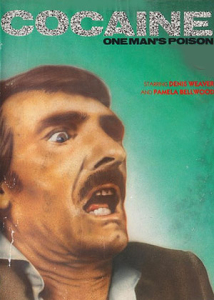
CocaineNow, I originally saw the 1983 made-for-TV movie Cocaine: One Man’s Seduction on Netflix so I have absolutely no first hand knowledge of how this film was advertised.  However, I have it on very good authority (i.e., I read it on another blog) that the image above is from the film’s VHS packaging.

Just looking at this image, you would be justified in thinking that Cocaine: One Man’s Seduction was an early David Cronenberg film.  Seriously, it looks like a deleted scene from Scanners and Dennis Weaver’s head is about to explode.

But no!  There are no scanners in Cocaine: One Man’s Seduction.  David Cronenberg did not direct this film.  As far as I can tell, it wasn’t even filmed in Canada.  Instead, Cocaine: One Man’s Seduction is about one man who gets seduced cocaine.

You may have noticed that I enjoy reminding you that this film is called Cocaine: One Man’s Seduction.  That’s because that’s a great title.  If the film had just been called Cocaine, you might watch the film expecting it to be set on a 1970s film set.  And if the film had just been called One Man’s Seduction, viewers may have watched the film expecting a Double Indemnity–style film noir.  But Cocaine: One Man’s Seduction leaves no doubt about what we’re about to see.

Add to that, it’s a very melodramatic title and the name of this series of reviews is, after all, Embracing the Melodrama Part 2!

Anyway, Cocaine: One Man’s Seduction is about a real estate agent named Eddie Grant (Dennis Weaver).  He’s the type of semi-successful white-collar suburban guy who you just know is going to have a really over-the-top midlife crisis.  He has a wife (Karen Grassle) who loves him.  He has a son (James Spader — yes, that James Spader!) who wants to put off going to college for a year.  Eddie also has a job where he’s viewed as being an over-the-hill relic.  People looking to buy a new home simply are not impressed with Eddie’s cheap suits, mild manner, and old-fashioned scotch-after-work style.

What Eddie needs is a new wardrobe and aviator sunglasses.  And, as we all know from watching movies set in the 70s and 80s, nothing gets you into aviator sunglasses faster than snorting a line of coke.

Soon, Eddie is driving a fast car, he’s wearing nicer suits, and he’s keeping a lot of secrets.  Then, one day, his son — JAMES SPADER! — happens to look inside Eddie’s shave kit and discovers where dad has been hiding his cocaine.

Now, this is where I was expecting Jeff VanVondern to show up and say, ” I see a bunch of people that love you like crazy and they feel like they are losing you. And they wanna fight to get you back.”  But apparently, people in the 80s did not need an intervention to get them to go to rehab.  Instead, they just needed to have a dramatic nose bleed at work and nearly overdose on someone else’s kitchen floor.  They also needed to be called out by James Spader.

Of course, it also helps that Eddie is friends with a recovering cocaine addict who is played by a very thin-but-already-bald Jeffrey Tambor.  Jeffrey Tambor is already something of a hyperactive actor (and that’s why we love him!) so when you combine that natural tendency with a character who is supposed to be coked up, it’s something that simply has to be seen.

Anyway, Cocaine: One Man’s Seduction is a fairly good example of the-worst-that-can-happen-will-happen cinema.  If nothing else, it has some worth as a time capsule and it’s undeniably interesting to see James Spader play a role that one would normally never associate with James Spader.

Cocaine: One Man’s Seduction is currently seducing viewers on Netflix.