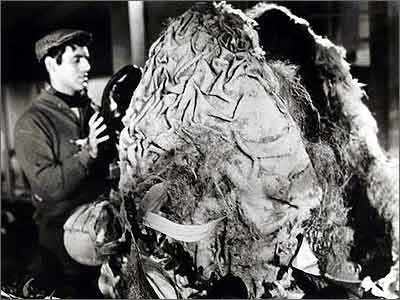
Horror Book Review: Night of the Living Dead: Behind The Scenes of the Most Terrifying Zombie Movie Ever


Where would modern horror be without George Romero’s 1968 masterpiece, Night of the Living Dead?

Well, it’s hard to say.  Perhaps another film would have come along and influenced thousands of future directors and writers.  Maybe another film would have popularized zombies or mixed social commentary with horror.  Perhaps another film would have popularized the concept of body horror.  You never know.

Still, it’s hard not to think that modern horror would be a lot different if not for Romero’s low-budget, independent film.  So many movies have been influenced by Romero’s Dead films that it’s difficult to keep track of them all.  Even if you could discount the influence of Romero, what about the Living Dead films that were later made by John Russo?  Even if they don’t get as much attention as Romero’s films, their combination of comedy and horror continues to be influential to this day.

The 2010 book, Night of the Living Dead: Behind The Scenes Of The Most Terrifying Zombie Movie Ever, not only tells the behind-the-scenes story of Night of the Living Dead but it also examines the film’s lasting influence.  While the majority of the book is taken up with the production and reception of Night, it also discusses Romero’s subsequent Dead films, Russo’s Living Dead films, and all of the unofficial sequels and remakes as well.  Author Joe Kane interviews not only several of the people who worked on Romero’s film but also filmmakers like Danny Boyle, who discuss how Romero’s vision influenced their own.

Finally, the book also contains the original script of Night of the Living Dead!  Written by John Russo, the script makes for an interesting read.  Night of the Living Dead is often described as being some sort of “accidental” masterpiece but the script reveals that many of the film’s themes were there from the beginning.  At the same time, it also makes you appreciate not only the directorial skill of George Romero but also the performances of Judith O’Dea, Duane C. Jones, and even Karl Hardmann.  (If you thought Harry was bad in Night, reading the script will show you just how much Hardmann actually humanized an inherently unlikable character.)

This book is must have for horror fans like you and me.
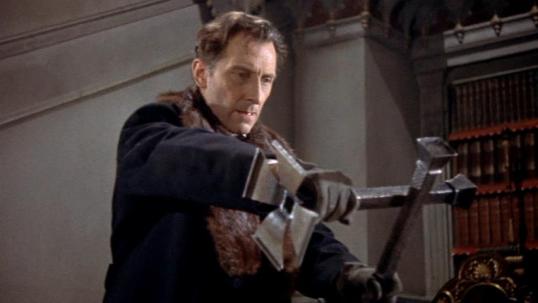
A Blast From The Past: Peter Cushing — A One Way Ticket To Hollywood


I’m not sure if you can be a true fan of horror (especially British horror) without loving Peter Cushing.

The actor played many roles over the course of his long career.  In fact, the first film in which he and Christopher Lee both appeared was not a horror film but instead Laurence Olivier’s 1948 production of Hamlet.  (They both also appeared in 1952’s Moulin Rouge.)  However, Cushing will probably always be best known for his Hammer roles and, of course, his villainous performance in Star Wars.  Peter Cushing was not only the virtuous Prof. Van Helsing but also the far less virtuous Baron Frankenstein.

According to almost every interview that I’ve read, Peter Cushing was a genuinely nice and professional person, one who didn’t personally care for horror films but who never took it personally when he was recognized for appearing in them.  Though they regularly played rivals on screen, he was close friends with Christopher Lee.  I once read an interview with Lee where he said that, decades later, he still hadn’t recovered from Cushing’s death in 1994.

Below, you’ll find a documentary from 1989.  It was called Peter Cushing — A One-Way Ticket To Hollywood.  It’s basically just Peter Cushing talking about his life and career for 49 minutes but it’s a charming little documentary.  Peter Cushing comes across as being very nice and very British.  He discusses not only his horror films but also his work in Star Wars and his performance as Winston Smith in a 1954 production of 1984.

It’s a nice documentary and I offer it up on Halloween as a tribute to one of horror’s gentlemen.

(Thank you to VintageTreats for uploading this!)

Italian Horror Showcase: The Vampire and the Ballerina (dir by Renato Polselli)


“If you want to taste the night, come downstairs.”

— The Professor (Pier Ugo Gragnani) in The Vampire and The Ballerina (1960)

A young woman relaxes with her friends at a waterfall.  She sees a funeral procession passing by and cheerfully announces, “A funeral!  It brings good luck!”

One person who would disagree with that would be the girl in the coffin.  She’s just the latest villager to have been found passed out in a field in the middle of the night, lacking blood.  The locals say that there’s a vampire on the loose.  The local doctor insists that the girl is just anemic and will recover in ten days.  Instead, the girl ends up in a coffin, only opening her eyes while being carried to her grave.  From her point of view, we watch as clumps of dirt are tossed onto the coffin, one after another until finally all is dark.

At night, she leaves her grave and runs into the horribly disfigured vampire who previously bit her.  He greets her and tells her to lie down in his coffin.  As soon as she does, he drives a take through her heart and says that he must remain “the master of my world.”

It’s a strange world.  In the village, a dance troupe is, for some reason, staying at a villa belonging to an older man (Pier Ugo Gragnani) who is called both “grandpa” and “The Professor.”  (Despite the film’s title and some of the dialogue, they are clearly a modern dance troupe.)  The professor tells the dancers a story about vampires.  Everyone’s amused.  Interestingly, most of the dancers seem to believe that there is a vampire on the loose but none of them seem particularly concerned about it.  From my own experience, this is probably the most realistic part of the film.  When you’re a dancer, that’s pretty much all you worry about.

Later, two of the dancers, Luisa (Helene Remy) and Francesca (Tina Gloriani), are walking around the woods with Francesca’s fiancée, Luca (Iscaro Ravaiolli) when it starts to rain.  They take refuge in a nearby castle, one which they believe to be deserted.  It turns out that it’s not.  Countess Alda (Maria Luisa Rolando) lives there with her manservant, Herman (Walter Brandi).  Alda explains that she allows the villagers to believe the castle is deserted and haunted because she doesn’t want to be bothered by them.  Luca is immediately enchanted with Alda while Francesca wonders why Alda looks exactly like the woman in a 400 year-old painting that is hanging in the dining room.  Luisa wanders off and gets bitten by the same disfigured vampire who has been preying on the villagers.

That night, Luisa waits in bed until the vampire comes to her.  Meanwhile Luca sneaks back to the castle to see Alda.  Alda claims that Herman is holding her prisoner but, when Herman suddenly shows up, Alda orders Luca away and proceeds to drink Herman’s blood and he goes from being a handsome servant to being the disfigured vampire that we saw earlier in the film.  It turns out that Alda and Herman’s blood-soaked relationship is all about trying to stay young.  When Herman ages, he drinks the villager’s blood to become young again.  Then Alda drinks his blood to retain her youth, which means that the now aged Herman again has to go out and drink more villager blood….

Meanwhile, the dance troupe’s choreographer has a brilliant idea!  Why don’t they do a number about vampires!?

1960’s The Vampire and the Ballerina is a personal favorite of mine.  That really shouldn’t surprise anyone, of course.  I love vampires.  I love to dance.  Of course, I’m going to love a film that brings those two things together!  But beyond that, The Vampire and The Ballerina is just such a strange little film.  From the off-center performances to Angelo Baistrocchi[‘s haunting cinematography, The Vampire and the Ballerina plays out like a filmed fever dream. The fact that the plot often doesn’t make sense only adds to the film’s surreal atmosphere.

Continuing what Hammer started with the Horror of Dracula, The Vampire and the Ballerina takes the sexuality that has always been the subtext of most vampire films and instead puts it front and center.  The formerly repressed Luisia writhes in bed as she waits for the vampire to come to her.  Luca stares at Alda with an obsessive intensity before forcefully kissing her hand.  Alda and Herman torment each other, even though one could not exist without the other, a relationship that is more sado-masochistic than supernatural.

The Vampire and the Ballerina is an Italian horror film that deserves to be better known than it is.  I mean, seriously, how can anyone resist a movie that has this many vampires and this much dancing?

It’s a strange world.

Horror Film Review: Nadja (dir by Michael Michael Almereyda)


When we first meet Nadja (Elina Löwensohn), the title character of this odd, 1994 film, she is walking around New York, wearing a cape and picking up men in bars.  She speaks with a thick, Eastern European accent and when she’s asked what she does, she explains that she comes from an old and very wealthy Romanian family.  As we quickly guess, Nadja has lived for centuries.  She’s a vampire, a daughter of Count Dracula.  Everything she says and everything she does is drenched in the ennui of someone who wishes to be set free but who knows she is destined to live forever in the prison of her existence.  Even when she has visions of her father getting a stake through the heart, it doesn’t provide her with the relief for which she was hoping.

It probably won’t come as a surprise to learn that it was a member of the Helsing family that drove the stake through Dracula’s heart.  However, having killed the vampire, Van Helsing (Peter Fonda) finds himself in trouble with the police.  Apparently, the cops don’t believe Van Helsing when he insists that he was just killing a vampire.  As far as they can tell, Van Helsing just killed a man with a sharp piece of wood.  Fortunately, Van Helsing’s nephew, Jim (Martin Donavon), also lives in New York and can bail his uncle out of jail.

While Jim is dealing with his uncle, Nadja is meeting a woman in a bar, a woman named Lucy (Galaxy Craze).  Both Lucy and Nadja feel empty and unfulfilled.  Lucy, who happens to be married to Jim, is soon inviting Nadja back to her home and becoming obsessed with her.  However, Nadja is more concerned with her brother, Edgar (Jared Harris).  Edgar lives in Brooklyn with his lover and nurse, Cassandra (Suzy Amis).  When Nadja visits Edgar, she decides to take Cassandra away from him.  Of course, Cassandra just happens to be Van Helsing’s daughter and Jim’s cousin!

Nadja is an odd film.  On the one hand, it’s pretentious in the way that only a mid-90s, New York art film can be.  Director Michael Almereyda shot the majority of film at night and a good deal of it with a PXL-2000, which was basically a toy video camera that was specifically marketed to children.  As a result, the black-and-white images are usually dark and grainy.  Sometimes, it’s a bit of struggle to tell just what exactly is happening on-screen.  And yet, at the same time, it kinda works.  Those hazy images, combined with the largely deadpan performances of the cast, give the film an undeniably dream-like feel.  When we see Nadja walking through the city, we feel her ennui and otherworldly presence.  At its best, the film achieves a hypnotic visual beauty.  If ever there was an American city that benefits from being filmed in grainy black-and-white, it’s New York City.

The film plays out like a satire of the typical decadent vampire film.  (Nadja even has a Renfield of very own.)  Nadja is so obviously a vampire that it’s impossible not to be amused by the fact that hardly anyone else seems to pick up on it.  However, the film’s most subversive element is Peter Fonda’s performance as Van Helsing.  With his long hair and a demented gleam in his eye, Fonda totally upends all our assumptions about who someone named Van Helsing should be.

In many ways, Nadja plays out like an elaborate inside joke but it’s just strange enough to always be watchable.  David Lynch, whose influence is obvious, has a cameo as a morgue attendant and he feels right at home.  This deadpan vampire film many not be for everyone but then again, few worthwhile films are.

Horror on the Lens: Night of the Living Dead (dir by George Romero)


Happy Halloween everyone!

Well, as another horrorthon draws to a close, it’s time for another Shattered Lens tradition!  Every Halloween, we share one of the greatest and most iconic horror films ever made.  For your Halloween enjoyment, here is George Romero’s Night of the Living Dead!

(Be sure to read Arleigh’s equally famous review!)

Music Video of the Day: This is Halloween, covered by Leo Moracchioli (2018, dir by Leo Moracchioli )


Indeed, it is!

This version was done Leo Moracchioli, a musician from Norway who has a band called Frog Leap.  If you like his cover, check out some more stuff from him:

You can buy his albums or singles here:

DIRECT FROM HIM (LOSSLESS) ► http://bit.ly/2usJ3lq

ITUNES ► http://apple.co/1Lni4PR

AMAZON ► http://amzn.to/1U2rqUa

GOOGLE PLAY ► http://bit.ly/1SOd6Nx


Frog Leap Studios Merchandise here:

US ► http://bit.ly/1qZ64KP

EU ► http://bit.ly/1NXI3Zz


Also he can be followed here:

Youtube ► http://youtube.com/leolego

Facebook ► https://www.facebook.com/FrogLeapStudios

Twitter ► https://twitter.com/FrogLeapStudios

Instagram ► https://instagram.com/frogleapstudios

Website ► http://frogleapstudios.com

Paetron — http://www.patreon.com/frogleapstudios

Frog Leap Studios YouTube Page — https://www.youtube.com/channel/UC98tcedR6gULv8_b70WJKyw


Happy Halloween everyone!

Enjoy!


Horror On TV: Kolchak: The Night Stalker 1.20 “The Sentry” (dir by Seymour Robbie)


Tonight on Kolchak….

There’s something on the loose underneath Chicago!  Could it be a …. killer lizard!?  Kolchak’s on the story!

Sadly, all good things must come to an end and this was the final episode of Kolchak: The Night Stalker.  Darren McGavin, of course, would later go on to epitomize the ideal middle American father when he played The Old Man in A Christmas Story.

This finale originally aired on March 28th, 1975.

I hope you have enjoyed this October’s trip down Kolchak Lane!

Horror on the Lens: The Little Shop of Horrors (dir by Roger Corman)


(It’s tradition here at the Lens that, every October, we watch the original Little Shop of Horrors.  And always, I start things off by telling this story…)

Enter singing.

Little Shop…Little Shop of Horrors…Little Shop…Little Shop of Terrors…

Hi!  Good morning and Happy October the 30th!  For today’s plunge into the world of public domain horror films, I’d like to present you with a true classic.  From 1960, it’s the original Little Shop of Horrors!

When I was 19 years old, I was in a community theater production of the musical Little Shop of Horrors.  Though I think I would have made the perfect Audrey, everybody always snickered whenever I sang so I ended up as a part of “the ensemble.”  Being in the ensemble basically meant that I spent a lot of time dancing and showing off lots of cleavage.  And you know what?  The girl who did play Audrey was screechy, off-key, and annoying and after every show, all the old people in the audience always came back stage and ignored her and went straight over to me.  So there.

Anyway, during rehearsals, our director thought it would be so funny if we all watched the original film.  Now, I’m sorry to say, much like just about everyone else in the cast, this was my first exposure to the original and I even had to be told that the masochistic dentist patient was being played by Jack Nicholson.  However, I’m also very proud to say that — out of that entire cast — I’m the only one who understood that the zero-budget film I was watching was actually better than the big spectacle we were attempting to perform on stage.  Certainly, I understood the film better than that screechy little thing that was playing Audrey.

The first Little Shop of Horrors certainly isn’t scary and there’s nobody singing about somewhere that’s green (I always tear up when I hear that song, by the way).  However, it is a very, very funny film with the just the right amount of a dark streak to make it perfect Halloween viewing.

So, if you have 72 minutes to kill, check out the original and the best Little Shop of Horrors

Music Video Of Day: I’ll Kill You That Way by Slashstreet Boys (2018, dir by ????)


Well, there’s no way that I could let October end without sharing this touching video!

I have to admit that, after watching this video, I was all excited and ready to buy tickets for the next time that the Slashstreet Boys came to Dallas but it appears that this killer boy band might just be an elaborate parody.  Which is a shame because if Michael Myers had been allowed to pursue music, he probably wouldn’t have killed as many people as he did.

Or maybe he would have.  Who knows?

Credit for this video goes to The Merkins!

Enjoy!

Chilling Adventures of Sabrina 1.6 “Chapter Six: An Exorcism In Greendale” (dir by Rachel Talalay)


So, I’m just going to start this review out by honestly admitting that the sixth episode of Chilling Adventures of Sabrina didn’t do as much for me as the previous episodes.

A lot of that, though, is because any show would struggle to follow up an episode as brilliant as Dreams In A Witch House.  The show didn’t do itself any favors by following up that episode, where Sabrina had to battle and trap a viscous demon, with another episode in which Sabrina had to battle and trap a viscous demon.  That similarity alone makes it impossible not to compare the two episodes against each other and, unfortunately, there’s no way to really top what went on in Episode 5.

Episode 6 does start out with an interesting example of psychological manipulation on the part of Ms. Wardwell.  With Sabrina confronting her about both being a witch and spying on her, Wardwell is quick to claim that she once wanted to marry a mortal and that she was an acolyte of Sabrina’s father.  Wardwell claims that she’s only been spying on Sabrina because Edward Spellman requested it.  Since Sabrina is still struggling to work out her feelings towards her deceased parents and their legacy, Wardwell told exactly the right lie to keep Sabrina from completely dismissing her.  However, Wardwell then took it too far by claiming that she had been in love with Edward.  Sabrina tells Wardwell to stay away from her but, by the end of the episode, Wardwell has once again go Sabrina confiding in her.

How does Ms. Wardwell accomplish this?

The answer is right in this episode’s title.  Wardwell helps Sabrina to do something that no witch has ever done before.  Wardwell helps Sabrina to exorcise a demon.

It turns out that Susie’s Uncle Jesse has been possessed by a demon, one who claims to be named Maerceci.  (Write it down on a piece of paper and then stand in front of a mirror.  As Ambrose puts it, demons have got a terrible sense of humor.)  Not only are Roz, Susie, and Harvey being haunted by visions of Uncle Jesse but apparently, the demon is going to possess one of them as soon as it gets finished devouring Jesse.  Despite being told that witches are not allowed to perform exorcisms, Sabrina, Wardwell, Hilda, and eventually Zelda do just that.

(It turns out that, in another case of deus ex Edward, Sabrina’s father just happened to come up with a exorcism ritual for witches, which leads to the question of whether there’s anything that Edward didn’t do before he died.)

The exorcism is a success, though Sabrina soon learns that it takes more than just successfully casting a spell to make people happy.  Even after he’s freed from the demon, Uncle Jesse still dies.  (He’s killed by Wardwell, though Sabrina doesn’t know that.)  Thanks to the demon, Roz fears that she’s losing her eyesight because her faith isn’t strong enough.  Harvey is still scared to death of going into the mines and worries that Sabrina thinks that he’s less of a man as a result.  The demon may be gone but Susie remains traumatized by the demon’s taunts and, by the end of the episode, is declaring, “I won’t be an abomination!”  In the end, that’s the main lesson of an Exorcism in Greendale.  Just because a story ends in with special effects and a temporary victory, that doesn’t erase the pain that came before.

Anyway, this was an okay episode.  It moved forward Sabrina’s relationship with Wardwell so, if nothing else, it served its purpose.  I hate to say it but I probably would have had a better reaction to this episode if the demon had been taunting Hilda, Zelda, and Ambrose as opposed to Sabrina’s friends.  The witches are just more interesting than the mortals.

Case is going to be reviewing the rest of this season so I’m going to wrap up this review by sharing my thoughts on the show as a whole.  As the first season of any show will, Chilling Adventures of Sabrina has its flaws.  Overall, though, it’s a good show.  I go back and forth on whether I like Michelle Gomez’s stylized performance as Ms. Wardwell but Kiernan Shipka, Lucy Davis, Miranda Otto, and Chance Perdomo are all perfectly cast.  (Kiernan Shipka simply is Sabrina.)  Ross Lynch also deserves a lot of credit for making Harvey into a compelling character.  I’m looking forward to seeing where this show goes in the future.

Oh — and, of course, I absolutely adore Salem!

(photo credit: Stewart Cook/REX/Shutterstock)