Are you living in a dystopian future that was apparently inspired by Blade Runner?
Well, don’t worry. Spice Girls are here!
One thing that I like about the Spice Girls is that you could always sing along to their songs. The other thing I like about them is that, regardless of how simple their music may have been, their music videos were almost always ludicrously overproduced. That’s the case here, where Spice Up Your Life is transformed into an anthem for revolution.
Spice Up Your Life was directed by Marcus Nispel, who has subsequently directed a few features film that I didn’t care much for.
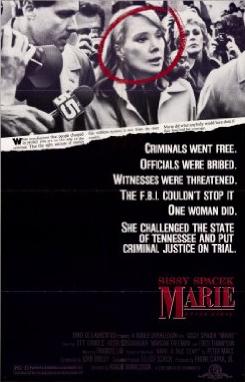
(In fact, the film’s official title is Marie: A True Story, just in case there was any doubt.)
The film opens in Tennessee, in the early 70s. Marie Ragghianati (Sissy Spacek) has left her alcoholic and abusive husband and is now living with her mother and trying to raise three children, one of whom is chronically ill, on her own. Though she manages to win a scholarship to Vanderbilt University, she quickly discovers that having a degree does not necessarily translate into getting a job. However, while Marie was a student, she became acquainted with Eddie Sisk (Jeff Daniels), a seemingly friendly lawyer who now has a job as the counsel for the newly elected governor of Tennessee, Ray Blanton (Don Hood). Marie goes to see Eddie and she soon finds herself working in the governor’s office.
With Eddie’s support, Marie rises up through the ranks. Of course, he does get a little bit annoyed whenever Marie asks him why the governor is so eager to offer clemency to certain criminals. At first, Eddie claims that it’s because the governor is against the death penalty and he doesn’t want to send anyone to die in “Old Sparky.” Later, Eddie claims that it’s because the state has been ordered to do something about prison overcrowding. And finally, Eddie admits that, on occasion, it’s done as a political favor. It appears that some of the children of Tennessee’s wealthiest families have a really bad habit of getting arrested for some very serious crimes.
Eventually, there’s an opening on the state parole board and Eddie recommends that Marie be appointed the board’s new chairperson. As Eddie explains it, the governor wants to put a Democrat on the board and he wants to appoint a woman. (Despite the governor’s insistence that he wants to bring more women into state government, the film makes it clear that the Blanton administration was essentially a boys club.) Marie agrees and soon, she’s making over a hundred dollars a day! (That was apparently an unusual thing in the 70s.)
No sooner has Marie moved into her new position than she is informed that some of the governor’s aides have been selling pardons. When Marie goes to Eddie about the situation, his charming facade disappears as he gets angry with her and accuses her of trying to ruin his career. When rumors get out that she may have gone to the FBI, Marie becomes a pariah. The governor demands her resignation, which she refuses to give. She finds herself being followed by strange cars and harassed by the police. (At one point, she is arrested for drunk driving despite being sober.) Meanwhile, people start to show up dead.
When Blanton fires Marie on trumped-up corruption charges, she decides to take the governor to court. Fortunately, Marie is friendly with a lawyer named Fred Thompson. The future U.S. Senator and presidential candidate plays himself in this film and he gives such an authoritative performance that he went on to have a busy career as a character actor whenever he wasn’t running for or serving in office.
Marie is a strangely disjointed film. On the one hand, you’ve got Sissy Spacek, Fred Thompson, and Jeff Daniels all giving excellent performances and you’ve also got an inspiring true story. On the other hand, the film attempts to combine so many different genres that it sometimes feels as if you’re watching multiple films at once. The film starts out as the story of a single mom trying to restart her life and then it becomes a workplace drama as Marie has to deal with gossip about her relationship with Eddie and hostile co-workers like fellow board member Charles Traughber (Morgan Freeman, in a small role that would probably be forgettable if it was filled by anyone other than Morgan Freeman). Then it becomes a courtroom drama, with Fred Thompson cross-examining witnesses and giving final arguments. Meanwhile, at the same time, it’s also a political thriller in which two men are brutally murdered before they can testify against the governor. And then finally, it’s also a crime drama as detectives try to track down a career criminal who has friends in the governor’s office. It’s a film of many good parts but those parts don’t always seem to easily fit together and the end result is somewhat awkward whole.
(Interestingly enough, some of the film’s moments that seem as if they’re most likely to be fictionalized are actually based on fact. For instance, two men who could have brought down Blanton were mysteriously murdered at the same time that Marie was suing the state.)
In the end, Marie doesn’t really come together but it has a good cast and a good lesson: Never trust a politician.
Sidney Poitier played Detective Virgil Tibbs for the third and final time in the 1970 film, The Organization.
This time, Virgil is investigating a murder at an office building in San Francisco. It’s a very odd murder, in that an executive was shot, a security guard was bludgeoned, and even though it looks like there was a robbery taking place, nothing appears to have actually been stolen. Since neither the company nor the executive were believed to be involved in anything shady, Virgil finds himself perplexed as to why any of this has happened at all.
Fortunately, the local urban revolutionaries are here to help! They contact Virgil and Virgil reluctantly agrees to meet with the group, which is made up of the usual collection of angry 1970s activists — i.e., a dissident preacher, a reformed drug dealer, a guy who won’t stop yelling, and a woman who is obviously going to be killed before the movie is over. The revolutionaries explain that they were the ones who broke into the office but they also say that they didn’t kill anyone. Instead, they broke into the office because they wanted the police to investigate the break-in and discover that the company was a front for a bunch of drug dealers. “The Organization” is flooding poor and minority neighborhoods with heroin and the revolutionaries want to stop them. In fact, the revolutionaries have stolen four million dollars worth of heroin. Now, they want Virgil to help them.
Even though Virgil is sympathetic to the revolutionaries, he’s still a cop and he can’t get directly involved with illegal activities. Instead, he agrees to not arrest the revolutionaries and to continue his investigation, in the hope of bringing down the Organization. It’s not going to be easy, of course. There’s evidence that the Organization may even have agents inside the San Francisco police department.
As far as the Virgil Tibbs movies are concerned, The Organization is slightly better than They Call Me Mister Tibbs! but it’s nowhere near as good as the one that started it all, In The Heat of the Night. Probably the biggest flaw with The Organization is that Virgil has to share the spotlight with the revolutionaries. With the exception of Raul Julia (who plays a former drug dealer named Juan), none of the revolutionaries are particularly memorable characters and their plan for taking down The Organization is so unnecessarily convoluted that it’s hard to believe that Virgil would go along with it.
On the plus side, The Organization works fairly well as a conspiracy thriller. It does manage to create a consistent atmosphere of unease and mistrust. This is one of those films where people are constantly getting shot by unseen gunmen mere minutes after getting arrested and the fact that even cool and in-control Virgil Tibbs can’t save them does a lot towards creating a nice sense of paranoia. The films end on perhaps the most downbeat note of all of the Virgil Tibbs movies, suggesting that, in the end, everything we’ve just watched was for nothing.
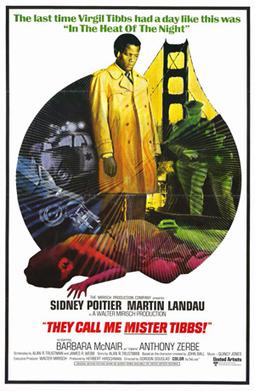
The 1970 police procedural, They Call Me Mister Tibbs!, opens with a murder in San Francisco.
A prostitute has been found dead in a sleazy apartment building and, according to witnesses, she was visited, shortly before her death, by the Reverend Logan Sharpe (Martin Landau). Rev. Sharpe is a prominent civic leader, an outspoken liberal who is a friend of the civil rights movement. Sharpe is currently at the forefront of a campaign to pass a city referendum that will add a “mini city hall” to every neighborhood and will help to fight against the gentrification of San Francisco. If Sharpe’s guilty, it will mean the death of the referendum.
Despite the fact that there’s a ton of evidence piling up against him and he kind of comes across as being a little bit creepy (he is, after all, played by Martin Landau), Rev. Sharpe insists that he’s innocent. Yes, he’s been visiting prostitutes but he’s not a client. No, of course not! Instead, Sharpe explains that he’s simply counseling them and praying for their souls. In fact, as far as Sharpe is concerned, this whole thing is just an attempt by the establishment to discredit his efforts to help the poor and underprivileged.
Heading up the investigation is a friend and supporter of Sharpe’s, Detective Virgil Tibbs (Sidney Poitier). That may seem like a good thing for Sharpe, except for the fact that Tibbs is an honest cop and he’s not the type to let friendship stand in the way of doing a thorough investigation. Tibbs admits that he supports Sharpe’s campaign and he wants the reverend to be innocent. But Tibbs is all about justice. Whether it’s teaching his son an important lesson about smoking or tracking down a potential serial killer, Virgil Tibbs is always going to do the right thing.
There are other suspects, all of whom are played by suitably sinister character actors. Anthony Zerbe plays a criminal who lived near the prostitute. Ed Asner plays her landlord, who may have also been her pimp. Is Sharpe being set up by the powers that be or is Tibbs going to have to arrest a man whom he admires?
They Call Me Mister Tibbs! was the second film in which Sidney Poitier played Virgil Tibbs. The first time he played the role was in 1967, when he co-starred with Rod Steiger in the Oscar-winning In The Heat of the Night. In that film, Poitier was a Philadelphia cop in the deep south who had to work with a redneck sheriff. In They Call Me Mister Tibbs!, Virgil is now working in San Francisco and he has to work the case on his own.
They Call Me Mister Tibbs! is a far more conventional film than In The Heat of the Night. Whereas In The Heat of the Night had a wonderful sense of place and atmosphere, They Call Me Mister Tibbs! could just as easily have taken place in Los Angeles, Phoenix, or even Philadelphia. With the exception of some slight profanity, They Call Me Mister Tibbs! feels more like a pilot for a TV show than an actual feature film. Perhaps the biggest problem with the film is that there’s no real surprises to be found within the film. You’ll guess who the murderer is within the first 10 minutes of the film and you’ll probably even guess how the movie will eventually end.
On the plus side, just as he did in In The Heat of the Night, Sidney Poitier brings a lot of natural authority to the role of Virgil Tibbs. He’s actually allowed to show a sense of humor in this film, which is something that the character (understandably) couldn’t do while he was surrounded by bigots and rednecks during his previous adventure. Virgil gets a few family scenes, where we watch him interact with his wife and his children. The scenes feel out of place but, at the same time, Poitier plays them well.
With Sharpe attempting to get his referendum passed and the possibility that riots could break out if Sharpe is indeed guilty of murder, there’s a slight political subtext to They Call Me Mister Tibbs! Sharpe’s argument that he was being set up by the establishment undoubtedly carried a lot of weight in 1970. Still, this is ultimately a shallow (if adequately entertaining) film that, for the most part, is only made memorable by Poitier’s commanding performance.
The 1987 film, Best Seller, tells the story of two men, both equally capable of violence but with two very different moral codes.
Dennis Meechum (Brian Dennehy) is a cop who also writes true crime. In the early 70s, he was the one of several cops who were attacked by a group of gunmen who were all wearing Richard Nixon masks. Though he was shot, Meechum survived and he even managed to stab one his assailants. 15 years later, Meechum is still haunted by the incident. Meechum is a brawler who doesn’t have much time for nonsense but he also has a strong moral code (or so he thinks).
Cleve (James Woods) talks fast and always seems like he’s a little bit nervous. He has a quick smile and a joke for almost every occasion. He’s also a professional assassin, a sociopath who is very interested in Dennis. Cleve has spent the majority of his life working for a powerful businessman named David Madlock (Paul Shenar) but he’s recently been laid off. Cleve wants revenge and he thinks that Dennis can help him get it.
Together …. THEY FIGHT CRIME!
Well, actually, they kind of do. Madlock’s done a lot of illegal stuff and Cleve and Dennis are exposing him, his crooked corporation, and all of his powerful connections. However, what Cleve really wants is for Dennis to write a best seller about his life. Cleve wants Dennis to write his story and most importantly, he wants Dennis to make him the hero. Dennis is still a cop and says that once all this is over, he’s going to have to arrest Cleve. Of course, eventually, he discovers that Cleve was the man who shot him 15 years earlier. At that point, Dennis says that he’s going to have to kill Cleve once all of this is over.
As a crime thriller, Best Seller hits all of the expected beats. As soon as we find out that Dennis is a widower and that he has a teenage daughter, we know that she’s eventually going to be taken prisoner by the bad guys. For that matter, we can also guess that there will be a few scenes where Cleve insists that Dennis is just like him. When Cleve starts telling people that Dennis is his brother, it’s a fun scene because it’s well-acted by both Woods and Dennehy but it’s not exactly surprising.
But no matter! Though the the overall plot may be predictable, there’s enough clever little twists and details that the film holds your interest. For instance, there’s an extended sequence where Dennis insists that Cleve introduce him to his family. For the next few minutes, the film stops being an action thriller and instead becomes a bit of a domestic comedy as Dennis meets Cleve’s friendly family, none of whom are aware that Cleve is a ruthless killer. The stuff with Cleve’s family doesn’t move the plot forward but your happy it’s there because 1) James Woods gives a great performance in those scenes and 2) it suggests that the film (which was written by Larry Cohen and directed by John Flynn, who was previously responsible for the brilliant Rolling Thunder) has more on its mind than just shooting people.
The main reason why Best Seller works so well is because the two leads are perfectly cast. Brian Dennehy was born to play tough cops while James Woods gives one of his best performances as the unstable but likable Cleve. I’ve actually had people get made at me for saying that James Woods is a good actor, simply because they disagree with his politics. But, when it comes to art and talent, I don’t care about anyone’s politics. (I mean, if I only watched movies starring people whose politics where approved by Film Twitter, I would end up spending the entire pandemic watching romantic comedies starring Alec Baldwin and Rosie O’Donnell and why should I suffer like that?) James Woods is a good actor and he’s great in Best Seller.
As I write this, I’m watching Bar Rescue on the Paramount Network and I’m trying to figure out why it is that I like this annoying show.
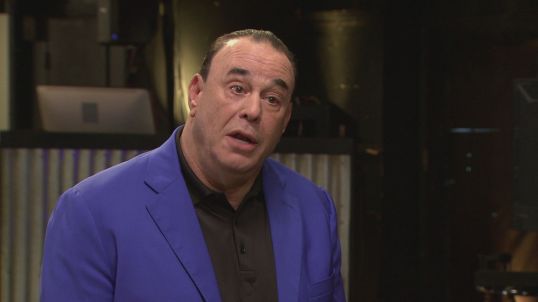
Bar Rescue, of course, is one of those shows where a jackass goes into a failing business — in this case, a bar — and basically screams at everyone for an hour until the bar starts making money. It stars Jon Taffer, who has all of the charm of a low-level gangster who desperately needs to make his quota for the week or else the capo is going to break his thumbs. The main them of each episode is that Taffer takes “bar science” very seriously and apparently cannot fathom a world where anyone tries to do anything different or quirky with their business.
If you search the internet, you’ll find all sorts of stories about the bars that Taffer “saved.” A good deal of them went out of business after Taffer gave them their makeover. Several of them immediately went back to the way they were running things pre-Bar Rescue. Some of those bars have survived and some of them have not. Taffer always makes a big deal about renaming almost every bar that he saves. It’s rare that anyone sticks with Taffer’s new name.
I have to admit that I rarely drink so I’ve never really cared that much about bars. In fact, it’s kind of hard for me to imagine anyone caring about the decor of the place where they’re getting drunk. That may be one reason why I always find it oddly compelling to listen to Taffer rant and rave, as if designing the perfect bar is somehow the same thing as restoring the Sistine Chapel. Whenever Taffer brings in his bar experts, I find myself smirking a little bit because Taffer’s experts are usually just people who are obviously angling for a show of their own. The “experts” tend to be so condescending that I actually look forward to people talking back to them.
Speaking of people talking back, another reason that I watch Bar Rescue is because there’s always a chance that someone might throw a punch at Jon Taffer. Seriously, he’s just obnoxious! It’s interesting to compare him to someone like Gordon Ramsay, who is just as loud and overbearing but who also somehow remains likable through the whole ordeal. Taffer just comes across as being a bully.
(What’s funny is that, while I was researching the bars that the show previous rescued, I came across several comments from people who worked at those bars. Most of them said that Taffer was actually very polite and rather affable off-camera. He plays a bully for the ratings and …. well, Hell, I’m watching so I guess it’s working.)
Watching the show in the age of Coronavirus, Bar Rescue almost feels like an artifact from a different age. Today, I watch it and I notice the huge crowds of people, all pressed up against each other in the bar. I notice all of the hand-shaking. (Taffer almost always shakes the bar owner’s hand at the end of each episode.) Just the fact that the show features a different bar every week makes Bar Rescue feel like something you might find in a time capsule.
Like I said, I don’t usually drink. But, as soon as all this is over, I’m going out and getting so drunk. (Well, buzzed. Actually, I’ll probably just go out and have a glass of water while everyone else gets drunk. But still, I’m going out, dammit!) Until then, I guess I can just watch Bar Rescue….
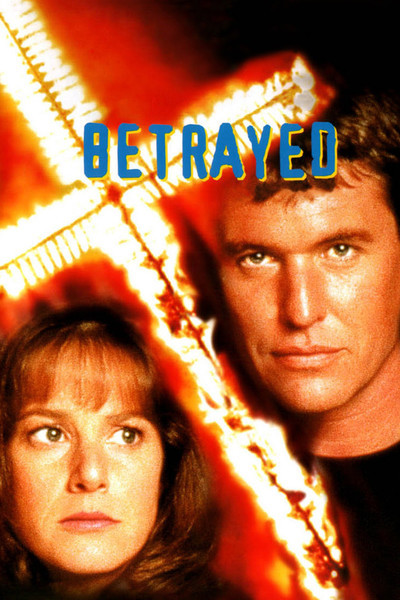
The 1988 film, Betrayed, starts out on a strong note but then quickly becomes annoying as Hell.
It opens with shots of a radio talk show host, an outspoken liberal named Sam Kraus (Richard Libertini). Kraus berates his callers. Kraus ridicules anyone who is to the left of Bernie Sanders. When a man with a rural-accent calls in and attacks Karus for being Jewish, Kraus calls the man an idiot. After he gets off the air, Kraus walks through a parking garage and stops in front of his car. Another car pulls up beside Kraus and suddenly, a masked man with a gun opens fire on Kraus, killing him. The gunman gets out of the car and spray paints, “ZOG” on Kraus’s car before then fleeing the garage.
(ZOG stands for Zionist Occupational Government. It’s a term used by the type of anti-Semitic dipshits who thinks that the Protocols of Elder Zion are real.)
From this shockingly brutal opening, we cut to panoramic shots of beautiful farmland and crops being harvested in the American midwest, the heartland. Gary Simmons (Tom Berenger) owns a farm. He’s a Vietnam vet who nearly received the medal of honor. He lives with his mother and he has two children. (He’s divorced and his ex-wife died as the result of a mysterious hit-and-run in California.) Almost everyone in his small hometown seems to worship Gary. They’re certainly curious about his new girlfriend, Katie Phillips (Debra Winger).
And really, they probably should be. Katie Phillips isn’t Katie Phillips at all. She’s actually an FBI agent named Cathy Weaver and she’s been sent undercover to investigate whether or not Gary was involved in the murder of Kraus. Cathy, who comes from a broken family and who we’re told has always been seeking some sort of deeper meaning in her life, is charmed by both Gary and his family. In fact, she falls in love with Gary. She tells her superior, Mike Carnes (John Heard), that there’s no way Gary is dangerous. Mike doesn’t believe her but, of course, Mike has a personal stake in this because he and Cathy used to be romantically involved.
(That’s right, everyone. Betrayed is so narratively lazy that it resorts to making Mike a scorned lover, even though the film’s plot would have worked just as well if he wasn’t.)
As I said, the first part of the movie works. Debra Wingers gives a strong performance and Tom Berenger is a charming roughneck. For the first half-hour or so, the film does a good job of showing why men like Gary and his friends are susceptible to conspiracy theories and why they feel that the entire world is stacked against them. You can understand why Cathy is so troubled by her assignment because Gary’s friends are hardly master criminals. For the most part, they’re farmers who feel like their entire way of life has been taken away from them.
Unfortunately, almost immediately after Mike refuses to allow her to end her investigation, Cathy returns to the farm and sleeps with Gary. Not only is this a plot development a disservice to everything that has previously been established about Cathy as a character but it also marks the point where the movie entirely falls apart. Immediately after sleeping with Cathy, Gary suddenly goes from being a complex but troubled character to being a cartoonish super villain. And listen — we’ve all been there. You meet a guy. He’s handsome. He says all the right things. He seems like he’s sensitive. He makes you feel safe. You let down your defenses for one night and the next morning, he’s yelling at you for wearing a short skirt in public. It happens. Of course, in Gary’s case, it means that he’s not only criticizing the way that Cathy dresses but he’s also taking her on a hunt where the prey is terrified person of color who Gary and his friends have kidnapped. It also means that Gary drags Cathy along on a bank robbery and then expects her to join him when he wants to assassinate a presidential candidate. Even after all that, Cathy remains conflicted about what to do with Gary. The problem is that it’s not like Gary’s a guy who needs sensitivity training or who spends too much time watching ESPN. Gary is a guy who is carting around weapons and talking about how he wants to kill “mud people.” That Cathy still has mixed emotions after all of that goes against everything that the film previously asked us to believe about her. Gary becomes too cartoonish to be plausible and, as a result, he drags down Cathy’s character as well.
Unfortunately, as the film’s narrative falls apart, so do the majority of the performances. While Debra Winger struggles to make her character’s motivations plausible, Tom Berenger is reduced to doing a lot of glaring. (Poor John Heard spends most of the movie shouting and bugging his eyes.) About the only actor who comes out Betrayed unscathed is John Mahoney, who plays Shorty. Shorty is one of Gary’s friends. He’s a friendly and personable guy who seems to sincerely care about everyone and who has a charmingly gentle smile. He’s also a total racist and the contrast between Shorty’s amiable nature and his hateful thoughts provide the latter half of Betrayed with its only powerful moments. Mahoney gets one big scene, where he talks to Cathy about how much he hates violence but, at the same time, he feels that the world has left him no other choice. Mahoney does a great job with his small role. It’s unfortunate that the rest of Betrayed couldn’t live up to his performance.
Today’s music video of the day comes to use from Italy.
Don’t ask me to explain what all is happening in the video. I’ll just say that it I appreciate the ominous atmopshere and the feeling of doom the permeates nearly every minute of this video. This is a video to haunt your dreams.
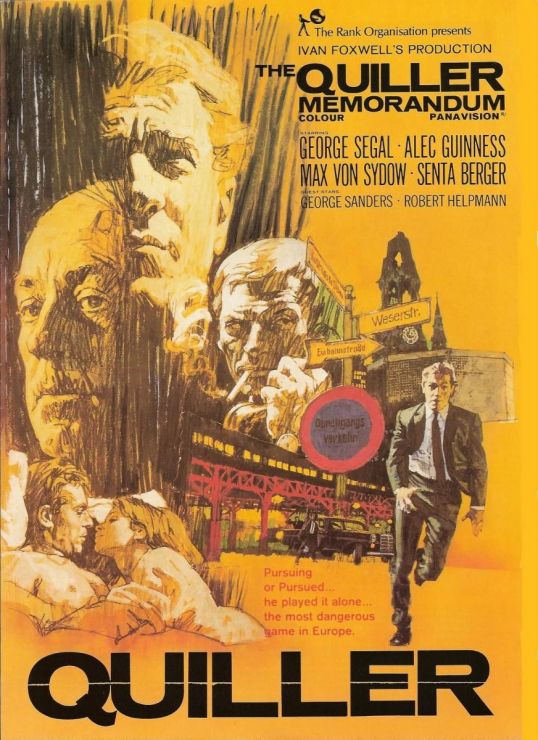
The 1966 film, The Quiller Memorandum, is a diabolically clever little spy thriller.
The film opens with a British secret agent getting gunned down while trying to make a call from a phone booth in Berlin. While we never learn the exact name of the agency that the man was working for, we do discover that they don’t take kindly to their agents getting gunned down in phone booths. They send in another agent, an American named Quiller (George Segal), to take his place.
In Berlin, Quiller’s boss is a man named Pol (Alec Guinness). Pol explains that the man in the phone booth was actually the second of his agents to be assassinated in Berlin. All of the agents were looking for information about a Neo-Nazi group called Phoenix. Pol tells Quiller that it is vitally important they discover just where, in Berlin, Phoenix is headquartered. Quiller is given a few items that were found on the dead man in the phone booth: a bowling alley ticket, a swimming pool ticket, and a newspaper article about a school where it was discovered that one of the teachers had Nazi sympathies.
Though The Quiller Memorandum was undoubtedly produced with the hopes of capitalizing on the popularity of the Bond films, Quiller is no James Bond. We know that as soon as we see him. It’s not just that Quiller’s an American while Bond was British. It’s also that James Bond was played by the cool and calculating Sean Connery while Quiller is played by George Segal. Whereas Connery’s Bond never loses his confidence, Segal’s Quiller comes across as being, at first, a bit cocky and, as a result, we worry about him. Whereas Connery’s Bond rarely gave his actions a second thought, Segal brings a slightly neurotic edge to Quiller. You take one look at Connery’s Bond and you know that he’s going to survive no matter what. Quiller, however, you never get that feeling. When he’s in danger, you worry about him because it’s easy to imagine him turning up like the man in the phone booth.
And, indeed, it doesn’t take long for Quiller to get captured by the members of Phoenix. A man bumps him with a suitcase, injecting a drug into his system that makes Quiller become drowsy. When Quiller awakens, he’s being interrogated by an erudite man named Oktober (Max von Sydow). Oktober’s an aristocrat. He speaks in a very calm tone, rarely showing any hint of anger. The only thing that betrays his evil nature are his eyes, which are cold and soulless.
Even though Quiller survives the interrogation, it’s tempting to give up on him. After all, Quiller got captured so easily and Oktober seems so clever that you kind of find yourself wondering if maybe the agency made a mistake when they gave this mission to Quiller. That’s where The Quiller Memorandum surprises you, though. Quiller turns out to be a lot more clever and resourceful than anyone gave him credit for being and, for that matter, the film itself turn out to have a few more twists and turns in store for the viewer.
It’s a clever and enjoyable spy film, featuring wonderful performances from Segal, Guinness, von Sydow, and Senta Berger as the teacher who may be in love with Quiller or who may have an agenda of her own. The film may be a spy thriller but Michael Anderson directs it as if its a film noir, full of shadowy streets and morally ambiguous characters. The script, by Harold Pinter, encourages us to trust no one and Anderson’s direction reminds us that we made the right decision. On the dark streets of Cold War Berlin, no one is who they seem.
The Quiller Memorandum is a must-see for fans of 60 spy films. Watch it with someone who you think you can trust.



 Through the Shattered Lens