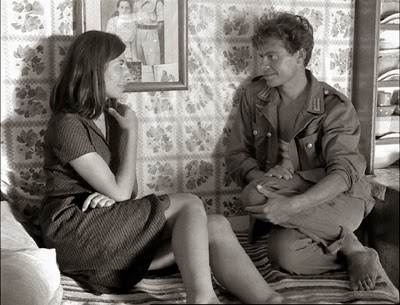
The 1968 German film, Signs of Life, is a deceptively simple film.
In fact, the story that it tells is so simple and so seemingly straight-forward that I’m sure some people would be surprised to discover that this was Werner Herzog’s first film. When most people think of Herzog, they think of Klaus Kinski ranting against the Amazon and maybe Herzog himself talking about how he feels that chaos is the only governing principle of the universe. Signs of Life, on the other hand, is a rather low-key and almost gentle film. That said, the film does contain several of the themes that would show up in Herzog’s later film. Even with his first feature film, Herzog already had a fairly good grasp on what he wanted to use cinema to express.
The film takes place in World War II and it deals with three German soldiers who have suffered from minor injuries in the war. Deemed unfit for combat, they’ve been assigned to guard the munitions that are being stored at an ancient fortress on the Greek island of Kos. It’s not demanding work. The villagers are largely passive and, for the most part, seem to be just waiting out the war. The leader of the soldiers, Stroszek (Peter Brogle), has recently married a Greek woman named Nora (Athina Zacharopoulou) and she is living with him at the fortress.
The film celebrates the beauty of Kos. Herzog’s camera finds poetry in the simple sight of white linens hanging out to dry. One of the soldiers explores the local cemetery and Herzog encourages us to ponder the long history of both the island and the people who live there. In perhaps the film’s best known scene, Stroszek and Nora look down on a valley full of windmills and the beauty of it is a bit overwhelming.
As would often happen in later Herzog films, the soldiers never quite appreciate the beauty of the world around them. While the audience is taking in scenes of breath-taking beauty, the soldiers are going a bit stir crazy. Could it be that, as men of war, they’re incapable of appreciating the peaceful surrounding? Perhaps but, then again, it could just be the fact that there’s not much to do on Kos other than ponder the mysteries of life and, in Herzog’s films, that often leads to insanity. Stroszek ends up threatening to blow up the munitions dump but it must be said that, as far as Herzog lunatics are concerned, he’s no Klaus Kinski.
The plot of Signs of Life is largely secondary to the images that Herzog captures. Watching Signs of Life, you get the feeling that Herzog simply fell in love with the island and that the film’s storyline is just something that he came up with so he’d have an excuse to share that love with the rest of the world. Signs of Life is an exercise in pure cinema. It’s not a perfect debut film but, at its best, it shows tantalizing hints of the great filmmaker that Werner Herzog would soon become.
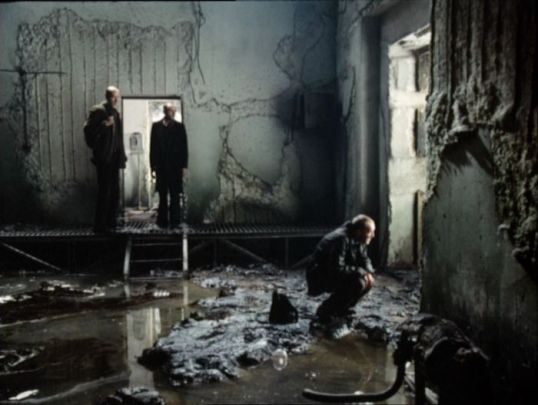
The 1979 Russian film, Stalker, takes place in a world that might be our own.
In the middle of a wilderness that we assume, just because of the language that’s spoken in the film, to be in Russia, there is an area known as the Zone. The Zone is a place where the normal laws of physics don’t seem to apply. It’s not an easy place to enter and it’s almost impossible to exit but it’s rumored that there’s a very special room located in one of the Zone’s deserted buildings. If you can find the Room, you’re innermost desires will be granted. It’s said, for instance, that a semi-legendary man known as Porcupine found the Room and became wealthy as a result. Of course, Porcupine also hung himself just a few days later.
Legally, no one is allowed to enter the Zone. Soldiers patrol the perimeter and the gate that leads into the Zone is only opened to allow a train to make it’s way through. However, there are outlaws who specialize in leading expeditions through the Zone. They can get people in and, as long as everyone does as instructed, they can hopefully lead people out. One of these outlaws is known as The Stalker (Alexander Kaidanovsky). The Stalker, a former student of Porcupine, lives in a drab village where everything is filmed in Sepia. (By contrast, the Zone is filmed in color.) The Stalker is married to a woman (Alisa Freindlich) who continually begs him to stop leading expeditions into the Zone but who also says that she married the Stalker because his illegal activities bring a little bit of life to an otherwise drab existence. They have a daughter (Natasha Abramova) who is described as being a “child of the zone.” She may have a physical disability, though we’re never quite sure what the exact details of it may be. The final enigmatic shot of the film belongs to her and it’s a shot that makes us wonder about everything that we’ve just previously seen.
The Stalker’s latest clients are the Writer (Anatoly Solonitsyn) and the Professor (Nikolai Grinko). Both the Writer and the Professor have their own reasons for wanting to see the Zone. The Writer is an alcoholic who has lost his inspiration and hopes to find it again. The Professor says that he’s interest in the Zone is a scientific one, though it turns out that his actual intentions are a bit more complex. The Stalker leads them into the Zone but it’s not an easy journey. The Stalker grows annoyed as he comes to realize that the Writer does not share his nearly spiritual reverence for the powers and the mysteries of the Zone. Meanwhile, the Professor obsesses over his backpack, even when the Stalker tells him to leave it behind. There’s something in that backpack that the Professor definitely doesn’t want to lose.
Stalker is a science fiction film but it’s one that has no elaborate special effects. There are hints that the Zone may have been visited by extraterrestrials but the film deliberately leave ambiguous the true origin of the Zone. Director Andrei Tarkovsky instead emphasizes the barren landscape and the discussions between the three men, each one of whom is desperate in his own way. Though the Zone may be filmed in vibrant color while the village is filmed in Sepia tones, both locations are equally desolate.
Watching this film today, it’s impossible not to compare the film’s Zone to the real-life forbidden zone surrounding Chernobyl. However, Stalker was made 7 years before the disaster at Chernobyl. The film’s Zone probably has more in common with the 1908 Tunguska event, which was when something (an asteroid, a comet, or maybe something else depending on how conspiracy-minded one is willing to be) either crashed into or exploded above Siberia. The explosion was the equivalent of 30 megatons of TNT and, needless to say, you can find all sorts of fanciful stories about strange things happening in the area in the years after the explosion. That said, it’s definitely not a coincidence that the modern-day guides who lead unauthorized tours of the Chernobyl area have taken to calling themselves stalkers.
The film itself is a fascinating one, though definitely not one for everyone. As a director, Tarkovsky’s trademark was the long take and the camera often lingers over each scene, inviting the viewer to look for a deeper meaning that may or may not be there. It’s a film that invites the viewer to think and to wonder who is right and who is wrong about the Zone. It’s a film that asks a lot of questions but never claims to have all the answers. The true meaning of it all is left the individual viewer to determine. It really is a film that probably could have only been made by an artist trying to subtly rebel against a totalitarian society. The Writer has lost his inspiration because society has become so drab and corrupt. The intellectual Professor is forced to be deceptive about his true intentions. And the Stalker looks for a deeper meaning that goes beyond what the State has to offer. For that, he’s willing to risk everything.
Tragically, it’s possible that filming Stalker may have contributed to Tarkovsky’s death in 1986. (Interestingly, he died just a few months after the Chernobyl disaster.) Much of Stalker was filmed near a chemical plant and it’s felt that filming in such a toxic condition may have eventually led to the illnesses that not only killed Tarkovsky but several other members of the film’s cast and crew. By the time of his death, Tarkovsky had escaped from Russia and was living in Paris. Today, incidentally, is his birthday. He would have been 88 years old.
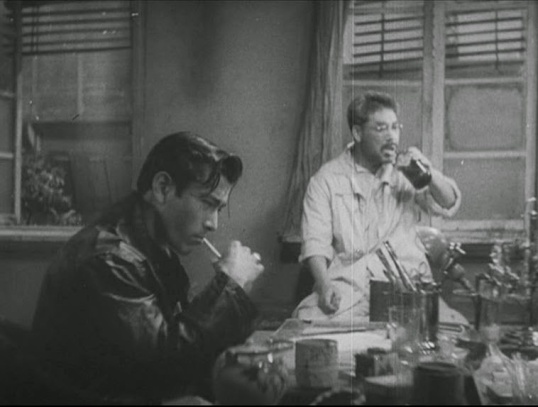
The 1948 Japanese film, Drunken Angel, tells the story of two seemingly different men living in a burned-out neighborhood in postwar Tokyo.
Sanada (Takashi Shimura) is an aging and world-weary doctor. Though he may drink too much and he is occasionally too quick to snap at his patients, he truly cares about the people who live near his clinic. He worries about the spread of tuberculosis, which was a very real concern in postwar Japan and which remains a concern to this day. He continually tells his patients that they need to stop drinking and take better care of themselves, even though he does not seem to be capable of taking his own advice.
Matsunaga (Toshiro Mifune) is a young Japanese gangster, a member of the yakuza. Matsunaga does everything with a swagger, one that he appears to have largely adapted from Hollywood gangster movies. He not only dresses like an idealized version of an American gangster but he also smokes his cigarettes like one. Everything about Matsunaga gives the impression that he’s desperate to prove that he’s something more than just a small-time hood living in a bombed-out neighborhood that’s centered around a poisonous bog.
One night, Matsunaga shows up at Sanada’s clinic. He’s got a bloody hole in his hand. Mastunaga claims that he walked into a door. When Sanada responds with skepticism, Matsunaga adds that the door had a nail sticking out of it. Sanada may not believe Matsunaga but he’s a doctor so he treats Matsunaga’s wound. Sanada also diagnosis Matsunaga as suffering from tuberculosis and tells him that he has to stop drinking and womanizing. Needless to say, Matsunaga is not pleased with this diagnosis.
Though they start out as antagonists, a weary friendship grows between the doctor and the gangster. Matsunaga even starts to follow the doctor’s advice or, at least, he does until his boss, Okada (Reisaburo Yamamoto), is released from prison. Under Okada’s influence, Matsunaga falls back into his own habits, drinking and going to nightclubs where the musicians perform Americanized music. Okada is also the ex-boyfriend of Sanada’s nurse and, when he threatens to murder Sanada unless the doctor lead him to her, Matsunaga is finally forced to decide which of his two potential mentors will have his loyalty.
Taken on its own, Drunken Angel is an entertaining gangster film that features two memorable lead performances. Takashi Shimura is likable as Sanada while Toshiro Mifune is dangerously charismatic as Matsunaga. Director Akira Kurosawa originally planned for the film to focus solely on Sanada, with Matsunaga only playing a minor role. Mifune, however, so impressed him that he ended up expanding Matsunaga’s role until Mifune was eventually the film’s co-lead. (Following Drunken Angel, Kurosawa would go on to make 15 other films with Mifune.) Kurosawa keeps the action moving at an exciting pace and he frames the story with haunting images of the dilapidated neighborhood that the two men call home.
However, Drunken Angel is even more fascinated with one consider that it was made at a time when Japan, having been defeated in World War II and still traumatized by the nuclear attacks on Nagasaki and Hiroshima, was still occupied by American forces. The film was made at a time when it was still very much an open question as to what role Japan would play in a postwar world. Would Japan become dominated by American culture (which, in this film, is represented by gangsters like Okada) or would it remain true to itself? When Sanada warns Matsunaga that he is surrounded by toxic germs that are making him ill and threatening his future, he could very well have been talking about what Kurosawa perceived as being the threat of Americans transforming Japan into a westernized playground.
In the end, it’s a film that works on many levels, as a gangster film, as a portrait of a friendship, and as a metaphor for a people and a culture trying to find their place in a new and imperfect world. If you haven’t seen it yet, now is the perfect time to do so.
On a snowy day in Montreal, a nameless young man (Maxim Gaudette) wanders about a cramped apartment. He loads a rifle. He drives to his mother’s house and leaves a note in her mailbox. He goes to École Polytechnique, the engineering school where he’s a student. Leaving the rifle in his car, he walks around the school. He stares at the students in the cafeteria, observing them with a hatred that they might not notice but which we’ll never forget. He goes back outside. He sits in his car while the snow continues to fall.
As we watch him, we hear him reading the suicide note that he’s written for the authorities. He talks about his belief that the world has been destroyed by feminists. He writes that he’s offended that he is expected to compete with women and that women have an unfair advantage in both the academic and the professional world. He brags about the good grades that he gets, despite the fact that he rarely attends school. He says that he’s never fit in with the world and that woman are to blame. He complains about women competing at the Olympics, showing that he views everything through the filter of his own misogyny. At one point, he apologizes for not being as eloquent as he believes he could be. He explains that he only had 15 minutes to put down his thoughts.
Inside the school, another engineering student, Jean-Francois (Sébastien Huberdeau ) struggles to complete an assignment before his next class begin. He sits in the cafeteria with open books scattered across the table in front of him. Later, we’ll see Jean-Francois running through the hallways of the school, trying to warn the other students that something terrible is happening. He’ll run to a security officer and ask him to call the police, just to be given a somewhat confused look in response. Later still, we’ll see Jean-Francois outside of the school, visiting his family and haunted by guilt.
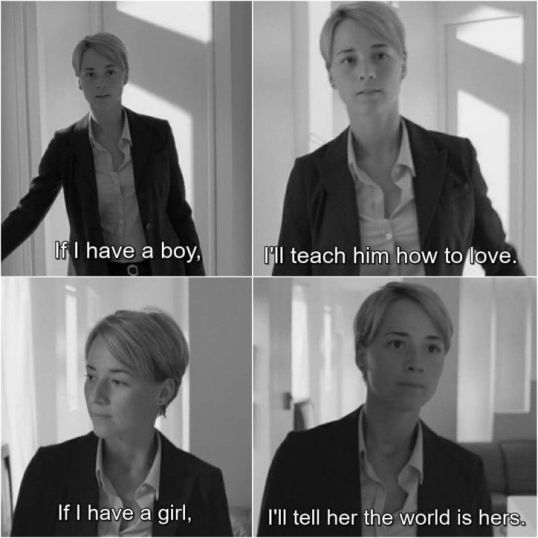
One of Jean-Francois’s classmates, Valerie (Karine Vanasse), goes to a job interview where the older male interviewer states that he’s shocked that Valerie wants to go into engineering after graduation. Most women, he says, don’t do that. It’s a profession that requires a lot of hard work and it’s not ideal for someone who wants to start a family. Stunned, Valerie lies and says that she doesn’t have any desire to start a family. Throughout the film, we watch as Valerie stop several times at her locker so that she can switch shoes. When she has to deal with stuff like her job interview, she puts on high heels that are obviously very uncomfortable for her. When she just wants to go to class, she has to stop and switch to shoes that she can actually walk in and, at that moment, I knew exactly what she was feeling. Every woman watching will instantly know what she’s going through. Later, she complains to her friend and roommate, Stephanie (Evelyn Brouchu), about how condescending the interview was. Stephanie tells her not to obsess on it.
Outside, the snow continues to fall in the night, creating a bleakly cold landscape and making Montreal look like a barren and bombed-out wasteland.
Later, we’ll see Jean-Francois arriving late for a class. Valerie and Stephanie are already in the class, listening to the lecture. Not long after Jean-Francois claims his seat, the unnamed man steps into the room, carrying his rifle. He orders the males to gather on one side of the room and the women on the other….
These are the moments and images that stick with you, long after the 2009 Canadian film, Polytechnique, concludes it’s brief 77-minute run time. It’s a haunting film, definitely not one to watch if you’re already feeling depressed. What makes it especially disturbing is that it’s based on a true story. On December 8, 1989, an Algerian-Canadian student opened fire at École Polytechnique in Montreal. (The film does not name the killer and I won’t either, because to name him without naming his victims does a disservice to their memory. Those who really want to know his name are free to look it up on Wikipedia.) As seen in the film, the gunman specifically targeted women and even ordered all of the males in the classroom to leave before he opened fire. Also, as seen in the movie, the men did just that, with not a single one trying to stop the gunman or warn others until they were already out of the classroom. The character of Jean-Francois stands in for all of the men who were haunted by their decision to leave. As I watched the film, I had mixed feelings about the men who left that classroom. Yes, the gunman was armed but there were enough men in that classroom that it’s hard to justify the fact that not a single one attempted to intervene.
Before shooting himself in the head, the gunman killed 14 women and wounded 10 women and 4 men. It remains the deadliest mass shooting in Canada’s history. When the police found his body, they also found a suicide note in his pocket, the same note that we hear read at the beginning of this film. In memory of the lives lost, the anniversary of the massacre has been commemorated as the National Day of Remembrance and Action on Violence Against Women.
Poltytechnique, which is dedicated to those who died, was directed by Denis Villeneuve, long before he would come to America and make a name for himself with films like Sicario, Arrival, and Blade Runner 2049. Polytechnique is filmed in harsh black-and-white and Villeneuve skips around in time, often showing us the consequences of the killer’s actions before showing us the actions themselves. It’s an approach that reminds us that the Montreal Massacre and all other acts of violence are events that will forever haunt us. The past will always cast a shadow over both the present and the future.
As I said, it’s not a happy film but perhaps not every film needs to happy. With Polytechnique, Villeneuve mourns for the lives lost on that day in 1989 and he encourages us all to try to create a better world for the future.
If there’s anything that I’ve discovered over the years, it’s that cinema is truly a universal language.
I’ve lost track of the number of film fans with whom I’ve bonded with over social media. Some of them live near me and some of them live very far away but the one thing that we all have in common is that we all love movies. For instance, I have a friend in India who loves Sofia Coppola almost as much as I do. Meanwhile, I’ve got friends in the UK who are as crazy about horror movies as I am and my friend Carlo in Italy shares my total disdain for Avatar. In short, films bring us together.
This month, I want to celebrate that fact here on the Shatered Lens. Along with my usual reviews, I’ll be taking a look at some films that were produced outside of the United States and far away from the Hollywood studios. Some of these films will be great and some of them probably won’t. Some of these films may be well-known and, again, some of them won’t be. What they all have in common is that they’re out there for discriminating viewers who aren’t scared of having to read a subtitle or two.
I want to start things off by looking at a French film, La fille au bracelet (The Girl With A Bracelet).
This low-key but thought-provoking courtroom drama opens with a family enjoying a day at the beach. We watch them from a distance and they seem almost like the perfect family unit. And yet, that perfection puts us ill at ease. We’ve seen enough movies to know that any family that appears to be perfect is going to be the exact opposite and, even more importantly, director Stéphane Demoustier knows this. Therefore, we’re not surprised when the police suddenly show up. We are perhaps a little bit more surprised when the police lead away not the mother or the father but instead, the teenage daughter, Lise (Melissa Guers).
The film jumps forward two years. Lise has been under house arrest ever since that day at the beach and is required to wear an ankle bracelet, so that the authorities can keep track of her. Lise has been charged with murdering her best friend, Floria. While her father (Rosdchy Zem) insists that Lise is innocent and gets involved in her defense, Lise’s mother, Celine (Chiara Mastroianni), has thrown herself into her work and says that she probably won’t even be able to attend her daughter’s trial.
As for Lise, she refuses to show remorse for a crime that she says she didn’t commit and she refuses to apologize for a lifestyle for which she feels no shame. As the proceedings begin, it becomes apparent that Lise is as much on trial for her perceived coldness and lack of conformity as for anything else. Much of the evidence against Lise seems weak. Lise and Flora had a fight shortly before the murder and Lise’s DNA was found on Flora’s body. Lise claims that she and Flora made up on the same night that Flora was found dead. While her parents listen, Lise’s sexual history is clinically dissected in the courtroom, suggesting that she is as much on trial for not conforming to society’s expectations as she is for any murder that she may have committed. Is Lise on trial because of the evidence or because she’s a member of generation that has been vilified by its elders? Is she on trial because she’s guilty or is she on trial because she’s a young woman who is not reacting the way that society expects women to react?
And yet, even though you want to be on Lise’s side, the film keeps you off-balance. Is it true that Lise is simply mourning her friend in her own way or is it possible that Lise is actually a remorseless murderer? At times, it seems like either one of the two could be true. The film ends on a deliberately ambiguous note, one that may leave some frustrated but which will also leave you thinking.
The Girl With A Bracelet requires some patience. The film plays out at a deliberate and methodical pace. However, your patience will be rewarded with a fascinating mystery that will keep you thinking. The cast is excellent, especially Anais Demoustier as the prosecutor. (Given the film’s theme of generational conflict, it’s interesting that the prosecutor is closer, in age, to Lise’s generation while Lise’s defense attorney is from her parent’s generation.) Melissa Guers makes her film debut in the role of Lise and gives an excellent and intriguing performance as an enigmatic character who always seems like she should be more sympathetic than she actually is.
I was fortunate enough to see The Girl With A Bracelet in Paris. (Two weeks later, and four days after Jeff & I returned home to the U.S., the entire world shut down. It’s strange to think about it now.) It’s a film that’s stuck with me and hopefully it’ll make it’s way over to the States sometime soon.
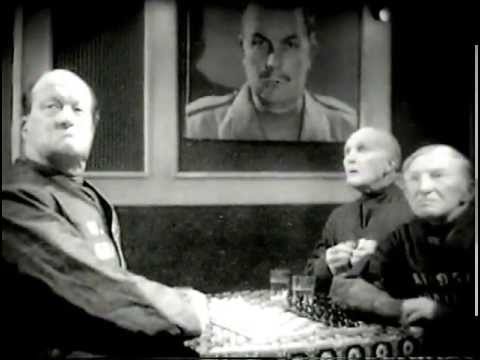
Well, here we are at the end of both March and the 18 days of paranoia. We started things off with a review of The Flight That Disappeared and now, we end things with a look at the 1954 BBC production of Nineteen Eighty-Four.
“Orewllian” is a term that gets tossed around a lot nowadays, largely by people who the real George Orwell probably would have viewed rather dismissively. Ever since the election of Donald Trump, for instance, it’s become rather common for certain people of twitter to say that “Orwell was right” or that we’re living in an “Orwellian nightmare.” I remember after Trump’s press secretary blatantly lied about the size of the crowd at the inauguration, there was even a commercial that featured Zachary Quinto giving a hilariously overwrought reading of the final passage of George Orwell’s 1984. “He …. LOVED …. BIG …. BROTHER!” Quinto declared while staring grimly at the camera.
Interestingly enough, many of the same people who complain about Trump’s lies being Orwellian never used the term during the previous 8 years, when we were being constantly told that a permanent recession was actually a sign of a strong economy and that if people liked their doctor, they could keep them. The fact of the matter is that, for a lot of people, “Orwellian” is just a term that they use whenever a politician from the other side does something that they dislike. It makes you wonder how many of them have actually read 1984 because, if they had, they would surely know that — if we truly were living in the world depicted in Orwell’s novel — no one would be allowed to acknowledge it and, in fact, Orwell and his books would have vanished down the memory hole. Just the act of saying that we’re living in 1984 without getting sent to a reeducation camp is proof that we’re not (or, at least, we’re not just yet).
That’s not to say that 1984 isn’t an important work of literature. In fact, it’s probably one of the most important books ever written, which is why it does it such a disservice to glibly toss around the term Orwellian. Even if we aren’t living in Orwell’s world right now, it’s probably easier than ever to imagine a scenario where we eventually could. The Coronavirus pandemic, for example, is just the sort of thing that could lead to the people accepting the idea that the government is meant to be a Big Brother and that those who disagree deserve to be reported for the good of the people. It’s easy to imagine a future where people believe that history started with the Coranavirus and that everything that happened before the pandemic was just a hazy rumor, like Europe before the Renaissance. As such, even if the term Orwellian is overused, 1984 is still a book that needs to be read and understood.
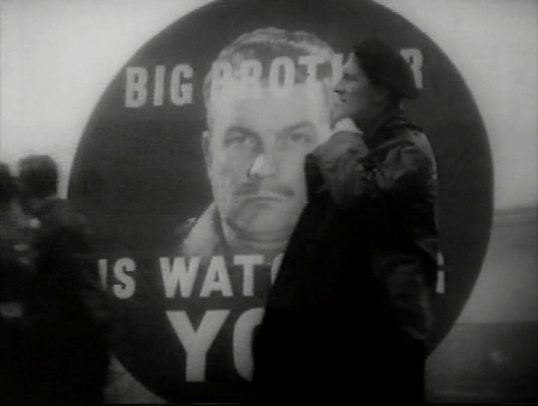
This version sticks closely to Orwell’s novel, though it downplays the book’s sexual themes. (This is not surprising considering that this version was made for 1950s television.) Though it condensed Orwell’s story, it hits all of the important points. Winston Smith (Peter Cushing) is a member of the Outer Party who works at the Ministry of Truth and who lives a rather drab existence in London, “the chief city of Airstrip One.” He is a citizen of Oceania, which has always been at war with Eurasia. Winston lives under a system of government called Ingsoc and every day, he spends two minutes hating a mysterious figure named Goldstein. All around him are posters of Big Brother, watching him and judging.
On the outside, Winston is a loyal party man but on the inside, he has questions and doubts. How can he not when he works for the Ministry of Truth? His job is to change history to reflect whatever the current version of it may be. Some of his co-workers, like Symes (Donald Pleaseance), are openly cynical about what they do. Others, like O’Brien (an imposing Andre Morell), seem as if they might be sympathetic to Winston’s doubts but Winston cannot be sure. Meanwhile, Winston has found himself obsessed with Julia (Yvonne Mitchell), who is a member of the Anti-Sex League but who might have doubts of her own. (Then again, she could also be a member of the Thought Police.)
When Winston is finally arrested for being a thoughtcriminal, it leads to a harrowing interrogation where he learns that truth doesn’t matter, the numbers add up to whatever the party says that they add up to, and that no one is strong enough to survive the ordeal of Room 101.
The BBC adaptation of Nineteen Eighty-Four was, for the most part, a live performance with a few filmed scenes inserted into the action. Still, the fact that the majority of the actors were delivering their lines lives brings a certain immediacy to the film. Everyone seem nervous and edgy. In real life, that could have been due to the fear that they would miss a line but it also feels appropriate for people who spend every day of their life being watched and judged by Big Brother. The entire production does an excellent job of creating a world where every minute is suffused in an atmosphere of dread and fear. From the minute we first see him, Winston seems to know that he’s doomed. The fact that Big Brother would rather torture and brainwash him rather than just make him disappear just makes things worse.
The production is full of actors — like Cushing, Morrell, and Pleasence — who would go on to become leading figures in the British horror industry and all of them do an excellent job bringing Orwell’s horror to life. Peter Cushing, with his mix of intelligent features and neurotic screen presence, makes for the perfect Winston Smith and Andre Morrell is just as perfectly cast as the fearsome O’Brien. The scene in which Winston is forced to confront Room 101 is still a harrowing one and this film perfectly nails the novel’s famous ending, doing so in a low-key manner that’s far more effective than the overwrought approach that other adaptations have brought to the final scene.
Nineteen Eighty-Four can currently be viewed on Prime. The print is a bit grainy but that only adds to the film’s power. It comes to us like a hazy vision of the future.
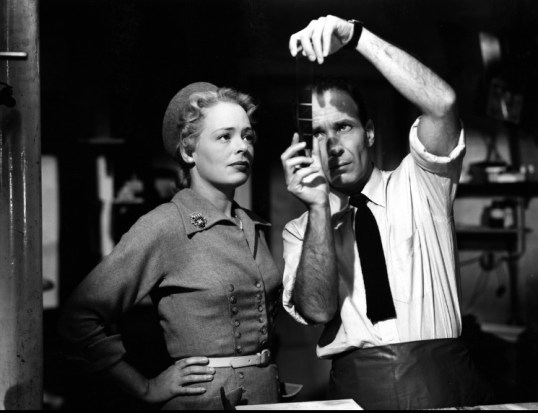
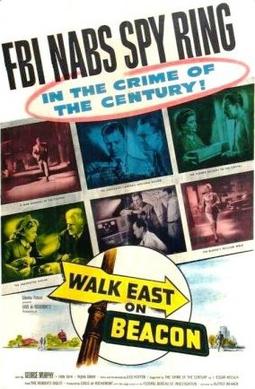
From 1952 comes Walk East On Beacon, a mix of spy thriller and film noir that highlights the efforts of the FBI to expose and take down a communist sleeper cell working right in the United States of America! (Cue the dramatic music.)
One need only check out the opening credits to see what type of film Walk East On Beacon is going to be. We’re told early on that the film was “suggested” by a Reader’s Digest article that was written by none other than the director of the FBI, J. Edgar Hoover. The title of that article was “The Crime of the Century: The Case of A-Bomb Spies” and it dealt with the FBI investigation that led to the arrest, conviction, and controversial execution of two Russian spies, Julius and Ethel Rosenberg. I haven’t read the article but judging by the fact that it was written by Hoover and published in Reader’s Digest, I think it’s fairly safe to guess that it wasn’t particularly concerned with things like protecting the First Amendment, civil rights, or the freedom to hold any ideological belief regardless of how unpopular it may be with the general public. (Of course, I would be remiss if I didn’t also point out that most historians now agree that, despite what many on the Left claimed over the decades, the Rosenbergs were indeed guilty of being spies and they played a very central role in the Russians discovering the secret to making atomic bombs.)
In the film, George Murphy plays an FBI agent named Jim Belden. According to J. Hoberman’s book, An Army of Phantoms, the FBI specifically requested that Murphy be cast in the lead role because Murphy was an outspoken anti-communist. (Murphy would also later be elected to the U.S. Senate.) Project Falcon, a super-secret U.S. program, has been infiltrated by spies and Belden has been assigned to track down and capture their ringleader. He does this by using a number of techniques that were probably considered pretty high tech back in 1952, stuff like hidden cameras and secret microphones. He even brings in a group of lip readers to watch silent footage of two possible spies speaking so that they can tell him what the spies are talking about. You don’t have to worry about a thing with Jim Belden on the case!
As for the members of the spy ring, they’re a mixed bunch. Some of them are just bad people who have betrayed their country just because it’s the evil thing to do. Others are people who idealistically joined the Communist Party years ago because they wanted to help their fellow man and, instead, they’ve now found themselves forced to spy against their country. Prof. Albert Kafer (Finlay Currie) doesn’t want to betray America but he’s been told that his son will be executed if he doesn’t cooperate. Kafer goes to the FBI.
As you can probably guess, this is not a particularly subtle film. The communists are all evil and the FBI is doing its best to protect the loyal citizens of America and, if you’re going to question the legality or the ethics of their methods …. well, why don’t you just move to Russia and tell Stalin about it, okay!? Interestingly enough, the film is shot like a film noir, with an emphasis on shadows and dark streets and desperate men trying to escape their fate. But it has none of the moral ambiguity that one usually expects to find in a film noir. Instead, it presents a thoroughly black-and-white view of the world. All of the communists are either neurotic or cruelly evil while the FBI is professional, bland, and rather humorless. There’s really only one moment — where a blackmailed spy admits to his wife that he’s been trapped into betraying his country — where the film seems to come to life. Otherwise, this is a rather dry film, one that even comes with officious voice over narration.
While the film may not work as a thriller, it is somewhat fascinating as a historical document. The film was shot on location in Boston and, while I realize this may just be the history nerd in me talking, it’s still somewhat interesting to see what an major American city looked like in 1952. (It looks remarkably clean.) As well, the film really delves into the minutia of stuff that today seems mundane but which probably took audiences by surprise in 1952, stuff like wiretapping, drop points, and how even a condolence card could be used to send a secret message. If nothing else, the film’s portrait of a world where anyone — from a cab driver to an atomic scientist — could be a spy certainly provides a interesting snapshot of 1950s paranoia.
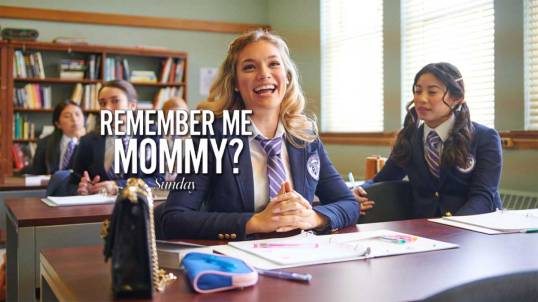
Last night, I watched the premiere of one of the greatest Lifetime films of all time, Remember Me, Mommy?
Why Was I Watching It?
It was on Lifetime. I’ve been ordered to shelter in place. What else could I do?
Then again, even if I wasn’t on lockdown, I probably still would have watched it because this is one of those Lifetime films that takes place at a private school and features a teacher with a secret in her past and those are typically my favorite Lifetime films. There’s just something irresistible about the mix of super snobs and dark secrets!
What Was It About?
Elena Walker (Sydney Meyer) is the newest student at Clark Academy! She’s a scholarship student, which means that she has to deal with a lot of hazing from all of the rich kids. It turns out that most of the students at Clark Academy have known each other for their entire lives so Elena is definitely an outsider.
However, fear not! Elena loves to write and the school’s creative writing teacher, Rebecca (Natalie Brown), is a former scholarship student herself. In fact, Rebecca is so impressed with Elena’s essays that she even arranges for Elena to meet with an Ivy League recruiter. So …. yay for the scholarship students, I guess.
Except …. well, Elena may not be who she claims. In fact, it turns out that Elena has a bad habit of killing people who get on her nerves. It also turns out that it’s not just a coincidence that Elena showed up at Clark Academy and immediately went out of her way to bond with Rebecca.
What is Elena’s plan? What is Rebecca’s secret? I’m not going to spoil anything, especially since the title of the film already does that.
What Worked?
It all worked!
Seriously, this is one of the best Lifetime films that I’ve seen in a while. Though you’ll probably guess Rebecca’s secret long before the film actually reveals it, Remember Me, Mommy? is still a lot of fun. In the tradition of the best Lifetime films, Remember Me, Mommy? fully embraces the melodrama. Elena never stops plotting, Rebecca never stops teaching, and the pace never slackens.
And I have to admit that, as evil as Elena was, it was hard not to like her. She was an agent of chaos, dropped in the middle of a bunch of complacent snobs and she reacted by disrupting the status quo. Of course, it would have been nice if she could have resisted the temptation to kill but still….
What Did Not Work?
It all worked!
“Oh my God! Just like me!” Moments
Like Elena, I always got along with my creative writing teachers. They were some of my favorite people.
At one point in the film, Elena is accused of plagiarism and I have to admit that brought back some memories of high school math class. I’ve always sucked at math. It’s just not my thing. Fortunately, I had an older sister who had taken the class a year before me and who had saved all of her tests so, whenever I had to take a test, I would just copy all the answers and …. well, technically, I guess I was cheating. My plan, if I was ever caught, was to argue that I wasn’t so much cheating as I was just plagiarizing my sister’s answers. Fortunately, I never got caught so I didn’t actually have to find out whether or not that argument would have worked.
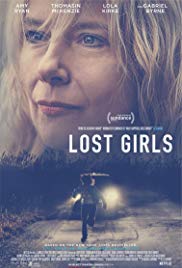
Lost Girls tells the true and infuriating story of Mari Gilbert and her search for her oldest daughter, Shannan.
Mari Gilbert is a single mother who is works as a waitress and struggles to give her children the best life that she can. She’s still haunted by a decision that she made years ago to temporarily put her three daughters into foster care. Though she eventually reclaimed two of her daughters, her eldest — Shannan — has basically been on her own since she was sixteen. Shannan, who is now 24, visits her mother and her sisters on a semi-regular basis. Despite the fact that Shannan claims that she’s just a waitress (like her mother), Shannan always seems to have a lot of money on her. Mari has her suspicions about what Shannan’s doing to make that money but she keeps them to herself.
Then, one day in May, Shannan disappears. Mari can’t get the police to take her seriously when she says her oldest daughter has vanished. They say that Shannan left on her own and will probably return at some point. They dismiss Mari’s concerns, telling her that her daughter was a prostitute and therefore, by their logic, unreliable. Even when Mari gets strange phone calls from a doctor who lives in a gated community in Long Island, the police refuse to take her seriously.
However, Mari then discovers that Shannan called 911 the night that she disappeared. Despite the fact that Shannan sounded panicked, the police waited an hour before responding to her call and, by the time they arrived, Shannan had disappeared. It’s only when Mari goes to the media that the police actually start to search the area of Long Island where Shannan disappeared. The police discover the bodies of several sex workers, all murdered by the same unknown killer.
However, they still don’t find Shannan’s body. Though Mari and her daughter, Sherre (Thomasin McKenzie), are convinced that Shannan is one of the killer’s victims, the police continue to insist that Shannan probably just ran off on her own. In fact, the local police commissioner (Gabriel Byrne) finds himself being pressured to do something about Mari because her now constant presence on TV is making the entire community look bad.
Meanwhile, Mari finds herself caught up in a personal feud between two men who live in the gated community, an amateur investigator (Kevin Corrigan) and a shady doctor (Reed Birney) who has a history of making inappropriate phone calls….
Lost Girls is an interesting but frustrating film. Some of that is because the story on which the film is based did not have a happy ending. The Long Island serial killer has never been identified or captured. The most obvious suspect was never charged with anything and subsequently moved down to Florida. Mari never got justice for Shannan and, sadly, was eventually murdered by her youngest daughter. (The murder is acknowledged via a title card but it is not actually depicted in the film.) As a result, the film itself doesn’t really offer up any of the payoff that you would normally expect to get after devoting 90 minutes of your life to it. It’s frustrating but, at the same time, its understandable.
Amy Ryan gives a great performance as Mari. That shouldn’t shock anyone. She makes you feel Mari’s pain, fury, and guilt. To its credit, the film does shy away from the fact that Mari often looked the other way when it came to how exactly Shannan was making the money that she regularly sent back to her family and Amy Ryan perfectly captures Mari’s struggle to not only get justice for her daughter but also to forgive herself. Unfortunately, the film is a bit less convincing when it deals with the police and the suspects. The film, for instance, can’t seem to decide whether or not Gabriel Byrne’s character is indifferent, incompetent, or just overwhelmed by a bad situation. By that same token, the doctor and his neighbor both seem oddly underwritten and underplayed. Obviously, the film can’t just come out and accuse a real, living person of murder (especially when that person hasn’t been charged with anything) but it still makes for a frustrating viewing experience.
Where Lost Girls succeeds is at creating a properly ominous atmosphere. Every scene seems to be filled with dread and, from the minute that Mari starts her investigation, you feel nervous for her. She’s taking a true journey into the heart of darkness. The film leaves you angry that the police refused to search for Shannan. Sex workers are regularly preyed upon and, because of what they do for a living, society often looks the other way. That’s how you end up with killers like The Green River Killer and the Long Island serial killer. They don’t get away with their crimes because they’re clever. They get away with it because, far too often, society refuses to care about their victims. Lost Girls is an imperfect film but its heart is in the right place and its message is an important one.
Last night, I watched the latest Lifetime premiere, A Mother Knows Worst!
Why Was I Watching It?
Because it was on Lifetime!
Plus, I loved that title. A Mother Knows Worst! I’m seriously hoping that, once this lockdown ends, I’ll run into a really obnoxious woman who is carrying around a baby so that I can snap at her, “A mother knows worst!”
What Was It About?
Okay, so this is kind of a complicated movie and there’s no way for me to totally tell you what it was about without spoiling some of the film’s biggest twists. So, I’ll just tell you what it pretends to be about while assuring you that there’s a few twists and turns that make this film a bit more interesting than you might think from just reading a rudimentary plot description:
Olivia (Kate Leclerc) and Brooke (Victoria Barabas) both gave birth on the same night. According to the hospital, Olivia’s baby died while Brooke’s survived. 6 months later, Olivia’s husband, Harry (Jeff Schine), has a job working for Brooke’s husband, Glen (Todd Cahoon). When Olivia sees Brooke’s daughter, she says that she felt an instant connection to the baby, a connection that Brooke feels that she has yet to establish. While Brooke is happy with the idea of Olivia helping to look after her daughter, both Harry and Glen are concerned that Olivia may be forming an unhealthy obsession with Brooke’s daughter.
Meanwhile, there’s a murderer on the loose and….
Well, that’s all I can really tell you. I know it sounds like a typical Lifetime baby kidnapping film but you’ll just have to take my word for it that it’s actually a bit more complicated than that.
What Worked?
This film was full of twists and turns! Seriously, I love Lifetime film but it’s rare that they take me by surprise. In fact, one of the appeals of the movies they show on Lifetime is that they tend to be predictable. A Mother Knows Worst, however, had some pretty effective surprises and it definitely kept you guessing as to who could be trusted and who should be feared.
Katie Leclerc and Jeff Schine both did a great job playing Olivia and Harry. In fact, the whole film was pretty well-acted. Everyone did a good job of keeping the viewers off-balance.
I loved Brooke and Glen’s house! That pool was to die for.
What Did Not Work?
Unfortunately, towards the end of the film, there’s a lot of flashbacks and they tend to kind of bog down the film’s finale. Though it’s a cliche, sometimes it’s best to just have the villain give a monologue explaining all of their evil deeds, especially when the other option is stopping all the action for a lengthy flashback.
“Oh my God! Just like me!” Moments
Olivia had red hair just like me so, of course, I totally related to her and was on her side. It’s a scary world out there and those of us blessed with the best hair color in the world have to stick together.
Lessons Learned
Take nothing for granted, not even the plot of the latest Lifetime film.




 Through the Shattered Lens