An Offer You Can Do Whatever You Want With #21: Carlito’s Way (dir by Brian De Palma)


It’s been a week so I guess it’s time for me to get back to reviewing mob movies, right?  Usually, I do my best not to take such a long break in-between reviewing films — especially when it’s a themed-series of reviews — but I just got busy this week.  It happens.  Luckily, even when we get busy, the movie’s remain ready to be watched and reviewed.

Last week, I reviewed Scarface and The Untouchables, two gangster films from Brian De Palma.  It only seems right to return to my look at the gangster genre by considering another Brian De Palma film.  Released in 1993, Carlito’s Way reunites De Palma with Scarface’s Al Pacino.  In Scarface, Pacino played a Cuban named Tony who was determined to get into the drug trade.  In Carlito’s Way, Pacino plays a Puerto Rican named Carlito who is desperate to escape the drug trade.

Carlito’s Way opens with Carlito getting released from prison in 1975.  He’s spent the past five years serving time on a drug conviction.  Originally, Carlito was sentenced to 30 years but his friend and attorney, David Kleinfeld (Sean Penn), managed to get the conviction thrown out on a technicality.  Now a free man, Carlito finds himself torn between two options.  He can either get involved, once again, in the drug trade or he can go straight.  Returning to his life of crime will mean once again doing something that he’s good at but it will also require him to deal with people who he can’t stand, like the sleazy Benny Blanco (John Leguizamo).  Going straight will mean escaping from New York with his girlfriend, a dancer named Gail (Penelope Ann Miller).  The problem is that it takes money to start a new life and there are people in New York who have no intention of allowing Carlito to leave.

Of the three De Palma-directed gangster films that I’ve recently watched, Carlito’s Way is probably the weakest.  De Palma has always been a frustratingly uneven director and Carlito’s Way contains some of his worst work and some of his best.  For instance, there’s a brilliant sequence where Carlito goes to a hospital to get revenge on someone who betrayed him and it is perhaps one of DePalma’s best set pieces.  But then there’s other scenes where DePalma’s trademark style feels rather empty and counterproductive.  Just when you’re starting to sympathize with Carlito’s predicament, DePalma will suddenly toss in a fancy camera trick and remind you that you’re just watching a film and that Carlito Brigante is just a character in that film.  That technique worked well in the satiric Scarface and the mythological Untouchables but it often feels unnecessary in Carlito’s Way.  

Al Pacino plays Carlito and, like DePalma’s direction, the end result is a bit uneven.  On the one hand, Pacino and Penelope Ann Miller have a likable chemistry, even if Carlito and Gail don’t really make sense as a couple.  On the other hand, this is one of those films where Pacino does a lot of yelling.  Sometimes it works and sometimes, it’s just too theatrical to be effective.  It’s hard not to compare Pacino’s performance here with his slyly humorous work in Scarface.  Tony Montana yelled because he genuinely enjoyed getting on people’s nerves.  The way that Tony expressed himself told us everything that we needed to know about the character.  Carlito yells because that was Al Pacino’s trademark at the time the film was made.

The best thing about the film is Sean Penn’s performance as David Kleinfeld.  Kleinfeld is one of the sleaziest character to ever appear in a movie and Penn seems to be having a good time playing him.  (Watching the film, I found myself wishing that Penn was willing to have that much fun with all of his roles.)  Penn doesn’t make Kleinfeld into a straight-out villain.  Instead, he portrays Kleinfeld as being a somewhat nerdy guy who thought it would be fun to pretend to be a gangster and who has snorted too much cocaine to understand the amount of trouble that he’s brought upon himself.  Just check out Penn in the scene where he’s dancing at a disco.  There’s a joy to Penn’s performance in Carlito’s Way that you typically don’t see from him as an actor.  He’s actually fun to watch in Carlito’s Way.

It’s a flawed film but fortunately, the movie’s good moments are strong enough to help carry the audience over the weaker moments.  The movie often threatens to collapse under the weight of its own style but it seems like whenever you’re on the verge of giving up on the film, De Palma’s kinetic camerawork will calm down enough to allow you to get at least mildly invested in Carlito’s predicament or Sean Penn’s amoral dorkiness will create an amusing moment and you’ll think to yourself, “Okay, let’s keep giving this a chance.”  Carlito’s Way may not be an offer that you can’t refuse but it’s still fairly diverting.

Previous Offers You Can’t (or Can) Refuse:

  1. The Public Enemy
  2. Scarface (1932)
  3. The Purple Gang
  4. The Gang That Could’t Shoot Straight
  5. The Happening
  6. King of the Roaring Twenties: The Story of Arnold Rothstein 
  7. The Roaring Twenties
  8. Force of Evil
  9. Rob the Mob
  10. Gambling House
  11. Race Street
  12. Racket Girls
  13. Hoffa
  14. Contraband
  15. Bugsy Malone
  16. Love Me or Leave Me
  17. Murder, Inc.
  18. The St. Valentine’s Day Massacre
  19. Scarface (1983)
  20. The Untouchables

Film Review: M.O.M. Mothers of Monsters (dir by Tucia Lyman)


“Where were the parents?”

That’s what we ask ourselves after every school shooting, isn’t it?  Because the perpetrators are usually not around to explain themselves, there’s a tendency to look to the shooter’s parents and to demand to know how they could have allowed things to get so out of control.  The assumption almost always is that the parents were negligent.  If only the shooter’s mother or father had done a better job, we’re led to believe, the tragedy could have been prevented.  It’s human nature.  When faced with an unspeakable tragedy, people need someone to blame.

Of course, an actual examination of the history of most school shooting does reveal some bad parents but it also reveals parents who did their best under difficult circumstances or who were as fooled by their children as everyone else in the world.  Yes, there are the parents who gave their obviously unstable children guns.  But there are other parents who tried to get their children help and who tried to be tough disciplinarians and who sincerely believed that that their children were doing better in school or life or whatever.  And if a parent does suspect that their child is a sociopath, what are they to do?  Are they supposed to stop loving that child and cast them away?  Too often, the trauma of violence leads people to seek out easy answers but often times, those easy answers are not there.  We forget that no one sets out to raise a monster.

M.O.M. Mother of Monsters is a found footage film that attempts to explore some of these issues.  Abbey Bell (Melinda Page Hamilton) is a single mom who suspects that her 16 year-old son, Jacob (Bailey Edwards), might be a psychopath.  So, she plants hidden cameras around her house and she obsessively films their every interaction.  She says that she’s doing it so that she can prove that her son is dangerous and also so she can help all of the other mothers out there who are struggling to raise psychotic children.

And yes, Jacob is certainly obnoxious.  He’s frequently angry and he makes inappropriate jokes about killing people.  He spends a lot of his time locked away in his room and he throws a fit when Abbey tries to take away his Playstation.  He’s casually racist and he listens to loud and angry music and he’s a habitual liar.  From the time he was 6 years-old, he’s been drawing disturbing pictures.  The question, though, is whether he’s the next school shooter or if he’s just a 16 year-old boy.

Not helping matter is that Abbey herself seems to be even more unstable than her son.  Abbey gets as mad at her own mother as Jacob does at her and she continually talks about whether or not evil is hereditary.  Throughout the film, there are dark hints about an incident that occurred before Jacob was born.  When we’re told that Abbey majored in psychology, we find ourselves wondering if she’s trying to use Jacob an his bed behavior to justify her own fears and obsessions.  Who is the bigger threat, Jacob or Abbey?  The film keeps you guessing all the way up to its violent conclusion.

The first two thirds of M.O.M. works pretty well.  Though I’m usually not a fan of the found footage genre, M.O.M. actually comes up with a believable justification for the constant filming.  It also makes good use of its low budget, setting almost all of the action in one claustrophobic house.  Bailey Edwards and especially Melinda Page Hamilton do a great job playing the two main characters and the film keeps you guessing as to whether Abbey is right to be concerned or if she’s projecting her own instability onto her son.

Unfortunately, the final third of the film features a plot twist that just didn’t work for me.  While I imagine that it will work for some people, it was just a bit too implausible for me to accept and the twist’s clumsy execution took me out of the film’s carefully constructed reality.  The film went from being an intriguing character study of two damaged people to just being another found footage thriller.  As such, the film’s final disturbing image didn’t quite have the power that it perhaps would have if not for that final twist.

That said, the first part of the film was undeniably effective and that’s enough for me to recommend it.  If nothing else, this film identities Tucia Lyman as a director to watch out for.  According to the imdb, this was first narrative feature film and she did a good job using the familiar rules of the found footage genre to tell an intriguing story.  I look forward to her second film.

Music Video of the Day: Crazy Inside by TAKIA (2020, dir by Jonathan Guttmann)


This is an especially relevant song and video for our day and age.  I think almost everyone has gone a little bit crazy inside, whether it’s from rage or just feeling a little bit stir-crazy at being shut up inside.

Of course, some people handle the craziness by going online and acting like a jackass.  Other people handle it by creating.  In this video, Keka Martin handles it by dancing.  That, by the way, is how I’ve also been handling it all.  Ever since I realized that this lockdown isn’t going to be ending anytime soon, not a day has gone by that I haven’t found time to dance a little.  It helps to keep me calm and centered and, even more importantly, it takes my mind off of the craziness all around.

“But, Lisa,” you’re saying, “I don’t dance!”

Well, that’s okay.  You don’t have to dance.  Maybe you should write.  Maybe you should watch an old movie.  Maybe you should just listen to music or tell yourself an old joke.  The important thing is to remember that there’s more to life than just worry and anxiety.  There’s creativity and movement and joy.  None of those things have to end just because the world kind of sucks right now.  In fact, it’s important that they don’t end.  Keeping creativity alive is the only thing that stand between us and authoritarianism.

Enjoy!

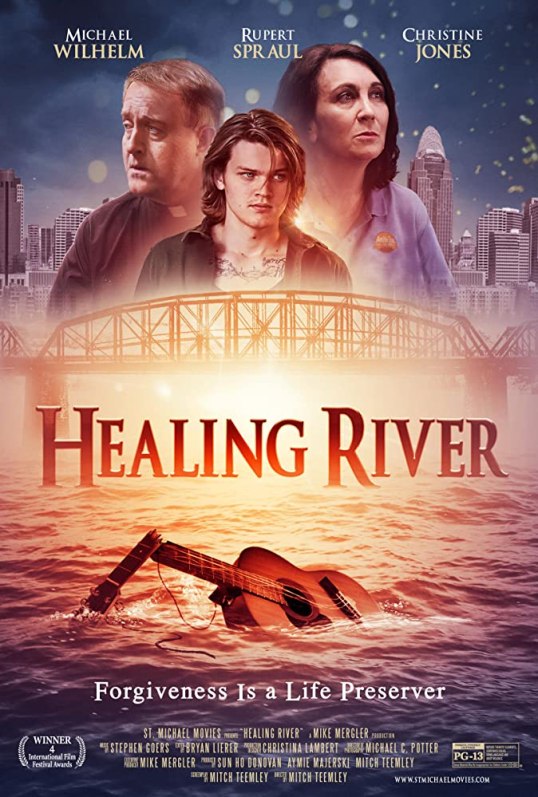
Film Review: Healing River (dir by Mitch Teemley)


Ingrid Ambelin (Christine Jones) owns a coffee shop in Cincinnati.  She has one son, a responsible young man named Michael (Spencer Lackey), and she also tends to think of herself as being a mother figure to everyone who works for her.  She’s the type of boss who keeps an extra set of clothes in the backroom, just in case one of her cashiers makes the mistake of coming to work in something that Ingrid considers to be too revealing.  (Actually, to be honest, that’s the sort of thing that would drive me crazy if I worked for Ingrid.)  Ingrid is old-fashioned but she means well.

Alec McCortland (Rupert Spraul) is a musician and a drug addict, someone who has never had anyone willing to look out for him.  Alec is the type who frequently goes to rehab but always relapses as soon as he gets out.  He’s angry but he’s also young.  In fact, he’s young enough that, when he accidentally drives his car straight into Michael, he’s tried as a juvenile.

At first, Ingrid is outraged that Alec will not be tried as an adult.  She forms a support group that meets in the basement of her church.  At first, Father Peter (Michael Wilhlem), who also happens to be Ingrid’s brother and Michael’s uncle, feels that the group will help her overcome her anger but instead, he watches as Ingrid and the group become obsessed with getting revenge.  In fact, when Ingrid catches Alec again breaking the law, she reports him and gets him thrown in jail.

And then, something unexpected happens.  At the urging of her brother, Ingrid finally visits Alec in prison and, as the two of them talk, Ingrid comes to realize that Alec is not the demon that she assumed he is and Alec finally starts to come to terms with his guilt over the death of Michael.  To the shock of her family and her employees, Ingrid comes to forgive Alec.  She works to try to reunite Alec with his father.  And when Alec is up for release, she volunteers to serve as his legal guardian….

I’m a big fan of the concept of forgiveness.  At the same time, I also know just how difficult it can be to truly forgive anyone, much less someone who has committed a heinous an act as Alec does in this film.  Therefore, I was curious to see how Healing River would handle the topic and I have to say that I was pleasantly surprised.  Healing River is a film that celebrates forgiveness and shows why forgiveness is necessary but, at the same time, it also doesn’t pretend as if forgiveness is easy.  For the most part, it takes an honest approach to the concept of forgiveness.  It’s portrayed as being important but it’s also not portrayed as being a magical elixir.  Even after Alec and Ingrid get to know each other and grow close, there’s still a lot of pain to be dealt with.

It helps that, as opposed to a lot of other inspirational films, Healing River has a little bit of an edge.  No one in the film, including Ingrid, is presented as being a saint.  The characters actually curse and I was glad they did because what mother wouldn’t curse while trying to explain how she feels about the death of her son?  Far too often, films like this seem to be set in a fantasy world that’s specifically designed not to challenge the target audience’s beliefs.  Healing River, however, takes place in the real world and, in the real world, people curse when they’re in pain.

There are a few scenes where the film’s low-budget does become a bit of a distraction.  An early scene featured a Hebrews-related pun that made me cringe.  (“Hebrews …. she brews.”)  There’s a narrative development in the third act that feels a bit clumsy.  It’s a flawed film, as most films are.  But it’s a sincere film and it’s a film that honestly explores both why forgiveness is important and why it’s also so difficult.

Film Review: Dispatched (dir by Gary Lee Vincent)


Dispatched, which is currently on Prime, is a low-budget film about a cop named Carl Thomas (Jeff Moore) who has an anger problem and a bad reputation.  Even though he makes a lot of arrests and gets a lot of criminals off the streets, his chief (Dean Cain) keeps having to reprimand him for using excessive force.

Anyway, one night, Carl is convinced to go to a revival meeting with some of his fellow police officers.  Carl witnesses a faith healing and, overnight, becomes the world most committed and outspoken Christian.  Suddenly, he’s able to give up his anger and now, whenever he arrests anyone, he treats them with compassion.  He tells them to follow Christ and get their lives together.  He goes down to the jail and he passes out bibles.  And….

Well, actually, that’s pretty much the entire film.  There’s really not much conflict to be found in Dispatched.  Admittedly, Carl’s first wife does divorce him because she can’t handle his sudden zeal for religion but most of that happens off-screen.  After the divorce, we don’t hear anything else about his ex-wife or his children from his first marriage.  We’re also repeatedly told that Carl was violent before he witnessed that faith healing but again, we don’t seem much evidence of it.  We do see Carl overreacting during a traffic stop and he definitely doesn’t come across as being the type of cop that anyone would want to deal with but, at the same time, the film shies away from showing us anything that could make us really dislike Carl.  That’s a mistake on the filmmaker’s part.  For a film about any type of redemption to work, you have to actually have to see some sort of difference between who the main character was before being redeemed and who the main character is afterwards.

That said, I can’t be too hard on Dispatched because, in the end, it’s a low budget message film.  The underlying message itself — that anger can be just as much of an addiction as any drug and that anyone can be redeemed if they’re truly willing to do the work — is not a bad one.  However, I think this is the type of movie that will be best appreciated by people who already agree with its religious theme.  If you’re like me and you tend to be a bit skeptical, you’ll probably zone out once the faith healing begins.  If you’re a believer in revival meetings and faith healings, you might have less of a problem with it all.  This is a film that preaches to the choir.  I doubt it will win over any nonbelievers but the choir might enjoy it and you know what?  There’s nothing wrong that.  The choir deserves to be entertained.  The real Carl Thomas appears at the end of the film.  He comes across as being sincere person, which is always a nice thing.

Anyway, Dispatched really wasn’t for me but I’m not going to criticize it the way I would a studio film with a 200 million dollar budget.  It’s a well-intentioned film, one that was made for a very specific audience and while will probably be most appreciated by those who already share its worldview.

Song of the Day: The Strength of the Righteous by Ennio Morricone


Since I reviewed The Untouchables yesterday, it only seems fit that it’s main title theme should be today’s song of the day.  From Ennio Morricone, it’s The Strength of the Righteous!

Previous Entries In Our Tribute To Morricone:

  1. Deborah’s Theme (Once Upon A Time In America)
  2. Violaznioe Violenza (Hitch-Hike)
  3. Come Un Madrigale (Four Flies on Grey Velvet)
  4. Il Grande Silenzio (The Great Silence)

Film Review: Frances Ferguson (dir by Bob Byington)


Frances Ferguson takes place in a town in Nebraska.  As the film’s narrator (Nick Offerman) explains it, it’s a town where everyone knows everyone else.  It’s a town where your mechanic knows your bartender and no one can really keep anything a secret for too long.  For instance, it’s the type of town where there’s no way that a substitute teacher in her mid-20s is going to be able to get away with having an affair with a 16 year-old student.

The teacher in question is named Frances Ferguson (Kaley Wheeless).  Frances wanders through her days in an apathetic haze.  When she steps outside of her house, she sees her useless husband (Keith Poulson) masturbating in the car.  When she spends time with her mother (Jennifer Prediger), she is criticized for every little thing.  On the rare days when she gets called to teach, the students look down on her and Frances thinks about how little she knows about any of the subjects on which she’s giving instruction.  Frances goes through her day holding back her emotions.  She only screams on the inside and, when she does, only she and the viewing audience can hear.

Things start to look up when Frances teaches a biology class and notices a handsome but vacuous student named Jake (Jake French).  When she finds out that Jake has been given detention, Frances volunteers to supervise him.  When Frances flirts with him and the scene cuts way, the narrator asks us, “Was this a crime?”

(Yes, it was.)

Frances and Jake have a short-lived affair, though it doesn’t seem to be particularly passionate.  If anything, Jake seems to be even more blase about it than Frances.  Wearing her old cheerleader uniform, Frances meets Jake in a laundromat.  “I’d never date a cheerleader,” Jake tells her.  We, the viewers, notice that there are other people in the laundromat.  Does Frances want to get caught?

Get caught, she does.  “This is the last time we see Jake,” the narrators tells us as Jake fades away.  Frances, meanwhile, sits in court.  Her mother comes to the trial and tells her that her clothes make her look fat.  Frances is convicted and sent to prison.  Her mom brings her a chocolate cupcake for her birthday.  Frances announces that she’s allergic to chocolate before taking a big bite and then pretending to die.  “Get off that dirty floor!” her mother orders her.

You may getting the impression that Frances Ferguson is a strange film and I supposed it is.  It’s a comedy but it’s an extremely deadpan comedy, with most of the humor coming from Frances’s seeming apathy to ever single thing that happens to her.  It’s not that Frances doesn’t have feelings or emotions.  We hear her inner scream enough times to know that she’s not as apathetic as she seems.  It’s just that Frances is so consumed with small town ennui that she realizes it’s pointless to react one way or the other.  Life is what it is and it continues regardless of how annoying it may all be.  Whether she screams on the inside or on the outside, she’ll still have to wake up every morning in the same situation.  One day, Frances Ferguson was a teacher.  The next day, she was a prisoner.  And the day after that, she was on parole and a minor celebrity.  (“You’re that teacher!” is a phrase that she continually hears.)  What happens, happens.

Here’s the thing …. though it may not sound like it from my description of the plot, Frances Ferguson is an incredibly funny film.  A lot of that is due to Nick Offerman’s performance as the snarky narrator.  (The narrator has a tendency to wander off topic.)  A lot of that has to do with the performance of Kaley Wheeless, who perfectly communicates Frances’s suppressed irritation.  Over the course of the film, Frances has to deal with a lot of people who, if not for her one mistake, she would have otherwise never had to deal with.  Some of them get on her nerves and some of them — well, two of them — provide her with some comfort.  I loved David Krumholtz’s performance as a beleagured but optimistic group leader.  Martin Starr also gets a nice bit at the end, though it would be too much of spoiler to say anything else about his role.  I also enjoyed the performances of Jack Marshall and Yoko Lawing, as the two detectives who investigate the charges against Frances and who explain that, because of TV cop shows, they can no longer get away with playing good cop/bad cop.

Frances Ferguson is good film.  It’s also a short one, clocking in at just 74 minutes.  To be honest, it’s the perfect running time for the story that this film tells.  We follow Frances’s story for just as long as we need to.  Frances Ferguson is on Prime so check it out.

Film Review: Burning Kentucky (dir by Bethany Brooke Anderson)


Burning Kentucky, which I just finished watching on Prime, is a film that has its own unique vibe.  You’re either going to connect with this frequently surreal film or you’re not.  If you do connect with it, you’re going to be aware that, while the film has its narrative flaws, it also has moments of visual brilliance.  If you don’t connect with it, you’ll probably dismiss it as just being another pretentious revenge thriller.  Burning Kentucky currently has a rating of 4.1 over that imdb, not because it’s a bad film but because it’s just not a film for everyone.  It’s not a crowd pleaser but it we’ve learned anything recently it’s that crowds suck.

Burning Kentucky takes place in the hills of Harlan County, Kentucky.  We find ourselves observing two families.  One family lives in a shack and brews moonshine.  They eat whatever animals they catch in the wilderness and about the only thing that’s vaguely modern about them is the camera that their daughter, Aria (played, in her film debut, by Emilie Dhir), carries with her.  (And even that camera appears to be from the mid-20th century.)  Aria also narrates the film, musing about life and death.  In the country, she explains, people understand that death is a part of life.  Regardless of any sentimental feelings, everything dies.

The other family is headed by an man named Jaxson (John Pyper-Ferguson).  Jaxson is the country sheriff, so he’s a man of some importance.  However, it’s also obvious that he’s a man who has long been on a downward spiral.  He drinks too much and he spends most of his time cursing God and complaining about the local preacher, Abe (Andy Umberger).  Jaxson has two sons.  Wyatt (Nick McCallum) appears to be relatively stable.  Rule (Nathan Sutton), on the other hand, is a junkie who lives in a shack that he shares with Jolene (Augie Duke).  Jolene wants to be a singer.  She wants to get off drugs.  Rule, on the other hand, appears to be content to just slowly kill himself.

Whenever Wyatt can get away from his drunk father and his wasted brother, he spends his time with Aria.  They’ve been in love for several years, ever since the night that Aria discovered Wyatt trapped in one of the traps that her family had set around their land.  When we first see Aria and Wyatt together, they talk about how they met on the same night that they each lost their mother.

It takes a while to figure out just what exactly is going on in Burning Kentucky.  The deliberately paced first half of the film freely hops from the past to the present and then back again.  The camera glides over the misty mountains of Kentucky, stopping to linger on deserted houses and crumbling buildings.  Everything seems to be suspended in a state of permanent decay.  The wilderness appears to be both beautiful and threatening at the same time and the imagery, when combined with Aria’s narration, is often surreal.  The first half of the film plays out as if we’re watching a filmed dream.

Unfortunately, the second half of the film is a bit more conventional.  Once we finally discover who everyone is relative to everyone else and after we learn what happened in the past, the film settles down to become a standard revenge thriller, albeit one that’s very much concerned with the concepts of guilt, redemption, and human nature.  Still, the Kentucky hills remains atmospheric and dream-like and the well-selected performers — particularly Augie Duke and John Pyper-Ferguson — continue to bring their haunted characters to life.

As I said, this isn’t necessarily a film for everyone.  The film’s ending will leave a lot of people feeling perplexed but that’s okay.  A story like this doesn’t need a neat ending.  In fact, Burning Kentucky is a film that demands to end on a hint of messiness and ambiguity.  I liked Burning Kentucky.  You might like it too.

Film Review: Emerson Heights (dir by Jennifer Hook)


Earlier tonight, on Prime, I watched a new film called Emerson Heights.  (Well, newish.  It came out in January.)

Emerson Heights tells the story of two people.

Cody McClain (played by Austin James, who also wrote the script and produced) is an aspiring actor who has recently moved out to Los Angeles with his mother and his little sister.  He’s handsome and he’s charming but he’s also dorky enough that he can’t put together a last minute pool party.  He’s only played a few small roles and is perhaps best known for appearing in a series of pretzel commercials.  At least he’s not having to work at Starbucks.

Briley (Gatlin Green) is an aspiring singer.  She does a killer version of Somewhere Over The Rainbow and she aspires to someday perform on Broadway.

Together …. THEY SOLVE CRIMES!

No, actually, they don’t.  Instead, they just meet one day and fall in love.  Unfortunately, Cody lives in Los Angeles while Briley lives in New York City but they’re determined to make it work.  They promise to write to each other often and, whenever Briley can make it out to California, she and Cody spend every moment together.  Briley fears that a long distance relationship won’t be able to survive but Cody promises her that it well.

However, can their relationship survive Cody suddenly becoming famous?  When Cody starts getting bigger roles and more fans, it all starts to go to his head.  While he’s shooting a spy film and hanging out with his seductive co-star, Haley Ryan (Amanda Grace Benitez), Briley is starring in a Broadway production of The Wizard of Oz and trying to figure out how to hold onto her job despite the fact that she’s just found out that she’s pregnant….

Emerson Heights is a pretty simple film.  From the minute that we meet Haley and Cody’s smarmy agent (Matt Singletary), we know that they’re both going to try to lead Cody astray.  We know that Cody’s going to struggle with temptation, just as surely as we know that Briley is going to be pressured to terminate her pregnancy.  It may occasionally be predictable but predictability is actually a strength when it comes to a film like this.  Emerson Heights is an unabashedly sentimental love story, a story about two people who belong together but who have to overcome 90-minutes worth of obstacles to reach each other.  When you’re having to deal with news of riots, pandemics, and threats of war on a daily basis, the predictable but likable romance featured in a movie like Emerson Heights is actually rather comforting.

And make no mistake about it, this is a very likable film.  Austin James and Gatlin Green are two appealing performers and they have a wonderful chemistry together.  (It didn’t surprise me to discover that they’re married in real life.)  They make for a sweet couple and they just seem as if they belong together.  I also liked the enjoyably snarky performance of Amanda Grace Benitez as Briley’s potential rival for Cody’s affection.  As played by Benitez, Haley seems to be having such a ball being bad that it’s fun to watch.  If you’re going to be a villain in a film like this, you might as well enjoy yourself!

Anyway, Emerson Heights is on Prime.  I enjoyed it.

An Offer You Can’t Refuse #20: The Untouchables (dir by Brian DePalma)


“Let’s do some good!” Eliot Ness shouts as he and a platoon of Chicago cops raid what they believe is a bootlegger’s warehouse.

That line right there tells you everything that you need to know about the 1987 film, The Untouchables.  In real life, Eliot Ness was known to be an honest member of law enforcement (which did make him a bit of a rarity in 1920s Chicago) but he was also considered to be something of a self-promoter, someone who tried to leverage his momentary fame into an unsuccessful political career.  In the 50s, after Ness had lost most of his money due to a series of bad investments and his own alcoholism, Ness wrote a book about his efforts to take down Al Capone in Chicago.  That book was called The Untouchables and though Ness died of a heart attack shortly before it was published, it still proved popular enough to not only rehabilitate Ness’s heroic image but also to inspire both a television series and the movie that I’m currently reviewing.

None of that is to say that Ness didn’t play a role in Al Capone’s downfall.  He did, though it’s since been argued that Ness had little to do with actual tax evasion case that led to Capone going to prison.  It’s just that, in real life, Eliot Ness was a complicated human being, one who had his flaws.  In The Untouchables, Kevin Costner plays him as a beacon of midwestern integrity, a Gary Cooper-type who has found himself in the very corrupt city of Chicago in the very corrupt decade of the 1920s.  The film version of Eliot Ness has no flaws, beyond his naive belief that everyone is as determined to “do some good” as he is.

So, The Untouchables may not be historically accurate but it’s still an entertaining film.  It’s less concerned with the reality of Eliot Ness’s life and more about the mythology that has risen up around the roaring 20s.  Everything about the film is big and operatic.  In the role of Al Capone, Robert De Niro sneers through every scene with the self-satisfaction of a tyrant looking over the kingdom that he’s just conquered.  While Costner’s Ness tells everyone to do some good, De Niro’s Capone uses a baseball bat to keep his underlings in line.  He goes to the opera and cries until he’s told that one of Ness’s men has been killed.  Then a big grin spreads out across his face.  It’s not exactly a subtle performance but then again, The Untouchables is not exactly a subtle movie.  It’s not designed to be a film that makes you think about whether or not prohibition was a good law.  Instead, everything is bigger-than-life.  It’s a film that takes place in a dream world that appears to have sprung from mix of old movies and American mythology.

In real life, Ness had ten agents working under him.  They were all selected because they were considered to be honest lawmen and they were nicknamed The Untouchables after it was announced to the press that Ness had refused a bribe from one of Capone’s men.  In the film, Ness only has three men working underneath him and they’re all recognizable types.  Sean Connery won an Oscar for playing Jmmy Malone, the crusty old beat cop who teaches Ness about the Chicago Way.  A young and incredibly hot Andy Garcia plays George Stone, the youngest of the Untouchables.  Best of all is Charles Martin Smith, cast as Oscar Wallace, a mild-mannered accountant who first suggests that Capone must be cheating on his taxes.  There’s a great scene in which the Untouchables intercept a liquor shipment on the Canadian border, all while riding horses.  Sitting on the back of his galloping horse and trying not to fall off, both Oscar Wallace and the actor playing him appear to be having the time of their lives.  For Oscar (and probably for much of the audience), it’s a fantasy come to life, a chance to “do some good.”

The Untouchables was directed by Brian DePalma and his stylish approach to the material is perfect for the film’s story.  DePalma fills the film with references to other movies, some from the gangster genre and some not.  (In one of the film’s most famous sequence, DePalma reimagines Battleship Potemkin‘s massacre on The Odessa Steps as a shoot-out between Eliot Ness and Capone’s men.)  DePalma’s kinetic style reminds us that The Untouchables is less about history and more about how we imagine history.  In reality, Capone was succeeded by Frank Nitti and The Chicago Outfit continued to thrive even in Capone’s absence.  In the film, Nitti (played by Billy Drago) brags about killing one of the Untouchables and, as a result, is tossed off the roof of a courthouse by Eliot Ness.  It’s not historically accurate but it makes for a crowd-pleasing scene.

Big, operatic, and always entertaining, The Untouchables is an offer that you can’t refuse.

Previous Offers You Can’t (or Can) Refuse:

  1. The Public Enemy
  2. Scarface (1932)
  3. The Purple Gang
  4. The Gang That Could’t Shoot Straight
  5. The Happening
  6. King of the Roaring Twenties: The Story of Arnold Rothstein 
  7. The Roaring Twenties
  8. Force of Evil
  9. Rob the Mob
  10. Gambling House
  11. Race Street
  12. Racket Girls
  13. Hoffa
  14. Contraband
  15. Bugsy Malone
  16. Love Me or Leave Me
  17. Murder, Inc.
  18. The St. Valentine’s Day Massacre
  19. Scarface (1983)