Get out there and celebrate your weekend, like these folks!
Enjoy!
Get out there and celebrate your weekend, like these folks!
Enjoy!
Welcome to Retro Television Reviews, a new feature where we review some of our favorite and least favorite shows of the past! On Fridays, I will be reviewing The Brady Bunch Hour, which ran on ABC from 1976 to 1977. All nine episodes can be found on YouTube!
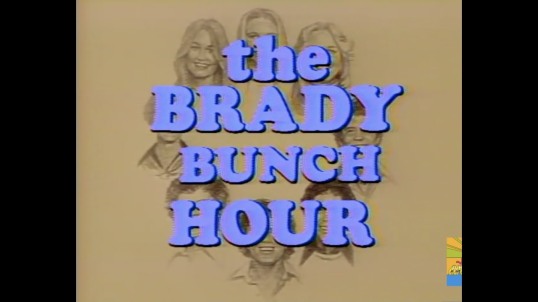
Following the rating success of the pilot for the Brady Bunch Variety Hour, ABC decided to bite the bullet and the Bradys returned to the airwaves!
*Deep sigh*
Okay, let’s do this….
Episode 1.2
(Originally aired on January 23, 1977, Dir by Jack Regas)
I’ve discovered that the dancers who performed on each episode of The Brady Bunch Hour were known as the Kroftettes. (The show as produced by Sid and Marty Kroft and there is definitely nothing creepy about naming your performers after yourself.) The second episode of the Brady Bunch Hour opened with the Kroftettes dressed in red, white, and blue and carrying small drums. It would be a perfect look for the 4th of July but this episode aired in January.
The dancers eventually move off stage and the audience goes crazy as the announcer informs them that tonight’s episode not only stars the Bradys but also Lee Majors, Farrah Fawcett-Majors, Rip Taylor, Ann B. Davis, and …. Kaptian Kool and the Kong! Well, who wouldn’t be excited by the Kong? The Kong was apparently a musical group. With a name like that, you would hope they would at least have the decency to dress up like gorillas but instead, they appear to have just been a typical 70s prog rock outfit.
The Bradys come out on stage and start awkwardly singing a rock version of Yankee Doodle Dandy. The YouTube screenshot below isn’t the best but I think it gives you some idea of what this performance is like:

“Yankee Doodle …. Keep it up!” the family chants as the Kroftettes splash about in the pool. The audience loves it.
With the song completed, the Brady Bunch introduce themselves. Greg spends too long talking about himself and is sharply reprimanded by Carol. Cindy explains that it is now 1977. Thanks, Cindy! Fake Jan smiles and tries not to cry as she jokes around with her new family. Mike Brady explains that the Bunch has a new house. “We have a terrific new show!” Mike says. Sure you do, Mike. Carol explains that the show will only be airing once a month. “We’re only a few minutes in and we’ve already been canceled!?” Mike says.
After a reprise of Yankee Doodle Dandy, the show mercifully breaks for commercial. When the show returns, the Bradys are stepping into their new home and discovering that they have no furniture! The movers ran off with it! Luckily, Alice the Maid randomly shows up with a bunch of sleeping bags.
“Well, Mike,” Carol says, “what do we do now?”
“The only thing we can do,” Mike replies, “is hit the sack.”
Every member of the Bunch hits their sleeping bag. 9 minutes in and this show is already giving me a migraine.
Fortunately, the moving man shows up. Unfortunately, the moving man is played by a very 70s comedian named Rip Taylor.

Rip Taylor is playing Mr, Merrill. Merrill refuses to take any blame for being late with the furniture. Carol suggests that Mr. Merrill come back tomorrow. Do they want their furniture or not? Well, it really doesn’t matter because it turns out that Mr. Merrill has some other family’s furniture in his truck and the Brady furniture is still missing. Mr. Merrill promises to have their furniture tomorrow. “Let’s hit the sack,” Mike says and everyone hits their sleep bag and ….. ARRRRRRRGHHHHH!
Where was I?
Anyway, the Bradys then sing Razzle Dazzle from Chicago, with all the skill of a small town community theater chorus.
Back at the Brady House, Alice scolds Marcia for hoarding all of her dolls. Alice tells her that everyone is having to give things up. Uhmmm …. they’re just dolls, Alice. And really, why is Alice giving Marcia orders? Marcia imagines Alice as the Wicked Witch of the West and then imagines herself as Dorothy and performing Car Wash with her brothers and Rip Taylor …. wait, what? Just watch for yourself.
Hey, who doesn’t love cocaine?
Fake Jan and Peter appear and explain that the Bradys eventually got their furniture. “Look at what happened!” Peter says. We cut to the family watching Mike hang an ugly painting over the fireplace. Mike orders everyone to go to bed at 8 pm. Greg objects and Mike threatens to kill him.

Alice explains that Mike wants the kids to go to bed so that he and Carol can make love in the living room. No sooner have the children (and the maid) left than Rip Taylor shows up again and explains that he’s also the Bunch’s landlord. He says that a lovely couple is going to be staying with the Bradys over the weekend. Enter Lee Majors and Farrah Fawcett! Lee is not amused to discover that Rip Taylor has double-booked the house. “Don’t hit me, you bionic bully!” Rip Taylor shouts. When Lee explains that his other house is being fumigated, Carol says that Lee and Farrah are “welcome to stay here with us.” RUN, LEE AND FARRAH! RUN!
After a commercial break, Carol welcomes the audience back to the second half of the show. Oh my God, there’s another 30 minutes of this? “I like that we can show you the way we really are at home,” Carol says.
Back at home, the Brady kids are getting their breakfast and are stunned to discover Lee Majors and Farrah Fawcett asleep on the living room couches. (Yes, they have separate couches.) When Farrah and Lee wake up, Greg awkwardly asks for an autograph. “I don’t carry a pen in my pajamas,” Lee explains. Alice comes in and is struck speechless.
Cut to Marcia, explaining that “one of the great things about having our own show is that we get to showcase the individual talents of our family.” Marcia introduced Fake Jan, who performs Your Song. It’s the highlight of the episode because Geri Reischl, not being an original Brady, can actually sing.
Fake Jan is followed by Carol who sings Send In The Clowns, which is the type of song that is perfectly designed to bring out the worst tendencies in even the most talented of singers. That certainly happens to Florence Henderson, who has a great voice but who also totally overdoes the bathos in her performance.
Greg catches Peter flirting with a Kroftette. Greg shoves Peter in the pool. Kaptain Kool and the Kong come out and perform a song called Names. It’s not a bad song but I have to admit that I’m more worried about the possibility of Peter breaking his neck the next time his older brother throws him in the pool without warning.
It’s time for the finale and Mike asks Carol why the stage is decorated with hearts. “It’s not Valentine’s Day,” Mike says, as if he and his family didn’t open this show by celebrating Independence Day in January. Carol explains that the theme of the finale is “Young and Old.” “Young and Old hearts?” Mike asks. DAMMIT, MIKE, JUST SHUT UP AND SING!
Anyway, much as with the Wizard of Oz/Car Wash thing, this is one of those things that can’t really be described. But it can be watched:
And then, thank God, it ends!
A huge flaw with this show is that the Bradys keep telling us how much they love being a family but we know they’re not a family. We know this because they brought in a substitute Jan. As such, the sentimental moments fall flat. “We’re so proud of our sister,” the kids say before Jan comes out to sing but seriously, we know that’s not Jan. I would much rather listen to Geri Reischl sing than any other member of the Bunch but it doesn’t change the fact that we know that’s not their sister.
Another flaw is that there’s not really any point to the show, other than the Bradys have somehow managed to get their own variety show. The whole thing with Lee Majors and Farrah Fawcett is perfect example of this show’s approach to storytelling. Lee and Farrah show up at the house unannounced but it’s fine because the Bradys live in a world with zero conflict. Lee and Farrah show up. The kids are shocked. Alice is shocked. And …. well, that’s it! So much for that plotline.
Oh well. Only 7 episodes left!
Welcome to Retro Television Reviews, a feature where we review some of our favorite and least favorite shows of the past! On Thursdays, I will be reviewing City Guys, which ran on NBC from 1997 to 2001. The entire show is currently streaming on Tubi!
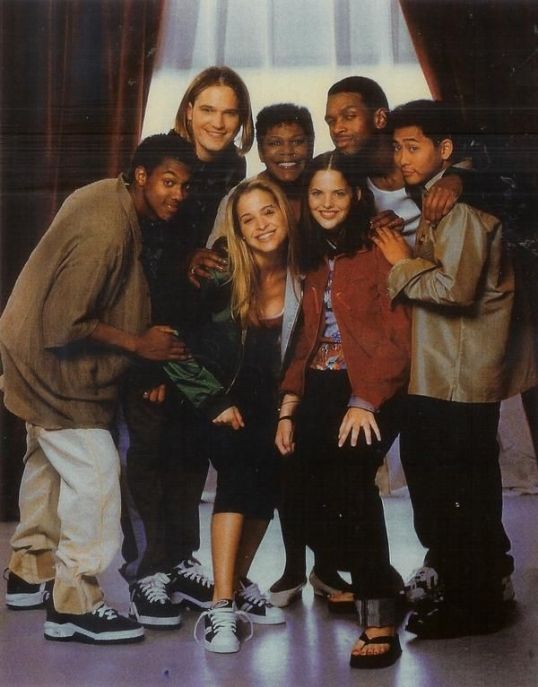
Roll with the city guys!
Episode 3.17 “Angels of Harlem”
(dir by Frank Bonner, originally aired on November 20th, 1999)
Ms. Nobel’s church is celebrating its 100th birthday so, of course, her students are roped into helping to decorate because who cares about keeping the church out of school and all that other stuff. It turns out that the church is going to be torn down by a real estate developer and that developer is …. CHRIS’S FATHER!
Chris and Dawn chain themselves to the church and …. well, look, this was a dumb episode and it featured way too much church stuff for my tastes. Let’s move on.
Actually, before I move on, I guess I should mention that Jamal starts dating Ashley in this episode and, unlike Jamal’s other girlfriends, it appears that Angela is actually going to be featured in multiple episodes. Ashely is played by Trina McGee, who also played Angela on Boy Meets World. Oddly enough, Trina was already two years into Boy Meets World when she did City Guys. Boy Meets World was also an ABC show whereas City Guys was an NBC show. It’s just a bit odd to see her pop up on this show.
Episode 3.18 “Rollin’ With The Homies”
(dir by Frank Bonner, originally aired on November 20th, 1999)
“Alright, alright, alright!” Jamal announces as he shows up at Manny High for another day of learning, “Only a few days to Christmas break! A brother can’t wait for Christmas vacation!”
Anyway, it’s time for the Winterfest Dance, which Cassidy explains is a dance on the roof in the middle of winter. And since this is an episode of City Guys, it’s also time for Ms. Nobel to show up and tell everyone to get a Christmas job working at a toy store. Did Ms. Nobel not have any other students to whom she could give these assignments?
The owner of the toy store informs Jamal, Chris, and L-Train that they’ll be working as delivery boys. The first delivery is a bunch of video games to the owner’s house. He explains that his son is home from boarding school and that the games are for him. “Are you interested in adopting a young black child?” Jamal asks.
Al, Dawn, and Cassidy are assigned to be salespeople. They get into a competition to see who can win the sales contest. Yawn. At least this episode acknowledges that Dawn and Al are now a couple.
Jamal, Chris, and L-Train make friends with the boss’s son, Tommy. Tommy is in a wheelchair and his father is superprotective. At first, Tommy is upset to discover that Jamal, Chris, and L-Train are getting paid extra to hang out with him but then Jamal makes it up to him by taking him out of the house without his Dad’s permission. When Tommy’s Dad finds out, he fires Jamal, Chris, and L-Train. Meanwhile, Tommy gets mad at everyone for treating him like he can’t take care of himself.
The next day, in school, Ms. Nobel decides to get involved because she doesn’t have a life outside of church and school. She tells Jamal to treat Tommy like he would treat anyone. Apparently, treating Tommy like everyone means throwing the Winterfest Dance in Tommy’s house. Tommy gets a date with Cassidy. Tommy’s father is a bit upset about the dance being moved to his house but Ms. Nobel talks him out of it. Because Ms. Nobel can do anything.
I’m just being snarky. By City Guys standards, this was actually a pretty good episode. Al and Dawn are a cute couple and I’m glad Tommy had a good Christmas.
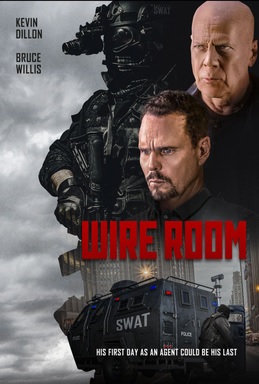
Wire Room tells the story of Justin Rosa (Kevin Dillon).
Once upon a time, Justin was a member of the Secret Service. But, for reasons that are never really made clear, Justin was eventually demoted and found himself working for Homeland Security. After 18 years, Justin has finally achieved his dream. He’s been assigned to a wire room, a high-tech command center where HSI agents conduct surveillance on high-profile criminals. On his first day, Justin shows up late. He gets yelled at by his superior, Shane Mueller (Bruce Willis). Justin explains that he couldn’t find anywhere to park. Shane is not impressed. Of course, Shane takes a taxi to and from work because Shane is a total alcoholic who likes to spend his free time at the local strip club.
After meeting Shane and Nour Holborow (Shelby Cobb), Justin is left in the wire room alone. His sole job is to keep an eye on a British arms dealer, Eddie Flynn (Oliver Trevena, who chews the scenery with relish). Shane is obsessed with taking down not only Eddie but also all of the corrupt cops that are on Eddie’s payroll. Eddie has no idea that his entire mansion is wired and that Homeland Security is watching him while he wanders around the house in his leopard-print robe. Eddie also doesn’t know that a bunch of assassins are coming to his house to try to kill him.
Realizing that Eddie is about to be killed, Justin tries to call Shane but Shane is too busy getting drunk to answer his phone. When Nour calls about an unrelated manner, Justin asks her for advice. She tells him to call Shane. He already tried that! Realizing that Homeland Security is full of drunks and incompetents, Justin decides to call Eddie himself. Soon, Justin and Eddie enter into an uneasy partnership. Justin tries to keep Eddie alive while Eddie tries to figure out how Justin knows what’s happening at his house. To me, it would seem like it shouldn’t be difficult for Eddie to figure out that Homeland Security has wired his house but no one in this movie is particularly smart.
Wire Room was one of the last movies that Bruce Willis made before announcing his retirement from acting. Willis doesn’t get much screen time and his dialogue consists mostly of profane insults. That said, it is nice to see Willis playing a good guy again and there’s even a few hints of the old Willis charisma to be found in his performance. If nothing else, he seems to enjoy the scenes in which Shane gives Justin a hard time. As for Justin, he really is a truly stupid character who makes so many obvious mistakes that it’s hard not to worry about the fact that he’s been entrusted with keeping the homeland safe. Fortunately, Kevin Dillon is an actor who can make stupidity likable. (There’s a reason why Johnny Drama was the only character on Entourage that anyone really cared about.)
Like the majority of Willis’s recent films, Wire Room is a low-budget action film. The special effects aren’t particularly special and the action scenes are fairly rudimentary. A huge problem with the film is that the viewer is never quite sure how close or how far anyone is from the titular location. For instance, we’re continually told that people are heading towards the wire room but it seems like it takes them forever to actually show up. At one point, we see a group of bad guys heading up to the wire room but, somehow, Justin and Shane still have time to scrounge up some weapons and have a fairly detailed conversation before any of them actually arrive. For all of the shooting and the yelling, Wire Room also never convinces us that there’s much at stake as far as the story is concerned. Shane, for instance, doesn’t seem to be particularly upset when Justin tells him about what is happening at Eddie’s house, despite the fact that Eddie’s death would destroy Shane’s investigation into police corruption. If Shane, the man in charge of the investigation, doesn’t care about what happens then why should we?
That said, there is some perhaps unintentional enjoyment to be found in Wire Room. Kevin Dillon plays Justin as being so dense and so slow-witted that the film almost becomes a parody of the recent spate of movies and television shows that have been released about hyper competent government agents. There are laughs to be found and Bruce Willis gets to be the good guy again. Wire Room is not a particularly memorable movie but it is a decent time waster.
Welcome to Retro Television Reviews, a feature where we review some of our favorite and least favorite shows of the past! On Wednesdays, I will be reviewing the original Love Boat, which aired on ABC from 1977 to 1986! The series can be streamed on Paramount Plus!
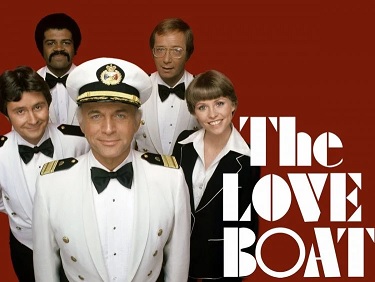
All aboard!
Episode 1.22 “A Selfless Love / The Nubile Nurse / Parents Know Best”
(Dir by Roger Duchovny, originally aired on February 25th, 1978)
The week’s cruise begins with the walking HR nightmare known as Dr. Adam Bricker announcing that he’s hired a new nurse and she’s a former Las Vegas showgirl! Gopher and Isaac are excited to learn this but no one is more excited than Doc, who quickly makes it clear that he’s hoping that she’ll be more than just his nurse.
However, it turns out that Dawn Delaney (Elaine Joyce) not only takes nursing very seriously but she would also rather do her job than make out with her boss. Needless to say, this upsets the doctor. It also turns out that she knows about all of the latest medical developments. This also upsets Doc Bricker because it leads to him getting upstaged. The final straw is when Dawn manages to cure Captain Stubing’s hiccups. Bricker gets upset but then Dawn explains that she actually wants to be a doctor but, because she’s a former showgirl, no medical school is willing to accept her. Bricker promises to use his contacts to got her admitted and then they share a long passionate kiss. And that’s the end of that story.
As I watched Doc react to his nurse, it occurred to me that this show was very lucky that Bernie Kopell agreed to play the role because Doc, to be honest, is a terrible doctor who violates his Hippocratic oath on every cruise. In the real world, Doc Bricker would be unemployable. On The Love Boat, everyone loves him and the reason that we believe he would be so popular is because Bernie Kopell was so naturally likable that it made it easy to overlook all of the character’s shady behavior.
While Doc hit on his new nurse, two parents (Monty Hall and Janis Page) tried to hook their dorky son (Mark Shera) up with a girl (Laurie Prange) on the cruise. What the parents didn’t know is that the girl was actually their son’s girlfriend and the entire cruise was an elaborate ruse to get them to finally meet. Seriously, that was the entire story. It was a bit forgettable.
Finally, Harry Morrison (Leslie Nielsen) is an old friend of Captain Stubing’s. He’s going to Mexico with his much younger girlfriend, Laura (Lynda Day George) and they plan to get married. However, Harry starts to worry that Laura is too young for him and Laura starts to worry that Harry would rather hang out with people his own age. She makes a reference to Donnie and Marie Osmond and Harry admits to not knowing who they are. Agck! Fear not, though. After talking about it, Harry and Laura decide to get married anyways. It was a predictable story but how can you not like watching the future stars of The Naked Gun and Pieces acting opposite each other?
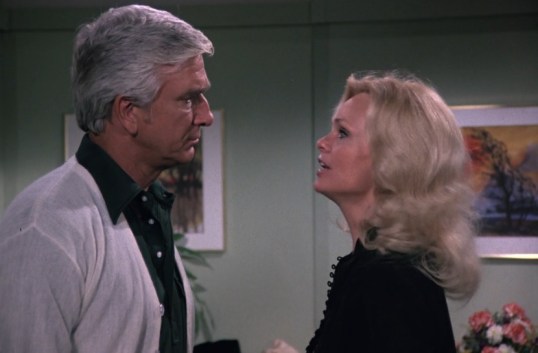
It was a bit of an odd episode. The Doc/Nurse storyline was cringey. The son and his parents storyline were forgettable. But I liked Leslie Nielsen and Lynda Day George’s story. They saved the cruise!
Next week, we’ll continue to set sail for adventure with three new stories!
Welcome to Retro Television Reviews, a feature where we review some of our favorite and least favorite shows of the past! On Tuesdays, I will be reviewing the original Fantasy Island, which ran on ABC from 1977 to 1986. The entire show is currently streaming on Tubi!
It’s time for another tonally confusing trip to Fantasy Island!
Episode 2.6 “War Games/Queen of the Boston Bruisers”
(Dir by Earl Bellamy, originally aired on October 28th, 1978)
We’re just six episodes into the second season of Fantasy Island but a definite pattern has emerged. Just as in the first season, each episode features two fantasies. But, in the second season, it appears that one fantasy is always comedic and the second is always serious. This has created an interesting tonal mishmash on Fantasy Island. Mr. Roarke spends half of his time laughing at the silliness of it all and the other half warning people that their fantasy could lead to death.
Take this episode for instance.
Rowdy Roberts (Anne Francis) is a roller derby champ whose fantasy is to become a “gentlelady” so that she can impress her daughter’s future in-laws. (Rowdy’s future son-in-law, meanwhile, is played by a young Jonathan Frakes.) Mr. Roarke and Tattoo spend an entire weekend teaching Rowdy how to speak properly, how to eat with silverware, and all the rest. However, snobbish Betty Wendover (Joanna Barnes) doesn’t want her son marrying Rowdy’s daughter so she arranges for Rowdy’s roller derby rival, Hooligan Hanreddy (Mary Jo Catlett), to come to the island and challenge Rowdy to a fight. Rowdy throws a punch and then runs off, ashamed at not being sophisticated. But, it turns out that Rowdy’s future son-in-law is really impressed with what Rowdy did and the wedding takes place after all. Yay!
Needless to say, this is all incredibly silly but it’s meant to be silly and both Anne Francis and Mary Jo Catlett seem to be having fun overplaying their rivalry. There is nothing particularly realistic about this fantasy but it’s not meant to be. It’s meant to make the viewer smile and, for the most part, that’s what it does.
But, at the same time, Vietnam vet Joe Beck (Christopher George) is chasing another Vietnam vet, attorney Ted Harmon (Greg Morris), through the jungle, intent on killing him. Joe blames Ted for the death of Joe’s younger brother. Apparently, they were all POWs together and Joe’s brother died during an escape. Joe is convinced that Ted betrayed his country. This is all pretty dramatic and it’s hard not to wonder why Roarke would have agreed to sponsor this fantasy in the first place. Ted is a prominent attorney who is thinking of running for political office. If he was murdered on Fantasy Island, that wouldn’t do much for the island’s reputation. Fortunately, it all works out in the end as Joe discovers that his younger brother is not only still alive but that he’s also the one who informed the VC about the escape attempt. Amazingly, Ted doesn’t seem to be at all upset that he was nearly murdered over a mistake. I guess that’s the magic of Fantasy Island.
These two fantasies didn’t really go together and, as a result, this episode feels a bit messy. But there is one cute moment in which Tattoo reveals to Mr. Rourke that his new side hustle involves selling phony college degrees.

Go Tattoo!
I like dancing. I like the country. What better music video to pick for Oscar Nomination Tuesday?
Enjoy!
Welcome to Retro Television Reviews, a feature where we review some of our favorite and least favorite shows of the past! On Mondays, I will be reviewing Hang Time, which ran on NBC from 1995 to 2000. The entire show is currently streaming on YouTube!
Having lost the tournament in California, the Tornadoes are back in Indiana!
Episode 3.13 “The Perfect Girl”
(Directed by Patrick Maloney, originally aired on October 25th, 1997)
Coach Fuller finds himself subbing as the teacher of the school’s cooking class. Thinking that the class will be an easy A, Michael, Teddy, Danny, and Julie all enroll in the class …. which, doesn’t really make any sense as they’re high school students and there are few high schools that will let you randomly enroll in a class halfway through a semester. Add to that, they’re specifically enrolling in the class because Fuller is teaching it but what are they going to do when the regular teacher comes back?
It turns out that Fuller expects them to take his cooking class seriously and, when they screw around and even try to pass off a Stadium-bought pie as their own work, Fuller threatens to give them all Fs. Seeing as how they randomly entered the class, couldn’t they just as randomly drop out before getting their final grade? I’m really not sure how this high school works. Eventually, the four of them get serious and make a real pie. Of course, Teddy trips and accidentally smashes it into Fuller’s face. Strangely enough, Danny did the exact same thing to a rival coach in the previous episode.
Meanwhile, Mary Beth enters a modeling contest and makes it to the finals. When she doesn’t win, she considers getting plastic surgery. As someone who was once told that the only thing keeping me from potentially becoming a star was a nose job, I could relate. And, much like Mary Beth, I did consider getting that nose job. Ultimately, I didn’t because I actually like my imperfect nose. It’s a physical feature that I shared with my mom and just about everyone else in my family. Mary Beth, thankfully, also declines to get plastic surgery, largely due to overhearing Vince talking about how beautiful she is. Awwwwww!
Episode 3.14 “Blood Drive”
(Directed by Patrick Maloney, originally aired on October 25th, 1997)
Kristy is tying to organize the school blood drive.
Mary Beth is trying to organize the school dance.
Danny helps Kristy because he likes her. That’s not a surprise since Kristy bears a strong resemblance to Sam, the former team manager who broke Danny’s heart at the start of the second season. Unfortunately, Danny gets jealous when he meets the handsome doctor who will be helping to draw the blood. Danny almost ruins everything with his jealousy but then, he somehow convinces an actual NBA star to show up and give some blood. The audience goes crazy. Kristy, however, informs Danny that she’s not ready to date anyone. (Seriously, Kristy, you’re only in high school for a limited amount of time. You might as well try to have some fun.)
Meanwhile, Vince nearly ruins Mary Beth’s dance because of his inability to find a good band. Finally, he finds a really cool old guy who plays an accordion. Woo hoo! The dance is saved.
Finally, I guess Julie broke up with that Jason guy because now she wants Michael to ask her to the dance. However, Michael is insecure because he can’t dance. Teddy tries to teach Michael how to dance and, even though it’s a really silly scene, Anthony Anderson gets so much into it that you can’t help but be charmed. Anyway. Julie fakes an ankle sprain so that Michael, seeing that she won’t be able to dance, will ask her to be his date and it works. Yay! I just hope this relationship works out better than every other relationship Julie has had. Chris cheated on her. Josh and Jason both mysteriously vanished. Michael seems to be a good guy, though.
This was a sweet episode. Hang Time was at its best when it just let the teens be teens.
I assume this music video is about vampires. Regardless, it’s certainly atmospheric.
Enjoy!
Welcome to Retro Television Reviews, a feature where we review some of our favorite and least favorite shows of the past! On Sundays, I will be reviewing the made-for-television movies that used to be a primetime mainstay. Today’s film is 1974’s The Elevator! It can be viewed on YouTube!
Marvin Ellis (Roddy McDowall) hates his job. He’s been assigned to be the manager of a new high-rise office building. Parts of the building are still under construction but that hasn’t stopped the company that owns it from selling out office space. When Mrs. Kenyon (Myrna Loy) comes by and asks to look at the top floor penthouse, Ellis agrees. In public, Ellis is always friendly and always courteous. It’s only under the most stressful of circumstances that Ellis reveals that he feels as if the building has been built of out lies and cheap material.
Ellis and Kenyon soon find themselves in a stressful situation when they are trapped in an elevator. Of course, they’re not alone in the elevator. There’s also Dr. Reynolds (Craig Stevens), his wife (Teresa Wright), and his mistress (Arlene Golonka). And then there’s Robert Peters (Barry Livingston), a teenager who has inherited a fortune. And finally, there’s Eddie Holcomb (James Farentino). Eddie has a suitcase full of money that he’s stolen from an office in the building. He’s also got a loaded gun. And, perhaps worst of all, he has an intense fear of tight places. The longer that he’s trapped in the elevator, the worse his claustrophobia becomes.
Because the building isn’t really finished yet, the elevator’s alarm button doesn’t really work. Other than the passengers trapped inside, the only people who know about the stalled elevator are Eddie’s partners-in-crime. Irene (Carol Lynley) is Eddie’s girlfriend and she just wants to get the situation resolved with as little violence as possible. Pete (Don Stroud) is Eddie’s sociopathic friend. Pete is not only determined to rescue Eddie and retrieve the suitcase. He’s also determined to take care of any potential witnesses by killing everyone on the elevator.
The Elevator is a disaster film, along the lines of Airport and The Towering Inferno. Due to the hubris of a faceless corporation, a group of people find themselves trapped in a potentially catastrophic situation. Some of them react with bravery. Some of them react with cowardice. All of them get a chance to reveal a bit of who they are on the inside. Some might say that being trapped in an elevator is not quite as bad being trapped in a fiery skyscraper or being a passenger on a airplane that’s being held hostage by a mad bomber. Technically, they’re right but I am also going to admit right now that I absolutely hate elevators and I try to avoid them whenever I can. I always say that this is because running up and down several flights of stairs is a good way to keep my legs looking good and certainly that’s part of it. But an even bigger reason is that I dread the thought of being stuck in a confined space with a bunch of strangers. If I was on an elevator that was stuck between floors, I would probably lose my mind. I have a hard enough time just standing in line for longer than 3 minutes. As directed by Jerry Jameson, The Elevator does as good job of capturing the feeling of being trapped in a small space. It’s not a film to watch if you have claustrophobia.
As for the cast, Myrna Loy is a delight as the eccentric Mrs. Kenyon. And seriously, how can you dislike any film that gives Roddy McDowall a monologue about how much he hates skyscrapers? It’s an entertaining, if undemanding, film. After watching The Elevator, I’ll keep taking the stairs.

