So, I was talking to a friend of mine about the movie The King’s Speech and I told him that the movie was very good but that it managed to “raccoon eye me.” He found this comment to be very humorous. In fact, he could not stop laughing at me. Finally, I got him to stop giggling long enough to explain to me what exactly was so funny about me crying for 2 hour and 13 minutes. At that point, he explained to me what “raccoon eyes” means to him and apparently every other boy on the planet and all I can say is “ewwwwww!” Seriously, I’m open to just about anything but….uhmm, no. Sorry, no.
Anyway, when I say that The King’s Speech left me all “raccoon-eyed,” I’m referring to the fact that I started crying about 3 minutes into the film — basically from the first minute that a frightened-looking Colin Firth tried to speak into a microphone — and I didn’t stop until the movie was over.
Why was I crying? A lot of it is because (and I know I say this about almost every movie I see but so what?) I related to the film’s subject matter. Colin Firth plays the future King George VI (father of the current Queen of England). Like millions of others (myself included), George VI spoke with a stutter. Ordinarily this wouldn’t have been a problem (as royalty wasn’t necessarily meant to be seen or heard) but George VI just happens to become king at a time when almost every household has a radio and everyone expects to hear the king’s voice. In short, the people expect the king to not only speak for them but to speak with them as well and George VI finds himself unable to even speak for himself, much less his nation. As a result, his wife (Helena Bonham Carter) secretly arranges for the king to receive help from an eccentric, self-trained speech therapist named Lionel Logue (Geoffrey Rush). The film details the King and Logue’s often contentious friendship, following their relationship up until George VI finds himself, in the days after the start of World War II, required to give the most important speech of his life.
To a certain extent, you’re going to have to take it on faith that The King’s Speech is a very intelligent, very funny, and very entertaining film because there’s no way to describe the film’s general plot without making it sound like one of those really tedious, boring films that always come out in December. However, director Tom Hooper takes material that might otherwise have been dry and predictable and he films it with a surprising flair so that even the most predictable of scenes (i.e., the King and Logue get inebriated together and the King talks about the loneliness of being royal) feel fresh and surprising. This a film that is both interesting to look at and listen to. Hooper recreates an often foggy, pre-World War II London using a palette of grays and faded primaries. As a result, the film somehow manages to be both melancholy and nostalgic at the same time. You marvel at the recreation of the past even with the knowledge that everything’s going to be destroyed in another few years by the onslaught of world war.
Hooper gets uniformly excellent performances from his entire cast. Rush is eccentric without being overly flamboyant and a result, his performance never descends into the cutesy tricks that have marred so many of his recent onscreen turns. Bonham Carter, as well, gives one of her most sympathetic performances, suggesting the class of royalty with just enough hint of the off-center persona that made her the perfect Marla Singer.
However, the film ultimately belongs to Colin Firth. After years of playing upper class idiots and tragically repressed company men, Firth finally gets to play a human being. It’s a tribute to his talent that he manages to be believable as both “Bertie,” the insecure Duke of York and as the man Bertie will eventually become, King George VI. The reason I cried through this film is not just because I used to (and occasionally still do) stutter. The reason was because Firth captured the essence of having so much to say but not feeling as if you’ll ever be allowed to say it. Everything Firth does in this film — whether he’s losing his temper over Lionel’s attempts to get him to open up or sadly trying to tell his daughters a joke or joyfully shouting out every piece of profanity he can think of because he doesn’t stutter while being profane — is perfection. I hate to say that any one was born to play a role (because I think it tends to devalue just how much effort goes into good acting) but it’s hard to escape the feeling that everything Firth has ever done on-screen was simply preparing both him and us for his triumphant performance here.
At the same time, I should add that The King’s Speech is probably the most English (as opposed to British) that I have ever seen. Lionel may question why George VI’s royal duties lead him to suffer but he never once questions whether or not those royal duties are actually necessary. Furthermore, the film also tells the tale of Edward VIII (a wonderfully narcissistic turn from Guy Pearce) and his famous abdication from the British throne so that he could be with “the woman I love,” American Wallis Simpson (played by Nurse Jackie’s Eve Best with a permanent scowl). The film presents Edward and Simpson with absolutely zero sympathy and leaves little doubt that the last thing a member of the British Royal Family should ever do is fall in love with a divorced American.
(That said, the film is probably correct when it suggests that Simpson and Edward were sympathetic to the Nazi cause.)
It says something about the three lead performances and the strength of Hooper’s direction that even I — proud as I am of my roots in Catholic Northern Ireland — still loved this film despite its obvious pro-English bias.
After the movie ended and I had finally managed to stop crying and clean my face, I found myself reflecting on the fact that I feel as if I know so much about the British Royal Family and yet everything I know about them comes from going to the movies. As far as the cinematic family history is concerned, The King’s Speech is the best chapter yet.
The final 15 minutes or so of Black Swan are so intense and exhilarating that, after I watched them, I ended up having an asthma attack. The movie literally left me breathless.
I saw this movie last Saturday at the Plano Angelika and I’ve been trying to figure out just how exactly to put into words my feelings about this movie. Why is it so much easier to talk about movies we hate than the movies we love? Perhaps it’s because we all know what a bad movie looks like but a great movie is something unique and beautiful. I fear that any review I write it going to cheapen this experience.
However, I’m going to try. And if my words can’t convince you then just see the movie yourself. You’ll either love it or you’ll hate it. As with all great works of art, there is no middle ground. Unfortunately, I don’t see any way for me to talk about this film without talking about a few key plot points that could be considered spoilers. So, if you haven’t seen the movie yet, read on with caution.
This year, there’s been two types of filmgoers. There’s been those who have spent 2010 waiting for The Social Network and then there are people like me who have been waiting for Black Swan. There’s a lot of reasons why I had been so looking forward to seeing this movie. First off, it’s directed by Darren Aronofsky, one of my favorite directors. Requiem for a Dream is a personal favorite of mine and I thought The Wrestler was one of the best films of 2008. Secondly, the movie stars Natalie Portman, a great actress who rarely ever seems to get parts worthy of her talent.
However, the main reason was a personal one. Black Swan takes place in the world of ballet and, for several years, ballet was literally my life. My family used to move around a lot but whether we were living in Ardmore, Oklahoma or Carlsbad, New Mexico or Dallas, Texas, ballet always remained my constant. Every town we ended up in, my mom tracked down the closest dance studio and enrolled me. I’ve loved all types of dance (and still do) but ballet is what truly captured my heart. It provided structure for my otherwise chaotic life. Ballet was something that I knew not everyone could do and when I danced, I felt special. I felt like I was something more than just an asthmatic girl with a big nose and a country accent. I felt beautiful and strong and special. When I danced, I felt alive.
As much as I dreamed of being a prima ballerina, I always knew that I wasn’t really that good at it. I’ve always danced with more enthusiasm than technique and, if forced to choose between perfect execution and just having fun, I almost always chose to have fun. My body also conspired me against me as I’ve been a D-cup since I was 14 and while boobs don’t necessarily make ballet impossible, they don’t exactly help. Of course, my main problem was that I was (and still am) a klutz. When I was 17 years old, I tripped, fell down a flight of stairs, and broke my ankle in two places. And so ended my ballet career.
To a certain extent, falling down those stairs is the best thing that ever happened to me because it forced me to explore a life outside of the idealized fantasy of ballet. It forced me to consider ambitions that don’t necessarily have to end the minute one turns 30. It allowed me to realize how much I love to write and how much I love to watch movies. Still, I do miss ballet. While I still love to dance, it’s just doesn’t feel the same. I still have fun but it no longer makes me feel special.
I guess I was hoping that Black Swan would remind me of that feeling that I had lost. And it did.
But enough about me. Let’s talk about Black Swan.
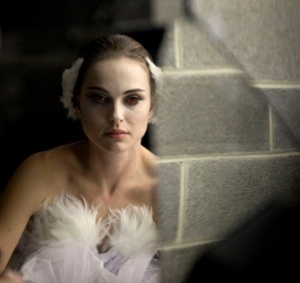
Natalie Portman plays Nina, a veteran ballerina who, despite being young enough to still live with her mother (and, it’s hinted, to still be a virgin), is also approaching the age when she’ll be considered too old to ever be a prima ballerina. She is a member of a struggling New York dance company that is run by Thomas (Vincent Cassel, turning up the sleaze level to 11). Thomas has decided that the company’s next show will be Tchaikovsky’s Swan Lake and that it’s time to replace the company’s prima ballerina, Beth (played by Winona Ryder), with a younger dancer. Nina begs for the chance to be Beth’s replacement but Thomas rejects her, claiming that her dancing is technically perfect but has no passion. He then attempts to kiss her which leads to Beth biting his lip and, apparently, convincing him that she has passion after all. Thomas soon announces that Nina will dance the lead in Swan Lake.
Unfortunately, even before winning the role, Nina is obviously unstable. Whether she’s obsessively stretching in her hideously pink bedroom, forcing herself to vomit up the contents of her stomach, or seeing shadows down every corridor, Nina’s every action and thought seems to be obsessed with finding the idealized perfection that ballet demands and life seldom affords. No matter how much she and her controlling mother (Barbara Hershey) cut her nails, she still wakes up with mysterious scratch marks across her back. Even worse, as she gets deeper and deeper into the role, she finds herself strangely drawn to and fearful of Lilly (Mila Kunis), a younger, free-spirited dancer who may, or may not, have her eye on taking Nina’s place.
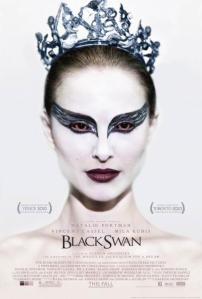
Along with being an homage to such classic films as Repulsion, Suspiria, and All About Eve, Black Swan is also a modern-day reinterpretation of Swan Lake. Swan Lake tells the story of Odette, a princess who has been cursed by an evil sorcerer. As a result of the curse, Odette is only allowed her human form at night. During the day, she exists only in the form of a white swan. A prince named Siegfried meets Odette in her human form and falls in love with her so Rothbart tricks the prince by transforming his own daughter, Odile, into the Black Swan, a seductress who looks just like Odette except she wears black. One reason why the lead role in Swan Lake is so coveted is because the same ballerina plays both the innocent and fragile White Swan and the seductive and uninhibited Black Swan. As such, the two roles are presented as opposite sides of the same coin. (I’ve always thought of the White Swan as representing what men idolize and the black swan representing what men actually desire.) The challenge is to be convincing in both roles while still perfectly executing the idealized movements of ballet.
Over the course of Black Swan, Nina is continually told (by Thomas) that she is perfect for the role of the innocent and sheltered White Swan but that she doesn’t have what it takes to be the sexy and uninhibited Black Swan. At one point, Thomas gives her a homework assignment for the role, ordering her to go home and touch herself. (Nina eventually does so just to suddenly realize, right when she’s on the verge of bringing herself to climax, that her mother is sleeping in the exact same room. This sudden shot of Barbara Hershey sleeping in that chair both made me jump and laugh at the same time.)
Thomas also suggests that Nina study that way that Lilly dances. In many ways, Lilly appears to be the exact opposite of Nina. (Though wisely, Aronofsky emphasizes how much Portman and Kunis — not to mention Ryder and Hershey — all resemble each other physically, therefore creating the feeling that we’re seeing four different versions of the same basic human being.) Whereas Nina’s every dance move appears to be the product of rigorous training, Lilly dancing follows her emotions. While Nina’s expression while dancing is always one of a grimly obsessive dedication, Lilly smiles and enjoys the moment. Whereas Nina is scared of sex and can barely bring herself to look a man in the eye, Lilly is openly flirtatious with both men and women. In short, Lilly is Nina’s Black Swan.
Even as Nina studies Lilly, Lilly starts to pursue Nina, even showing up at her apartment and inviting Nina out for a night on the town. Desperate to escape her controlling mother (whose goal seems to be to keep Nina as the innocent White Swan for the rest of her life), Nina goes out with Lilly. They hit the clubs, Lilly convinces Nina to drink a spiked drink, and soon Nina is making out with random men in corners and eventually with Lilly in a taxi cab.
Now, I know this is something that a lot of people are wondering about so I’ll just confirm it. Yes, Mila Kunis does go down on Natalie Portman in this film. And yes, it’s hot. But even more importantly, it works as something more than just a juvenile male fantasy of what we girls do when you guys aren’t around. When Nina touches Lilly, she is reaching out for and accepting the side of her personality that she’s previously tried to deny. She’s accepting what she knows could destroy her.
(SPOILERS BELOW READ CAREFULLY)
And sure enough, after her encounter with Lilly (which Lilly subsequently claims never happened), Nina’s world grows more and more distorted. She looks at the paintings that line her mother’s room and she sees a hundred faces laughing at her. On the subway, men leer at her. And suddenly, Thomas seems to be paying more attention to Lilly (who is named as her alternate) than to her. Lilly visits Beth in the hospital where Beth is recovering from a car accident. Beth responds to Lilly’s presence by mutilating herself with a fingernail file. And so things go until the film reaches its climax in a dizzying mix of dance and blood.
Much like ballet itself, Black Swan presents a very stylized view of existence and, in order for the film to work, the performances have to be perfect. I’m happy to say that everything you’ve heard about Natalie Portman in this film is correct. She gives a brilliant performance. The film doesn’t provide a definite explanation as to what lies at the root of Nina’s mental instability but the clues are all there in Portman’s subtle but effective performance. Perhaps even more importantly, Portman is convincing in the ballet sequences. She captures perfectly the rigorous and often times painful dedication that ballet demands. In the movie’s finale, as she dances on stage while her fragile world collapse around her, she was suddenly creating my own fantasy of what it would be like to be a true prima ballerina. Watching her, I felt her every move as if I was on the stage dancing the role. It left me exhausted and breathless and I have to admit that after the movie, I foundd myself crying for a solid hour as I realized that would truly be as close as I would ever get to living my old teenage fantasy.
Portman pretty much dominates the entire film but still leaves room for Hershey, Cassell, and especially Mila Kunis to give impressive performances. Alternatively loving and spiteful, Hershey is the stage mother from Hell. Cassell’s character is almost too sleazy for his own good but Cassell still has fun with the role and even adds a few notes of ambiguity. However, Mila Kunis is the true standout among the supporting players. Playing a role that requires her to be both likable and vaguely threatening, Kunis holds her own with Portman and proves here that she actually can act. Her character also provides the film with a few much-needed moments of humor. Lilly gets all the best one-liners and Kunis delivers them flawlessly.
So, I’m sure many people might be saying at this point, “That’s great that you loved it, Lisa Marie. But you’re like all convinced that this film is actually about you. What about us normal people who don’t really care about ballet? Is there anything here for us?”
That’s not an easy question for me to answer precisely because I do love ballet and I did relate a lot of this film to experiences — both good and bad — from my own life. It’s also an issue that Aronofsky acknowledges in a rather clever scene where Nina and Lilly flirt with two frat boy types who react to Nina’s talk of ballet with boredom. However, I do think that this film can be seen and appreciated by those who aren’t into ballet for the exact same reason why I loved The Wrestler despite being interested in professional wrestling like not at all.
I’ve always felt that ballet — and by that, I mean the whole experience of both the dancing and all the stuff that goes on before and after the actual dance — was in many ways the perfect metaphor for life.
For instance, in my experience, there were always two separate cliques in any dance school or company.
There was the group of dancers who had spent their entire lives preparing for the one moment they would become a prima ballerina. These were the girls who spent hours obsessing over their technique and who minutely examined every performance for the least little flaw. These were the girls who risked their health to maintain perfect dancer bodies. They obsessed over everything they ate, which struck me as strange since they usually just threw it all back up a few minutes later anyway. They had parents who not only spent the money to make them the best but who, unlike the rest of us, actually had the money to spend in the first place. These were the girls who knew every move they were supposed to make but they never knew why.
And then, there was the group that I was always a part of. We were the girls who never worried about perfect technique. We would laugh when we missed a step and we joked about our mistakes. When we danced, we followed our emotions and if that meant breaking a rule, so be it. The perfect girls hated us because, for the most part, we were more popular than they were because we allowed ourselves to be real as opposed to perfect. And we hated the perfect girls because we knew that they would eventually have the life that we fantasized about.
I used to think that was unique to ballet and certainly, in Black Swan, it’s clear that Portman would be one of the perfect girls and Kunis would be one of us. However, once my life was no longer solely about ballet, I realized that everyone was either a part of the perfect group or a part of the real group. It wasn’t just ballet. It was life, the conflict between those who try to create an idealized fantasy and those who simply take advantage of the randomness of everyday life. And, when I watched Black Swan, it was obvious that Aronofsky recognizes this as well.
Ballet is all about creating perfection, of telling a story through exactly choreographed movements. As the film progresses, it become obvious that the root of Nina’s psychosis is that the reality has not lived up to her idealized worldview. Nina hides from the real world because the real world, unlike ballet, is not messy. Movement in ballet is controlled but movement in reality is random and often frightening. However, by submerging her identity into ballet, Nina has fallen into another trap because, as a prima ballerina, her every movement has to be perfect. There’s no room for error. There’s no room for her to break free of Thomas’s choreography. Her every move has been dictated for her and not a single mistake can be tolerated.
And I guess that’s truly why this film got to me because who hasn’t felt like that? Who hasn’t felt as if the world is watching and waiting to pounce on you for failing to live up to their ideal? While I’m not suggesting that men don’t face unique pressures of their own, this theme especially hit home for me as a woman. Everyday, I wake up knowing that I’m being expected to live up to some sort of societal concept of perfection that was set up long before I was born by people I’ll never actually meet. Every day, I wake up knowing that I’m always look my best without flaunting it in a way that would suggest that I know I look my best, to find a husband and devote my life to the agonizing pain of childbirth, to suffer my period in respectful silence, to always be weak when I want to be strong, and certainly to never, ever view sex as anything other than a duty. It’s the type of expectation that leads every woman to consider embracing her own black swan. Some of us are brave enough to do it. And others, scared of being rejected as imperfect, simply try to pretend that they never saw it in the first place.
For me, that’s what Black Swan is truly about. It’s not about ballet and it’s not about Mila Kunis bringing Natalie Portman to orgasm. It’s about finding the courage to live life regardless of how scary it might be. Much as Aronofsky used pro wrestling to tell the story of everyone who ever refused to be anonymous and forgotten, Black Swan is the story of every one who ever struggled to reconcile the demands of society with the realities of existence.
Since this is an Aronofsky film, viewers will either love it or hate it. As exhilarating as I found that film’s finale to be, I can already hear other viewers saying, “What!?” As a director, Aronofsky has always been willing to walk that thin line between art and excess and you’re reaction to him will probably depend a lot on where you personally draw that line. Throughout the film, Aronofsky comes close to going over the top. However, he also directs the film in such a way as to make it clear that we’re not meant to be watching an exact recreation of reality. Instead, we view most of the film’s events through the prism of Nina’s own unstable mind and both the film’s grainy cinematography and the deliberately odd camera angles perfectly capture the feel of a mind losing its grip on reality.
Again, I should admit that I’m bipolar and, as such, I reacted very sympathetically to Nina’s struggle to distinguish the real world from the world created by her own paranoid fears because I recognized much of it from my last major manic episode. Now, would I have had a different reaction if not for my own personal experiences? The honest answer is that I don’t know. All I know is that Darren Aronofsky gets it right.
The film’s ending will surely be the root of not a little controversy. (Again: MAJOR SPOILER WARNING) Much like the end of the The Wrestler we’re left to wonder whether our main character has truly triumphed or if she’s been defeated. Is Aronofsky celebrating self-destruction or is he celebrating the individualistic impulse that leads people to pursue their passions no matter what the end result? Has Nina found true perfection and freedom or has she been destroyed by her own demons?
Aronofsky leaves it up to the viewer to decide and a lot of people won’t like that.
However, for me, Black Swan is the best film of 2010.
Last weekend, I went down to one of my favorite movie theaters, the wonderful Plano Angelika, and I saw one of the best — if unheralded — independent films of 2010, Welcome To The Rileys.
Kristen Stewart plays Alison, a 16 year-old runaway who, as the movie opens, is working as a stripper and prostitute in New Orleans. One day, while at work, she meets a middle-aged businessman named Doug Riley (James Gandolfini). Doug is in New Orleans attending a convention and he reluctantly accepts Alison’s offer of a private dance. As soon as they’re alone together, Alison immediately offers to have sex with Doug for money. Doug turns her down, Alison angrily accuses him of being an undercover cop, and a flustered Doug leaves the club. Later that night, Doug happens to run into Alison again and, looking to make amends with her, he gives her a ride back to her “home,” which turns out to be an apparently abandoned and condemned row house. Doug ends up sleeping over at the house (though again, he refuses to have sex with Alison). The next day, Doug offers to pay Alison a hundred dollars a day if he can stay in her house while he’s in New Orleans. Alison, who is always on the look out for extra money, agrees. After a rough start, Doug and Alison settle into a bizarre sort of domesticity with the paternalistic Doug teaching Alison how to make a bed and Alison calling on Doug when one of her clients refuses to pay her for her services.
What Alison doesn’t know is that Doug has a wife in Indiana. Lois Riley (played by Melissa Leo) hasn’t stepped outside of their suburban home in years. Ever since the tragic death of their 16 year-old daughter, Lois has cut herself off from the world and her husband (even to the extent of tolerating Doug’s affair with a local waitress). However, when Doug calls her from New Orleans and announces that he won’t be coming home for a while, Lois forces herself to leave the house. While Doug is busy trying to escape from reality, Lois is driving down to New Orleans to try to bring him back.
When Lois reaches New Orleans, Doug introduces her to Alison and, to his surprise, the two of them almost immediately start to bond. Lois tells Alison about how their daughter and Alison responds by telling the story (which, the film hints, might not be true) of how her own mother also died in a car accident. Soon, both Doug and Lois have — for all intents and purposes — adopted Lois as their own daughter. However, what neither has considered is that Alison might not want to a part of the Riley family…
Welcome To The Rileys is ultimately a touching and low-key exploration of grief, guilt, and the struggle to accept the occasionally unpleasant realities of life. It’s also a portrait of three lost souls struggling to connect with the existence around them. Jake (son of Ridley) Scott’s direction is properly low-key and manages to be affecting without indulging in any of the obvious tricks that one might expect to see in a film like this. However, what makes this film ultimately work is a strong trio of lead performances from Gandolfini, Leo, and Stewart.
Playing Doug (a character that both I and the film had mixed feelings about), James Gandolfini gives a performance that’s so good that I never once found myself tempted to make any “Soproano”-related asides under my breath. Though his Southern accent comes and goes, Gandolfini brings the perfect combination of warmth, concern, self-pity, and stubbornness to his role and he makes Doug an understandable and sympathetic — if not always likable — character. A part of me feels that the film’s screenplay is a bit too quick to let Doug off the hook for some of his actions but, as an actor, Gandolfini never makes the same mistake.
Playing Alison, Kristen Stewart proves that it’s time to forgive her for starring in Twilight. Her performances in Into The Wild and The Runaways provided hints that she’s actually a very talented actress but her performance here proves it. She not only captures Alison’s sadness but, even more importantly, she doesn’t shy away from the anger that feeds off that sadness. She never sentimentalizes her performance, there’s no moment where she pauses to let the audience know that she’s a good girl at heart. Instead, she dares us to reject her while revealing just enough of her inner pain to make it impossible for us to do so.
However, for me, the film really belongs to Melissa Leo. Whether she’s struggling to figure out how to drive her husband’s car or primly introducing herself to Alison (who, at the time, is dressed for work), Leo is simply amazing. When Lois first appeared in the film, I was worried because it felt as if the filmmakers were using her agorophobia to justify Doug’s adultery. However, Melissa Leo subtly and surely starts to peel away the layers of Lois’ outward repression until, by the end of the movie, Lois is the most vibrant character in the film. Just check out the scene where Lois responds to a flirtatious man in a truck stop with a combination of pride, amusement, and surprise and you’ll see what great acting is all about.
When Lois finally ends up in New Orleans, she seems to bring a whole new life to the movie. What previously seemed to simply be a meditation on loss and sadness is instead revealed to be a celebration of life and love. For a film that originally seemed to be about an errant husband and an angry runaway, Welcome To The Rileys eventually turns out to be a tribute to one woman who turns out to be far stronger than anyone gave her credit for.
With all the current Oscar hype surrounding films like The Social Network and The Kids Are All Right, Welcome To The Rileys is the type of low-key, subtle movie that will probably be forgotten in the rush to jump on all the more obvious bandwagons. That’s a shame because it’s one of the best films of 2010 and one that deserves to be seen over the years to come.
There is exactly one genuinely effective and emotionally (and intellectually) honest scene in the new film Love and Other Drugs. It’s a scene that features people who actually have Parkinson’s talking about living life with this disease. As they speak, they are watched by Anne Hathaway who is playing a character who has Stage 1 Parkinson’s. Their words brought tears to my eyes but, at the same time, it also reminded me that, unlike them, Hathaway (who smiles throughout the entire scene like a Miss America runner-up) was merely playing someone with Parkinson’s. It was hard not to think about the fact that while the people speaking are still dealing with the disease today, Hathaway is off shooting her next film.
That’s the type of film that Love and Other Drugs is. It’s the type of film where the slightest amount of reality only serves to remind the viewer of how fake the rest of the movie is.
The movie stars Jake Gyllenhaal, who I will always love because he will always be Donnie Darko. That’s why it pains me to say that Gyllenhaal’s over-the-top performance in this film is just a little bit awful. He’s playing a compulsive womanizer who becomes a salesman for Pfizer in the 1990s. The first fourth of the film is pretty much made up of him fucking every girl he meets and then abandoning her afterward. However, the film suggests we shouldn’t hold this against him since apparently, every woman in America is presented as being a giggling, simple-minded whore. Except, of course, for Anne Hathaway who is presented as being a depressed, angry, and sick. Gyllenhaal falls in love with her and the subtext here, I guess, is that Gyllenhaal is redeemed because he’s willing to love a girl with a terrible disease. So, in a way, Anne Hathaway’s character having a terrible disease is the best thing that could have ever happened to our protagonist.
At the same time this is going on, Gyllenhaal is trying to sell a new drug called Viagra which, once again, gives director Ed Zwick an excuse to show a bunch of frumpy women going nuts over a drug for men who can’ t get it up. Interestingly enough, we don’t see any of the men with limp dicks obsessively taking the pills until all the blood stops flowing to their brains. Gyllenhaal does have a scene where he can’t get it up but Hathaway (who doesn’t even get upset — now, that is confidence!) still manages to get him off after listening to him talk about how difficult it is to be a rich, white boy. Later on, Gyllenhaal is tricked into taking Viagra (by a woman, naturally) and he ends up having to go to the ER with an erection that everyone tells us is very impressive. They have to tell us because we don’t actually get to see it or any other cocks in this film though Anne Hathaway’s boobs are listed in the end credits.
Love and Other Drugs is one of those films that it so overwhelmingly bad that I’m sure it’ll have some passionate defenders who will probably bitch and moan about this review. So, allow me to say a few things to them now so I won’t have to waste my time replying — when a movie introduces a bunch of senior citizens getting on a bus to go to Canada to get affordable medication just so that Jake Gyllenhaal can later chase the bus down in his Porsche and shout about how much he loves Anne Hathaway, the movie has got some issues. When a movie features Anne Hathaway responding to getting a breast exam from a fake doctor by then agreeing to fuck the fake doctor, the movie has obviously been made by men who have never given one thought to the reality of breast cancer. When a movie insists that Hathaway’s promiscuity is due to her being emotionally damaged but Gyllenhaal’s identical behavior is presented as being cute and funny then that essentially makes this movie a sexist fantasy.
As I said earlier, Jake Gyllenhaal gives a performance here that is just bad. He’s miscast here. The off-centered vibe that made him the perfect Donnie Darko doesn’t work here and he reacts by smiling during the comedic scenes and screwing up his face all weird-like during the dramatic ones.
Anne Hathaway — who was so brilliant playing me in Rachel Getting Married — actually gives a pretty good performance but she’s constantly betrayed by the movie’s script and direction. I was first diagnosed as being bipolar nine years ago and I can say that Hathaway perfectly captures both the shame and the defiance that comes from having a socially unacceptable disease.
The rest of the cast is made up of character actors playing thinly-drawn stereotypes. Hank Azaria, however, has a few good scenes as a hedonistic doctor but then you have to deal with Gabriel Macht who plays a rival salesman who just happens to be Hathaway’s ex and a psycho. Why do filmmakers never realize that giving their fantasy figures psychotic ex-boyfriends does nothing more than trivialize the entire plot? For the entire film, I sat there and wondered, “But why would anyone go out with someone that evil in the first place? Other than the fact that it’s convenient for the plot?”
I saw this movie with my very good friend Jeff and my sister Erin. Since Erin is a pharmaceutical sales rep, I asked her how accurate this film was. Erin smiled and replied, “Well, there is a company called Pfizer.” I also asked Jeff if this movie was a realistic portrayal of how men see the world. He declined to answer.
Love and Other Drugs attempts, all at the same time, to be a romantic drama, an over-the-top comedy, a recreation of history, a political/social satire, and a well-intentioned piece of social advocacy. Taken individually, each of those genres is difficult to pull off successfully. Toss them all together and it’s nearly impossible. Yes, it could be done but not by director Ed Zwick.
This is going to be a quick review because Unstoppable is a quick movie. That’s not meant to be an insult because Unstoppable is one of those, race-against-time type films that has to move quickly to be succesful.
Unstoppable’s plot is amazingly simple. There’s a runaway train that could derail at any seconds. Since the train is being used to transport dangerous and toxic chemicals, this could potentially lead to the destruction of a small portion of Pennsylvania. However, there’s another train on the tracks. The train is being steered by Denzel Washington and Chris Pine. Washington’s a grizzled veteran type. Pine’s a callow, headstrong youth type. Can they put aside their difference and work together to save Pennsylvania? Does the sun rise in the … wait, which side of the Earth does the sun rise on?
I have to admit that I was prepared to dislike Unstoppable. For one thing, its set in Pennsylvania and right now, I’ve got some issues with that state. For several years, I liked Pennsylvania because I associated the state with The Office. But then a few months ago, that damn Levi’s Jeans commercial started up with that “Heigh Ho” song playing over grainy black-and-white images of Braddock, Pennsylvania and John Fetterman (the town’s mayor, who looks like a serial rapist) saying something about half the town being in a landfill. And those commercials made me dislike Pennsylvania because, seriously, Fetterman, you’re not fooling anyone.
(Quick disclaimer: Fetterman, to my knowledge, has never been accused, arrested, indicted, or convincted of rape. Also, Braddock has a really inspiring story that all you rich kids who know nothing about poverty can go swoon over.)
But anyway, back to Unstoppable. It’s actually a fairly entertaining movie. Scott’s direction keeps the action pretty tight and both Washington and Pine give pretty good performances even if they are playing stereotypes. Both of them have to deliver a lot of technical, “train” dialogue and they both deliver it with such confidence that it really didn’t matter that I couldn’t figure out what they were talking about most of the time.
The real star of the film, obviously, is that runway train and — roaring across the tracks and shattering through various barrier — the train does not disappoint. Give it the Oscar for Best Supporting Performance By A Machine.
In the end, watching Unstoppable is kinda like wrapping yourself up in your favorite blanket. It’s warm and familiar and it serves its purpose.
(Quick note: I always find it funny how Tony Scott is always credited as “the director of Man on Fire” as if that’s a good thing.)
Director Michele Soavi is probably best known for directing the last great Italian horror film, Dellamorte Dellamore. However, his word in that film has been so praised that, to a certain extent, Soavi’s earlier horror films have been overshadowed. This is a shame because Soavi was (and is) a great director and — before he temporarily retired from films in the mid-1990s — he directed four of the greatest Italian horror films ever made. The first of these films (and Soavi’s directorial debut) was the 1987 slasher film Stagefright.
As written by Luigi Montefiore (who, as an actor, was better known as George Eastman), Stagefright’s basic story function almost as a parody of a stereotypical 80s slasher film. On a dark and stormy night, an eg0-crazed, cocaine-addicted theatrical director (played by David Brandon) is running a rehearsal for his latest show, a campy musical about a fictional serial killer. However, even as his cast performs fictional mayhem on stage, a real killer escapes from a nearby mental hospital and makes his way to the theater. After the real killer murders the production’s wardrobe mistress, the director decides it would be a brilliant idea to rewrite his show to make it about the real killer. Not realizing that the real killer has snuck into the building, the director secretly locks his cast inside the theater and forces them to rehearse his new show. As you can probably guess, mayhem ensues and blood (a lot of blood) is spilled.
That the film worked (and continues to work over 20 years later) is a tribute to the talent of Michele Soavi. Obviously understanding that he was working with a genre piece, Soavi embraced the expectations of the slasher film and then pushed those expectations as far as he could. The end result is a film that works as both an old school slasher film and as a commentary, of sorts, on the genre as a whole. Soavi’s camera prowls every corner of the film’s theater, creating an atmosphere of truly claustrophobic dread. To me, the most effective thing about the film is that, for once, our victims actually do the smart thing. They stick together and try to fight off the killer as a group. And they end up failing miserably in a scene of horrific choas that shows Soavi at his best.
Soavi started his career as an actor and appeared in a countless number of Italian horror films in the late 70s and early 80s. (For whatever reason, Soavi always seemed to be getting killed in some awful way…) Perhaps that’s why, of all the great Italian horror directors, Soavi always seemed to have the best instincts when it came to casting. For a slasher film, Stagefright is well-acted by a cast made up of horror regulars. Barbara Cupisti is a properly likable protagonist in the role of “final girl” while the great Giovanni Lombardo Radice does good work in the small role of Brett, a flamboyantly gay actor. However, the film is dominated by David Brandon who snorts cocaine and barks out orders as if the fate of the world depended upon it.
(Soavi, himself, appears in a small role as an ineffectual policeman who, while people are dying all around, is more concerned with whether or not anyone else agrees that he looks like James Dean. And, it should be noted, there was a resemblance.)
As opposed to a lot of other directors involved with the Italian horror genre, Soavi had (and, I hope, still has) a genuine love of film and that love is obvious in his stylish direction here. There’s something truly exhilarating about seeing a movie made by someone who is truly in love with the possibilities of film and, because of that love, has no fear of pushing genre “rules” to their extreme.
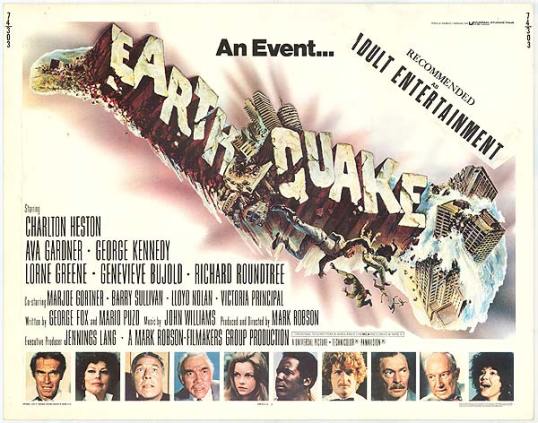
Since it’s impossible for me to talk about anything without somehow relating it to a movie, I guess it makes sense that my reaction to San Francisco winning the World Series was to write a review of the award-winning, 1974 disaster film Earthquake. If the Rangers had won, I would have been obligated to write up a review of No Country For Old Men.
So, Earthquake is one of those movies from the 70s in which a large group of different characters had to deal with some sort of cataclysmic disaster that could, in theory, have happened in reality as well as up on the movie screen. There were apparently about 2,000,000 of these films made between 1970 and 1980 and they all had titles like Hurricane, Tornado, Big Fire, Asbestos, Flash Flood, Lava Flow, Khardashian, Avalanche, and, of course, Earthquake. These movies always featured an “all-star” cast of people that nobody had ever actually heard of and I guess part of the fun was trying to guess who would survive and who would die. Apparently, they were the 1970s version of Dancing With The Stars. Call it Dying With Celebrities.
Earthquake is one of best known of these films. Apparently, it made a lot of money in 1974 and it won Academy Awards for its earthquake effects. Bleh. Whatever. Have you ever really sat down and looked at a list of the movies that have won at least one Academy Award since they first started handing those things out? Earthquake is like a 6 hour movie and Los Angeles doesn’t start shaking until halfway through. The Earthquake itself only lasts for 15 minutes and it’s kind of impressive to watch but it’s 15 minutes out of 360.
Before the earthquake hits, we get to meet the usual cross-section of humanity. Charlton Heston is an architect who is married to Ava Gardner who is the daughter of Heston’s boss, who is played by an actor named Lorne Greene who appears to be younger than either Heston or Gardner. Heston has a mistress who is played by Genevieve Bujold who is really pretty, sweet, and boring. Gardner is none of these things but she is a foul-mouthed alcoholic who fakes suicide attempts so I was pretty much on her side as far as the whole love triangle is concerned. After the Earthquake, Heston and Greene and a bunch of accident-prone extras are stuck in the ruins of sky scraper. Heston grimaces a lot in this film but you know what? Say what you will about Charlton Heston’s politics or his clenched-teeth acting style, the man knew how to wear an ascot.
While Heston is torn between Gardner and Bujold (a plot development that reportedly inspired the famous Sartre play No Exit), Richard Roundtree just wants to jump over stuff on his motorcycle. That’s right — John Shaft is in this movie and we can dig it. He’s a professional daredevil. He’s also a surprisingly dull actor. Who would have guessed that, without a theme song playing, Shaft would turn out to be so boring? Still, there’s a really cool scene where Roundtree tries to ride his motorcycle through Los Angeles in the middle of the earthquake and the film is worth watching for his all-flare stunt daredevil costume if nothing else. Plus, Roundtree’s playing a character named Miles here and I like that name.
There’s another subplot. It involves George Kennedy as a blue-collar cop who does what he has to do to try to maintain the peace before and after the Earthquake. Bleh. I mean, Kennedy actually gives a pretty good performance and he’s probably the most likable character in the film but seriously — Bleh.
And finally, this collection of humanity is rounded out by an aspiring actress (played by actress Victoria Principal who, four years earlier, had made history by being the first woman to successfully seduce actor Anthony Perkins and no, I don’t want to go into how I know that) and the psychopathic grocery store manager who is obsessed with her. The grocery store manager is played by former child evangelist and 70s exploitation icon Marjoe Gortner. Much as in the later film Starcrash, Gortner projects a remarkably unlikable vibe that works well for his character. He also has a really bad perm and a mustache and his performance is so sublimely bad that it’s actually pretty good. As for Principal, her character here is apparently the owner of 1974’s most ginormous afro and, like most women in the 70s, really should have considered wearing a bra. It’s hard to really judge Principal’s performance because any time she’s on-screen, you just start thinking, “Oh my God, she had sex with Norman Bates but somehow, she thinks she’s too good for Marjoe Gortner?”
These are the characters that we follow as Los Angeles is destroyed on-screen. None of them are really much more than cardboard cut outs but there’s something oddly comforting about how shallow and predictable they all are. Add to that, most of them end up dead so if you do dislike them, you’ll find a lot to enjoy. You’ll especially enjoy the film’s final few moments unless, like me, you can’t swim and you’re terrified of drowning. If you’re like me, that scene might give you nightmares.
Flawed as it may be, I still have to recommend this movie as 1) a time capsule and 2) as a quintessential piece of American camp. Every line of dialogue, every performance, every image, and every scene in Earthquake simply screams 1974. I guess the best way to look at Earthquake is to think about it as if the movie’s a time machine. You might not like where the machine takes you but you’re still going to get into the damn thing and, once you find yourself stuck in Iowa in the year 1835, you’ll find someway to force yourself to be entertained because otherwise, you’re just hanging out in Iowa in 1835.
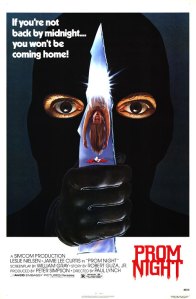
As I mentioned in another post, my sister Erin and I spent Tuesday night watching the Killer Party Marathon on Chiller. One of the movies we saw was the original 1980 Prom Night, starring Jamie Lee Curtis and directed by Paul Lynch. Prom Night, of course, was remade two years ago with cross-eyed dumbfug Brittany Snow as the star. If, like me before Tuesday night, you’re only familiar with the tepid and bland remake than the original Prom Night is a surprise indeed.
The original Prom Night is an old school slasher film, one of the many that came out in the two years immediately after Halloween. It even stars the star of Halloween, Jamie Lee Curtis. Prom Night also stars a lot of Canadians because it was one of the many low-budget B-movies that was made in Canada in the early 80s. Apparently, Canada was offering tax breaks to film companies willing to shoot up north. Several web sites have said that the setting is obviously Canadian but I couldn’t really tell. Of course, I’m from Texas. Anything above Arkansas looks like Canada to me.
Plotwise, the film is pretty much your traditional old school slasher film. There’s a terrible tragedy in the past, an innocent man is blamed for it, and ten years later, teenagers end up getting killed at some communal event. In this case, the tragedy is the death of a young girl who is killed during a truly demonic game of tag. The children responsible for her death lie about what happened and a disfigured drifter is convicted and imprisoned for her murder. As for the communal event, in this case, it’s prom night. The killer stalks the prom, which is what I suggested my classmates call our prom way back when. They disagreed and that’s their loss. The Killer Stalks The Prom would have been a story to remember.
Anyway, here’s a few random thoughts about the original Prom:
1) As with all old school slasher films, it’s interesting to see just how much of the early products of this all-American genre borrowed from the Italian giallo genre. Everything from the elaborate, past tragedy to the black gloves worn by the killer to the attempts to keep audiences guessing who the killer actually is to even the supporting character of the burned out cop simply screams giallo. The main thing that the Americans brought to the giallo format was the idea of having the murders revolve around a previously innocent gathering or holiday.
2) Especially when compared to recent “slasher” films, Prom Night is a relentlessly grim film. Prom Night’s killer doesn’t waste any time with comic relief or one-liners. He’s too busy savagely killing people. And our victims aren’t the usual collection of bimbos and soulless jocks. No, this is the type of movie where even the token virgin ends up getting her throat ripped out with a gigantic shard of glass. There’s not a lot of deaths in Prom Night, just six. But they all hurt.
3) I usually just think of Jamie Lee Curtis as the crazy woman selling Activia on Lifetime but this movie shows that she’s actually a pretty good actress. Even working with a script that isn’t exactly full of brilliant dialogue or multi-faceted characters, Curtis is a sympathetic, likable, and most of all, believable heroine (which is all the more remarkable when you consider that she, like everyone else in this film, appears to be far-too old to still be worrying about the prom). She even manages to make the film’s ending rather touching and even poignant. And how many slasher films can you say that about?
4) Prom Night is as much about tacky — yet insanely catchy — disco music as it is about spilling blood. Seriously, if I owned the soundtrack to this film, I would listen to it 24/7 for two years straight. I’d force all of my friends to listen to it too and eventually we’d all go insane and just spend the rest of our lives wandering around going, “Prom night! Everything is alright!”
5) One last thing — Prom Night showcases what has to be the most believable, cheap, and tasteless prom ever put on film. The theme is Disco Madness and the students are all very chic in that way that even they know will be painfully dated in another two years. Indeed, this is one of the rare films that understands that the perfect prom is nothing less than an unintentional camp spectacular. For someone like me who, as the result of seeing too many episodes of Saved By The Bell: The New Class, grew up with an unrealistic expectation of what the senior prom would be, the original Prom Night remains a refreshing breath of fresh air even 30 years after it was made.
And always remember: “Prom Night! Everything is all right…”
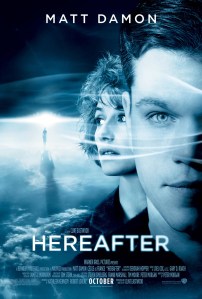
Hereafter is a very serious film about a very serious topic, death. Following three separate but ultimately connected stories, the film attempts to explore death and the question of what happens after death from three different angles — intellectually, emotionally, and spiritually. I really wanted Hereafter to be a great film. So did the film’s makers, which is precisely why Hereafter fails.
The intellectual consideration of death is represented by the character of Marie (Cecile De France), a French journalist who, at the start of the film, drowns in a tsunami and is, for a few minutes, clinically dead. Before she is eventually revived, she has a classic near-death experience: the bright light, the people waiting to greet her, the whole deal. After this experience, Marie is compelled to investigate whether or not there truly is such a thing as an afterlife. As she does so, Marie finds herself shunned by her resolutely secular friends and grows increasingly distant from her skeptical (and rather condescending) boyfriend.
The emotional response to death is represented in the story of twin brothers, Marcus and Jason (played by Frankie and George McLaren). The two boys live in London with their drug-addicted mother and share a strong (and, to be honest, kinda creepy) bond. Jason, while simply trying to return home with some drugs for his detoxing mother, is roughed up by some bullies and ends up running out into the middle of the street. Naturally, since this is a movie, Jason is hit by a truck as soon as he steps off the curb. Jason is killed and Marcus is taken away by social services and put into a foster home. Marcus continues to carry Jason’s cap with him and soon starts tracking down local English psychics in an attempt to talk to his brother again.
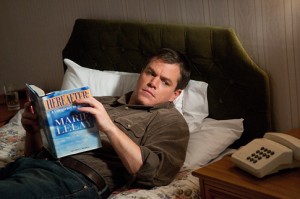
Finally, the spiritual aspect is detailed in the film’s most interesting story. This story features Matt Damon as George Lonegan, a psychic who can speak with the dead. After years of being a minor celebrity, George burned out and went into a self-imposed exile. He now works at a factory while his brother (Jay Mohr, who looks incredibly puffy in this movie) keeps trying to find ways to convince George to get back into the business of talking to dead for fun and profit. After George reluctantly gives a reading to Richard Kind, he finds himself being dragged back into his old life.
A lot of viewers and critics have compared Hereafter to Alejandro González Iñárritu’s 2006 masterpiece, Babel. Both films follow three separate but connecting stories and both films are concerned with the theme of death and how it connects us all. As well, Babel featured Brad Pitt in a serious role and Hereafter features Matt Damon. The main difference, however, is that Babel was a great film but Hereafter is basically an uneven mess.
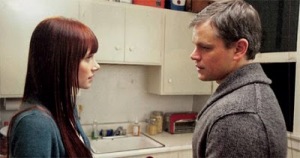
Whereas Babel featured three strong stories, Hereafter features 1 compelling story (that would be Damon’s) which is compelling solely because Matt Damon is a talented enough actor that he can apparently perform miracles. He’s probably about as likable as he’s ever been in the role of George but he also wisely plays the role as being just a little bit off. Even though the film makes the mistake of never really going into the details of just what exactly caused George to give up being a psychic, Damon is so good in the role that you’re willing to take him at his word that he had a good reason. Probably the highlight of the film (and one of the few sections to really inspire any sort of real emotional response) is an extended sequence where Damon befriends and the manages to alienate an insecure, single woman played by Bryce Dallas Howard. Damon and Howard have a scene that involves eating while blind-folded that manages to be both powerfully erotic and wonderfully romantic at the same time. If the entire film had been about them, Hereafter would have been a much better movie.
Unfortunately, we’ve got to slog through two other stories.
Cecile La France gives an excellent performance as Marie and the opening tsunami scene is truly terrifying. For someone like me, who cannot swim and risks having a panic attack if she even stands near the deep end of a swimming pool, the tsunami scene was almost impossible to watch. I had to put my hands in front of my eyes and watch the scene through my fingers. However, once she drowns, Marie sees a vision of the afterlife that — as a harbinger of things to come — is rather dull. I mean, with everything that can supposedly be done in movies today, the best that Hereafter can give us is a bland white light. Once Marie returns to Paris and starts her investigation, La France remains a sympathetic presence and the film actually does a pretty good job of showing just how condescending most supposedly “liberal” men are whenever a woman starts to stray from the established orthodoxy. But, unfortunately, her story is just never that interesting. Marie decides to write a book about the afterlife. As a writer myself, I have to say that there is nothing more boring than watching someone else write.
As for Marcus, I was shocked just how little I cared about him or his attempts to contact his brother. I come from a very close family and I have a very strong bond with all three of my sisters and, among them, I am notorious for crying at any movie that deals with that sort of sibling bonding. Yet I sat through the saga of Marcus and Jason without shedding a tear and I felt terrible about it. I really wanted to cry. I really wanted to have some sort of emotional response to the story but I just never believed it. I hate to say this but honestly, a lot of this was due to the fact that the McLaren twins are such bad actors. Director Clint Eastwood has said that he specifically cast them because they weren’t professional actors and therefore, they wouldn’t introduce any false “sentimentality” into the mix. But dammit, it was a sentimental story. Sentiment is not necessarily a bad thing and just because something is sentimental, that doesn’t make it false.
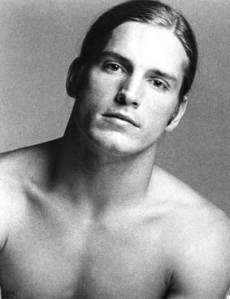
So, what exactly went wrong with Hereafter? The film opens strongly with a terrifying tsunami and the final 30 minutes are also undeniably touching (if also a bit contrived). It’s everything that happens in between those two points that ruins Hereafter. Director Eastwood, obviously looking to avoid that dreaded curse of being sentimental, keeps the whole film very low-key and realistic. Other than the opening tsunami, there are no big wow moments but to be honest, isn’t that what movies are for? If you’re going to make a movie that specifically shuns the wow moment, you better have something compelling (a perfect script or an entire cast giving a compelling performance as opposed to just a handful of them) to take its place. Hereafter doesn’t and, as a result, the movie drags. This, honestly, has got to be one of the slowest, most boring movies I’ve ever seen. If director Eastwood’s westerns and actions films can all be seen as homages to Sergio Leone and Don Siegel, I think Hereafter must be an homage to some of Andy Warhol’s intentionally dull films. Whereas Warhol, at the very least, gave us Joe Dallesandro to look at, Eastwood gives us Jay Mohr. It’s not a fair trade.
I don’t know how much of Hereafter should be blamed on Eastwood and how much should be blamed on the script written by Peter Morgan. Here’s a quote from Morgan that appeared in The Hollywood Reporter:
“It’s quite spiritual material, and quite romantic, too. It’s the sort of piece that’s not easy to describe and in the hands of different filmmakers could end up as wildly different films. Quite unlike some of my other material, which I think there were only certain ways that you could shoot it. It’s really not just another boring Hollywood movie with the same old boring Hollywood actors, although I see the point that the public and sick of paying $10.00 to see a movie with same old faces and the same gramma of story telling.”
And to that, all I can say is “Shut up, Peter Morgan!”
This is not spiritual material as much as it’s just a bunch of vaguely New Age platitudes being delivered by a mainstream screenwriter who apparently doesn’t have the guts to come down either firmly for or against an afterlife. This is the type of feel-good BS that leads to thousands of people every year giving up their life savings to some fraud who claims he can deliver messages from beyond. Morgan’s script goes out of its way not to actually define the afterlife. Is it heaven or is it Hell? Is there a God? Do the worthy go to Heaven? Are souls saved? Or are they just ghosts who are waiting for us to be willing to let them go? These are all questions that would have been considered by a good film but Hereafter doesn’t consider them. Oh, don’t get me wrong. It pretends to bring them up but only so the movie can shrug and go, “I guess nobody knows.” And to that I say, either take a position or don’t expect everyone else to pay money just to listen to you duck the question because you’re too scared of alienating mainstream critics or audiences.
(Myself, I do believe that those who love us are always with us in some way even if I don’t believe in a literal afterlife. And while I know that answer might seem vague, you should also consider that I’m not the one spending millions of dollars to make a movie celebrating that vagueness.)
Morgan’s script also make its a point to incorporate real-life events into his contrived narrative. As a result, the London Subway bombings and the Thailand Tsunami are both used as convenient plot points in much the same way that The Curious Case of Benjamin Button used Hurricane Katrina. I felt it was ghoulish when Button did it and, the more I think about it, it’s equally ghoulish in Hereafter. It’s hard not to feel that the film’s saying, “Too bad all those real people died but what’s important is how these events impacted the lives of a bunch of fictional characters.”
Hereafter’s main problem is that it simply tries too hard to be great. You get the feeling that every scene and line has been calculated to make you go, “Wow, what genius!” As a result, even the scenes that work still somehow feel very dishonest. The end result is a very insincere film about some very sincere concerns.
At the same time, it’s not, as so many are rabidly insisting, a great film either.
It’s a good film that takes a lot of liberty with the truth and, in the process of telling the “story” about the founding of Facebook, reveals that screenwriter Aaron Sorkin doesn’t really get the whole Internet thing.
David Fincher directs like a man who still can’t believe he didn’t get an Oscar for The Curious Case of Benjamin Button. In other words, he doesn’t do anything that might be too far out of the mainstream. Face it, folks. The man who directed Fight Club has grown up. And, as they say, when you grow up, your heart dies.
The main problem with The Social Network is that it is essentially a very mainstream movie being made about a grindhouse topic. Hackers, like the best grindhouse directors, do what they do because 1) they can and 2) it’s a way of telling the rest of the mainstream world to fuck off. Unfortunately, both Sorkin and Fincher are members of that mainstream world so instead of celebrating Facebook and the Internet as a revolution, they instead try to convince us that the only reason Facebook exists is because the founder’s heart was broken by his ex-girlfriend.
That ex-girlfriend is portrayed by Rooney Mara, who will be playing Fincher’s version of the girl with the dragon tattoo. The film presents her as being a shallow bitch but then again, the film presents every woman in the world as being a shallow bitch. Then again, this is a mainstream movie and the mainstream hates women who actually think for themselves. Certainly, that’s been the case with everything else that Aaron Sorkin has ever written.
Still, Mara is presented as just being insensitive and not evil or crazy. If the movie has a villain, it’s Sean Parker (played by Justin Timberlake) who is presented as being the evil Iago-like figure who ruined Facebook. If anything, the film mostly seems to hate him because Parker co-founded Napster and therefore cost the mainstream media a good deal of money.
Admittedly, it’s a well-acted movie. Both Jesse Eisenberg and Andrew Garfield are excellent as the soon to be estranged founders of Facebook. Armie Hammer actually plays two characters — twin brothers — and he creates two unforgettable and unique characters. Justin Timberlake is a bit less convincing as Sean Parker but then again, by the film’s logic, Parker is less a human being and more a demon sent from Hell to keep David Geffen from getting another few thousand. Finally, Rooney Mara does what she can with a demeaning and insulting role. I didn’t see any signs of Lisbeth Salander in her performance but then again, this isn’t a film about strong women. It’s a movie about weak little boys.
Anyway, to return to my original point, the Social Network is a good film. It’s well-acted, it looks pretty, the story moves quickly, and Trent Reznor’s score is excellent. Unfortunately, the movie’s being presented to us as a great film and anyone who disagrees is running the risk of being lynched by the same obnoxious fascists who, last year, demanded that everyone bathe in their own cum while watching Avatar. The main reason these people are so over-the-moon about this movie is that it’s the epitome of the type of film that pats the viewer on the back for being so smart without actually requiring that viewer to prove it.
So, if you watch this movie, realize that you keep your mind open at your own risk.