Film Review: Dracula A.D. 1972 (dir. by Alan Gibson)


If you’re following the news then you probably heard that Dallas got hit with like a 100 inches of snow yesterday.  Seriously, more snow fell yesterday than has even fallen in recorded history (or, at the very least, in my recorded history).  You want to talk about Snowmageddon?  Well, we had a Snowpocalypse.

The neighborhood on Friday morning (picture taken by Erin Nicole Bowman)

So, I spent most of yesterday cooped up inside with my sister and our cat and once we got over the whole fun of being able to go outside and scream, “SNOW DAY!” at the top of our lungs, there really wasn’t much to do.  So, in an attempt to fight off cabin fever, I raided my DVD collection and we ended up watching one of the old Christopher Lee-as-Dracula-films from Hammer Studios.  Specifically, we ended up watching Dracula A.D. 1972.

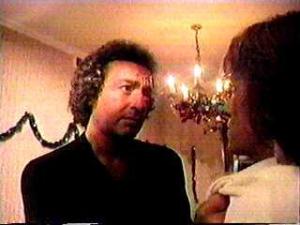
The film opens in 1872 with a genuinely exciting fight on a runaway carriage that ends with the death of both Count Dracula (Christopher Lee) and his nemesis, Prof. Van Helsing (Peter Cushing).  However, as Van Helsing is buried, we see one of Dracula’s disciples (played by Christopher Neame, who had an appealingly off-kilter smile) burying Dracula’s ashes nearby.  The camera pans up to the clear Victorian sky and, in a sudden and genuinely effective jumpcut, we suddenly see an airplane screeching across the sky.

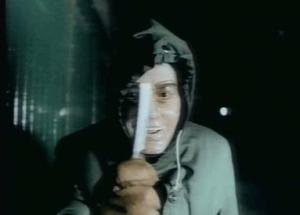
Well, it’s all pretty much downhill from there.  Suddenly, we discover that a hundred years have passed and we are now in “swinging” London.  The city is full of red tourist buses, hippies wearing love beads, and upright policemen who always appear to be on the verge of saying, “What’s all this, then?”  We are introduced to a group of hippies that are led by a creepy guy named Johnny Alculard (also played — quite well, actually — by Christopher Neame). One of those hippies (Stephanie Beacham) just happens to be the great-great-granddaughter of Prof. Van Helsing.  Apparently, she’s not really big on the family history because she doesn’t notice that Alculard spells Dracula backwards.  Then again, her father (played by Peter Cushing, of course) doesn’t either until he actually writes the name down a few times on a piece of a paper.

Anyway, the film meanders about a bit until finally, Alculard convinces all of his hippie friends to come take part in a black mass.  “Sure, why not?” everyone replies.  Well, I don’t have to tell you how things can sometimes get out-of-hand at black mass.  In this case, Dracula comes back to life, kills a young Caroline Munro, and eventually turns Johnny into a vampire before then setting his sights on the modern-day Van Helsings.
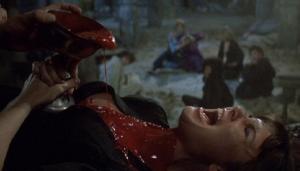
Dracula A.D. 1972 was Hammer’s attempt to breathe some new life into one of its oldest franchises and, as usually happens with a reboot, its critical and (especially) commercial failure ended up helping to end the series.  Among even the most devoted and forgiving of Hammer fans, Dracula A.D. 1972 has a terrible reputation.  Christopher Lee is on record as regarding it as his least favorite Dracula film.  And the film definitely has some serious flaws.  Once you get past the relatively exciting pre-credits sequence, the movie seriously drags.  There’s a hippie party sequence that, honest to God, seems to last for about 5 hours.  As for the hippies themselves, they are some of the least convincing middle-aged hippies in the history of fake hippies.  You find yourself eagerly awaiting their demise, especially the awkward-looking one who — for some reason — is always dressed like a monk.  (Those crazy hippies!)  But yet…nothing happens.  All the fake hippies simply vanish from the film.  Yet, they’re so annoying in just a limited amount of screen time that the viewer is left demanding blood.  Add to that, just how difficult is it to notice that Alculard is Dracula spelled backwards?  I mean, seriously…

To a large extent, the charm of the old school Hammer films comes from the fact that they’re essentially very naughty but never truly decadent.  At their heart, they were always very old-fashioned and actually quite conservative.  The Hammer films — erudite yet campy, risqué yet repressed — mirrors the view that many of my fellow Americans have of the English.  For some reason, however, that Hammer naughtiness only works when there’s the sound of hooves on cobblestone streets and when the screen is populated by actors in three-piece suits and actresses spilling out of corsets.  Dracula A.D. 1972 did away with the support of the corset and as a result, the film is revealed as a formless mess with all the flab revealed to the world.
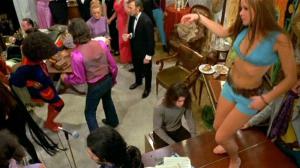
Still, the film isn’t quite as bad as you may have heard.  First off, the film — with its middle-aged hippies — has a lot of camp appeal.  It’s the type of film that, once its over, you’re convinced that the term “groovy” was uttered in every other scene even though it wasn’t.  As with even the worst Hammer films, the film features a handful of striking images and Christopher Neame is surprisingly charismatic as Alculard. 

As with the majority of the Hammer Dracula films, the film is enjoyable if just to watch the chemistry between Christopher Lee and Peter Cushing.  Both of these actors — so very different in image but also so very stereotypically English — obviously loved acting opposite of each other and whenever you see them on-screen together, it’s difficult not to enjoy watching as each one tried to top the other with a smoldering glare or a melodramatic line reading.  As actors, they brought out the best in each other, even when they were doing it in a film like Dracula A.D. 1972.  In this film, Cushing is like the father you always you wished you had — the stern but loving one who protected you from all the world’s monsters (both real and cinematic). 
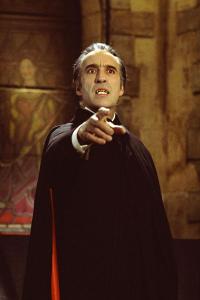
As for Lee, he’s only in six or seven scenes and he has even fewer lines but, since you spend the entire film wondering where he is, he actually dominates the entire movie.  Lee apparently was quite contemptuous of the later Hammer Dracula films and, oddly enough, that obvious contempt is probably why, of all the Draculas there have been over the years, Lee’s version is the only one who was and is actually scary.  F0rget all of that tortured soul and reluctant bloodsucker crap.  Christopher Lee’s Dracula is obviously pissed off from the minute he first appears on-screen, the embodiment of pure destructive evil.  And, for whatever odd reason, the purity of his evil brings a sexual jolt to his interpretation of Dracula that those little Twilight vampires can only dream about.  Even in a lesser films like Dracula A.D. 1972, Christopher Lee kicks some serious ass.

So, in conclusion, I really can’t call Dracula A.D. 1972 a good film nor can I really suggest that you should track down a copy of the DVD.  I mean, I love this stuff and I still frequently found my mind wandering whenever Cushing or Lee wasn’t on-screen.  However, it’s not a terrible movie to watch if you happen to find yourself trapped in the house by a mountain of snow.

Classic Game: Baldur’s Gate II


A lot of people – and I mean a lot – have played BioWare’s games over the years. Knights of the Old Republic, Neverwinter Nights, Dragon Age: Origins, Mass Effect, Mass Effect 2… and it’s still going strong. BioWare has at least two games that are probably going to come out in 2011. But as time goes on, I rarely find someone who played the games that sort of set off the whole BioWare phenomenon. I would consider BioWare to be the definitive “WRPG” developer, much as Squaresoft would have been the definitive JRPG guys in the past. Of course there are others in the medium, and their work is good too, but when I look back, I always find myself staring back at one game: Baldur’s Gate II: Shadows of Amn.

I think of Shadows of Amn more than the original Baldur’s Gate because it’s a better game. In a lot of cases, we can probably agree the sequels never quite match up with the originals. I think Shadows of Amn blows away the original game for two reasons. First of all, it used to be that advancing technology and increasing popularity for video games made sequels that had a bigger budget and more respect than the originals. History is replete with examples of this phenomenon and it definitely continues into the late 90’s and early 2000’s.

Baldur’s Gate II, however, is a little bit unique in my opinion in the way that the evolution of the same general WRPG style takes a significant step backward from the sophistication and features that BGII integrates. We see in Shadows of Amn an alignment system which your party members will react to throughout the game (including outright leaving if they don’t like your guts), several romances which have interaction with one another, as well as a culmination within the game. A wide cast of characters who support and aid you throughout, and a five-character party which allows for sophisticated and tactical combat.

How much of that transfers on to Knights of the Old Republic? Earnestly, not a great deal. KotOR is still the evolutionary advancement of Baldur’s Gate, it’s just not as evolutionary as you might think. In a lot of ways, it represents a significant step backward in terms of the sophistication of WRPG, the decision-making process that characterizes the genre, and other things. Just one of a thousand reasons that I will always feel that KotOR is insanely overrated. As you’ve probably caught on to by now, I don’t tend to favour titles which don’t advance the genre in some way. I admit that there is some logic to the idea that making changes just to make changes is a recipe for disaster (and let’s face it, there’s no stronger example than my most hated game ever released, Master of Orion 3), but I also think that games should evolve along with the technology that supports them.

Do I think that Mass Effect is a better game than Baldur’s Gate II? In most respects; yes. I thought that the party interactions in Baldur’s Gate II were more sophisticated and more fun, but in most respects, I don’t even think it’s arguable that Mass Effect has moved us in a positive direction with the usage of technology and budget, and is the superior title. But even with Mass Effect (one of my favourite “modern” titles) I’m not certain that everything has been done better than Shadows of Amn. As usual, when we forget about past games, we’re leaving diamonds buried in the sand, and it’s not becoming of us.

So, I guess the bottom line is, play Baldur’s Gate II if you get an opportunity to do so. Try and appreciate the elements of it that are still great, and are still better than modern WRPGs, despite the inferior technology, the (relatively) primitive game system, and even the ongoing use of AD&D 2.0 rules.

What Lisa Marie Watched Last Night: Road House (dir. by Rowdy Herrington)


The other night, I watched an old Patrick Swayze movie called Road House.  The movie was on Channel 64, which is also known as the Ion Network.  Anyway, the movie started at 8:00 and I was really, really tired for some reason so, as the movie started, I made the mistake of grabbing a pillow and curling up on the couch with the cat and, no offense to the memory of Patrick Swayze but, as soon as he showed up on my TV screen, my eye lid started to get so heavy.  My sister Erin sat down beside me and said, “Are you falling asleep?”  “No,” I said and then I was out like a light.

Luckily, Erin turned on the DVR as soon as she heard the sound of my asthmatic wheeze of a snore so when I woke up at 3 in the morning, I sat up and proceeded to watch the final 80 minutes of Road House.

Why Was I Watching It?

Because almost every guy I know seems to be in love with this movie.  When Patrick Swayze died, I though about Dirty Dancing and Donnie Darko.  But almost every guy I know — from my friend Jeff to my cousins in Arkansas to my boss at work to my online friends on twitter — was going, “Road House!”  So, I watched it to see if I could maybe understand what makes the male mind tick.  Plus, I was bored and really, really tired.  And I couldn’t find the remote to change the channel.  (Turns out it was actually underneath me, lost in the cushions of the couch.)

What’s It About

Patrick Swayze plays Dalton, who is apparently a legendary “cooler,” which apparently is what you call a bouncer who thinks he’s too good to be called a bouncer.  He get hired to be a boun–oh, sorry, a cooler — at a bar called the Double Deuce that is located down in Jasper, Missouri.  So, Swayze goes down there and starts cleaning the place up and then it turns out that the entire town is controlled by Brad Wesley (played with a true joie de vivre by Ben Gazzara) and Wesley wants…well, I’m not sure what he wants, to be honest.  I mean, seriously, I was so tired when I started watching this movie.  I’m sure I missed all sorts of nuance and such.  But anyway, Gazzara wants something and Swayze won’t let him have it so there’s a lot of fights at the road house and a car dealer ship gets destroyed and a barn blows up and then eventually Patrick Swayze rips out some guy’s throat with his bare hands.

In between all of this, Swayze recruits his mentor (Sam Elliott) to  come  down and help out.  This leads to Elliott getting murdered but nobody ever thinks to say, “Hey, Patrick — maybe if you had just let Gazzara do his thing, Sam Elliott would still be alive today.”  Also, Swayze romances a local doctor played by Kelly Lynch.  She used to be Gazzara’s girlfriend and she gets upset after seeing Swayze rip out someone’s throat with his bare hands.  But then she ends up skinny dipping  with him about fifteen minutes later so I guess she got over it.

Did I mention that Patrick Swayze rips out someone’s throat with his bare hands?

What Worked

Road House is one of those “so-bad-its-good” type films.  This is a film that sets out to be manly and ends up being so manly that it becomes ludicrous.  But guys are almost always fun to watch when they’re trying to be all guy-like.  (Though not always, as will be discussed under the heading of What Didn’t Work.)

Ben Gazzara is a lot of fun in the role of Brad Wesley.  Seriously, he looks like he had so much fun playing the part.  Usually, it annoys me when a film’s main female character is revealed to be the ex of a total and  complete psycho (and I’m looking at you, Love and Other Drugs) but it totally works here because seriously, Ben Gazzara is the man. 

And Sam Elliott provides all sorts of grizzled, beer-soaked, chain-smoking, unwashed sexiness.

The film features a lot of countryside that doesn’t look much like Missouri but it’s still really pretty.  (Missouri’s really pretty too.  You rock, Missouri!)

Since this film was being shown on television, all of the bare asses and visible nipples were edited out as were all the four-letter words.  However, it was that really weird, half-ass style of editing where you hear Patrick Swayze yelling, “FU—-CK YOU, WESLEY!”  Also, whenever anyone said the F-word, a big blurry dot suddenly appeared over their mouth.  That may not sound like much but at 3 in the morning, it really can cause you to giggle.

At one point, one of the bad guys grabs Patrick Swayze from behind and goes, “I used to FU—-CK Guys like you in prison!”  That line made me laugh way too much.  Plus, the guy saying it was really hot but then Patrick Swayze used his bare hands to rip out of the guy’s throat and that kind of ruined the whole mood.

What Didn’t Work

Well, technically, the entire film didn’t work but that’s kind of the whole point.  Still, for a film that’s supposed to be so bad that it’s good, Road House is still not that good.  It never quite reaches the level of Troll 2 or The Room.  Quite frankly, there’s waaaaaaaaaay too much testosterone rampaging through this movie and the whole time I watched, I kept on thinking about the violence that seems to define day-to-day existence for far too many people. 

Add to that, all of the men seemed to be beating each other up mainly because they were all actually in love with each other but refused to be honest with themselves about it.  Seriously, this movie has some issues.

Plus, Ben Gazzara ends up dead at the end of the film which really upset me because he’s the most likable character in the entire film!  At the very least, he’s got a really nice house.

Both Swayze and Elliott are apparently meant to be legendary bouncers.  They’re so legendary that apparently everyone on the entire planet knows who they are.  Now, I’m curious — are there really legendary bouncers?  I mean, is there like an in-house magazine that all the coolers and bouncers and barmaids subscribe to?  Maybe Patrick Swayze’s character was on the cover a few times.  I mean, I can accept that maybe Swayze would be legendary in a few cities were he had worked but would the citizens of Jasper, Missouri really have the slightest idea who he is? 

“Oh My God!  Just like me!” Moments

Uhmmm…I’m thinking.  There really weren’t any moments that made me go, “Oh my God!  Just like me!”  I mean, I don’t know Tae Kwon Do, I don’t really drink all that much, I’ve never ripped out anyone’s throat with my bare hands, I’ve never fired a shotgun at Ben Gazzara, and I don’t cover myself in body oil before going outside shirtless and practicing Tai Chi.  

Oh, wait a minute!  Much like Kelly Lynch in this movie, I would probably totally freak out if my boyfriend ripped out some guy’s throat.  In fact, I would probably freak out even more than she did.  I mean, even if — like Patrick Swayze in this movie — he made things right by dumping the corpse in a lake and then screaming, “FUCK YOU!” at Ben Gazzara, there’s no way you’d get me to go skinny dipping with him after all of that.  Because the whole time, I would just be like, “That’s great you got everyone to kill Ben Gazzara, sweetie but seriously, I saw you rip someone’s larynx out of their freaking throat.  So, just stand six feet away and keep your hands where I can see them.”

Agck!  Now, I’m kinda freaking out about my own throat.  I mean, is it that easy to do?  *Shudder*  I probably never should have given this that much thought…

Lessons Learned:

Protect your throat at all times.  Seriously, I’m going to start wearing a stainless steel choker every time I leave the house. 


Lisa Marie Does The Company Men (dir. by John Wells)


The Company Men is the first film to be directed by veteran television producer and writer John Wells.  Previously, Wells worked on ER, The West Wing, Southland, Third Watch, and a whole host of other shows that I’d rather die than ever have to actually sit through.  With The Company Men, Wells attempts to tell the story of the current economic recession and what its like to go from being a high-paid executive to just another unemployed statistic.  The end result is a deeply uneven film that comes so very close to succeeding but ultimately fails.

The film opens in 2008 and indeed, most of the film takes place in ’08.  It always amuses me how any film that comes out now that deals with either the economy or the wars in the Middle East (the Hurt Locker being an obvious example), the filmmakers always go out of their way to let us know that their movie is taking place during the Bush administration and not the Obama Administration.  Some people would call that “ass kissing” but I just find it to be amusing. 

Anyway, getting back on track here, the films follows three corporate executives who all work for a fictional company called GTX.  There’s a rich, white guy played by Ben Affleck.  And then there’s a richer, white guy played by Chris Cooper.  And then finally, I guess to add some variety to the mix, there’s a white guy who is really, really rich and he’s played by Tommy Lee Jones.  Anyway, Affleck, Cooper, and Jones are all cheerfully doing their thing until one day, the recession hits and boom!  Suddenly, Affleck is told that he has become “redundant.”  He’s given a severance package and sent off on his merry way.  Meanwhile, Cooper worries that he’s about to face the same fate while Jones — who is one of the company’s vice presidents — tries to keep GTX’s satanic CEO from putting anyone else out of work. 

It’s Affleck and his story that commands most of the film’s running time and, to his credit, Affleck actually gives a surprisingly good performance here as he starts out as smug and self-centered before eventually becoming desperate and insecure until finally, by the end of the film, he’s reached a state of acceptance.  A lot of this has to do with the fact that he finally humbles himself into accepting a job with his blue-collar brother-in-law, a homebuilder played by Kevin Costner.

A word about Kevin Costner in this film: I could have done without him.  First off, I understand his character is supposed to be a blue-collar, plain-spoken, salt-of-the-Earth type but honestly, he just comes across like a overlymacho asshole who probably voted for Lyndon LaRouche at some point in the past.  I guess he’s supposed to be John Wells’ version of the noble savage or something.

But with that one glaring exception, The Company Men is a remarkably well-acted film.  Even though Jones and Cooper are saddled playing predictable characters, they both bring a real unexpected poignancy to their portrayals.  Cooper, especially, is strong and always sympathetic even though you know everything that’s going to happen to him from the minute he first shows up on-screen.  Rosemarie DeWitt has the rather thankless role of being Affleck’s wife but she brings a lot of strength to a thinly written character and she and Affleck have a real chemistry.  When they’re on-screen together, you believe in their marriage which is more than you can say for most screen couples.

The cast of The Company Men is such a strong ensemble that you really find yourself hoping (and sometimes even believing) that the overall film will succeed as well.  But, alas, the film fails and it manages to fail for all the obvious reasons.  John Wells is best known for his work in television and The Company Men never really shakes that made-for-TV feeling.  For every scene that offers up an unexpected insight or a subtle piece of characterization, there’s a hundred more that feel glib, smug, and ultimately forced.  For every honest note, there’s a false one waiting right around the corner to pounce on it and beat it into submission.  This is the type of movie where Tommy Lee Jones walks around a deserted shipyard and delivers a monologue about the way things use to be to a character who has absolutely no logical reason for being there beyond the fact that Wells needed to find an excuse for Jones to deliver the whole long speech to begin with.  Don’t get me wrong — Jones delivers the words beautifully but so what?  The scene still feels safe, predictable, and ultimately false.   

And what’s the deal with Maria Bello in this film?  She plays Sally Wilcox who is apparently in charge of “downsizing” at GTX.  She’s also having an adulterous affair with Tommy Lee Jones despite the fact that all Jones ever does is criticize her for even existing.  Never mind the fact, of course, that Jones is a part of the entire corporate culture that’s responsible for the Sally Wilcoxes of the world to begin with.  It’s hard not to feel that her character is there to largely let Jones off the hook.  It’s not Jones’s fault that everyone who works under him ends up unemployed and, in one really obvious plot development, dead.  No, it’s that evil Sally Wilcox with her blonde hair and black lingerie.  And what you can’t blame on Sally, put the blame on Jones’s wife and toss Cooper’s wife in there as well since they’re both portrayed as being heartless wenches (as opposed to DeWitt who is a good wife because she supports Affleck no matter what).  The Company Men is full of sympathy for depressed, self-pitying white guys but it has next to none for the women who have to live with them. 

Wells is obviously trying to say something about the Recession but what?  Obviously, he lays a lot of the blame at the doorstep of greedy CEOs like the one played, in this film, by Craig T. Nelson.  Unfortunately, you get the feeling that Wells seems to think that he’s the only person in the world who has managed to figure out that excessive corporate greed can be a bad thing.  He may think that he’s educating but really all he’s doing is preaching and the only ones listening are the choir.

A Quickie With Lisa Marie: Somewhere (dir. by Sofia Coppola)


So, a few weeks ago, some of my fellow pop culturally inclined writers were talking about the worst movies of 2010.  I had, earlier, declared Love and Other Drugs to be the worst film of 2010 and I was told to hold off on making that judgment until I saw Sofia Coppola’s latest film, Somewhere.  At this point, another writer chimed in to let me know that he hadn’t heard one good word about Somewhere.

At that point, I made a prediction.  Simply based on the movie’s trailer (which played at Plano Angelika for 5 months before it actually opened in Dallas last week) and the fact that so many people seemed to hate this film with such a passion, I predicted that Somewhere would probably turn out to be one of my favorite films of the year.

I saw the film last Saturday and it turns out I was correct.  I absolutely loved Somewhere. 

In many ways, Somewhere feels like a prequel to Coppola’s Lost In Translation.  Somewhere tells the story of Hollywood actor Johnny Marco (Stephen Dorff) who, despite being a film star — if not, its implied, a particularly respected actor — spends his days wandering through life in a haze of ennui.  At the start of the film, he drunkenly breaks his arm and, when not promoting an upcoming action film, he spends his days recovering at the Chateau Marmont in Los Angeles.   He smokes a lot of cigarettes, drinks a lot of beer, and languidly lies in bed while twin pole dancers do their routines in front of him.  The first fourth of the film is devoted to establishing Johnny’s shallow daily routine with the only excitement coming from insulting text messages that he occasionally receives.  Right when you’re wondering how much more of Johnny Marco’s existential crisis you can handle, his 11 year-old daughter Cleo (Elle Fanning, who gives a surprisingly mature performance) shows up and both Johnny and the movie suddenly spring to life.

Cleo’s mother has basically abandoned her daughter, calling up Johnny and explaining that she needs “to find” herself.  Until Cleo is scheduled to start at summer camp, she tags along with Johnny on his day-to-day life.  They go to Italy where Johnny promotes his latest film and answers vapid questions at a hilariously awkward press conference and then accepts an award during a televised ceremony even though he’s not quite sure what the award is for.  Back in the states, Cleo and Johnny hang out at the hotel, discuss the plot of Twilight, and finally — on the way to summer camp — Johnny takes her to Vegas. 

With the exception of one scene, Cleo and Johnny never discuss why he’s no longer with her mother nor do they address the issue that both of her parents are essentially abandoning Cleo.  However, even though it’s never addressed directly, the movie is full of clues for those who are willing to pay attention.  We actually learn very little about why Johnny is the way he is but, again, Coppola fills every scene with hints and then allows the viewer to draw their own conclusions.  None of the film’s mysteries are directly explained — we never learn who is sending Johnny the angry text messages nor do we ever learn the full significance of a phone call Johnny makes to an unseen woman named Layla — but the explanations are there and, in Coppola’s assured and subtle hands, the search for those explanations ultimately turns into a portrait of a society full of lost human beings who have lost the ability to connect.

Admittedly, one reason why I loved this film is because the relationship between Johnny and Cleo reminded me a good deal of my relationship with my own dad.  So much of the film rang painfully true to me that I was thankful for the many moments where Cleo and Johnny were just allowed to be a normal father and daughter.  I’m thinking of the moments were Cleo explains to plot of Twilight or where, during their trip to Italy, Cleo sits in the hotel lobby and concentrates on Sudoku.  It was moments like this that rang so true to me and it’s these moments that made Somewhere one of my favorite movies of 2010.

Review: Assassin’s Creed: Brotherhood


The Bottom Line

Assassin’s Creed just gets better and better. Ubisoft has proven that they understand what things work, and what things don’t, in this series.

Unfocused Ramblings

No one was more excited than I was when the original Assassin’s Creed was announced. It brought to my head dreams of my days of playing Thief. I’d been starving for a new stealth-based game for years. It just seemed like nobody was making those kinds of games anymore, and this one had real potential to be what I’d been missing. Well, of course, anyone who played the original Assassin’s Creed can attest to the fact that stealth had little to do with Altair’s journey through the twelfth century Holy Land. I enjoyed the game, but it definitely had its flaws, and I fervently hoped that these things had been addressed when I bought my copy of Assassin’s Creed II. I was not disappointed. The team from Ubisoft working on these games understands what works in their games. I don’t know how better to explain it. And they continue to let the game evolve in a desirable way with Assassin’s Creed: Brotherhood.

Brotherhood once again follows Ezio de Auditore in Renaissance Italy, literally beginning at the minute that Assassin’s Creed II ended, as he exits the Vault. This time, Ezio begins the game as a fully trained assassin, though he’s missing some of his bag of tricks due to an event near the game’s open. And he finds himself in the city of Roma circa the late 16th century, once again pursuing the Borgia family; Cesare, Lucrezia, and of course, Rodrigo. As the game moves along, Ezio can eventually regain all of the mechanical tricks from the previous title plus a couple of new ones… including a long-awaited gem in the crossbow. As a weapon, the crossbow does not disappoint. It kills swiftly and silently, and carries a fair amount of reserve ammo. If you’re anything like me, you’ll use the crossbow a lot.

Piling on to the improvements in the game are the huge number of side missions available (although they are met with a disappointing reduction in the girth of the core story). There are several guilds in the city whose allegiance Ezio must win. Once he has it, they each come with a slew of side missions that he can undertake. In addition, Leonardo Da Vinci returns, this time having been forced to craft war machines for the Borgia. Fortunately, Ezio can destroy these mechanical monstrosities in a series of stealth-based side missions that take him to other places in the Italian countryside. Templar Agents must be brought down in side assassination missions. We explore more of Ezio’s past through missions that center around Cristina, a beautiful Italian girl, and Ezio’s first love. The Followers of Romulus have a series of underground lairs which must be negotiated Tomb Raider style, much like the Assassin Tombs found in Assassin’s Creed II, which will grant a special set of armor.

Oh, and we still have the whole ‘rebuild the town and generate income’ mechanic, except this time you’re rebuilding the entire city of Roma, which has fallen into disrepair under the neglect of its Borgia masters. To seize control of the city, Ezio must destroy Borgia towers (essentially, viewpoints that are owned by the Borgia) from which they extend their influence into the city.

And then, of course, there’s the reason this game is called Brotherhood. As you might have noticed if you’re a fan of the series, the Assassins are often a hard-luck bunch, always taking casualties and being beat up on by the Templar. Fortunately, people can be found willing to take a stand against oppression. After saving certain bold citizens from the Borgia guards, Ezio can recruit them into the Brotherhood of Assassins. These Assassin recruits can be called in to assist Ezio in fighting, assassinate a target, or bombard an area with a storm of arrows to massacre a guard patrol. Their effectiveness grows as they are used, and they can also be sent on missions for the Assassins all over Europe, returning to Ezio with florins and special items gained while out on their assignments (these assignments are of the boring point-click-and-wait variety, but if you do things intelligently the process isn’t too laborious).

And all of that is strictly in addition to a palatable, if not necessarily filling, main storyline that begins to tie in Desmond Miles and his compatriots in the year 2012 much more than in previous titles. Desmond continues to be able to exit the Animus at any time to converse with his Assassin friends, but now that he has mastered Ezio’s skills, he can also cruise around the modern version of Monteriggioni, and there are some action sequences that utilize Desmond as well.

The Big Question

How soon will the next Assassin’s Creed be out? Because I’m already hungry for more, and not just because of the serious cliffhanger that Brotherhood ends with. This series is one of the best-handled that I have ever had the pleasure to play. Each installment is noticeably better than the last. The games become more polished, more fun, and with more stuff. Once this franchise has run its course, which might just take a while, I’m equally excited to find out what this development team will be working on next.

Overall Game-Play: 8.0

The gameplay hasn’t changed tremendously since the original Assassin’s Creed. Minor improvements and polishes have made the contextual controls a little better, but they still suffer from the same limitations as always. If you play the game enough, you’ll occasionally find Ezio infuriatingly doing something you didn’t intend; likely to your cost. But once you’ve really gotten the hang of the controls and gotten into a rhythm, these incidents are likely to be few. The biggest limitation to the game play (and, I will add, I don’t have any great suggestions on how to fix the issue) is probably the use of the ranged weapons available in the game. The pistol still feels clumsy and useless, and while the crossbow is predictably powerful with its silent kills, it’s tough to use against enemies who have been alerted to Ezio’s presence.

It’s definitely worth noting that while Assassin’s Creed basically eschewed stealth except for the mundane business of traveling from place to place, while Assassin’s Creed II embraced it and made it a valuable tool at your disposal, Brotherhood seems to demand it. There are a number of sequences where stealth will make your mission a hundred times easier, and others where it is required by the mission itself. And I’m not just talking about tailing people in the market. As much as I appreciate the game fully embracing, and even desiring, your use of stealth, I’m actually now a little aware of the limitations of the controls as far as stealth goes. I feel odd not being able to crouch and skulk silently, or press up against cover, like Sam Fisher. Ezio can presumably do these things. If stealth is going to become a focus, I’d love for the controls to be more conducive to it being successful.

Story 9.0

The story is a quality affair. For this return trip to Ezio’s memories, we now have a very explicit goal; to recover the Apple of Eden that Ezio took in the 16th century in the year 2012. Desmond is already a full-trained assassin, so we’re spared any introductory sequences where we gain valuable abilities one by one over time. Instead, the story literally begins where Assassin’s Creed 2 ended. From there, Ezio’s life of seeking revenge while staying distant even from his family continues. The story gets rolling more quickly now; we already know almost all of the characters on Ezio’s side of the story. We only need to meet a few of the new villains that we know we’ll be assassinating to get things moving.

And actually, it’s probably worth noting that the core storyline doesn’t seem to focus on or revolve around the individual assassination of individual people the way it did before. It also gives us a lot more reasons to specifically dislike each person we’re assassinating as opposed to just making them a part of a conspiracy too large for us to get to know each member of. All of that is fine, and the level to which we can now use stealth to make kills is incredible. Did I mention that I like stealth?

To me, this more mature Ezio is a much less vibrant character than the youthful assassin we met in the last game. It makes sense, given his life experience, but I really do feel like there’s an aspect of sadness to Ezio’s character and his life by now. He’s determined, and strong, and I still find him very likable (especially compared to the dryness of Altair) but his life is as an assassin. Presumably he’s spent too long, and killed too many people, to be anything else.

Anyway, since Desmond now has a much more focused goal while perusing Ezio’s memories, and he can now do things outside of them, we have a bigger tie-in with the year 2012 than we did in the previous games. While the 2012 side of the story does advance, it’s still not a core part of the game. I think a lot of people anticipated more action in the frame story in this installment, and it could be considered a disappointment. I guess it’s worth noting that it didn’t bother me much; I still found Ezio (and the city of Roma) compelling.

Graphics 10.0

I suppose I’ve just come to expect this from the Assassin’s Creed franchise. The game is visually breathtaking. The city of Roma has more recognizable landmarks per capita than any place we’ve yet been, and they’re rendered spectacularly. As are are the buildings. The major characters. The minor characters. The random guards. The civilians who have you no interaction with whatsoever. The game is gorgeous. I’m not sure that anyone would be surprised by that at this point.

Sound 8.0

The voice acting is held to a high standard, as it has been through the franchise. The music is also compelling, and features from beautiful tracks, but I actually fervently wish they had done more with it; or at least included more variety of tracks for the streets of the city, or something. I eventually found myself growing a little tired of the ubiquitous “traveling the streets of Roma” track. Still, the sound is unlikely to disappoint all but the pickiest and most easily-bored gamers (like me).

Lisa Marie Does The Green Hornet (dir. by Michel Gondry)


And I would!  For an overweight, kinda disheveled guy who gives off a definite fear-of-intimacy type of vibe, Seth Rogen has a definite charisma and appeal to him.  But, is he believable as a super hero?  That’s the question posed by the new film, the Green Hornet.

In The Green Hornet, Rogen plays Britt Reid, the son of a wealthy Los Angeles newspaper publisher.  Britt has a difficult relationship with his dad (played by the great Tom Wilkinson).  His dad constantly reminds Britt that he’s wasting his potential and Britt responds by holding wild parties and throwing TVs off of balconies.  (I’ve always wondered what the children of rich people do whenever their favorite show comes on since they always seem to be destroying any nearby televisions.)  Anyway, Britt’s dad suddenly dies and just as suddenly, Britt inherits both his dad’s newspaper and one of his dad’s mechanics, Kato (Jay Chou).  It turns out that Kato is something of a genius who spends his spare time sketching women, bullet-proofing cars, and making weapons.  Kato’s also a skilled martial artist.  Well, of course, what else can Britt do but fight crime with Kato as his loyal sidekick?  Of course, fighting crime means coming into conflict with the biggest crime lord in Los Angeles, a paranoid Russian mobster (Inglorious Basterd’s Christoph Waltz) who is having a rather bloody midlife crisis.  Along the way, Rogen also hires Cameron Diaz to work at the newspaper and soon finds himself competing with Kato for her affections.  (I can’t remember, off the top of my head, the name of the character that Diaz plays but it doesn’t really matter.  Much like Gwynneth Paltrow in the Iron Man movies, Diaz is mostly there to be herself.)

So, is Rogen a convincing super hero?  No, not really.  But that’s kind of the point of the entire movie.  If The Dark Knight was the first truly postmodern comic book movie than The Green Hornet is the first mumblecore one.  If The Dark Knight was the first movie to question what the deeper meaning of comic book heroism might be, The Green Hornet is the first movie to confidently answer with “there are none.”  As played by Rogen, Britt becomes a super hero because there is literally nothing else to do.  Kato becomes his sidekick for much the same reason while the film’s villain spends most of his time agonizing over what his evil catchphrase should be.  That’s the genius of a The Green Hornet: it’s a super hero film about people who seem to understand that they’re characters in a super hero film and therefore, they have to act accordingly even while they comment on the absurdity of it all.

There is a plot to The Green Hornet but it’s really not that important.  Ultimately, this film is all about Britt’s relationship with Kato.  Kato is upset to constantly find himself being referred to as being the Green Hornet’s sidekick.  Britt, meanwhile, is painfully aware of the fact that he contributes next to nothing to the team.  Both of them find themselves competing for the affections of Diaz who doesn’t appear to have feelings for either of them.  At first, Britt and Kato do the whole male bonding thing and then, after Waltz comes after them, they end up going their separate ways only to reunite in time for the film’s conclusion.  This is a bromance disguised as an action movie but, fortunately, Chou and Rogen are both engaging and likable and they have a definite chemistry together that makes them fun to watch. 

That’s probably the best way to sum up The Green Hornet.  It’s a likable, entertaining, and frequently very funny movie that has a few memorable moments and, in this case, that’s more than good enough.

Lisa Marie Does Murder By Decree (Dir. by Bob Clark)


A week ago, I had a very odd dream, one that was more disturbing than frightening.  I saw myself walking down a fog-covered street in London.  Simply by the way I was dressed and the distant sounds of horses crossing cobblestone streets, I knew that this was towards the end of the 19th century.  I walked down the street, aware that there were people near me who I could hear but couldn’t see because of the thick fog.  Finally, I reached a shabby-looking boarding house.  As I watched myself starting to open the front door, I realized that, in my dream, I was Mary Kelley, the final victim of Jack the Ripper.  And, by stepping into that boarding house, I was heading towards my own death.  That’s when I woke up.

Over on my twitter profile, I describe myself as being a “sweet little thing with morbid thoughts.”  I guess my fascination with the mystery of Jack the Ripper is an example of those morbid thoughts.  Out of all of the Ripper’s victims, Mary Kelley has always been the one that I’ve felt “closest” to.  She was murdered on November 9th, 1888.  I was born on November 9th, 1985.  Like me, she was a fallen Irish Catholic.  Like me, she had red hair.  While the other Ripper victims were all in their 40s, Kelley was only 25 years old and, for the longest time, I believed I was destined to die between my 25th and 26th birthdays.  (I’m 25 years old so hopefully, that was just my imagination working overtime.)  I think what truly made Kelly’s murder stand out in my mind is that she was killed in her own room, probably attacked while she was either asleep or passed out.  Being attacked while asleep has always been one of my phobias, one of the reasons why I’m often happier with insomnia than sleep.

Still, until my dream, I had given much thought to Jack the Ripper or any of his victims for quite some time.  After the dream, I ordered a copy of The Jack The Ripper Encyclopedia from Amazon and then I rewatched my personal favorite of all the Jack the Ripper films, Bob Clark’s Murder By Decree.

Released in 1979, Murder by Decree mixes the facts of the Ripper case and the fictional characters of Sherlock Holmes and Dr. Watson with the same Royal Conspiracy theory that lies at the heart of the better known film From Hell.  Unlike From Hell, Murder By Decree is an almost bloodless film.  Instead of emphasizing the savagery of the Ripper murders, Clark chose to focus on creating an oppresively grim and paranoid atmosphere.  Whether it’s the ominous image of the Ripper’s carriage slowly moving through the London fog or Holmes’ visit to a nightmarish insane asylum, Clark’s London is a grim and forbidding dreamscape that almost seems to have sprung from some lost example of German expressionism.

Into this dark and oppressive atmosphere, Murder By Decree drops the familiar and comforting characters of Holmes and Watson (played, respectively, by Christopher Plummer and James Mason).   I have to admit that I’ve never actually been able to bring myself to read any of the Holmes stories (though I’ve tried) but the characters are both so iconic that I feel as if I had.  Both Holmes and Jack the Ripper are characters that everyone feels they knew about even if they’re not sure when they first heard of them.   Though this might sound rather gimmicky to have these two characters meet, a good deal of the film’s strength comes  from the contrast between the nostalgic innocence of Holmes and Watson and the harsh reality of Jack the Ripper’s London.  By the end of the film, when Holmes’ voice cracks as he describes the conspiracy behind the Ripper movies, he’s gone from being an icon to being a stand-in for everyone who has ever been disillusioned by what they previously believed in.

Plummer makes for a surprisingly physical Holmes but he does a good job with the role, bringing a surprising vulnerability to the detective.  James Mason, meanwhile, makes for a perfect sidekick and he and Plummer both have the type of chemistry that Robert Downey, Jr. and Jude Law could only dream about.  The rest of the cast is made up of familiar English and Canadian character actors and they all give memorable performances.  Donald Sutherland is excellent as a haunted psychic but my favorite supporting performance probably comes from David Hemmings who plays a shadowy police inspector.  This is because every time I see Hemmings on-screen, I’m reminded of Dario Argento’s Deep Red.   

If I do have any issues with this film, it’s that it promotes the long discredited Royal/Masonic Conspiracy as a solution.  (This theory will be familiar to anyone who has seen or read From Hell.)  However, of all the various solutions that have been offered up in an attempt to explain and understand Jack the Ripper, the whole political conspiracy angle is undoubtedly the most cinematic and Clark makes good use of it here.  This is a film in which a growing sense of paranoia and unease seems to pervasively fill every scene just as surely as the London fog.  The viewer, in the end, is thankful to actually have the familiar characters of Holmes and Watson to identify with because otherwise, the worldview of Murder By Decree is almost unbearably dark.

By the way, the role of Mary Kelley in this film is played by a fellow redhead, the Canadian actress Susan Clark who tended to show up in a lot of low-budget, Canadian movies in the 70s.  Though she doesn’t have many scenes, she is sympathetic presence and Plummer’s reaction to his inability to save her from Jack the Ripper is a scene that has haunted me since the first time I watched this movie and every time since.

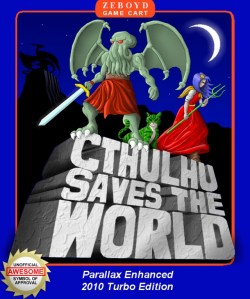
Review: Cthulhu Saves The World


Cthulhu Saves the World, an Xbox 360 indie game from Zeboyd Entertainment, the same people who brought us Breath of Death VII: The Beginning.

Once again Zeboyd Entertainment resurrects the feel of an old school 16-bit RPG with the graphics and sound feeling like they’re right out of an old SNES RPG.

The plot of this game is that the evil Cthulhu is defeated in battle and is under a curse that makes him lose all his powers.  The only way to regain them is to become a true hero.

Really the first thing that comes to mind is this… what would H. P. Lovecraft think if he were still alive today?  First there’s the three-parter of South Park featuring Cthulhu and now this.  He’s either rolling in his grave now or if he had a sense of humor he’d laugh.  No telling unfortunately.

It features the gameplay and graphics of Breath of Death VII, but with improvements.  For starters you can save anywhere but in battle which is a major improvement.  It was annoying that you could only save at inns in Breath of Death VII.  The game has still image cut scenes which are really cool, and of course there’s the dialogue.  Some of the funniest dialogue I’ve seen in a game.  Constantly breaking the fourth wall which in parody games is always a nice little treat.  In addition to Cthulhu you have 6 other party members you can choose from to form your party having up to 4 characters.

Like Breath of Death VII each time you level up you have two options to customize customize your character, whether it be new spells, new effects for current spells, improving stats and more.

The best part about this game is it’s only 240 MS points ($3).  Yeah Breath of Death VII was only 80, MS points, but trust me, the $2 extra is well worth it as this is the superior game.

If you enjoyed Breath of Death VII, I cannot recommend this game enough.  Zeboyd Entertainment I look forward to your future games.

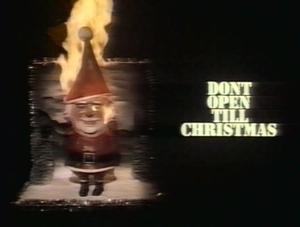
Film Review: Don’t Open ‘Til Christmas (dir. by Edmund Purdom, et al)


It’s been a while since I reviewed a real grindhouse/exploitation film on this site so I want to remedy that by talking about an English slasher film called Don’t Open ‘Til Christmas.

As the movie opens, we find ourselves in England with Christmas quickly approaching.  The fog-drenched streets of London have apparently been besieged by drunk old men dressed up like Santa Claus.  However, at least one citizen has taken things into his own hands by wandering the streets at night and killing anyone he comes across dressed as Santa Claus.  Seriously, we see a lot of Jolly St. Nicks meeting an untimely end in this film.  Most of them are done in by straight razor but at least one ends up getting shot and then another ends up bursting into flame and one Santa even up getting a spear driven through the back of his head.

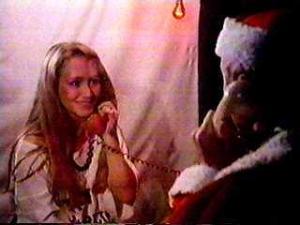
That Santa has a daughter named Kate (Belinda Mayne) and Kate has a boyfriend named Cliff (Gerry Sundquist).  While they make most of their money by standing out in the middle of street and playing the flute, Cliff also has a side job as just a generally sleazy guy.  The day after Kate’s father dies, Cliff tries to convince Kate to take part in a pornographic, Santa-themed photo shoot.  Needless to say, Kate doesn’t react well to this and storms out.  So, Cliff convinces another model to wear the Santa suit.  That model is later caught outside in that Santa suit by the killer.  However, after opening the suit and giving the camera an excuse to linger over the model’s body the killer leaves without harming her.  This would seem to indicate that he’s only looking to kill men in Santa suits.  Normally, I’d be all for this development because fair play is fair play except for the fact that its eventually revealed that the whole Santa suit thing is pretty much just a red herring.  But, more on that later.

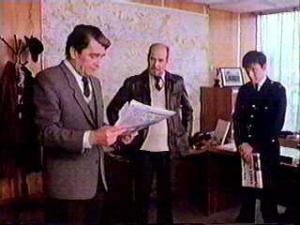
Anyway, Kate wants justice for her father but unfortunately, the police investigation is being headed up by Inspect Harris and you know that Harris isn’t going to be much help because he’s played by Edmund Purdom.  Purdom appeared in a lot of Italian and Spanish horror films in the 70s  and 80s and he was always the epitome of British incompetence.  Purdom is also credited as being director here but again, more on that later.

Now, by the time the 100th Santa has been brutally murdered, you might think that people would just naturally stop dressing up as Santa Claus when they’re out in public but no, that doesn’t appear to occur to anyone.  Instead, we get a mall Santa getting castrated while standing at a urinal.  And then we get another one getting killed while visiting a local sex shop and talking to a character credited as “the Experience Girl” (played surprisingly well by Kelly Baker).  Yet another Santa finds himself getting murdered while backstage at a TV variety show.  His body is discovered by Caroline Munro (star of Starcrash and Maniac) who plays herself and gets to sing a disco song before finding the body.  She also gets to wear this really amazing red dress that I would kill to own because, seriously…

Suddenly, this guy named Giles (played by Alan Lake, who apparently died right before this film was released) pops up and tells Kate that he’s a reporter and he starts asking her all theese questions about her father.  Kate gets mad and tries to call up Inspector Harris just to be told that Harris is out for the day taking care of some personal business.  Hmmm…could Harris be our killer?  It makes sense since he’s played by Edmund Purdom.  Then again, Cliff could be the killer as well because, while Kate is doing all this, Cliff is making money by selling her sexual favors to his friends.  Then again, it seems that Giles might be the killer because he then promptly shows up and kills Kate.

Meanwhile (we’re only about 40 minutes in to the film by this point), the Experience Girl is being interviewed by Harris’s partner, a tall guy named Powell who hates women.  The Experience Girl tells Powell that she would know who the killer is if she saw the killer smile.  Powell tells her she’s an idiot.  So, the Experience Girl goes back to work.  Giles shows up and smiles.  Experience Girl screams.  Giles kidnaps her but instead of killing her, he takes her to his flat and chains her up.  Giles explains that he’s a killer because Inspector Harris is his brother and Giles is jealous.  The Experience Girl knows who Harris is despite the fact that we’ve only seen her meet Powell. 

Speaking of Powell, he investigates Kate’s death and realizes he may have made a mistake dismissing the Experience Girl.  Then he tries to open a car door and gets electrocuted until he eventually ends up blowing up.

Now, none of this qualifies as being a spoiler because, even at this point, there’s still nearly 40 minutes of plot left.

Like a lot of 80s grindhouse films, the production of Don’t Open ‘Til Christmas is shrouded in mystery.  Shooting on the film apparently started in 1981 but it the film wasn’t actually completed and released until 1984.  Reportedly, Edmund Purdom was the original director but he ended up walking off the set which led to screenwriter Derek Ford taking over the movie for two days before he was apparently fired.  The film was then completed by Alan Birkinshaw (and possibly a few other people), working under the name of Al McGoohan.

Certainly, this explains why the film is such a huge mess but it’s also a part of the fun as watching the movie becomes a game of trying to figure out who directed what. 

Since Purdom walked off the film, I think it’s fairly safe to assume that he directed all of the scenes that he appears in.  (It also explains why his character disappears from the movie after the first 40 minutes.)  These scenes are all distinguished by the general immobility of the camera.  Purdom’s scenes are so static and so defiantly dull that they almost work in a strangely Warholian way.  The actors wander into frame, the actors wander out of the frame, the out-of-focus lens rebelliously refuses to follow them. 

The non-Purdom scenes — the scenes in which men dressed like Santa are graphically murdered and the scenes featuring the “Rxperience Girl” — appear to have snuck in from a totally different movie and often, they’re only link to anything we’ve seen in the Purdom scenes is some awkwardly dubbed dialogue.  These scenes feel as if they’re drenched in sleaze.  The camera not only moves, it lingers and it invades like a voyeur looking at dirty pictures in a public library.  Unpleasant on their own, these scenes somehow become even more distasteful when compared to the aritificiality of the Purdom scenes. 

It all makes for a very disorienting viewing experience and if the film isn’t really well-done enough to ever become disturbing or nightmarish, it still had a very odd dream-like feel to it.  Major characters wander through the film without every actually meeting each other.  Seemingly important plot points are brought up just to be quickly abandoned and forgotten.  Even all the multiple murders turn out to have very little to do with Santa Claus or Christmas.  If nothing else, this is a unique slasher film in that the murders are pretty much just  red herrings.

There’s a lot in this movie that doesn’t work but, as with many grindhouse films, that just adds to the charm of Don’t Open ‘Til Christmas.  Even the ending — which everyone seems to criticize — is oddly appropriate in that it makes as little sense as everything else we’ve seen on screen.  Also, like most grindhouse films, there’s a handful of memorable moments that actually do work.  For instance, the killer’s mask is genuinely creepy.  The scene where Giles chases the Experience Girl through the streets of London is also handled well and is even more suspenseful in that it takes place during the day as opposed to expected dark and foggy night.  And again, Kelly Baker is a sympathetic, if unexpected, protaganist in the role of the Experience Girl (though you get the feeling that the role was created and cast long after Purdom left the initial production).  Finally, this is a film that epitomizes the spirit that makes the Grindhouse great — i.e., it may have taken two years and multiple directors and the end result might be kind of chaotic but, in the end, the movie got made.

I ended up watching Don’t Open ‘Til Christmas last night because there have been reports that its about to finally snow here in North Texas and, as a result, I was in a holiday mood.  Since this is apparently one of those movies that has entered the public domain, the version I own is a part of one of those “50 Horror Classics” collections that Mill Creek puts out.  As a result, the transfer looked and sounded terrible.  But you know what?  That terrible transfer added a certain charm to the film.  Don’t Open ‘Til Christmas is a movie that was meant to be seen with a lot of random scratches and faded colors flashing across the screen. 

So, in the end, Don’t Open ‘Til Christmas is a pretty bad movie but it’s an undeniably watchable and oddly memorable one.  Plus, it features that really great red dress.  Seriously, just to die for…