There’s literally been hundreds of film adaptations of Mary Shelley’s novel Frankenstein, or the Modern Prometheus. Everyone from James Whale to Terrence Fisher to Paul Morrissey to Kenneth Branagh to Marcus Nispel has taken a shot at interpreting the legend and the monster’s been played by everyone from Boris Karloff to Christopher Lee to Robert De Niro to Srdjan Zelenovic (who was pretty freaking hot and yummy for a creature stitched together out of random corpses in Flesh for Frankenstein).
However, the very first cinematic version of Frankenstein came out in 1910. Produced by Thomas Edison’s film company, this 10-minute, silent film starred an actor named Charles Ogle as the monster. Frankenstein, himself, was played by Augustus Phillips while his fiancée was played by Mary Fuller. The film was directed by a fellow known as J. Searle Dawley. Dawley reportedly directed over a hundred silent films and most of them are lost to history.
For about 6 decades, it was assumed that Dawley’s Frankenstein was lost as well. However, in the mid-70s, it turned out that one remaining print of the film still existed and was apparently sitting up in someone’s attic in Wisconsin. It also turned out that the film was still in viewable condition.
And now, thanks to a combination of YouTube and the fact that every movie made before 1922 is now in the public domain, I’ve had the opportunity to see this movie for free and even better, here’s your chance to see it for free. Understand that when I say better, I’m speaking from the point of view of someone who is fascinated by history in general and cinematic history in specific. In many ways, this film epitomizes everything that makes it difficult for modern audiences to appreciate the excitement once generated by silent film. The acting is overly theatrical and watching the film makes you appreciate the eventual development of the dolly shot and the zoom lens even more. Add to that, the music that was selected to accompany this video is way too obvious and heavy-handed. I would suggest, before watching, that you mute the video and put your own preferred music on instead.
Still, the film does have a lot of historic interest. I don’t think you can truly judge and appreciate the films of today unless you know something about the films of the past. Watching a movie like the 1910 Frankenstein not only makes you realize how far films have come as an art form but also how much of the medium’s inherent earnestness has been lost with each advance in technology.
Anyway, with all that said, here is the 1910 version of Frankenstein…
So, in my review of The Beaver, I talked about the annual Hollywood Black List and how the movies that are always listed at the top of the black list usually turn out to be vaguely disappointing. Well, in that review, I failed to mention that The Beaver was not the only Black List film that I’ve seen (so far) in 2011. A few months ago, I saw the film that topped last year’s list, Cedar Rapids. (The Cedar Rapids screenplay, by the way, was written by Phil Johnston.)
Now, Cedar Rapids (which is scheduled to be released on DVD in June) actually had a pretty good run down in here in Dallas. Unlike Austin, Dallas is not a film-crazed city and — with only four theaters currently specializing in indie and art films — it’s usually a case of “you snooze, you lose” when it comes to seeing anything out of the mainstream. We’ll have a few hundred theaters all showing something like Avatar for half a year but a film like James Gunn’s Super will usually sneak in, play in one theater for two weeks, and then just as quickly vanish.
Cedar Rapids, however, stuck around for about a month and a half, playing exclusively at the Dallas Angelika. It took me a while to actually find the time to go see it (and, perhaps because of the whole Black List thing, I just didn’t feel much enthusiasm for seeing it) and, in fact, I ended up seeing it the last day it played at the Angelika.
As for why I wanted to see it — well, it had gotten some very positive reviews from critics who traditionally don’t give comedies good reviews so that piqued my interest. I knew that the film featured three of my favorite character actors — John C. Reilly, Stephen Root, and Thomas Lennon. The film was also being touted as a comeback for Anne Heche whose autobiography Call Me Crazy was a favorite book of a former roommate of mine. Finally, I wanted to see the film because it starred Ed Helms, who, at the time, I thought seriously might end up as the new boss on The Office.
Helms, in case you don’t know for some reason, plays Cornell graduate Andy Bernard on The Office. When he first appeared during the show’s third season, he was portrayed as an incredibly obnoxious preppy with an anger management problem and I loved how Helms so thoroughly threw himself into making Andy just the most annoying human being ever. Andy was eventually sent to anger management classes and, upon returning, the character has become less obnoxious and just more buffoonish and, in my opinion, a lot less entertaining. As well, with Jim and Pam now safely married, Andy ended up as the focus of some of the Office’s weakest episodes. In fact, Andy was the center of so many episodes earlier this season that I found myself wondering if the show’s producers weren’t perhaps trying to see how the audience would react to Ed Helms becoming the new star of the show. Since I had mixed feelings about that prospect, I felt that maybe Cedar Rapids would provide me with an answer.
In Cedar Rapids, Ed Helms plays Tim Lippe, an almost impossibly innocent insurance agent who is sent by his boss (Stephen Root, who appears to be the go-to guy when you need someone to play a friendly but vaguely threatening manager) to a regional conference in Cedar Rapids, Iowa. Tim is ordered to conduct himself well, to go out of his way to impress the conference president (Kurtwood Smith), and to win the prestigious “Two Diamonds” Award. (The award has been won for the company in the past by Helms’ rival at the company who, at the beginning of the film, accidentally kills himself while practicing autoerotic asphyxiation. The rival is played by Thomas Lennon and I’m kinda sorry that Lennon didn’t have more scenes because seriously, he always makes me smile.)
After saying goodbye to his much older girlfriend (Sigourney Weaver, who is wasted in her cameo), Helms heads off for Cedar Rapids. This is a big deal for him because he’s the type of movie innocent who has never even been on a plane before. Helms arrives at Cedar Rapids determined to do the right thing but he soon discovers that he is rooming with Dean Ziegler (John C. Reilly), a loud, crude, and cynical agent who indulges in every vice that Helms has been ordered to avoid. Needless to say, Helms initially tries to resist being drawn into Reilly’s orbit but soon, he finds himself being corrupted and enjoying it. Through Reilly, he meets yet another insurance agent (played by Anne Heche) that he soon finds himself falling in lust with. All this happens, of course, under the disapproving eye of Kurtwood Smith and Helms soon learns just how far he is expected to go to win that Two Diamonds Award…
As it might be obvious from the above description, Cedar Rapids is one of those films that attempts to be both a wild comedy and a poignant coming-of-age drama. And it succeeds very well at being a comedy and it does pretty good job of being a drama but it never manages to do both at the same time. The end result is an entertaining but wildly uneven film that never feels like it’s quite as good as it should be.
The film is at it’s best when it’s just Helms, Reilly, Heche, and Isiah Whitlock, Jr. (playing another insurance agent) hanging out and BSing. Those scenes ring well and all four of these actors have a real ensemble chemistry together. You really do end up believing that Reilly, Heche, and Whitlock truly do care about their new friend and you just as strongly believe that Helms really is falling in love with Heche. These are the best scenes in the movie.
The film is less effective when it tries to be something more than just an ensemble comedy. It’s in these scenes — with Kurtwood Smith quoting bible verses and the Two Diamonds Award becoming a metaphor for all sorts of things — that the film gets heavy-handed and a bit boring. I also have a feeling that these scenes are probably the reason why so many Hollywood readers went nuts of the Cedar Rapids screenplay because these scenes are the least challenging in the film. These are the scenes that pat you on the back for watching the movie. Anyone who has ever seen a movie knows that Kurtwood Smith’s character is going to turn out to be a hypocrite because when was the last time that you see a movie in which the guy who talked about Jesus didn’t turn out to be a hypocrite? Therefore, it’s kinda hard to buy into Helms’s shock when he discovers that Smith isn’t all that he’s cracked up to be. I mean, I can force myself to buy that the Helms character has never been on a plane before but my God, has he never seen a movie or an episode of Law and Order before either? Seriously, the character isn’t a Mennonite. He’s just from the midwest.
In the lead role, Ed Helms is a lot like the movie. He’s great when he’s just a member of the ensemble but sometimes seems to struggle a bit in the more dramatic scenes. To a large extent, the problem is that the film goes so out of it’s way to present Helms as being some sort of man-child that it’s hard to take him seriously once he suddenly starts to think for himself. As I previously stated, the supporting cast is uniformly strong. Reilly is a drunken, foul-mouthed force of nature while Heche steals every scene that she’s in and, in the end, proves herself to really be the heart and soul of the film.
So, in the end, I guess I would say that Cedar Rapids, as uneven and as frustrating as it occasionally turned out to be, is worth seeing once it comes out on DVD in June.
So, there’s this thing in Hollywood that they call the Black List. The Black List comes out at the end of each year and basically, it’s a list of the “best” unproduced screenplays of the year. The reason I put best in quotation marks is because the list is 1) determined by studio people and studio asskissers and we all know that those people are toadsuckers, 2) film is not a writer’s medium so the best screenplay in the world can still be ruined if the wrong director gets involved with it, and 3) the films made from the scripts on the blacklist always seem to end up sucking like I did during my sophomore year of high school. Seriously, that was a lot of sucking.
The Beaver (written by Kyle Killen) was at the top of the Black List in 2008 and now, 3 years later, it’s finally been made by Jodie Foster and released to mixed reviews and indifferent box office. I saw The Beaver on Saturday. So does, the Beaver continue the tradition of disappointing movies being produced from Hollywood’s “best” screenplays? Well, yes and no. The final 20 minutes of the Beaver are incredibly effective and almost moving. Unfortunately, they’re not effective enough to make up for the wildly uneven 90 minutes that come before.
One thing that films that top the Black List tend to have in common is that they almost always try to tell a very traditional, rather obvious story by using some quirky gimmick that becomes less and less clever the more you think about it. The Beaver continues that tradition. Mel Gibson plays a guy named Jerry who runs a toy company and who has become clinically depressed. After a unsuccessful attempt to commit suicide, he comes up with a novel solution to deal with his inability to communicate his feelings. He starts to walk around with a beaver hand puppet and whenever he has to talk to his estranged wife (Jodie Foster) or his angry son (Anton Yelchin), he does so through the puppet. And, as long as he has that beaver puppet, he has the strength to be a good husband and a good father. At first, Foster is happy — if confused — but soon she finds herself growing frustrated with always having to talk to the Beaver as opposed to speaking to her husband. However, Gibson has now grown so dependent on the Beaver that he can’t give it up, even though the Beaver has now started to insult Gibson whenever there’s no one else around.
Eventually, this leads Gibson to doing something very shocking and quite disturbing and it’s once that happens that The Beaver actually starts to work as a film. Unfortunately, by that point, there’s only 20 minutes left in the film and we’ve had to sit through a whole lot of subplots, none of which seem to belong in the same movie.
On the one hand, we have Gibson reviving his company by launching a toy line based on the Beaver. These scenes are probably the weakest in the film. Gibson shows up at work and tells everyone that the Beaver hand puppet is in charge and nobody quits. Apparently, nobody calls up the tabloids to tell them that CEO of a major toy company has apparently had a nervous breakdown. Instead, work goes on as normal. Every time I saw Gibson’s character sitting in his office with that hand puppet, I wondered, “Does this company not have shareholders?”
Meanwhile, Yelchin is dealing with the beginning stages of the same clinical depression that has crippled Gibson and (its implied) led to his grandfather killing himself years earlier. A high school senior, Yelchin has a lucrative career writing other students papers for them. He’s hired by Jennifer Lawrence who asks him to write her graduation speech. It also turns out that Lawrence is not only a popular cheerleader who is graduating at the top of her class but she’s also a graffiti artist as well who has a convenient family tragedy that she needs help getting through. Now, that’s not as impossible as it may sound because my sister Erin’s a truly talented artist who was also a cheerleader in high school but that doesn’t change the fact that Lawrence’s character still basically came across as just being a typical male fantasy, the nurturing madonna figure who only exists to justify and/or excuse the behavior of an obviously autobiographical male figure. Still, Lawrence and Yelchin’s subplot is probably the most compelling part of the movie.
As you can probably guess, the main problem with the movie is that it’s essentially about a guy walking around with a Beaver puppet. Neither Kellen’s screenplay nor Foster’s direction seems to be sure just how seriously we should take that beaver and as a result, it just comes across as being a really cutesy idea that never really works as well as the movie seems to think that it does. As well, it’s hard to take anything seriously once the word Beaver is introduced into the conversation. For instance, as we watched Gibson bonding with his employees, my friend Jeff suggested that all Gibson needed to do in order to feel better about his life was to “stick his hand up a beaver and move his fingers.” However, I have to admit that the worst beaver joke was made by me and it happened about halfway through the film when we see Gibson and Foster having sex, with Gibson keeping that beaver on his hand. After they finish, Foster turns her back to him and Gibson caresses her face with — yes, you guess it — the beaver. “I bet that’s not the first time she’s had a beaver in her face,” I said. All of this could have been avoided if the film just hadn’t been made in the first place.
Still, The Beaver is not a complete failure and when the film does work, it works so well that it makes it even more frustrating that the movie, as a whole, doesn’t. Even before the final 20 minutes, the film has the occasional intelligent line or knowing detail that indicates that, if not for the whole beaver thing, this could have been a very touching film about the pain of mental illness. Perhaps the film’s greatest strength is that it features a quartet of excellent performances. Yelchin and Lawrence have a real chemistry and watching them, you kinda wish that the movie would have just focused on them. Foster also does a good job as Gibson’s confused wife and, it must be admitted, that Mel Gibson is perfectly cast in the lead role. He looks like hell here and there’s next to no vanity to be found in his performance here. He actually probably gives the best performance of his career here but, I do have to admit, it was difficult to watch him onscreen without imagining some alcohol-soaked voice ranting and raving and spewing out a lot of anti-Semitic hate.
We saw the Beaver at the Plano Angelika and I have to admit that, even if the film didn’t really work, at least we had a good time seeing the film. On the Saturday afternoon that we went to see it, the Shops at Legacy (where the Plano Angelika is located) were having a street fair with live music and booths and everything. So, at the very least, I got to literally dance in the street both before and after seeing The Beaver.
Last night, I watched the latest episode of South Park, Funnybot.
Why Was I Watching It?
Because it’s South Park, of course!
What Was It About?
Aspiring stand-up comedian Jimmy Vulmer puts together the first annual Comedy Awards show at South Park Elementary. Only Tyler Perry shows up to accept his award and only Token Black seems to be happy to see him. Once he’s arrived, Perry refuses to leave and instead spends his time wandering around the school, dressed up like Madea and saying, “Oh Lord!” Soon, every student except for Token is sick of him and demanding that Perry go away. However, Token — who has apparently been hypnotized by Perry — finds himself incapable of not giving Perry money to stick around.
However, there’s an even bigger problem than Tyler Perry. During the Comedy Awards Ceremony, the Germans are named the least funny people on the planet. The Germans react by creating Funnybot, a robot with a very methodical, rather German approach to humor. Soon Funnybot is the biggest, most popular stand-up comedian on the planet even though his jokes are simply a mad lib-style of random pop cultural references mixed in with a few standard situations. However, the world loves Funnybot and they continue to love him even after he starts to violently murder everyone who comes to see his shows.
After all of South Park Elementary is taken hostage by the comedians that have been put out of work by Funnybot. Kyle, Cartman, and Stan try to talk some sense into Funnybot. Funnybot responds by explaining that he’s going to destroy the world.
And, as the world awaits destruction, Barack Obama watches a Tyler Perry movie…
What Worked?
I’ll be honest. I love South Park so, as far as I was concerned, the whole show worked. Funnybot was a great creation and, according to my friend Jeff, Funnybot was a reference to Dr. Who and that made Jeff happy which was pretty cool. I’ve seen a few people online who are complaining that it wouldn’t make any sense for Funnybot to remain a popular comedian even after he starts killing people but those people are obviously not true fans of South Park. A true fan of South Park would know that South Park always presents the entire population of the world as a bunch of sheep who are incapable of thinking for themselves.
Plus, this show did what South Park does best in that it bluntly acknowledged an inconvenient truth — i.e., that white people just do not get Tyler Perry and that many of us find watching his “style” of comedy can be a very awkward experience. As well — and this is something that seems to have gone over the heads of a lot of people who watched this show — South Park’s Tyler Perry is essentially portrayed as being the human equivalent of the Funnybot. Just as Token is shown to be incapable of resisting Perry, all the other (white) characters are incapable of resisting Funnybot.
(I am going to say one thing in his defence: the year that Precious was nominated for best picture, Perry was one of the presenters at the Academy Awards and he actually came across as endearingly nervous and almost likable. Or, at least, he did to me.)
Finally, on a purely silly level, I loved the way that Jimmy responded to every problem by saying, “But I think we can all agree that the 1st Annual Comedy Awards was a great success.” It just made me laugh.
What Didn’t Work?
Hmmm…well, as funny as the idea of a bunch of stand-up comedians taking an elementary school hostage is, I kinda wish that Trey Parker and Matt Stone had done more with it. That said, I love Matt and Trey and I hope they win all sorts of Tony Awards for The Book of Mormon.
“Oh my God! Just like me!” Moment
Much like Funnybot, I find that going “Awkward!” in a cute little voice is the perfect way to make an unfunny joke funny.
Okay, two quick confessions. First off, I really wanted to write this post in Spanish because it’s Cinco De Mayo but unfortunately, other than a few phrases I picked up from my mom, I don’t speak Spanish. Secondly, I’ve done some research and I’ve discovered that the band featured here (Santa Esmeralda) is actually a French group. So, despite the fact that Santa Esmeralda’s cover of Don’t Let Me Misunderstood is obviously influenced by Latin music, it’s still not exactly ideal for Cinco De Mayo.
But you know what? When I first heard this song on the soundtrack for Kill Bill Volume One, I immediately fell in love with it and I forced my mom to listen to all 10 minutes of it and she loved it too. And unlike me, my mom grew up speaking Spanish and actually had a very pretty singing voice. She was also very proud of her heritage. So, if this song was good enough for her, it’s good enough for me.
I have to admit, as well, that when I first heard Santa Esmeralda’s version, I assumed that the cover had been recorded specifically for the Kill Bill soundtrack. Well, turns out I was not only wrong, I was way wrong. This cover version was actually recorded way back in 1977.
I also thought, before I started writing this post, that the song was originally performed by the Animals. Wrong again. The song was first written in 1964 by Bennie Benjamin, Gloria Caldwell, and Sol Marcus and it was originally performed by Nina Simone. Then, in 1965, the Animals did their famous cover. The Animals’ version of the song is the one that got stuck in my head when I was dating this guy who worked at Mervyn’s because, oh my God, it was playing all the freaking time in that store!
But the Santa Esmeralda version is my favorite and it is today’s song of the day.
Okay, I’ll admit it right now: I’m way too late in reviewing this film. Seriously, if you were planning on seeing The Source Code, then you’ve probably already seen it by this point. You already have your own opinion about the film. Why do you need hear mine? You’re probably saying, “Girl, move on.”
And to that I say: “I do what I want!”
Anyway…
The Source Code is a surprisingly smart and occasionally even moving little sci-fi thriller. Jake Gyllenhaal plays Colt Stevens, an army helicopter pilot who, as the film begins, awakens to find himself on a commuter train with no idea who he is or how he got there. The woman sitting across from him (played by Michelle Monaghan) seems to know he is. The confused Gyllenhaal wanders around the train trying to figure out who he is. He goes into the train’s restroom, looks in the mirror, and sees a stranger staring back at him. And then the entire train blows up.
Suddenly, Gyllenhaal wakes up again. He’s apparently trapped in a dark chamber with his only link to the outside world being a computer screen. An army officer (Vera Farminga) appears on the screen and explains to him that he was sent into the past in order to find out who bombed the train. And he will continually be sent back into the past to relive the few minutes before the bomb goes off. He’s told that the past cannot be changed, the people on the train cannot be saved, and his only mission is to discover who planted the bomb.
It’s a clever little plot (one that would do Philip K. Dick proud) that has a lot more twists and turns than is obvious from a simple recap. Along with a smart script, the film has a cast who bring a lot of conviction and nuance to their roles. Jake Gyllenhaal, in particular, redeems himself after his unfortunate work in Love and Other Drugs. However, the film’s real hero is director Duncan Jones who gives The Source Code both a heart and a brain. His work here confirms that talent that was evident in Moon and I’m looking forward to what he gives us next.
Robert Redford’s new historical drama The Conspirator is the first prestige picture of 2011 and it’s also (arguably) the worst film of the year so far.
Oh, I hear you out there: “Really? Worse than even Season of the Witch and Your Highness?”
Yes. Way worse. Season of the Witch and Your Highness might have been bad films but they knew they were bad. They never truly aspired to be anything other than bad. The problem with The Conspirator is that it’s obviously meant to be a great and important film. It’s meant to shape public debate. We’re supposed to feel like better people for having sat through it and the filmmakers are supposed to be better people just for having made it. There’s a smugness to these type of self-styled “prestige pictures” that elevates their badness beyond anything to be found in Your Highness. Indeed, if the makers of Your Highness appeared to be getting high off of herb than the people behind The Conspirator are high off of their own good intentions and that makes them for more annoying.
The Conspirator is based on the trial of Mary Surratt, the only woman to be arrested, tried, and subsequently executed as a result of the conspiracy to assassinate Abraham Lincoln. The execution of Mary Surratt was controversial because 1) she was a civilian tried by a military tribunal, 2) the evidence against her was largely circumstantial (she owned the boarding house where the conspirators — including her son John Surratt — supposedly met), and 3) she was a woman.
Now, I have to confess that I’m secretly kind of a big history nerd and — unlike most of this film’s audience — I was already familiar with the story of Mary Surratt before I sat down in the theater. The story of the Lincoln Conspiracy and the aftermath of the assassination is a really interesting one that is full of all sorts of weird twists and turns and odd characters all conspiring together and being mysterious. It has all the makings of a great grindhouse film.
However, director Robert Redford is too good to make a grindhouse movie. No, he has something important to say and, as a result, The Conspirator becomes yet another one of those tedious films where every line of dialogue and every image is supposed to make us go, “Hey, they might be talking about post-Civil War America but, by golly, this is relevent to our post-911 lives! OH MY GOD!” So, we get Tom Wilkinson showing up randomly to give speeches about why military tribunals are the work of the devil. Wilkinson is playing a historical figure Reverdy Johnson but they might as well have just renamed him “Prestige Actor Cast As Mouthpiece.” And then Kevin Kline (as Secretary of War Edwin Stanton, though they should have just called him Dick Cheney) is there to go, “The whole world has changed.” Meanwhile, the camera lingers over the conspirators being held in their dirty cells with bags over their heads (“OH MY GOD, HONEY!” we’re supposed to shout at our loved ones, “THAT’S JUST LIKE GUANTANAMO BAY! WOW!”) and then we’re constantly reminded that Mary Surratt was a devout Catholic and that America in 1865 viewed Catholicism in much the same way that America views Islam in 2011.
And, yeah, we get it and I’m not saying that director Redford is incorrect in his message or his beliefs. However, a boring, heavy-handed film is just as boring and heavy-handed regardless of where its heart may lie. The Conspirator is so busy being good for us that it forgets that it needs to entertain as well. It preaches at us but it never bothers to engage us.
Mary Surratt is played by Robin Wright and she gives a good performance but because of the way the film is structured, Mary is never allowed to become anything more than a convenient symbol. Instead, most of the film’s screen time is given to James McAvoy who plays the young lawyer who reluctantly defends her at trial. Now, I love James McAvoy. I’ve loved him ever since Atonement and that’s why it’s kinda heart breaking to see what a bad performance he gives here. He’s good for the first ten minutes or so of the film but then he’s assigned to defend Ms. Surratt and I swear to God, he doesn’t stop yelling for the rest of the movie. It’s not totally McAvoy’s fault. As written, his character doesn’t really have much to do other than get mad. As an actor, McAvoy can do anger quite well (again, check out Atonement) but here his anger just seems to spring out of nowhere. At first, he is unconcerned about Mary Surratt and resentful that he has to defend her. Then suddenly, he’s going all late style Al Pacino on everyone.
Justin Long shows up as McAvoy’s best friend and seriously, if you’re making a historical drama, you don’t cast a guy who automatically makes you think, “He’s a PC and I’m a Mac.” It’s not Long’s fault. He’s a likable actor and he’s likable here even if his character doesn’t have any reason for being in the movie. It’s just that typecasting is a bitch. Alexis Bedel gets the thankless role of “rich snob who loses faith in her boyfriend” while Evan Rachel Wood, playing Mary Surratt’s daughter, is the only member of the cast who actually seems to truly connect with the material.
Regardless of the film’s historical accuracy, everything about The Conspirator feels false. I don’t know if it was just the copy that I happened to see but the entire movie just looks like crap, a combination of soft-focus blurriness and respectfully muted colors. This is another one of those films where the interior scenes are lit so that it appears that sunlight is just flooding in through the windows, making any white article of clothing just appear to throb with radiation. Seriously, I had a headache after watching 30 minutes of this film.
As I said previously, there’s a great grindhouse movie waiting to be made out of this material. For instance, did you know that Boston Corbett — the man who shot John Wilkes Booth — was also a religious fanatic who years earlier, in order to resist being tempted by a prostitute, castrated himself with scissors? Also, did you know that Henry Rathbone — the army major who was sitting with Lincoln at the time of the assassination — was years later named Ambassador to Germany and, while in Germany, suffered a sudden nervous breakdown that led to him chopping off his wife’s head? Also, one of the men who was arrested (though eventually released and never charged) for taking part in the conspiracy was Frances Tumblety who later moved to England where he would later become one of the many men suspected of being Jack the Ripper?
And that’s just the tip of the iceberg.
However, The Conspirator is too busy being important to bother with being interesting. While a grindhouse version of the story would have been both interesting and thought-provoking, The Conspirator is just a smug film that is never manages to live up to its own rather high opinion of itself.
Last night, I watched on old movie on the Lifetime Movie Network. The name of that movie? Mother, May I Sleep With Danger?
Why Was I Watching It?
Mother, May I Sleep With Danger? pops up on the Lifetime Movie Network like constantly and it’s always advertised as “the cult classic: Mother, May I Sleep With Danger?” Now, to be honest, the entire Lifetime Movie Network is something of a cult classic but Mother, May I Sleep With Danger is the only film shown on that network that is actually advertised as being “a cult classic.” I mean, even something like Confessions of a Go Go Girl is usually advertised as if it’s a perfectly normal, totally serious movie. Therefore, I figured, if even Lifetime realizes that Mother, May I Sleep With Danger? is a cult film then it must be the most culty cult film ever made.
Plus, just from the title, I think I was justified in assuming that at some point, someone would be heard to utter the line, “Mother, may I sleep with danger?” In fact, beyond the whole cult film thing, that was actually my main reason for watching the movie. I wanted to hear that line so I could clap my hands and yell, “We have a title!”
Seriously, I was really looking forward to that.
What’s It About?
Laurel (played by Tori Spelling, who looks like a Modigliani painting in this film) is a college student who has an overprotective mother (Lisa Banes, who has a great first name) and who is recovering from an eating disorder. Anyway, Laurel is also a competitive runner and she’s got a chance to go study abroad in China. However, she also has a really possessive boyfriend named Kevin (played by an actor named Ivan Sergei) and soon Kevin is running her life. Obviously, he’s dangerous and Laurel’s mother soon starts to dislike him. Laurel gets mad at her mom before even asking if she can sleep with danger. Anyway, Kevin eventually ends up locking Laurel up in a cabin that has 8 cross-shaped windows but ony one door.
What Worked?
The genius of this film was that nothing worked. Absolutely nothing. Here’s just a few of the more memorable lines from the film:
“Sex, mother! The word is sex! Sex!”
“You will protect me from everyone and anything now, right? (giggle) Bye!”
“When I don’t see you, I bleed to death.”
“You don’t want me to climb a tower with a gun, do you?”
“I just never learned to trust love.”
“It’s gonna to take the type of time that breaks down mountains.”
And my personal favorite:
“If you’re lying to me, I’ll know by the way you make love to me.” (And let me just say, boys — nothing gets my panties on the floor quicker than hearing something like that. Seriously, the idea of using fucking as a lie detector is one that needs to be explored. It would certainly make daytime television more interesting.)
As the psycho boyfriend, Ivan Sergei gives a performance that would seem to indicate that somebody held a gun to his head and yelled, “ACT! NOW!” I mean, seriously, I’ve dated a few guys who, in retrospect, I shouldn’t have, but even silly, little naive me knows that if a guy can’t stop twitching and stammers nervously whenever you ask him about his past, chances are that the guy has some issues. Watching Sergei’s performance here, you ask yourself, “What type of stupid moron would actually go out with this loser?”
Then you remember that this film stars Tori Spelling. As I mentioned earlier, Tori does not look her best in this film but oh my God, I don’t even know where to begin. I mean, I don’t want to be all catty here but seriously — when your head is that much bigger than the rest of your body, you’ve got some issues.
When we first see Tori, she’s debating Daisy Miller with a college professor and, amazingly enough, her comments about Daisy Miller’s fate manages to neatly parallel what happens in the movie. It’s amazing how that happens. Anyway, once English class is finished, Tori goes running across campus in the most horrid combination of black running capris and purple sports bra ever. Now, I have to admit that I started running a few months ago. It helps with my asthma and it’s something that I’ve grown to really enjoy but I always feel a little insecure while running because I’m also something of a klutz. However, seeing Tori Spelling — with her gigantic head and her stick-like body — running around in that tacky purple outfit with her chicken-like arms and spindly legs flying all over the place, it filled me with all sorts of confidence. From now on, if I feel insecure, I’ll be able to say, “At least I don’t look like Tori Spelling in Mother, May I Sleep With Danger.”
The mother of the title is played by Lisa Banes. Her best moment comes when she finds out that Tori is planning on spending the summer in Guatemala with Ivan Sergei instead of studying abroad in China. She bulges her eyes and literally spits out the line, “GUATEMALA!? WHAT ABOUT CHINA!?”
What Didn’t Work?
Not once did Tori Spelling or Ivan Sergei say, “Mother, may I sleep with Danger?” Not once! Seriously, I sat there for 2 hours waiting to hear that said so that I could clap and cheer and be all cute about it.
“Oh my God!” Just Like Me Moment
There’s a scene where Tori is running across campus and she almost knocks over a few extras with her flying arms. Back when I was dancing, I did the same thing a few times. Though in my defense, if those other people hadn’t been in my way, they wouldn’t have gotten kicked.
Lessons Learned
There were several lessons learned. One of them was that if you’re boyfriend twitches constantly, lies about his identity, and responds to questions about his day by breaking plates, don’t agree to go to an isolated cabin with him. If you do, however, make sure that isolated cabin has a random canoe sitting nearby. Seriously, that canoe is important.
The main lesson, I learned, however is not to ever allow myself to be filmed while running because, 20 years later, some snotty little bitch might see the footage and write a blog post making fun of me.
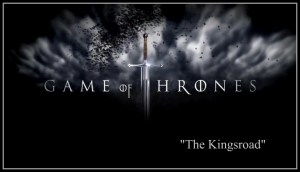
With Arleigh being away in Boston this weekend, I’ve agreed to attempt to review the second episode of Game Of Thrones, The Kingsroad. I say attempt because, unlike Arleigh and a lot of our regular readers, I am totally and completely unfamiliar with the books that this show is based on.
In other words, up until last week, I was a virgin, at least as far as Game of Thrones was concerned. And while I’m happy to say that losing my Game of Thrones virginity was actually a lot more enjoyable than losing my actual virginity, it still left me, in many ways, just as confused. Who are all these people? I wondered as I watched the 1st episode. Other thoughts that I can remember off the top of my head: Awww…cute little wolves! Wait, is he the king? My red hair is prettier than hers. What the Hell’s going on? Hey, it’s that guy! Huh? Peter Dinklage for the win! What? Huh? Oh shit, that kid’s going to leave a mess when he lands!
Unlike those of you who have read the books, I came into Game of Thrones with absolutely no tools to help me keep everything straight. But yet, through a combination of surprisingly sincere performances, intriguing plot twists, and hot guys acting like men, the show held my interest to enough of an extent that I decided to come this week and get confused all over again.
So, what about this latest episode? Well, looking at it from the point of view of someone who is still learning this show’s language, I think TheKingsroad was the perfect follow-up. After the somewhat frantic pilot episode, Kingsroad slowed the story down a bit and instead devoted most of its time to allowing us to get to know the characters and filling in a lot of backstory. If the first episode concentrated on making the character watchable, this episode concentrates on making the characters into human beings with all the individual quirks, flaws, and strengths that go along with being human. The pilot told us why we should watch. This episode gave us some clues as to why we should care.
After seeing tonight’s episode, there’s still a lot that I don’t understand but I understand enough to know that Joffrey’s a little punk and Tyrion — Tyrion just flat out rocks. (Though, and this is how much of freaking newbie I really am, I originally called him Tyrone throughout this entire review.)
Below are ten other somewhat random thoughts inspired by watching the second episode of Games of Thrones.
1) If I came away with anything from tonight’s episode, it’s that I really need to get myself one of those dire wolves. Over the course of this latest episode, I saw one wolf rip open an assassin’s throat while another one attacked that hateful little brat Joffrey. I mean, I love my cat but the only person he’s willing to attack is me. As long as he gets fed, he doesn’t care if I live or die.
2) But then there was that heart breaking moment when Nedd had to kill Sansa’s dire wolf. I have to admit that I was cringing when I first saw Nedd holding that blade and that I kinda breathed a sigh of relief when I realize that they weren’t actually going to show it happen. But then that pathetic yelp erupted on the soundtrack and it just left me heartbroken.
3) Which is why I can now say that I will probably never dislike another character as intensely as I now dislike Joffrey. In retrospect, the most satisfying part of this episode was watching Tyrion slap Joffrey around at the beginning.
4) And speaking of Tyrion, Peter Dinklage kicks so much serious ass that I don’t even know where to start in praising his performance. His big scene here (outside of slapping around Joffrey) was when he explained to Jon that, if he was a peasant, he would have been left in the forest to die. He delivered the line with the perfect combination of cynicism, weariness, and dark humor. It’s too early to say for sure but I may have found someone to fill the Josh Halloway-shaped void in my heart that was created when Lost ended.
5) I have to say that Sansa, with her refusal to stand-up for her younger sister and her reference to the wounded Joffrey as her “poor prince,” is not doing her fellow redheads proud. Of course, I’m sure some of it has to do with the fact that she’s kind of overshadowed by her far cooler baby sister. I guess that has to be difficult to deal with. Next chance I get, I’ll ask my older sisters about it to find out for sure. 🙂
6) The majority of this episode’s actual “plot” centered around Bran who was last seen getting kicked out of a very high window. Shockingly enough, he’s still alive but he spends most of the show in a coma. To be honest, there was only one false moment for me in this episode and it came when Catelyn found that hair at the “scene of the crime.” I mean, what’s she going to do with it? Call in David Caruso and have him take it back to Miami to be analyzed? Still, I enjoyed the look on the faces of both Cersei and Jaime when they heard that Bran was alive.
7) One thing that I am greatly enjoying about this show is the way that the personal and the political mix throughout the story. For all the plotting and talk of strategy, most of the show’s past and future conflict appears to be largely the result of wounded pride, jealousy, insecurity, and miscommunication. Just like in real life and that, I think, is why this show will survive and why I will continue to watch it even if I am never 100% sure just what exactly is really going on.
8 ) I’m actually enjoying the fact that Game of Thrones takes a bit of effort to follow. It was actually a pretty wise choice on the show’s producers’ part to just jump right into the action. It makes the show feel real and relatable. It allows even those of us who haven’t read the books to enjoy it.
9) So, did all you guys out there enjoy watching Daenerys learning how to pleasure her scary giant of a husband? It’s okay if you did because I did and I’m a card-carrying Ms. 45 feminist. Fact of the matter is that, once you get through all of the usual “quality television” arguments, the main appeal of HBO is that its quality television with frequent frontal nudity. (That’s why me and Erin used to secretly watch Oz when we were younger.) And Daenerys’ demand that Drogo at least look at her face while using her — well, who couldn’t relate to that?
10) Finally, I have to mention that this show has got to have one of the best opening credit sequences ever! Seriously, that majestic yet ominous music playing over images of a civilization being created, it’s a wonderful combination and definitely one that I hope to see for many more weeks to come.
I wasn’t expecting much from Insidious, the new horror film that’s recieved a surprising amount of critical acclaim over the past month. After all, the film is the product of a collaboration between the makers of Saw and Parnormal Activity, two of the most overrated horror films ever. Add to that, the movie is rated PG-13 and the lesson I took away from seeing The Roommate earlier this year was that PG-13 dooms horror. Insidious might be the proverbial exception that proves the rule.
As with all good horror films, Insidious starts with a deceptively simple premise. Patrick Wilson and Rose Byrne play a married couple whose marriage is thrown into choas when their oldest son slips into what appears to be a coma. After three months of being in the hosptial, their son is moved back into their house where he spends his days lying in bed, hooked up to ominous medical equipment.
(Speaking for myself, there is no more disturbing sound than the sound of heart monitor, because for every beep, there’s that moment of deafening silence between beeps. The film’s director James Wan knows this too because he makes brilliant use of sound in this film.)
While Wilson deals with things by finding excuses to stay late at work, Byrne is soon seeing shadowy figures running through the house and hearing voices coming from empty rooms. Even as Wilson continues to insist that its just her imagination (that’s something all men seem to have in common — they never ask for direction and they always refuse to accept that the house is haunted), Byrne becomes more and more convinced that its not. Eventually, with a help of an eccentric psychic (well-played by Lin Shaye), Wilson and Byrne are forced to confront the evil forces that have taken control of their lives.
Let’s get the most important thing out of the way first.
Insidious is one scary movie. It’s scarier than any movie rated PG-13 has any right to be. It scared me when I was sitting in the theater watching it and, even more importantly, it’s still scary a day later.
Let me set the scene for you. As I sit here writing this, it is nearly 3 in the morning. I live in a two-story house that is full of random cold spot and which, for some reason, never seems to be totally lit even with all the lights on. My friends are with their families for Easter. My sister Erin is currently in Arlington, visiting with our other sister, Melissa. I’m in this house alone with only my overactive imagination keeping me company. Oh, did I mention that, because of some foundation issues, this house tends to randomly creak?
About two hours ago, I had just taken a shower and I was sitting, wrapped in a towel and a blow dryer, on the edge of my bed. I have this antique floor mirror that sits a few feet in front of my bed and I was about to start drying my hair when it suddenly occured to me — what if I looked at the mirror and I suddenly saw a dark shadow — like the ones in Insidious — sitting on the bed directly behind me?
And yes, I knew that was a silly thought just like I know, despite what the Insidious might tell us, there’s no such thing as ghosts and demons. I knew that if I rasied my head, I would not see anything but isolated, vulnerable little me reflected in the mirror.
But, God help me, I could not bring myself to look. Because, even though I knew that there was 99.9% chance that nothing would be sitting behind me, I knew that there was 0.1.% chance that something would be. I sat there, almost paralyzed with my heart pounding so hard I could almost hear it. I realized I was starting to breathe faster, knowing that if there was something there, it was there with me at that exact moment, siting behind me, waiting to strike…
Finally, realizing that I was on the verge of giving myself a very real panic attack over a very unreal possibility, I forced myself to look up at the reflection in the mirror.
A dark shadow was sitting directly behind me.
And I screamed and jumped off that bed so quickly that I’m amazed I actually managed to stay on my feet. I swung around, cluthing that blow dryer like a weapon, prepared to do whatever…
Nobody was sitting on the bed.
Slowly, I creeped across the room. Cautiously, I stuck a foot underneath my bed to feel if anything was hiding underneath it. I opened the closests and pushed my clothes to the side to confirm that nobody was hiding behind them.
Finally, after I somehow found the courage to sit back down on the bed, I realized that there had indeed been a shadow behind me and that shadow, because of the angle of the lights in my room, had been mine.
That’s the type of film Insidious is. It’s the type of film that uses the simple things that scare us — the unexplainable noises, the things that you sometimes think you see out of the corner of your eye — to creates a truly macabre experience that sicks with you. At its best, its a truly creepy film that works its way into your imagination through a perfect combination of atmosphere and paranoia. One reason why the haunted house genre has remained such a dependable horror set up is because it perfectly reflects one of our most basic fears — the fear of having no control, of knowing that there is no place to hide, that the forces of chaos and evil can even get to us in the sanctuary of our own homes. Especially during its first half, Insidious exploits this fear perfectly. James Wan’s camera prowls through the otherwise unremarkable suburban home like a creature possessed and you find yourself spotting shadowy figures and sudden movements in every frame that flickers before your eyes. Wan makes remarkably good use of sound here. I realize that sound of silence may be an oxymoron but if silence can make a sound, then director Wan manages to capture it in Insidious.
A lot of critics and filmgoers have been rather critical of the film’s second half and it is true that the second half if remarkably different from the first. If the first half finds Wan concentrating on atmopshere then the second half concentrates on shock and, as a result, it feels a lot more conventional. During the 2nd half of them, we learn just what exactly is happening and why and unfortunately, no possible solution could hope to compete with the sense of dread that the first part of the movie generated. That doesn’t mean that the second half of the movie isn’t well-executed. It is. It’s just not as surprising as the first half.
(However, there is one scene in that 2nd half — a red-skinned demon cheerfully sharpening his finger nails — that is just so bizarre and disturbing that it borders on genius.)
Now, I will admit (POSSIBLE SPOILER COMING UP DEPENDING ON HOW ANAL YOU ARE) that I was not a huge fan of the film’s ending. It’s not that the ending didn’t work or that it wasn’t well-exectued. It’s just that it’s the same type of ending that we’ve come to expect from all horror films, the type of thing that used to be considered a twist but now is just a cliche.
Still, ending aside, Insidious is an effective, little horror film. While it is true that the film rather liberally borrows from a lot of previous horror films (most blatantly from Poltergiest, Mario Bava’s Shock, an Australian film called Patrick, and an excellent Canadian shocker called The Changeling), Wan still takes all of those familiar elements and molds them into a genuinely scary experience.