I’m currently working on several reviews for horror month here at the Shattered Lens but tonight, rather than just review a film, I want to share one with you. Released in 1920, the German film The Cabinet of Dr. Caligari is one of those films that we’ve all heard about but far too few of us have actually seen. Like most silent films, it requires some patience and a willingess to adapt to the narrative convictions of an earlier time. However, for those of us who love horror cinema, The Cabinet of Dr. Caligari remains required viewing. Not only did it introduce the concept of the twist ending (M. Night Shyamalan owes his career to this film) but it also helped to introduce German expressionism to the cinematic world.
My initial reaction to The Cabinet of Dr. Caligari was that it simply wasn’t that scary. It was certainly interesting to watch and I was happy that I was finally experiencing this film that I had previously only read about. However, the film itself was obviously primitive and it was difficult for my mind (which takes CGI for granted) to adjust to watching a silent film. I didn’t regret watching the film but I’d be lying (much like a first-year film student) if I said that I truly appreciated it after my first viewing.
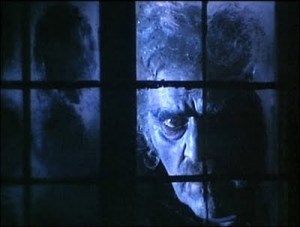
But you know what? Despite my dismissive initial reaction, the film stayed with me. Whereas most modern films fade from the memory about 30 minutes after the end credits, The Cabinet of Dr. Caligari has stuck with me and the night after I watched it, I even had a nightmare in which Dr. Caligari was trying to break into my apartment. Yes, Dr. Caligari looked a little bit silly staring through my bedroom window but it still caused me to wake up with my heart about to explode out of my chest.
In short, The Cabinet of Dr. Caligari passes the most important test that a horror film can pass. It sticks with you even after it’s over.
For the curious who have 50 minutes to spare and an open mind to watch with, here is Robert Wiene’s The Cabinet of Dr. Caligari…
Brighton Rock is a British film noir that’s currently both playing in limited release and which is also available via video-on-demand. Based on a novel by Graham Greene, Brighton Rock is the story of Pinkie (Sam Riley), a sociopathic gangster who murders a gambler. The chase leading up to the murder is witnessed by a mousey waitress named Rose (Andrea Riseborough) who doesn’t realize what she’s actually seen. In order to keep her quiet, Pinkie marries Rose. Rose, however, works for Ida (Helen Mirren) and Ida just happens to have been friends with the murdered gangster. Realizing that Rose is in danger, Ida takes it upon herself to expose Pinkie for the murderer he is.
Brighton Rock is a visually striking film and it has a handful of good performances but it never quite comes together. Before making his feature film directing debut here, Rowan Joffe wrote the script for last year’s The American and, much like The American, Brighton Rock has an abundance of style and is full of references to the classic crime films of the 60s and 70s. Also, much like The American, the style — too often — seems to exist separately from any larger vision. As a result, the film ultimately feels like several disconnected — if pretty scenes — strung together by convenience. The film has an intriguing-enough plot but the narrative lacks any sort of forward momentum. Interestingly enough, Greene used the story of Pinkie, Rose, and Ida to examine larger theological issues within the Catholic church. With the exception of a scene where Pinkie prays, an over-the-top sequence featuring a judgmental nun, and a few inserts of crucifixes artfully hanging on grimy walls, Joffe pretty much jettisons the story’s religious angle but without it, Pinkie and Rose’s actions make a lot less sense.
Joffe’s decision to cast Sam Riley, whom I’ve had a crush on ever since I first saw Control, in the lead role of Pinkie is problematic. It’s not that Riley gives a bad performance because he doesn’t. He makes a convincing psychopath and if he’s never quite charming enough to be a true anti-hero, he’s still makes Pinkie into a compelling figure. Unfortunately, Riley is still totally miscast in the film. In Graham Greene’s original novel, Pinkie was only 17 years old. Sam Riley is 31 and looks even older. Unfortunately, all of the other characters in the film continually refer to him as “the kid.” John Hurt, at one point, gives a monologue in which he wonders how someone so young could be so evil. But Riley isn’t young and as a result, I found myself wondering just how old someone had to be before they were considered to be an adult in 1960s England.
Still, if nothing else, Joffe gets some good performances from his supporting cast. Andrea Riseborough manages to be both poignant and annoying as Rose while Andy Serkis appears to be having a lot of fun playing a slightly ludicrous gangster. Not surprisingly, Helen Mirren commands every scene she appears in and she and John Hurt have got a great chemistry. Regardless of how you might feel about the film as whole, it’s impossible not to enjoy their scenes together. They’re final scene together made me squeal with delight and, in the end, that has to count for something.
Since I previously reviewed two classic horror films from Mario Bava, it now seems like the perfect time to watch a film from Herb Wallerstein, called Snowbeast. Well, no, not really. In fact, to be honest, Snowbeast seems to exist on a totally different planet from either Black Sabbath or Planet of the Vampires. The two latter films are classics of cinema that should be seen by everyone, regardless of the season. Snowbeast, on the other hand, is the epitome of the perfect movie to turn on for background noise. Snowbeast is fun, unthreatening, likable, and ultimately rather forgettable. But sometimes, especially when it comes to finding something safe but appropriate to watch during the Halloween season, that is exactly what’s needed.
Snowbeast was originally made in 1977 and wow, does it show. According to Wikipedia (see, I do to research my claims occasionally), Snowbeast was originally a made-for-tv movie and it has retained a “cult following.” Well, I don’t know if I quite see the film’s cult appeal though it’s certainly better than any 82-minute tv show has any right to be. The film has also entered into the public domain, which, of course, means that it’s been released in a few thousand different Mill Creek box sets. Last time I counted, I actually had four different box sets that featured Snowbeast. So, if nothing else, I’ll always have Snowbeast.
Snowbeast takes place at a ski resort. An unseen monster is killing tourists. The sheriff (Clint Walker) thinks the monster is a yeti. Nobody believes him and the owner of the ski resort — Sylvia Sidney, who once starred in films directed by Josef Von Sternberg — is more interested in making money off of vacationers than in protecting the public safety. Now, if this happened today, I’d imagine there would be an OccupySnowBeast demonstration or something. However, since this film was made in the 70s, this instead just leads to Walker and Bo Svenson going off into the mountains to track down and kill the snowbeast.
Now, the plot of Snowbeast may sound a little familiar and that’s because it’s basically the exact same plot as Jaws except the water has been replaced with snow-capped mountains and the shark is now a Yeti. But otherwise, it’s pretty much the exact same story, right down to the greedy businesspeople going, “Shut down the mountain!? That’ll be bad for tourism!” and the film’s 3 heroes all giving each other knowing looks when the wrong bear is killed and paraded in front of the cheering townspeople. (That said, I have to say that if you love spotting overreacting extras in crowd scenes, this is the film for you.)
So, Snowbeast doesn’t win any points for originality but I’m willing to cut it some slack. Even though it’s a bit before my time, I’ll bet that Snowbeast wasn’t the only low-budget B-movie to rip off Jaws in the 70s and you don’t really watch a movie called Snowbeast for the plot anyway. You watch a movie called Snowbeast because you’re looking for something silly that won’t require too much thought. And that’s a perfect description of Snowbeast. It’s a film that’s done well enough that you won’t hate yourself for watching but, at the same time, is so predictable that you can do about a hundred other things while it’s playing without running the risk of missing anything important. It is literally a movie that you can start watching at any point after it’s started.
Ironically enough, Snowbeast is actually more effective because it was made for television. Yes, you don’t get the gore, sex, or profanity that you would typically expect from one of these films but it also means that you don’t get to see the killer Yeti except for one very brief shot. Otherwise, the Snowbeast of the title is represented by point-of-view shots of the monster about to attack some unsuspecting skier. As I’ve mentioned in other horror reviews, our imaginations will always come up with something scarier than even the most effective of special effects and Snowbeast‘s low budget origins force us to use our imagination more than the typical monster film would. As well, the snowy setting is beautiful to look at and if you’re a fan of watching people ski (and ski and ski and ski) this is the film for you. Seriously.
For my latest horror review, I will be reviewing another classic film from one of my favorite directors, Mario Bava. Following the suggestion of my twitter friend Tom, I spent last night watching Bava’s 1963 classic Black Sabbath.
Starring Boris Karloff, Black Sabbath is a compilation film that’s made up of three different horror-themed stories. Originally entitled Three Faces of Fear, Black Sabbath has been released in many different versions over the years. Depending on which version you seen, the stories may be in a different order than in the order that Bava intended. The version I watched was the original, uncut, Italian-language version that was released by Anchor Bay. For those of you who want to truly experience the genius of Mario Bava, this is the version to see.
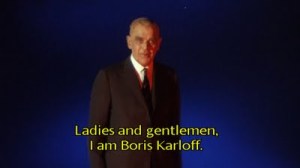
Black Sabbath begins with Boris Karloff playing himself, giving a deliberately over-the-top introduction and informing us that there could very well be vampires and werewolves sitting next to us in the theater. Yes, it’s silly and yes, it’s campy but it’s also a lot of fun. A lot of this is because these words are delivered by Karloff, an actor who could make even the silliest of dialogue sound important. The other part is that, as silly as the introduction may be, it’s beautiful to look at. Instead of going for the standard spooky narrator in a cobweb-filled library approach, Bava frames Karloff standing against a brilliant dark blue backdrop that establishes that this isn’t just your typical horror host … this is BORIS FREAKIN’ KARLOFF!
After Karloff’s introduction, we move on to the first of Black Sabbath’s three separate stories, The Telephone.
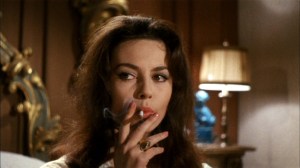
In The Telephone, Michele Mercier plays a Parisian prostitute who returns to her apartment after an evening out. As she tries to change for bed, her bright red telephone rings. Every time Mercier opens the phone, she hears a man’s voice taunting and threatening her. Finally, the caller claims to be Frank, Mercier’s former pimp who has just escaped from prison. The terrified Mercier calls her estranged lesbian lover (Lydia Alfonsi). Alfonsi comes over to the basement to comfort Mercier. However, what Mercier doesn’t realize is that it wasn’t Frank calling her. It was Alfonsi, pretending to be Frank. However, needless to say, there’s more twists to come before the night’s over.
Of the three segments, The Telephone is probably the least succesful if just because it has the most pedestrian plot. At the same time, this segment also show just how good Bava was at creating tension even with so-so material. Speaking as someone who has been stalked in the past, I can say that both Mercier and Bava perfectly captures the way that one seemingly simple intrusion on your privacy can leave you suddenly feeling very isolated and very alone. Finally, even after the segment’s over, it’s impossible to forget the sight of that vibrantly red phone sitting like a lurking monster in that artfully drab apartment.
The Telephone is followed by probably the film’s most famous segment, The Wurdalak.
Based on a short story by Tolstoy, The Wurdalak opens with a Russian nobleman (played Italian exploitation mainstay Mark Damon) on a long trip through the Russian wilderness. He comes across a headless corpse with a dagger plunged into its heart. Damon takes the dagger as a morbid souvenir of his trip.
As night falls, Damon comes across a small cottage and asks the family inside for shelter. Inside the cottage, Damon discovers a wall that is covered with daggers similar to the one he found earlier. His hosts explain that the daggers belong to the family patriarch, Gorcha (Boris Karloff). Gorcha left five days earlier to kill a wurdolak (or vampire, by any other name). As the family waits for Gorcha to return, not knowing whether or not he himself is now a vampire, Damon finds himself falling in love with Gorcha’s daughter. When Gorcha finally does return, it’s obvious that he’s not the same man he was when he originally left.
Of the three segments, The Wurdolak is probably the most obviously Bavaesque and a whole lot of the same images and themes would later turn up in Bava’s masterwork, Kill, Baby, Kill. Everything, from the constantly howling wind to the sense of isolation to the well-meaning but ultimately impotent upper-class hero, is classic Bava. Special mention should also be made of Boris Karloff’s performance here. Because Karloff was best known for appearing in “monster” movies, he never gets enough recognition for being a pretty good actor. His performance here, which is full of malice and threat, is just as menacing as his earlier appearance in the introduction was fun and campy.
The final segment of the film is entitled The Drop of Water.
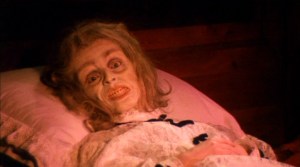
In many ways, The Drop of Water is the simplest segment of the film but for me, personally, it’s also the scariest. In London, a nurse (Jacqueline Pierreux) is called to a large house to prepare a medium for burial. While doing this. the nurse notices a large (and, quite frankly, kinda gaudy) ring on the medium’s finger. The nurse steals the ring and returns to her own apartment. As soon as she goes to her apartment, she finds herself haunted by increasingly ominous events: a buzzing fly refuses to leave her alone, the sound of water dripping echoes through the apartment, the lights go on and off, and — naturally — a mysterious figure suddenly appears in her bedroom.
Mixing the sense of growing paranoia that characterized The Telephone with Wurdolak’s sense of predestined, metaphysical doom, The Drop of Water is the perfect concluding chapter of Black Sabbath. It also happened to scare the Hell out of me. Along with Bava’s usual superb direction, this film was distinguished by some wonderfully creepy make-up work. Seriously, once that mysterious figure reveals itself, you’ll wish it hadn’t.
I usually don’t enjoy compilation films because, too often, it seems that you’re lucky if you get just one above average story surrounded by a bunch of forgettable filler. Far too often, the stories themselves don’t seem to go together. Instead, they just appear to have been tossed together randomly with the weakest of possible connection. Black Sabbath is an exception and that’s largely because of Mario Bava’s iconic direction. The stories aren’t linked together by plot as much as their linked together by motif and theme. Each story — from the emphasis on isolation to the creative use of color to suggest mood and menace — is linked by Bava’s style. Boris Karloff may have been the name emphasized in the credits but the true star of Black Sabbath is Mario Bava.
The genius of Bava wasn’t in the originality of the stories he told but instead, in the new ways that he found to tell familiar stories. Usually, I hate it when directors describe themselves as being about “style” as opposed to “substance.” Too often, it seems like that’s just an excuse to not come up with an interesting story. However, Bava is one of the few directors about whom the term “style over substance” can be used as a compliment. Bava knew how to make style into art and he certainly did that in Black Sabbath.
Later tonight, I’m going to watch Mario Bava’s Black Sabbath but before I do, I want to take a few minutes to review another one of Bava’s films, 1965’s sci-fi/horror hybrid Planet of the Vampires.
Taking place in the far future, Planet of the Vampires begins with two space ships receiving a distress call from an unexplored planet. While landing, the two ships are separated from each other. As the Argos lands, its crew is possessed by an unknown force and suddenly start trying to kill each other. Only the ship’s captain (Barry Sullivan, who gives a surprisingly good performance in a role that most actors would have just sleepwalked through) is able to resist and he manages to snap the rest of the crew out of their hypnotic state.
Once the Argos lands, search parties are sent out to find the other ship. They find themselves on a barren planet where the surface is obscured by a thick, multi-colored fog. As they wander through the planet, it quickly becomes apparent that they aren’t alone. The searchers may have left the ship as human but they return as something else all together. It all leads up to a surprisingly bleak conclusion.
If the plot of Planet of the Vampires sounds familiar, that’s because it’s probably one of the most influential, if not widely known, films of all time. The film has been imitated in several other, far more expensive films but few of them manage to capture Planet of the Vampires’ sense of isolation and impending doom. With this film, Bava again showed that he was one of the few directors wh0 could accomplish so much with so little. While this isn’t an actor’s film, fans of Italian horror will squeal with delight to see Ivan Rassimov pop up here in a small role.
I’ve mentioned Planet of the Vampires before on this site when I was giving 10 reasons why I hated Avatar. To me, Planet of the Vampires stands as proof that you don’t need a gigantic budget to make an effective horror (or sci-fi film). In fact, often times, all a huge budget does is shut down the audience’s imagination and quite frankly, nothing on film will ever be as impressive as what the audience can imagine. With Planet of the Vampires, all that Mario Bava had to create an alien world were two plastic rocks and a smoke machine. Working without the crutch of CGI, Bava had to pull off most of the film’s special effects “in camera,” and he would later say that one of the benefits of all that smoke was that it helped to obscure just how low budget this film was. In short, Bava was working under circumstances that James Cameron would refuse to even consider and yet Planet of the Vampires holds up better upon repeat viewings than Avatar ever will. The low-budget forced Bava to emphasize atmosphere over effects. Yes, this film has its share of gore (it’s an Italian horror film, after all) but ultimately, this is another example of a horror film that works because of what it doesn’t show. This is a film that exploits your imagination, working its way into the darker corners of your consciousness. Bava creates a palpable atmosphere of doom that makes Planet of the Vampires into a surprisingly effective film.
For my first horror review of October, I want to tell you about a movie that was directed by one of my favorite Italian filmmakers, Lucio Fulci. That movie is the unjustly neglected Gato nero, or the Black Cat.
In The Black Cat (loosely — and I do mean loosely — based on Edgar Allan Poe’s short story), the great David Warbeck plays a detective who is sent to a small English village to investigate a series of mysterious deaths. Corpses are turning up covered in scratches. A man crashes his car after a black cat suddenly shows up in the passenger’s seat. A young couple is found dead in a locked-up boathouse. Evidence suggests that the killer entered through a small air vent. No human could fit through that vent but…how about a cat? Warbeck enlists the aid of a visiting American photographer (Mimsy Farmer) to investigate the crimes and he soon comes across a half-crazed medium (Patrick Magee) who just happens to own an adorable, if ill-tempered, black cat…
Fulci is well-known for directing such seminal (and gory) horror films as Zombi 2 and The Beyond trilogy. The Black Cat was made during the same period of time as his more infamous films but it has never received as much attention. Perhaps that’s because The Black Cat almost doesn’t feel like a Fulci film. The gore is played down, the plot is coherent and (for a Fulci film) surprisingly linear, and the film even has a playful sense of humor to it. Indeed, this often feels more like a minor, if entertaining, Hammer film than a Fulci film. However, visually, this film is clearly the work of Lucio Fulci. With his constantly prowling camera following isolated characters through dark streets and passageways, Fulci manages to make a small English village feel just as menacing as the dying Caribbean island from Zombi 2. For all the attention given to Fulci as a “master of gore,” the true strength of his best films came from Fulci’s ability to create a palpable atmosphere of dread. Fulci used gore as a tool but not as a crutch and if The Black Cat is a minor Fulci film, it’s still a film that proves that he was a far better director than even many of his fans give him credit for.
The Black Cat is surprisingly well-acted by a cast that’s made up of an appealing combination of Fulci regulars and English B-movie veterans. I read an old interview in which Warbeck complained that he felt his performance here was “boring,” but actually he was the perfect lead for this type of film, likable and with enough of a sense of humor to keep you watching. Al Cliver may not be a household name but he and his blonde mustache seemed to show up in just about every movie Fulci made and he shows up here as well. This time, he’s playing a local English constable and he’s no more believable here than he was playing a scientist in The Beyond or a boat captain in Zombi 2. Still, any true Fulci fan will always be happy to see Cliver show up in a Fulci film because — much like familiar but bland wall paper — he lets us know that we’re home. Patrick Magee is probably best known for his over-the-top performance as Mr. Alexander in A Clockwork Orange. Magee goes just as much over-the-top here but, just as in A Clockwork Orange, Magee’s performance fits in perfectly with the film he’s appearing in. Much as Stanley Kubrick contrasted Magee’s performance with Malcolm McDowell’s more subtle work, Fulci contrasts Magee’s theatrical approach with the more relaxed performances of Warbeck and Farmer. Did I just compare Lucio Fulci to Stanley Kubrick? Yes, I did and I stand by it.
However, the real star of this film is the black cat. Trust me, this black cat (or black cats as I imagine several were used) is both adorable and blood-thirsty. I still say that our cat Doc is the cutest black cat in the world but this film’s murderous feline comes in a very close second.
As I try to put into words my reaction to the new film Dream House, one phrase comes to mind:
Bleh.
Dream House is about this guy played by Daniel Craig who we’re told, at the start of the film, is a writer. He’s moved out to his “Dream House” out in the middle of one of those cinematic suburban communities. He shares his dream house with his wife Libby (Rachel Weisz) and his two little girls. However, things aren’t quite what they seem. The girls keep seeing a shadowy figure watching them. Teenagers keep performing Satanic rituals in the basement. Craig’s neighbor looks just like Naomi Watts. Oh no! Has he been sucked into Mulholland Drive!?
No, not quite. Instead, he’s just found himself trapped in a painfully slow movie that takes itself and it’s half-baked plot way too seriously. This film is being advertised as if it’s a horror movie but there’s nothing scary about it and it’s almost as if the film itself is refusing to lower itself to providing us with any “cheap” thrills. The film instead is a mystery but it’s one of those mysteries where we discover the solution not through any artfully placed clues but instead by random characters showing up and having flashbacks.
There’s a big twist about 80 minutes into this 99 minute film and, as a reviewer, I know that it would not be right for me to spoil that twist. Fortunately, however, Morgan Creek Productions decided to include that twist in the film’s trailer so, if you want to know, here you go:
Again, it takes this film 80 minutes to reach the twist that the trailer reveals after 1 minutes and 17 seconds. So, as a result, you spend the first 80 minutes going, “Okay, we know…” Once the twist is revealed, there’s only 18 minutes to wrap up the film’s plot and this is done in the clumsiest way imaginable.
Now, one reason for this might be that the film’s producers reportedly clashed with director Jim Sheridan and eventually took the film away from him. Sheridan, Craig, and Watts have all refused to do any promotion for the film and have publicly stated that they hate the version that has been released. I don’t know. My natural impulse has always been to side with the artists as opposed to the corporate people. After all, we’ve all heard about what happened to Erich Von Stroheim’s original cut of Greed and about what Terry Gilliam went through with Brazil. Still, it’s hard to look at the assembled footage and see any hint that this film could have been anything more than the film that’s currently playing at your local theater.
When I told Arleigh about my feelings towards Dream House, he asked me if I felt it was the “worst one of the year.” I wouldn’t go quite that far. Dream House is forgettable but it’s not as pompous as The Conspirator or as insulting as Straw Dogs.
Last night, I actually put off watching Dancing With The Kinda Stars so that I could catch the first episode of Fox’s much-hyped sci-fi series, Terra Nova. This show was produced by Mr. Mainstream himself, Steven Spielberg.
Why Was I Watching It?
I was beaten into submission by the nonstop commercials. Now, I have to admit that the commercials seemed to represent everything that I traditionally dislike in my entertainment: political subtext, “inspiring” speeches, and Stephen Lang. However, it also had dinosaurs and seriously, who doesn’t love dinosaurs?
What’s It About?
Okay, we’re several years into the future and the Earth looks a lot like Blade Runner. Why? It turns out that Al Gore was right and ManBearPig has basically messed up the entire planet. However, there is hope! There’s some sort of tear in the whole space-time continuum and stepping through it allows a few lucky citizens to go back to the Island from Lost. However, since this is the FAR future, nobody remembers Lost so they think they’ve actually gone back to the prehistoric past. In the prehistoric past, time travellers are living in a small community that is overseen by a vaguely menacing guy who we suspect might secretly be evil because he’s named Nathaniel and he’s played by Stephen Lang.
Anyway, there’s this family that has issues in the future and since Jeremy Kyle is long dead (we can only hope), they can’t go on TV to work it out. So, they go through the time portal. The father — who is a fugitive from future law — quickly becomes a part of Nathaniel’s security force. Meanwhile, the teenage children get all rebellious and there’s these guerillas who live outside the compound and they’re led by a woman who might as well have been played by Michelle Rodriguez but wasn’t.
Oh! And there are dinosaurs! Yay!
What Worked?
The show is filmed in Australia and, as a result, it’s really pretty to look at.
I make fun of Stephen Lang a lot because I honestly believe that he gave one of the worst performances in cinematic history in Avatar. (Fortunately, he was acting opposite Sam Worthington, who can make anyone look like an Olivier by comparison.) But, I have to admit, Lang is well-cast here and comes the closest to anyone in this episode to actually being memorable.
The dinosaurs are impressive and fun to watch. Unfortunately, the fake dinosaurs often displayed more personality than the living actors but still, who doesn’t love dinosaurs? Hopefully, in a future episode, the annoying and way too English talk show host Jeremy Kyle will come through the portal and get devoured (in slow-motion) by one of the dinosaurs. I may start a letter-writing campaign.
What Doesn’t Work?
A lot.
My biggest complaint with the show was that this episode really put the sloth into the giant sloth. Seriously. Lost took its time as well but the show itself was never boring. Terra Nova, at least in this episode, seems to feel that elaborate special effects are a proper substitute for interesting characters, witty dialogue, and anything else that might organically create narrative momentum. I actually ended up falling asleep during the final 30 minutes of the show and had to watch the finale off of the DVR.
The dinosaurs were impressive but the rest of the show’s special effects were rather predictable and a little on the bleh side. The time portal looked like every other time portal in the history of science fiction and the dystopian future looked a lot like Blade Runner but without any of the small details to make it feel like anything other than CGI.
I am officially bored with shows that use global warming as a plot point. Seriously, they’re always so smug about it.
This show is being compared, by many people, to Lost. Like Lost, the scenery is beautiful and the plot has the potential for a lot of secrets and mysteries to be uncovered. However, Lost also had a lot of quirky, interesting characters and that’s something that Terra Nova, on the basis of this episode, is lacking. The first episode of Terra Nova felt a lot like Lost if Lost had only focused on Jack Shepherd and Michael Dawson. Terra Nova needs its own Sawyers, Hurleys, and John Lockes.
Now, I want to make clear — my comments here are strictly based on seeing Genesis and a lot of my criticisms could be due to the fact that it’s just the first episode. Hopefully, as a series, Terra Nova will — much like Lost and Fringe and other comparable shows — evolve beyond the strengths and flaws of the first episode.
“OMG! Just like me!” Moments
Much like Nathaniel’s rebellious daughter, I would also go a little stir crazy if I was stuck in that highly regimented, socialistic commune. Seriously, the commune looked like a really bleh place to live.
Here’s one thing I’ve learned about relationships – sometimes, you have to compromise. Sometimes, you have to do things for your man that you’d rather not do and you have to pretend like you’re enjoying it and sometimes, you even have to do it several times before you get what it is that you want. Case in point: I recently went to two sports films with Jeff.
Now, I have to be honest. I don’t know much about sports in general and quite frankly, I really have next to no desire to know. Why am I so indifferent to this thing that most men appear to be incapable of living without? Well,
1) I have asthma and therefore, I never got to play any of the games that all the other kids were playing. This led to me becoming bitter towards those who could actually breathe and have fun at the same time and,
2) I’m a girl.
My indifference to sports tends to extend even to cinematic sports. Seriously, most sports-related films either put me to sleep or lead to me making a lot of snarky comments under my breath. However, I recently forced Jeff to accompany me to see One Day, which is one of the most girly movies ever made. In fact, it was such a girly movie that I’ve had to see not one but two sports movies with Jeff. The first was Warrior and the second (which we saw on Saturday) was Moneyball.
I don’t quite feel qualified to review Moneyball because, to be honest, I couldn’t make heads or tails of what was going on during most of the film. Normally, I would just say that this was a sign of failure on the film’s part but the audience around me really seemed to love this film and so did Jeff. So, I’m going to refrain from judging Moneyball too harshly. Instead, I’ll simply state that this film was not for me but if you’re a baseball fan (and you really love to get into the nitty gritty details of how a baseball team is put together), chances are that you’ll enjoy this film.
Fortunately, there are a few things that help make Moneyball a tolerable experience even for a sport illiterate like me. The film tells the story of Billy Beane, the general manager of the Oakland A’s and how he turned the A’s into a winning team by revolutionizing the way that teams are put together. I’m not really sure what he did that was revolutionary because the film itself really doesn’t spend too much time explaining how his method is different from the previous method. It spends a lot of time telling us that his approach is different but Aaron Sorkin’s script seems to assume that everyone in the audience already knows how baseball works. (That’s not necessarily a slam against the film, either. It’s a baseball movie, after all.) Luckily, Brad Pitt, who gives such a mature and multi-faceted performance here that you hope that Billy succeeds even if, like me, you’re not really sure what he’s talking about half the time, plays Billy Beane. Seriously, this was the first time I’ve ever watched Brad Pitt and forgotten that I was watching Brad Pitt. Pitt is ably supported by Jonah Hill, who plays his assistant and is largely responsible for introducing Pitt to the “new” system. Hill plays his scenes with all the enthusiasm of a high school nerd who has finally forced the cool kids to acknowledge how much smarter he is than them. It’s a truly endearing performance and again, you find yourself rooting for Hill even if you can’t quite understand what he’s going on about half the time.
Again, if you’re a sports fan or a fan of statistics (which I am not because seriously, math is just one big bleh to me), you’ll find a lot of to enjoy in Moneyball. I wish the film had been a bit more accessible for someone like me but obviously, I’m not that target audience and, regardless of whether you’re a sports fan or not, director Bennett Miller keeps the action moving quickly and the performances of Pitt and Hill both hold your attention.
Warrior takes place in the world of “mixed martial arts,” which I assume is the new big sport. I say assume because I actually know even less about the world of mixed martial arts than I do about baseball. Before going in to see Warrior, all I knew about MMA and the Ultimate Fighting Championship was that Russell – one of the most unlikable Big Brother houseguests ever – was apparently a UFC contender. Or maybe it was Jesse. I don’t know. I have trouble keeping all the Big Brother houseguests straight, to be honest.
Warrior is the story of two brothers. One of them is a bitter, pill-popping ex-Marine who fights because he’s angry at the world. Tom Hardy plays him. The other is played by Joel Edgerton and is presented as a happily married teacher who is fighting because he’s flat broke and in danger of losing his home. The two brothers haven’t spoken in years and about the only thing they have in common (beyond the fact that they’re both good at fighting) is a shared hatred for their father (a quite poignant Nick Nolte, doing wonders in a role that seems almost too perfect for him), a recovering alcoholic who sees his sons as his only hope for redemption. Ultimately, the parallel fighting careers of the two brothers leads to a surprise family reunion in Atlantic City where they find themselves both competing in the same brutal, winner-take-all tournament.
Warrior tells a pretty familiar story and there are a few plot developments (such as Hardy’s AWOL status from the Marines) that feel undeveloped but the film still works about a hundred percent better than it has any right to. Director Gavin O’Connor wisely takes a low-key approach to the film’s more melodramatic moments and brings a sense of gritty realism to the beginning of the film that provides quite a contrast to the later gaudiness of Atlantic City. Nolte and Edgerton both give excellent performances and, after years of being best known for his mug shot, it’s nice to see what a strong and multifaceted actor Nick Nolte actually is. However, the film truly belongs to Tom Hardy. In this film, Hardy is a true force of nature and gives a performance that is both frightening and sympathetic at the same time. You want to reach out and give the poor guy a hug even though you know he might end up killing you in response.
Coming out of Warrior, I still didn’t know much about MMA but I did know that I had just seen a well-made, emotionally satisfying film.
Have you seen The Guard yet? If you haven’t, you need to. This deceptively simple (and violent) Irish film is one of the best films of the year so far. It’s also one of my personal favorites.
Boyle (played by the great Brendan Gleeson) is a casually corrupt but well-meaning Irish policeman who appears to have settled into a life of quiet complacency. He spends his time caring for his aging mother, bragging (and perhaps lying) about his past career as a competitive swimmer, entertaining prostitutes, and taking the occasional acid trip. As there’s little real crime taking place in the small coastal village that he calls home, Boyle is free to spend his workday playing video games and ignoring his far more serious partner, a rookie named McBride (played by Rory Keenan). McBride is married to a mail order bride and, beneath his straight-laced exterior, has a secret of his own. Things start to pick up for Boyle and McBride when an unidentified man is brutally murdered in a manner that suggests he fell victim to Satanists. Meanwhile, cocky FBI agent Wendell Everett (Don Cheadle) is in the village, searching for three viscous drug smugglers (played by Liam Cunningham, Mark Strong, and David Wilmot). Despite Wendell’s condescending attitude and Boyle’s own casual racism, the two of them soon discover that their two cases are connected and that there’s more to Boyle than originally meets the eyes…
In almost every way, The Guard is a triumph. Director John Michael McDonagh (whose brother Martin directed Gleeson in In Bruges) finds a perfect balance between comedy and tension and manages to maintain it throughout the entire film. McDonagh has a wonderful eye for detail and the entire film is full of memorable characters who are quirky without ever being silly. Though the villains (and their ultimate evil scheme) will be familiar to anyone who has ever seen an action film, Cunningham, Strong, and Wilmot are all believably ruthless and intimidating. Don Cheadle is perfectly cast as the straight-laced Wendell and the film has a lot of fun with his “fish-out-of-water” attempts to bring American justice to the Irish coast.
However, ultimately, this film is all about Brendan Gleeson. For decades, Gleeson has been one of the most dependable character actors in the movies. Whether he was playing a villain or a hero and regardless of the size of his role, Gleeson has always made an impression and he’s always left filmgoers like me wanting to see more of him. Well, in The Guard, Gleeson gets to show us exactly what he can do and the result is one of the best performances of the year. Whether he’s greeting a prostitute in an immaculate three-piece suit or having a secret meeting with the local representative of the IRA, Gleeson dominates the entire film and, most importantly, keeps us guessing about just who Boyle is. Gleeson triumphs in The Guard and the end result is one of the best films of 2011.