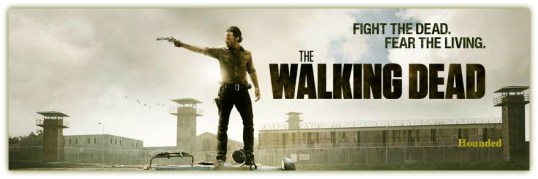
Review: The Walking Dead S3E06 “Hounded”


“Eat. Drink. Be Merry. Tomorrow we die.” — Phillip “The Governor” Blake

We’re now over a third of the way throughseason 3 of The Walking Dead. The season began in such a fast pace that it almost as if the writers were trying to exorcise the demons of the very deliberate and pastorial season 2. The question that now arose was whether the writers will be able to keep the fast pace going through most of the season. There was bound to be some slow spots through the 16-episode run for this season, but the series seems to have avoided it, so far.

“Hounded” marks the sixth episode this season. Last week’s episode was a break from the action and this break continues with tonight’s episode. We get a pre-credits opening of Merle leading a small group of Woodbury tough guys on a hunt to find newcomer and resident badass Michonne. It would seem her suspicions about the Governor and the “idyllic” Woodbury was right on the nose. Before we can say “look it’s Evil Glenn” the Merle quartet was suddenly down two men, but Michonne gets winged by a Merle shot for her troubles.

After the intro credits we find ourselves back in the prison with Rick as he’s speaking to the voice on the phone which ended last week’s episode in a cliffhanger. Everything Rick ever wanted since the first season he hears from the female voice on the phone. A haven that’s safe from zombies, raiders and internal struggles. It’s a call from paradise that Rick has wanted for his family since he reunited with them midway through season 1.

The episode concentrates on these two paralleling storylines with some visits back in Woodbury to see how Andrea continues to fall under the Governor’s spell and just reminding everyone why she’s now the most hated character on the show now that Lori has exited. It’s these Andrea scenes that seem to slow tonight’s episode even more than it already has. It doesn’t help that the writers haven’t been able to find a way to course-correct the character after two season’s worth of a bungled job. Maybe it’s a character that’s broken beyond fixing or the actress portraying her (Laurie Holden) who always comes off in every scene as being too cocky for her own good. There’s still time to get this character turned around, but with Mazzara and company already making good on correcting the show’s past season mistakes both in it’s storytelling and in underused and underdeveloped character I don’t see much hope that Andrea will survive the season (plus she seems to be the last of the original Darabont veteran troupe hired for the show initially).

We find that the hounding of Michonne by Merle mirrors the hounding of Rick by those on the other side of the phone. While the former was one storyline that was a literal hounding the latter was a psychological one as Rick realizes that those he has been speaking to were not as he thought they were. We see Rick finally have the proper breakdown into grief at Lori’s death that the previous episode didn’t even attempt to do. We hear him confess his regret for not being able to keep his family safe and finally admitting that he still loved his wife and would do anything to get her back to tell her that.

It’s a lot to process and the episode suffered because of it. The scenes back in Woodbury did nothing other than make Andrea look even worst as she finally succumbs to the Governor’s charms. It’s this inconsistency in her character that has made her such a frustrating character to believe in. One moment she’s regretting not listening to Michonne then the next moment she’s in with the Governor. These scenes took away from the two storylines that dominated tonight’s episode. With just those two the episode was already stretched thin as it was.

So, tonight’s episode might have been a lot of set-up for what looks to be the long-awaited confrontation between Team Rick and Team Governor, but it also looks like it’s the third season’s first truly weak episode. We don’t learn anything new about any of the character old and new. We do get reminded that some of the show’s past mistakes still linger and keeps it from really taking off. So, the question about whether the writers will be able to keep season 3’s pace of quality tv has been answered. It’s just one episode but it highlighted just how much improvement the show still has to go. Fortunately, we’re not getting a sense that the writers intend to keep subplots from dragging along (the Sophia and Greene Farm being great examples of pacing killers). Now it’s time to see if the Mazzara Crew can get back on track with the final two episode of the season before it goes on a winter break.

Notes

  • Tonight’s episode was directed by series newcomer Dan Attias and written by series regular Scott M. Gimple.
  • Evil Glenn, we hardly knew you and now you’re gone.
  • Andrea just will continue to be the new target of hate for fans of the show. She just seems to always have smug look on her face even when she has no reason to be smug about.
  • Her skill in killing the zombie outside the wall did show that she’s probably one of the better killers in Woodbury outside of Merle and the Governor himself.
  • Hershel looks to be taking over as the voice of conscience for Rick. He looks to be taking on the role in the show that was originally taken by our dear departed Dale Horvath.
  • Rick must’ve really gone on a major killpocalypse in the prison in the previous episode if things were clear enough for Hershel to limp his way through safely.
  • Merle builds the kid’s courage up and just as easily takes it away with a bullet.
  • The Maggie and Glenn duo continue to be a very cute thing in a show that’s very lacking in the cute department.
  • Maggie continues to be this show’s version of the comic book Andrea which means she’s the team’s female badass until Michonne comes along.
  • Interesting how the show continues to deviate from the comic book’s narrative but still manages to create new scenes reminiscent of what was on that path not taken.
  • Nice how Glenn stays consistent with how he treats outsiders after mentioning in last week’s episode that the group should be very wary of anyone that’s not part of the group.
  • It seems like the show is setting things up to have a Dixon Brother showdown.
  • Nice to see the writers making sure that subplots introduced this season that has a chance to slow things down considerably get some sort of resolution: missing Carol and mysterious phone call.
  • Not many zombie kills this week, but the magicians over at KNB EFX still managed to make what kills there were memorable: zombie stomach sliced open and out slides out the goods.
  • Zombie Kill Count of tonight’s episode: 5

Past Season 3 Episode Review
  1. Episode 1: “Seed”
  2. Episode 2: “Sick”
  3. Episode 3: “Walk With Me”
  4. Episode 4: “Killer Within”
  5. Episode 5: “Say the Word”

A Blast From The Past: The Snob (1958)


I love watching the old educational films from the 1950s.  Whether they are dealing with the threat of outside agitators, the need for families to eat dinner together, or the importance of obsessive grooming, these films often provide an interesting view into the past.

(Though, as far as I’m concerned, obsessive grooming is a theme that will never get old.)

Two weeks ago, I first came across The Snob on YouTube.  In the days since I first saw it, this 13-minute educational film has become something of an obsession of mine.  Some of this is because this film deals with a universal subject.  Though I don’t think I’ve ever been a snob, I’ve certainly known a few.  Even more importantly, everyone in this film is just so intense.  If Edward Albee wrote an educational film, it would have been a lot like The Snob.

Also, is it just me or is the kitchen scene between Sarah and her father kind of creepy?

James Bond Review: Casino Royale


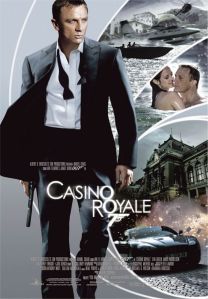
Welcome, one and all! Leading up to the North American release of the latest James Bond film, Skyfall, The Shattered Lens has taken on the task of reviewing each and every one of the twenty two James Bond films that precede it. Today’s is the penultimate review, Casino Royale, the first film of the series to star current-iteration Bond Daniel Craig. It serves as a reboot of the James Bond character, looking back to the beginning of his career, and entirely unconnected from all of the previous films in the series. The only returning actor is Dame Judi Dench, who reprises her role as M, in a more maternal overseer role looking out for a young Bond, despite his rash actions potentially causing trouble for MI6.

Our cold open this time has a black and white Bond confronting a crooked MI6 section chief – one who has been selling secrets to make money on the side. Bond kills both the section chief and his contact, which is enough to earn him his 00-status. The freshly minted 007 heads to Madagascar in pursuit of an international bomb maker. He attempts to find a way to apprehend the bomb maker alive, but is made, and is forced to pursue this man across the city. Bond eventually corners the bomb maker in an embassy building and kills him, blowing up part of the wall, and effecting his escape.

Back in England, M chides Bond for his itchy trigger finger, pointing out that while the world has one less small-time terrorist, they had hoped to get information which would let them fight international terrorism on the organisational level. Bond seems suitably chastened, but M goes further, asserting that she promoted Bond too early, that he is reckless, and a danger. Bond coldly replies that, since the 00-agent’s life is not typically a long one, she will not have to live with her mistake for long.

That’s the sort of Bond that we’re dealing with under the handling of Daniel Craig. While the character is still capable of being charming, he’s a very far cry from Sean Connery’s easy smile and one liners, or Pierce Brosnan’s especially terrible puns. This is sort of the crux of the movie; what controversy exists surrounding its qualities is heavily tied into how you respond to this new take on James Bond. Like all things 2000s, our hero is much grittier than before. Absent is all of Q’s high tech wizardry, and as I stated before, we are not even dealing with a seasoned killer in James Bond, but rather a freshly minted 00 agent. As a result of all these factors, this film has a distinctly different feel from every Bond produced before it. If you like the changes, everything is cool. If you don’t, you may still find yourself appreciating Casino Royale, which has a relatively simple plot, but spends quite a bit of effort on setting up and establishing its characters, including this new James Bond, for the audience.

The main plot of Casino Royale revolves around a high-stakes Texas Hold ‘Em tournament held at the titular casino, located in Montenegro. James Bond is assigned to win the tournament which is being staged by terrorist financier Le Chiffre (Mads Mikkelsen) to recoup the terrible losses he suffered when he used the money of his clients to short sell stock, predicting that a terrorist strike which he himself had planned would send prices into free fall. M hopes that by pushing Le Chiffre to the point of desperation, they can force him to cut a deal with MI6 – sanctuary in exchange for everything he knows about terrorists around the world. Bond is assisted in his goal by fellow MI6 agent Rene Mathis (Giancarlo Giannini) and Vesper Lynd (Eva Green), this iteration’s Bond girl, an agent from HM Treasury, who is assigned to manage Bond’s $10M buy-in, and to provide him with a $5M re-buy if she believes it would be a good investment. However, since a failure on Bond’s part would mean that Her Majesty’s Treasury was directly funding international terrorism, there is incentive to be cautious.

It takes us nearly an hour to begin to engage in the meat of the film, at the titular Casino Royale. Or, at least, this should be the meat of the film. However, the structure of Casino Royale is a little bit off. It feels like it has enough action, but it doesn’t feel properly paced, with the front half of the film (really just a series of subplots to get us to Montenegro) feels like classic “action Bond”. The scenes in the Casino could have been pulled (well, if Daniel Craig could smile, at any rate) from any other Bond film, as his history is littered with a rich litany of casino sequences. Before and after the casino sequences, however, are framing bits that involve idyllic locations, and if I may be so bold, it doesn’t exactly zoom along. The spacing between the casino sequences and the finale, in particular, made the final act feel very tacked on and a little out of place, even as deliberately intended setup for Quantum of Solace. This can also be off-putting, as it feels like there are two different movies going on here.

For the most part though, I think Casino Royale works. If you can live with a grimmer, grittier, low-talking James Bond, you may really appreciate this low-tech return to basics for our favourite 00-agent.

Tomorrow you’ll get a healthy dose of Quantum of Solace, but before I sign off, let me leave you with the theme from Casino Royale, one of the cooler James Bond themes in the franchise, performed by Chris Cornell.

Scenes That I Love: The Candidate


(SPOILER WARNING)

It’s election day!  Today is the day that American citizens select the person that they’ll be angry with for the next four years.  Have you voted yet?  I did and, after I turned in my ballot, this guy at the polling place told me that I was the prettiest voter that he had seen all day.  Awwwwww!

Today’s scene that I love is particularly appropriate for Election Day.  In The Candidate (1972), Bill McKay (played by Robert Redford) runs for the U.S. Senate.  Directed in a documentary fashion by Michael Ritchie, The Candidate features excellent supporting performances from Melvyn Douglas and Peter Boyle and it’s one of the best films ever made about the American political system.

The scene below takes place at the end of the film, after the votes have been counted.  And, of course, the entire scene is a spoiler so don’t watch it if you haven’t seen The Candidate.

Review: The Walking Dead S3E04 “Killer Within”


“No more kids stuff. People are gonna die. I’m gonna die. Mom. There’s no way you can ever be ready for it.” — Rick Grimes

[spoilers within]

This third season of The Walking Dead has been hitting 3 for 3 when it came to quality episodes. The surprising part is that the season is three episodes in. Last week we had an episode where Rick and the prison group never appeared. It was a well-done introduction for the new characters that will have a major impact on the series. With tonight’s episode, aptly named “Killer Within”, we return to Rick and the prison as they start to settle in their new safe haven (as safe as any place can be in a zombie apocalyptic world).

Tonight’s episode begins with a mysterious individual who seems to be up to no good within the confines of the prison fences. We see this person (all we see is that he’s dressed like a prisoner) using the carcass of a deer (or was it a wolf) t lure zombies into the prison and also taking an axe to the chains and lock that kept the gate secured. It’s an ominous beginning to an episode that would see a major reshuffling of the show’s cast of characters. To say that tonight’s episode was shocking would be an understatement. It was full of what fans and critics had been saying last season lacked. It had action pretty much through half the episode’s running time not to mention even the quieter scenes in the beginning of the prison segment and back at Woodbury led to something instead of just filling up airtime.

The mystery of the  “killer within” of the episode’s title was kept a secret until pretty much close to the end of the episode. It was quite surprising to finally find out who it was who had opened up the gates to the prison and turned on the prison alarm which was ringing the dinner bell to zombies within the prison and those still outside the fences. There’s some leaps of logic that someone watching tonight’s episode would need to get past as to how this “killer” was able to survive so long since episode two without being noticed, but the positives of tonight’s episode outweighed any failures in logic that one noticed.

With tonight’s episode we got to see how much Rick and Carl has changed since the end of the second season and this season. What exactly happened to the group during the 7-8 months they had been out in the Georgia wilds trying to survive day-to-day until they happened upon the prison. The writers have been very silent about whether there would be some flashback sequences that showed how the group survived the Fall and Winter. All we’ve seen this season was how those months out in the wilds had turned the group into a well-oiled survival machine that had one leader and everyone with a role they’d accepted and played. The fact that the group suffered no casualties during the time-off between season 2 and the start of season 3 showed that maybe being on the move was the best thing. They’ve just moved into the prison and started cleaning the place up and now two (maybe three) of their group has died.

One of the things which stood out the most with tonight’s episode is how much Carl has come to be just like his father this season. Last season, Carl had become a joke to the audience with is penchant to avoid his adult handlers and go off running into danger. His behavior and actions even led to the group losing one of their own late in season 2. Carl before this season was almost as if the writers had no idea how to write up a child character in a zombie apocalyptic world. One moment Carl was this helpless and naive child then the next he would act and talk tough like Rick or Shane. Both sides of Carl last season didn’t ring true, but we saw hints of changes to the character in the last two episodes. We see the result of the change in the show’s leadership and mission statement for season 3. Chandler Riggs has improved as an actor which goes to show that good writing will bring out the best in even the least experienced performer. While we find out who the killer within was the episode’s title could easily mean the arrival of a harder Carl who could be on the dark path to turning out to be a killer.

As for Rick, we see another instance where he seems to have left his idealism behind and accepted the fact that ruthless pragmatism was the new golden rule of this zombie apocalyptic world. He looks at strangers not with an open-mind or whether these new people would become helpful members of his group. No, Rick has taken an insular view of the world. If you’re not part of his group then you’re a danger waiting to happen whether that suspicion has credence or not. This mindset has kept his group alive since they left the farm after season 2 but it has also made him harder, colder and more ruthless to those in the outside looking in and, more importantly, even to some within his group.

Will tonight’s events finally become the final straw that breks Rick both emotionally and mentally or will it galvanize him even more to protecting his own and damn to everyone else. This Ricktatorship has suffered it’s first casualties and it should open up a whole new world of storylines moving forward. Idealistic Rick became a frustrating character to root for in the second season, but there’s also the danger of a despot Rick this season becoming too much on the other side of the personality spectrum. It will be up to Mazzara and his talented group of writers to balance Rick as a character where he still has some sense of the white hat sheriff’s deputy, but at the same time also knowing that he cannot let that very idealism endanger him and his people.

As an audience we’ve come to expect a season to spread out how much action and tense moments a drama series has the length of a season, but the writers of this series seem to be making up for all the “go nowhere” episodes of season two with a vengeance. I’ve been saying since the beginning of this season that we’re finally seeing the series’ take on the narrative style of it’s newest showrunner in Glen Mazzara who came up writing some of the best episodes of the FX cop drama The Shield over seven seasons. He and his writers seem to understandthat in a world as savage and cruel as the one in The Walking Dead having episodes where nothing happens outside of character debating and philosophizing about the nature of civilization and humanity wouldn’t make for very dramatic tv. the question that comes up now is whether the show will be able to sustain this streak of very good episodes over the length of season three.

NOTES

  • Tonight’s episode was directed by Guy Ferland and written by series newcomer Sang Kyu Kim.
  • Some levity involving Glenn and Maggie didn’t last the episode which looks to be the most nihilistic of the series to date.
  • Michonne may not be as chatty as Andrea this season, but she’s made her words count when she has spoken. Also very observant of not just her surroundings but her situation.
  • We come across a situation regarding strangers and their fate. Last season the group, especially Rick, would’ve debated all episode long and maybe into the next one about how to deal with the strangers. Another sign that this season has become a sort of reset for the series with Rick (with some help from Daryl) deciding not to change the agreement he has with the surviving prisoners.
  • Look between Rick and Lori before all hell broke loose looked like things may be thawing between the two.
  • Good to see the writers not making Hershel go through a bout of self-pity. He even made good use of the crutches when things got real stressful.
  • This now marks the third stressful and action-packed episode inside the prison. Writers have definitely taken to heart about the lack of action and tension that plagued Season 2.
  • Carl has definitely become a mini-badass like his father.
  • It had to happen and the sequence leading up to T-Dog finally getting bit was handled quite well. There was no mysterious zombie suddenly popping out of nowhere to chomp down on his shoulder. When he moved to close the gate one could see just before the scene switched away a zombie come into the frame and move up towards T-Dog who had his back turned.
  • Part of me thinks that disagreeing with Rick’s decisions is like people saying “NO” to Jack Bauer. It’s a sure way to get yourself killed either by Rick or some other way.
  • This season really hasn’t made Andrea a sympathetic character. I’m wondering if the writers have a new role for her in contrasts to how she was in the comics. I can definitely see her turning on the group and joining the Governor.
  • The Governor definitely has a way with him when it comes to getting his way. Andrea seems to be buying what he’s been selling her and even Merle seems off his game around him.
  • It’ll be quite a turn of events if this season we end up getting Merle rejoining the group as a helpful member while Andrea becomes the Judas.
  • We learn that the Governor’s first name is Phillip and that he has a young daughter. We also get to see him channel his inner James Bond villain with a scene of him doing practice golf swings at the zombies beyond Woodbury’s walls.
  • Carl’s reaction when Maggie told Lori to take her pant’s off was classic.
  • T-Dog went out a hero and his final scene was a nice shout out to a similar throat-rip scene from Day of the Dead (the original one).
  • We finally find out the answer to whether Andrew the prisoner who Rick left locked in the prison yard with the zombies died or lived.
  • Sarah Wayne Callies performance as Lori in tonight’s episode was some of her best to date.
  • For all the talk on Twitter about zombie babies I like to remind people that the best zombie baby ever comes courtesy of Peter Jackson.
  • We hear the shot but we never truly saw Lori die by Carl’s hand. Here’s to hoping the writers are not trying to pull a fast one on the audience.
  • Carl definitely turned a corner in tonight’s episode. This season we’ve seen that Carl’s become more useful and mindful that his past behavior had some fatal consequences. It’s not until tonight that we see Carl lose that final vestiges of his childhood behind and become the child-soldier Rick and his group need him to be.
  • For all his cold distancing from Lori we see that Rick still loved Lori in the end. Talk about heart-wrenching scene from Andrew Lincoln.
  • I have to give it up to Sarah Wayne Callies, Chandler Riggs, Lauren Cohan and Andrew Lincoln for bringing their A-game and more for tonight’s episode.
  • The monologue towards the end that really got to this hardened horror fan: “You’re gonna be fine, you’re gonna beat this world. You are smart, and you are strong, and you are so brave. You promise me you’ll always do what’s right. It’s so easy to do the wrong thing in this world. You promise me you’ll always do what’s right. It’s so easy to do the wrong thing in this world. So, if it feels wrong, don’t do it. Alright? If it feels easy, don’t do it, don’t let the world spoil you. You’re so good. My sweet boy. The best thing I ever did. I love you.” — Lori Grimes
  • Zombie Kill Count for tonight’s episode: 32.

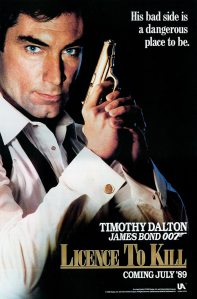
James Bond Film Review: Licence to Kill (dir. by John Glen)


Licence to Kill, which was initially released in 1989, was the 16th “official” James Bond film.  It was also the second and the last one to feature Timothy Dalton in the role of James Bond.  This is the one where Felix Leiter gets eaten by a shark, Bond resigns from MI6, and ends up going to Central America in search of revenge.  Sad to say, it’s also one of my least favorite of the Bond films.

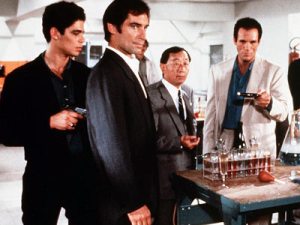
Licence to Kill starts out with Bond in Florida, attending the wedding of his best friend, Felix Leiter (played by David Hedison, who previously played the role in Live and Let Die).  However, before going to ceremony, Felix and Bond take a few minutes to arrest notorious drug lord Franz Sanchez (Robert Davi).  With the help of a crooked DEA agent (played by a wonderfully smarmy actor named Everett McGill), Sanchez escapes from custody.  Accompanied by his psychotic henchman Dario (Benecio Del Toro), Sanchez gets his revenge by killing the new Mrs. Leiter and feeding Felix to a shark.  When Bond discover the barely alive Felix, he also discovers a note that (in a scene borrowed from the novel Live and Let Die) reads, “He disagreed with something that ate him.”

Investigating on his own, Bond discovers that Sanchez’s partner in Florida is the wonderfully named Milton Krest (played by a brilliantly sleazy Anthony Zerbe).  Soon, James Bond is on a mission of vengeance that involves tracking down and killing every member of Sanchez’s organization.  However, M (Robert Brown) doesn’t like the idea of his best secret agent killing the entire population of Florida.  Bond responds by resigning from the service and heading to Central America on his own.

In typical Bond film fashion, James Bond manages to infiltrate Sanchez’s organization and Sanchez soon takes a liking to the man who has vowed to kill him.  Along the way, Bond romances both Sanchez’s abused mistress Lupe (Talisa Soto) and an ex-CIA agent named Pam Bouvier (Carey Lowell) and the viewers learn that Sanchez’s criminal enterprise not only involves drugs but also a crooked TV preacher (played by Las Vegas mainstay Wayne Newton) as well.

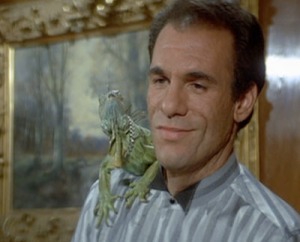
Let’s start with the positive.  Robert Davi, playing the role of Franz Sanchez, makes for a memorable villain.  Along with the silky charm and hints of madness that we’ve come to expect from Bond villains, Davi brings an almost perverse edge to the character.  Every line of dialogue that he delivers is practically dripping with decadence.  Whether he’s doting on his pet iguana, his main henchman Dario, or poor Lupe, Sanchez makes for a dangerously charismatic and compelling villain, one that feels like he would have been at home in one of Ian Fleming’s original novels.  Wisely, Davi plays his role almost as if he was playing James Bond and, as a result, the scenes that he shares with Dalton all have a crackling energy to them that is missing from the film as a whole.

In fact, almost all of the villains are compelling in this film, from Franz Sanchez all the way down to the lowliest henchman.  As played by a very young Benicio Del Toro, Dario is all smoldering intensity and arrogant swagger.  Smuggler Milton Krest is played by veteran character actor Anthony Zerbe and he gets one of the bloodiest death scenes in the history of the series.  However, I have to admit that my favorite bad guy was Sanchez’s business manager, Truman-Lodge (played by Anthony Starke).  Truman-Lodge is just so enthusiastic about the business opportunities that came along with allying oneself with evil that it’s rather infectious.

With such a memorable collection of bad guys, it’s a shame that the film didn’t provide them with any goals worthy of their evil talents.  In previous (and future) Bond films, far less interesting villains have still come up with plans to allow them to take over the world.  Even Moonraker‘s Hugo Drax was able to overcome his lack of personality and come up with a diabolical intergalactic scheme.  Meanwhile, Franz Sanchez — one of the most complex and impressive Bond villains of all time — is simply content to sell drugs and feed people to sharks.  It feels almost disrespectful to Davi’s performance that Sanchez’s goals are, ultimately, so boring.

And, in the end, I think that’s the main problem that I have with Licence to Kill.  The film feels so predictable.  There’s nothing about it that makes it comes across as a story that could only have been about James Bond.  Instead, it feels like the type of standard action/revenge film that always seems to come out every summer.  The film’s hero might be an Englishman named James Bond but he could just as easily be an American named Jake Sully.

According to Sinclair McKay’s invaluable history of the Bond franchise, The Man With The Golden Touch, Licence to Kill was specifically written to compliment Timothy Dalton’s more “realistic” interpretation of the Bond character.  As Dalton played Bond as grim and serious, Licence to Kill is a grim and serious film.  Innocents and villains alike die in bloody agony and, the few times that Dalton does smile, the expression looks so unnatural that you worry that his face is about to split in half.  Unfortunately, along with being grim and serious, Dalton’s Bond is also remote and uncharismatic and, with the exception of Robert Davi, he doesn’t have any chemistry with anyone else in the cast.  (Carey Lowell brings a lot of energy to the role of Pam but Dalton’s Bond never seems to be that into her.)  Dalton simply doesn’t make for a very compelling hero and, as a result, Licence to Kill ends up feeling like an empty collection of occasionally impressive stunts.

Licence to Kill holds a few dubious distinctions.  It was the least financially succesful of all the Bond films and it was also the last Bond film to be produced by Albert Broccoli and directed by John Glen.  It was also the last to feature Robert Brown in the role of M and, of course, it was also the last to feature Timothy Dalton in the role of James Bond.  (That’s not all that shocking when you consider just how miserable and bored Dalton seems to be in this film.)  Over the next six years, the Bond franchise would be mired in a lawsuit between Eon productions and producer Kevin McClory and when James Bond finally did return, he would do so in the form of Pierce Brosnan.

We’ll be taking a look at Goldeneye tomorrow.

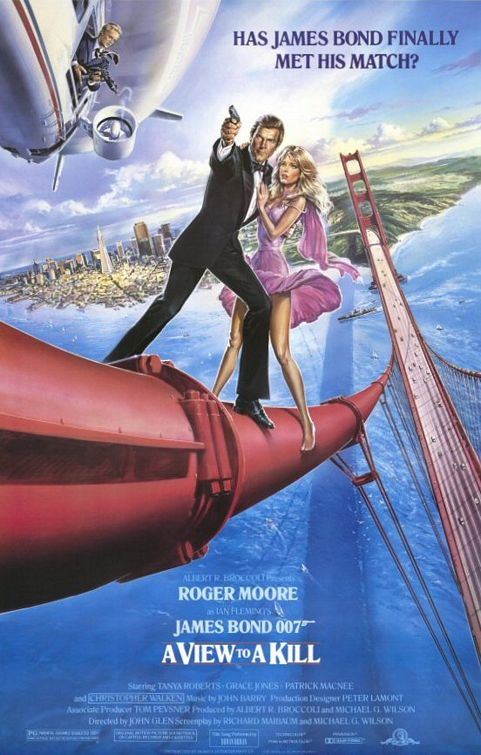
James Bond Film Review: A View to a Kill (dir by John Glen)


In the days leading up to the American premiere of Skyfall, the Shattered Lens has been revisiting the previous films in the James Bond franchise.  Today we take a look at 1985’s A View To A Kill.

Along with bring the 14th “official” Bond film, it was also the last to star Roger Moore in the role of 007.  On a personal note, it was also released the same year that I was born.  I have to say that I hope I’ve aged better than this film has.

Much like The Spy Who Loved Me, A View To A Kill opens with a ski chase between Bond and a bunch of Russians.  And while the chase itself isn’t all that exciting, it does lead to one of the better opening credits sequences of the Bond franchise.


Say what you will about A View To A Kill, it features the perfect theme song.  I first heard Duran Duran’s title song long before I saw the actual film.  After I graduated high school, I spent the summer in Italy and I can still remember hearing this song blaring from a loud speaker in Venice.  With it combination of exuberant music and incoherent lyrics, the song is the perfect soundtrack for both an American girl abroad and a mid-80s spy flick.

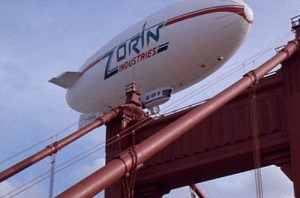
A View To A Kill finds James Bond investigating the mysterious industrialist Max Zorin (Christopher Walken).  Though Zorin is one of the world’s richest men, MI6 is suspicious of him.  Microchips manufactured by Zorin Industries are turning up in Russian submarines.  Perhaps even worse, it’s become apparent that, much like Auric Goldfinger, Zorin is a cheater.  He owns a champion racehorse but it’s rumored that the horse is somehow being given steroids.  MI6 sends Bond and racehorse trainer Sir Godfrey Tibbets (played, quite wonderfully, by Patrick Macnee) to investigate.

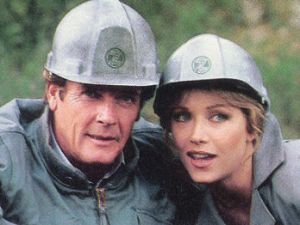
These scenes, in which an undercover Bond sneaks around Zorin’s estate in France, are my favorites of the film.  Moore and Macnee make for a likable team and it’s fun to watch the two veteran actors play off each other.  As well, since these scenes are more about detection than action, it’s easier to ignore the fact that Moore was 58 years old when he made A View To A Kill.

Unfortunately, the rest of the film doesn’t work as well and that’s unfortunate because A View To A Kill starts to get seriously weird as things progress.  It turns out that Zorin isn’t just a shady businessman.  No, he’s actually the product of Nazi genetic experimentation and, as a result, he’s both a genius and a complete sociopath.  What this means is that, opposed to previous Bond antagonists, Zorin spends a lot more time giggling and smiling as if even he can’t believe how evil he is.

Bond ends up following Zorin and his aide, May Day (Grace Jones), to San Francisco.  It’s there that Bond discovers that Zorin is planning on setting off a massive underground explosion, in hopes of causing an Earthquake that will totally destroy California.  This will allow Zorin to corner the world microchip market and make a lot of money but, for the most part, Zorin just seems to want to do it so that he’ll have something to talk about the next time he gets together with his fellow megalomaniacs.

Once everyone arrives in San Francisco, James Bond ends up teaming up with geologist Stacy Sutton (played by Tanya Roberts, better known as Donna’s mother on That 70s Show).  As for Zorin, he divides his time between holding business meetings on his blimp and laughing like a maniac while gunning down random people.

Seriously, it’s an odd film.

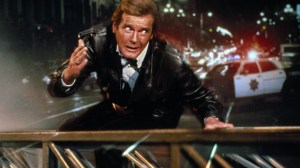
Whenever film critics are looking over the Bond films, A View to  A Kill seems to be the Bond film that’s destined to get the least amount of respect and admittedly, this is an uneven entry in the Bond franchise.  In Sinclair McKay’s excellent look at the oo7 films, The Man With The Golden Touch, Roger Moore is quoted as having been uncomfortable with just how violent A View To A Kill eventually turned out to be and, watching the film, he definitely had a point.  It’s odd to see Moore’s light-hearted approach coupled with scenes in which Zorin gleefully kills a thousand people in a thousand seconds.  It also didn’t help that, in this film, Roger Moore looked every bit of his 58 years.  Never have I been as aware of stuntmen then when I watched A View To A Kill.  Finally, Moore and Tanya Roberts have next to no chemistry together.

With all that in mind, A View To A Kill is something of a guilty pleasure and that’s largely because of the bad guys.

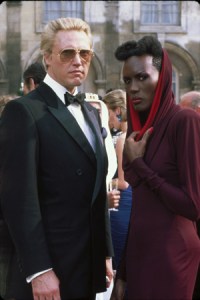
If anyone was born to play a Bond villain, it’s Christopher Walken and Max Zorin is an enjoyably over-the-top villain.  Whereas previous Bond villains were motivated primarily by greed, Zorin is the first Bond sociopath and Walken seems to be having a blast playing bad.  As opposed to the grim bad guys of the past, Zorin laughs and grins through the whole movie and Walken is a lot of fun to watch.  Regardless of whatever other flaws that the film may have, Max Zorin is rightly regarded as one of the best of the cinematic Bond villains.

As played by Grace Jones, May Day is one of the franchise’s most memorable and flamboyant villainous lackeys.   Much like Richard Kiel in The Spy Who Loved Me, Jones is such a physical presence that she dominates every scene that she’s in.  In their scenes together, Walken and Jones have the type of chemistry that’s so noticeably lacking between Moore and Roberts.

As I previously stated, A View To A Kill was Roger Moore’s final appearance as James Bond.  Before we started our look at the Bond films, I spent some time researching the history of both the franchise and the men who have played 007.  One thing that quickly became apparent was that nearly everyone agreed that Roger Moore is a nice, likable guy but that he didn’t bring much more than likability to the role of James Bond.  Having now rewatched the Bond films, I can say that Roger Moore’s performance as James Bond was and is seriously underrated.  Yes, Moore may have brought a light touch to the role but his interpretation of Bond was perfect for the films that he was starring in.  Much as it’s difficult to imagine Roger Moore in From Russia With Love, it’s just as difficult to visualize Sean Connery in The Spy Who Loved Me.  Moore’s greatest talent may have been likability but that likability kept the Bond franchise alive and Moore’s interpretation of the role deserves better than to be continually dismissed.  

With Roger Moore leaving the franchise, the role of James Bond would next be played by an actor named Timothy Dalton.  If Moore was the likable, fun Bond, Dalton was, in many ways, the complete opposite.  We’ll be taking a look at The Living Daylights tomorrow.

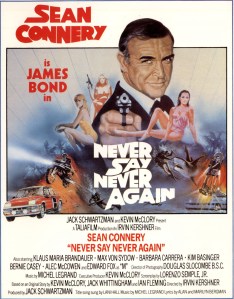
James Bond Review: Never Say Never Again


With the release of the latest James Bond yarn, Skyfall, imminent, the Shattered Lens has been looking back at every single James Bond film ever created – the entire history of the franchise. Today’s selection for review is 1983’s Never Say Never Again. Unlike the overwhelming majority of the franchise, this film was not produced by EON productions, but rather by an independent studio. It is an adaptation of Ian Fleming’s Thunderball, much like the 1965 film that shares the novel’s name. It also marks the return of Sean Connery to portray the film’s lead, 00-agent James Bond, 12 years after appearing in Diamonds Are Forever.

I have to say, when I entered into reviewing this film I was certain that I had seen it before, but it took only ten minutes or so of film action before I realized that this film, somehow, had completely flown under my radar.

I have to say, it does not make a strong first impression. We don’t get a cold open with Bond, but rather launch directly into the credit sequence with what I have to admit may be the worst opening theme song of the entire franchise. I haven’t even posted it here, I’m so embarrassed by it, but I’m sure a quick youtube search will yield some results. It’s lengthy, slow, and weirdly incongruous with what proves to be a fairly action-packed Bond adventure.

The story here is sort of needlessly complicated. Addressing the long lapse between Connery appearances as bond, M (Edward Fox) notes that he has recalled James Bond to service against his will, and that after failing a routine training exercise, that Bond is in unacceptable physical condition. His first assignment? To proceed to a health spa to be placed on an exercise and dietary regimen to bleed all of the toxins out of his system, with a strong implication that Bond’s behaviour and mind-set are as much of a problem as his physical condition. While at the spa, of course, Bond becomes privy to a strange interaction between the beautiful nurse Fatima Blush (Barbara Carrera) and an accomplice with a bandaged face, one Jack Petachi (Gavan O’Herlihy). The duo spot Bond, and attempt to have him assassinated, but 007 is able to overcome the assassin and lives to fight another day.

We learn that both Blush and Petachi are agents of the infamous terrorist organization, SPECTER, headed by Ernst Stavros Blofeld (Max Von Sydow). In a convoluted plot, Jack Petachi will use a surgically implanted false eye to replicate the retinal scan of the President of the United States. Using this eye, he is able to arrange for two nuclear warheads to be placed aboard cruise missiles. Using strategically positioned transmitters, SPECTER’s agents then guide the launched missiles remotely, driving them into the sea where their agents can retrieve the nuclear weapons. With the warheads, Blofeld plans to hold the world hostage, forcing world governments into paying an annual tribute to SPECTER, or risk the annihilation of world cities in nuclear fire. Soon after, Jack Petachi is murdered by Fatima Blush, who throws a snake into his speeding vehicle, causing him to lose control and crash through a wall. She then plants a bomb in the vehicle and blows him sky high.

Responding to the crisis presented by SPECTER, M reluctantly reinstates the 00-agents, including James Bond. Bond is immediately assigned to track down the missing warheads.

From there, we’ll travel from the Bahamas, home of SPECTER agent Maximillian Largo (Klaus Maria Brandauer)’s massive yacht, Flying Saucer. Bond meets Domino Petachi, Jack Petachi’s sister, and Largo’s lover (Kim Basinger) and comes into conflict with both Fatima Blush and Largo himself. Bond will chase Largo from the Bahamas to France, into the Mediterranean, and out to the Middle East, with help from noted CIA agent Felix Leiter (Bernie Casey). The action sequences, once they get rolling in the second half of the movie, don’t really let up, and take us to an underwater finale where Domino finally kills Largo in revenge for the needless death of her brother.

For all that this film does right, I have to confess that this was definitely not my favourite James Bond film. The pacing seemed brutally uneven for much of the film, with the action sequences spaced too far apart. The film does spend a little effort winking and nodding at the earlier Connery Bond films, probably in part because Never Say Never Again was not developed by the franchise’s principle producers, EON. Although this film is a far cry from the extremely gadget and superscience-y Bond films that dot the landscape after Connery’s original departure, there is a definitively 80s quality to this film – especially in the film’s score, which at times is loud and invasive, and other times oddly subdued – which prevents it from ever fitting right in with the other Connery films.

The performances are pretty good all around. Sean Connery himself might never have taken a 12 year vacation from playing 007, the women around him are beautiful, and Brandauer is a flamboyant villain in the classic Bond style. Max Von Sydow is excellent in presenting yet another take on supervillain Ernst Blofled, though I thought he was more or less wasted in a very limited role.

If you are waxing nostalgic and just can’t live without one more trip with Connery as James Bond, you probably won’t find this film disappointing. Something about it never really struck a chord with me, however, and I came away thinking of it as a bit of a slog.

Join us tomorrow as we continue our odyssey through the history of James Bond with the slightly-silly but always-fun Octopussy. Until then, against my better judgment, I’ll leave you with the theme song to Never Say Never Again … remember what I said about the music score before you chance it though!

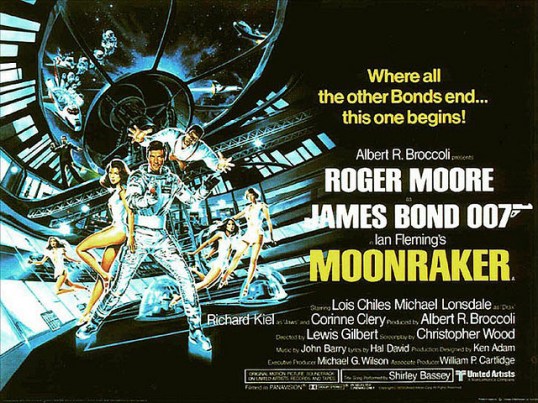
James Bond Film Review: Moonraker (dir. by Lewis Gilbert)


For the past two weeks, here at the Shattered Lens, we’ve been reviewing the James Bond film franchise.  We’ve reviewed the good, the bad, and the ugly of James Bond and today, we’re going to take a look at James Bond at his silliest.  Today, we’re going to review the 11th official James Bond film, 1979’s Moonraker.

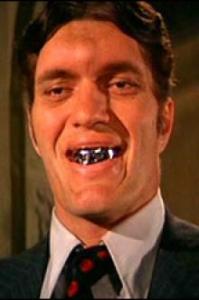
Moonraker starts out with a genuinely exciting pre-credits sequence.  James Bond (Roger Moore) is on an airplane when he’s suddenly attacked by the stewardess, the co-pilot, and Jaws (Richard Kiel), the henchman with the steel teeth.  All four of them end up falling out of the plane.  In mid-air, Bond wrestles the pilot’s parachute away from him and uses it to safely land on the ground.  The pilot and the stewardess presumably plunge to a very grisly death.  Jaws, meanwhile, crashes into a circus tent and walks away without a scratch.  This scene pretty much establishes the tone of Moonraker — increasingly implausible action sequences that usually end with some sort of crowd-pleasing joke.  In short, Moonraker is Bond as pure spectacle.  Those looking for another From Russia With Love should look elsewhere.

As for the rest of the film, someone’s stolen a space shuttle and James Bond and CIA agent Holly Goodhead (Lois Chiles) team up to find it.  It turns out that the shuttle was stolen by Hugo Drax (Michael Lonsdale), who plans to wipe out life on the Earth and start a new society in space.

That’s right, in space!

Moonraker was made in 1979, at the height of the cinematic science fiction boom.  In the late 70s, everyone was going into space and James Bond wasn’t going to get left behind.  Not surprisingly, it turns out that Drax has a secret HQ in a space station that’s orbiting the Earth and Bond is not only the world’s greatest secret agent but the universe’s as well!

It also turns out that Jaws is now working for Drax and his girlfriend Dolly (Blanche Ravelec) works in the space station.  I know that a lot of Bond fans hate Moonraker because of this very subplot but seriously, just take a look at the happy couple!  They’re so cute together!

I have to admit that I have mixed feelings on Moonraker.  On the one hand, it’s the most over-the-top of Roger Moore’s Bond films and it’s certainly the silliest.  Your reaction to it will depend on just how seriously you take or want to take your Bond films.  Myself, I appreciate Moonraker as a celebration of excess but, at the same time, I can also understand why so many fans of the Bond franchise consider Moonraker to be a low point for the series.

At its weakest, Moonraker feels almost like a generic Bond rip-off as opposed to an official Bond film.  It’s obvious that most of the preproduction attention was devoted to the film’s special effects.  The rest of the film feels almost like an afterthought and several of the sequences feel as if they’ve been lifted from other Bond films.  Bond’s initial meeting with Hugo Drax is reminiscent of the golf game in Goldfinger and both Drax’s evil scheme and motivation appear to have been borrowed from The Spy Who Loved Me‘s Karl Stromberg.

Especially when compared to his witty performance in The Spy Who Loved Me, Roger Moore appears to be simply going through the motions here and he has next to no chemistry with Lois Chiles.  One gets the feeling that Bond is merely with her so that he can brag to his mates back in London that he actually hooked up with someone named Holly Goodhead.  If her name was Holly Smith, he wouldn’t have any interest in her.

On the plus side, Michael Lonsdale makes for a good villain, the film’s special effects still look good over 30 years later, and I like the way that Jaws’ storyline is resolved.  I know that a lot of people hate the fact that Jaws softens up by the end of this film but I wouldn’t have it any other way.  Richard Kiel and Blanche Ravalec are so cute together that you simply can’t help but smile at their unlikely romance.

Finally, how can you not enjoy the curiosity value of having James Bond in space?  I’m not a huge sci-fi fan.  Whenever I hear people mention Dr. Who, Star Wars, or Star Trek, my eyes roll up into the back of my head and I end up zoning out for a few hours.  But there’s just something so odd and vaguely inappropriate about the idea of James Bond floating around in a space station with a laser gun.  If nothing else, Moonraker serves as a time capsule of the late 70s, a time when even James Bond could turn up in outer space.

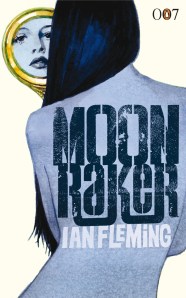
Much like The Spy Who Loved Me, Moonraker has little in common with the book that inspired it.  The literary Moonraker featured a villain named Hugo Drax but the Moonraker of the title was a nuclear missile.  Nobody went into outer space and there was certainly no one named Holly Goodhead.  Instead, Bond worked (and fell for) a fellow agent named Gala Brand.  It’s a shame that no one has ever filmed a faithful adaptation of Moonraker because it’s actually one of the best of the Bond novels.  Bond and Gala have a genuinely interesting relationship and the book has a melancholy, rather introspective feel to it.  Surprisingly, the end of the book deals with why none of Bond’s relationships last that long and makes an attempt to deal realistically with the psychological consequences of being the world’s greatest secret agent.

Surprisingly enough, the spectacular, effects-heavy Moonraker would be followed by the much more realistic and low-key For Your Eyes Only.  We’ll take a look at that film tomorrow.

Until then, here’s the Moonraker theme song:

James Bond Film Review: The Spy Who Loved Me (dir. by Lewis Gilbert)


For the past few days, the Shattered Lens has been taking a journey through the history of the James Bond film franchise.  Today, we continue that journey by taking a look at 1977’s The Spy Who Loved Me.  This was the 10th film in the “official” James Bond series and the 3rd to star Roger Moore as 007.  It was also the first of Moore’s films to be embraced by contemporary critics and it’s still considered to be one of the best films in the entire series.  It’s also one of my personal favorites.

The Spy Who Loved Me opens with one of the most of brilliant pre-credit sequences in the history of the franchise.  British and Russian submarines are mysteriously vanishing.  M (a returning Bernard Lee) summons James Bond (Roger Moore) to investigate.  Not surprisingly, Bond is with a woman at a ski resort when the summons comes.  As Bond starts to leave, the woman says, “But James, I need you.”

“So does England,” Bond replies.

Now, this was long before my time so I can’t say for sure but I always like to imagine  that line got some applause when it was first heard in theaters.  It is with that line (and, even more importantly, with his self-assured but humorous delivery of that line) that Roger Moore truly claims the role of James Bond as his own.  No, this scene seemed to be telling us, Moore would never be Sean Connery.  But he would be James Bond.

After leaving the chalet, Bond finds himself being pursued by several Russian agents.  This downhill ski chase, filmed by real people who were truly putting their lives in danger in the days before CGI, is one of the most exciting of all the chases to be found in Bond films and it builds up to a perfect climax.  After Bond manages to kill one of his pursuers, he skis right over the edge of a cliff.  Luckily, he has a parachute in his backpack and, of course, it’s a union jack parachute.  Again, I like to imagine that audiences applauded at this moment.

Bond’s escape leads to the opening credits and, even more importantly, Carly Simon singing the film’s theme song, “Nobody Does It Better.”  Seriously, I love this song.

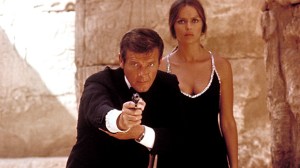
Both MI6 and the KGB discover that the plans for a submarine tracking system are being sold on the Egyptian black market.  Suspecting that this is connected to the missing submarines, both James Bond and the Russian agent Anya Asamova (Barbara Bach) are sent to Egypt.  Bond and Anya team up to find the plans.  Along the way, they are attacked multiple times by Jaws (Richard Kiel), a hulking man with steel teeth.

Eventually, Bond and Anya discover that the man responsible for the missing submarines is Karl Stromberg (Curt Jurgens), a shipping magnate who is planning on destroying the surface world so that he can start a new society underwater.  The two secret agents work together to defeat Stromberg even though Anya assures Bond that she’s going to kill him as soon as their mission is completed.  Remember the man who Bond killed during that opening ski chase?  It turns out that man was Anya’s lover and she’s only putting off getting her revenge so that she and Bond can save the world first.

With its confident mix of humor, intrigue, and spectacular action, The Spy Who Loved Me remains one of the most popular of the Bond films.  It’s certainly one of my favorites.

Along with From Russia With Love and On Her Majesty’s Secret Service, this is the most romantic of the Bond films.  Roger Moore and Barbara Bach have a very real chemistry and, as a result, you actually care about whether or not Bond and Anya will still be together after the end credits.  As played by Barbara Bach, Anya is one of the strongest of the Bond girls.  For once, Bond and his lover are truly equals.  For anyone who doubts the importance of having a strong Bond girl, I invite them to compare this movie to The Man With The Golden Gun.

For those who are more into action than romance, The Spy Who Loved Me will not leave them disappointed.  This film features some of the best set pieces in the history of the Bond franchise.  Along with the ski chase at the start of the film, there’s also a genuinely exciting car chase that features Bond and Anya being pursued by a helicopter piloted by Caroline Munro.

(Speaking of cars, this film also features one of my favorite Bond gadgets — a car that doubles as a submarine.)

Karl Stromberg makes for an interesting villain.  His plan makes absolutely no sense but he may be the first Bond bad guy to motivated by perverted idealism as opposed to pure greed.  As you would expect from a Bond film, his secret underwater HQ is quite an impressive set.  However, the best thing about Stromberg is that he employs Jaws.  With his stainless steel teeth, Jaws was the best henchman since Goldfinger‘s Oddjob and he proved to be such a popular character that he actually returned in the next Bond film.

One final note: As has often been noted, The Spy Who Loved Me was the first Bond film to have absolutely nothing in common (beyond a title) with the book that it was based on.  This is largely because the literary Spy Who Loved Me wasn’t really about James Bond.  Instead, it told the life story of Vivienne Michel, a Canadian woman who just happens to meet Bond towards the end of the book.  Fleming reportedly considered this book to be a failed experiment on his part and reportedly he only sold the film rights when he was assured that only the book’s title would be used.

That said, I recently read The Spy Who Loved Me and it’s not that bad.  Vivienne Michel is a compelling character and it’s interesting to, for once, see James Bond through the eyes of a lover as opposed to the other way around.  If it is a failed experiment, it’s still an experiment that’s worth reading.

As for the cinematic James Bond, he conquered the sea in The Spy Who Loved Me so it only made sense that, in his next film, he would attempt to conquer space.  We’ll take a look at Moonraker tomorrow.