Film Review: You’re Next (dir by Adam Wingard)


If Luis Buñuel had ever made a slasher film, it would probably have been a lot like You’re Next.

You’re Next tells the story of the ill-fated Davison clan.  Paul (Rob Moran) has recently retired from his job as a defense contractor and now, he and his wife, Aubrey (Barbara Crampton) are looking forward to celebrating their anniversary at their isolated vacation home.  Soon after they arrive at the house, Aubrey is convinced that she can hear someone else in the house.  However, since the frail Aubrey is obviously emotionally unstable, Paul dismisses her concerns.

Over the course of the day, Paul and Aubrey’s children arrive at the house.  Though, in the best tradition of all troubled families, the Davisons attempt to maintain a facade of peace and harmony, it quickly becomes clear that each member of the family is dealing with his or her own issues and petty jealousies.

For instance, oldest son Drake (Joe Swanberg) obviously feels that he’s superior to his siblings.  His wife, Kelly (Margaret Laney), is just as obviously unhappy with their marriage.

Crispian (A.J. Bowen) is a neurotic academic who is struggling financially and is viewed as being a weakling by the rest of his family.  His girlfriend, Erin (Sharni Vinson) has a secret in her past that will become unexpectedly important as the day progresses.

Daughter Aimee (played by Amy Seimetz, who was so good earlier this year in Upstream Color) tries so hard to be cheerful that you know that she has to be secretly be on the verge of having a nervous breakdown.  Her boyfriend, Tariq (Ti West), is a struggling filmmaker who is scandalized to discover that Drake prefers to watch commercials as opposed to documentaries.

Finally, there’s the youngest son, Felix (Nicholas Tucci).  Felix appears to be the most well-adjusted of all of the Davison children but his quiet girlfriend Zee (Wendy Glenn) is a different story.

Once the family has gathered together for the anniversary dinner, the bickering begins.  What the family don’t realize is that a group of men (all of whom wear animal masks) have previously slaughtered the neighbors and have now surrounded the Davison house.  The bickering is interrupted by a brutal attack that leaves one dead, one seriously injured, and the rest of the family fighting for their lives.

You’re Next starts out as an effective but rather standard home invasion film (think of The Strangers or even Michael Haneke’s Funny Games) but the film features two twists which set it apart.

The first twist is that Erin turns out to be as effective and determined a killer as the men laying siege to the house.  I’ve sat through a lot of horror movies and I love movies where women get to kick ass and I can tell you, without fear of contradiction, that there’s probably no other horror heroine who kicks as much ass as Erin.  As played by Sharni Vinson, Erin is destined to become an iconic character in the history of horror.

youre-next-sharni-vinson

The other twist is one that I can’t tell you about because it’s this twist that literally turns the entire film upside down.  What I can tell you is that this twist forces you to reconsider everything that you’ve seen up until that point.  Most impressively, director Adam Wingard reveals this twist to us long before he reveals it to the film’s characters.  As such, just when the viewer is getting used to the idea of You’re Next being just another home invasion film, a whole new element of suspense is added to the story.

Some reviewers have referred to You’re Next as being a comedy.  I disagree, if just because the film’s violence is too brutal and the gore is too graphic for this film to be considered anything other than primarily a horror film.  That said, there is a strain of dark humor that runs through the film and occasionally provides a much needed relief from the nonstop tension onscreen.  A good deal of the film’s humor comes from just how incredibly screwed-up the Davison family is, even before they find themselves under attack.  This is a family of people who, even while they’re trying to plot their escape from the house, can not resist getting into argument about who can run the fastest.

Ultimately, You’re Next works as both a brutally effective horror film and as a satirical portrait of an All-American family that’s secretly so dysfunctional that — even if they weren’t being attacked by masked men with crossbows — they probably would have eventually ended up killing each other anyway.  It’s a genre film that manages to transcend the rules of genre even while embracing them.  In a year that, so far, has been dominated by surprisingly intelligent and effective horror films, You’re Next is one of the best.

youre-next-movie-image-05

An Appreciation of It


Annex - Bow, Clara (IT)_01

(Spoilers below)

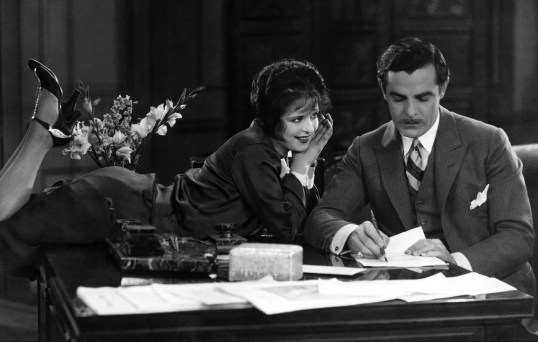
If I could be any character from a silent film, I would want to be Betty Lou Spence, the heroine of the classic 1927 film, It.

As played by the beautiful Clara Bow, Betty has It.  What is It, you may ask?  That’s the question that this film sets out to answer.  The movie starts out with a title card that read, “That quality possessed by some which draws all others with its magnetic force. With ‘It’ you win all men if you are a woman and all women if you are a man. ‘It’ can be a quality of the mind as well as a physical attraction.”  Throughout the film, every man who sets his eyes on Betty automatically says that she has “it.”   Though the film never explicitly says so, it’s pretty obvious that “It” is a combination of sensuality, intelligence, and inner strength.

It is sex.

And yes, since she’s played by Clara Bow, Betty Lou Spencer definitely has ‘it’ and she knows what to do with it as well.

However, one thing that Betty doesn’t have is a lot of money.  Instead, she’s a proud and poor shopgirl who sets her sights on her wealthy and handsome employer, Cyrus Waltham (played by Antonio Moreno).  Realizing that the uptight Cyrus will never notice her while at work, Betty accepts a date with Cyrus’s irresponsible best friend Monty (William Austin).  Knowing that Cyrus and his girlfriend will also be there, Betty asks Monty to take her to a fancy restaurant.  While Monty orders their food, Betty stares shocked at the high prices on the menu.  Why just the appetizers cost $2.00!

Ah, 1927.

Eventually, Betty does manage to get Cyrus’s attention.  After spending a day slumming with her down on Coney Island, Cyrus attempts to kiss Betty.  Betty responds by slapping him and telling him, “So, you’re one of those minute men — the minute you meet a girl, you think you can kiss her!”

The next day, things get a bit more complicated when Betty discovers that two social workers have shown up at the apartment of her best friend, Molly (Priscilla Bonner).  Molly is a single mother and the social workers have shown up to take away her baby.  Betty boldly steps forward, claiming that she is the baby’s true mother and that, since she has a job, the social works have no reason to take away her baby.

One of the snooty social workers (who, needless to say, does not have it) stares down here nose at Betty and asks, “And where is your husband?”

Betty stares straight back at her and replies, “That’s none of your business.”

Seriously, nobody tells Betty Lou Spence what to do.

Since this movie was made in 1927, everyone is scandalized.  Cyrus, obviously miffed that he couldn’t even get a kiss from an unwed mother, dumps her.  Betty responds by quitting her job.  A title card informs us that Betty may have needed the money but her pride was far more important to her.  What makes this movie unique, especially when compared to even some contemporary films, is that Betty is not punished for putting her pride before money or romance.  Instead, the film celebrates her independence.

The rest of the film deals with her getting her own brand of vengeance on Cyrus.  In the end, Betty gets her man but she gets him on her own terms.  Again, take a minute to consider that this film, made nearly 90 years ago, not only features a liberated woman but celebrates her as well.

After this film, Clara Bow became known as the “It Girl,” and it’s easy to see why.  In the role of Betty Lou Spence, Bow epitomizes the perfect combination of outward sensuality and inward strength.  Whether she’s sarcastically telling off a rude customer, defending her best friend, or saving the life of her romantic rival, Clara Bow epitomizes both sex and independence.  In the end, she pursues her man not out of obligation but out of desire.  When she does find her happy ending, she finds it on her own terms.

Those of us in 2013 have a lot to learn from the It Girl of 1927.

Film Review: Lovelace (dir by Rob Epstein and Jeffrey Friedman)


About halfway through the new biopic Lovelace, there’s a scene where former porno actress Linda Lovelace (played by Amanda Seyfried) is hooked up to a lie detector.  The polygraph examiner explains that he’s going to ask Linda a few test questions to get a reading.

“Is your name Linda Lovelace?” he asks.

Visibly nervous, Linda replies, “Can you ask something simpler?”

It’s a great scene because it establishes the central mystery of both the film and the title character.

Just who exactly was Linda Lovelace?

A girl whose main talent was apparently giving head, Lovelace became a star in the 70s when she starred in Deep Throat, the first (and perhaps only) hardcore film to become a legitimate mainstream hit.  For a brief while, Lovelace was the face of the American sex industry.  However, her attempts to have a mainstream film career failed and Lovelace retreated into obscurity.

Several years later, she wrote a book called Ordeal.  In Ordeal, Lovelace claimed that she was forced, by her abusive husband, to perform in Deep Throat.  Whereas Lovelace, during her brief stardom, originally claimed to simply be a sexual adventurer who performed on camera because it was liberating, the post-stardom Lovelace presented herself as being a brainwashed victim.  Or, as Lovelace herself put it, “When you watch Deep Throat, you’re watching me getting raped.”  While several people disputed the authenticity of Ordeal, Lovelace herself passed a polygraph examination.  Lovelace then became an anti-pornography activist before, once again, descending into obscurity and eventually dying in an automotive accident in 2002.

Lovelace deals with the issue of figuring out just who Linda Lovelace was by basically telling her story twice.

During the first 45 minutes of the film, we see how young Linda Boreman first meets Chuck Traynor (Peter Sarsgaard).  Everything about Chuck — from his mustache to his perm to his flashy clothes — practically screams sleaze but, since he’s played by Peter Sarsgaard, he also has an undeniable charm.  (With this film and An Education, Sarsgaard has proven himself to be the definitive older man who your parents warned you about.)  Chuck and Linda eventually marry and, when they need money, Linda turns to “acting” in order to pay the bills.

Under the watchful eye of producers Bobby Cannavale and Chris Noth, director Hank Azaria, and co-star Adam Brody, Linda stars in Deep Throat and becomes the face of the sexual revolution.  While there are occasional hints that things might not be perfect (bruises are often visible on Linda’s arms and legs), Linda seems to truly love the spotlight.  Even Hugh Hefner (played by James Franco, who is way too hot to only have a cameo) says she’s going to be a huge star.

And then, rather abruptly, we jump forward six years.  Linda is now writing Ordeal and we once again see how she first married Chuck Traynor, starred in Deep Throat, and came to be a star..  However, we now see the story through her eyes.  We see that Chuck wasn’t just controlling but that he was also an abusive psychopath who would hold a gun to her head in order to get a performance out of her.  We see that, during the shooting of Deep Throat, she was regularly beaten by her husband.  We see Linda attempting to reconnect with her strict and tradition parents (played by Sharon Stone and Robert Patrick).  We see the ugliness that was hidden underneath the glamour.

Considering the subject matter and the talent involved, Lovelace should have been one of the most interesting films of 2013 but, unfortunately, the two separate halves of the film just don’t come together.  While the first half of the film does a good job of capturing the absurdity of sudden fame, the second half of the film falls apart.

Oddly enough, Chuck Traynor and Linda Lovelace only come across as real human beings during the superficial first half of the film.  During the second half of the film, both Chuck and Linda come across as one-dimensional ciphers.  Linda becomes such a total victim and Chuck becomes such a melodramatic villain that neither one of them is all that compelling as a character.  Instead of being disturbing and revealing, the second half of the film just feels like another generic film about the price of fame.

Most of what I know about Linda Lovelace and Chuck Traynor comes from two sources — the 2005 documentary Inside Deep Throat and Legs McNiel’s and Jennifer Osborne’s book The Other Hollywood.  In both the book and the documentary, Lovelace comes across as being a rather pathetic figure who was exploited by both the adult film industry and the anti-pornography activists who used her as a symbol.  Both the industry and the activists abandoned Linda once her novelty was gone.  Ironically, even though both the documentary and the book are rather critical of her, it is there that she comes across as a far more interesting, sympathetic, and ultimately tragic figure than she does in this biopic.

With all that in mind, Lovelace is not necessarily a failure as a film.  The 70s are convincingly recreated and there’s a few scenes that hint at the type of film that this could have been if the filmmakers had been willing to take a few more risks.

The film is also full of excellent performances.  Seyfried is sympathetic and believable as Linda and, up until the second half of the film requires him to abandon all shades of ambiguity, Sarsgaard perfectly captures the sleazy charm that someone like Chuck Traynor would need to survive.  As Linda’s strict mother, Sharon Stone  is surprisingly strong.  Just watch the scene where Linda’s mom explains to her that she has to go back to abusive husband because that’s what marriage is all about and you’ll see an example of great acting.  Even better is Robert Patrick, who brings a poignant sadness to the role of Linda’s father.  The scene where he tells Linda that he saw her on film is heartbreaking.

Lovelace is a film of hits and misses.  Sadly, it misses the big picture but a few individual parts and performances are strong enough to justify sacrificing spending 93 minutes to watch it.

It Came From The Public Domain: Indestructible Man (dir by Jack Pollexfen)


(SPOILERS BELOW)

First released in 1956, Indestructible Man is a low-budget B-movie that, as a result of being in the public domain, has been released on DVD by several different companies and seems to be included in just about every other compilation box set released by the folks at Mill Creek.  Perhaps because it stars Lon Chaney, Jr., it also seems to turn up on TCM fairly regularly.  That’s how I first saw it.

Whenever anyone mentions the film Indestructible Man to me, I always think about … well, actually no one ever mentions Indestructible Man to me.  But if they did, I would probably always remember one scene in particular.  It comes towards the end of the film.  Detective Dick Chasen (Max Showalter) has managed to solve the mystery of the Indestructible Man.  He celebrates by going out with his new girlfriend, a burlesque dancer played by Marian Carr.  Sitting there in the car, illuminated by the romantic glow of the moon, Detective Chasen informs her that he’s gotten her fired from her job because she’s going to be way too busy being his wife to have a career.  “Even if I wanted to, I couldn’t say no!” his girlfriend responds.

Don’t believe me?  Watch for yourself.  From Indestructible Man, here’s one of the most sexist scenes in film history…

Up until that ending, Indestructible Man tells the story of Charles “Butcher” Benson (Lon Chaney, Jr).   As you might guess from his nickname, Butcher isn’t a nice guy.  In fact, he’s a career criminal who is sitting on death row in California.  He’s been double-crossed by his criminal partners (who include both a lawyer and a guy named Squeamy, so you know they’re bad) and, from his prison cell, he swears that he will have his revenge.

And then he’s promptly executed.

However, his body is donated to science.  Scientist Robert Shaye is investigating whether or not massive electrical shock can be utilized to cure cancer.  When he and his assistant (Joe Flynn) shock the Butcher’s corpse, the Butcher comes back to life and starts to wander around the laboratory.  Shaye attempts to give him a shot but the hypodermic needle snaps when pressed against the Butcher’s skin.  The Butcher proceeds to strangle both the scientist and his assistant…

What’s going on?  Well, fortunately, this film is narrated by Detective Dick Chasen (and yes, that is the character’s name and that’s all I’m going to say about it).  Dick Chasen explains to us that 1) the electrical shock fried Butcher’s vocal chords and rendered him mute and that 2) the shock caused Butcher’s cells to multiply at such a rate that he is now …. INDESTRUCTIBLE!

Anyway, Butcher proceeds to spend the rest of the movie tracking down and murdering his former criminal associates.  Even before you reach the most sexist ending in the history of American cinema, it’s all rather silly.  It’s also rather slow.  The film lasts 70 minutes and I would say that 20 of those minutes consist of pure padding.

However, as often happened with B-movies, the low budget occasionally works to the film’s advantage.  The flat black-and-white and the stark sets may have been an unintentional consequence of economic reality but, at the same time, they give the film a much needed edge.

Much as the low budget accidentally worked to the film’s advantage, so to did the personal demons of Lon Chaney, Jr. contribute to making him into a surprisingly effective and disturbingly believable killer.  Though he’s best remembered for playing the handsome and soulful Larry Talbot in the original Wolf Man, by the time Lon Chaney, Jr. made Indestructible Man, years of drinking, smoking, and self-destructive behavior had caught up with the former matinée idol.  Chaney’s ravaged face, marked by deep lines and sporting a permanently grim expression, makes him perfect for this role.  The highest praise that I can pay to Chaney’s performance is that you look at him and you truly believe that his character would be nicknamed Butcher.

As I stated at the start of this review, Indestructible Man is in the public domain and it’s fairly easy to track down.  For that matter, you can always watch it below.

And just remember … you’re not supposed to say no to a detective…

What Lisa Watched Last Night #87: Invasion Roswell


Last night, I forever lost 2 hours of my life because I watched the latest SyFy “original” film, Invasion Roswell, with my friends, the Snarkalecs.

Why Was I Watching It?

When I first heard the title of the latest SyFy film, I thought to myself, “Roswell!?  I kinda remember that show!”  However, I quickly realized that — other than taking place in New Mexico and featuring aliens — Invasion Roswell had nothing to do with Katherine Heigl’s old TV show.

Invasion Roswell was actually broadcast on Thursday night.  As we’ve been doing ever since SyFy stopped showing original films on Saturday, the Snarkalecs dvred Invasion Roswell when it first premiered and then we actually watched (and live-tweeted) it on Saturday.

Why did we do this?

Because that’s what we do.

It’s an existential thing.

What Was It About?

This film was a combination Red and about every single alien invasion film that’s even been made.  Aliens invade the Earth and naturally, they chose to destroy large parts of London and Paris (take that, Europe!), as well as Washington D.C.  (take that, IRS!).  It turns out that the only people who can defeat this threat are a bunch of old alien hunters who have been previously forced to retire by a random corporate guy in a suit.

So, while Patrick (Greg Evigan) and Linda (Denise Crosby) attempt to get the old gang of gun-wielding geezers back together again, the aliens continue to progressively conquer every inch of the planet.

(Except for Canada, of course.  Canada’s tough!)

What Worked?

The aliens themselves were effective, especially when compared to some of the invaders who have populated previous SyFy films.  Clad in black armor and firing blue laser beams, the aliens managed to be intimidating and campy at the same time.

The Snarkalecs managed to get Invasion Roswell trending on twitter during the entire two hours we spent watching it.  It was fun to watch non-snarkalecs try to figure out why Invasion Roswell was trending.  “Have we been invaded?!” one random dumbfug toadsucker tweeted.  Seriously, some people are stupid.

What Did Not Work?

Invasion Roswell was literally one of the slowest movies that I have ever seen on SyFy.  A typical SyFy film accomplishes more in 10 minutes than Invasion Roswell did in 85 minutes.  Between the slow pace, the predictable storyline, and the uninteresting characters, there really weren’t many opportunities for Invasion Roswell to actually be entertaining.

As a result, my tweets suffered.  Usually, I think I’m a pretty lively force when it comes to live-tweeting SyFy films but, when it came to Invasion Roswell, I found myself struggling to stay awake.

To put it another way, I thought Heebie Jeebies was bad until I saw Invasion Roswell.

“Oh my God!  Just like me!” Moments

When I was little, my family very briefly lived in New Mexico.  However, we were in Carlsbad and, as a result, I don’t think we ever met any aliens.  Then again, we were citizens of New Mexico for only a few months so maybe we could have met some aliens if we had just stuck around long enough.  I guess that’s just going to have to be one of life’s mysteries.

Otherwise, there were no “Oh my God!  Just like me!” moments in Invasion Roswell. Maybe someday, when I’m as old as Denise Crosby, I’ll be able to relate to this film.

Lessons Learned

I can forgive a lot of things but I cannot forgive dullness.

Review: True Blood 6.9 “Life Matters”


True Blood

When the history of True Blood is eventually written, Life Matters will be remembered as the best episode of season 6 and perhaps as one of the best episodes of the entire series.

For a show that has occasionally been a tad too complicated and a bit too dependent on easy snark as opposed to genuine sentiment, tonight’s episode was both focused and sincerely emotional.  If an episode of True Blood could ever make you cry while still making you laugh and occasionally jump, Life Matters is that episode.

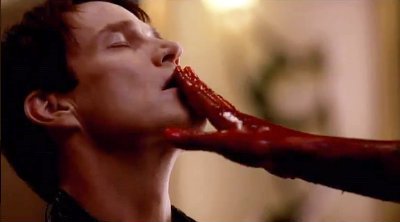
Tonight, True Blood was all about death.  While the citizens of Bon Temps gathered to say a final goodbye to Terry, the vampires got their revenge on the humans at Vamp Camp.  The Rev. Newlin finally met his well-deserved demise at the hands of Eric and the sun while Jason came close to murdering Sarah Newlin before finally relenting.

At the end of last week’s episode, Bill and Sookie were standing over Warlow’s drained body.  Well, it turns out that Warlow is not dead.  He’s just weakened.  After Sookie allows him to feed on her, she leaves for Terry’s funeral while Bill heads to Vamp Camp.

The rest of the episode very skillfully cuts back and forth from the powerful emotion of Terry’s funeral and Bill and Eric’s bloody rampage at Vamp Camp.  While those at the funeral speak of the value of celebrating life, Bill, Eric, and the vampires are literally killing every human that they can find.  While Andy and Sam talk about (and we see flashbacks of) the first time they ever met Terry, Bill is killing a human scientist by stomping his face in.  While Sookie gives her eulogy and also outs herself as being a telepath, Eric is releasing all of the female vampires and announcing, “Go forth and kill all the humans!”

Sarah Newlin, realizing that she’s literally one of only two humans left alive at Vamp Camp, climbs up to the top of the roof of the sun room and turns a wheel that opens up the ceiling.  The sun shines down on the vampires below but all of the vampires have now fed on Bill’s blood and are now immune to the sun.

Every vampire except for the Rev. Newlin, of course.

Newlin begs to be allowed to feed on Bill’s blood but none of the other vampires are willing to allow Newlin to get near him.  Finally, Eric grabs Newlin by the throat and holds him in place as the sun shines down on him.  As Sarah watches from above, her ex-husband starts to burn and then explodes into a mess of red goo.  Newlin’s last words are to declare his love for Jason Stackhouse.

As for Jason, he catches Sarah as she tried to flee Vamp Camp and, in a rather uncomfortable scene, holds a gun to Sarah’s face while she begs for her life.  Jason finally allows her to escape, saying that he doesn’t want her blood on his hands.  As hateful a character as Sarah is, I’m glad that Jason didn’t kill her.  Jason may be many things but he’s not a cold-blooded murderer.  That’s one reason why we all love him.

Bill, weakened after having been drained, lies on the floor of the sun room and has a vision of Lillith’s sirens approaching him.  They tell him that it’s time for him to come with Lillith.  Bill says that he’s not ready to go.  Fortunately, Jessica and James find him and James feeds him.

Meanwhile, Terry’s funeral ends with Arlene accepting an American flag from the Marine honor guard and Big John singing “Life Matters.”  A random old lady wonders why there’s so many black people at Terry’s funeral.  That’s just life in Bon Temps.

As the episode ends, Bill and the other vampires are celebrating in the daylight.  However, Pam sees Eric standing some distance away.  Pam tells Eric that he better not leave her.  Eric responds by doing just that, shooting off into the sky and leaving Pam by herself.

Tonight’s episode of True Blood felt almost like a series finale.  As I watched it, I had to keep reminding myself that I wasn’t watching the end of the show or even the end of the season.  Instead, I was watching the 9th episode of a 10-episode season.  There’s one more episode and at least one more season to go before True Blood concludes.

I just hope that Eric comes back.

Random Observations:

  • Considering just how marginal his character often seemed to be in the grand scheme of things, I was a bit surprised at how touching Terry’s funeral truly turned out to be.
  • Still, as a friend of mine pointed out on twitter, dead Terry got more screen time during tonight’s episode than he ever did while he was alive.
  • If an episode of True Blood ever deserved an Emmy for editing, this is the one.
  • How is Season 6 going to end?  Is there more to the Lillith story or will next week’s episode just be about setting things up for season 7?  Your guess is as good as mine.
  • I’m sure that those of you who got this review in your e-mail might be wondering if I really did accidentally type Big Brother instead of True Blood in my initial draft of this post.  Yes, I did.  Whoops.  I also write a daily blog over at the Big Brother Blog.  My mistake was the result of me trying to write reviews of two very different shows at the same time.
  • “I love you, Jason Stackhouse!”

A Quickie With Lisa Marie: Big Jim McLain (dir by Edward Ludwig)


During my sophomore year of college, I was acquainted with a bearded sociology major who would tell anyone that he met that he was a communist.  He also insisted that he was a revolutionary in the tradition of Che Guevara though, for the most part, he never seemed to do much more than hang out in the lobby of Bruce Hall and yell at the top of his lungs.   When he wasn’t attacking George W. Bush and Dick Cheney, he was busy quoting Karl Marx and telling people about how communism would fix all of America’s problems.  He would also get very upset if you called him a socialist.  “No,” he would say, “I’m a communist and I’m proud of it!”

I have to admit that I usually went out of my way to avoid him and I would cringe whenever I would hear him shouting my name and inviting me to come sit down next to him so he could attempt to give me my daily indoctrination while he stared at my breasts.  I could never summon up much enthusiasm for his ideology or his idolization of Hugo Chavez.  It all sounded rather dreary and boring to me.

I recently found myself thinking about those days in Bruce Hall lobby after I watched the 1952 anti-communist melodrama, Big Jim McLain.

Produced by and starring John Wayne, Big Jim McLain was made at the height of the red scare.  Produced in full cooperation with the infamous House Un-American Activities Committee, Big Jim McLain was meant to be an answer to all those weak-willed liberal types who claimed that the committee was going too far in its hunt for communist subversives.

Big Jim McLain starts out with a thunderstorm.  While stock footage of lightning illuminates the screen, a medley of patriotic songs play on the soundtrack and a somber-voiced narrator quotes The Devil Vs. Daniel Webster.  

Suddenly, the scene changes.  We’re in Washington D.C. and we’re watching a meeting of the House Un-American Activities Committee.  A shifty little man with a beard is being interrogated by the members of the committee.  They ask him if he’s ever been a communist.  He takes the fifth amendment.  He’s asked if he would ever take up arms against the United States.  Again, he pleads the fifth.

The camera pans back to reveal two remarkably tall men listening to the man’s testimony.  They both share the same look of disgust, a look that leaves no doubt how they feel about this sleazy little subversive and his constitutional rights.  They are Big Jim McLain (John Wayne) and his partner, Mal Baxter (James Arness) and they fight communists.

Suddenly, we hear the familiar sound of John Wayne’s determined drawl on the soundtrack and we realize that Big Jim McLain was using multiple voice-overs long before Terrence Malick even made his first film.

Wayne, speaking in character as Big Jim, explains that he and Mal have spent the last few months proving that the witness is a communist.  And now, they have no choice but to watch as he hides behind the constitution.  We’re told that this communist will be able to return to his position of teaching economics at an unnamed “north eastern college.”

That opening scene pretty much tells you everything that you need to know about the ideological outlook of Big Jim McLain.  The government is looking out for our best interests, outsiders are dangerous, and good men know the importance of following orders.

HUAC sends Big Jim and Mal to “the territory of Hawaii,” where they hand out a lot of subpoenas, conduct a smattering of illegal wiretaps, and try to figure out who is actually in charge of the local communist party.  Along the way, Big Jim meets and romances a naive secretary named Nancy (played by Nancy Olson).  Nancy just happens to work for a communist doctor but we know that she’s okay because she’s the widow of a serviceman.

Big Jim McLain is a real curiosity piece, a true product of its time.  Perhaps not surprisingly, the film really does feel like a time capsule.  Full of simplistic characters and nonstop speech-making from John Wayne, it’s easy to laugh at and dismiss a film like this.

Then again, the main idea behind Big Jim McLain seems to be that the government is justified in doing anything to fight its enemies and that anyone who openly questions or disagrees our leaders most be either evil or mentally incompetent.  Just how much has our culture changed since then?  How different is anti-communist crusader Big Jim McLain from those who today continually assure us that we have nothing to fear from the NSA?  One gets the feeling that if this film were made today, Big Jim would be hunting down Edward Snowden and directing drone strikes against America’s enemies.

Perhaps for obvious reasons, Big Jim McLain is a fairly obscure film.   I first found out about it from reading J. Hoberman’s Army of Phantoms.  Oddly enough, within a day or two of my reading about it, Big Jim McLain turned up on TCM.  It’s not a very good film but, in the best exploitation tradition, it is a document of its time and therefore, worth seeing as a piece of history.

As for the communist of Bruce Hall, he ended up dropping out at the end of the semester and, apparently, he later turned up in New York doing the whole Occupy Wall Street thing.  I’ve been told that he was recently spotted in Austin, still wearing his Che Guevara t-shirt.

One thing’s for sure.

Big Jim McLain would have taken him out with one solidly placed right hook.

Review: True Blood 6.8 “Dead Meat”


True Blood

If nothing else, this episode will always be remembered for confirming what all of us ladies already knew.  High heels are murder!

Seriously, if you had any doubts about whether or not Sarah Newlin (played, with manic glee, by Anna Camp) truly was batshit crazy, all you had to do was watch tonight’s episode.

First off, she’s refusing to tell anyone that Gov. Burrell is dead and it wouldn’t surprise me if she’s got his severed head in the trunk of her car.

Secondly, when Mrs. Suzuki came by Vamp Camp to check out what was going on with the Tru Blood production, Sarah ended up chasing her through the prison.  Now, I’ve seen enough horror movies to know that it is next to impossible to successfully run away from a crazed maniac while wearing high heels.  That still doesn’t stop Mrs. Suzuki from trying but, once she ends up tripping on a steel grating, Sarah proceeds to beat her to death with one of her own high heels.  Underneath the grating, a grateful group of male vampires feast on Suzuki’s blood.  “Thank you, Jesus!” an orgasmic Sarah proclaims.

This macabre chase scene — coming towards the end of tonight’s episode — perfectly sums up season 6 of True Blood.  It was over the top, silly, melodramatic, vaguely sordid, and yet definitely effective.

Mrs. Suzuki was murdered to prevent her from telling the FDA about Sarah’s plan to give all the vampires Tru Blood that’s been spiked with Hep V.  The first batch of infected Tru Blood was given to the prisoners during tonight’s episode.  James, the hot new vampire who Jessica is now in love with, warned the Rev. Newlin not to drink the infected blood.  This led to Sarah demanding to know why Newlin was refusing to drink the blood.  Since Newlin is a weasel, he quickly revealed the names of every vampire who knows the truth about the new Tru Blood.

As a result, Newlin, James, Pam, Tara, Willa, and Jessica all found themselves in that white death chamber that Bill keeps seeing in his visions of the future.  As Jessica quickly figures out, this is where they’re going to stay until the sun rises, the ceiling opens up, and they’re all burned to death.

Bill, however, has a plan.  As he tells Sookie, he wants to allow all the vampires at Vamp Camp to drink Warlow’s blood so that they can be immune to the sunlight.  Warlow tells Sookie that he’ll only do it if Sookie agrees to be “his.”  So, once again, the future of the vampires pretty much depends upon Sookie surrendering any shred of independence from the whims and needs of the men in her life.

So, as must happen at least once during every season of True Blood, Sookie prepared to sacrifice herself.  She took Bill to the faerie dimension so that she could give herself over to Warlow and then Warlow could give himself over to Bill.  However, as soon as she and Bill arrived, they discovered that Eric had gotten there first and had already drained Warlow.

And that, quite simply, is why I love Eric.  While everyone else talks and broods, Eric gets stuff done.

Finally, in case you were wondering how long it would take Sam to get over Luna, the answer is eight episodes.  Sam returned to Bon Temps for Terry’s funeral and, upon arrival, he discovered that Alcide had rescued Nicole from the werewolves (and, in the process, had surrendered the title of pack leader to Rikki).  Sam discovered that Nicole’s pregnant and, within a few scenes, the two of them were declaring their love for each other.  Nicole is a boring character and werewolf politics tend to put me to sleep unless they involve Alcide getting naked.  Since Alcide kept his clothes on tonight, I have to admit that I pretty much zoned during the majority of the Sam/Nicole/Alcide scenes.

But no matter!  Between Sookie preparing (yet again) to sacrifice herself and Sarah getting crazier by the minute, tonight’s episode was a lot of fun.  I assume that Eric is now heading towards the Vamp Camp and I can’t wait to see what happens once he arrives.

Random Thoughts and Observations:

  • Tonight’s unofficial scene count: 48
  • I always enjoy it when Bill and Eric get to argue.  Alexander Skarsgard and Stephen Moyer really throw themselves into those scenes.
  • Nora may be dead by Lucy Griffiths — much like Arliss Howard and Todd Lowe — is still listed in the opening credits.
  • Rev. Newlin seemed to have a thing for people who have had sex with Jessica.
  • I was a little surprised that Alcide didn’t know who Terry was.
  • I’m proud to say that, in last week’s review, I totally guessed Bill’s plan for Warlow’s blood.
  • “Mother, I can fly!”
  • “The only way he’ll agree to help you is if I agree to become his faerie vampire bride!  So there!”
  • “How about that, you motherfucking monster!?”
  • “I’m trying to decide if I’ll be more uncomfortable in here or out there!”
  • “Sarah Newlin!?”  “Don’t tell me you’re a fan!”

Guilty Pleasure No. 9: The Principal (dir by Christopher Cain)


A confession:

I have a weakness for films about idealistic educators who try to teach and change lives in the inner city.  You know which films I’m talking about.  These are the films that always take place in a decaying high school and there’s usually at least one scene where the teacher is warned not to care too much about their hopeless students and then the teacher goes, “Someone has to care!”

Why do these films fascinate me so?

To a large extent, it’s because they take place in a world that is so extremely outside of my high school experience.  I was recently doing a search on my school and I came across a video on YouTube that was made by some students from my alma mater:

As I watched this video, I realized that neither the students, the campus, nor the neighborhood had really changed in the 9 years since I graduated.

I also realized that, even though I didn’t realize it at the time, I went to one of the most suburban, white bread high schools in the DFW metroplex.  At the time, of course, a lot of my classmates thought they were tough.  They would make a big deal about blasting Jay-Z and 50 Cent while they were driving down to Starbucks during lunch.  For the most part, though, we put the suburb in suburban.

That, I think, is why I’m fascinated by inner city high school films.  It’s even better when those films are totally over-the-top and feature a hero who not only teaches but who kicks some ass as well.

Perhaps that’s why I recently enjoyed watching The Principal.

Originally released way back in 1987, The Principal is one of those films that seems to regularly show up on the lesser known television networks.  A few weeks ago, I saw that it was going to be broadcast on Ion Television so I set the DVR to record it and I finally ended up watching it this weekend.

In The Principal, James Belushi plays Rick Lattimore.  (You can tell that this movie was released quite some time ago because Belushi has a lot more hair and lot less chins than he does now.)  Rick’s a teacher with an anger problem.  When he sees his ex-wife out on a date with his divorce lawyer, Rick loses it and physically assaults the lawyer.  The next morning, Rick is called into a meeting with the school board.  He’s expecting to get fired.  Instead, he’s promoted.  Rick is now principal of Brandel High.

Brandel High, it turns out, is the most troubled high school ever!  Drugs are sold and used openly in the hallways.  Few students bother to attend class (but yet they still come to the school).  The teachers spend most of their time hiding in either their classroom or the teacher’s lounge.  The school’s head of security, Jake (Lou Gossett, Jr.), spends most of his time making sarcastic comments.  When Rick pulls up on his motorcycle, the first thing he sees is a fight between rival drug dealers.

Rick responds to all of this by holding a school assembly.  As every student at Brandel jeers him, Rick announces that he has only one policy: “NO MORE!”  It’s at this point that the school drug lord Victor Duncan (played by Michael Wright) stands up and announces, “You talk too much!”

Things continue to build up from there as Rick divides his time between educating and getting beaten up by resentful students, Jake starts to actually care about his job again, and Victor wanders through the school hallways, dressed like he’s in one of the Underworld films and saying stuff like, “Try to reach me and I’ll just cut off your hand…”

The Principal is such an over-the-top, silly, yet heart-felt film that it’s impossible not to enjoy it in much the same way that you might enjoy eating junk food.  As I watched this film, I found myself wondering what had happened to James Belushi in the years since it was originally released because, in The Principal, he’s actually likable.  However, the film really belongs to Michael Wright.  Seriously, as played by Wright, Victor Duncan is the most evil student in the history of high school cinema.  When he tells Rick that he’s willing to cut off his outstretched hand, you believe him.

The Principal is a thoroughly predictable film that promotes a dubious educational policy of zero tolerance.  However, it’s also a lot of fun.

In other words, it’s the epitome of a guilty pleasure.

Belushi

Previous Guilty Pleasures:

  1. Half-Baked
  2. Save The Last Dance
  3. Every Rose Has Its Thorns
  4. The Jeremy Kyle Show
  5. Invasion USA
  6. The Golden Child
  7. Final Destination 2
  8. Paparazzi

Review: True Blood 6.7 “In The Evening”


Bill_embraces_lilith

Poor Eric!

Going into tonight’s episode of True Blood, I knew that another major character was expected to die but I was really hoping that it wouldn’t be Nora.  Not only did I feel that the character (and Lucy Griffiths) has never quite been used to her potential (not an uncommon occurrence on a show that has a huge ensemble, like True Blood) but it also seems like Eric is always losing the vampires who are most important to him.

However, I also knew that, story-wise, Nora had to die if just so we could understand how dangerous Hep-V truly is.

And so, after bringing Nora to Bill’s mansion and even going so far as to pray for her recovery, Eric ended up holding Nora while she literally melted in his arms.  Adding to the pathos of the situation, we were treated to a flashback to 1666 where we saw how Eric originally turned Nora into a vampire in order to save her from falling victim to the Great Plague.

It was a highly effective moment in an otherwise average episode of True Blood.  If the show often struggled to figure out what exactly to do with Nora, it at least allowed her to make a powerful exit.

Tonight’s episode was all about death.  While Eric watched Nora die, the rest of Bon Temps struggled to deal with the demise of Terry.  Sookie abandoned the post-coital bliss of Warlow so that she could comfort the grief-stricken (and quite drunk) Arlene.

Sookie’s return allowed Bill to track her down and, in a wonderfully tense scene that was very well-acted by real-life husband and wife Anna Paquin and Stephen Moyer, Bill told Sookie that if she doesn’t lead Bill to Warlow than all the other vampires will die.  I imagine that Bill’s plan is for all the other vampires to drink Warlow’s blood.  Once they, like Bill, are immune to the sunlight, the LAVDF will no longer be able to burn all the vampires to death.

Back at Vamp Camp, Jessica, Pam, and WIlla are aware that the new tru blood is tainted with Hep-V but, as Pam explained, they can’t say anything because, if all the vampires refuse to drink the tru blood, then the authorities will know that the secret is out.  That said, Jessica still asked Jason to arrange a meeting between her and the surprisingly sensitive vampire James (Jake Grimes).   Jessica informed James about the tainted tru blood and then proceeded to lose her vampire virginity to him.  And good for her because James is seriously superhot!

Meanwhile, Sarah Newlin discovered the massacre at the Governor’s mansion and, after kissing the Governor’s severed head, she took command of his plan to destroy all of the vampires.  She returned to the Vamp Camp where she tracked down Jason, cut his wrist, and then tossed him into a cell full of female vampires.  Tara jumped up to defend him but then, a vampire named Violet announced that Jason was hers.

FInally, Sam found out about Terry’s death and is now planning on returning to Bon Temps, despite the fact that he promised Alcide that he wouldn’t.  Alcide, it turns out, lied to the rest of the pack and told them that he had killed both Sam and Nicole.  As tonight’s episode ended, Alcide discovered that Nicole and her mother had been captured by the pack and his lie had been exposed…

(Seriously, I can understand why Alcide didn’t want to be packmaster.  The werewolves are way too much drama!)

As I said, this was an average episode of True Blood.  It featured a few memorable moments (Nora’s death, Arlene getting drunk, and the James/Jessica sex scene) but, for the most part, it felt like the main purpose of this episode was to set things up for the season finale.  There’s only 3 more episodes left before the end of season 6 and there are rumors that at least one more major character might be leaving before the end of the season.

Here’s hoping it’s not Eric!

Random Thoughts and Observations:

  • Tonight’s unofficial scene count: 49
  • I noticed that Todd Lowe is still listed in the opening credits.  Was Arliss Howard listed as well?
  • Willa really does look a lot like Nora.   It’s a bit distracting.
  • In my notes, I wrote: “Ewwwwwww!” when Sarah Newlin kissed the Governor’s head.
  • The attempts to provide therapy for the vampires are a pretty obvious comment on the whole “ex-gay” movement.
  • Alexander Skarsgard made me cry tonight.
  • During tonight’s show, I tweeted the following: “When Sheriff Andy is the voice of reason, you know bad things are going to happen in Bon Temps. #TrueBlood”  As of this writing, it’s been retweeted 77 times and favorited by 52 people.  That’s a personal best for me so yay!
  • “How deep do you want to go?”