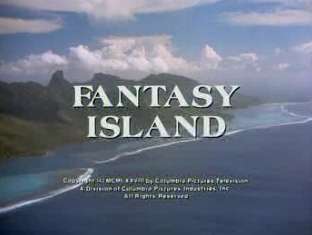
Retro Television Review: Fantasy Island 6.18 “The Devil Stick/Touch and Go”


Welcome to Retro Television Reviews, a feature where we review some of our favorite and least favorite shows of the past!  On Tuesdays, I will be reviewing the original Fantasy Island, which ran on ABC from 1977 to 1984.  Unfortunately, the show has been removed from most streaming sites.  Fortunately, I’ve got nearly every episode on my DVR.

It’s time to go back to the Island.  Smiles, everyone, smiles!

Episode 6.18 “The Devil Stick/Touch and Go”

(Dir by George McCowan, originally aired on March 19th, 1983)

I had mixed feelings about this episode.

On the one hand, we do learn a little bit about Tattoo’s past in this episode.  We discover that he lived in Paris before coming to Fantasy Island and becoming Roarke’s assistant and we learn that he may have been a taxi driver.  At one point, his life was saved by a woman named Susan Henderson (Georgia Engel).  To repay her, Tattoo arranges for Susan to come to the Island so that she can pursue her fantasy of getting concert pianist Carter Ransome (Bernie Kopell — who I love on The Love Boat but who is just plain miscast here) to fall in love with her.  Even though Roarke says it will only be for the weekend, Susan is okay with that.  Of course, things get complicated.  Roarke also asks Tattoo how he plans to pay for the fantasy.  Since when does Roarke care about money?  Seriously, after all of the free fantasies that he’s handed out!?  Give Tattoo a break, Roarke!

On the other hand, this fantasy featured Georgia Engel.  Georgia Engel was an actress who specialized in playing very nice women who rarely spoke above a whisper.  Ever since I’ve started doing these retro television reviews, I’ve watched countless episodes featuring Georgia Engel as quirky women who refuse to speak above a whisper.  At first, it didn’t bother me.  Then I watched Jennifer Slept Here, a short-lived sitcom co-starring Georgia Engel.  It was while watching Jennifer Slept Here that I found myself yelling, “SPEAK UP!” whenever Georgia Engel appeared onscreen.

I feel bad because Georgia Engel, in every role that I’ve seen her play, came across as being a genuinely kind soul but the whispering thing …. oh my God, it just annoys the Hell out of me.  And that was certainly the case with this episode.  It was nice to learn more about Tattoo’s life and I’m glad that everyone found love but I’m sick of having to strain to understand or even hear the dialogue whenever Georgia Engel guest stars on one of these shows.

The other fantasy, I liked a bit more.  Carl Peters (Dean Butler) comes to Fantasy Island to meet a woman who has loved for afar, Hallie Miller (Crystal Bernard).  It turns out that Hallie lives on a village on the other side of the Island.  Roarke warns that it’s a weird village that’s never gotten over the execution of a witch several centuries earlier.  At first, I was like, “Since when is there a town on the other side of the Island?” but then I remembered that, during the first season, there was a whole fantasy that took place in fishing village that happened to be on the Island.  Anyway, this fantasy is supernatural-themed and I always like it when Fantasy Island embraces its supernatural origins.

It was an uneven trip to the Island this week but what can I say?  I like island trips!


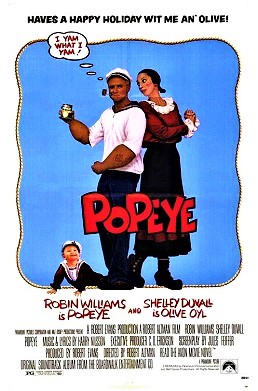
Popeye (1980, directed by Robert Altman)


I like Popeye.

Sometimes, I feel like I’m the only one.  Popeye got such bad reviews and was considered to be such a box office disappointment that director Robert Altman didn’t make another major film for a decade.  Producer Robert Evans, who was inspired to make Popeye after he lost a bidding war for the film rights to Annie, lost his once-sterling reputation for being able to find hits.  This was Robin Williams’s first starring role in a big screen production and his career didn’t really recover until he did Good Morning Vietnam seven years later.  Never again would anyone attempt to build a film around songs written by Harry Nilsson.  Screenwriter Jules Fieffer distanced himself from the film, saying that his original script had been ruined by both Robert Evans and Robert Altman.  Along with Spielberg’s 1941 and Michael Cimino’s Heaven’s Gate, Popeye was one of the box office failures that signaled the end of the era in which directors were given a ton of money and allowed to do whatever they wanted to with it.

I don’t care.  I like Popeye.  I agree with the critics about Nilsson’s score but otherwise, I think the film does a great job of capturing the feeling of a comic strip come to life.  Altman was criticized for spending a lot of money to construct, from scratch, the seaside village that Popeye, Olive Oyl (Shelley Duvall), Bluto (Paul L. Smith), Wimpy (Paul Dooley), and everyone else called home but it does pay off in the movie.  Watching Popeye, you really are transported to the world that these eccentric characters inhabit.  If the film were made today, the majority of it would be CGI and it wouldn’t be anywhere near as interesting.  Featuring one of Altman’s trademark ensemble casts, Popeye create a world that feels real and lived in.

Mumbling the majority of his lines and keeping one eye closed, Robin Williams is a surprisingly believable Popeye, even before he’s force fed spinach at the end of the movie.  Paul L. Smith was an actor who was born to play the bullying Bluto and there’s something very satisfying about seeing him (literally) turn yellow.  As for Shelley Duvall, she is the perfect Olive Oyl.  Not only does she have the right look for Olive Oyl but she’s so energetic and charmingly eccentric in the role that it is easy to see what both Popeye and Bluto would fall in love with her.  Though the humor is broad, both Williams and Duvall bring a lot of heart to their roles, especially in the scenes where they take care of their adopted infant, Swee’Pea.  Popeye may be a sailor but he’s a father first.

Popeye deserves a better reputation than it has.  It may not have been appreciated when it was originally released but Popeye has a robust spirit that continues to distinguish it from the soulless comic book and cartoon adaptations of today.

Late Night Retro Television Reviews: Friday the 13th: The Series 1.10 “Tales of the Undead”


Welcome to Late Night Retro Television Reviews, a new feature where we review some of our favorite and least favorite shows of the past! On Fridays, I will be reviewing Friday the 13th, a show which ran in syndication from 1987 to 1990. The show can be found on YouTube!

This week, Ryan learns why you never meet your heroes.

Episode 1.10 “Tales of the Undead”

(Dir by Lyndon Chubbock, originally aired on January 25th, 1988)

Comic book fan Ryan is shocked when he witnesses the murder of the owner of his favorite comic book store.  He’s even more shocked by the fact that the murderer appeared to a legendary comic book character, a robot who was created and drawn by an artist named Jay Star.

Micki is skeptical when Ryan tells her that he thinks one of his favorite comic book characters has come to life.  Despite having dealt with a cursed doll and quill that could kill someone just by being used to write that person’s name, Micki draws the line at living comic book characters.  However, Ryan does some research and discovers that a cursed comic book was indeed purchased from the store.

Seriously, think about this.  Ryan not only witnesses a murder but the murder is committed by his favorite comic book character and then he discovers that it’s all linked to the cursed antique store where Ryan just happens to work.  That’s an amazing coincidence!  Jack would probably be concerned about how all of that came to happen but, oddly enough, Jack is not in this episode.

Instead, it falls to Ryan and Micki to track down the comic book.  This leads them to the man who created the robot, Jay Star (played by special guest star Ray Waltson).  Jay Star created the robot in the 40s and became a hero to comic book readers everywhere but he feels that he wasn’t properly compensated for his services.  (This is something that happens far too often to real comic book artists as well.  Some people have definitely gotten a lot of money as a result of all the Marvel films but the families of Jack Kirby and Steve Ditko have not.)  The comic book company kept the rights to his character and they refused to publish the issue in which Jay killed him off.  The company is still making money off of Jay’s work while Jay lives in obscurity as a recluse.  At the start of the episode, Jay Star does not own the cursed comic book.  However, he does manage to track it down and steal it from its current owner, Cal (David Hewlett).  Soon, Jay is transforming into the killer robot and seeking revenge on everyone who he feels has betrayed him.

This was one of the stronger episodes of Friday the 13th.  What really set this episode apart from some of the ones that came before and after was that Ryan had a personal stake in recovering the cursed item.  As he explains it to Micki, comic books were the one constant he had during his dysfunctional childhood.  He grew up admiring artists like Jay Star and dreaming of being one of them and of being a hero who could solve all of the world’s problems.  In this episode, Ryan discovers that his hero is a murderer and John D. LeMay does a very good job of playing Ryan’s disillusionment.  The episode ends on a rather sweet note, with Micki encouraging Ryan to remember Jay Star for his talent and not for his crimes.

The episode is also distinguished by Ray Waltson’s empathetic performance as Jay Star, a villain for whom you can’t help but have some sympathy.  When Jay transforms into the killer robot, the episode itself switches to comic book-style animation, which is one of those gimmicks that works far better than one might expect.  Even the robot was about as scary as a monster on a low-budget show like this could possibly be!

This was a good episode.  I hope Ryan never stopped drawing.

October Hacks: Popcorn (dir by Mark Herrier and Alan Ormsby)


The 1991 film, Popcorn, tells the story of what happens when an experimental film goes wrong.

In the late 60s, a freaked-out hippie named Lanyard Gates directed a short film called PossessorPossessor featured footage of him apparently preparing to sacrifice a woman on an altar.  Gates declined to film a third act conclusion to the film.  Instead, he murdered his family on stage and in front of a terrified audience.  The resulting panic caused a fire to break out, killing almost everyone at the Dreamland Theater.  As a result, Possessor has become a legendary film, one that is believed lost.  Of course, it’s not lost, as a group of film students and their professor find out over the course of Popcorn.

Years later, one of those film students, an aspiring screenwriter named Maggie (Jill Schoelen), has been having disturbing nightmares about being caught in a fire and being pursued by a madman.  When she sees Possessor, she realizes that much of the imagery in her dreams comes from the film.  When Maggie attempts to talk to her mother about all of this, Suzanne (Dee Wallace) denies knowing anything about Possessor or Lanyard Gates but it’s not hard to tell that she’s lying.

Still, Maggie does have other things to worry about.  Her school’s film department has been hit by budget cuts and neither she nor her classmates will be able to make their student films unless they raise some money.  One of the students, Toby (Tom Villard), suggests holding a fundraiser at the Dreamland Theater, where they could show old movies and even recreate some of the old gimmicks that were used to promote those movies.  Professor Davis (Tony Roberts) thinks that is a great idea!  Why, he could even control the giant, remote-controlled bug that was used to promote Mosquito!

Filmed in Jamaica (and featuring a somewhat random performance by a reggae band), Popcorn was originally offered to director Bob Clark.  However, Clark didn’t want to return to the horror genre so, instead, it was Clark’s frequent collaborator, Alan Ormsby, who was hired to direct the film.  Reportedly, Ormsby was replaced a few weeks into filming by Mark Herrier, with the assumption being that the producers felt that Ormsby was spending too much time on filming the three fake movies that are screened during the fund raiser.  Those films are Mosquito, The Attack of the Electrified Man, and a dubbed Japanese film called The Stench.  In the film’s credits, Ormsby is credited with directing the three fake film while Mark Herrier is credited with directing the “modern” scenes.

Perhaps not surprisingly, the three fake film are actually the best thing about Popcorn.  If Alan Ormsby was taking a lot of time to shoot the fake films, it obviously paid off because all three of them perfectly capture the feel of the era when they were supposedly shot and all of them are filled with the type of details that only a true fan of old horror movies would think to include.  Mosquito is a giant bug film that feels as if it could have come straight from 1957.  The Amazing Electrified Man feels like one of the films that poor Lon Chaney Jr. would have found himself starring in after leaving Universal.  And The Stench is the perfect import — slow-moving, a bit pompous, and terribly dubbed.

As for the rest of Popcorn, it’s a well-made slasher film.  Mark Herrier did a good job directing the “modern” scenes, with a scene in which the killer’s face seems to literally melt after he kisses one of his victims being a definite creepy highlight.  The kills are reasonably creative and, in one case involving electrocution, rather disturbing.  Jill Schoelen is a likable heroine, Derek Rydall is cute as her hapless boyfriend, and Tom Villard’s uninhibited performance gives the film a much-needed jolt of energy.  Though the old films may be the highlight of Popcorn, the “modern” scenes hold up as well.

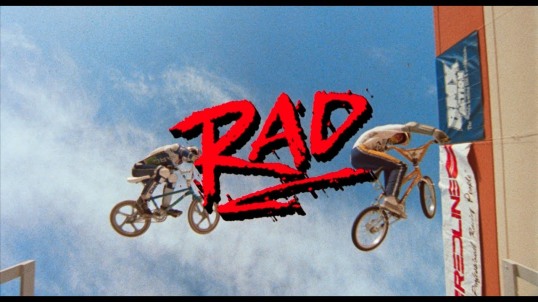
Film Review: Rad (dir by Hal Needham)


The 1986 film, Rad, tells the story of Christopher “Cru” Jones (Bill Allen).  Cru lives in a small, kind of ugly town in middle America.  Cru has a job delivering newspapers so, every morning, he rides around town on a bicycle and he throws rolled-up copies of USA Today at people.  He throws the papers fairly aggressively and doesn’t seem to have much concern about riding his bike through backyards or using his bike to jump over (or sometimes, onto) cars.  And yet, no one can stay mad at Cru because he has a plucky, can-do attitude and he can do all sorts of tricks on his bicycle.

Cru has a decision to make.  He can either go to college or he can compete in a bicycle race.  If he goes to college, he might actually be able to get a career and actually have a future.  If he wins the bicycle race, he’ll get a car and $100,000.  His mother (Talia Shire) feels that Cru should go to college.  Cru, however, says that his gut is telling him to enter the race….

Hey, Cru, your gut is lying to you!  Seriously, I’m all for Cru competing and showing off how good he is at a rather mundane and kind of boring sport but college is college.  There’s a scene early on in the film where one of Cru’s classmates is talking about all the schools to which he’s applied.  “UCLA, Princeton, SMU, Harvard….” Cru rides by and laughs but, 35 years later, who do you think currently has the nicer house?

Of course, despite his willingness to give up his future for $100,000 and a new car, it turns out that Cru might not even be able to compete.  The race’s evil sponsor (Jack Weston) is determined to make sure that his tea, wins the race and he keeps changing the rules to prevent Cru from being able to enter.  He demands that Cru find an official sponsor so Cru starts his own business.  He then demands that the business be worth at least $50,000!  Cru doesn’t have that type of money but — wait a minute — is that Ray Waltson, playing an eccentric businessman!?  Maybe he’s got $50,000!

Still, does Cru have the confidence necessary to enter the race and beat the best in the country?  Don’t worry, Cru’s little sister designs a t-shirt that reads, “Cru is Rad!”  Seriously, just try to beat that encouragement!

Anyway, you may be thinking that Rad sounds like it’s a pretty silly movie and it is.  Having now watched Rad, BMX Bandits, and Quicksilver, I am ready to announce that, in the 80s, there was absolutely no way to make BMX racing cinematic.  At the end of the movie, Cru performs a series of tricks while the end credits role and, instead of being impressed, you just notice how much Cru is struggling to maintain his balance.  Neither Bill Allen nor Bart Conner (who plays Cru’s main rival) have much screen presence and the whole film just looks and feels cheap.

And yet….

To be honest, it’s difficult to really dislike Rad.  For all of its many flaws, it’s all just so damn sincere.  Cru just wants to win that race so badly that it’s hard not to root for him and it is kind of touching to see the way the entire town rallies around him.  While the lead racers may have been blandly portrayed, Talia Shire, Jack Weston, Ray Waltson, and Lori Loughlin all turn in effective performances.  In fact, you could probably argue that Talia Shire is almost too good in her role.  She so effectively portrays the anguish of a mother watching her son throw his future away that you really do find yourself worrying about what’s going to happen to Cru when he’s older and he can’t get a job because he blew off college.  (I’m going to guess that Talia Shire’s presence in this film is due to the fact that it was produced by her late husband, Jack Schwartzman.)

Rad is sincere and unpretentious and rather silly.  Like a lot of 80s movies, it’s got a good soundtrack.  It especially makes good use of the song Send Me An Angel.  There’s also an out-of-nowhere scene where Cru and Lori Loughlin do a series of impromptu freestyle bike tricks on the middle of a dance floor and it’s just surreal enough to be memorable.

Rad is a simple but inoffensive tribute to throwing your life away.


Horror On TV: Suspense 2.5 “Dr. Violet” (dir by Robert Stevens)


I think it’s fairly safe to say that wax museums are inherently creepy.

I mean, don’t get me wrong.  If I see a wax museum off of the side of the road, I’m definitely going to visit it, if just so I can find the Hall of Presidents and give the finger to FDR.  (It’s a long story.)  But that said, wax museums are definitely not some place where you would want to get accidentally locked in.

Well, in tonight’s episode of Suspense, that’s exactly what happens to one unfortunate college student.  AGCK!

This episode originally aired on October 4th, 1949 and it has a very impressive cast that will be familiar to anyone who has ever spent a few hours watching TCM: Anne Francis, Hume Cronyn, Ray Waltson, Evelyn Varden, and Mike Kellin are all featured.

Enjoy!

The TSL’s Daily Horror Grindhouse: Galaxy of Terror (dir by Bruce D. Clark)


galaxy_of_terror

Long before Event Horizon (but, perhaps more importantly, shortly after the original Alien), there was 1981’s Galaxy of Terror!

Produced by Roger Corman and featuring production design and second unit work from James Cameron, Galaxy of Terror tells the story of what happens when, in the future, the crew of the Quest are dispatched to a mysterious planet.  They’re on a rescue mission but what they don’t realize is that they’re heading into a trap!

The crew of the Quest is virtually a who’s who of cult actors.

The youngest member of the crew is Cos.  Cos is scared of everything and, from the minute you see him, you can tell that he’ll probably be the first to die.  Cos is played by Jack Blessing, who subsequently became a very in-demand voice over artist.  You may not recognize the name or the face but you’ve probably heard the voice.

Captain Trainor, who is still troubled by a disastrous mission in the past, is played by Grace Zabriskie, who is rumored to have inspired Bob Dylan’s “Like A Rolling Stone” and who subsequently became a regular member of David Lynch’s stock company.

The fearsome Quuhod is played by one of the patron saints of exploitation filmmaking, the one and only SID HAIG!  Quuhod doesn’t say much but Sid Haig doesn’t have to say much to make an impression.

Technical officer Dameia is played by Taaffe O’Connell.  She suffers through the film’s most infamous and distasteful scenes, in which she’s assaulted by a gigantic space worm.  That scene was apparently insisted upon by Roger Corman and it’s not easy to watch.  At the same time, since the film takes place on a planet that is ruled by pure evil, the scene somehow works.  It’s that scene that tells you that Galaxy of Terror is not going to be your typical B-movie.  That is the scene that says, “This movie is going to give you nightmares!”

Ranger is played by Robert Englund!  That’s right — the original Freddy Krueger himself.  It’s interesting to see Englund in this role because Ranger is actually one of the only likable characters in the film.  It’s strange to see the future Freddy Krueger being menaced by the same type of threats that he unleashed on Elm Street.  But Englund does a good job in the role.  In fact, he does so well that you wonder what would have happened in his career if he hadn’t been forever typecast as the man of your nightmares.

The arrogant and cocky Baelon is played by future director, Zalman King.  It says something about King’s acting career that Galaxy of Terror is not the strangest film that he ever appeared in.

Burned-out Commander Ilvar is played by Bernard Behrens, who is one of those character actors who has a very familiar face.  If you watch any movie from the 80s or 90s that features a weary homicide detective or an unsympathetic bureaucrat, it’s entirely possible that he was played by Bernard Behrens.

Kore, the ship’s cook, is played by Ray Waltson, who is another one of those very familiar character actors.  Over the course of his long career, Waltson appeared in everything from The Apartment to The Sting to Fast Times At Ridgemont High to a countless number of TV shows and TV movies.  Waltson was usually cast in comedic roles so it’s interesting to see him here, playing a role that is very much not comedic.

Alluma, an empath, is played by Erin Moran, who was best known for playing Ron Howard’s bratty sister on the somewhat terrible (but apparently popular and deathless) sitcom, Happy Days.  Moran’s explosive death scene is another reason why Galaxy of Terror has a cult following.

And finally, the “star” of the film is Edward Albert, who plays Cabren.  To return to my earlier comparison to Event Horizon, Edward Albert has the Laurence Fishburne role.

Anyway, our crew is sent on a rescue mission but, when they crash land on the planet Morganthus, they find themselves outside of a desolate pyramid.  They make the mistake of exploring the pyramid and end up being confronted by their greatest fears.  (They also eventually discover that one of their crewmates is a traitor.)  It’s pretty much a typical sci-fi slasher film but it makes an impression because, thematically, it’s just so dark.  The fears that attack the crew members are so ruthless and brutal that they will take even the most jaded of horror fans by surprise.  Galaxy of Terror is relentless and merciless in its effort to scare the audience.

What especially distinguishes Galaxy of Terror is that, despite the obviously low budget, the entire film feels sickeningly real.  A lot of credit for that has to go to James Cameron, who creates a lived-in future that actually feels a lot more plausible than anything to be found in Avatar.

So, if you have the chance, turn off the lights, watch the film in the dark, and prepare for a perfect Halloween nightmare!

http://www.youtube.com/watch?v=mJO07ylhTu4

Lisa Reviews an Oscar Winner: The Sting (dir by George Roy Hill)


Earlier tonight, as a part of their 31 Days of Oscar, TCM aired The Sting, the film that the Academy selected as being the best of 1973.  I just finished watching it and what can I say?  Based on what I’ve seen of the competition (and there were a lot of great films released in 1973), I would not necessarily have picked The Sting for best picture.  However, the movie is still fantastic fun.

The Sting reunited the director (George Roy Hill) and the stars (Robert Redford and Paul Newman) of Butch Cassidy and the Sundance Kid and told yet another story of likable criminals living in the past.  However, whereas Butch Cassidy largely satirized the conventions of the traditional Hollywood western, The Sting is feels like a loving homage to the films of 1930s, a combination of a gritty, low-budget gangster film and a big budget musical extravaganza.  The musical comparison may sound strange at first, especially considering that nobody in The Sting randomly breaks out into song.  However, the musical score (which is famously dominated by Scott Joplin’s The Entertainer) is ultimately as much of a character as the roles played by Redford, Newman, and Robert Shaw.  And, for that matter, the film’s “let-pull-off-a-con” plot feels like an illegal version of “let’s-put-on-a-show.”

The film takes place in the 1936 of the cultural imagination, a world dominated by flashy criminals and snappy dialogue.  When con artists Johnny Hooker (Robert Redford) and Luther Coleman (Robert Earl Jones) inadvertently steal money from a gangster named Lonnegan (Robert Shaw), Lonnegan has Luther murdered.  Fleeing for his life, Hooker goes to Chicago where he teams up with Luther’s former partner, veteran con man Henry Gondorff (Paul Newman).  Gondorff used to be one of the great con artists but he is now living in self-imposed obscurity, spending most of his time drinking and trying to avoid the FBI.  Hooker wants to get revenge on Lonnegan by pulling an elaborate con on him.  When Gondorff asks Hooker why, Hooker explains that he can either con Lonnegan or he can kill him and he doesn’t know enough about killing.

The rest of the film deals with Hooker and Gondorff’s plan to con Lonnegan out of a half million dollars.  It’s all very elaborate and complicated and a bit confusing if you don’t pay close enough attention and if you’re ADHD like me.  But it’s also a lot of fun and terrifically entertaining and that’s the important thing.  The Sting is one of those films that shows just how much you can accomplish through the smart use of movie star charisma.  Redford and Newman have such great chemistry and are so much fun to watch that it really doesn’t matter whether or not you always understand what they’re actually doing.

It also helps that, in the great 70s tradition, they’re taking down stuffy establishment types.  Lonnegan may be a gangster but he’s also a highly respected and very wealthy gangster.  When Newman interrupts a poker game, Lonnegan glares at him and tells him that he’ll have to put on a tie before he’s allowed to play.  Lonnegan may operate outside the law but, in many ways, he is the establishment and who doesn’t enjoy seeing the establishment taken down a notch?

As entertaining as The Sting may be and as influential as it undoubtedly is (Steven Soderbergh’s Ocean films may be a lot more pretentious — which makes sense considering that Soderbergh is one of the most pretentious directors in film history — but they all owe a clear debt to The Sting), it still feels like an unlikely best picture winner.  Consider, for instance, that The Sting not only defeated American Graffiti and The Exorcist but Ingmar Bergman’s Cries and Whispers as well.  On top of that, when you consider some of the films that were released in 1973 and not nominated — Mean Streets, Badlands, The Candy Snatchers, Day of the Jackal, Don’t Look Now, Jesus Christ Superstar, and The Long Goodbye — it’s debatable whether The Sting should have been nominated at all.  That’s not a criticism of The Sting as much as it’s an acknowledgement that 1973 was a very good year in film.

So, maybe The Sting didn’t deserve its Oscar.  But it’s still a wonderfully entertaining film.  And just try to get that music out of your head!

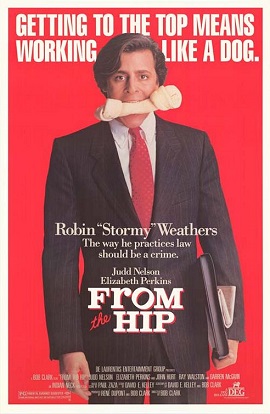
Insomnia File No. 8: From the Hip (dir by Bob Clark)


What’s an Insomnia File? You know how some times you just can’t get any sleep and, at about three in the morning, you’ll find yourself watching whatever you can find on cable? This feature is all about those insomnia-inspired discoveries!

From_the_Hip_(film)

Last night, if you discovered that you couldn’t get any sleep around two in the morning, you could have turned to Showtime and watched the 1987 film, From The Hip.

In From the Hip, Judd Nelson plays a character named Robin Weathers.  Of course, his nickname is Stormy.  Robin has just graduated from law school and is working at a prestigious law firm.  He’s ambitious, he’s outspoken, and he’s totally frustrated.  As his co-workers (played, quite well, by David Alan Grier and Dan Monahan) continually remind him, nobody gets to try a case during their first year out of law school.  They advise him to be patient and to wait his turn.

However, a man who is capable of being patient would not be nicknamed Stormy.  It just wouldn’t make any sense.  So, Stormy Weathers schemes his way into the courtroom.  One morning, he intentionally withholds information from the senior partners, going out of his way to keep them from realizing that a trial is scheduled to begin that afternoon.  When senior partner Craig Duncan (Darren McGavin) discovers what Stormy has done, he fires him and makes sure that he never get hired at another law firm … oh wait.  No, he doesn’t because that would make too much sense.  Instead, he allows Stormy to try the case because, at this point, Stormy is the only one who knows anything about it.

The case is a simple assault case that involves two bankers and should be resolved easily but Stormy manages to drag it out for several days and his flamboyant style catches the attention of the media.  The other partners in the law firm — who are all old and boring — want to fire Stormy but Stormy’s client says that, if Stormy is fired, he’ll take his business and his money elsewhere.  Stormy becomes a minor celebrity but — in a rather clever little twist — it turns out that he and the prosecuting attorney are old friends from law school and they conspired to make each other look good.

Anyway, Stormy is now so famous that he gets assigned to defend a college professor, named Benoit (John Hurt), who has been accused of murder.  When it quickly becomes obvious that Benoit is not only guilty but will probably murder again, Stormy is forced to choose between ambition and morality…

When my friend Evelyn and I first started to watch From the Hip last night, I really thought I was going to hate it.  The hot pink neon credits screamed, “Bad 80s movie!” and, because I happen to know quite a few lawyers, I tend to be a 100 times more critical of movies about lawyers than I am when it comes to movies about, say, homicidal fishermen.

And, honestly, From The Hip is a heavily flawed film.  Judd Nelson is miscast and the scenes with his politically conscious girlfriend (Elizabeth Perkins) are painfully shallow and reek of limousine liberalism.  But, if you can get through the weak opening, the film itself is watchable and enjoyable in a dumb sort of way.  John Hurt does a great job as a sociopath and, miscast as he may be, it’s still fun to watch Nelson go insane in court.

From The Hip is not a great film but, in its way, it’s an enjoyable little time capsule.  Believe it or not, there was a time when Judd Nelson starred in a movies that were actually released in theaters.

Previous Insomnia Files:

  1. Story of Mankind
  2. Stag
  3. Love Is A Gun
  4. Nina Takes A Lover
  5. Black Ice
  6. Frogs For Snakes
  7. Fair Game


Lisa Watches The Oscar Winners: The Apartment (dir by Billy Wilder)


Apartment_60

After the Nun’s StoryI continued to experience TCM’s 31 Days of Oscar by watching the 1960 best picture winner, The Apartment.  The Apartment is unique among Oscar winners in that it’s one of the few comedies to win best picture.  (Though, in all honesty, it would probably be more appropriate to call The Apartment a dramedy.)  It was also, until the victory of The Artist, the last completely black-and-white film to win best picture.

(And, as long as we’re sharing trivia, it was also the first best picture winner to feature a character watching a previous best picture winner.  At the start of the film, Jack Lemmon deals with insomnia by watching Grand Hotel.)

The Apartment tells the story of C.C. “Bud” Baxter (Jack Lemmon), an anonymous officer worker who is determined to climb the corporate ladder despite not being very good at his job.  However, Baxter does have one advantage over his co-workers.  He’s single and therefore, his apartment has become the place to go for corporate executives who need a place where they can safely cheat on their wives.  Bud spends his day trying to coordinate who is going to be in his apartment and when.  Meanwhile, he spends his nights exiled from his own home and wandering around New York.  In fact, the only beneficial thing about this arrangement is that all of Bud’s supervisors have been giving him good evaluations in return for using his apartment.  (Well, that and Bud’s neighbor, played by Jack Kruschen, is convinced, based on the thinness of the apartment walls, that Bud must be a great lover.)

When Bud finally does get his promotion, it’s only because the personnel director, Jeff D. Sheldrake (an amazingly sleazy Fred MacMurray), wants to use Bud’s apartment.  Bud celebrates his promotion by finally working up the courage to ask out Fran (Shirley MacClaine), an elevator operator who works in the office.  What Bud doesn’t realize is that Fran is also the woman who Sheldrake wants to bring to the apartment….

Fran is convinced that Sheldrake is going to leave his wife for her.  What she doesn’t realize — and what Fred MacMurray’s performance makes disturbingly clear — is that Jeff Sheldrake is basically just a guy having a midlife crisis.  He’s the type of middle-aged guy that every woman has had to deal with at some point, the guy who pulls up next to you in a red convertible and stares at you from behind his sunglasses, attempting his best to entice you into helping him relive the youth that he never had.  When Fran eventually learns the truth about Sheldrake, it leads both to near tragedy and to Bud having to decide whether he wants to be a decent human being or if he wants to keep climbing the corporate ladder.

When one looks over a chronological list of all of the best picture winners, it’s a bit strange to see The Apartment listed in between Ben-Hur and West Side Story.  As opposed to those two grandly produced and vibrantly colorful films, The Apartment is a rather low-key film, one that devotes far more time to characterization than to spectacle.  And while both Ben-Hur and West Side Story are ultimately very idealistic films, The Apartment is about as cynical as a film can get.  The Apartment may be a comedy but the laughs come from a place of profound sadness.

Because it’s more interested in people than in spectacle, The Apartment holds up better than many past best picture winners.  We’ve all known someone like Bud.  We’ve all had to deal with men like Sheldrake.  And, in one way or another, we all know what it’s like to be someone like Fran.  The Apartment remains a truly poignant and relevant film.

http://www.youtube.com/watch?v=B4OXm9-E8OQ