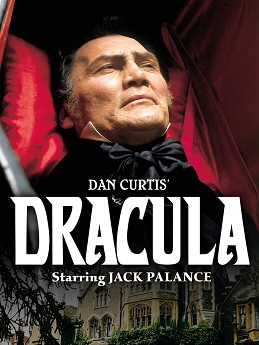
Horror Film Review: Bram Stoker’s Dracula (dir by Dan Curtis)


1974’s Bram Stoker’s Dracula opens with a familiar sight.

British solicitor Jonathan Harker (Murray Brown) is in Transylvania, where he has an appointment with a mysterious man named Dracula.  The local villagers are superstitious and seem to be frightened of Dracula’s very name.  When Harker reaches Dracula’s castle, he discovers that Dracula (Jack Palance) is a courtly but enigmatic man.  When Dracula sees a photograph of Jonathan’s fiancée, Mina, and her best friend, Lucy, something about it seems to capture his attention.  Later, that night, Jonathan is attacked by several female vampires.  After Dracula saves Jonathan’s life, he forced Jonathan to write a letter home, saying that he will be staying in Transylvania for month.  Jonathan attempts to escape but is instead dragged off to the crypt, where Dracula’s brides await….

Soon, Dracula is in England.  Lucy (Fiona Lewis), who looks exactly like Dracula’s long-dead wife, is taken mysteriously ill and dies.  Dr. Abraham Van Helsing (Nigel Davenport), called in when Lucy was showed signs of being sick, suspects that there is a vampire at work.  Lucky’s fiancé, Arthur Holmwood (Simon Ward), doesn’t believe it until he sees, with his own eyes, Lucy raised from the dead and calling for him to come and join her….

Not to be confused with the Francis Ford Coppola film, 1974’s Bram Stoker’s Dracula was directed by horror impresario Dan Curtis.  It’s a rather loose adaptation of Bram Stoker’s novel.  For one thing, Jonathan Harker does not return to England.  Dracula is, from the start, more interested in Lucy than in Mina.  Lucy’s other suitors — Quincy Morris, John Seward — are not present.  And Dracula himself does not get younger as the result of drinking blood.  In fact, it’s such a loose adaptation that it’s actually difficult to justify calling it Bram Stoker’s Dracula.  (In fact, the film is also known as Dan Curtis’s Dracula, which is a far more appropriate title.)

That said, it’s still an entertaining vampire movie.  Jack Palance, who previously worked with Dan Curtis in The Strange Case of Dr. Jekyll and Mr. Hyde, gives a properly intense performance as Dracula.  He doesn’t try to adopt any sort of Eastern European accent or anything like that.  Instead, he delivers his lines through clenched teeth (or, perhaps, fangs) and he fixes his victims with a powerful stare that hints at the animalistic urges behind his controlled demeanor.  Palance plays Dracula as being arrogant and convinced that no mere mortal can defeat him.  At the same time, there’s a vulnerability to Palance’s Dracula.  Watch how his face briefly lights up when he sees Lucy’s picture and is reminded of his long-dead wife.  Watch his fury when he discovers that Van Helsing and Arthur have gotten to Lucy before him.  His love for his wife is the one shred of humanity that Dracula still has within him.  When he loses her a second time (in the form of Lucy), he’s prepared to go to war.

Bram Stoker’s Dracula was originally meant to air in October of 1973 but the showing was pre-empted by the announcement that Vice President Spiro Agnew had resigned.  As a result, this film — so clearly meant for Halloween — did not air until February of 1974.  That doesn’t seem fair.  Poor Dracula.
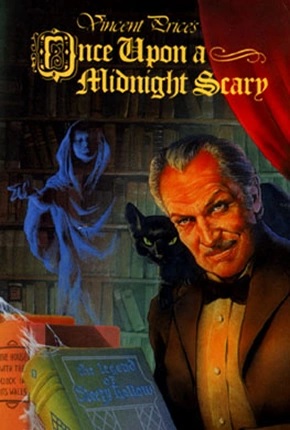
Insomnia File #64: Once Upon A Midnight Scary (dir by Nell Cox)


What’s an Insomnia File? You know how some times you just can’t get any sleep and, at about three in the morning, you’ll find yourself watching whatever you can find on cable or streaming? This feature is all about those insomnia-inspired discoveries!

If you were having trouble getting to sleep last night, you could have gone over to YouTube and watched 1978’s Once Upon A Midnight Scary.

Made for CBS and featuring Vincent Price as the sardonic, cape-wearing host, Once Upon A Midnight Scary was a special designed to encourage young viewers to pick up a book and read.  Price introduced three different stories, each centering around ghosts and each based on a book.  In the first story, based on the book The Ghost Belonged To Me, a young farmboy discovers a ghost hiding in a barn and becomes a hero when the ghost warns him about an impending disaster.  The second story is an adaptation of The Legend of Sleepy Hollow and it features Rene Auberjonois as a rather neurotic Ichabod Crane, who finds himself being pursued by the headless horsemen.  The third and longest story is an adaptation of The House With A Clock In Its Walls, featuring Severn Darden and a rather annoying child actor.

One thing you immediately notice about this show is that the special doesn’t actually reveal how any of the stories end.  Instead, each story is basically a recreation of the most exciting or interesting parts of the larger story but, whenever it appears that we’re heading for a conclusion, Vincent Price suddenly appears and says, “What happened next, you ask?  Read the book!”  This special basically casts Vincent Price as the world’s most devilish book salesman and while that might be annoying if you’re watching the special because you want to see how the stories turn out, it’s a lot of fun if you’re just watching the show to watch Vincent Price act like Vincent Price.  Vincent is not in the special as much as you might want but he still shows off his unique charm.  It’s impossible to be in a bad mood while watching Vincent Price.

Previous Insomnia Files:

  1. Story of Mankind
  2. Stag
  3. Love Is A Gun
  4. Nina Takes A Lover
  5. Black Ice
  6. Frogs For Snakes
  7. Fair Game
  8. From The Hip
  9. Born Killers
  10. Eye For An Eye
  11. Summer Catch
  12. Beyond the Law
  13. Spring Broke
  14. Promise
  15. George Wallace
  16. Kill The Messenger
  17. The Suburbans
  18. Only The Strong
  19. Great Expectations
  20. Casual Sex?
  21. Truth
  22. Insomina
  23. Death Do Us Part
  24. A Star is Born
  25. The Winning Season
  26. Rabbit Run
  27. Remember My Name
  28. The Arrangement
  29. Day of the Animals
  30. Still of The Night
  31. Arsenal
  32. Smooth Talk
  33. The Comedian
  34. The Minus Man
  35. Donnie Brasco
  36. Punchline
  37. Evita
  38. Six: The Mark Unleashed
  39. Disclosure
  40. The Spanish Prisoner
  41. Elektra
  42. Revenge
  43. Legend
  44. Cat Run
  45. The Pyramid
  46. Enter the Ninja
  47. Downhill
  48. Malice
  49. Mystery Date
  50. Zola
  51. Ira & Abby
  52. The Next Karate Kid
  53. A Nightmare on Drug Street
  54. Jud
  55. FTA
  56. Exterminators of the Year 3000
  57. Boris Karloff: The Man Behind The Monster
  58. The Haunting of Helen Walker
  59. True Spirit
  60. Project Kill
  61. Replica
  62. Rollergator
  63. Hillbillys In A Haunted House

International Horror Film Review: The Night Digger (dir by Alistair Reid)


The 1971 British film, The Night Digger, revolves around three people.

Maura Prince (Patricia Neal) lives in a dilapidated mansion out of London. She has never married and spends almost all of her time taking care of her blind mother, Edith (Pamela Brown). Edith goes out of her way to make sure that Maura will never have the courage to leave her and find happiness on her own. However, with the mansion falling apart around them, it’s becoming obvious that Maura cannot take care of the entire place on her own. That’s when a mysterious but handsome man named Billy Jarvis (Nichols Clay) rides up on his motorcycle and asks if the women need a handyman.

Billy has a dramatic story about his past, claiming that he lost almost everything that he owned as the result of a fire in a barn, one which also led to the death of his mother. Billy is charming and handsome and he ride a really impressive motorcycle and he looks good in a leather jacket.  He represents youth but he’s also the epitome of the rebel without a cause, the sensitive but inarticulate Marlon Brando of The Wild One or the biker played by Peter Fonda in The Wild Angels.  Some may look at him and only see a somewhat seedy character on a motorcycle but others look at him and see someone who is running from something and needs someone to take care of him.  They see the soul of poet within the body of a drifter, someone who needs to escape from his past and who can also provide a better future.  He’s the rebel without a cause, the one that everyone dreams about, even if some of those dreams are dreamt in secret.  Though one may have rode a bicycle and the other was knight of the round table, there is much Nicholas Clay’s future performance as Lancelot in John Boorman’s Excalibur to be found in his performance in The Night Digger.  Much like a groundkeeper in a D.H. Lawrence novel, he represents the secret and potentially dangerous earthy sensuality of Britain.

As a result, You certainly can not blame Maura for starting to fall in love with him. Nor can you blame Edith for wanting to have an athletic young man around as there have been stories about a madman who stalks the night, killing women. The Traveling Maniac, some have taken to calling him. Complicating the matter, though, is the fact that Billy just happens to be The Traveling Maniac. With Maura falling in love with him, will she discover the truth or will she become his next victim?

The Night Digger took me by surprise. I wasn’t expecting much from this film when I watched it last year but it turned out to be rather clever and suspenseful thriller, one that told its story with a good combination of black humor and emotional honesty. Atmospherically directed by Alistair Reid and featuring a trio of excellent lead performances, The Night Digger was compelling compelling thriller, a gothic horror story with a great ending. This is definitely one to keep an eye out for!

Embracing the Melodrama Part II #26: Cleopatra (dir by Joseph L. Mankiewicz)


Cleopatra_posterWhile watching the 1963 best picture nominee, Cleopatra, I had many thoughts.  The film lasts over 4 hours so I had a lot of time to think.

For instance, I often found myself impressed by the sheer size of the production.  I marveled at the recreation of ancient Greece and Rome.  I loved looking at the ornate costumes.  I loved feeling as if I was taking a look back at what Rome may have actually looked like at the height of the Roman Empire.  Making it all the more impressive was that this film was made in the days before CGI.  When the film’s Romans walked through the streets of Rome, they weren’t just actors standing in front of a green screen.  They were walking down real streets and surrounded by real buildings.  It reminded me of the awe and wonder that I felt when I was in Italy and I was visiting the ruins of ancient Rome.

(I don’t know if any of the cast accidentally flashed everyone like I did when I visited during Pompeii on a windy day but considering how short some of the skirts on the men were, it wouldn’t surprise me if they did!)

And, as I marveled at the recreation of Rome, I also thought to myself, “How long is this freaking movie?”  Because, seriously, Cleopatra is an amazingly long movie.  It’s not just the film is over four hours long.  It’s that the film feels even longer.  Gone With The Wind, The Godfathers Part One and Part Two, Once Upon A Time In America; these are all long films but, because they’re so great, you never find yourself checking the time while watching.  Cleopatra is the opposite of that.  Cleopatra is a film that, at its slowest, will make you very much aware of how many seconds are in a minute.

I found myself marveling at the lack of chemistry between Elizabeth Taylor and Richard Burton.  If anything, this is the most shocking thing about Cleopatra.  If Cleopatra is famous for anything, it’s famous for being the film where Elizabeth Taylor (cast in the role of Cleopatra) first met Richard Burton (who was playing Mark Antony).  Their affair dominated the gossip headlines.  (If TMZ and YouTube had been around back then, there would be daily videos of Richard Burton punching out paparazzi.)  Cleopatra was the first of many big-budgeted, overproduced films that Taylor and Burton co-starred in.

(Then again, they also starred in Who’s Afraid of Virginia Woolf, a film that is almost the exact opposite of Cleopatra.)

In the role of Mark Antony, Burton spends most of the film looking absolutely miserable.  Elizabeth Taylor, meanwhile, seems to be having a lot more fun.  It’s almost as if she understood what Cleopatra was going to become so she went out of her way to give the type of over-the-top performance that the film deserved.  The same can also be said about Rex Harrison, who plays Julius Caesar and who, perhaps because he appears to have shared her attitude, actually does have some chemistry with Taylor.

Actually, if anyone gives a truly great performance in Cleopatra, it’s Roddy McDowall.  McDowall plays the future Emperor Augustus with a mesmerizing intensity.  Again, McDowall’s performance is not exactly subtle but Cleopatra is not a film that demands subtlety.

As the film finally neared its end, I found myself wondering how Joseph L. Mankiewicz went from directing two close to perfect films, A Letter To Three Wives and All About Eve, to directing this.  Even more amazing, Mankiewicz had previously directed one of the best Roman Empire films ever, 1953’s Julius Caesar.  (When compared to Cleopatra, the low-key and thoughtful Julius Caesar appears to have been filmed on an entirely different planet.)  Well, in Mankiewicz’s defense, he was not the original director.  He was brought in to replace Rouben Mamoulian, who had previously attempted to make the film with Joan Collins, Ben-Hur‘s Stephen Boyd, and Peter Finch.  When Mankiewicz was brought in, the cast was replaced with Taylor, Burton, and Harrison.  Between the expensive stars, the troubled production, and all of the offscreen romantic melodrama, Mankiewicz probably did the best that he could.

Today, Cleopatra is mostly interesting as an example of a film from the “Only Gigantic Productions Will Save Us From Television!” era of Hollywood filmmaking.  Cleopatra started out as a $2,000,000 production and ended up costing $31,000,000.  It was the number one film at the 1963 box office and it still nearly bankrupted 20th Century Fox.  While the film does have some kitsch appeal, the critics hated it and it’s easy to see why.

And yes, it was nominated for best picture of the year, a tribute to the size of the production and the determination of 20th Century Fox to get something — anything — in return for their money.

Cleopatra is a bit of a chore to sit through but it can be fun if you’re in a snarky mood.  It’ll do until the inevitable Angelina Jolie remake comes along.