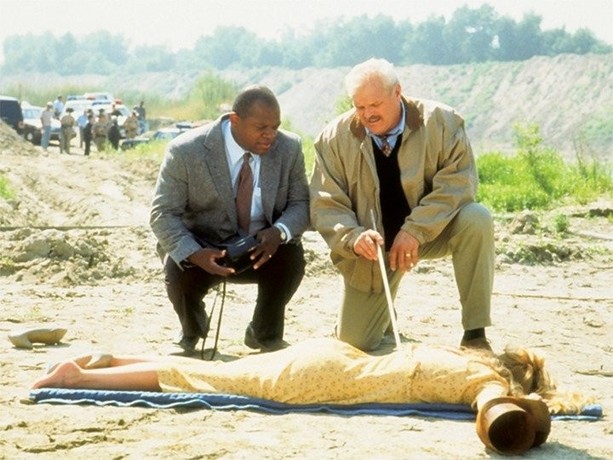
Brad reviews JACK REED: A SEARCH FOR JUSTICE (1994), starring Brian Dennehy!


Brian Dennehy directed, co-wrote and starred in this made-for-TV movie about Chicago homicide detective Jack Reed. This is the third TV movie based on Reed’s exploits, following 1992’s DEADLY MATRIMONY, and 1993’s BADGE OF HONOR. In A SEARCH FOR JUSTICE, Jack Reed (Brian Dennehy) investigates the murder of pregnant stripper Lorelei Bradley (Marjorie Monaghan), who also happens to love children, even running a daycare center in the trailer park she lives in. Reed’s investigation quickly identifies the politically connected businessman and strip club owner, Win Carter (Miguel Ferrer), as the prime suspect. As if trying to solve the murder isn’t tough enough, Reed must also deal with corrupt superiors within his own department and train his new boss Charles Silvera (Charles S. Dutton), the latest in a long line of men to be promoted over him. No matter what obstacles Reed encounters, he remains determined to bring the killer to justice!

JACK REED: A SEARCH FOR JUSTICE, is my first “Jack Reed” film, and I enjoyed it. The character of Jack Reed is based on real life Cook County, Illinois Sheriff John “Jack” Reed, with each of the different movies loosely based on cases that Reed investigated throughout his career. As you might imagine, Brian Dennehy is excellent in the lead role as the tough, principled cop who will stop at nothing to catch criminals. The Chicago backdrop adds a nice wrinkle to the proceedings with its strong reputation for corruption, something that plays strongly into this installment and makes Reed’s job that much harder. I also really like Charles S. Dutton’s character, Lieutenant Charles Silvera. Initially promoted due to the color of his skin, and as a way to stick it to Reed, Silvera turns out to be an incorruptible lawman who develops a great working relationship with Reed. I’ve always been a fan of Dutton as an actor, mainly because of his ability to project decency and integrity on screen, and I’m looking forward to seeing them work together in future installments. Miguel Ferrer is also a good villain. He doesn’t go over the top here, rather he plays the part as low key, politically connected, amoral, and ultimately, very dangerous. It’s a good choice.

The fact that JACK REED: A SEARCH FOR JUSTICE is based on real life cases helps bring a little more realism than you might get in most TV movie cop movies of the time. As an example, our cops are more concerned about putting together solid evidence and getting a conviction over anything else. There is some action, but after watching this installment, I realize that these movies are just as likely to end with lawyers cutting a deal than with a big shootout. On the flip side, there are elements of the story that don’t seem realistic at all, such as Reed’s wife Arlene (Susan Ruttan) doing her own undercover work at one point, and our victim’s unlikely dual life as a stripper and daycare operator. What can I say, it’s not a perfect movie, but if you enjoy 90’s TV cop dramas like I do, you should enjoy this film and this series. The cast is good, and the characters are men of integrity trying to bring justice to a corrupt world. That’s a recipe for enjoyment as far as I’m concerned, and I’m looking forward to watching the rest of the film series! 
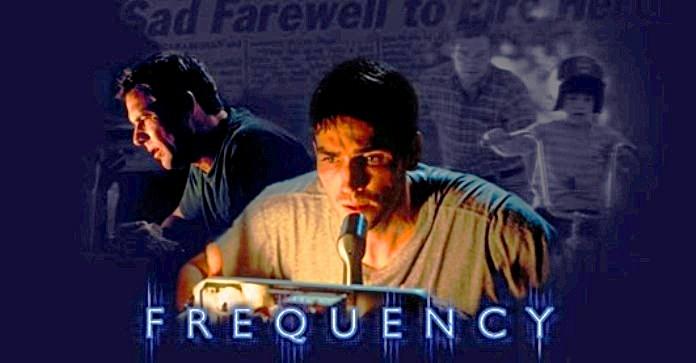
FREQUENCY (2000) – What would you give to talk to your dad or mom one more time?


I find it difficult to write about my favorite movies, because it can be hard to put into words why I love them so much. It seems that nothing I can say will do the movie justice. FREQUENCY is one of those movies that I abolutely love, and I’ll tell any person who will listen that it’s one of my all-time favorites. Sadly, I run into quite a few people who aren’t even aware of the almost 25 year old film at this point. That just doesn’t set right with me, so I’m here today to sing the praises of FREQUENCY!

FREQUENCY stars Jim Caviezel as homicide detective John Sullivan, a guy who lives in the same house he’s lived in his entire life. John is still dealing with emotional scars related to the death of his firefighter father Frank (Dennis Quaid), who died fighting a fire 30 years earlier. One night John’s hanging out with his buddy Gordo (Noah Emmerich), when they come across his dad’s old Ham radio. Some of John’s fondest memories of his dad include him speaking with people around the world on that old radio. They hook it up not even sure if it even works anymore. Sometime later that night when he’s there alone, a man’s voice comes across the airwaves. John starts talking back, and that’s when the greatness of this movie starts for me. The two guys start talking about baseball, and the voice on the other end of the line wants to know what John thinks about New York’s Amazin’ Mets chances to win the 1969 World Series. It seems that somehow through movie magic and the “mother sunspot of all time,” John is talking to his own father at the same location, separated by 30 years of space and time. John tells his dad about the specific fire that he dies in on that fateful day 30 years earlier. With John’s warning, Frank is able to survive the fire, and John gets a bunch of new memories that show him growing up with his dad in his life. Unfortunately, the changing of the past has real world consequences in the present. Now, John’s mom Julia (Elizabeth Mitchell) is gone, killed by a serial killer whose “Nightingale murders” had ended with 3 nurses in 1969, but has now ballooned to 10 in 1999. Separated by those 30 years, and not knowing when their connection on the radio might end, John and Frank work together to try to stop the Nightingale killer and save Julia, not knowing what other things they might change in the process.

FREQUENCY is a cross-genre concoction. It’s a fantasy film in the way that it brings people together from two different timeframes. The exact way this is done is never spelled out and shouldn’t be thought about too much. We just know that the phenomenon known as the aurora borealis, which is a natural light show that occurs when charged particles from the sun interact with Earth’s magnetic field, is going on in both 1969 and 1999. This natural phenomenon is somehow allowing John and Frank to talk to each other. It’s also a solid dramatic thriller as John is able to first save Frank’s life from the fire, and then as the two work together to catch a serial killer (Shawn Doyle) before he takes out Julia. This is put together extremely well by director Gregory Hoblit, who gets solid performances from Jim Caviezel, Dennis Quaid, and Elizabeth Mitchell as the Sullivan family. I also want to shout out Andre Braugher, who plays Frank’s best friend Satch in the 1969 timeframe, and who’s John’s cop partner in 1999. He’s so good in FREQUENCY. Despite winning two primetime Emmy awards, I still believe that Andre Braugher was an amazing actor who was underused during his lifetime. Sadly, he passed away in 2023 at just 61 years of age.

But the reason that I love FREQUENCY is the fantastic notion that a son who’s lost his father would somehow have the chance to talk to him again. Father-son relationships in movies affect me more than anything else, and I’m all in for the way it is addressed here. I cry like a baby every time I watch FIELD OF DREAMS with Kevin Costner, and I also cry like a baby every time I watch FREQUENCY. I mentioned earlier that John is dealing with emotional scars from not having his dad growing up. In this film, we get to hear their conversations and put ourselves in that same position. The film really leans into the joy of this unique opportunity to change the past and erase much of the pain that came with such deep emotional wounds. This shared desire to right past wrongs and erase past pain elevates the film even when logic fails. FREQUENCY got on my radar back at the turn of the century when I read articles about grown men crying in theaters as they watched. I remember telling a friend of mine, a friend whose father had died when he was young, about this film. He told me later of his own emotional experience watching it. There really is something universal about wanting to connect with our parents once they are no longer with us. As of this writing, my own father is still here, yet I am still emotionally overwhelmed every time I watch FREQUENCY. I can’t even begin to imagine what it will feel like if there’s a time that I’m still here, and he’s gone.     

Film Review: The Good Nurse (dir by Tobias Lindholm)


It’s suspected that Charles Cullen might be the most prolific serial killer in U.S. history.

He’s currently sitting in prison, serving 18 consecutive life sentences.  (For those keeping track, he’ll be eligible for parole in the 25th Century.)  In order to avoid getting the death penalty, Cullen confessed to killing 29 people in New Jersey and Pennsylvania.  It is thought that, between the years 1988 and 2003, he actually killed over 400 people.  What made Cullen’s crimes especially horrifying is that he was a nurse and his victims were his patients.  When Cullen first confessed, he tried to portray himself as being a mercy killer, someone who only murdered those who would have no quality of life.  Cullen also claimed that he had been traumatized the first time that he saw a team of doctors fail to resuscitate a patient so he would specifically give overdoses to terminal patients so that they could die both with dignity and without leaving him traumatized.  It was subsequently discovered that few of Cullen’s victims had been terminally ill and that many of them were actually only a day or two away from being discharged from the hospital when Cullen killed them.  Cullen later said that many of his murders were impulsive acts and he wasn’t sure why he had committed them.  In the end, no one can be sure what drove Cullen to commit his murders.

Even before he was arrested, Cullen had developed a bad reputation as a nurse who lost a lot of patients.  He moved from hospital to hospital and he seemed to generate suspicion wherever he went.  Cullen would leave the hospitals whenever it became apparent that anyone was investigating any of the deaths in which he had been involved.  The hospitals were usually happy to be rid of him.  Despite all of the suspicions about him, no one ever tried to stop Cullen from getting another job.  Why risk getting sued for having had Cullen on staff when you could just dump him off on another hospital?

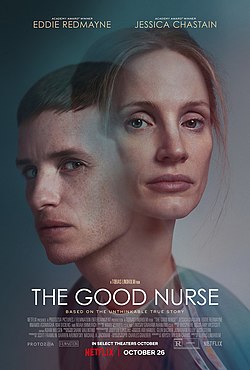
The Good Nurse, which just dropped on Netflix this week, stars Eddie Redmayne as Charles Cullen and Jessica Chastain as Amy Loughren, the nurse who worked with Cullen at his final place of employment.  In the film, Amy is workaholic single mother who needs a heart transplant but who still finds time to show compassion to the patients in the ICU.  She is, as the title states, the good nurse.  When Charles Cullen shows up to work the night shift, she is happy for the help and she takes an immediate liking to the polite and seemingly hardworking Cullen.  Just like Amy, Cullen has two daughters and they bond over their struggles to be both good nurses and good parents.  Cullen tells Amy about how his former coworkers were always plotting against him.  Amy, somewhat naively, invites Cullen to come to her house to meet her daughters.  But when patients start to die, Amy soon suspects that Cullen is responsible.  When she ends up as a patient in the hospital and is faced with the horrifying prospect of Charles Cullen being her nurse, Amy goes to the police and offers to to help them build their case against her former friend.

The Good Nurse is a typical Netflix true crime movie, complete with the slightly washed-out look that almost all of these films seem to share.  The film does a good of capturing the isolation of an ICU ward at night.  With only a handful of nurses and patients on the floor, it’s easy to see how someone like Charles Cullen could have committed his crimes without being caught.  Indeed, some of the film’s most disturbing moments are when Cullen appears to literally emerge from the dark shadows of the ICU ward, like some sort of ghostly hunter seeking his prey.  At the same time, there’s a few moments where the movie feels more like an extra-long episode of Law & Order than a feature film.  Noah Emmerich and Nnamdi Asomugha play the two detectives who are assigned to investigate Cullen’s crimes and their scenes often feel as if they could have been lifted from a dozen other similar true crime films.

As Amy, Jessica Chastain is well-cast, though the role itself is somewhat underwritten.  The film is stolen by Eddie Redmayne, who plays Charles Cullen with an intensity that is frightening to behold at times.  As played by Redmayne, Cullen is creepy from the first time that we see him but, at the same time, Redmayne plays the role with just enough needy charm that the viewer can understand how he was able to fool so many people at so many hospitals.  Redmayne plays Cullen as man who is incapable of compassion but who has learned how to fake it.  It’s only towards the end of the film that Cullen allows his mask to slip and what we see underneath is terrifying.  Eddie Redmayne brings to life a truly evil man, someone who is all the more nightmarish because he really exists.

In the end, The Good Nurse suffers from the same problem as Netflix’s Extremely Wicked, Shockingly Evil, and Vile.  It attempts to comprehend an evil that is beyond normal comprehension.  In the end, both films suggest that there’s no real way to understand what motivates a Ted Bundy or a Charles Cullen.  Instead, all one can do is remain vigilant and hope they’ll be stopped before they can cause any more pain. Cullen is in prison for life.  Bundy got the electric chair.  Both of them left behind many questions that will never be answered.

Here Are The Winners of the 24th Annual Critics Choice Awards!


TSL writer Patrick Smith has referred to The Critics Choice Awards as being his “fifth favorite awards show” and that seems like the perfect description of where they fall in awards season.  People do pay attention to them and, in the past, they’ve been a pretty good precursor as far as the Oscars are concerned.  At the same time, there always seem to be confusion as just who exactly votes for the Critics Choice Awards.

Well, the answer to that question is that the Critics’ Choice Awards are voted on by the Broadcast Film Critics Association and, tonight, they announced their picks on the CW.

It was interesting night — two ties and Christian Bale was named Best Actor twice, which of course meant we had to suffer through his “I’m just an ordinary working bloke!” routine two times too many.  By far, my favorite winner was Amy Adams for Sharp Objects.

(On another note: Taye Diggs was an interesting choice to host.  I thought he did okay but, with his talent, he really should be receiving the awards instead of talking about them.  Someone write a great role for Taye Diggs ASAP!)

Here are tonight’s winners!  (Check out the nominees here!)

Movie

Best Song — Shallow from A Star is Born

Best Young Actor or Actress — Elsie Fisher, Eighth Grade

Best Supporting Actor — Mahershala Ali, Green Book

Best Supporting Actress — Regina King, If Beale Street Could Talk

Best Sci-Fi or Horror Movie — A Quiet Place

Best Acting Ensemble — The Favourite

Best Action Film — Mission Impossible: Fallout

Best Animated Film — Spider-Man Into The Spider-Verse

Best Foreign Language Film — Roma

Best Original Screenplay — Paul Schrader, First Reformed

Best Adapted Screenplay — Barry Jenkins, If Beale Street Could Talk

Best Actress In A Comedy — Olivia Colman, The Favourite

Best Actor In A Comedy — Christian Bale, Vice

Best Comedy — Crazy Rich Asians

Best Cinematography — Alfonso Cuaron, Roma

Best Production Design — Hannah Beachler and Jay Hart, Black Panther

Best Editing — Tom Cross, First Man

Best Costume Design — Ruth Carter, Black Panther

Best Hair and Makeup — Vice

Best Visual Effects — Black Panther

Best Original Score — Justin Hurwitz, First Man

Best Director — Alfonso Cuaron, Roma

Best Actress (tie) — Glenn Close, The Wife and Lady Gaga, A Star is Born

Best Actor — Christian Bale, Vice

Best Motion Picture — Roma

Television

Best Supporting Actor (Drama) — Noah Emmerich, The Americans

Best Supporting Actress (Drama) — Thandie Newton, Westworld

Best Supporting Actor (Comedy) — Henry Winkler, Barry

Best Supporting Actress (Comedy) — Alexis Borstein, The Marvelous Mrs. Maisel

Best Supporting Actor (Limited Series or Made-For-TV Movie): Ben Whishaw, A Very English Scandal

Best Supporting Actress (Limited Series or Made-For-TV Movie): Patricia Clarkson, Sharp Objects

Best Movie Made For Television — Jesus Christ Superstar Live In Concert

Best Animated Series — BoJack Horseman

Best Actor (Limited Series or Movie Made-For-TV): Darren Criss, American Crime Story: The Assassination of Gianni Versace

Best Actress (Limited Series or Movie Made-For-TV): (Tie) Amy Adams, Sharp Objects and Patricia Arquette, Escape at Dannemora

Best Actor (Comedy Series) — Bill Hader, Barry

Best Actress (Comedy Series) — Rachel Brosnahan, The Marvelous Mrs. Maisel

Best Actor (Drama Series) — Matthew Rhys, The Americans

Best Actress (Drama Series) — Sandra Oh, Killing Eve

Best Limited Series — American Crime Story: The Assassination of Gianni Versace

Best TV Drama Series — The Americans

Best TV Comedy Series — The Marvelous Mrs. Maisel


Stallone Acts: Cop Land (1997, directed by James Mangold)


Garrison, New Jersey is a middle class suburb that is known as Cop Land.  Under the direction of Lt. Ray Donlan (Harvey Keitel), several NYPD cops have made their home in Garrison, financing their homes with bribes that they received from mob boss Tony Torillo (Tony Sirico).  The corrupt cops of Garrison, New Jersey live, work, and play together, secure in the knowledge that they can do whatever they want because Donlan has handpicked the sheriff.

Sheriff Freddy Heflin (Sylvester Stallone) always dreamed of being a New York cop but, as the result of diving into icy waters to save a drowning girl, Freddy is now deaf in one ear.  Even though he knows that they are all corrupt, Freddy still idolizes cops like Donlan, especially when Donlan dangles the possibility of pulling a few strings and getting Freddy an NYPD job in front of him.  The overweight and quiet Freddy spends most of his time at the local bar, where he’s the subject of constant ribbing from the “real” cops.  Among the cops, Freddy’s only real friend appears to be disgraced narcotics detective, Gary Figgis (Ray Liotta).

After Donlan’s nephew, Murray Babitch (Michael Rapaport), kills two African-American teenagers and then fakes his own death to escape prosecution, Internal Affairs Lt. Moe Tilden (Robert De Niro) approaches Freddy and asks for his help in investigating the corrupt cops of Garrison.  At first, Freddy refuses but he is soon forced to reconsider.

After he became a star, the idea that Sylvester Stallone was a bad actor because so universally accepted that people forgot that, before he played Rocky and Rambo, Stallone was a busy and respectable character actor.  Though his range may have been limited and Stallone went through a period where he seemed to always pick the worst scripts available, Stallone was never as terrible as the critics often claimed.  In the 90s, when it became clear that both the Rocky and the Rambo films had temporarily run their course, Stallone attempted to reinvent his image.  Demolition Man showed that Stallone could laugh at himself and Cop Land was meant to show that Stallone could act.

For the most part, Stallone succeeded.  Though there are a few scenes where the movie does seem to be trying too hard to remind us that Freddy is not a typical action hero, this is still one of Sylvester Stallone’s best performances.  Stallone plays Freddy as a tired and beaten-down man who knows that he’s getting one final chance to prove himself.  It helps that Stallone’s surrounded by some of the best tough guy actors of the 90s.  Freddy’s awkwardness around the “real” cops is mirrored by how strange it initially is to see Stallone acting opposite actors like Harvey Keitel, Robert De Niro, and Ray Liotta.  Cop Land becomes not only about Freddy proving himself as a cop but Stallone proving himself as an actor.

The film itself is sometimes overstuffed.  Along with the corruption investigation and the search for Murray Babitch, there’s also a subplot about Freddy’s unrequited love for Liz Randone (Annabella Sciorra) and her husband’s (Peter Berg) affair with Donlan’s wife (Cathy Moriarty).  There’s enough plot here for a Scorsese epic and it’s more than Cop Land‘s 108-minute run time can handle.  Cop Land is at its best when it concentrates on Freddy and his attempt to prove to himself that he’s something more than everyone else believes.  The most effective scenes are the ones where Freddy quietly drinks at the local tavern, listening to Gary shoot his mouth off and stoically dealing with the taunts of the people that he’s supposed to police.  By the time that Freddy finally stands up for himself, both you and he have had enough of everyone talking down to him.  The film’s climax, in which a deafened Freddy battles the corrupt cops of Garrison, is an action classic.

Though the story centers on Stallone, Cop Land has got a huge ensemble cast.  While it’s hard to buy Janeane Garofalo as a rookie deputy, Ray Liotta and Robert Patrick almost steal the film as two very different cops.  Interestingly, many members of the cast would go on to appear on The Sopranos.  Along with Sirico, Sciorra, Patrick, and Garofalo, keep an eye out for Frank Vincent, Arthur Nascarella, Frank Pelligrino, John Ventimiglia, Garry Pastore,  and Edie Falco in small roles.

Cop Land was considered to be a box office disappointment when it was released and Stallone has said that the film’s failure convinced people that he was just an over-the-hill action star and that, for eight years after it was released, he couldn’t get anyone to take his phone calls.  At the time, Cop Land‘s mixed critical and box office reception was due to the high expectations for both the film and Stallone’s performance.  In hindsight, it’s clear that Cop Land was a flawed but worthy film and that Stallone’s performance remains one of his best.


An Olympic Film Review: Miracle (dir by Gavin O’Connor)


(Back in 2011, Chris Mead — who wrote under the name Semtex Skittle — reviewed Miracle for this site.  At the that time, I had not seen the film.  Below are my thoughts but please, also be sure to read Chris’s review as well.)


Like all good people, I’m currently obsessed with the Winter Olympics.  Earlier this week I asked a couple of friends if they could recommend some good Winter Olympics movies.  A lot of movies were suggested but, without fail, everyone thought I should see Miracle.  (A lot of people also suggested Cool Runnings, which I’ll be watching next week.)  Having watched Miracle earlier today, I can see why everyone recommended it.

The year is 1980 and two hockey teams are about to face off at the Winter Olympics in upstate New York.  (The location, to be exact, is Lake Placid.  Fortunately, the giant alligators are nowhere to be seen.)

On one side you have the Russian team (or the Soviets as they were known back then).  They are widely considered to be one of the greatest hockey teams in history.  They are big, fierce, and determined.  Coming from a system that has declared individuality to be a crime against the state, the Soviet team plays like a machine.  The Soviets have won the gold in the last four Olympics.  As one American coach puts it, their greatest strength is that every other hockey team in the world is terrified of them.

On the other side, you have the American team.  However, this isn’t the type of American dream team that one would expect to see today.  In 1980, professional athletes were not allowed to compete on the U.S. Olympic team.  Instead, the 1980 hockey team is made up of amateurs and college players.  Unlike the Soviet teams, the American don’t have a government that grooms and supports them.  Instead, win or lose, they have to do it on their own.

Of course, it’s not just two hockey teams that are about to face off.  It’s also two super powers and two very different ways of life.  In 1980, the U.S. and the Soviet Union were the two most powerful rivals in the world.  The Soviets were trapped in an endless and unpopular war in Afghanistan.  Meanwhile, in the U.S., the economy was shaky, American citizens were being held hostage in Iran, and an ineffective President gave long-winded speeches about how unhappy everyone in the country appeared to be.  Both countries needed a victory but only one could win.

And it would take a miracle for that winning team to be American…

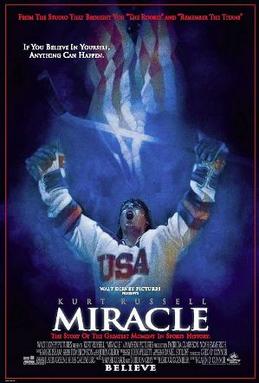
I don’t think it requires a spoiler alert to tell you that’s exactly what happens.  I mean, after all, I’m reviewing a film  called Miracle!  On top of that, it’s based on true events.  The U.S. hockey team — made up of college students and led by Coach Herb Brooks (played, in one of his best performance, by Kurt Russell) — not only managed to defeat the highly favored Soviet team but they went on to win the gold medal.

Even if you didn’t know that the Americans beat the Russians, you would never have any doubt about how Miracle is going to end.  Miracle is a film that utilizes almost every sports film cliché but it manages to do so with such sincerity and such style that you don’t mind the fact that the movie doesn’t exactly take you by surprise.  Is there any actor who is as good at project sincerity and human decency as Kurt Russell?  Whenever he says that he’s going to make his team into champions, you believe him.  When he says that he’s being hard on them because he wants them to be the best, you never doubt him or his techniques.  When he says that he’s proud of his team and his country, it brings tears to your eyes.  If there’s ever a movie that deserves a chant of “USA!  USA!  USA!,” it’s Miracle.

Film Review: Jane Got A Gun (dir by Gavin O’Connor)


Jane_got_a_Gun_Poster

Jane Got A Gun, which was released with little fanfare in January and is now available on Netflix, could just as easily have been called This Bishop Boys Are Coming And Who Gives A Fuck?

In fact, I like that title better than Jane Got A Gun.  As far as I’m concerned, I am no longer reviewing Jane Got A Gun.  Instead, I am going to tell you about a film called The Bishop Boys Are Coming And Who Gives A Fuck?

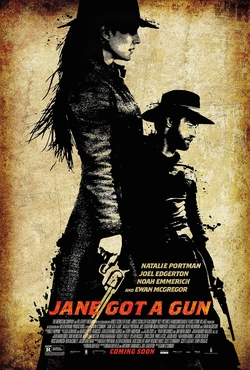
The film is a western, taking place shortly after the end of the Civil War.  (Isn’t it interesting how every western recently produced has taken place shortly after the Civil War?  Way to avoid awkward historical truths, Hollywood.)  Jane (Natalie Portman) lives on an isolated farm, with her daughter and her husband, Bill Hammond (Noah Emmerich, who is wasted both figuratively and literally).  Hammond used to be an outlaw but now, he’s a pretty good guy.  But the Bishop Boys are still after him!

Who are the Bishop Boys?

Well, John Bishop is Ewan McGregor.  He’s an evil businessman and a bounty hunter and he used to be in love with Jane but now it seems that he mostly just wants to collect the bounty that’s on Hammond’s head.  I love Ewan McGregor but, as we all should have learned from his performance in Haywire, he doesn’t make the most convincing villain.  McGregor is one of those actors who radiates an inner humanity.  No actor falls in love as convincingly as Ewan McGregor.  That’s what makes him a compelling actor but it also means that he’s totally miscast as a bounty hunting sociopath.

Anyway, the Bishop Boys end up putting five bullets in Hammond so he goes home to die.  “The Bishop Boys are coming,” he says and Jane has to prepare for the upcoming siege.  Fortunately, her surly neighbor, Dan (Joel Edgerton, who seems to be bored with the whole thing), just happens to be her former fiancée and he’s still in love with her, though he tries to hide his love behind bitterness and pithy one-liners.  It also turns out that Dan was a hero in the Civil War but he’s weary of violence.

Don’t worry, though!  Dan is still willing to kill.  After all, not much would happen in the movie if Dan wasn’t willing to shoot people…

Anyway, The Bishop Boys Are Coming And Who Gives A Fuck only lasts for 98 minutes but there’s a lot of hints that there was originally supposed to be a lot more to the movie than actually showed up on screen.  We get a few lengthy flashbacks, all of which hint at a story that actually explores what it means to be a woman in a patriarchal society and which, if properly handled, would have made The Bishop Boys Are Coming And Who Gives A Fuck the feminist western that it’s attempting to be.  Watching this movie, you get the feeling that a lot of the original storyline was either not filmed or left on the cutting room floor.

To be honest, I really wanted this to be a great movie or, at the very least, a decent showcase for Natalie Portman, who was one of my favorite actresses even before Black Swan.  However, I officially gave up on this film after 50 minutes.  That was around the time that Dan started to ramble about life, death, and doin’ the ratt thang.   It was all just so clichéd and the rest of the film wasn’t any better.

The Bishop Boys Are Coming And Who Gives A Fuck? did receive some attention because its screenplay was included in the Black List, which claims to be an annual survey of the best unproduced screenplays in Hollywood.  The Black List is one of the greatest con jobs ever perpetrated by the film industry.  While it’s true that American Hustle and The King’s Speech appeared on the Black List, a typical Black List screenplay usually turns out to be something like The Beaver, Broken City, or Cedar Rapids.  You can add The Bishop Boys Are Coming And Who Gives A Fuck? to the long line of Black List scripts that became utterly forgettable movies.

Film Review: Blood Ties (dir by Guillame Canet)


So, there’s this fucking movie called Blood Ties and it’s about a lot of fucking guys who live in fucking New York City in the fucking 70s and they’re all kind of a bunch of fuck-ups but they all know how to fucking use the word fuck as both an adjective and an adverb.  That’s the main impression that I took away from Blood Ties, a film that feels a lot like a mash-up of Place Beyond The Pines and every Martin Scorsese film ever made.

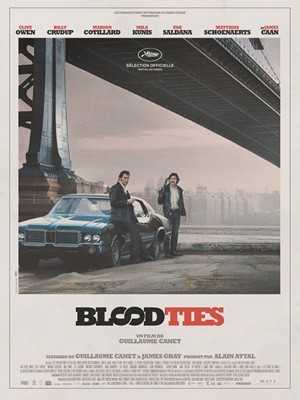
The year is 1974.  After serving several years on a murder conviction, 50 year-old Chris (Clive Owen) has been released from prison.  Chris’s transition back into society is a bumpy one.  For one thing, his ex-girlfriend (Marion Cotillard) is now a prostitute and refuses to let Chris see his children.  Though he gets a new girlfriend (Mila Kunis), he still finds himself struggling to hold down a job and he soon finds himself tempted to once again pursue a life of crime.

What might make that difficult for him is the fact that his younger brother, Frank (Billy Crudup), is now a cop with an old school porn star mustache.  Frank makes little secret of how much he resents his older brother and it isn’t long before the two of them are constantly fighting.  However, Frank has problems beyond Chris.  For one thing, he’s romantically pursuing Vanessa (Zoe Saldana), despite the fact that he earlier put her husband, Anthony (Matthias Schoenaerts), in prison.

In order to keep their dying father (James Caan) happy, Chris and Frank try to put aside their differences.  However, when Frank sees Chris fleeing from the scene of a robbery, it becomes harder and harder for him to ignore his brother’s activities.  Meanwhile, Chris has to decide whether or not to potentially sacrifice his freedom to keep his brother safe from a vengeful Anthony…

When Blood Ties was originally released at the beginning of the year, I considered seeing it but — for some reason — I ended up seeing The Legend of Hercules instead.  (Don’t you hate it when that happens!)  And I have to admit that I had forgotten about Blood Ties until I discovered that we were getting EPIX for free this holiday weekend.  Blood Ties is one of the films that’s currently showing on EPIX and, when I saw it was available, I thought to myself, “I can’t wait to see A Most Violent Year but until that opens up down here in Dallas, why not watch another violent New York period piece?”

And so I watched Blood Ties and … well, bleh.  Actually, bleh may be too harsh of a judgment.  The film is full of fun period details and Billy Crudup gives a really good performance as Frank.  There are some well done action scenes and I appreciated the fact that, for the most part, the film did not try to make violence look glamorous or fun.  The film has a great soundtrack though, for the most part, most of the songs here can also be heard in a countless number of superior Scorsese films.

But, ultimately, Blood Ties is never as good as you want it to be.  The film’s plot is about as predictable as can be and, far too often, scenes that start out interesting quickly degenerate to various characters standing around and yelling at each other.  And while that may often be what happens in real life, it still doesn’t make it particularly interesting to watch.  And then you’ve got poor Clive Owen, a good actor who is seriously miscast here.  Casting Clive Owen as a streetwise New York gangster is a bit like casting Ray Liotta as a member of the Queen’s Guard.  It just doesn’t work.

For those of us hoping for a great New York City crime epic — well, we’re just going to have to keep hoping that A Most Violent Year turns out to be just as good as everyone says it is…

Blood_Ties_poster


Review: Super 8 (dir. by J.J. Abrams)


The 1980’s was a special time in my life. It was another phase in my development in loving film. That decade saw many films starring kids and teens in coming-of-age tales both comedic, thrilling, dramatic and poignant. While there were many filmmakers who delved into this genre it was Steve Spielberg who mined it to great effect culminating in his classic boy-meets-alien film, E.T.: The Extra-Terrestrial. It’s been almost 30 years since the release of that film and now comes a filmmaker who seem to have grown up idolizing and loving Spielberg films of that era. The year is now 2011 and J.J. Abrams is that filmmaker who dared to pay homage to those very same coming-of-age Spielberg films of the 80’s with his very own simply titled Super 8.

From the very moment the film begins there’s a sense of wonderment as we, the audience, meet young kids who become the central characters of Super 8. The film takes place in the early days of 1979 in the town of Lillian, Ohio as Joe Lamb (Joel Courtney) tries to cope with the death of his mother. His friends keep him busy and dwelling on this tragedy through the Super 8 film they’re making in their spare time after school. These early scenes we begin to see the dynamics of the group as Joe acts as the calming influence on the group’s filmmaker, Charles (Riley Griffiths), the neurotic actor in Martin (Gabriel Basso) and the group’s stuntman/special effects tech in Carey (Ryan Lee). They all meet up at an old train depot where they plan to shoot scenes for their Super 8 zombie film. Into this eclectic group of kids comes in Alice (Elle Fanning) to play the wife to Martin’s detective character in their film.

It’s the scenes between the kids which lifts Super 8 from just being a nostalgic film to one that’s charming and magical. These scenes captures the creativity and youthful energy kids have always had no matter the era and place. These kids don’t act like stereotypes of what Hollywood thinks kids in films should act. There’s still little of the cynical teen dialogue that films nowadays give kids to say to make them seem more mature and worldly. There’s a sense of innocence in how these kids interact with each other. Some have called these scenes as being too on-the-nose nostalgic of Spielberg films of the 80’s. What some might call nostalgic I prefer to call as timeless. I still remember myself behaving with my childhood friends the way these kids did in this film

If Super 8 had just been about these group of kids trying to finish their Super 8 zombie film I conjunction with the dysfunction in the two main leads in Joe and Alice’s home life then Abrams film would’ve been the instant classic some have dubbed it. There’s only one problem with this and that’s the last half hour of the film and the scenes leading up to that involving the train derailment and the arrival of the U.S. Air Force to clean things up. The film begins to take on a split personality as these new elements get introduce to what has been a great coming-of-age story.

It’s these new elements and the final half hour which shows Abrams trying to combine a sweet story of kids and their lives growing up in small-town with an otherworldy and conspiracy tale that seem to come out of left field. By the time the final act of Super 8 arrives it becomes a different film altogether and the transition doesn’t work as well as the filmmakers might have hoped it would. Sure, this final reel has the thrills, explosions and danger, but the tonal shift in the story became so jarring that I had wished that Abrams just made two films instead of one. One film being the coming-of-age story and the other a thrilling sci-fi film.

Despite this I still enjoyed the film and I definitely loved the first two-thirds. The performances by Joel Courtney and Elle Fanning as Joe and Alice became the focal point for the story’s emotional foundation. Elle Fanning’s performance as Alice was one of the best things about Super 8. She nails every scene where she has to show extreme ranges of emotions but at the same time not try to oversell them. There’s a scene in the middle of the film where she begins to recount a personal detail as Joe sits behind her listening. Emotions begin to overwhelm her, but as kids moving towards teenhood are wont to do she tries to hold back the tears just waiting to flow freely and the sobs wanting to escapes. I wouldn’t be surprised if this scene alone had more than a couple people in the audience remembering similar events in their lives and just sobbing along with Alice.

Super 8 has been advertised as this mysterious film that may or may not have aliens but does pay homage to Spielberg and kid films of the 80’s. Abrams’ film definitely delivers on the thrills in the end, but it could’ve been so much more if it just stayed on course with just being about the kids and their magical time together making an amateur Super 8 zombie film in 1979. That would’ve been a film that deserved labels of instant classic.

All in all, Super 8 comes across as one of the more entertaining and magical films of the summer of 2011 if not the entire year. Make sure to stick around as the end credits roll to see the fruits of the kids labor titled simply as “The Case”.

Super 8 (Super Bowl TV Spot)


I’ve always looked at all J.J. Abrams productions with some guarded optimism since so many people seem to hype his stuff. I liked his reboot of Star Trek, but was very so-so on his Mission Impossible 3. I will admit that he does have a good batting average when it comes to tv and now film. His latest film is Super 8.

This Super Bowl tv spot shows more than the teaser trailer with the train wreck and the steel door being pounded at. The film looks to be set sometime around the 1950’s if the set is to be believed. Some have reacted to info leaked about this film as Abrams’ homage on a certain family-friendly Spielberg alien film from the early 80’s.

Super 8 looks like the one film this summer that the less I know about it the better I’ll enjoy it when it finally comes out on June 10, 2011.