I’ve been trying for about three days now to figure out how to explain why Wall Street: Money Never Sleeps is one of the most disappointing films of 2010. Notice I didn’t use the term “worst film.” There’s enough in the movie that works (Michael Douglas is fun to watch as Gordon Gekko and there’s a handful of scenes that perfectly capture the modern atmosphere of financial panic) to keep it from being a truly awful movie. But just because the movie isn’t awful, that doesn’t necessarily mean that it’s any good.
Oh, Wall Street — how did you fail? Let me count the ways.
1) Michael Douglas gives a great performance but he actually has less screen time here than he did in the original Wall Street. Yes, it’s fun to watch Gekko claw his way back up to the top but, once you take those scenes out of the equation, you still have about 1oo minutes of non-Gekko material to slog through.
2) Instead most of the screen time goes to Shia LeBouf. Let me repeat that — most of the screen time goes to Shia LeBouf. In this film, Shia plays a cocky young financial genius. Let me repeat that. In this film, Shia LeBouf plays a genius. Back before Shia became the human face of the Transformers franchise, I’ll admit that I thought he was kinda cute in his geeky, awkward way. However, in Wall Street, his character isn’t supposed to be geeky or awkward. He’s supposed to be some sort of financial genius.
3) We’re also supposed to automatically sympathize with Shia LeBouf’s character because, while he’s a part of the system that created the recession, he’s also dedicated to funding some sort of green energy project. Much like James Cameron in Avatar, Oliver Stone trots out a simplistic environmental theme here and expects to be praised just for mentioning it. The message is: “Love my film or Mother Earth gets it.”
4) The film’s plot: Shia LeBouf’s mentor and boss — played by Frank Langella — commits suicide after being run out of business by evil millionaire Josh Brolin. So, Shia takes a job working with Brolin. Meanwhile, Shia is also engaged to the daughter of Gordon Gekko. This leads to him taking Gekko on as a mentor. Shia apparently wants to take Brolin down. Or does he? Unfortunately, LeBouf doesn’t seem to know for sure and that comes across in his performance. As a result, the majority of the film is about as exciting as watching anyone else go to work.
5) Josh Brolin’s the villain here. We know he’s a villain because everyone else in the film keeps insisting he’s the villain and Brolin plays the role as if he’s auditioning for a role in the next James Cameron film. Which is to say, Brolin gives a dull and lifeless performance.
6) The little guy who is creating this alternate source of energy that Shia is so obsessed with? The little guy is played by Austin Pendleton who, I swear to God, is one of the most annoying character actors ever. Seriously, Pendleton, stop fucking smiling all the time!
7) Having seen both this and the original Wall Street, I can now say that I have no idea how the stock market works and I really don’t care to learn. I just want everyone to stop yelling and throwing paper all over the place. Seriously, Stone tries to make the “market” scenes exciting here but, once you get over the fact that Stone knows how to use a zoom lens, they’re pretty dull. Lucio Fulci and Jean Rollin — they would have found a cool way to film those scenes. Stone just resorts to the same old tricks.
8) That little smiley face looks so cute with his sunglasses on.
9) As with the original Wall Street, this is yet another film about little boys and their daddy issues. Which father figure will Shia choose? Meanwhile, Shia’s mother (a grating performance from Susan Sarandon) and his girlfriend (Carey Mulligan) are portrayed as total fools. Mulligan, after her performance in An Education, especially deserve better than to be stuck playing some sexist fantasy of a human being. Sarandon is blamed for the housing collapse while Mulligan’s character is cheated out of a fortune towards the end of the film. The message here, I guess, is don’t let women have money because we’ll just fuck everything up. I love how I can always count on “progressive” filmmakers to prove themselves to be a bunch of pigs at heart.
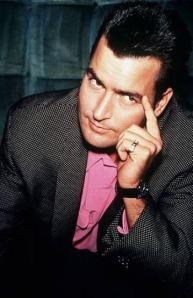
10) Charlie Sheen shows up for a really awkward cameo. He’s supposed to be playing his Bud Fox character from the original film but, watching his performance, you get the feeling that Charlie doesn’t remember being in the original film. Showing up at a charity dinner with a separate date on either ar, Bud Fox is presented as being just as corrupt as Gordon Gekko. Michael Douglas, quite frankly, looked somewhat embarrassed by the whole scene. However, as awkward as the scene was, it did manage to perfectly capture the theme of this movie:
Eventually, even Bud Fox will grow up to be Charlie Sheen.
Yesterday, me and my friend Jeff were planning on seeing Wall Street: Money Never Sleeps. However, there was one problem — I’d never seen the original Wall Street. Though I owned the movie on DVD, I’d never actually bothered to sit down to watch it. Don’t get me wrong, I knew that this was the movie that won Michael Douglas an Oscar. I knew that Douglas played a character named Gordon Gekko who, at one point in the film, delivered the line, “Greed is good.” Who hasn’t seen that clip?
So, yesterday, before leaving to see the sequel (which I’ll be reviewing in the near future), I sat down and watched the original. I discovered that there’s a reason why everyone remembers Gordon Gekko’s little “Greed is good” speech. It’s literally the only memorable part of the entire movie.
Wall Street tells the tale of Bud Fox (Charlie Sheen), a young stock broker who becomes a protegé to an intense and amoral businessman named Gordon Gekko (Michael Douglas). Gekko specializes in taking over other companies and putting people out of work. He wants to take over an airline that employs Bud’s father. Bud’s father is played by Martin Sheen and he’s such a self-righteous, judgmental, blue-collar asshole that you find yourself hoping that Gekko does put him out of work. Anyway, Bud engages in insider trading (which is apparently a crime though I’m not sure as the film seems to assume that everyone already understands how the stock market works) yet then finds his conscience awakened when Gekko’s greed threatens his dad’s job. Yes, this is yet another one of those laughably masculine films in which an overage boy has to pick a father figure.
I guess we’re supposed to care about whether or not he picks the right father but seriously, Bud Fox is such a dull character and Charlie Sheen is so miscast that I found myself wondering when the film’s real hero was going to show up. I had some hope when James Spader popped up in a supporting role but no, the lead character here is Bud Fox and he’s played by Charlie Sheen.
Not surprisingly, this is pretty much a male-dominated film. There’s only two notable female characters in the film. Darryl Hannah plays a ditz and Sean Young plays a bitch and neither one gets a chance to even have fun with the stereotypes. However, we all know that this film is really just about Gordon Gekko plunking his twanger over money and Bud Fox jackin’ the beanstalk to Gekko.
However, once you see Michael Douglas’s performance as Gordon Gekko, it’s a bit easier to understand why he causes Bud to walk Willie the One-Eyed Wonder Worm. Douglas truly is amazing in this role. In fact, Douglas is so charismatic in the role that it actually hurts the movie. It’s hard to take much pleasure in listening to Martin Sheen talk about how much he loves his union when you realize that all he’s doing is taking up time that could have been devoted to Michael Douglas fucking over poor people. I don’t know if a bad film can ever be truly redeemed by just one good performance but Douglas definitely makes Wall Street — with all of its awkward moralizing and sexist (and sexual) confusion — worth seeing.
As little as I thought of Wall Street, I still found myself excited about seeing the sequel. Why? Because I knew Michael Douglas was coming back and Martin Sheen wasn’t. Perhaps, I thought, this sequel will simply focus on Gekko being an over-the-top, charming viper instead of forcing us to sit through a repeat of the first film’s heavy-handed moralizing and simplistic political posturing. Of course, I was wrong but that’s another review for another day.
Oh, one last note: Oliver Stone’s direction is far better than his script. I once read an old review from Pauline Kael in which she said that Oliver Stone directed “as if someone held a gun to his head and shouted, ‘Go!'” and this is certainly the case with Wall Street. That said, I still find it hard to stay interested in any scene that features stock brokers screaming at each other and tossing around little bits of paper. Seriously, how does the Stock Market work? Whenever I see any footage from the New York stock exchange, it just looks incredibly silly.
Hi, my name is Lisa Marie Bowman and I hate just about every movie you’ve ever made. Well, that’s not totally true. First off, I haven’t seen every movie you’ve ever made. And I have to admit that when I was 12, I would cry and cry whenever I saw Titanic. So, let’s just say that I hate Avatar and I thought it was kinda fun to watch your ex-wife kick your ass at the Oscars earlier this year.
From my research, it appears that you take issue with people who disagree with you or who dare to suggest that you might not be the greatest filmmaker since DeMille. So, let me just add that this letter is being written by me and me only. When you send out your army of Orcs to punish the heretic at Through The Shattered Lens, they need only come for me. I may think you’re just a cranky, old dumbfug toadsucker but that’s my opinion and mine alone.
See, good people can have differing opinions. Unfortunately, just judging from some of your comments in the past, I don’t think you quite understand that. Maybe that explains why, rather than defend your movie, you always seem to end up accusing your critics of supporting global warming and the war in Iraq. Maybe that’s why the few Oscars that Avatar won were all accepted by balding little eunuchs who spent their whole acceptance speech praising your name as if they knew that if they didn’t, you’d end up going all psycho killer on them.
Listen, James, I’m going to help you out. Here’s my plotline for Avatar 2, which, trust me, is a lot more interesting than anything you’re planning on doing.
The film opens on Earth. As you explained in the first film, there “is no green” on Earth. But there are television networks and there are documentary crews. One of these networks has recently sent a group of young filmmakers to Pandora. Their assignment? To track down the Na’vi and to make a documentary about these “brutal savages” and their life on the green hell that is Pandora.
(Yes, James, this film is a prequel. Perhaps you could have Jake’s brother getting murdered in the background of one of the opening New York City shots.)
However, a week after the documentary crew first arrived on Pandora, all contact with them has been lost. The television networks hires a portly anthropology professor to go to Pandora and find out what has happened. Before the professor leaves on his mission, he is informed that the documentarians frequently staged the very atrocities that their films are known for.
Our anthropology professor — let’s call him Nick, since I know you like to dumb things down — goes to Pandora. With the help of a native guide, he manages to track down the Na’vi and win their trust. Taken to the Na’vi village, he discovers that the remains of the documentary crew are hanging from the Soul Tree. He realizes that they were captured and eaten by the Na’vi. However, the Na’vi did not destroy any of the film crew’s cameras. The footage of their final days in the jungles of Pandora has been preserved. Nick steals the footage and manages to make it back to “civilization” even as hordes of angry Na’vi chase after him (not mention Sigourney Weaver who can do a cameo somewhere around here).
While all this is going on, the film will occasionally pause to show grainy stock footage of various jungle animals being killed in various sickening ways.
Nick returns to Earth with the film. Sitting in a dark theater with the television executives, Nick views the footage.
Now, James, this is the tricky part. The “found footage” will dominate the last 40 minutes of Avatar 2. It’s important that the footage look so authentic that, for decades after, various dumbfugs will swear that they’re watching actual footage of actual people being eaten on camera. So, you’re going to have to abandon the 3-D for this part of the film. Instead, you’ll have to develop a multi-billion dollar process that will make the film look damaged. I’m talking about random scratches, unsynchronized sound, solarization, the whole deal.
As for the footage itself, this is what will make Avatar 2 special. We’ll see how the documentary crew staged “reality.” We’ll watch as they set a Na’Vi village on fire and how they arrogantly assumed that they’re superior to the natives. Finally, however, the Na’Vi will strike back and, in the film’s final moment, we’ll watch as the documentarians are eaten by the Na’Vi while their own cameras silently record the massacre.
Before I get to my review, you should understand that I nearly didn’t see The Town last night. Earlier, on Friday morning, I had to leave work early because I was so sick and nauseous that I was on the verge of passing out. Once I got home, I had to 1) convince my aunt that I wasn’t pregnant (“Are you sure?” she said after I reassured her) and 2) had to convince myself that my appendix wasn’t about to burst (and it’s not so don’t worry). After all that, there was a part of me that said, “The Town can wait. I’ll go on Saturday or maybe even later in the week.”
But I ignored that part of me and I went and saw the movie anyway. Why? Well, I wanted to review it for this site. (That’s dedication for you!) Plus, I knew my friend Jeff wanted to see it with me and I wanted to see it with him and since when has a little thing like a ruptured appendix ever been an excuse not to have a good time? Last but not least, The Town is Ben Affleck’s second movie as a director. His first was 2007’s Gone, Baby, Gone. Personally, I think Gone, Baby, Gone is one of the best crime films ever made. It’s certainly one of my favorite. I was curious to see if The Town would be a worthy follow-up or would it just prove Gone, Baby, Gone to have been a fluke.
The Town takes place in the Charlestown section of Boston. At the opening of the film, we’re told that Charlestown apparently produces more professional armed robbers than any other place in the entire world. It’s a practice that is handed down from father-to-son. (Or, in the case of this movie, from Chris Cooper to Ben Affleck.)
Affleck plays Doug, a former hockey player who is now the head of a gang of Charlestown bank robbers. His second-in-command is Jem (played by Jeremy Renner). Over the course of the film, we learn Doug’s father (Chris Cooper) is a career criminal who is currently serving a life sentence in prison. When his father went to prison, Doug was taken in by Jem’s family. Doug even ended up dating Jem’s sister (Blake Lively) and might be the father of Lively’s daughter. For this reason, Doug and Jem are fiercely loyal to each other despite the fact that Doug is essentially a nice guy and Jem is not.
(As a sidenote, why is it in the crime films that people are always shocked when the psychotic supporting character ends up doing psychotic? I mean, have these people never gone to the movies before? Have they never checked out Goodfellas from Netflix? Did they miss the whole Joe Pesci “How am I funny?” thing?)
At the start of the film, Doug, Jem, and the gang rob a bank. Doug is a model of professionalism. Jem goes a little bit crazy and beats one bank employee nearly to death. This gives the bank manager, Clare (Rebecca Hall), just enough time to set off a silent alarm. Realizing that the police are on the way, Jem responds by taking Clare hostage as the gang flees. Clare is later released on a desolate beach.
However, there’s a problem. Before releasing her, Jem stole Clare’s ID. Looking at it after the robbery, he discovers that Clare lives in Charlestown and, as a result, there’s now a risk that she might simply see one of the gang on the street and identify him. Jem wants to kill her but Doug says that he’ll take care of her himself.
By “taking care of,” Doug means that he’ll follow her around town, eventually strike up a conversation with her, and then end up pursuing a romance with her (while declining, of course, to mention that he already knows her). Jem, however, was under the impression that “taking care of” meant to kill. So, needless to say, he’s a little bit miffed when he stumbles across Doug and Clare having a lunch date.
Soon, Doug finds himself trapped in the life he’s created for himself. In love with Clare but torn by his loyalty to the increasingly unstable Jem, Doug agrees to one more big job. All the while, he is pursued by two relentless FBI agents (Jon Hamm and Titus Welliver) and he has to deal with an Irish mob boss (Pete Postlewaite) who has an agenda of his own.
The Town works largely because Ben Affleck has, unexpectedly, turned out to be an intelligent, no-nonsense director. The movie features three robbery scenes and, in each one of them, Affleck creates genuine tension and excitement without ever once resorting to outlandish stunts or random slow motion. Unlike a lot of (bad) actors turned director, Affleck never seems to feel the need to toss in any showy (but ultimately empty) tricks to try to convince us that he’s a director. This is a confident movie that shows that Gone, Baby, Gone wasn’t a fluke. (That said, Gone, Baby, Gone remains the superior film for reasons that I’m getting to.)
Also, as with Gone, Baby, Gone, The Town benefits from Affleck’s obvious love for the city and people of Boston. Shot on location and featuring a number of local actors, The Town has a wonderful sense of place to it. By the end of it, you feel as if you know Charlestown even if, like me, you’re just a country girl from Texas.
Ben Affleck the director also manages to do something truly surprising — he gets a good performance out of Ben Affleck the actor. In the past, I’ve always enjoyed looking at Ben Affleck on-screen but I never really wanted to hear him talk. Because as soon as he would open his mouth, whatever appeal that Affleck possessed would immediately dissolve. In the past, as an actor, Affleck often epitomized that whole concept of “there’s no there there.” However, in this film, he gives a low-key, subtle performance that really helps to hold the entire film together. I still wouldn’t call Affleck a good actor. Instead, he’s one of those rare directors who (like fellow bad actor Quentin Tarantino) knows how to get good performances even from the most unlikely of performers.
Affleck is well-supported by Hall, Lively, and Renner. Hall has a difficult job because she’s not so much playing an actual human being as much as she’s playing an idealized concept. Her character really doesn’t have any purpose beyond offering Doug a chance at redemption and (this is obvious more in retrospect than during the actual film) really doesn’t have much of an identity beyond how her life touches Doug’s. Hall, however, is so vulnerable in the role that, while you’re watching the film, that none of this really becomes obvious until a few hours after the movie ends. Lively (better known for her role on Gossip Girl) is only in a few scenes and, in many ways, her character is even less developed than Hall’s. If Hall has to represent the Madonna part of the Whore/Madonna complex, guess what Lively represents. Still, Lively brings some much needed humor to the role and to the film. She’s having fun playing her drunken, drug-addled character and she steals almost every scene that she’s in.
However, the film is ultimately dominated by Jeremy Renner. With his angelic voice and deceptively soft voice, Renner is the psychopath that you can’t help but love. Movie psychos are a dime-a-dozen so when an actor comes along and actually finds something new to do with the role, it’s impossible not to be impressed.
So much works in The Town that I almost feel guilty talking about what doesn’t. For all its strengths, it also has three rather glaring flaws. As with all things, the final verdict on this film depends on just how willing the viewer is to overlook these flaws.
First off, Ben Affleck proves himself to be a better director than writer. The Town’s story is well told but the majority of it will still be awfully familiar to anyone who has ever seen a heist film. Unlike Quentin Tarantino, Martin Scorsese, or Michael Mann, Affleck doesn’t embrace the conventions in order to deconstruct them. Instead, he uses the conventional storyline as an excuse to explore the Charlestown culture. As a result, this flaw arguably works to the film’s advantage. Still, those viewers who are expecting to be surprised by the film’s plot should consider themselves warned.
As well acted as the movie is, there is one big exception in the cast and that is Mad Men’s Jon Hamm. Hamm plays the FBI agent who is determined to capture Affleck. He’s the Javert to Affleck’s Valjean. Unfortunately, as played by Jon Hamm, he’s also a cinematic black hole. Hamm may be an excellent television actor but, playing a key supporting role and surrounded by actual film actors, it’s obvious that Hamm has no idea how to act for the big screen. As a result, he never comes across as a worthy or even dangerous adversary and his pursuit of Affleck never becomes compelling nor do we ever worry that Affleck might not be able to outsmart him. There’s a scene, towards the end of the film, where Hamm yells something like, “Drop your weapon, asshole!” I have to admit that I stunned just about everyone in the theater when I burst into laughter at the sound of Hamm shouting “asshole” and sounding, more or less, like an overgrown kid on a playground.
(Hamm’s sidekick, by the way, is played by another tv actor, Titus Welliver. Welliver is probably best known for playing the Man In Black on the final season of Lost. Though he gets next to nothing to do, Welliver dominates every scene that he’s in. Unlike Hamm, he knows how to act on a big screen.)
The most glaring flaw with The Town, however, is that the entire plot pretty much depends on the viewer accepting that Hall’s character, just days after being traumatized by being held hostage and seeing one of her co-workers nearly beaten to death because he attempted to protect her, would so easily trust and open up her life to a stranger (even if that stranger is Ben Affleck). Never mind the fact that we are then expected to believe that she would stay loyal to Affleck even after learning the truth. Realistically, this would seem to indicate that the character’s something of a sadomasochist but the film really doesn’t explore that (or really anything else that might make Hall’s character anything more than just an idealized Madonna figure).
I mean, I’m always open to experimentation in a relationship. Different people enjoy different things and I’ve never been one to judge anyone else’s particular fetish. However, just speaking for myself, the day that you stick a gun in my face, put a blindfold over my eyes, and then abandon me out on the beach is the same day that I decide that there’s probably not going to be a long-term relationship there.
So, once again, it’s all a question of whether or not you can accept these flaws. I have to admit that, as I watched the film, I occasionally had a hard time doing so. If you can agree to overlook the flaws, however, then The Town is an entertaining, well-acted crime thriller with an authentic sense of place. And if you can’t overlook those flaws, than The Town is a good but imperfect movie that still indicates that Ben Affleck has got quite a future as a director.
1) Scream and Scream Again — This is actually a pretty good British horror film from 1970. It even has a political subtext for those of you who need your horror to mean something. I love the whole “swinging” vibe of the trailer.
2) The Spook Who Sat By The Door — This 1973 film apparently used to be something of a legend because it was extremely difficult to see. It was sold, obviously, as a blaxploitation film but quite a few people apparently saw it as being a blueprint for an actual revolution. I’ve never seen this movie though, believe it or not, I did find a copy of the novel it was based on at Half-Priced books shortly after I first saw this trailer. I bought the book but I haven’t read it yet.
3) The Black Gestapo — This is another one of those old school blaxploitation trailers that, to modern eyes, just seems so wrong. I’ve actually seen this film. It’s surprisingly dull, to be honest.
4) Sunset Cove — This one of the many trailers that I first came across on one of Synapse’s 42nd Street Forever compilations. I’ve never seen the actual film and probably never will as apparently it’s like the uncut version of Greed — lost to the ages. That’s okay because the film really does look really, really bad. However, the trailer fascinates me because it has got such an oddly somber tone to it. Just from the narration and one or two of the clips shown, you get the feeling that this movie ends with the National Guard gunning down a lot of teenagers while the tide comes in. However, I think that might just be my own overactive imagination. The film was apparently directed by Al Adamson who, in the mid-90s, was apparently murdered and buried in wet cement.
5) Autopsy — This 1975 Italian classic is one of my favorite examples of the giallo genre. I can’t recommend it enough. This is one of the most intense and disturbing films ever made. The trailer’s pretty good too.
6) Visiting Hours — I don’t know much about this movie, other than it appears to be a slasher film from the early 80s. I’m posting it here for one reason and one reason only — the skull.
In 1978, just based on what I’ve read, everyone in America was regularly doing huge amounts of cocaine. Whether you were in a disco or at a PTA meeting, you knew that eventually someone would produce a small mirror covered with white powder. President Carter even snorted it during that year’s State of the Union speech. Sure, some people used gold spoons and others had to make do with a one dollar bill but, in the end, cocaine brought all Americans together as a nation and helped the country heal after the trauma of Watergate.
It also contributed to some the year’s best films. Days of Heaven, Superman, The Deer Hunter, Coming Home, Grease, Animal House, Interiors, Halloween, Midnight Express, Convoy, Go Tell The Spartans, and An Unmarried Woman; these were all films fueled by the Peruvian Headache Powder.
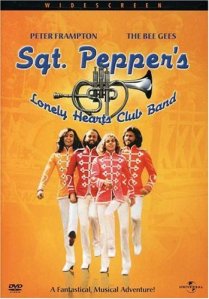
However, no discussion of 1978 cocaine-fueled films would be complete with mentioning Sgt. Pepper’s Lonely Hearts Club Band. Featuring songs originally performed by the Beatles and starring the Bee Gees, Peter Frampton, and a whole bunch of other people that my mom liked, Sgt. Pepper’s is a film that, quite honestly, should just be retitled 1978.
Plotwise — oh God, do I really have to try to describe the plot? Seriously, this could take forever. I mean, the film isn’t quite two hours long but a lot of stuff happens and really the only connection between any of it is that these odd cover tunes of classic Beatles songs keep popping up in the weirdest places. Okay, let me try to get this all into one paragraph —
There’s a small town called Heartland that is very small and simple but it’s also the home of the legendary Sgt. Pepper who, throughout history, has maintained world peace by playing his magic instruments. But then Sgt. Pepper dies and apparently turns into a gold weather vane. His magic instruments are given to the mayor of Heartland, Mr. Kite (George Burns, who also narrates the entire movie). The world is in mourning. But then one day, the Henderson Brothers (the Bee Gees) decide to form a new Sgt. Pepper’s Lonely Hearts Club Band and they invite Sgt. Pepper’s grandson, Billy Shears (played by Peter Frampton) to be their lead singer. Heartland rejoices and George Burns has a surprisingly sweet scene where he sings Fixing A Hole.
Anyway, the new band is such a hit that the owner of a record company invites them to come to Los Angeles and record an album. Billy says goodbye to his girlfriend, Strawberry Fields (Sandy Farina) and then joins the Hendersons in a hot air balloon which promptly leaves for California. En route, the balloon collides with an airplane but nobody is seriously injured.
In Los Angeles, they meet the record company owner and it turns out that he’s played by Donald Pleasence. (It’s interesting to think that Pleasence filmed this and Halloween around the same time.) Pleasence proceeds to sing the creepiest version of I Want You ever heard. I’d include a clip of the performance but Pleasence manages to go on for a good ten minutes, repeating “I want you,” in an odd little voice while staring at Peter Frampton.
The boys sign a contract with Pleasence. Billy Shears is led astray by Lucy and her band, the Diamonds. (Guess which song they get to sing.) Somehow, this allows Mean Mr. Mustard to steal Sgt. Pepper’s magic instruments. Mr. Mustard drives around in a yellow van and he’s assisted by two female robots who, at one point, sing She’s Leaving Home in their electronic, robot voices.
The band is informed that the instruments have been stolen. Outraged, they jump back in their hot air balloon and quickly start a recovery operation. It turns out that Mean Mr. Mustard has given the instruments to three separate villains.
The first villain is Dr. Maxwell Edison who uses his silver hammer to turn old people into boy scouts. This may sound ludicrous and silly but fortunately, Maxwell is played by Steve Martin. His cameo is one of the highlights of the film, if just because he seems to be one of the few people who actually enjoyed himself on set.
The second villain is the Reverend Sun. He brainwashes people or something. I’ve seen this movie a few times and I still can’t quite figure out what Reverend Sun’s deal is. When I first saw this movie, I got excited because I thought that Tom Savini was playing Rev. Sun. Then I forced my sister Erin to watch the movie and she told me I was stupid because Rev. Sun was obviously being played by Frank Zappa. Well, I did some reasearch and discovered that we’re both stupid. That’s neither Savini nor Zappa. It’s Alice Cooper.
The final villains are played by a very young (and very, very hot!) Aerosmith. Here, they are called the Future Villain Band and oh my God, Joe Perry…this film needed a lot more Joe Perry. I mean, it’s understandable that Steve Tyler gets most of the screen time and young Steve actually looks pretty good in a Mick Jagger sort of way but Joe Perry…Oh. My. God. Anyway, Aerosmith does a cover of Come Together and Joe Perry circa 1978 was just so freaking gorgeous, oh my God. Eventually, Frampton and the Bee Gees come along and ruin things by getting into a fight with Steve Tyler which leads to the camera constantly cutting away from Joe Perry who is really, really, really hot and all kinds of sexy in this movie. They should have just called this movie Joe Perry. Oh. My. God.
Uhmm, where was I? Oh yeah — so, anyway, eventually the weather vane comes to life and suddenly, Sgt. Pepper’s a black man who sings Get Back and ends up magically resetting the past and turning Mean Mr. Mustard into an altar boy or something like that. Oh, and the Bee Gee who looks like a New Age healer ends up singing my favorite Beatles song, A Day in the Life.
Finally, it appears that every single person on the planet shows up in the film’s final scene where a huge group of “stars” show up and sing the film’s title tune one last time. In the end credits, these people are listed as being “Our Guests At Heartland.” Doing some research (i.e., looking the thing up in Wikipedia), I’ve discovered that these folks were apparently all pop cultural icons in the 70s. I didn’t recognize a single one of them but I’m sure they probably all snorted a lot of cocaine.
(And, by the way, Joe Perry does not get to return for the finale so bleh on you, movie.)
For some reason, this movie kept showing up on Starz last November and that’s where I first discovered it. The first time I saw it, I came in right at the start of Steve Martin’s cameo and the film itself was so just plain weird that I had to jump on twitter and let the world know what I was watching. (Actually, it doesn’t take much to make me jump on twitter and tell the world what I’m doing.) As a result, I soon discovered that, apparently, I was the only person on the planet who didn’t know about this film.
Sgt. Pepper’s Lonely Hearts Club Band is really a pretty bad movie. The plot tries way too hard, the pacing is terrible with some scenes lasting forever and others ending before they really start, and Frampton and the Bee Gees are all distinguished by an utter lack of charisma. The youngest Bee Gee appears to be cheerfully stoned throughout the entire movie while the other two (and Frampton) are trying way too hard to act.
And yet, the film fascinates me. After I saw it the first time, I forced my sister to watch it with me a second time. I then watched it again on my own. Finally, I went down to the local Fry’s and nearly did a happy little dance when I found it on DVD. I’ve watched it since several times. Whenever I’m depressed, it always cheers me up.
What’s the appeal? Some of it is definitely the whole “so-bad-its-good” thing. Actually, that’s probably most of it. Another thing fascinating thing is how literally the filmmakers choose to interpret the Beatles lyrics. Considering the fact that the Beatles themselves were rather open about the fact that a lot of their lyrics were simply nonsense and word games, it’s interesting to try to understand logic behind trying to force them into a coherent storyline. (This is also the appeal of 2007’s Across The Universe, which is technically a better movie than Sgt. Pepper’s but isn’t half as fun to watch.) For instance, Billy Shears isn’t in the film because he’s an interesting character. Instead, he’s just here because — 10 years earlier — either John Lennon or Paul McCartney choose to toss the name into a song. We’re never quite sure what Mean Mr. Mustard’s dastardly motivation is beyond the fact that the filmmakers had the rights to his song. If nothing else, the film is an interesting example of what happens when people try to create a novel out of somebody else’s short story.
However, I think the main appeal of Sgt. Pepper’s is the appeal of 1978. Watching the movie, you feel almost as if you’re literally sitting beside the cast at Studio 54, watching as everyone snorts a line. I think that, for future historians, this film may very well turn out to be a cinematic Rosetta Stone.
Then again, maybe it really is just so bad that it’s good.
1) Graveyard Shift — This is a Canadian film from 1986. Ever since I first saw it on DVD last year, this has been one of my favorite vampire films. It’s an atmospheric, strangely well-acted film that is just trashy enough to remain interesting.
2) Panorama Blue — I’ve never seen this movie and apparently, it’s a lost film of some sort. The trailer can be found on one of the 42nd Street Forever compilation DVDs. Apparently, this is some sort of pornographic epic. I just enjoy the trailer even though I wouldn’t be caught dead on a roller coaster. (They’re scary!)
3) Zombi 3 — This film is credited to Lucio Fulci but he actually only directed about 60% of it before he was fired and replaced by Bruno Mattei. This trailer deserves some sort of award because it manages to make an amazingly boring film look exciting and almost fun.
4) Rolling Thunder — Another film that I’ve never seen (and another trailer that I first found on a 42nd Street compilation). This is an effectively moody trailer. As a Texan, I also like the fact that Rolling Thunder apparently not only takes place in Texas but was also actually shot there with actual Texans in the cast. And I love the ominous yet casual way that Tommy Lee Jones delivers the “I’ll get my gear,” line.
5) Angel — This is a trailer from the early 80s. This is another one of those trailers that I love because it’s just so shamelessly sordid and trashy.
6) Hitch-Hike — Okay, quick warning — this trailer is explicit. Not as explicit as many grindhouse trailers but it’s still explicit enough that some people might find it objectionable. It’s certainly not safe for work though why are you visiting this site from work anyway?
However, all that taken into account, it’s still a very good trailer for a very good movie, 1977’s Hitch-Hike. Not only is it a nicely cynical little thriller, but it features not only another iconic psycho performance from David Hess but also a brilliant lead performance from Franco Nero. I will also admit right now that if I ever got my hands on a time machine, the first thing I would do would be go back to 1977 and give Franco Nero a hummer. Seriously.
Okay, I’ve said too much. Just watch the trailer and enjoy one of Ennio Morricone’s best scores.
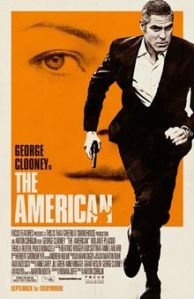
Earlier today, I had the misfortune to sit through the just released movie The American.
The title character, as played by George Clooney (who also produced the film), is an aging assassin. He’s done some bad, bad things and, as a result, he has some bad, bad people after him. So, he hides out in an isolated, Italian village. He makes friends with the local priest, engages in some shady business of some sort with a mysterious woman (Thekla Reuten), and of course falls in love with the proverbial hooker with a heart of gold (Violante Placido). The whole time, the American is aware that his days are numbered and that he can trust no one.
And who really cares?
Director Anton Corbijn appears to be trying to do an homage to the noir-influenced French New Wave of the late 50s and 1960s but he seems to have forgotten that Jean-Luc Godard’s and Francois Truffaut’s films were usually as entertaining as they were intellectually stimulating. (This, of course, is something that Godard forgot as well.) As a result, The American often feels like a parody of an art film. Every scene drips with great importance and all the actors play their roles like they’re in a passion play but, in the end, it’s just a lot of pretension that ultimately adds up to nothing.
As a movie, the American is pretty to look at but I lost interest in it fairly early. Corbijn tries to create an atmosphere of ennui but the end result is simply dull. Clooney attempts to give a restrained performance full of self-loathing and paranoia but he’s miscast in the part. George Clooney the producer doesn’t seems to realize that Clooney’s essential shallowness is the key to his appeal. George Clooney comes across as the perfect one-night stand, the epitome of fun-while-it-lasted but nothing to regret once he’s gone. Whenever Clooney attempts to suggest anything suggesting any greater depth — like in this film — he simply seems lost.
Speaking of lost, so was I as I watched this dull, boring movie. I’m sure some will embrace this film but for me, I’ll pass.
Located below is the famous Vitajex advertising montage from Elia Kazan’s 1957 film, A Face In The Crowd. Everytime I see this, I wonder if maybe American audiences in the 50s were smarter than we give them credit for.
Then again, A Face in The Crowd was a notorious financial and critical failure when it was first released. It’s actually one of the best and most influential movies ever made. Certainly, it’s one of the few Kazan films that still seems artistically relevent today. It should also be noted that A Face in the Crowd features Anthony Franciosa years before his starring turn in Dario Argento’s Tenebrae, Andy Griffith playing a villain, the film debut of Lee Remick, Walter Matthau as a tv writer, and Patricia Neal having a nervous breakdown. Supposedly, a very young Rip Torn is somewhere in this film as well but I’ve never been able to spot him.
Sadly, this DVD is now out-of-print and the people selling it on Amazon want you to pay something like $80.00 for it. That’s a shame because The Candy Snatchers is, arguably, one of the greatest films ever made. This is one of those movies that I desperately need to review but I’m still struggling to find the right words to express just how brilliant this movie is.
This trailer doesn’t really do justice to Django Kill which, quite frankly, is probably the strangest, most surreal western ever made. Yes, this film is even stranger than El Topo. However, I still like the pop art feel of this trailer.
Also known as The Nights of Terror, this is one of the more infamous examples of the Italian zombie genre. To be honest, this is an amazingly trashy, stupid movie but once you start watching, you can not turn away. This is another film I’ve been meaning to review for a while as I think it’s actually the most political of all the Italian zombie films. People tend to get some caught up with the whole incest subplot that they miss the whole Marxist subtext. And yes, the movie does include a title card that contains the word “profecy.”
I love this trailer. It is such a relic that I almost feel like it should be put in a time capsule. Plus, that whole “She corrupted the morals…” tag line is just so priceless.
When this 1975 movie was released on DVD, it was titled Boss. Well, that’s only half of the original title. I’ve never seen this movie (as the only westerns that interest me are Italian-made) but this trailer has always stuck with me because of the whole “Did I just hear that?” factor. However, after I first saw this trailer, I did some research and discovered that the movie was actually written and produced by the film’s star, Fred Williamson. So, that makes me a bit more comfortable with it.