Retro Music Review: Nine Lives (by Aerosmith)


Alright, let’s talk about Nine Lives. If you were an Aerosmith fan in the spring of 1997, you were probably in one of two camps. Camp One: you were still riding the high of the Get a Grip era, cranking “Livin’ on the Edge” in your hand-me-down Camry, and you couldn’t wait to see what the Toxic Twins would do next. Camp Two: you were a grizzled, old-school devotee who thought they’d sold their soul to MTV back in ’89, and you viewed any new album with the skeptical squint of a man watching his favorite dive bar turn into a Hard Rock Cafe. I landed somewhere in the middle, which might be the perfect vantage point for Nine Lives, because this record is a glorious, baffling, overstuffed, and surprisingly scrappy cat of an album. It’s not the sleek panther of Pump or the cuddly but commercially declawed kitten of Get a Grip. No, this is a half-feral tomcat with a crooked tail, a chipped tooth, and nine lives’ worth of attitude to burn.

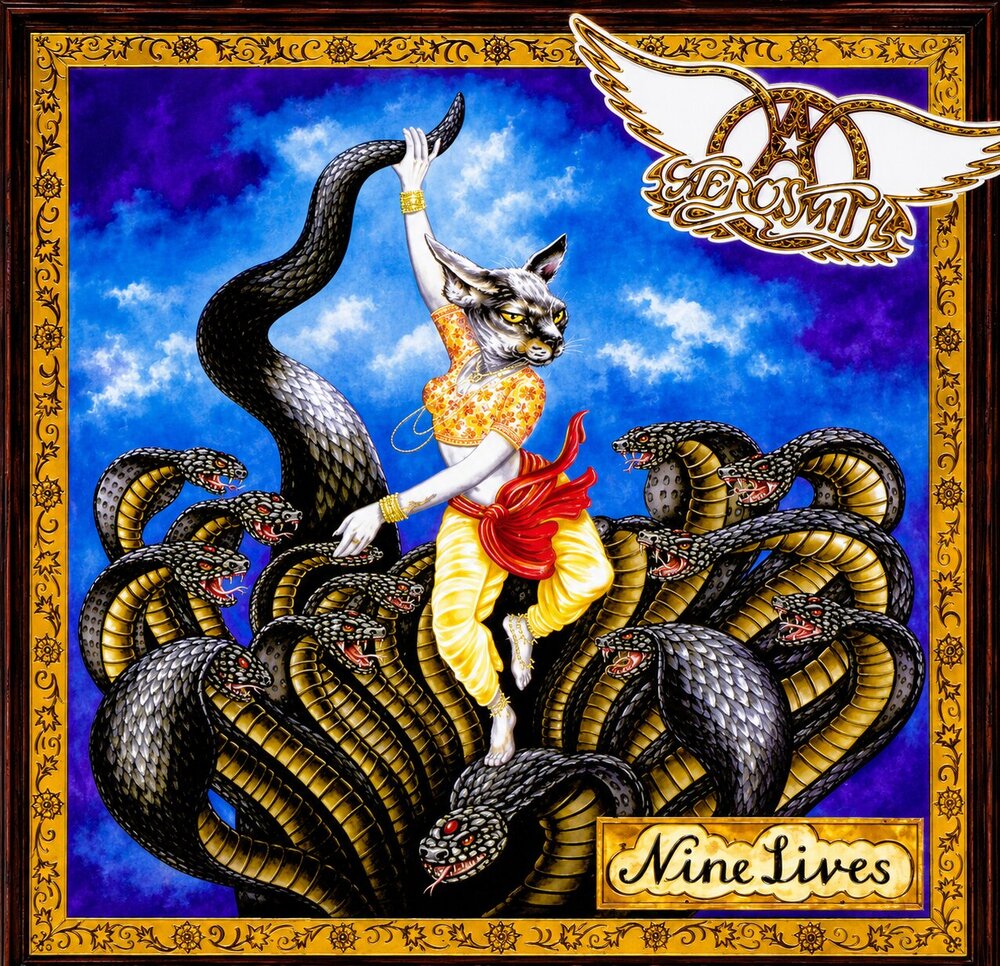
First, let’s get the elephant—or rather, the cat—out of the room: the cover. That bizarre, Kabuki-meets-Dali cat face with the third eye and the psychedelic swirls is your first warning that this isn’t going to be a straightforward rock record. And that’s because the making of Nine Lives was famously a disaster. They fired their long-time producer, Bruce Fairbairn, after cutting a whole album’s worth of material, brought in Kevin Shirley, who was known for his harder, rawer sound with bands like Diamond Head and Slayer’s Divine Intervention, and then proceeded to spend a fortune in studio time and label anxiety. You can hear that tension in the grooves. It’s not a polished, radio-manufactured product; it’s a band fighting with each other, fighting with their label, and fighting with their own legacy, and somehow, that ugly, beautiful struggle is what makes Nine Lives so endlessly listenable.

The album kicks off with “Nine Lives,” the title track, and it’s a mission statement disguised as a glam-stomp barnburner. That opening riff is pure, swaggering Joe Perry, all bluesy grease and garage-rock crunch, but then Steven Tyler comes in with that almost rapped, spoken-word verse that sounds like he’s reciting a beat poem about reincarnation inside a biker bar. It’s weird. It’s catchy. And by the time that “meow” hits in the chorus, you’re either cringing or grinning ear to ear. I’m firmly in the grinning camp. It’s a bold, goofy, and utterly confident opener that sets the table for an album that refuses to take the safe route.

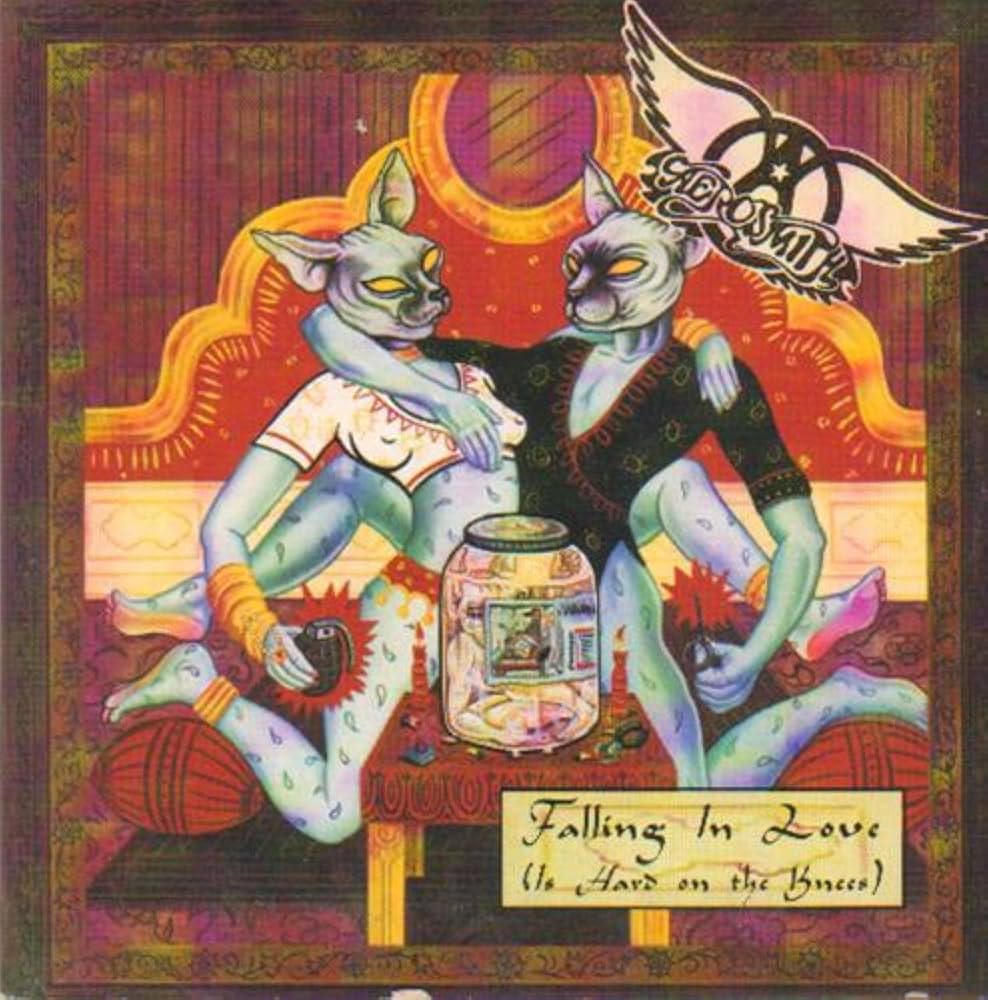
Then comes “Falling in Love (Is Hard on the Knees),” which was the lead single, and man, did that song divide the fanbase. On one hand, it’s classic Aerosmith—sleazy, double-entendre lyrics, a hip-shaking groove, and that trademark Tyler yelp. On the other hand, it’s so deliberately, almost parodically sexy that it borders on self-satire. But here’s the thing: it rocks. That riff is a chainsaw, and the bridge where the tempo lurches and Tyler starts wailing about his “love gun” is pure, unfiltered nonsense genius. It’s not Dream On, but it’s not supposed to be. It’s a party track for a band that knows exactly how ridiculous they can be and leans into it with a wink.

But the real heart of Nine Lives isn’t in the singles; it’s in the deep cuts that show Aerosmith still had teeth. “Taste of India” is the first gut-punch. Clocking in at over five minutes, it’s a mid-tempo, Eastern-tinged blues-rock odyssey that features some of Tyler’s most evocative, cryptic lyrics about a woman who tastes like “chai and cardamom.” The sitar-like guitar work from Perry is hypnotic, and the rhythm section—Tom Hamilton’s chunky bass and Joey Kramer’s tribal, pounding drums—locks into a trance-like groove that feels more Led Zeppelin III than Permanent Vacation. It’s the sound of a band stretching their legs, and it’s magnificent. Similarly, “Full Circle” is the unsung hero of the entire record. That acoustic intro is deceptively gentle, but when the full band crashes in, it transforms into a soaring, gospel-tinged rock anthem about karma and survival. The harmonies between Tyler and Perry are some of the best they’ve ever laid down, and that chorus—“I’ve been around and I’ve come full circle”—feels like a genuine moment of reflection from a band that had seen every high and low imaginable.

Of course, you can’t talk about Nine Lives without addressing the power-ballad elephant, “Hole in My Soul.” Oh boy. This is the song that makes the purists reach for the skip button. It’s slick, it’s adult-contemporary, it’s got that Diane Warren-ish sheen that screams “soundtrack to a romantic montage in a 90s movie.” And yet… I have a soft spot for it. Is it cheesy? Absolutely. Is Tyler oversinging the hell out of it? You bet. But that bridge, where he goes “I’m a fool with a hole in my soul,” is delivered with such desperate conviction that I can’t help but buy in. It’s not Cryin’ or Angel, but it’s a perfectly fine power ballad for a band that had earned the right to be a little sappy. Plus, the guitar solo is pure Perry fire, which saves it from being a total snooze.

But then, just when you think they’ve gone soft, they drop “The Farm.” This is the weirdest, most underrated track in their entire 90s catalog. It’s a sludgy, grungy, almost industrial-tinged stomper about a mental institution, with a lyric that goes “They’re coming to take me away / To the funny farm.” It’s dark, it’s paranoid, and it features Tyler doing this manic, whispered vocal that sounds like he’s lost his last marble. The guitar tone is filthy, and the breakdown in the middle is pure chaos. It’s the closest Aerosmith ever came to sounding like Nine Inch Nails, and it works shockingly well. It’s proof that even in their commercial peak, they were still willing to get their hands dirty.

Elsewhere, “Crash” is a straight-up, high-octane rocker that sounds like it could have been a B-side from Permanent Vacation, all revved-up riffs and Tyler’s car-crash metaphors. It’s fun, it’s dumb, and it’s over in three minutes flat. “Kiss Your Past Good-Bye” is another deep-cut gem, a shuffling, bluesy kiss-off that features some slick harmonica and a chorus that begs to be sung along to with a whiskey in hand. And then there’s “Pink,” the second big single, which is pure pop-rock confection—a bouncy, funk-lite ode to, well, you know what. It’s clever, it’s silly, and the video was a masterpiece of 90s MTV absurdity. It doesn’t have the weight of “Janie’s Got a Gun,” but it’s not supposed to; it’s a sugar rush, and it’s delicious.

The album closes with “Fall Together,” a moody, atmospheric number that builds from a quiet piano intro into a swirling, psychedelic crescendo, and “Ain’t That a Bitch,” which is a bittersweet, acoustic-driven closer that finds Tyler reflecting on love and loss with a weary, world-weary rasp. It’s a surprisingly tender way to end an album that’s been so over-the-top and manic. It’s like the cat finally curls up on the windowsill and goes to sleep.

So, is Nine Lives a masterpiece? No. It’s too long, too bloated, and too inconsistent for that. The production, while rawer than Fairbairn’s work, can feel muddy in places, and there’s a sense that they threw every idea at the wall—ballads, hard rock, psychedelia, funk, grunge—to see what stuck. But that’s also its charm. This is the sound of a band that had absolutely nothing to prove commercially—they’d already sold millions—so they decided to get weird, get loud, and get a little dangerous again. It’s the album where Aerosmith remembers they used to be a dirty bar band from Boston, even if that bar now has a cocktail menu and a velvet rope. If you come to it expecting Toys in the Attic, you’ll be disappointed. But if you come to it with an open mind and a tolerance for glorious messiness, you’ll find an album full of character, muscle, and heart. It’s not their best life, but it’s certainly one of their most interesting ones. And frankly, nine lives in, who wouldn’t want to get a little scratchy?
Song of the Day: Falling In Love (by Aerosmith)


Alright, let’s talk about a seriously underrated gem from Aerosmith’s later years: Falling In Love (Is So Hard On The Knees). If you only know the band from their big power ballads, you’re missing out on this side of them. This track is pure, unapologetic fun, and it’s the perfect example of why they’re rock legends. It’s got that classic, bluesy swagger that just makes you want to crank up the volume and strut around the room. Forget the sappy love songs; this is Aerosmith reminding everyone that they are, first and foremost, a rock and roll band that knows how to have a good laugh. The groove alone is so dirty and infectious that you’ll be nodding your head before Steven Tyler even opens his mouth.

And speaking of Tyler, the genius of this song is how it takes the emotional rollercoaster of love and just turns it on its head with a massive dose of humor. He isn’t crooning about a broken heart here; he’s basically throwing his hands up and saying, “This whole love thing is ridiculous!” The title itself is a killer metaphor—love literally brings you to your knees, both physically and emotionally—but the real gold is in the wordplay. Check out the double entendre in lines like “I major in love, but in all minor keys,” which is a clever nod to both musical theory and the melancholy that often comes with romance. And then there’s the absolute classic, “Don’t give me no lip, I’ve got enough of my own,” which works as both a sassy put-down and a sly wink at, well, using your lips for other things in a relationship. It’s self-deprecating, surprisingly clever, and makes light of the universal struggle of romance without ever sounding whiny.

You also have to see the music video, which was directed by none other than Michael Bay, and it is absolutely bonkers in the best way possible. It’s a surreal, chaotic masterpiece of 90s MTV, filled with wild imagery like a man literally chained up, leashed by his tongue, and being tormented by gorgeous women. It’s weird, it’s funny, and it’s a perfect visual match for the song’s chaotic energy. The video won a Moonman for Best Rock Video, and honestly, you watch it once and you’ll never forget it. It takes the playful, masochistic vibe of the lyrics and turns it into a visual feast that amplifies every wink and nudge Tyler throws out in the verses.

Now, set your watch for around the 2:05 mark, because that’s when Joe Perry steps out and absolutely takes over. The solo runs from about 2:05 to 2:25 and honestly, those 25 seconds are worth the price of admission alone. He comes in hot — not showy for the sake of it, but mean and deliberate, like every note has a purpose. There’s this gritty, almost bluesy bite to it that reminds you Perry is not just a rock guitarist, he’s a feel guitarist. He bends notes in ways that sound almost vocal, like he and Tyler are having a conversation, and then he just rips into this run toward the end that’ll make you hit rewind before you even realize you’ve done it. It’s compact, it’s nasty in the best way, and it’s over before you want it to be — which honestly is the mark of a truly great solo.

Look, I’ll be honest—I was late to the Aerosmith party. For the longest time, I only knew them from their Walk This Way collab with Run-DMC, which I loved, but I stupidly figured that was their only trick. It wasn’t until I randomly heard Cryin’ and Amazing on the radio one summer that something clicked, and I dove headfirst into their 90s output. That era—Get a GripNine LivesPermanent Vacation—absolutely hooked me with its mix of grit, melody, and pure swagger. And once I was in, I never looked back… well, except to go binge Toys in the Attic and Rocks and realize what I’d been missing all those years. So if you’re like me and you’ve slept on this band, do yourself a favor: put Falling In Love (Is So Hard On The Knees) on, pay close attention to the lyrical gymnastics, and just let it put a smile on your face. Trust me, you won’t regret it.

Falling In Love (Is Hard On The Knees)

You’re so bad you’re so bad you’re so
You’re so bad you’re so bad

You think you’re in love
Like it’s a real sure thing
But every time you fall
You get your ass in a sling
You used to be strong
But now it’s ooh baby please
‘Cause falling in love is so hard on the knees

You’re so bad you’re so bad you’re so
You’re so bad you’re so bad

We was making love when you told me that you loved me
I thought ol’ cupid he was taking aim
I was believer when you told me that you loved me
And then you called me someone else’s name

There ain’t gonna be no more beggin’ you please
You know what I want
And it ain’t one of these
You’re bad to the bone
And your girlfriend agrees
That falling in love is so hard on the knees

You’re so bad you’re so bad you’re so
You’re so bad you’re so bad

Chip off the old block
Man you’re so much like your sister
My fantasize it must be out of luck
My old libido has been blowing a transistor
I feel like I have been hit by a fuck

Yeah

I’m Jonesin’ on love
Yeah I got the DT’s
You say that we will
But there ain’t no guarantees

I’m major in love
But in all minor keys
Cause falling in love is so hard on the knees

What are you looking for
It’s got to be hard core
Must be some kind of nouveau riche

Is this your only chance
Or some hypnotic trance
Let’s get you on a tighter leash

Own it own it own it

[guitar solo @2:05]

You’re so bad you’re so bad you’re so
You’re so bad you’re so bad

You ain’t that good
Is what you said down to the letter
But you like the way I hold the microphone
Sometimes I?m good but when I’m bad
I’m even better
Don’t give me no lip
I’ve got enough of my own

There ain’t gonna be no more beggin’ you please
You know what I want
And it ain’t one of these
You’re bad to the bone
And your girlfriend agrees
That falling in love is so hard on the knees

I’m Jonesin’ on love
Yeah I got the DT’s
You say that we will yeah
But there ain’t no guarantees
I’m major in love
But in all minor keys
‘Cause falling in love is so hard on the knees

Great Guitar Solos Series

Horror Film Review: Everfall (dir by John Kissack)


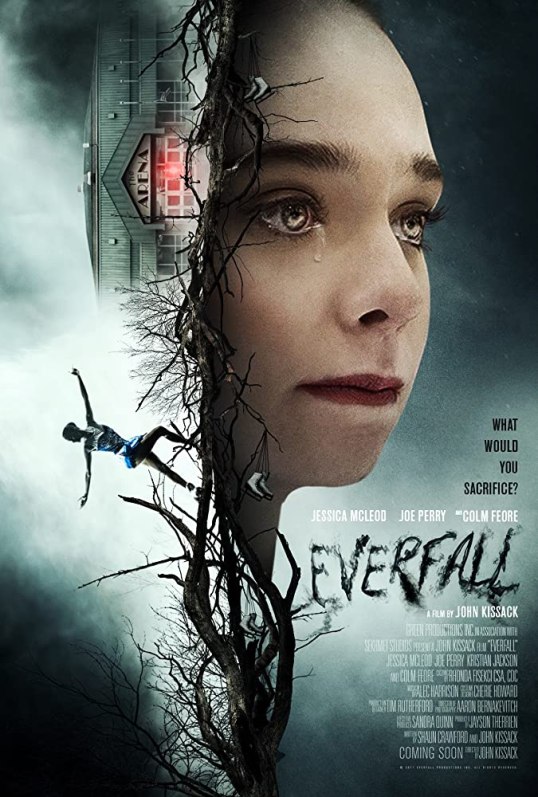
The 2018 horror film, Everfall, tells the story of Eva and Daniel.

Eva Saint (Jessica McLeod) is a figure skater who, at one time, had a bright future.

Daniel (Joe Perry) is the world’s worst boyfriend.

Daniel is also the reason why Eva’s skating career get derailed.  Daniel hosts his own “extreme sports YouTube channel,” which he calls “The Daniel Show.”  Daniel is the type who tends to say things like, “This is going to be a totally new direction for the Daniel Show!”  One of Daniel’s new directions was to convince his girlfriend to stand on a ledge.  Unfortunately, while Daniel was showing off for the camera, Eva fell off that ledge and broke her leg.

A year later, Eva’s leg is scarred but healed.  She wants to get back into the world of competitive figure skating but she’s struggling.  She’s no longer as confident in herself as she once was.  None of her old partners want to work with her anymore.  Even worse, she’s still going out with Daniel.  I’m not sure why.  If I was dating a guy who was responsible for me falling off a roof, I’d probably break up with him as soon as I regained consciousness.

Eva’s coach gives her one last option.  She can go to an obscure little town called Everfall, where they have an annual skating competition.  Eva’s never heard of it before but she knows that she has to do something so she agrees.  And again, for some reason, she takes Daniel and Daniel’s cameraman, Jordan (Kristian Wang), with her.

The competition at Everfall turns out to be even worse than Eva was expecting.  First off, the ice skating rink appears to be on the verge of collapse.  Secondly, there don’t seem to be another other skaters around.  The mysterious Mrs. Redgrave (Catherine Gell) sends Eva to Dressing Room #5.  Dressing Room #5 turns out to be a not very pleasant place to be….

Everfall is an effectively creepy film, one that makes good use of its eerie location and which features an excellent performance from Jessica McLeod.  Everfall is also a film that never really makes much sense but, in this case, that’s acceptable.  When you’re dealing with a skating rink that may or may not be haunted by several ghosts, you can get away with a little incoherence.  The film is full of surreal moments and disturbing imagery.  Characters appear to die and then, just as quickly, they show back up again.  It’s a film that was obviously influenced by Kubrick’s The Shining — particularly the final few scenes — but it also manages to carve out its own rather odd identity.

While Eva, Daniel, and Jordan are wandering around the skating rink from Hell, there’s also wildfire raging around the town of Everfall.  Amazingly enough, Eva’s father is a fireman but he refuses to acknowledge that Eva’s in any sort of danger.  Eva’s parents are played by Jayson Therrien and Julie Orton.  They bicker through the entire film and, to be honest, I could have done without the majority of their scenes.  The scenes between Therrien and Orton wreck havoc on the film’s narrative momentum.  Whenever you’re really starting to get into whatever’s happening to Daniel, Eva, and Jordan, Eva’s parents pop up and start arguing with each other.  The main theme of these scenes is that Eva’s dad isn’t willing to rescue her from a fire despite the fact that he is a fireman and that’s literally his job.  You really can’t help but feel sorry for Eva.  She never had a chance.

Everfall has its flaws.  This is one of those films where the camera is always moving, even when it should be sitting still.  That said, there’s enough strange details and out-there plot twists to make it an effective head trip and it ends on a nicely surreal note.  That’s always a good thing.

Review: Sgt. Pepper’s Lonely Hearts Club Band (Dir. by Michael Shultz)


In 1978, just based on what I’ve read, everyone in America was regularly doing huge amounts of cocaine.  Whether you were in a disco or at a PTA meeting, you knew that eventually someone would produce a small mirror covered with white powder.  President Carter even snorted it during that year’s State of the Union speech.  Sure, some people used gold spoons and others had to make do with a one dollar bill but, in the end, cocaine brought all Americans together as a nation and helped the country heal after the trauma of Watergate. 

It also contributed to some the year’s best films.  Days of Heaven, Superman, The Deer Hunter, Coming Home, Grease, Animal House, Interiors, Halloween, Midnight Express, Convoy, Go Tell The Spartans, and An Unmarried Woman; these were all films fueled by the Peruvian Headache Powder. 

However, no discussion of 1978 cocaine-fueled films would be complete with mentioning Sgt. Pepper’s Lonely Hearts Club Band.  Featuring songs originally performed by the Beatles and starring the Bee Gees, Peter Frampton, and a whole bunch of other people that my mom liked, Sgt. Pepper’s is a film that, quite honestly, should just be retitled 1978.

Plotwise — oh God, do I really have to try to describe the plot?  Seriously, this could take forever.  I mean, the film isn’t quite two hours long but a lot of stuff happens and really the only connection between any of it is that these odd cover tunes of classic Beatles songs keep popping up in the weirdest places.  Okay, let me try to get this all into one paragraph —

There’s a small town called Heartland that is very small and simple but it’s also the home of the legendary Sgt. Pepper who, throughout history, has maintained world peace by playing his magic instruments.  But then Sgt. Pepper dies and apparently turns into a gold weather vane.  His magic instruments are given to the mayor of Heartland, Mr. Kite (George Burns, who also narrates the entire movie).  The world is in mourning.  But then one day, the Henderson Brothers (the Bee Gees) decide to form a new Sgt. Pepper’s Lonely Hearts Club Band and they invite Sgt. Pepper’s grandson, Billy Shears (played by Peter Frampton) to be their lead singer.  Heartland rejoices and George Burns has a surprisingly sweet scene where he sings  Fixing A Hole.

Anyway, the new band is such a hit that the owner of a record company invites them to come to Los Angeles and record an album.  Billy says goodbye to his girlfriend, Strawberry Fields (Sandy Farina) and then joins the Hendersons in a hot air balloon which promptly leaves for California.  En route, the balloon collides with an airplane but nobody is seriously injured. 

In Los Angeles, they meet the record company owner and it turns out that he’s played by Donald Pleasence.  (It’s interesting to think that Pleasence filmed this and Halloween around the same time.)  Pleasence proceeds to sing the creepiest version of I Want You ever heard.  I’d include a clip of the performance but Pleasence manages to go on for a good ten minutes, repeating “I want you,” in an odd little voice while staring at Peter Frampton.

The boys sign a contract with Pleasence.  Billy Shears is led astray by Lucy and her band, the Diamonds.  (Guess which song they get to sing.)  Somehow, this allows Mean Mr. Mustard to steal Sgt. Pepper’s magic instruments.  Mr. Mustard drives around in a yellow van and he’s assisted by two female robots who, at one point, sing She’s Leaving Home in their electronic, robot voices.

The band is informed that the instruments have been stolen.  Outraged, they jump back in their hot air balloon and quickly start a recovery operation.  It turns out that Mean Mr. Mustard has given the instruments to three separate villains.

The first villain is Dr. Maxwell Edison who uses his silver hammer to turn old people into boy scouts.  This may sound ludicrous and silly but fortunately, Maxwell is played by Steve Martin.  His cameo is one of the highlights of the film, if just because he seems to be one of the few people who actually enjoyed himself on set.

The second villain is the Reverend Sun.  He brainwashes people or something.  I’ve seen this movie a few times and I still can’t quite figure out what Reverend Sun’s deal is.  When I first saw this movie, I got excited because I thought that Tom Savini was playing Rev. Sun.  Then I forced my sister Erin to watch the movie and she told me I was stupid because Rev. Sun was obviously being played by Frank Zappa.  Well, I did some reasearch and discovered that we’re both stupid.  That’s neither Savini nor Zappa.  It’s Alice Cooper.

The final villains are played by a very young (and very, very hot!) Aerosmith.  Here, they are called the Future Villain Band and oh my God, Joe Perry…this film needed a lot more Joe Perry.  I mean, it’s understandable that Steve Tyler  gets most of the screen time and young Steve actually looks pretty good in a Mick Jagger sort of way but Joe Perry…Oh. My.  God.  Anyway, Aerosmith does a cover of Come Together and Joe Perry circa 1978 was just so freaking gorgeous, oh my God.  Eventually, Frampton and the Bee Gees come along and ruin things by getting into a fight with Steve Tyler which leads to the camera constantly cutting away from Joe Perry who is really, really, really hot and all kinds of sexy in this movie.  They should have just called this movie Joe Perry.  Oh.  My.  God.

Uhmm, where was I?  Oh yeah — so, anyway, eventually the weather vane comes to life and suddenly, Sgt. Pepper’s a black man who sings Get Back and ends up magically resetting the past and turning Mean Mr. Mustard into an altar boy or something like that.  Oh, and the Bee Gee who looks like a New Age healer ends up singing my favorite Beatles song, A Day in the Life

Finally, it appears that every single person on the planet shows up in the film’s final scene where a huge group of “stars” show up and sing the film’s title tune one last time.  In the end credits, these people are listed as being “Our Guests At Heartland.”  Doing some research (i.e., looking the thing up in Wikipedia), I’ve discovered that these folks were apparently all pop cultural icons in the 70s.  I didn’t recognize a single one of them but I’m sure they probably all snorted a lot of cocaine.

(And, by the way, Joe Perry does not get to return for the finale so bleh on you, movie.)

For some reason, this movie kept showing up on Starz last November and that’s where I first discovered it.  The first time I saw it, I came in right at the start of Steve Martin’s cameo and the film itself was so just plain weird that I had to jump on twitter and let the world know what I was watching.  (Actually, it doesn’t take much to make me jump on twitter and tell the world what I’m doing.)  As a result, I soon discovered that, apparently, I was the only person on the planet who didn’t know about this film.

Sgt. Pepper’s Lonely Hearts Club Band is really a pretty bad movie.  The plot tries way too hard, the pacing is terrible with some scenes lasting forever and others ending before they really start, and Frampton and the Bee Gees are all distinguished by an utter lack of charisma.  The youngest Bee Gee appears to be cheerfully stoned throughout the entire movie while the other two (and Frampton) are trying way too hard to act. 

And yet, the film fascinates me.  After I saw it the first time, I forced my sister to watch it with me a second time.  I then watched it again on my own.  Finally, I went down to the local Fry’s and nearly did a happy little dance when I found it on DVD.  I’ve watched it since several times.  Whenever I’m depressed, it always cheers me up.

 What’s the appeal?  Some of it is definitely the whole “so-bad-its-good” thing.  Actually, that’s probably most of it.  Another thing fascinating thing is how literally the filmmakers choose to interpret the Beatles lyrics.  Considering the fact that the Beatles themselves were rather open about the fact that a lot of their lyrics were simply nonsense and word games, it’s interesting to try to understand logic behind trying to force them into a coherent storyline.  (This is also the appeal of 2007’s Across The Universe, which is technically a better movie than Sgt. Pepper’s but isn’t half as fun to watch.)  For instance, Billy Shears isn’t in the film because he’s an interesting character.  Instead, he’s just here because — 10 years earlier — either John Lennon or Paul McCartney choose to toss the name into a song.  We’re never quite  sure what Mean Mr. Mustard’s dastardly motivation is beyond the fact that the filmmakers had the rights to his song.  If nothing else, the film is an interesting example of what happens when people try to create a novel out of somebody else’s short story.

However, I think the main appeal of Sgt. Pepper’s is the appeal of 1978.  Watching the movie, you feel almost as if you’re literally sitting beside the cast at Studio 54, watching as everyone snorts a line.  I think that, for future historians, this film may very well turn out to be a cinematic Rosetta Stone.

Then again, maybe it really is just so bad that it’s good.