Film Review: Anna (dir by Jorge Dorado)


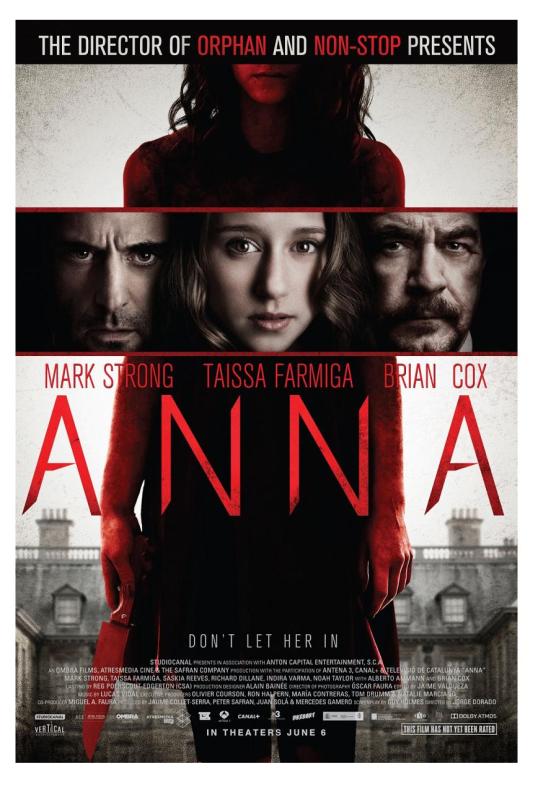
AnnaI just finished watching Anna, a Spanish thriller that was briefly given an American release way back in June.  Anna (which was produced under the title Mindscape) got fairly bad reviews, with many critics dismissing it as being a weak imitation of Inception.

Having now seen the film, I can say that, once again, the critics were wrong.

Oh, don’t get me wrong.  It’s obvious that without Inception, there never would have been an Anna.  But, as any fan of old school Italian horror can tell you, imitation is not necessarily a bad thing.  Anna may start out as a low-budget take on Inception but, by the end of the film, it has established its own unique identity.

Anna tells the story of John (Mark Strong), a “memory detective.”  John has the power to enter into people’s memories, where he can search for clues to help people deal with psychological trauma and to occasionally help the police solve crimes.  At the start of the film, John is recovering from a trauma of his own.  After their son dies, his wife — who is also a memory detective — retreats so deeply into her memories that she can’t come back.  (Yes, I know.  It’s exactly like Inception.  Just be patient…)  While exploring the memories of an assault victim, John’s own memories start to intrude on the victim’s memories, leading to John having a stroke.

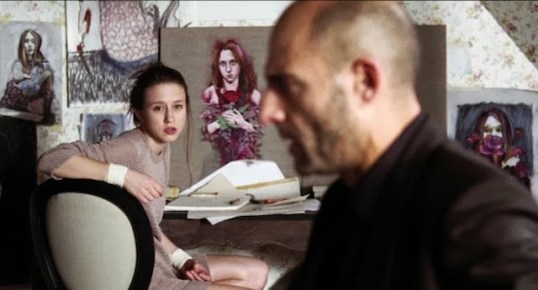
After John recovers from the stroke, he finds himself both financially destitute and emotionally unstable.  His boss (Brian Cox) takes sympathy on John and assigns him to what should be an easy case.  16 year-old Anna (Taissa Farmiga) is refusing to eat and her extremely wealthy parents want to know why.

John meets Anna and discovers that she’s a sarcastic, intelligent, and withdrawn teenager.  When John enters into her mind, he discovers memories of neglect and abuse.  The night after John first enters Anna’s memories, her nurse is pushed down a flight of stairs.  The nurse claims that Anna pushed her while Anna swears that she’s being framed.  Anna’s parents, meanwhile, have signed papers to have her committed, giving John just a few days to determine what’s behind Anna’s behavior.

Convinced that she’s innocent, John enters into Anna’s memories and searches for clues that will answer the question of whether Anna is a victim or a sociopath.  As he does so, he finds more and more evidence that Anna was abused.  However, he also starts to discover hints that there may be more to Anna’s memories than he originally realized.

Anna is a good and entertaining mystery of a film, one that takes its time telling its multi-layered story.  Jorge Dorado makes his directorial debut with Anna and he wisely emphasizes characterization and atmosphere above all else.  There’s a dream-like sense of menace that fills every frame of the film, casting a palpable feeling of unease over both John and the audience.  As a result of his work here, I’m definitely looking forward to seeing what Dorado does in the future.

Mark Strong is a talented and intelligent actor who has gotten typecast as a villain.  As such, it’s nice to see him actually get a chance to be the star for once.  Strong gives a sympathetic performance while adding just enough instability that the audience is never totally at ease with John.  The same can also be said of Taissa Farmiga, who gives a wonderfully ambiguous performance that makes Anna both innocent and destructive at the same time.  Anna keeps both John and the audience guessing until the very end of the film.

Anna is currently making the rounds on cable.  I would recommend keeping an eye out for it.

strong


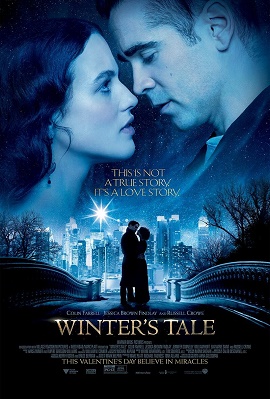
A Late Film Review: Winter’s Tale (dir by Akiva Goldsman)


Winter's_tale_(film)

I liked Winter’s Tale.

And I don’t care what anybody else says!

And that’s a good thing too because, critically, Winter’s Tale has been one of the most maligned movies of 2014.  It came out on Valentine’s Day, at the same time as Endless Love.  And the critics absolutely hated it!  For a while there, the online film community was taking bets on which one of the two Valentine’s Day releases would end up with the lowest score on Rotten Tomatoes.  And, though it was a close race, Winter’s Tale actually ended up with the lower score, coming in at 13% as opposed to Endless Love‘s 15%.

That’s right — according to most mainstream film critics, Winter’s Tale was actually worse than Endless Love.

Well, those critics were wrong.  That’s how I felt when I first saw Winter’s Tale and, after watching it a second time on HBO, that’s still how I feel.  Winter’s Tale is not a bad movie!

(Incidentally, Winter’s Tale has a 6.2 rating over at the imdb, which would seem to indicate that I’m not the only person who knows better than Peter Travers.)

Admittedly, the plot of Winter’s Tale does not make much logical sense but that’s kind of the point.  It’s a tale and tales are not about being realistic.  Tales are about emotion and the whole point of listening to or telling a tale is to inspire feelings. To truly appreciate Winter’s Tale, you have to understand that this is a fairy tale that happens to be set in the most mythical of American cities, New York.

Opening in 1895 and ending in 2014, Winter’s Tale tells the story of Peter Lake (Colin Farrell).  When Peter was an infant, his immigrant parents were refused entry into Manhattan because they both had tuberculosis.  So, they put Peter in a toy boat and dropped him into ocean and watched as the boat slowly floated towards America.

Jump forward 21 years and Peter has grown up to be a thief, working for a gangster named Pearly Soames (Russell Crowe).  What few people know is that Pearly is actually a demon who regularly visits his boss, Luicfer (played by Will “Yes, that Will Smith” Smith).  Pearly is immortal as long as he stays in New York City.

When Peter decides that he wants to leave Pearly’s gang, Pearly orders that Peter be killed.  However, while fleeing from the rest of the gang, Peter is rescued by a flying white horse.  While Peter’s first instinct is to fly the horse out of New York and spend the winter in Florida, he instead decides to rob one more mansion.  (It helps that the horse literally takes him to the mansion.)

While robbing the mansion, Peter meets Beverly Penn (Jessica Brown Findlay), a passionate and talented pianist who is dying of tuberculosis.  In what is literally a case of love at first sight, Peter forgets about robbing the mansion and instead has a cup of tea with Beverly.  They discuss their lives and Beverly tells Peter that everyone has a miracle inside of them and that everyone becomes a star after dying.

Soon, Peter and Beverly are a couple and Peter even manages to win over Beverly’s suspicious father, Isaac (William Hurt).  Peter and Beverly spend the winter at her family’s summer home.  Peter believes that his miracle is to save Beverly.  Meanwhile, an angry Pearly waits for his chance to get revenge…

Now, I will admit that there are some obvious flaws with Winter’s Tale.  Russell Crowe goes totally overboard, with his accent wildly going from Australian to New Yorkish to Scottish and back again.  Meanwhile, Will Smith is not necessarily a bad choice to play the devil and he actually gives a pretty good performance but it doesn’t chance the fact that, whenever he’s on screen, all you can think about is that he’s Will Smith and he’s playing the devil.

But, honestly, who cares?  This is an amazingly romantic film and Farrell and Findlay have a lot of chemistry.  When you see them together, you have no doubt that Peter and Beverly are meant to be together.  You care about them as a characters, even if you don’t always understand everything that’s happening around them.  Their love feels real and, when it comes to telling a love story, isn’t that the most important thing?

(Add to that, does any actor fall in love as convincingly as Colin Farrell?)

And the film itself is gorgeous!  From the costumes to the set design to Caleb Deschanel’s cinematography, the film is just beautiful to look at.  Undoubtedly, cynics would argue that the film is almost too glossy in its appearance but Winter’s Tale is not a film for cynics.  It’s a film for romantics.

So, yes,  I did like Winter’s Tale and I am not ashamed to admit it.

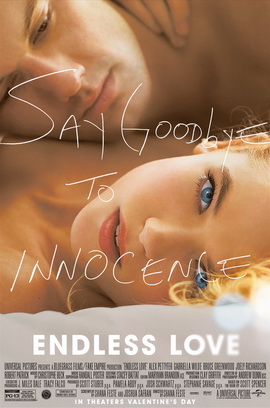
Film Review: Endless Love (dir by Shana Feste)


EDL_31_5_Promo_4C_2F.indd

Oh, what a disappointing film this turned out to be!

When the trailer for Endless Love came out way back in the closing days of 2013, both me and my BFF Evelyn were seriously excited about seeing it.  The trailer was great!  It featured Florence + The Machine!  The movie looked hot and sexy and fun and…

Well, let’s just rewatch the trailer, shall we?

Here’s the thing:  Sometimes, trailers lie.

I saw Endless Love when it was originally released in February but I didn’t review it.  I meant to review it but somehow I never got around to doing so.  And, unfortunately, the film itself was so bland and forgettable that I actually struggled to think of anything to say about it.  Some movies make you laugh.  Some movies make you cry.  Some movies make you mad.  And some movies are just there.

Endless Love is a just there type of movie.

That said, when I saw that Endless Love would be making its cable debut on Cinemax on Saturday night, I decided to give it a second chance.  “Who knows?” I thought to myself, “Maybe I just went into the film with unrealistic expectations.  Maybe I was just in a bitchy mood when I saw it.  Maybe, on a second viewing, I’ll discover that Endless Love works on a purely emotional level…”

No such luck!  Having watched Endless Love a second time, I can now actually remember enough about the film to finally get around to writing a review.  However, I have also now been reminded why I didn’t care much about the film the first time I saw it.

Endless Love is essentially a collection of generically pretty scenes that all feature pretty performers thinking about love, talking about, and making love.  Recent high school graduates David (Alex Pettyfer) and Jade (Gabriella Wilde) start going out.  Jade comes from a wealthy family.  David does not.  Jade’s overly protective father, Hugh (Bruce Greenwood), does not approve of the relationship because Jade has an ivy league future ahead of her while David has no plans to attend college at all.  Jade becomes more rebellious.  David lectures Hugh on the fact that nothing is more important than love.  Hugh takes out a restraining order against David.  Jade goes off to college.  David tries to secretly see her.  And, of course, there’s a fire.

(Though, unlike in the original Endless Love, the fire is not deliberately set.  This is Endless Love  reimagined as a Nicholas Sparks novel.)

And who really cares?

The problem with Endless Love is that we’re supposed to care about David and Jade and we’re supposed love how obsessed they are with each other but David and Jade are two of the most boring people ever so who cares?  Alex Pettyfer is nice to look at.  Gabriella Wilde is pretty.  But, as a couple, they have next to no chemistry.  Instead, they come across like one of those vapid couples that my boyfriend and I always worry we’re going to end up getting trapped in an endless conversation with.

(“How did you two meet?  Wait, before you start — let me tell you how we met… It’s a great story…you guys are going to love this…we were both attending kindergarten on a dance scholarship but the ballet kids all hated the ballroom kids.  Then they moved to Iceland and I asked my dad if we could move to Greenland and then…”)

And again, this just shows the power of a good trailer.  Watching the trailer, you would never guess how boring David and Jade truly are.  Incidentally, the best parts of the trailer are all taken from a “David and Jade dating” montage that occurs about halfway through the film.  As such, the scenes that made me want to see Endless Love pretty much just serve as filler in the actual film.

Also, Florence + The Machine are nowhere to be heard in the actual film.  And their haunting, atmospheric music would have been out of place anyway.  Florence + The Machine embraces the power of ambiguity and Endless Love takes place in a world where there is no ambiguity.

However, there is a lot of blue.

Seriously!  (And yes, I do realize that there’s a typo in my tweet but everyone is allowed to be illiterate on twitter so get off my back.)  This movie opens with a high school graduation where everyone is wearing a blue robe and the entire cast is so oppressively cheerful and overwhelmingly pleasant-looking that I briefly wondered if they were supposed to be a graduating class or a cult.  Later on, David works at a valet at a country club and, of course, he wears a blue shirt.  Everyone who belongs to the club also appears to be wearing a blue shirt, except that it’s a lighter shade of blue than David’s blue.  It’s just odd-looking and reinforces the feeling that Endless Love is less a movie and more a collection of commercial outtakes.

Endless Love, of course, is a remake of a film from the early 80s.  The first Endless Love isn’t very good but it’s at least a lot of unintentional fun!  And you can read my review of it (and even watch the film!) by clicking here.

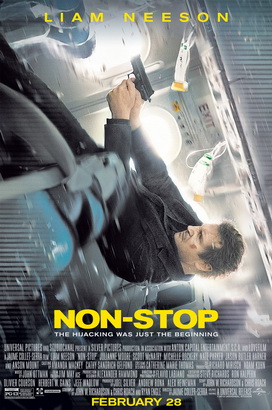
A Late Film Review: Non-Stop (dir by Jaume Collet-Serra)


NST_31_5_Promo_4C_4F.indd

With 2014 rapidly coming to a close, I am currently trying to get caught up on some of the movies that I either missed seeing or did not get a chance to review earlier this year.  After all, in just another month and a half, it’ll be time for me to make out my “Best Of the Year List” and I want to have as many options as possible.

With that in mind, I just finished watching Liam Neeson in Non-Stop, an action-suspense film that came out way back in February.

In Non-Stop, Liam Neeson plays Bill Marks.  It’s interesting to note that Bill Marks has the same initials as Bryan Mills, the very specifically trained CIA agent that Neeson plays in the Taken films.  And really, Bill Marks might as well Bryan Mills because Neeson pretty much gives the exact same performance in Non-Stop that he previously gave in Taken.  That’s not necessarily a criticism.  There’s a reason why Liam keeps getting cast in these type of roles.  He’s good at them.

In fact, I would say that Liam Neeson is one of the few action stars who I can imagine actually killing someone in real life (though only if he had to).  He has a rugged, world-weary cynicism about him.  You look into the eyes of a character played by Liam Neeson and you realize that he’s had to do things that you probably don’t want to know anything about.  At the same time, Neeson also projects a certain old-fashioned decency as well.  He’s the epitome of a decent man forced to use bad methods for the good of us all.

As for Non-Stop, I imagine it was probably pitched as being “Taken on a plane.”  Bill Marks is an air marshal who is on board a non-stop flight from New York to London.  Shortly after the plane takes off, he starts to receive mysterious text messages telling him that, unless he arranges for a 150 million dollar ransom to be paid into a specific bank account, someone on the plane will die every 20 minutes.  While Bill tries to discover who is sending him the text messages and various people on the plane die, the authorities on the ground are convinced that Bill is hijacking the plane.  Why?  Well, mostly because the bank account is in Bill’s name…

That’s right!  Somebody’s trying to frame Bill Marks!  Can Bill — with the help of a passenger played by Julianne Moore — figure out who is trying to frame him and why?  I have to admit that there was a part of me that was hoping that it would turn out that Bill really was the mastermind behind the whole scheme but instead, the movie offers up a solution that is even more ludicrous and illogical.  Naturally, there’s a twist.  The hijacking is not what it originally appears to be.  Perhaps if Non-Stop itself was more fun, the total implausibility of the twist wouldn’t bother me.

Director Juame Collet-Serra (who previously directed Neeson in Unknown) manages a few good action sequence but, ultimately, Non-Stop is really saved only be the presence of Liam Neeson.  Regardless of how implausible or silly the film may get, Neeson always brings a lot of authority to his role.  He’s never more convincing than when he’s walking up and down the aisles, glaring at the passengers and barking out orders.

It’s the type of performance that leaves us assured that the world will be safe as long as Liam Neeson is around to kill people.

Liam Neeson, about to kill someone

Liam Neeson, about to kill someone

Film Review: In the Blood (dir by John Stockwell)


in-the-blood-1

Do you remember Haywire?

Haywire was an action film that came out in 2011.  It briefly got a lot of attention because it starred MMA fighter Gina Carano in her feature film debut and it was directed by Steven Soderbergh.  I have to admit that I didn’t care much for Haywire.  Some of that is because Gina Carano herself didn’t seem to be a very good actress but my main issue with the film was with Steven Soderbergh.  Don’t get me wrong — I know that Soderbergh can be a genius.  However, he’s also a remarkably pretentious filmmaker.  Sometimes that pretension works, like with The Girlfriend Experience.  But, in the case of Haywire, all the pretension served to do was to make a thin story even more annoying.

John Stockwell, on the other hand, is a director who is the very opposite of pretentious.  Whereas Soderbergh often makes genre films that try too hard to be art, Stockwell makes genre films that are so unapologetic about being genre that they often become art despite themselves.  Stockwell may never be as acclaimed as Soderbergh but, on the whole, he’s a much more consistent filmmaker.

Take In The Blood for instance.  In the Blood came out earlier this year, got thoroughly mediocre reviews, and disappeared from theaters pretty quickly.  When I watched it last night, I had very low expectations.

But you know what?

In the Blood isn’t bad.

In fact, it’s a perfectly entertaining and, ultimately, rather empowering film.

In In The Blood, Gina Carano plays Ava.  Ava, we quickly learn, has led a difficult life.  Raised in extreme poverty by a father who taught her early how to fight and how to defend herself, Ava is a former drug addict.  When she goes to rehab, she meets and falls in love with fellow addict Derek (Cam Gigandet).  Once they’re both clean, Ava and Derek marry despite the concerns of Derek’s wealthy father (Treat Williams).

For their honeymoon, Derek and Ava go to the type of Caribbean island where bad things always happen in movies like In The Blood.  They meet Manny (Ismael Cruz Cordova), who agrees to be their guide on the island.  One night, Manny takes them out to a club where Ava ends up getting into a huge fight with literally everyone on the dance floor, including a local gangster played by Danny Trejo.  The next morning, Manny takes them zip lining but Derek ends up plunging from the zip line and crashing down to the ground below.  He’s rushed to the hospital where he promptly vanishes.

Despite being ordered to return to America by police chief Luis Guzman, Ava is determined to figure out what has happened to her husband and she’s willing to beat up the entire island to do it…

Obviously inspired (much like almost every other low-budget action film released over the past few years) by Taken, In The Blood is a familiar but enjoyable burst of pulp fiction.  As opposed to Soderbergh’s approach to Haywire, Stockwell doesn’t worry about trying to disguise the genre roots of In The Blood.  Instead, he simply tells the story and he tells it well.  In The Blood is a film that’s full of beautiful island scenery, villainous character actors, and enjoyable melodramatic dialogue.  The pace never falters and the action is exciting.  In a few years, the club fight scene will be remembered as a classic of action cinema.

And best of all, Gina Carano kicks ass!  In The Blood gives her a chance to show what she can actually do when she has a director who is willing to get out of her way.  As opposed to Haywire, where she often seemed to get lost amongst all of Soderbergh’s showy techniques, Gina Carano gives a confident and determined performance in In The Blood.  After having to sit through countless action films where every female character is either a victim or a pawn, there is something so wonderful about seeing a movie where a woman gets to do something more than whimper and beg.  Regardless of how predictable the film’s plot may be, the fact that it’s a woman — as opposed to a man — who is getting to kick ass (and look good while doing it!) serves to make In The Blood something of a minor masterpiece of the pulp imagination.

If nothing else, In The Blood shows that sometimes it’s best to keep things simple.

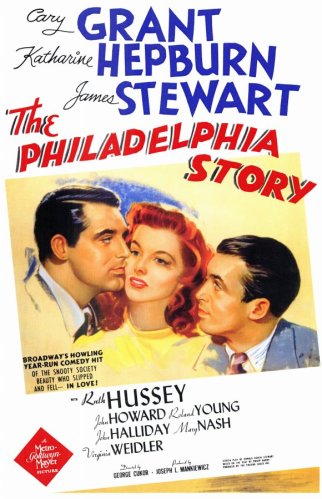
Lisa Reviews The Oscar Nominees: The Philadelphia Story (dir by George Cukor)


The-Philadelphia-Story-(1940)

There are a few reasons why The Philadelphia Story was one of those films that I had been meaning to watch for a while.  For one thing, The Philadelphia Story was nominated for best picture of 1940 (it lost to Alfred Hitchcock’s Rebecca) and my ultimate goal is to see and review every single film ever nominated for best picture.  The other reason is that Jimmy Stewart won an Oscar for his performance in The Philadelphia Story and anyone who doesn’t love Jimmy Stewart has obviously never seen Anatomy of a Murder (not to mention It’s a Wonderful Life!).

Well, The Philadelphia Story was on TCM last night and I finally got to see it and what can I say?  I absolutely loved it.  For a 74 year-old, black-and-white comedy, The Philadelphia Story is still a lot of fun.

The Philadelphia Story tells the story of Tracy Lord (Katharine Hepburn), a wealthy socialite who is engaged to marry George Kitteridge (John Howard), a self-described “man of the people,” who is widely respect for both his strong moral character and the fact that — unlike most of Tracy’s friends — he made his fortune as opposed to inheriting it.

It would be tempting to reach into the bag of simplistic blogging clichés and call the Lords a 1940s version of Khardashians but I’m not going to do that because the Lords have a lot more wit and class.  My favorite member of Tracy’s family was Dinah (Virginia Wiedler), her teenage sister who is sarcastic, cheerfully cynical, and has no problem demanding to be the center of attention.  My sister Erin claims that the reason I liked Dinah is because I saw a lot of myself in the character and that’s probably true.  However, I have to say that the great thing about both Tracy and Dinah is that they were both wittier, classier, and better dressers than all of the Khardashians and Jenners combined.

Anyway, the evil editor of Spy Magazine, Sidney Kidd (Henry Daniell), wants to get pictures of Tracy’s very exclusive and very private wedding so he sends two of his reporters in under cover.  Mike Connor (James Stewart) is a frustrated writer who hates having to lower himself to writing for a tabloid.  Photographer Liz (Ruth Hussey) is secretly in love with Mike.  Helping Mike and Liz pass themselves off as friends of the family is Tracy’s ex-husband, C.K. Dexter Haven (Cary Grant).

As quickly becomes obvious, Dexter is still in love with Tracy.  However, Tracy divorced Dexter because Dexter was an irresponsible alcoholic and, even though Dexter has changed his ways and she is still obviously attracted to him, Tracy is now engaged to the morally upright but boring and judgmental George.

However, Tracy is not just torn between George and Dexter.  She is attracted to Mike as well, to the extent that Tracy even takes the trouble to read some of Mike’s short stories.  For only the second time in her life, Tracy gets drunk and goes for a midnight swim with Mike.  This, of course, leads to the best scene in The Philadelphia Story: Jimmy Stewart singing Somewhere Over The Rainbow.

Seriously, the scene made my entire night.

The Philadelphia Story is based on a play and the film itself is rather stagey in that way that films from the 40s often appear to be to modern viewers.  But, once you get used to the fact that the movie was made in 1940 and not 2014, it’s a real delight.  The dialogue is funny and it’s delivered by one of the best casts ever.  Playing a role that was specifically written for her, Katherine Hepburn is brilliant as the strong-willed but unapologetically romantic Tracy and Cary Grant is just as charming as you would expect Cary Grant to be.  Best of all, you’ve got Jimmy Stewart singing Somewhere Over the Rainbow and seriously, how can you not love that?

Trailer: The Cobbler


Listen, I’m just going to put this out there:

Adam Sandler can be a good actor.

I know, I know.  You scoff and you have every reason to do so.  After all, Sandler is best known for appearing in Razzie-winning films like Jack and Jill and That’s My Boy.  Sandler’s film career has been so lowbrow that, when Amy Dunne mentioned the misery of being forced to watch Sandler movies, audiences watching Gone Girl knowingly nodded and thought to themselves, “She may be a crazy but she knows her movies…”

And yet, occasionally, mixed in with all of the crap, you’ll come across a film that actually requires Sandler to act and play a character and he usually does a pretty good job at it.  It’s the talent that you see in films like Punch-Drunk Love, Spanglish, Reign Over Me, and Funny People that makes it so frustrating that Sandler has devoted so much of his career to things like Grown-Ups 2.

When Sandler stops trying to make everyone laugh and actually lets his guard down, he has the ability to be a surprisingly good actor.  And, though it’s hard to believe now, a lot of film bloggers — like me — were convinced that 2014 would be the year that Sandler would prove that he was capable of more than just winning Razzies.

He had two films scheduled to come out and both of them were directed by “serious” filmmakers.  And Sandler got some good reviews for his performance in Jason Reitman’s Men, Women, & Children but the film itself was critically reviled.

As for Sandler’s other 2014 film, Thomas McCarthy’s The Cobbler opened to mixed reviews at the Toronto International Festival and, as a result, it probably will only get a very limited release in the early months of 2015.

However, I’m still looking forward to seeing The Cobbler.  Thomas McCarthy’s previous film — Win Win — was one of the best of 2011 and the film’s premise — a cobbler discovers that he can assume anyone’s physical appearance and life simply by putting on their shoes — sounds like it could be promising, especially is Sandler plays to his natural sadness as opposed to going for easy laughs.

Here’s the international trailer for The Cobbler.


Lisa Reviews The Oscar Nominees: Nicholas and Alexandra (dir by Franklin J. Schaffner)


Nicholas_and_Alexandra-831476012-large

(Depending on how much you know about world history, the review below may contain spoilers.)

It was nearly four years ago that I decided that my goal in life was to watch and review every single film — no matter how obscure or potentially disappointing — that had ever been nominated for best picture.  Of course, that’s not my only goal.  If anything, I may have too many, often contradictory goals in my life.  But seeing all of the best picture nominees was definitely one of them and, all these years later, it’s a goal that I’m still trying to achieve.  With the help of TCM and their nonstop schedule of movies made long before I was born, it’s also a goal on which I am slowly but surely making progress.

Last night, as I scrolled through the guide, I noticed that TCM would be showing Nicholas and Alexandra, a three and a half hour film from 1971.  Now normally, I would be hesitant about watching a film that long, if just because I have ADHD and I doubt I’d be able to concentrate on it.  In a theater, watching the action unfold on a big screen, it wouldn’t be a big deal.  However, it’s totally different when you’re talking watching a movie on TV in a house that is full of potential distractions.  Add to that, Wednesday night is when I usually watch shows like Survivor, Hell’s Kitchen, and South Park.

But, here’s the thing.  The title Nicholas and Alexandra sounded familiar to me and not just because I’m an obsessive history nerd.  I did some checking and I discovered that, regardless of how obscure the film may be today, Nicholas and Alexandra was nominated for best picture.  It lost to The French Connection but it was nominated.

So, of course, I had to watch it.

And you know what?
NA

It’s not a terrible movie.  It’s certainly not great.  It has multiple flaws and it’s hard to imagine this film being nominated alongside films like The French Connection, Last Picture Show, and A Clockwork Orange.  Watching the movie, I got the feeling it was probably nominated because it was a big, expensive epic and not because it was one of the best of the year.  But, if you stick with the film (which, if we’re going to be honest here, is much easier said than done), it’s not quite as disappointing as you might expect it to be.

Nicholas and Alexandra tells the story of the last monarch of Russia, Tsar Nicholas II (Michael Jayston).  Struggling to escape the shadow of his father and incapable of understanding what life is like for those not born into royalty, Nicholas is portrayed as being well-meaning but autocratic and blind to the fact that the days of royalty are rapidly coming to an end.  His wife, Alexandra (Janet Susman) is also unpopular with both the Russian citizenry and the royal court on account of being German.

Alexandra spends most her time doting on her youngest son, Alexei, who suffers from hemophilia.  When a flamboyant Serbian monk named Rasputin (Tom Baker) claims that he has the power to heal Alexei, Alexandra immediately brings him into the court.  Soon, rumors are flying across Russia about Rasputin’s relationship with Alexandra.

Meanwhile, men with names like Lenin (Michael Bryant), Trotsky (Brian Cox), and Stalin (James Hazeldine) are plotting to lead a “worker’s revolution…”

If you know anything about history, it’s not really a spoiler to reveal what happens in the second half of Nicholas and Alexandra.  (And if you’re not into history, you probably would not have any interest in watching the movie in the first place.)   Archduke Franz Ferdinand is assassinated, plunging the entire world into war.  Russia declares war on Germany and the German-born Alexandra becomes even more unpopular than before.  The rest of the royal court, jealous over the mad monk’s influence, plots against Rasputin.  The Tsar is forced from the throne and Nicholas and his family spend their last days as captives of the people they once ruled.  Now a powerless prisoner, Nicholas finally starts to understand the world beyond his palace walls.  However, in the end, Nicholas, Alexandra, their children, and their loyal servants are taken into a small room and violently executed.  End of movie.

NA2

So, there are a lot of things wrong with Nicholas and Alexandra.  Not the least of the film’s problem is an unwieldy length and generally slow pace.  (The film was directed by Franklin J. Schaffner, who also directed the still-fun original Planet of the Apes.  Little of the flair he brought to Planet of the Apes is present here.)  This is one of those films that is full of incident with various characters popping up and discussing the intricacies of international politics with little concern as to whether or not any of this is the least bit cinematic or even compelling on a narrative level.  The film has a huge cast but very few memorable characters.

Even worse is that neither Nicholas nor Alexandra never come across as being all that interesting.  The film makes the case that Nicholas’s downfall was largely a result of him being unlucky enough to rule at a time when people across Europe and Asia were rejecting the old ways for the new ways of revolution and industrialization.  Nicholas is continually portrayed as being well-meaning but isolated and that has the potential to be interesting but, at times, the film feels almost as emotionally detached as its characters.

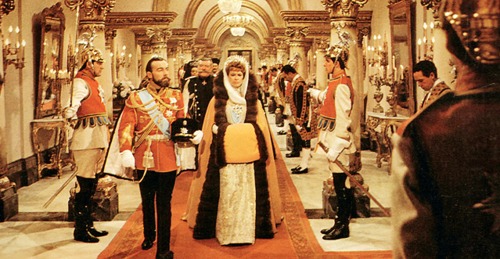
That said, Nicholas and Alexandra does work as a spectacle, as a showcase for beautiful clothing and ornate scenery.  As a character study, Nicholas and Alexandra largely fails but, as a fashion show, it’s actually a lot of fun.    Early on in the film, there’s a lengthy sequence in which Nicholas and Alexandra walk down the red-carpeted hallways of their palace.  It’s shot through Nicholas’s eyes and we see a collection of guards and noblemen and women standing to the side and bowing their heads as the Tsar and his wife walk past.  It’s a good scene and one that perfectly shows not only the life that Nicholas is used to but also why Nicholas doesn’t want to change that life.

baktna03

Perhaps not surprisingly, the first two hours of Nicholas and Alexandra work best when they focus on the flamboyant character of Rasputin.  Baker does a really go job as Rasputin, delivering all of his lines with a ferocious intensity while staring with obviously unhinged eyes.  When he’s with Alexandra, Rasputin is calculating and coldly conniving, providing just enough comfort to keep her under his control.  When he’s with Nicholas or any of the other male members of the court, he reveals himself to be an arrogant libertine, making profane jokes and bragging about his conquests.  It’s a really good performance but, as with so many other good performances in this film, it occasionally gets lost in the film’s dense production.

The best moments of Nicholas and Alexandra come towards the end, with the humbled Nicholas finally revealing his humanity and the Tsar’s family struggling to maintain their dignity even as their inevitable fate approaches.  At this point, the performers came to life.  The film suddenly had an emotional resonance.  It finally became about something!  For those final 20 or so minutes, Nicholas and Alexandra suddenly seemed worthy of being awarded.

In fact, based on those final 20 minutes, I would even be willing to see a sequel called Nicholas and Alexandra and Rasputin Makes Three.  

(Though I’m not sure how that sequel could ever be made.  As @Kev1Media pointed out when I suggested it on twitter, Adam Sandler would have to be somehow involved.)

As for Nicholas and Alexandra, it’s not a great film but if you’re into history or you’re an Oscar completist like me, the film has its occasional charms.  You just have to be willing to look for them.

Nicholas and Alexandra

What Lisa and the Late Night Movie Crew Watched Last Night #107: Prisoners of the Lost Universe (dir by Terry Marcel)


Last night, I gathered with about 17 friends over at SyFyDesigns and we watched an obscure little fantasy film from 1983, Prisoners of the Lost Universe.

P-0002_Prisoners_of_the_Lost_Universe_quad_movie_poster_l

Why Were We Watching It?

We were watching it because we are the late night movie crew and that’s what we do.  We watch movies and we watch them late at night and, since we are all intelligent and snarky people, we have a natural tendency to pick movies with titles like Prisoners of the Lost Universe.

(Add to that, since Prisoners of the Lost Universe is in the public domain, it has been included about a dozen different Mill Creek Box sets and it’s also on YouTube.  So, it was an easy film for everyone to watch.)

What Was It About?

News reporter Carrie (Kay Lenz) is interviewing Dr. Hartmann (Kenneth Hendel) when a sudden earthquake hits California.  Dr. Hartmann stumbles into an interdemensional transporter and disappears!  Then Dan (Richard Hatch) stops by Hartmann’s house and he stumbles into the transporter and disappears as well!  And then, after that, Carrie stumbles into the transporter and she vanishes!  Why is everyone in this movie so clumsy?

Anyway, Carrie is transported to the Lost Universe, which looks a lot like South Dakota.  (Actually, the movie was made in South Africa so apparently, South Africa also looks a lot like South Dakota.)  Carrie wanders around for a little while and spends a while talking to herself about how much she hates being in the Lost Universe.  Part of Carrie’s problem was that she was wearing high heels.  If you’re going to visit South Dakota, South Africa, or the Lost Universe, be sure to wear sensible shoes.

Eventually, Carrie is reunited with Dan and they meet a lot of other citizens of the Lost Universe.  They meet a green man.  They meet a gigantic cave man.  They meet a bearded thief.  They also meet a tribe of angry people who all have glowing red eyes.  When they’re climbing up a mountain, Dan offers a helping hand.  “Take your hand off my butt!” Carrie snaps back.  They’re not exactly Hepburn and Tracy.

Finally, Carrie is kidnapped by an evil warlord who happens to be played by John Saxon.  The warlord has a dueling pistol with him that he uses to enforce his will on everyone else in the Lost Universe.  He explains that it was built for him by a sorceror from another universe.  Any guess who that is going to turn out to be?

Anyway, it’s up to Dan to rescue Carrie and hopefully end the tyranny of John Saxon.

What Worked?

Prisoners of the Lost Universe is one of those otherwise forgettable films that suddenly becomes the most entertaining thing in the world if you’re watching it with the right people.  Last night, I watched it with the right people and our natural wit and snarkiness elevated the entire film.

Beyond the snarkiness, John Saxon made for a good and fun villain.  And I liked the Green Man.  He had an above-it-all attitude that was very entertaining.

What Did Not Work?

To be honest, it’s really a very bad movie.  If I hadn’t been watching this movie with 17 other snarky and talkative people, I imagine I would have been bored out of my mind.  If Prisoners of the Lost Universe had been produced by Crown International Pictures, it probably would have been a lot more fun.

“Oh my God!  Just like me!” Moments

I have a feeling that if I accidentally got transported to the Lost Universe, I’d probably be wearing high heels as well.  And I’d probably complain a lot.  Who wouldn’t?

Lessons Learned

Why go to the Lost Universe when you can just go to South Dakota?