Overlong, wildly uneven, gimmicky too a fault, and often laugh out loud funny with a mix of jokes that range from the crude to the sublimely clever to the surprisingly sentimental, The History of the World, Part I is the ultimate Mel Brooks films.
Narrated by Orson Welles and featuring five historical stories and a collection of coming attractions, The History of the World Part I follows man from his caveman origins to the French Revolution and the thread that ties it all together is that humanity always screws up but still finds a way to survive. Moses (Mel Brooks) might drop and break one of the three tablets listing the 15 Commandments but he’s still able to present the other ten. Stand-up philosopher Comicus (Mel Brooks) might make the mistake of poking fun at the weight of Emperor Nero (Dom DeLuise) but he still makes his escape with Josephus (Gregory Hines), Swiftus (Ron Carey), and Miriam the Vestal Virgin (Mary-Margaret Humes) and ends up serving as the waiter at the Last Supper. (“Jesus!”) The Spanish Inquisition may have been a catastrophe but it also gave Torquemada (Mel Brooks) a chance to show off his performance skills. The French Revolution may have been a bloodbath but the future still held promise. Ask for a miracle and he’ll show up as a white horse named Miracle, no matter what era of history you’re living in.
The humor is very Mel Brooks. During the Roman Empire sequence, Madeline Kahn plays Empress Nympho. Jackie Mason, Harvey Korman, Cloris Leachman, Spike Milligan, Jan Murray, Sammy Shores, Shecky Greene, Sid Caesar, Henny Youngman, and Hugh Hefner all make cameo appearances. Carl Reiner is the voice of God. John Hurt plays Jesus. The film ends with the promise of a sequel that will feature “Jews in Space.” Not every joke lands. The entire caveman sequence feels forced. But when the film works — like during The Inquisition production number — it’s hard not get caught up in its anything-goes style. The entire Roman Empire sequence is probably more historically accurate than the typical Hollywood Roman epic. That’s especially true of Dom DeLuise’s naughty performance as Emperor Nero.
Mel Brooks is 99 years old today and he says that he has at least one more film to give us, a sequel to Spaceballs. I’m looking forward to it! I’m also looking forward to rewatching and enjoying all of the films that he’s already given us. The History of the World, Part I may not have initially enjoyed the critical acclaim of his earlier films but, in all of its anarchistic glory, it’s still pure Mel Brooks.
In 1984’s CityHeat, Clint Eastwood plays Lt. Speer, a tough and taciturn policeman who carries a big gun, throws a mean punch, and only speaks when he absolutely has to.
Burt Reynolds plays Mike Murphy, a private investigator who has a mustache, a wealthy girlfriend (Madeleine Kahn), and a habit of turning everything into a joke.
Together, they solve crimes!
I’m not being sarcastic here. The two of them actually do team up to solve a crime, despite having a not quite friendly relationship. (Speer has never forgiven Murphy for quitting the force and Murphy has never forgiven Speer for being better at everything than Murphy is.) That said, I would be hard-pressed to give you the exact details of the crime. CityHeat has a plot that can be difficult to follow, not because it’s complicated but because the film itself is so poorly paced and edited that the viewer’s mind tends to wander. The main impression that I came away with is that Speer and Murphy like to beat people up. In theory, there’s nothing wrong with that. Eastwood is legendary tough guy. Most people who watch an Eastwood film do so because they’re looking forward to him putting the bad guys in their place, whether it’s with a gun, his fists, or a devastating one-liner. Reynolds also played a lot of tough characters, though they tended to be more verbose than Eastwood’s.
That said, the violence in CityHeat really does get repetitive. There’s only so many times you can watch Clint punching Burt while various extras get gunned down in the background before it starts to feel a little bit boring. The fact that the film tries to sell itself as a comedy while gleefully mowing down the majority of the supporting cast doesn’t help. Eastwood snarls like a pro and Reynolds flashes his devil-may-care smile but, meanwhile, Richard Roundtree is getting tossed out a window, Irene Cara is getting hit by a car, and both Kahn and Jane Alexander are being taken hostage. Tonally, the film is all over the place. Director Richard Benjamin was a last-minute replacement for Blake Edwards and he directs without any sort of clear vision of just what exactly this film is supposed to be.
On the plus side, CityHeat takes place in Kansas City in 1933 and the production design and the majority of the costumes are gorgeous. (Unfortunately, the film itself is often so underlit that you may have to strain your eyes to really appreciate it.) And the film also features two fine character actors, Rip Torn and Tony Lo Bianco, are the main villains. For that matter, Robert Davi shows up as a low-level gangster and he brings an actual sense of menace to his character. There are some good things about CityHeat but overall, the film is just too messy and the script is a bit too glib for its own good.
Burt Reynolds and Clint Eastwood had apparently been friends since the early days of their careers. This was the only film that they made together. Interestingly enough, Reynolds gets the majority of the screentime. Eastwood may be top-billed but his role really is a supporting one. Unfortunately, Reynolds seems to be kind of bored with the whole thing. As for Clint, he snarls with the best of them but the film really doesn’t give him much to do.
A disappointing film, CityHeat. Watching a film like this, it’s easy to see why Eastwood ended up directing himself in the majority of his films.
The 1985 comedy, Clue, opens with a set of six strangers arriving at an ominous mansion in New England. They’re meet by Wadsworth (Tim Curry), an oddly charismatic butler who explains that all six of the strangers have a few things in common. They all work in Washington D.C. They are all, in some way, involved with the government. And they’re all being blackmailed by Mr. Boddy (Lee Ving), the owner of the house.
The six strangers have all been assigned nicknames for the night.
Miss White (Madeleine Khan) is the enigmatic widow of a nuclear physicist who may have had communist sympathies. Actually, Miss White is a widow several times over. All of her husbands died in circumstances that were a bit odd. Is Miss White a black widow or is she just unlucky? And what about the flames of jealousy that she occasionally mentions?
Professor Plum (Christopher Lloyd) is a psychiatrist who once worked for the World Health Organization and who has an unfortunate habit of sleeping with his patients.
Mr. Green (Michaele McKean) explains that he works for the State Department and that he is also secretly gay. If his secret got it, he would be deemed a security risk or perhaps even a communist agent.
Mrs. Peacock (Eileen Brennan) is the wife of a U.S. Senator who forced to resign after getting caught up in a bribery scandal.
Colonel Mustard (Martin Mull) is a somewhat stuffy war hero-turned-arms dealer.
And finally, Miss Scarlet (Lesley Ann Warren) is Washington D.C.’s most powerful and most witty madam.
Once everyone is in the house, Wadsworth explains that the police have been called and will arrive in 45 minutes, at which point Mr. Boddy will be arrested and everyone’s secrets will be exposed. Mr. Boddy’s solution is to suggest that one of the six kills Wadsworth. After tossing everyone a weapon, Mr. Boddy turns out the lights. When the lights come back on, Wadsworth is still alive but Mr. Boddy is not. But who murdered Mr. Boddy? And in what room? And with what weapon? And what to make of the other people who were either in the house or show up at the front door, like the maid, Yvette (Collen Camp), or the motorist (Jeffrey Kramer) who shows up to use the phone or the traveling evangelist (Howard Hesseman)? Can the mystery be solved before the police show up and presumably arrest everyone?
Based on the old board game, Clue is a hilariously exhausting film, one that mixes smart wordplay and broad physical comedy to wonderful effect. It’s not often that you see a film that gets equal laughs from two people colliding in a hallway and from characters accusing each other of being communists. In fact, it’s so easy to marvel at the physical comedy (especially the lengthy scene where Tim Curry runs from room to room while explaining his theory about who committed the murders) that it’s easy to forget that the film is also a sharp satire on political corruption, national paranoia, 50s morals, and the McCarthy era in general. Since all of the characters are already convinced that they’re either surrounded by subversives or in danger of being accused of being a subversive themselves, it’s not a great leap for them to then assume that any one of them could be a murderer. I mean, if you’re willing to betray your country than who knows what you might be willing do in the study with a candlestick?
The cast is full of comedy veterans, all of whom know how to get a laugh out of even the mildest of lines and none of whom hold back. Madeline Kahn, in particular, is hilarious as Miss White though my favorite suspect, in both the game and the movie, has always been Miss Scarlet. Not only is she usually portrayed as being a redhead in the game but, in the movie, her dress is to die for. In the end, though, it’s perhaps not a surprise that the film is stolen by Tim Curry’s energetic performance. The film’s final 15 minutes are essentially a masterclass in physical comedy from Tim Curry but he’s just as funny when he’s delivering his frequently snarky dialogue. Both Wadsworth the character and Tim Curry the actor appear to be having a blast, running from room to room and shouting out accusations.
When Clue was originally released, it was released with three different endings. Apparently, the audience wouldn’t know which ending they were going to get before the movie started. I guess that the idea was to get people to go the movie three times to see each ending but I imagine few filmgoers had the patience to do that and who knows how many viewers went to multiple showings just to discover that the randomly selected ending was one that they had already seen. I’m surprised that I haven’t come across any reports of riots breaking out. Fortunately, the version of Clue that is now available for viewing features all three endings. Of course, none of the endings make much sense. Hercule Poirot would demand a do-over, especially if he was being played by Kenneth Branagh. But the fact that it’s all so ludicrous just adds to the comedy. I watched Clue two Fridays ago with a group of friends and we had a blast. It’s definitely a movie that’s more fun when you watch it with other people.
(That said, as far as incoherent solutions are concerned, the third one was my favorite and I think Poirot would agree.)
As for the board game itself, I used to enjoy playing it when I was a kid. We had really old version from the 60s and I always used to imagine what all of the suspects were like when they weren’t being accused of murder. I always imagined that Mr. Green and Miss Scarlet probably had something going on. Today, I’ve got a special Hitchcock edition of the game. It’s all good fun, this never-ending murder mystery.
THE CHEAP DETECTIVE could easily be subtitled “Neil Simon Meets MAD Magazine”. The playwright and director Robert Moore had scored a hit with 1976’s MURDER BY DEATH, spoofing screen PI’s Charlie Chan, Sam Spade, and Nick & Nora Charles, and now went full throttle in sending up Humphrey Bogart movies. Subtle it ain’t, but film buffs will get a kick out of the all-star cast parodying THE MALTESE FALCON, CASABLANCA , TO HAVE AND HAVE NOT, and THE BIG SLEEP .
Peter Falk does his best Bogie imitation as Lou Peckinpaugh, as he did in the previous film. When Lou’s partner Floyd Merkle is killed, Lou finds himself in a FALCON-esque plot involving some rare Albanian Eggs worth a fortune. Madeline Kahn , John Houseman, Dom De Luise , and Paul Williams stand in for Mary Astor, Sydney Greenstreet, Peter Lorre, and Elisha Cook Jr, respectively, and they milk it for every…
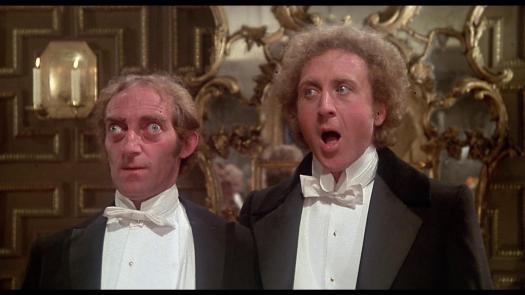
The late Gene Wilder was well loved by filmgoers for his work with Mel Brooks, his movies alongside Richard Pryor, and his iconic role as Willie Wonka. Wilder had co-written the screenplay for Brooks’ YOUNG FRANKENSTEIN, and now branched out on his own as writer/director/star of 1975’s THE ADVENTURE OF SHERLOCK HOLMES’ SMARTER BROTHER.
The zany tale, set in 1891, finds Sherlock’s jealous brother Sigerson (Wilder, who derisively calls his more famous sibling “Sheer-Luck”) assigned to the case of music hall singer Jenny Hill (Madeline Kahn) who’s being blackmailed by opera singer Eduardo Gambetti (the enormously funny Dom DeLuise ). Assisting Sigerson is his own Watson, the pop-eyed Sgt. Orville Stacker (Marty Feldman), blessed with “a photographic sense of hearing” that he can only access by whacking himself upside the head. The plot thickens as Sigerson learns Jenny’s a practiced liar (who only trusts men when she’s sexually aroused), she’s…
Like any newly inaugurated President, Manfred Link (Bob Newhart) faces many new challenges. The biggest challenge, though, is keeping control of his family and his White House staff. His wife (Madeline Kahn) is an alcoholic. His 28 year-old daughter (Gilda Radner) is so desperate to finally lose her virginity that she is constantly trying to sneak out of the White House. General Dumpson (Rip Torn) wants to start a war. Press Secretary Bunthorne (Richard Benjamin), Ambassador Spender (Harvey Korman), and Presidential Assistant Feebleman (Fred Willard) struggle and often fail to convince everyone that all is well.
President Link needs to form an alliance with the African country of Upper Gorm, a country that speaks a language that only one man in America, Prof. Alexaner Grade (Austin Pendleton), can understand. The President of Upper Gorm (John Hancock) orders that the kidnapping of Link’s daughter. Holding her hostage, he demands that Link send him several white Americans so that the citizens of Upper Gorm can know what it is like to have a minority to oppress.
First Family not only featured a cast of comedy all-stars but it was also directed by one of the funniest men in history, Buck Henry. So, why isn’t First Family funnier? There are a few amusing scenes and Newhart can make a pause hilarious but, for the most part, First Family feels like an episode from one of Saturday Night Live‘s lesser seasons. Reportedly, Henry’s first cut of First Family tested badly and Warner Bros. demanded that certain scenes, including the ending, be reshot. Perhaps that explains why First Family feels more like a sitcom than a satire conceived by the man who wrote the script for The Graduate and whose off-center perspective made him one of the most popular hosts during Saturday Night Live‘s first five seasons. Famously, during one SNL hosting gig, Henry’s head was accidentally sliced open by John Belushi’s samurai sword. Without missing a beat, Henry finished up the sketch and performed the rest of the show with a band-aid prominently displayed on his forehead. Unfortunately, there’s little sign of that Buck Henry in First Family.
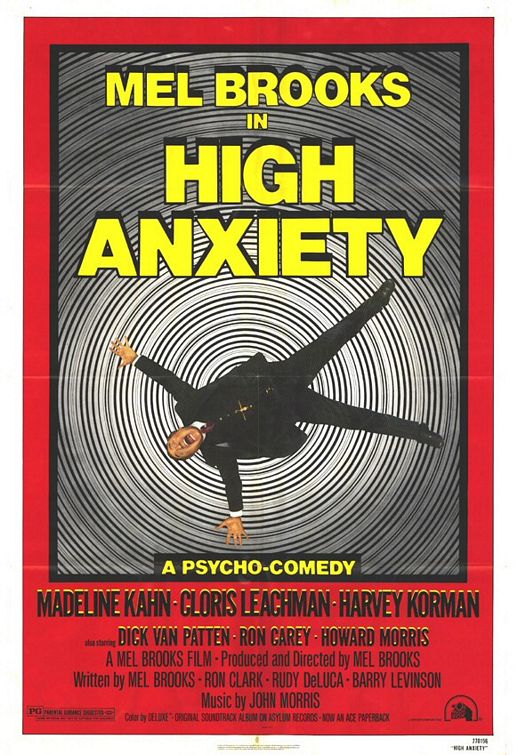
Mel Brooks loves films as much as the rest of us do. After skewering Westerns in BLAZING SADDLES and horror movies in YOUNG FRANKENSTEIN, Mel set his satirical sights on Alfred Hitchcock in HIGH ANXIETY. The result is a film biff’s dream, with the gags coming fast and furious as Mel and his band of merry pranksters pay a loving but hysterical homage to the films of the Master of Suspense.
Mel takes the lead here as Dr. Richard Thorndyke, the new head of the Psycho Neurotic Institute for the Very, Very Nervous. Thorndyke’s aide, the inept Brophy, thinks the former director was “a victim of foul play”. At the Institute, he meets oily Dr. Montague and starched Nurse Diesel, whose S&M/B&D relationship isn’t their only secret. Thorndyke has an ally in his mentor, Prof. Lilloman (say it slowly). The professor works as a consultant, and tries to help Thorndyke conquer his own…
For our latest entry in the 44 Days of Paranoia, we take a look at Oliver Stone’s 1995 presidential biopic, Nixon.
Nixon tells the life story of our 37th President, Richard Nixon. The only President to ever resign in order to avoid being impeached, Nixon remains a controversial figure to this day. As portrayed in this film, Nixon (played by Anthony Hopkins) was an insecure, friendless child who was dominated by his ultra religious mother (Mary Steenburgen) and who lived in the shadow of his charismatic older brother (Tony Goldwyn). After he graduated college, Nixon married Pat (Joan Allen), entered politics, made a name for himself as an anti-communist, and eventually ended up winning the U.S. presidency. The film tells us that, regardless of his success, Nixon remained a paranoid and desperately lonely man who eventually allowed the sycophants on his staff (including James Woods) to break the law in an attempt to destroy enemies both real and imagined. Along the way, Nixon deals with a shady businessman (Larry Hagman), who expects to be rewarded for supporting Nixon’s political career, and has an odd confrontation with a young anti-war protester who has figured out that Nixon doesn’t have half the power that everyone assumes he does.
Considering that his last few films have been W., Wall Street: Money Never Sleeps, and Savages, I think it’s understandable that I’m often stunned to discover that, at one point in the distant past, Oliver Stone actually was a worthwhile director. JFK, for instance, is effective propaganda. Nixon, which feels a lot like an unofficial sequel to JFK, is a much messier film than JFK but — as opposed to something like Savages — it’s still watchable and occasionally even thought-provoking. Thanks to Hopkins’ performance and, it must be admitted, Stone’s surprisingly even-handed approach to the character, Nixon challenges our assumptions about one of the most infamous and villified figures in American history. It forces us to decide for ourselves whether Nixon was a monster or a victim of circumstances that spiraled out of his control. If you need proof of the effectiveness of the film’s approach, just compare Stone’s work on Nixon with his work on his next Presidential biography, the far less effective W.
(I should admit, however, that I’m a political history nerd and therefore, this film was specifically designed to appeal to me. For me, half the fun of Nixon was being able to go, “Oh, that’s supposed to be Nelson Rockefeller!”)
If I had to compare the experience of watching Nixon to anything, I would compare it to taking 10 capsules of Dexedrine and then staying up for five days straight without eating. The film zooms from scene-to-scene, switching film stocks almost at random while jumping in and out of time, and not worrying too much about establishing any sort of narrative consistency. Surprisingly nuanced domestic scenes between Anthony Hopkins and Joan Allen are followed by over-the-top scenes where Bob Hoskins lustily stares at a White House guard or Sam Waterston’s eyes briefly turn completely black as he discusses the existence of evil. When Nixon gives his acceptance speech to the Republican Convention, the Republican delegates are briefly replaced by images of a world on fire. Familiar actors wander through the film, most of them only popping up for a scene or two and then vanishing. The end result is a film that both engages and exhausts the viewer, a hallucinatory journey through Stone’s version of American history.
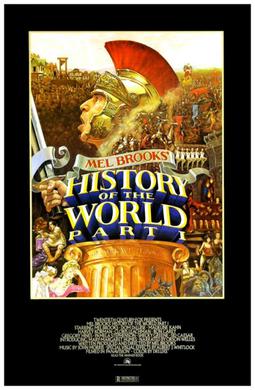 Overlong, wildly uneven, gimmicky too a fault, and often laugh out loud funny with a mix of jokes that range from the crude to the sublimely clever to the surprisingly sentimental, The History of the World, Part I is the ultimate Mel Brooks films.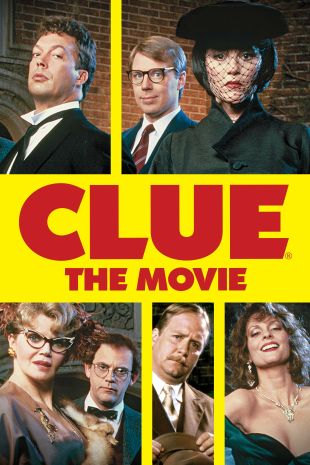


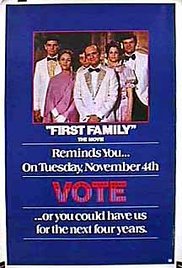 Like any newly inaugurated President, Manfred Link (Bob Newhart) faces many new challenges. The biggest challenge, though, is keeping control of his family and his White House staff. His wife (Madeline Kahn) is an alcoholic. His 28 year-old daughter (Gilda Radner) is so desperate to finally lose her virginity that she is constantly trying to sneak out of the White House. General Dumpson (Rip Torn) wants to start a war. Press Secretary Bunthorne (Richard Benjamin), Ambassador Spender (Harvey Korman), and Presidential Assistant Feebleman (Fred Willard) struggle and often fail to convince everyone that all is well.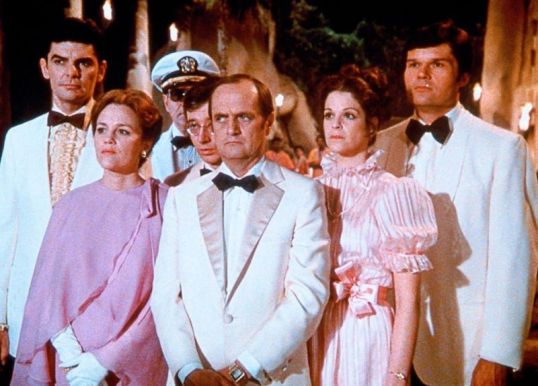

 Through the Shattered Lens