On this date, 116 years ago, Lon Chaney, Jr. was born in Oklahoma City. At the time, Oklahoma wasn’t even a state. His father was the actor Lon Chaney Sr.
Originally named Creighton Chaney, Lon Jr. followed in his father’s footsteps. Like many sons of famous men, he often struggled to escape his father’s shadow. While he would never be mistaken for a man of a thousand faces, Lon Chaney, Jr. did make a name for himself, first as Lenny in the Oscar-nominated 1939 film version of Steinbeck’s Of Mice and Men and then as Larry Talbot, the unfortunate man who found himself cursed to turn into the Wolf Man whenever the moon was full. Chaney spent the majority of his career appearing in horror films and, later, westerns. Not only did he play The Wolf Man but he was also one of the many actors to take a shot at playing both Frankenstein’s Monster and Dracula. Later, he would appear in a series of low budget horror films that were often a far cry from his best-known films. In his later years, he was a favorite of producer/director Stanley Kramer, who cast him in both High Noon and The Defiant Ones and who once said that Chaney was one of the finest character actors in Hollywood. His deep voice and craggily face made an undeniable impression in those later films. Looking at him, you could see had lived a tough life but he had the heart of a survivor.
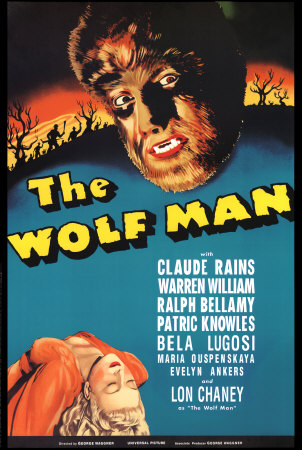
In today’s scene that I love, Larry Talbot learns the facts about being a werewolf. From 1941’s The Wolf Man, here is Lon Chaney, Jr in his signature role.
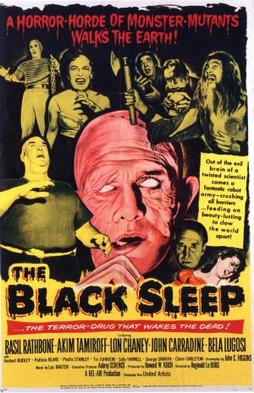
1956’s The Black Sleep opens in a London prison cell. The year is 1872 and Dr. Gordon Ramsay (Herbert Radley) awaits execution. He’s accused of murdering a chef who twice sent rubbery scallops to the pass …. wait, a minute, sorry. Wrong Gordon Ramsay! This Gordon Ramsay is accused of murdering a man named Curry and he’s considerably more whiny than the modern-day Gordon Ramsay.
Ramsay is visited by Sir Joel Cadman (Basil Rathbone) and Cadman’s associate, Odo the Gypsy (Akim Tamiroff). Cadman explains that he has developed a potion called “The Black Sleep.” Drinking it will put the drinker in a state of suspended animation that can pass for death. And, indeed, it will turn into death unless Cadman administers the antidote. Cadman offers to give the potion to Ramsay, in return for Ramsay helping Cadman out with his own experiments. Ramsay agrees.
Ramsay is found “dead” in his cell. His body is claimed by Cadman and Odo. (Odo mentions that, in a past life, he was a grave robber and that he died as a result of the guillotine.) Ramsay is revived and goes to work with Cadman. As soon as Ramsay enters Cadman’s mansion, he finds himself surrounded by several familiar faces. For instance, Lon Chaney, Jr. plays the twisted Mungo, who stumbles through the hallways of the mansion and can only be controlled by Daphnae (Phyllis Stanley). Bela Lugosi plays Casimir, the mute butler. Bohemud (John Carradine) is a bearded man who rants and raves and calls for Biblical vengeance. And finally, in the basement, there’s Mr. Curry (Tor Johnson), the man who Ramsay was convicted of murdering! It turns out that Cadman isn’t quite as benevolent as he presented himself as being.
The Black Sleep may feature an incoherent story but it has a great cast and it is entertaining to see Carradine, Chaney, Tor Johnson, Akim Tamiroff, Bela Lugosi, and Basil Rathbone all living under the same roof and trying to outdo each other as far as the scenery chewing is concerned. Admittedly, some members of the cast look healthier than others. Rathbone is as imperiously dashing as always and John Carradine appears to be having a lot of fun with his role. Akim Tamiroff gets all of the best lines as Odo and he delivers them with just the right amount of wit. Unfortunately, neither Chaney and Lugosi were in good shape when they appeared in this film. Lugosi was ill when he did the film. Chaney, meanwhile, had seen his one-promising career sabotaged by his own alcoholism and, by the time the 50s rolled around, his once handsome features were now ravaged by his drinking. It transformed him from being a somewhat dull leading man to a craggly character actor. (Producer/director Stanley Kramer considered Chaney to be one of the best character actors in Hollywood and cast him in both High Noon and The Defiant Ones.) In The Black Sheep, Chaney’s face is twisted and almost ravaged. It works for the film but it’s still sad to see. As for Tor Johnson …. hey, he’s Tor Johnson. He growls and he tosses things around and he does so convincingly.
(In an interview shortly before his death, Tor said he was offered the role of Oddjob in Goldfinger. It’s sad to think the world was robbed of the Sean Connery/Tor Johnson team-up it needed.)
This was Bela Lugosi’s final film performance before his death in 1956. (The footage that appears in Plan 9 From Outer Space was filmed before The Black Sleep.) It’s a shame that Lugosi wasn’t given more to do in his final film. Lugosi, with that famous voice, ending his career playing a mute just doesn’t seem right.
On this date, 115 years ago, Lon Chaney, Jr. was born in Oklahoma City. At the time, Oklahoma wasn’t even a state. His father was the actor Lon Chaney Sr.
Originally named Creighton Chaney, Lon Jr. followed in his father’s footsteps. Like many sons of famous men, he often struggled to escape his father’s shadow. While he would never be mistaken for a man of a thousand faces, Lon Chaney, Jr. did make a name for himself, first as Lenny in the Oscar-nominated 1939 film version of Steinbeck’s Of Mice and Men and then as Larry Talbot, the unfortunate man who found himself cursed to turn into the Wolf Man whenever the moon was full. Chaney spent the majority of his career appearing in horror films and, later, westerns. Not only did he play The Wolf Man but he was also one of the many actors to take a shot at playing both Frankenstein’s Monster and Dracula. Later, he would appear in a series of low budget horror films that were often a far cry from his best-known films. In his later years, he was a favorite of producer/director Stanley Kramer, who cast him in both High Noon and The Defiant Ones and who once said that Chaney was one of the finest character actors in Hollywood. His deep voice and craggily face made an undeniable impression in those later films. Looking at him, you could see had lived a tough life but he had the heart of a survivor.
In today’s scene that I love, Larry Talbot learns the facts about being a werewolf. From 1941’s The Wolf Man, here is Lon Chaney, Jr in his signature role.
In the 18th century, the inhabitants of Arkham, Massachusetts yank Joseph Curwen (Vincent Price) out of his mansion and tie him to a tree. They accuse Curwen of being a warlock who is in league with the devil and who has been bringing young women to his “palace,” and putting them in a trance. They burn Curwen alive but, before the flames are lit, they also give Curwen a chance to speak and curse both them and their descendants.
You really do have to wonder about the logic behind witch (and warlock) burnings. They seem counter-productive because they always give the accused just enough time to cast one final curse before being burned to a crisp. Indeed, you have to wonder why witches and warlock were allowed any final words to begin with. I mean, at some point, you would think everyone would notice that the final words were always a curse.
Anyway. 110 years later, Joseph Curwen’s descendant, Charles Dexter Ward (Vincent Price, again) rides into town with his wife, Anne (Debra Paget). He is stunned to see that Arkham has apparently fallen on hard times, with many of the town’s people being horribly disfigured. It’s explain to him that the disfigurements and the poverty are all a result of his ancestor’s curse. That’s going to make things a bit awkward, considering that Charles Dexter Ward has not only inherited the Palace but he’s also inherited a copy of Necronomicon and a legacy of messing with Cthulhu. The townspeople don’t want Ward around but he and Anne decide to spend the night in the Place regardless.
Of course, it doesn’t take long for Curwen’s spirit to possess Charles. Soon, Charles is trying to resurrect Curwen’s mistress, Hester (Cathie Merchant) and pursuing Curwen’s goals of breeding a race of super humans by forcing the women of the town to mate with the fearsome Yog-Sothoth. Charles also seeks vengeance on the descendants of those who burned Curwen at the stake, as if all of the poverty and the deformities aren’t punishment enough. Again, this is why you don’t give warlocks and witches a chance to get out one last curse before being executed.
Though The Haunted Palace is usually considered to be a part of Roger Corman’s Edgar Allan Poe cycle, the story itself is actually based on H.P. Lovecraft’s The Case of Charles Dexter Ward. (In Lovecraft’s novella, Ward seeks out his evil ancestor whereas, in the film, Ward is more or less an innocent victim.) The film’s title comes from a Poe poem, which is recited at both the beginning and the end of the film. But the film itself, with its references to the Cthulhu mythos and its hideous New England setting, is definitely a work of Lovecraftian horror.
Fortunately, it’s an effective work of Lovecraftian horror, one that captures the feeling of people unwisely trying to control a force of evil that they cannot begin to comprehend. Roger Corman keeps the action moving quickly and creates a gothic atmosphere of impending doom. Vincent Price, toning down his usual theatrics, is chillingly evil as Curwen and sympathetic as Charles. The film’s strongest performance, however, comes from Debra Paget, who desperately tries to free her husband from Curwen’s control. Any woman who has suddenly felt as if she can no longer recognize the man who she once loved will be able to relate to Paget’s performance.
The Haunted Palace is a strong entry in the films of Roger Corman and Vincent Price and one of the better adaptations of the work of H.P. Lovecraft.
What’s an Insomnia File? You know how some times you just can’t get any sleep and, at about three in the morning, you’ll find yourself watching whatever you can find on cable or streaming? This feature is all about those insomnia-inspired discoveries!
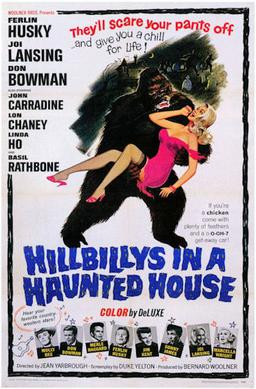
If you were having trouble getting to sleep last night, you could have jumped on Tubi and watched a film from 1967 called Hillbillys In A Haunted House and it would have put you right to sleep.
Hillbillys In A Haunted House has some big names in the cast but, unfortunately, none of them get to do much. Instead, the main characters are country singer Woody Wetherby (Ferlin Husky), his partner Boots Malone (a very pointy Joi Lansing), and their road manager, Jeepers (Don Bowman). When we first see them, they’re driving to Nashville and even worse, they’re singing about the fact that they’re driving to Nashville. They’re scheduled to perform in “the Jamboree.” However, after they’re delayed by a bunch of cops having a shoot out with two spies, Boots announces that Jeepers is a nervous wreck and that they really need to stop and rest for the night.
Unfortunately, they’re in the town of Sleepy Junction and there’s not much to Sleepy Junction because everyone in town recently moved to Acme City. As a result, there are no hotels or motels in Sleepy Junction. But there is a big, deserted mansion that is rumored to be haunted. With a storm approaching and Jeepers’s nerves even more on edge then before, they head to the mansion. At the mansion Woody sings a song and then some neighbors stop by and they all sing another song. Are you getting the feeling that there’s a lot of singing in this movie? You’re right, there is. It’s all studio-perfect singing too. Woody lip-syncs like a pro.
Anyway, the mansion is also being used by four spies, played by Basil Rathbone, John Carradine, a hulking Lon Chaney, Jr., and Linda Ho. The four of them live in the surprisingly clean basement of the mansion. Living with them is a gorilla. The spies planning on stealing a formula for rocket fuel from Acme City but first they need to do something about the hillbillys that are currently in the haunted house. Carradine and Rathbone try to scare them out with some remote control ghost action. Jeepers may be a coward and Woody may be a redneck and Boots may have atrocious taste in clothes but all three of them are Americans and they’re not going to stand for any spy nonsense!
If you think it sounds like this was stupid, you’re right. Carradine and Rathbone both struggle to maintain a straight face. Poor Lon Chaney Jr. often appears to be out of breath. There’s way too much singing. Seriously, couldn’t the hillbillies have just driven another few miles to Acme City and found a hotel?
The film will put you to sleep, though. It has its uses.
As some of our regular readers undoubtedly know, I am involved in a few weekly live tweets on twitter. I host #FridayNightFlix every Friday, I co-host #ScarySocial on Saturday, and I am one of the five hosts of #MondayActionMovie! Every week, we get together. We watch a movie. We tweet our way through it.
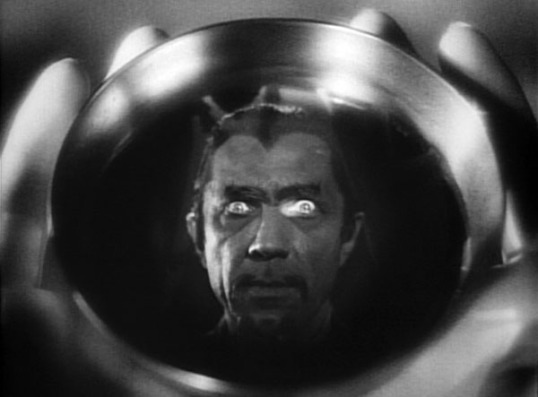
Tonight, we’ve got a special Halloween double feature! First up, we’ve got 1932’s White Zombie, starring Bela Lugosi!
After White Zombie, we will watch 1940’s The Wolf Man, starring Claude Rains, Lon Chaney Jr, and …. Belua Lugosi!
Halloween is always fun at #ScarySocial!
If you want to join us on Saturday night, just hop onto twitter, start White Zombie at 9 pm et, and use the #ScarySocial hashtag! The films are available on Prime! I’ll be there co-hosting and I imagine some other members of the TSL Crew will be there as well. It’s a friendly group and welcoming of newcomers so don’t be shy.
When last we checked in with Kharis the Mummy, he was running into a swamp in Massachusetts, carrying the reincarnation of Princess Ananka with him. Chasing after him were the standard towns people with torches and guns. It’s not a Universal horror film without angry villagers, even if the movie itself is taking place in Mapleton, Massachusetts.
Upon entering the swamp, both Kharis and Ananka sunk under the water, traumatizing Ananka’s boyfriend but apparently bringing Kharis’s reign of terror to an end.
Well, not so fast!
The 1944 film, The Mummy’s Curse, opens with the townspeople talking about how Kharis continues to haunt the old swamp, so much so that most of the locals refuse to work in the swamp. Oddly enough, though, the townspeople are suddenly a mix of Cajuns and gypsies. (The film even opens with a gypsy woman singing a song in a bar.) The swamp has now become a bayou. We are repeatedly told that the film is taking place in the same location as the previous Mummy films but suddenly, that location has changed from Massachusetts to Louisiana.
As for the plot of The Mummy’s Curse, it all centers around the swamp. The Southern Engineering Company (and that really doesn’t sound like a Massachusetts company) is draining the swamp. The locals are worried that draining the swamp will bring back the curse of the mummy. Two representatives from the Scripps Museum show up and announce that they want to search the drained swamp for the remains of the mummies. Dr. James Halsey (Dennis Moore) is typical of the archeologists who tend to show up in these Mummy films. Meanwhile, his associate is Dr. Ilzor Zandeeb (Peter Coe) who — surprise! — is that latest Egyptian high priest to come to America to try to recover the bodies of Kharis and Princess Ananka.
Ananka (Virginia Christie) is the first to emerge from the swamp, though she has no memory of who she is. When she is discovered on the side of the road by Prof. Halsey and his love interest, Betty (Kay Harding), they allow her to stay at their camp on the edge of the swamp. Everyone is really impressed by the fact that this amnesiac knows so much about ancient Egypt. Eventually, Kharis (Lon Chaney, Jr., again tightly wrapped in bandages) eventually emerges from the swamp as well, determined to protect Ananka.
The Mummy’s Curse was the final film to feature Lon Chaney, Jr. as Kharis. Unfortunately, it’s pretty forgettable and certainly not a satisfying conclusion to the story of one of Universal’s original monsters. A good deal of the film’s 60-minute running time is taking up with flashbacks to previous Mummy films and it seems like it takes forever for Kharis to actually get around to spreading the usual mummy mayhem. Though it may be too much to ask for too much continuity from these films, the sudden switch from Massachusetts to Lousiana is distracting for those of us who have actually invested the time to watch the previous Mummy films. One gets the feeling that, by the time this film went into production, no one involved really cared that much about poor Kharis and his never-ending mission to protect his princess.
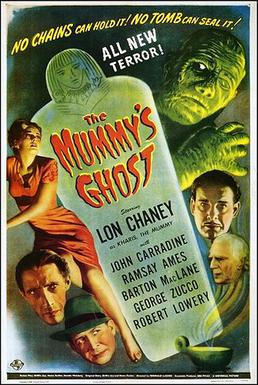
When we last checked in with Kharis the Mummy, he was trapped in the middle of an inferno in Massachusetts. Having come to America to kill the members of the expedition that discovered the Tomb of Ananka and who brought Princess Ananka’s body to the United States, Kharis (Lon Chaney, Jr.) was trapped by the citizens of the town of Mapleton who, in the best tradition of Universal horror, cornered Kharis in a house and then set the place on fire.
1944’s The Mummy’s Ghost begins with the revelation that Kharis did not die in that inferno. Somehow, he managed to escape and, rather improbably, he’s spent the last few years wandering around town without anyone ever noticing him. The film presents Kharis as being largely a nocturnal creature but, even if he is only coming out at night, it still seems strange that no one would notice a mummy wandering around, especially since the entire town was traumatized by Kharis’s previous reign of terror. As well, it’s also been established that Kharis owes his eternal life to an ancient Egyptian plant. One reason why Kharis has always needed a “minder” is because Kharis needed someone who could keep him supplied with the plant. So, if Kharis has been wandering around Massachusetts for the past few years, from where has he been getting the plant?
The Mummy’s Ghost also established that, in Egypt, High Priest Andoheb (Georg Zucco) is still alive. This is somewhat surprising, considering that Andoheb died in both The Mummy’s Hand and The Mummy’s Tomb. But no matter! Andoheb is apparently still alive. He’s really old and his hands shake but he’s still alive and he’s still determined to bring both Kharis and Princess Ananka back to Egypt. This time, he sends Yousef Bey (John Carradine) to Massachusetts.
Yusef Bey takes over managing Kharis and he’s even able to supply Kharis with more of the special plant the keeps him alive. However, Kharis grows upset when it discovers that Bey has tracked down the reincarnation of Ananka in the person of Amina (Ramsay Ames) and that, rather than return her safely to Egypt, Bey wants to give her eternal life with the help of the plant and then marry her. This leads to Kharis going on a rampage and carrying Amina into a nearby swamp while Amina’s boyfriend, Tom Hervey (Robert Lowery), chases after them.
Full of plot holes and inconsistencies, The Mummy’s Ghost is about as silly as a mummy film can be. If the previous films about Kharis managed to create a feeling of tragic inevitability as Kharis tracked down all of the people who had entered Ananka’s tomb, The Mummy’s Ghost presents Kharis as being something more akin to Frankenstein’s Monster, an inarticulate and easily frustrated creature who does things with little rhyme or reason. That said, the film does make good use of Lon Chaney Jr’s hulking physicality as Kharis. He’s still an intimidating figure when he goes after someone. And John Carradine’s pained expression as Yousef Bey is memorable as a reminder of how much Carradine disliked most of the Universal monster films in which he found himself. Otherwise, The Mummy’s Ghost is fairly forgettable.
1942’s The Mummy’s Tomb picks up 30 years after the end of The Mummy’s Hand.
Archeologist Steve Banning (Dick Foran) is now living a peaceful life in the small town of Mapleton, Massachusetts. As the film opens, he is telling his guests about the time that he and his friend, Babe Hanson (Wallace Ford), went to Egypt and discovered the tomb of an Egyptian princess. He tells them how Andoheb (George Zucco) tried to use the ancient mummy, Kharis, to protect the tomb. Steve assures everyone that Andoheb is now dead and Kharis is no longer a threat to anyone.
The film then travels to Egypt where we discover that Steve was not quite correct. Adoheb survived being shot at the end of The Mummy’s Hand. He’s now an old man, dying but still obsessed with getting revenge. He instructs his disciple, Mehemet Bey (Turhan Bey), to travel to America with Kharis (now played, under a bunch of bandages, by Lon Chaney, Jr.) and to get revenge on the remaining members of the Banning expedition.
Bey and Kharis travel to Massachusetts and soon, the entire town of Mapleton is gripped in fear as Kharis starts to murder people. Steve Banning is the first victim. Then Steve’s sister, Jane (Mary Gordon). Kharis even kills Babe Hanson, whose role in the previous film was largely comic relief. Seriously, not even Frankenstein’s Monster killed the comic relief. Kharis is a ruthless and unstoppable killer and, in a performance that is totally focused on his hulking physicality, Lon Chaney, Jr. makes for a frightening mummy. Kharis moves slowly, dragging one foot behind him. But when he does attack, he’s relentless. This movie reminded me of why the mummy has, to me, always been the scariest of the old Universal monsters.
Despite the fact that Kharis is leaving bandages and ancient mold all over the place, the authorities are not quite convinced that an ancient mummy has come to their small town. However, the townspeople have no doubt what’s happening and, since this is a Universal film, they are soon running around with torches and pitchforks. Meanwhile, Steve’s son, John (John Hubbard), tries to figure out how to destroy the mummy and how to protect his fiancée, Isobel (Elyse Knox). Bey has decided that he’s in love with Isobel and he orders Kharis to bring her to him. Even under all the bandages, Kharis’s facial expression still suggests that he knows this isn’t a good idea.
The Mummy’s Tomb suffers from the same problem that afflicted The Mummy’s Hand. It feels like it takes forever to actually get to the good stuff. This is only a 60-minute film and ten of those minutes is taken up with a flashback to The Mummy’s Hand. But no matter! Once Kharis arrives in America, the pace of the film picks up and it becomes an effective little horror film. Lon Chaney, Jr. is frightening Kharis. I wouldn’t want him following me down a dark alley!
When last we saw Dracula, the Wolf Man, and Frankenstein’s Monster, they were all coming to an untimely end in House of Frankenstein.
Dracula (John Carradine) was caught out in the sun by a group of angry villagers and ended up turning back into a skeleton while desperately trying to climb into his coffin. The Wolf Man, also known as Larry Talbot (Lon Chaney, Jr.), was shot, presumably with a silver bullet, and finally, the world was free of having to listen to Larry whine about his unfortunate condition. The Monster (Glenn Strange) was last seen drowning in quicksand.
Despite all of that, all three of them return in 1945’s House of Dracula. The Monster is at least found in an underground lair, preserved in a state of suspended animation by the quicksand. Dracula and Larry Talbot, however, just show up with neither looking the worst for wear. I supposed that Larry could have survived being shot but Dracula’s return is bizarre because he was literally exposed to sunlight. In the past, reviving Dracula has always required the stake to be removed from his heart. Did someone remove the sunlight from Dracula’s skeleton?
All three of the cursed beings show up at the castle of Dr. Franz Edelmann (Onslow Stevens). Working with two nurses, the beautiful and religious Milizia (Martha O’Driscoll) and a compassionate hunchback named Nina (Janes Adams), Edlemann is researching blood transfusions. He believes that blood transfusions can cure just about anything. Edelmann is so convinced that he can cure Dracula of his vampirism that he allows Dracula to move his coffin into the castle’s cellar. Edelmann is also convinced that he use the spores of a special plant to cure Larry of his lyncanthropy. As usual, Larry Talbot is skeptical and spends the entire movie boring everyone with the details of how much it sucks to be a werewolf. As for Frankenstein’s Monster, he’s in the castle because Edelmann happend to come across him in an underground chamber. Quite a coincidence, that.
Unfortunately, all of the blood transfusions in the world can’t stop Dracula from being Dracula and soon, the Lord of the Vampires is trying to turn Milizia into his queen. Larry is also in love with Milizia, to the extent that he doesn’t realize that Nina is falling in love with him. Meanwhile, Edelman ends up infecting himself with some of Dracula’s blood and soon, his reflection is no longer showing up in mirrors and he’s feeling the temptation to revive Frankenstein’s Monster. A violent murder upsets the villagers, who refuse to listen to Inspect Holz (Lionel Atwill) when he begs them to let the police take care of things as opposed to laying siege on the castle with a bunch of torches. That’s what happens when you allow your house to become the House of Dracula.
House of Dracula is a clear and marked improvement on House of Frankenstein. While Larry Talbot is just as whiny as ever (and Lon Chaney, Jr.’s sad sack performance is a bit dull) and Frankenstein’s Monster is a bit underused, John Carradine makes for a perfect Dracula, mixing old world charm with cunning cruelty. Director Erle C. Kenton directs the film as if it were a film noir, filling the castle with ominous shadows and giving us a cast of morally conflicted characters. Though I think most modern viewers are a bit too jaded to be truly scared by the old horror films, the scene where Edelmann watches as his reflection disappears from the mirror is effectively creepy. I can only imagine how audiences in 1945 reacted to it.
When first released, House of Dracula was not a hit and, as a result it was one of the final “serious” films to feature the Universal monsters. (Chaney and Strange would reprise their signature roles in a few comedies while Carradine would play Dracula in several other non-Universal productions.) Seen today, it seems like the perfect final chapter for the monsters that, for 20 years, defined Universal.




 Through the Shattered Lens