Film Review: The Caine Mutiny Court-Martial (dir by William Friedkin)


The Caine Mutiny Court-Martial is a film that I wanted to like more than I actually did.

The movie, which is based on a play by Herman Wouk (which was itself based on a novel by Wouk that was adapted into an Oscar-nominated film in 1954), takes place in a Naval courtroom.  Lt. Steven Maryk (Jake Lacey) is on trial, accused of mutiny against his commanding officer.  Maryk claims that, when the ship sailed into a storm, his commanding officer, Philip Francis Queeg (Kiefer Sutherland), was giving orderss that put the entire ship at risk.  With the support of the officers, Maryk relieved Queeg of command.  Maryk claims that he did so with the knowledge that it would lead to him being court-martialed.

Maryk is assigned Lt. Greenwald (Jason Clarke) as his defense counsel.  Greenwald is not happy with his assignment because he think that Maryk is guilty and he believes in the chain of command.  When Maryk and his fellow officers claim that Queeg was showing signs of mental instability, Greenwald wonders how they came to that conclusion.  Whereas Maryk and his fellow officers, including Keith (Tom Riley) and Keefer (Lewis Pullman), claim that Queeg was dangerously unstable, Greenwald sees an insecure commander who was abandoned by his men.  Greenwald comes to realize that keeping Maryk out of the brig will mean destroying Queeg on the stand.

As I said, I wanted to like this film more than I actually did.  The Caine Mutiny Court-Martial was the final film to be directed by William Friedkin.  Friedkin started his career by directing adaptations of plays like The Birthday Party and The Boys In The Band, so another theatrical adaptation does feel like an appropriate bookend for a legendary career.  Friedkin’s best films featured troubled and somewhat obsessive individuals, people who are almost addicted to taking risks.  That’s certainly an accurate description of several of the characters in The Caine Mutiny Court-Martial, from Queeg to Keefer to even Greenwald himself.  After Friedkin passed away in August, I found myself really hoping that The Caine Mutiny Court-Martial would be one final brilliant Friedkin film.

There’s a lot of good things to be said about The Caine Mutiny Court-Martial, including the fact that Jason Clarke is well-cast as Lt. Greenwald.  But, in the end, The Caine Mutiny Court-Martial is essentially a filmed play and, despite a camera that moves frequently, it all feels rather stagey and, at a time, a bit too theatrical.  As good as Clarke is, some other members of the cast can’t break free of the film’s staginess and their performances often feel disappointingly superficial.  This is especially true of Monica Raymund as the prosecutor and, surprisingly, Kiefer Sutherland as Queeg.  Sutherland, who, when he was younger, would have been the ideal pick for the role of Lt. Keefer, gives an overly mannered performance as Queeg, one that is all tics and nerves but with little of the vulnerability that Humphrey Bogart brought to the role in the 1954 film.

Friedkin’s The Caine Mutiny Court-Martial takes place in 2022, as opposed to the World War II setting of Wouk’s original novel.  This does lead to an interesting subtext, as Friedkin’s version of the story is set during a time when many people are no longer confident in America’s military leadership.  (Wouk’s novel and play came out while America was still feeling confident after the victory of the Allies in World War II.)  Friedkin takes a direct approach to the material, allowing the audience to decide for themselves whether Maryk did the right thing.

It’s a solid enough film but one that never quite escapes its stage origins.  Friedkin’s respect for the material comes through, even if the film isn’t totally successful.
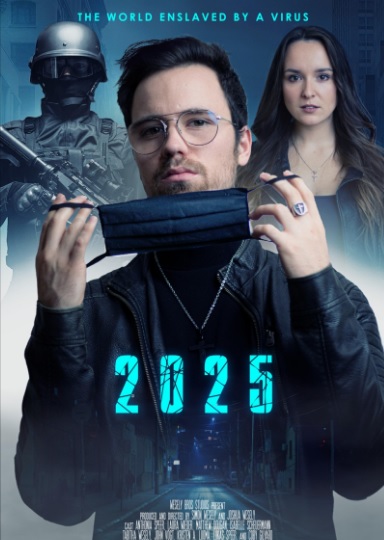
October Positivity: 2025 — The World Enslaved By A Virus (dir by Joshua Wesley and Simon Wesley)


The 2021 film, 2025 — The World Enslaved By A Virus, opens with a series of title cards.

We learn that the Coronavirus has raged out of control.

We learn that fear of the virus led to the creation of a one world government.

We learn that “communism is everywhere.”

We also learn that English is now the official language of the world.  (Yay!  Take that, French!)

Finally, we learn that Christianity has been outlawed.

It’s a scary world, one in which everyone is enslaved by the fear of the virus.  It’s a world where free thought is no longer allowed.  It’s a world where everyone is expected to pledge allegiance to the “new Constitution.”  It’s a world where former friends rat each other out to the authorities and privacy is a thing of the past.

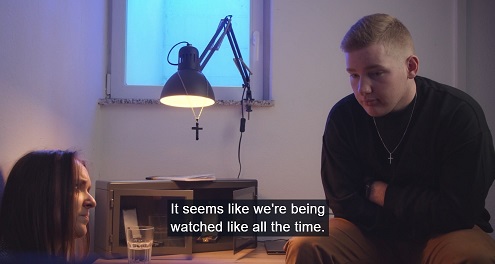
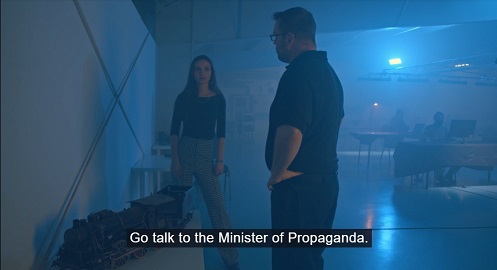
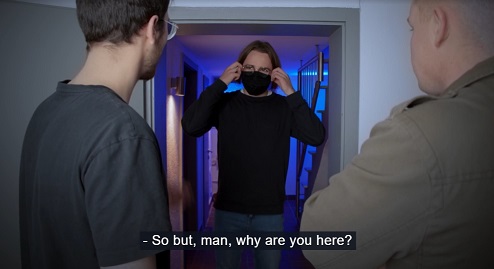
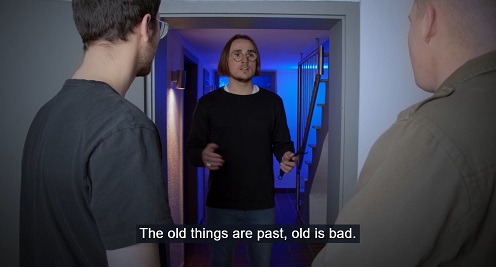
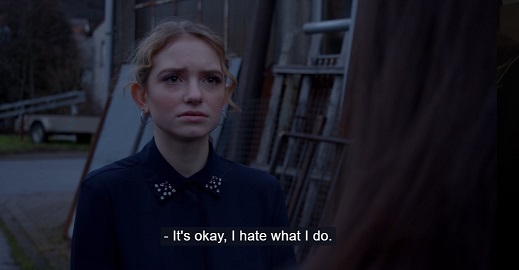
As you can probably guess from screenshot above, 2025 is not a particularly expensive-looking film.  This is the end of the world on a budget and one gets the feeling that the majority of that budget went to filming a fairly decent shoot out and car chase that occurs towards the end of the film.  As a result, this is one of those films where our characters spend a lot of time sitting in their apartment and talking about what’s going on in the world and how they feel about it.  We hear about what happens but we rarely get to see it.  Watching the film, one gets the feeling that many of the conversations were improvised, which means that there’s a lot of awkward pauses and meandering sentences.  On the one hand, that doesn’t make for a particularly compelling narrative.  On the other hand, it does capture the feelings of isolation and ennui that haunted many people during the Coronavirus lockdowns.

The film follows a group of Christians as they try to fight back against the one world government.  It starts with them spray painting Jesus fish onto walls and sidewalks.  (One of the sidewalks that they use as a canvas is covered by leaves so you can’t help but feel that one strong gust wind is going to totally destroy all of their work.)  Eventually, a hacker shows up at their apartment and helps them get their message out.  Christians start to meet in secret and our main character (played by one of the film’s two directors, Joshua Wesley) gives a variation of Mel Gibson’s Braveheart speech.

While the Christians are doing that, the government is plotting how to get more people to swear allegiance to the “New Constitution.”  Again, since this is the end of the world on a budget, the government is represented by one small office and a handful men wearing tactical vests.  They’re not extremely intimidating but, just as with the film’s sense of isolation, their incompetence tends to mirror the incompetence of the actual authorities during the lockdowns.

Eventually, even the Christians’s wussy neighbor is showing up at their door and telling them that they need to stop what they’re doing before they make everyone’s life difficult.  They need to accept the new world order.

2025 is indeed a bad movie.  The pace is slow.  The acting is terrible.  The dialogue is risible.  The film has been developing a reputation for being one of the worst ever made and there’s certainly a case to be made.  That said, much like Plan 9 From Outer Space, 2025 has worth as a historical document.  Setting aside the religious aspect of 2025,the film does definitely capture the paranoia that people were feeling during the lockdowns.  Some people were paranoid about the virus and other were paranoid about the government but the important thing is that, in the end, everyone was paranoid.  With all the gaslighting that’s going on from people who desperately want us to believe that the lockdowns actually weren’t as big or traumatic a thing as we all know they were, a film like 2025 serves as a useful historical document.  It’s a recording of the way many people felt about the world just two years ago.

Of course, that doesn’t actually make it a good film.  You can’t have everything.

Late Night Retro Television Reviews: Gun 1.5 “The Hole”


Welcome to Late Night Retro Television Reviews, a feature where we review some of our favorite and least favorite shows of the past!  On Tuesdays, I will be reviewing Gun, an anthology series that ran on ABC for six week in 1997.  The entire show is currently streaming on Tubi!

This week, the gun ends up at the bottom of a swimmin’ hole!

Episode 1.5 “The Hole”

(Dir by Ted Demme, originally aired on May 24th, 1997)

Yep, this episode of Gun centers around an old country swimming hole.  Every day, teenage Sondra (Kirsten Dunst) and her younger brothers, Brendan (Drake Bell) and Tad (Joe Pichler), head down to the Hole.  For Sondra, swimming in the Hole is a chance to escape from her life of living in a trailer park with her trashy mother (Carrie Fisher) and her pervy stepfather (Cliff Bemis).  For Brendan and Tad, going to the Hole is a chance to look for the treasure that they are convinced is at the bottom of the water.  It is true that there is something shiny in the Hole.  Sondra thinks that it might be the diamonds that she could use to finance an escape from the trailer park and a one-way trip down to Florida.  Actually, it’s the pearl-handled gun that’s been at the center of every episode of Gun.

(In this episode, it’s suggested that the gun has been at the bottom of the hole for over a year.  So, how did it end up in that town in the first place?  Is this episode taking place before or after the previous episodes?  I guess the simple solution is that it’s not the same gun as the gun seen in the previous episodes but the part of me that loves continuity is having a hard time accepting that.)

The gun belonged to James Munday (Johnny Whitworth), who has only recently been released from prison.  He was convicted of murdering his girlfriend and only the fact that he was a minor at the time kept him from being given a life sentence.  James claims that his girlfriend died as a part of a failed suicide pact and he’s convinced that the gun in the Hole can prove his innocence.

When James and Sondra meet, it doesn’t take long for them to fall for each other.  Sondra remains James of his dead girlfriend and Sondra, like of all of us, is attracted to brooding rebels.  However, when the rest of the town hears that James has been going to the Hole, a lynch mob is formed.  Dick Sproule (Max Gail), the father of the girl that James was convicted of killing, is soon at the Hole with a rifle in his hands.  Can James prove his innocence and will the town even care?

This episode was extremely overwrought and it featured every flaw that tends to turn me off of anthology shows in general.  All of the characters were broadly drawn.  The dialogue was way overwritten.  Director Ted Demme told the story with a heavy-hand and used slow motion as if he was under the impression that he was the first director to ever consider heightening the drama by slowing things down.  The whole thing just felt like a bad creative writing assignment.  Out of the cast, only Kirsten Dunst was able to really create a character who felt as if she had a life outside of the demands of the story.  Everyone else seemed to be a caricature.  In the end, James may have been a hot, brooding rebel but he was also kind of whiny.  That got old pretty quickly.

*Sigh*  Well, that’s another disappointing episode of Gun for you!  Next week, I’ll be reviewing the series finale.  Hopefully, this show will at least end on a worthwhile note.

Horror AMV of the Day: This Is Halloween (Various)


I hope you’ve had a great Halloween and a great October!  How about one final amv for this year’s Horrorthon?

Song: This Is Halloween by Real Chantay

Anime: Cube x Curious x Cursed, Higurashi no naku koro ni, Shiki

Creator: Nightmare Nyu

Past AMVs of the Day

Horror on TV: The Curse of Degrassi (dir by Stefan Brogren)


This is a special episode of my favorite TV show of all, Degrassi!  Originally airing on October 28th, 2008, The Curse of Degrassi features Degrassi’s main mean girl, Holy J Sinclair (Charlotte Arnold), getting possessed by the vengeful spirit of deceased school shooter, Rick Murray (Ephraim Ellis).  Chaos follows!  Fortunately, Spinner (Shane Kippel) is around to save the day.  As any true Degrassi fan can tell you, only Spinner has a chance against the forces of the undead.

What I like about this episode is that, in the best tradition of Degrassi, it goes there.  Holly J does get possessed.  Just about the entire cast end up dying horribly.  Spinner has to battle the undead spirit of Rick Murray and he has to do it without the help of Drake.  And, as far as we know, this episode is canon.  So, yes, Rick Murray’s ghost actually does haunt Degrassi Community School and yes, only Spinner can save us all.

Go Spinner!

Enjoy!

Horror on TV: The Hitchhiker 6.20 “New Blood” (dir by Joel Farges)


Tonight, on the final episode of The Hitchhiker, Rae Dawn Chong plays an aspiring actress who wants to join the hottest theatrical troupe.  Unfortunately, there’s a price for everything and sometimes, that price is your soul!

This episode originally aired on February 22nd, 1991.

Horror Film Review: Magic (dir by Richard Attenborough)


There have been many disturbing ventriloquist’s dummies over the years but I don’t know if there’s ever been one who is quite as hateful as Fats, the dummy that is used by Corky Withers (Anthony Hopkins).

Corky and Fats are at the center of the 1978 film, Magic.  When we first meet Corky, he’s an aspiring magician without a dummy.  He’s a talented magician and it’s obvious that performing is one of the only things that brings Corky happiness.  But, from the start, there’s something off about Corky.  There’s a desperation to him and his performance.  He craves the applause of the audience just a bit too much, as if he doesn’t know who he is unless people are clapping for him.  (This performance, from a youngish Anthony Hopkins, is quite a contrast to the characters that Hopkins is today known for playing.)  Corky is told that he needs to get a “gimmick” if he’s ever going to be a success and that gimmick turns out to be Fats, a ventriloquist dummy who is as confident as Corky is insecure.  Whereas Corky often seems to be struggling to find the right thing to say, Fats always has the perfect comeback ready.

Of course, Fats is Corky.  Fats is the self-absorbed and cocky “person” that Corky wishes he could be.  When Fats tells Corky that he’s a useless loser, it’s actually Corky saying that to himself.  When Corky argues with Fats, he’s arguing with himself.  With Fats, Corky has found a way to express himself but he’s also sacrificed half of his identity as a result.  Can Corky survive without Fats?  He’s not sure but he does know that Fats is a hit with audiences.

When Corky’s agent (Burgess Meredith) announces that he has gotten Corky a network television special, Corky panics.  Corky doesn’t want to take the medical or mental exams that the network would probably require before giving him a contract.  He flees to the Catskills, where he grew up.  (Corky’s obsession with performing makes sense when one realizes that he grew up in the Catskills, a region that played home to many aspiring comedians.)

Corky visits Peggy Ann Snow (Ann-Margaret), with whom Corky went to high school and who he had a huge crush on.  (Imagining Anthony Hopkins in high school — especially an American high school — is not particularly easy.)  Peggy is unhappily married to Duke (Ed Lauter) and she soon finds herself falling in love with Corky.  Corky appears to finally have a chance for happiness but Fats has other plans.  Murder follows and it says something about how well this film is done that we think of Fats as being the mastermind behind the murders even though we know that Fats is really just Corky talking to himself.

Magic is the definitive evil ventriloquist’s dummy film, one that is beautifully shot by Richard Attenborough and which features a great performance from Anthony Hopkins.  It’s a sign of the strength of his performance that we still feel sorry for Corky, even though he ends up killing one of the most likable characters in the film.  Of course, it’s a dual performance for Hopkins because he’s playing both Corky and Fats.  He is excellent and frightening in both roles.

Vincent Price Recites The Tell-Tale Heart!


Earlier today, I featured Christopher Lee reading The Fall of the House of Usher.

Here to continue to spread the Halloween spirit is Vincent Price, performing The Tell-Tale Heart.  This is from 1970 and was a part of a PBS special called An Evening With Edgar Allan Poe.

Horror Film Review: Look Away (dir by Assaf Bernstein)


Poor Maria (India Eisley)!

Maria is a 17 year-old high school student in Canada.  She goes to a school where everyone wears a uniform, everyone plays hockey, and everyone is looking forward to a prom that is going to be held on an ice skating rink!  (Personal injury attorneys love this school!)  Everyone is obsessed with living on the ice but Maria can’t even skate.  Popular hockey player Mark (John C. MacDonald) taunts Maria for not being able to maintain her balance.  Her best friend, Lily (Penelope Mitchell) offers to teach Maria how to skate but Lily turns out to be a cruel and taunting teacher, probably because she knows that Maria has a crush on her boyfriend, Sean (Harrison Gilbertson).

Maria’s life at home isn’t any better.  Her mother, Amy (Mira Sorvino), is suffering from crippling depression and often can’t even be bothered to get out of bed or off the couch.  Her father, Dan (Jason Isaacs), is a plastic surgeon who is obsessed with the idea that he can fix any flaw through surgery.  He’s the type who cruelly critiques his daughter’s looks, despite the fact that Maria is actually a very pretty girl whenever she can find the courage to actually look up from the floor.  Dan is also cheating on his wife.  Perhaps the only good thing that Dan does is that he encourages Maria to stay home from school, though his reasoning is that she doesn’t look good on that particular day and she needs to get her “beauty sleep.”

Seriously, watching this movie, your heart truly breaks for Maria.  It’s as if the whole world has been against her since the day she was born.  Everyone gives Maria a hard time for not having more confidence but how can someone be confident when all they hear is about how much of a disappointment they are?  Maria’s only friend is her reflection in the mirror.

At first, Maria freaks out when her reflection starts talking back to her.  Airam, as Maria’s reflection calls herself, may look like Maria but she initially seems to have a totally different personality.  Airam is confident in both her appearance and her sexuality.  Airam is willing to strike back at the people that have hurt her.  Airam is confident where Maria is insecure.  When Maria talks to Airam, she ends up laughing so loudly that Amy actually comes into the bathroom and asks if Maria is smoking weed.  After Maria is cruelly humiliated at prom, Maria agrees to switch places with Airam by kissing the mirror.  Suddenly, Maria is the one in the mirror and Airam is the one who is in the real world, looking for revenge against everyone who has hurt Maria.

Or is she?  Watching the film, I found myself wondering if Maria was just imagining talking to her reflection and perhaps “the switch” was all in Maria’s mind.  Perhaps Airam isn’t some malevolent force that’s brought into the world as much as she’s just Maria having been pushed too far by the cruel taunts of her classmates and her father’s refusal to show her the consideration that he shows to his mistress.  Airam is soon doing everything that Maria wishes she could do but when people start dying, Maria begs Airam to stop.  Is Maria really trapped in the mirror and begging Airam to stop or is she just imagining a conversation with her own conscience?  India Eisley’s performance keeps you guessing.

This is an intriguing film, even if is sometimes a bit too ambiguous for its own good.  (The final shot is artfully done but it still made me want to throw something at the TV.)  The film’s greatest asset is India Eisley, who is convincing whether she’s the mousy Maria or the bold Airam.  Jason Isaacs, as well, gives a strong performance, turning his plastic surgeon into one of the all-time bad fathers.  Watching Isaacs’s performance as Dan, it’s hard not to understand why Dan’s daughter would want to hide in a mirror.

Retro Television Reviews: Fantasy Island 3.21 “Jungle Man/Mary Ann and Miss Sophisticate”


Welcome to Retro Television Reviews, a feature where we review some of our favorite and least favorite shows of the past!  On Tuesdays, I will be reviewing the original Fantasy Island, which ran on ABC from 1977 to 1986.  Almost entire show is currently streaming is on Youtube!

This week, Fantasy Island is invaded by jungle men and ventriloquists!

Episode 3.21 “Jungle Man/Mary Ann and Miss Sophisticate”

(Dir by Michael Vejar, originally aired on March 8th, 1980)

For years, David Farley (Dennis Cole) starred as Jungle Man on television.  When the show was canceled, David made a living by doing public appearances as Jungle Man but then the producers of the show filed a lawsuit.  As a result, David is no longer allowed to ever dress up in a loin cloth.  David comes to Fantasy Island, hoping for one last chance to be Jungle Man.

(This fantasy, by the way, had its roots in what happened to the original Lone Ranger, Clayton Moore.  Moore was told that he could no longer wear the mask in public because a new Lone Ranger movie was coming out.  The producers also took Moore to court.  Moore reacts by ditching the mask and wearing wrap-around sunglasses instead.)

Mr. Roarke explains to David that his fantasy will make Jungle Man a reality.  There will be no stunt doubles and the bad guys might not be as easy to defeat as on television.  David says he doesn’t care.  He finds himself again in the jungle, transformed into Jungle Man!  He also discovers that all of his friends are upset with him because they haven’t seen him for two years.  They think that Jungle Man just abandoned them and, of course, Jungle Man can’t explain that the show was canceled.

In Jungle Man’s absence, Queen Mara (France Nuyen) has agreed to surrender the jungle to the evil hunter, Derrick Haskell (Dick Butkus, who between Half-Nelson, Hang Time, and this show, is becoming a bit of a regular on this site).  Can Jungle Man prevent Mara from signing over her land?  And can he save Rima (Barbara Luna), the woman he loves?  And, even more importantly, can he convince Roarke to to let him live forever in the jungle?

Of course, he can.  This was a bit of silly fantasy but it still worked because of how earnest Dennis Cole was in the role of Jungle Man.  Plus, I enjoyed that life in the jungle had continued even after the Jungle Man television show was canceled.  It captured the way that a lot of us feel when our favorite TV show is cancelled and we wonder what happened to all the characters after the finale.

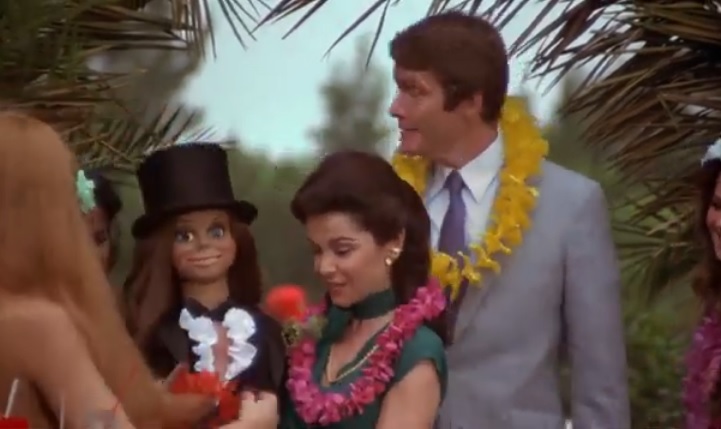
The other fantasy was …. well, it was weird and creepy and surprisingly dark.  Annette Funicello played Mary Ann Carlin (Annette Funicello), a world famous ventriloquist.  Mary Ann is worried that she can no longer tell where her personality ends and where the personality of her dummy, Valerie, begins.  Is there anything creepier than a ventriloquist with a personality conflict?

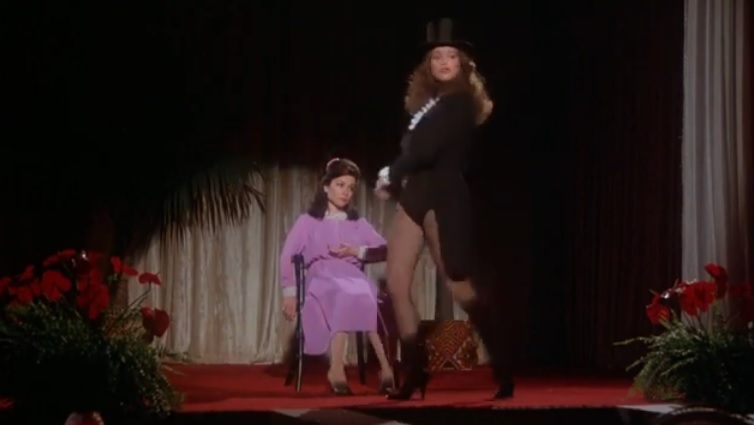
Mary Ann’s fantasy is to separate her personality from Valerie’s for a weekend so that she can decide what to do with her career.  (This sounds like something that would be better handled by a therapist than a resort owner but whatever.)  Mr. Roarke’s solution is to turn Valerie into a living human being.  Unfortunately, it turns out that Valerie has a man streak and she not only seduces Mary Ann’s boyfriend (Don Galloway) but she also gives a surreal performance in which, somehow, Mary Ann is transformed into the dummy.

Fortunately for Mary Ann. everything works out.  She finally snaps out of whatever spell she was under and she tossed Valerie, who is now suddenly a doll once again, in a fire.  Mary Ann and her boyfriend leave the Island, planning on getting married and settling down.  Apparently, Mary Ann doesn’t have a problem with the fact that her boyfriend had sex with a ventriloquist’s dummy but I still imagine that it’s something she’ll bring up whenever they have a disagreement about something.  “You think I’m spending too much money!?  Remember that time you screwed a block of wood?”

It really doesn’t make much sense at all but it’s so surreal and weird that it’s fun to watch.  This fantasy was the Island at its most nightmarish and certainly, that makes it an appropriate fantasy to close out October with!