Welcome to Retro Television Reviews, a feature where we review some of our favorite and least favorite shows of the past! On Wednesdays, I will be reviewing the original Love Boat, which aired on ABC from 1977 to 1986! The series can be streamed on Paramount Plus!
This week, season 5 comes to a close!
Episode 5.29 “Mothers Don’t Do That/Marrying for Money/Substitute Lover”
(Dir by Jerome Courtland, originally aired on May 15th, 1982)
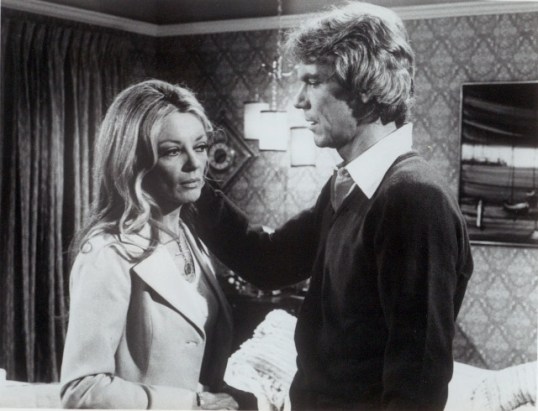
Glamorous Marian Healy (Eva Gabor) boards the boat and is reunited with the son that she barely knows, Danny (Brad Savage). Danny, however, reads Marian’s diary and declares, “Mother don’t do that!” Hey, you little brat, how do you think you came into existence?
Meanwhile, yet another old high friend of Julie’s board the boat and proceeds to lie to a passenger. It seems like this happened every week. This time, it’s Bert (Eddie Mekka) who pretends to be the pen pal of Marla Bennett (Audrey Landers). Don’t worry, Marla forgives Bert when she learns the truth. If there’s anything I’ve learned from watching The Love Boat, it’s that romantic relationships that start off with some horrible lie always work out for the best.
Finally, Gopher and Isaac are worried that Lola Trout (Caren Kaye) is trying to kill her new husband, Orville (Arte Johnson), by forcing him to exercise. They can’t think of any other reason why Lola would marry Arte, other than to murder him and take his money. If they spent more time watching Fantasy Island, they would know that there are simpler ways to kill your husband than by making him exercise. You could challenge him to a pentathlon for instance….
This was the final episode of the fifth season and everyone seemed to be a little bit tired. None of the three stories is particularly developed and you can really tell that everyone’s eager to get off the boat and spend some time on dry land. That’s fine. Season 5 was a pretty good season, even with that terrible musical episode. Everyone deserves a break and if that means the finale is a bit underwhelming, so be it!
Next week, we start Season 6! I have a feeling I will never finish reviewing this series and that’s okay. The Love Boat is a show that I could happily watch forever!
4 Shots From 4 Films is just what it says it is, 4 shots from 4 of our favorite films. As opposed to the reviews and recaps that we usually post, 4 Shots From 4 Films lets the visuals do the talking!
Today is Dinosaur Day and you know what that means! It’s time for….
4 Shots From 4 Dinosaur Films
The Ghost of Slumber Mountain (1918, dir by Willis O’Brien, DP: Willis O’Brien)
One Million Years B.C. (1966, dir by Don Chaffey, DP: Wilkie Cooper)
Planet of the Dinosaurs (1978, dir by James Shea, DP: Henning Schellerup)
Carnosaur (1993, dir by Adam Simon, DP: Keith Holland)
Welcome to Late Night Retro Television Reviews, a feature where we review some of our favorite and least favorite shows of the past! On Tuesdays, I will be reviewing Pacific Blue, a cop show that aired from 1996 to 2000 on the USA Network! It’s currently streaming everywhere, though I’m watching it on Tubi.
This week, the bike patrol’s stupidity and worthlessness puts everyone at risk. What are they thinking!?
Episode 2.5 “Point Blank”
(Dir by Michael Levine, originally aired on September 21st, 1996)
A report comes in about an armed robbery so TC and Chris speed off on their bicycles to catch the guy …. *snicker*
I’m sorry, I need a minute to stop laughing.
Anyway, TC gets knocked off of his bike by the robber, who proceeds to steal TC’s gun. Oh my God, TC’s such a dumbass! The real cops show up in their cars and Chris is all like, “Go get the robber while I tend to my fallen colleague and his totally rocking bicycle.” Seriously, Chris is kind of rude about it, frantically motioning at them to go after the robber. What else do you think they were going to do, Chris?
While TC searches for his gun, Chris discovers that someone has signed her up for a video dating service. Chris, who is always complaining about how she can’t get a date, complains about having too many dates. Then she complains that none of her dates work out, largely because of her whiny and abrasive personality.
Meanwhile, a little kid has lost his dog. Del Toro and Cory suspect that the pet has been kidnapped and sold to a research lab. They go from one sleazy kennel to another, searching for the dog. They take the kid with them and probably traumatize him for life. The good thing is that they save the dog and break up the dognapping ring. The bad thing is that their story and likable chemistry still has to share the screen with Chris whining and TC searching for his lost gun.
TC’s gun eventually lands in the hands of a bullied teenager who promptly threatens to shoot his bullies. But he changes his mind and instead give the gun back to TC. TC’s praises the kid for doing the right thing. To be honest, the kid threatened to kill three people. Haul him off to jail, TC! DO YOUR JOB, BICYCLE BOY!
First released in 1953, The Naked Spur is one of the most cynical and downbeat movies that I’ve ever seen.
It’s also one of the most visually beautiful. Filmed in the Rockies and presented in glorious Technicolor, The Naked Spur is a western that is full of amazing scenery, from green forests to snow-capped mountains to a river that, under different circumstances, would probably be a wonderful place to just sit down and think for a spell. Director Anthony Mann crafts an image of the American frontier that makes it easy to understand why anyone would want to explore it and build a new life there. Mann contrasts the beauty of nature with the ugliness of the people who trample across it.
Jesse Tate (Millard Mitchell) is a grizzled and somewhat sickly prospector who runs into a stranger named Howard Kemp (James Stewart). Kemp is, at first, antagonistic and paranoid but soon, he offers to pay Tate $20 if Tate will help him track down an outlaw named Ben Vandergroat. Vandergroat, wanted for the murder of a U.S. marshal, is believed to be hiding in the mountains. In need of the money, Jesse agrees. Soon, he and Kemp are joined by another wanderer, a recently discharged soldier named Roy Anderson (Ralph Meeker). From the minute that Roy shows up, it’s obvious that he’s not being totally honest about why he’s wandering around the Rockies.
As for Ben Vandergroat (Robert Ryan), he is indeed hiding in the mountains. He’s accompanied by Lina Patrch (Janet Leigh), a naive young woman whose late father was one of Ben’s partners-in-crime. Lina looks up to Ben as a father figure and refuses to believe that he could possibly be guilty of any of the things that he’s been accused of doing. Ben, meanwhile, manipulates Lina into doing his bidding.
After being captured by Kemp, Jesse, and Roy, Ben proves himself to be far more clever than he initially seems. After revealing that Kemp isn’t who Jesse assumed him to be, Ben works to try to turn the three men against each other. There’s a reward on Ben’s head and, after Kemp reluctantly agrees to share the money with Jesse and Roy, Ben mentions that there will be a lot more money if its split two ways instead of three. Soon, Ben has the three men distrusting each other even more than they already did. However, Lina finds herself falling in love with Kemp.
TheNakedSpur is a great film. Featuring only five-speaking parts, it plays out like a particularly intense play and every single member of the cast does a great job of bringing the film’s characters to life. Robert Ryan is coolly manipulative as the cocky Ben while Ralph Meeker is crudely menacing as the untrustworthy Roy Anderson. Millard Mitchell is, at times, heart-breaking as the sickly prospector. Janet Leigh reveals the strength underneath Lina’s naive persona. Of course, the film is stolen by James Stewart, who is convincingly bitter and ultimately rather poignant as Howard Kemp. Kemp feels like a continuation of the character that Stewart played in BrokenArrow. He’s seen the worst that humanity has to offer. Even in the beautiful Rockies, Stewart’s character cannot escape the ugliness that he’s witnessed firsthand. Stewart’s performance as that haunted and angry Howard Kemp is one of his best.
TheNakedSpur is an intelligent and well-acted western and one of eight movies that Stewart made with director Anthony Mann. It’s psychological complexity, beautiful scenery, compelling script, and brilliant cast make it a true classic.
Though the Academy of Motion Picture Arts and Sciences claim that the Oscars honor the best of the year, we all know that there are always worthy films and performances that end up getting overlooked. Sometimes, it’s because the competition too fierce. Sometimes, it’s because the film itself was too controversial. Often, it’s just a case of a film’s quality not being fully recognized until years after its initial released. This series of reviews takes a look at the films and performances that should have been nominated but were, for whatever reason, overlooked. These are the Unnominated.
Oh, how this movie made me cry!
Released in 1940, at a time when war was spreading across Europe, Asia, and Africa but the United States was still officially neutral, The Mortal Storm opens on January 30th, 1933. In the mountains of Germany, near the Austrian border, Professor Viktor Roth (Frank Morgan) is celebrating his 60th birthday. He starts the day being applauded by his students at the local college. In the evening, he returns home for a celebration with his family, including wife (Irene Rich), his daughter Freya (Margaret Sullivan), his son Rudi (Gene Reynolds), and his two stepsons, Otto (Robert Stack) and Erich von Rohn (William T. Orr). Also present are Freya’s fiancé, Fritz (Robert Young) and one of Roth’s students, a pacifist named Martin Breitner (James Stewart). It’s a joyous occasion and the film takes its time introducing us to Prof. Roth and his extended family. At first, everyone seems very kind. They seem like people who most viewers would want to spend time with or live next to….
But then, the family’s maid excitedly enters the room and announces that it’s just been announced that Adolf Hitler is the new chancellor of Germany. Otto and Erich are overjoyed and head out to celebrate with the other members of the Nazi Youth Leage. Martin is less happy and excuses himself to return home. Roth and his wife worry about what this means for people who do not agree with Hitler’s beliefs. Freya says that they shouldn’t talk politics. It is jokingly mentioned that Hitler has taken away Roth’s special day but Roth’s young son Rudi says that he’s learned in school that the needs of the individual will never be more important than the needs of the state. If Hitler wants to take away your day, it’s your duty to give it up or face the consequences.
Based on a 1937 novel, The Mortal Storm was not the first Hollywood production to take a stand against Hitler and the Nazis but it was one of the best. I say this despite the fact that the film only hints at the fact that Prof. Roth is Jewish, something that was made very clear in the book. (In the movie, Roth and his wife worry what will happen to “Non-Aryans” and “freethinkers.”) That said, the film perfectly captures how quickly and insidiously the authoritarian impulse can spread. The town, which once seemed so friendly, becomes a very dark place as the students at the university put on their swastika armbands and start to hunt down anyone who dissents from the party line. When Roth says that, as a scientist, he does not believe one race can be genetically superior to another, his students walk out on him. A local teacher is beaten when he fails to return to the Nazi salute. When Martin refuses to join the Party, Otto and Erich turn against him despite being lifelong friends. When Martina and Freya flee for the border, Fritz pursues them. And even after Prof. Roth is sent to a concentration camp, Otto and Erich continue to follow the orders of Hull (Dan Dailey), the sinister Youth Party Leader.
It’s a powerful film, one that remains just as relevant today as it was when it was first released. Hull and Erich’s fanaticism would, today, find a welcome home on social media. The scenes in which the townspeople eagerly threaten to report their former friends and neighbors for failing to salute or show proper enthusiasm for the government have far too many modern day equivalents for me to even begin to list them all. This film was also the last the James Stewart made with frequent co-star Margaret Sullivan and they both give great performances. (All-American Jimmy Stewart might seem a strange choice to play a German farmer but he is never less that convincing as Martin, one of the few people in the town not to surrender his principles and beliefs to the crowd.) The film’s final moments, with the camera panning around the empty Roth home, brought very real tears to my eyes.
Despite being a powerful film, TheMortalStorm was not nominated for a single Oscar. (Jimmy Stewart did win his only Oscar that year but it was for The Philadelphia Story.) It’s temping to assume that, at a time when America was still divided about how to react to the war in Europe and when many Americans still remembered the trauma of the first World War, TheMortalStorm was too explicitly political and anti-Nazi to get a nomination but, the same year, The Great Dictatorwas nominated for Best Picture. It seems more likely that, in those days when the studios ruled supreme, MGM decided to puts it weight behind The Philadelphia Story rather than The Mortal Storm.
That said, The Mortal Storm was definitely worthy of being nominated, for Picture, Director, Screenplay, Actress (Margaret Sullivan), Actor (Stewart), Supporting Actor (Frank Morgan and Robert Stack), and Supporting Actress (Irene Rich and, in the role of Stewart’s mother, Maria Ouspenskaya). The film may not have been nominated but it remains a powerful and important work of art.
In honor of James Stewart’s birthday, our scene that I love comes from one of my favorite Stewart films, 1959’s Anatomyofa Murder.
In today’s scene that I love, James Stewart explains to his client (played by Ben Gazzara) that there are four ways that he can defend a murder charge. The contrast between Stewart’s classic style and Gazzara’s intense method style makes for an intense scene between two very talented and unique actors.
Welcome to Retro Television Reviews, a feature where we review some of our favorite and least favorite shows of the past! On Tuesdays, I will be reviewing the original Fantasy Island, which ran on ABC from 1977 to 1984. Unfortunately, the show has been removed from most streaming sites. Fortunately, I’ve got nearly every episode on my DVR.
“Smiles, everyone, smiles!” It’s time for another two fantasies.
Episode 6.17 “King of Burlesque/Death Games”
(Dir by Cliff Bole, originally aired on March 12th, 1983)
I’m going to deal with the first of this week’s fantasies very quickly because, quite frankly, it’s not every interesting. Rich Little is Tom Vail, a wall street accountant who wants to be a burlesque comedian. He gets his fantasy. He performs at the Fantasy Island Burlesque Revival. He wears a hideous suit with a big bowtie. He falls in love with a dancer. The always likable Red Buttons appears as a Burlesque veteran. It’s not a bad fantasy but it’s not terribly interesting.
Meanwhile, Vanessa Walgren (Joanna Pettet) has come to the Island to compete in the “First Annual Fantasy Island Pentathlon.” However, Mr. Roarke knows that she’s there for another reason. She wants to kill him! A year ago, Vanessa’s husband was lost at sea while on his own fantasy. (He wanted to retrace the route of the Kon Tiki.) Vanessa blames Roarke and she’s put a bounty on his head. Roarke sighs and says, “Fine, but if you don’t kill me by the end of the weekend, you have to leave the Island and never bother me again.” Vanessa agrees….
WHAT!? What type of vengeance is that!? Seriously, if you’re obsessed with vengeance, you don’t just shrug and accept an arbitrary rule from the person you’re trying to kill.
Anyway, Roarke is the judge for the Pentathlon so he’s got various athletes trying to kill him over the course of the entire weekend. He even gets cut during a fencing match! (“If you can bleed, you can die!” Vanessa declares in a wonderfully over-the-top moment.) Whenever anyone fails to kill him, Roarke says, “Get off my Island!,” which is rally cool. Tattoo wonders why Roarke is allowing this to happen. Why doesn’t Roarke order Vanessa to get off the Island. Roarke is all like, “I can’t tell you, just trust me.” The final event is a skydiving competition and I’m not really sure how you compete at that but whatever. Despite Vanessa’s efforts to sabotage his parachute, Roarke lands safely.
Vanessa then offers him two glasses of wine. One glass is poisoned! Can Roarke pick the right glass? Roarke is like, “Screw this,” and finally reveals that Vanessa’s husband is not dead. Instead, he’s a secret agent who had to fake his own death but who is now ready to be reunited with Vanessa….
Again, WHAT!? Seriously, that came out of nowhere.
Reunited with her husband, Vanessa apologizes for trying to murder Roarke. Roarke says it’s fine because Mr. Roarke is very forgiving.
The burlesque fantasy was boring (loved the costumes, though!) but the revenge fantasy made up for it. I love it when FantasyIsland embraces the melodrama. Plus, this fantasy actually gave Ricardo Montalban and Herve Villechaize quite a bit to do. All in all, this was a good trip to the Island!