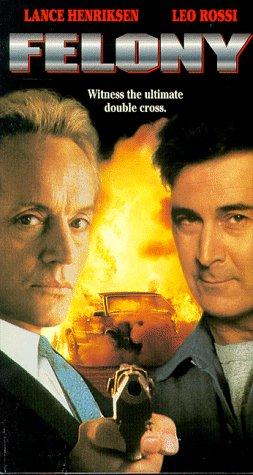
In New Orleans, a drug raid gone wrong leads to eleven cops being gunned down and then blown up. The disastrous raid was being filmed for a Cops-like reality show The show’s producer, Bill Knight (Jeffrey Combs) finds himself being pursued through New Orleans by a collection of rogue intelligence agents, cops, and gangsters, all of whom want the tape of the massacre.
It’s a simple direct-to-video premise and the film’s plot hits every chase film cliche, while keeping the action moving at a decent pace. Bill Knight is not supposed to be a typical action hero. He’s just a television producer who was in the wrong place at the wrong time. Yet Knight proves himself to be as indestructible as any Arnold Schwarzenegger hero. He gets shot, twice. He falls from a great height. He crashes through a window. He repeatedly gets hit over the head. And yet, his injuries never seem to really slow him down or even hurt that much. He does hook up with a nurse (Ashley Laurence) but still, it’s hard to believe anyone could take that much punishment and keep running. Jeffrey Combs, the brilliant star of films like Re-Animator, is miscast as Knight but he’s still always entertaining to watch.
In fact, the cast is the main thing that Felony has going for it. David Prior was able to assemble a true group of B-movie all-stars. Lance Henriksen and David Warner are the evil intelligence agents who are determined to kill Knight. (Warner finally gets to handle a grenade launcher and we’re all the better for it.) Leo Rossi and Charles Napier are the two New Orleans cops who are investigating the drug raid. Joe Don Baker is the rogue intelligence agent who dresses like a cowboy and who is trying to clean up everyone else’s mess. The cast keeps the action moving and there are enough eccentric personalities in this film that it’s always watchable. I think this might be the only film to feature Joe Don Baker and Lance Henriksen performing opposite each other. If nothing else, it deserves to be watched for that!
(The cover for Felony features Lance Henriksen and Leo Rossi but not Jeffrey Combs, even though Combs is the lead in the film and Rossi’s role is actually pretty small. Henriksen also doesn’t have blonde hair in the movie. There are plenty of double crosses in the movie but I can’t think of any that really qualify as the “ultimate double cross.”)
Even with its miscast lead and its cliche-heavy plot, Felony is what direct-to-video action movies should be all about, fact-paced action and a cast unlike any other,
When his daughter is strangled, New Orleans Mayor David Stiles (Charles Napier) hires ex-cop-turned-bounty-hunter Mace (David Keith) to keep an eye on the main suspect, Mitch McCullum (Robert Hays). What the mayor doesn’t know is that his daughter’s murder was ordered by Deputy Mayor Jenkins (Stacy Keach) and now, both Mace and Mitch are being stalked by a crooked cop named Atkins (Leo Rossi). Also getting involved in this mess is a hooker with a heart of gold named Sarah (Pamela Anderson), who is angry because Mace earlier stole his clothes while trying to get the jump on a bail jumper. Sarah and Mitch soon fall in love. Mace is good with a gun and Mitch turns out to know karate (because he watched a lot of Bruce Lee movies growing up) but the film’s high point is when one of the bad guys is taken out with a giant novelty dart.
The plot is dumb and David Keith comes across as being a discount version of Patrick Swayze but this film does give the always likable Robert Hays a good role and fans of Pamela Anderson (and you know who you are) will definitely appreciate at least two scenes in the movie. Actually, Pamela Anderson isn’t bad in Raw Justice. She’s mostly there for her looks but she still has a likable and energetic screen presence. Otherwise, this is a typical low-rent David Prior production, complete with action scenes featuring guns that never run out of bullets (unless it’s convenient for the plot) and a score that is pretty much the same guitar riff over and over again. It’s not exactly good but it is entertaining if you’re in the right mood.
This film was also released under the title Good Cop Bad Cop, which doesn’t make much sense because neither Keith nor Hays is playing a cop.
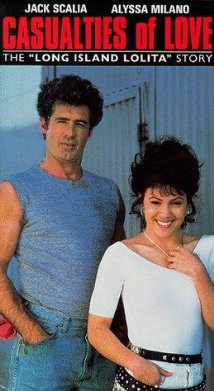
As seen in the 1993 made-for-TV movie Casualties of Love, Joey is a saintly, salt-of-the-Earth blue collar guy who works as an auto mechanic on Long Island. He’s also an aspiring drummer, one who struggles with a major cocaine addiction. When his loving wife, Mary Jo (Phyllis Lyons), threatens to leave him and take the kids unless he cleans up his act, Joey checks into rehab. Six months later, he leaves rehab clean and sober and dedicated to his family. All of the other patients lean out of their windows and wish Joey well. Everyone loves Joey!
Joey, the most handsome and sweetest auto mechanic in the state of New York, does have a problem, though. A sociopathic teenager named Amy Fisher (Alyssa Milano) has grown obsessed with him and keeps intentionally damaging her car so that she can come hang out at the garage. When the other mechanics say that Amy is hot, Joey agrees but that’s all he does. Joey loves his wife. When Amy tries to kiss him at a carnival, he shoves her away and then kisses his wife to make sure that everyone understand that Joey Buttafuoco is the best guy ever. When Amy accuses Joey of giving her a STD, everyone realizes she’s lying because Joey would never have an STD in the first place.
And when Amy shoots Mary Jo in the face, the media and the police try to make it seem like Joey is somehow to blame but again, we know that he’s not. Joey Buttafuoco is a name that means honor and respect.
Uhmm …. yeah.
So, this is story is very loosely based on a true story and by that, I mean that there was a teenager named Amy Fisher who shot a woman named Mary Jo in the face and later said that she was having an affair with her husband, Joey. Apparently, there were three made-for-TV movies made about the case, all of which premiered in the same month. Casualties of Love is told from the point of view of Joey and Mary Jo and it fully supports Joey’s initial claim that he never slept with Amy and she was just some obsessed psycho.
While watching this film, I got bored enough to look up the case on Wikipedia and I learned that, after this movie aired, Joey admitted that he did have an affair with 16 year-old Amy Fisher and he subsequently went to jail for statutory rape. After getting out of jail, Joey divorced his wife and has subsequently been in and out of trouble with the law. He also become a regular on TV court shows, where he would sue people who failed to pay him for fixing their cars. My point is, Joey Buttafuoco sounds like a bit of a sleaze in real life. That makes this film’s portrayal of him as being some sort of Saint of Long Island feel rather dumb.
Actually, it would feel dumb even if the real Joey Buttafuoco was a solid citizen. Casualties of Love is one of the silliest films that I’ve ever seen, portraying Joey as being a streetwise former cocaine addict who was somehow too naive to realize that it would look bad to spend time in his office alone with Amy. As Joey, Jack Scalia is very handsome and very sincere and he feels totally miscast as someone who spends hours working underneath the hood of other people’s cars. Leo Rossi and Lawrence Tierney both show up, mostly so they can say, “Oh, what were you thinking!?” to Joey. As Amy Fisher, Alyssa Milano gives an amazingly lifeless performance. Occasionally she talk fast and plays with her hair. This is the film’s way of letting us know that she’s supposed to be unhinged. I mean, I do the same thing. If you’ve got long hair, you’re going to play with it whenever you got bored. It doesn’t make you crazy.
Unfortunately, though the film may be silly, it’s not much fun. The direction is workmanlike and the film’s portrayal of Joey and Mary Jo’s marriage is so earnestly bland that the film never even rises to the level of camp. The film ends with a warning that Amy would soon be eligible for parole. (Oddly, it also points out that Amy could take college courses in jail, as if that was a bad thing.) Meanwhile, “Mary Jo is taking it one day at a time.” Fortunately, Mary Jo eventually took herself out of Joey’s life and filed for divorce. That’s the happy ending this film lacks.
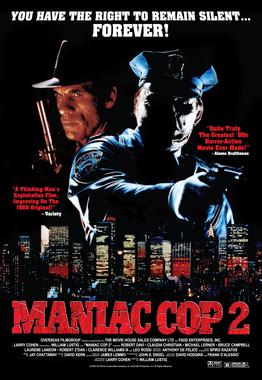
Maniac Cop 2 picks up where the first Maniac Cop ended.
The NYPD thinks that the undead maniac cop Matt Cordell (Robert Z’Dar) has been destroyed but he is actually still alive and killing civilians and cops in New York. He has even teamed up with a serial killer named Steven Turkell (Leo Rossi, ranting and raving like a pro). Jack Forrest (Bruce Campbell) and Theresa Malloy (Laurene Landon) both return from the first film but both of them are killed by Cordell before the movie is even halfway over. Maniac Cop 2 is not playing around.
With Jack and Theresa gone, it falls to Detective Sean McKinney (Robert Davi) and Officer Susan Riley (Claudia Christian) to discover what the rest of the audience already knows, that Cordell is seeking revenge against the system that abandoned him in prison. The new police commissioner, Ed Doyle (Michael Lerner), is determined to cover up what happened but Cordell is even more determined to have his vengeance. Working with Turkell, Cordell heads to the prison where he was unjustly incarcerated and murdered.
Maniac Cop 2 is a marked improvement on the first film. Cordell is no longer a lumbering and slow monster. He is now a ruthless, Terminator-style executioner who, in the film’s best-known scene, wipes out an entire police precinct in a matter of minutes. Cordell is so ruthless that he won’t even stop when he’s on fire. His partnership with Turkell adds a new twist to the Maniac Cop saga. Turkell views Cordell as his partner-in-crime but Cordell is only interested in getting his revenge. (Turkell was originally meant to be Frank Zito, the main character from Lustig’s Maniac. When Maniac star Joe Spinell died before shooting began, the role was changed to Leo Rossi’s Steven Turkell.)
Stepping into the shoes of the main investigation, Robert Davi gives one of his best performances. As opposed to the boring heroes of the first film (sorry, Bruce!), Davi’s Sean McKinney is just as obsessive and ruthless as Cordell. Cordell sets fire and McKinney uses those fires to light his cigarettes.
William Lustig has described Maniac Cop 2 as being his best film and he’s probably right. It is definitely the best of the Maniac Cop films and the only one to fully take advantage of its premise.
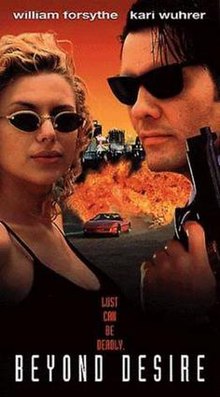
1995’s Beyond Desire tells the story of Ray Patterson (William Forsythe). He’s spent the last 14 years in jail, convicted of a murder that he says he didn’t commit. He likes to sing. He’s obsessed with Elvis. He claims that he doesn’t know how to drive because he’s been in prison for the last 14 years but he appears to be in his mid-40s so you have to kind of wonder if maybe Ray just wants other people to drive him around. After all, Elvis never drove himself.
Perhaps because everyone is sick of listening to him as he sings Amazing Grace in his cell, Ray is released from prison. Since he was serving his time in Nevada, this means that Ray now has to walk down a desert road and hope that someone gives him a ride. Fortunately, for Ray, a woman named Rita (Kari Wuhrer) pulls up in fancy red car and asks him where he’s going. Rita explains that she’s always had a fantasy about picking up someone who has just been released from prison. Ray accepts her offer of a ride and soon, they’re at a desert motel, engaging in saxophone-scored, Vaseline-on-the-lens softcore sex. Ray may have forgotten how to drive but apparently, he didn’t forget everything during those 14 years he spent in prison. If nothing else, this film reveals more of William Forsythe than most viewers probably ever thought they’d see.
Soon, Ray and Rita are head to Vegas. Of course, it turns out that Rita wasn’t quite honest about why she picked up Ray. Rita is a high-priced escort and she works for a local crime boss named Frank (Leo Rossi). Frank wants Ray to reveal the location of some stolen money. Ray, meanwhile, feels that Frank is the key to clearing his name and catching the real murderer. At first, it seems like everyone is just manipulating everyone else but Rita and Frank do eventually end up falling in love. Can their love survive bullets and hints of betrayal?
Like many 90s crime films, Beyond Desire is one of those films that was obviously made to capitalize on the success of Quentin Tarantino. The characters of Ray and Rita are such obvious copies of True Romance‘s Clarence and Alabama that the film comes close to turning into a self-parody. Ray is a big Elvis fan and occasionally quotes lyrics at inopportune times. The soundtrack itself is full of Elvis songs, though the budget apparently wasn’t big enough to actually get the rights to any of Elvis’s recordings. Instead, we get cover versions, the majority of which feel rather wan. The film emphasizes the garish glitz of the Vegas Strip but none of the quirky beauty of it. Las Vegas, an adult playground sitting in the desert, is pure Americana. That was something that was captured by Francis Ford Coppola in The Godfather, Martin Scorsese in Casino and David Lynch in Twin Peaks: The Return. The film uses Vegas as a convenient backdrop but it has nothing to say about the location itself.
Like the majority of road movies, the film tends to meander a bit. Ultimately, the road leads to nowhere. That, in itself, is not necessarily a problem. The same could be said of Tony Scott’s True Romance or any number of films directed by Wim Wenders. Unfortunately, this film wasn’t directed by Tony Scott or Wim Wenders. Instead, it was directed by the guy who did Halloween 5 and the end result is a film that, even when taken as a purely stylistic exercise, still feels rather empty. It’s a shame because William Forsythe shows off a lot of quirky, bad boy charm in the role of Ray and Kari Wuhrer make Rita into a far more complex and conflicted character than one might expect. But, unfortunately, the film itself just doesn’t live up to their performances.
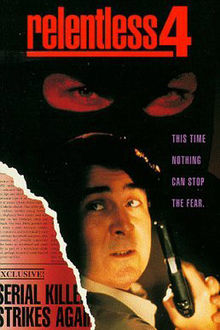
Sam Deitz (Leo Rossi) is back to hunt one last serial killer in this, the last of the Relentless films.
This time the killer is a boring nonentity. He’s not as interesting as the killers played by Miles O’Keeffee or William Forsythe. Nor is he as unintentionally funny as the one played by Judd Nelson in the first Relentless film. Instead, he’s just your run-of-the-mill religious fanatic, killing sinners and performing rituals. His trademark is that he only kills the person that he wants to kill. Anyone else who might be around is just taken out with a stun gun. That’s a boring if considerate trademark.
Deitz is assigned to track down the killer, along with his new partner, Jessica Pareti (Colleen Coffey). While Deitz is trying to solve the case, he’s also having to deal with his rebellious teenage son (Christopher Pettiet). Between this film and the last, Deitz’s ex-wife died and now Deitz is a single father. He and his son barely know each other. Deitz tries to keep his son under control while all his son wants to do is spend time with his girlfriend, Sherrie (Lisa Robin Kelly).
Relentless IV is the least interesting of the Relentless film. It’s so trapped by the now-stale Relentless formula that not even the casting of Famke Janssen as a possible femme fatale can save it. Janssen is a psychiatrist who is connected not only to one of the victims but possibly to the killer as well. She and Deitz are obviously attracted to each other and Deitz is torn between that attraction and treating her like a possible suspect. The relationship between Deitz and the doctor has potential but it keeps getting sidetraced by scenes of Deitz trying to deal with his teenage son and it never really lives up to what it could have been. Janssen is beautiful and Rossi gives a typically good performance but watching the film, it’s obvious that there wasn’t much left to do with the character of Detective Sam Deitz.
Direct-to-video mainstay Oley Sassone directs in a flat and unmemorable manner and the entire film just seems tired. When the best your serial killer can do is kill someone with a Campbell’s soup can, you know you’re running on empty. There would not be a Relentless V. Hopefully, Sam Deitz finally found some peace and figured out how to balance being an intense New Yorker with living in laid back California.
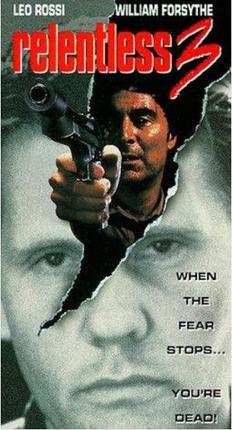
Detective Sam Deitz (Leo Rossi) is back and somehow, his life is even more crappy than before.
Detective Deitz is still an intense New Yorker struggling to fit in with the laid back California lifestyle. Watching a Relentless film, you would think that it’s a crime to be laid back in New York. After three films, Deitz should no longer be as much of a fish out of water as he is in Relentless 3.
Deitz is now divorced and he hardly ever sees his son. That bothers him but also means that there aren’t anymore arguments between Deitz and his wife about him bringing his work home. Deitz is now out on the dating scene. The movie spends a lot of time on scenes of Deitz trying to pick up women. It’s not easy because he’s an intense New Yorker and they’re all laid back California girls. He eventually meets and falls for Paula (Signy Coleman).
Meanwhile, there’s a new serial killer on the scene. Walter (William Forsythe) lives with a mentally unstable woman and is always bragging about how he’s a star. He picks up women in bars, take them home, kills them, and then has sex with their dead bodies before eventually dumping them around Los Angeles. Even though Deitz no longer wants to chase serial killers, he agrees to serve as a consultant. When Walter finds out that the famous Sam Deitz is working the case, he decides to make it personal. Being a “star,” Walter wants to compete with the best.
Relentless 3 gets off to a good start but it runs out of gas quickly. William Forsythe is an effective villain and some of the early scenes of him picking up women are suspenseful. Also, there’s an effective scene where Walter mails Deitz a patch of tattooed skin and proves, as if there was any doubt, that Walter was one sick puppy. But the movie, which should be a relentless cat-and-mouse game between Deitz and Walter, gets sidetracked with all of the scenes of Deitz trying to get back into the dating scene. For all the build-up, the final confrontation between Deitz and Walter feels like a let down. This Relentless film just isn’t relentless enough.
Leo Rossi still does a good job as Deitz but it seems like we learned as much as we need to know about the character during the first two Relentless films and nothing that Deitz does surprises us anymore. Despite good performances from Rossi and Forsythe, Relentless 3 never comes together.
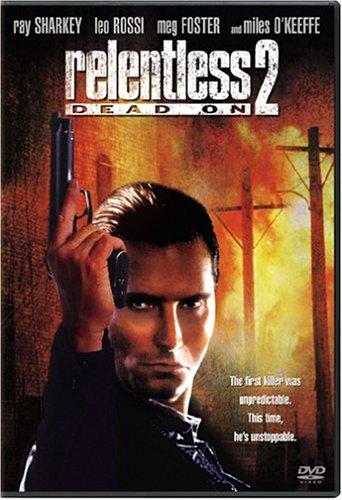
Still struggling to recover from having to act opposite Judd Nelson in the previous Relentless film, Los Angeles homicide detective Sam Deitz (Leo Rossi) finds himself investigating another string of seemingly random murders. This time, the killer is Gregor (Miles O’Keeffe), a master of disguise who hangs his victims, decorates the crime scene with Satanic graffiti, and takes a lot of ice baths. Deitz is forced to team up with a condescending FBI agent named Kyle Valsone (Ray Sharkey), who has his own reasons for wanting to capture Gregor and who might not have the best interests of the case in mind. As if having to deal with killer Russians and crooked FBI agents isn’t bad enough, Deitz is also having to deal with the collapse of his married to Meg Foster and the everyday irritations of being an intense New York cop in laid back Los Angeles.
Relentless II is a better than the first Relentless, mostly because Miles O’Keeffe is a better villain than Judd Nelson. Whereas Nelson was too twitchy to be taken seriously in the first Relentless, O’Keeffe is cold as ice and believably dangerous. He’s a worthy opponent for Rossi and Sharkey. How much Keeffe was in this movie? Just enough to make it work.
Whenever O’Keeffe isn’t doing his thing, the movie focuses on Deitz and Valsone. To a certain extent, their relationship mirrors the relationship that Deitz had with Malloy in the first Relentless except, this time, the mentor turns out to be just as bad the killer. Ray Sharkey was a good actor whose career nosedived because of his own addictions. He was always at his best playing streetwise bad guys, like Sonny Steelgrave in Wiseguy. He’s good as Valsone, giving a performance that indicates that, even if mainstream Hollywood wasn’t willing to take a chance of him, he could have carved out a direct-to-video career as a poor man’s Michael Madsen. Unfortunately, Sharkey contracted HIV as a result of his heroin addiction and he died of AIDS just a year after the release of Relentless II.
Leo Rossi gives another good performance as Sam Deitz. Rossi was usually cast as abusive boyfriends and low-level mobsters and it’s obvious that he enjoyed getting to play a hero for once. Meg Foster may not get to do much as Deitz’s wife but her otherworldly eyes are always a welcome sight.
Relentless II was the high point of the Relentless films. It made enough money to lead to a sequel. Sam Deitz’s days of hunting serial killers were not over.
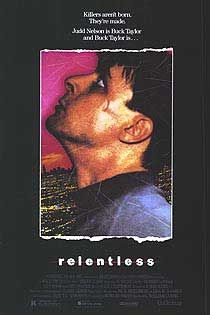
Buck Taylor (Judd Nelson) is the son of an LAPD cop who has never gotten over the bitterness he feels over being rejected by the force himself. Determined to get revenge on a world that refuses to look beyond the dark circles under his eyes, Buck becomes a serial killer. He picks his victims at random from the phone book. Because his father was a cop and he studied to join the force, Buck knows all the tricks of the trade.
Pursuing Buck are two cops. Bill Malloy (Robert Loggia) is a veteran detective who is supposed to be laid back though Robert Loggia was one of those actors who never seemed like he had been laid back a day in his life. Malloy’s new partner is Sam Dietz (Leo Rossi). Dietz has just transferred to Los Angeles from New York and he’s having a hard time adjusting. Everyone is just too laid back.
When Buck starts to target the two cops who are investigating him, the case gets personal and relentless.
Relentless is a movie that I’ve been meaning to review for five years now. In the past, I’ve always been deterred by the fact that reviewing Relentless would mean rewatching Relentless. But, having just spent two weeks watching all of the Witchcraft films, I now feel like I can handle anything. Relentless is a movie that I always remember as being better than it actually is. The murders are creepy but Judd Nelson gives such a one-note performance as the killer that it’s impossible to believe that he could have gotten away with them. As played by Nelson, Buck Taylor is such an obvious serial killer that I’m surprised that he wasn’t already in jail, having been accused of every single unsolved murder on the books. There’s nothing compelling about this killer and films like this pretty much live and … ahem … die based on the quality of their villain.
Why do I always remember Relentless as being better than it is? Most of the credit for that probably goes to Leo Rossi, an underappreciated character actor who gives such a good performance as Sam Dietz that he makes the entire movie better. Rossi even got a brief franchise out of his performance in Relentless, as Dietz returned for three sequels. Robert Loggia is also good as Malloy and it’s unfortunate that the movie doesn’t do as much with the character as it could have.
Rossi and Loggia aside, Relentless doesn’t live up to its potential. But it was still popular enough to launch a direct-to-video franchise. Tomorrow: Relentless 2.
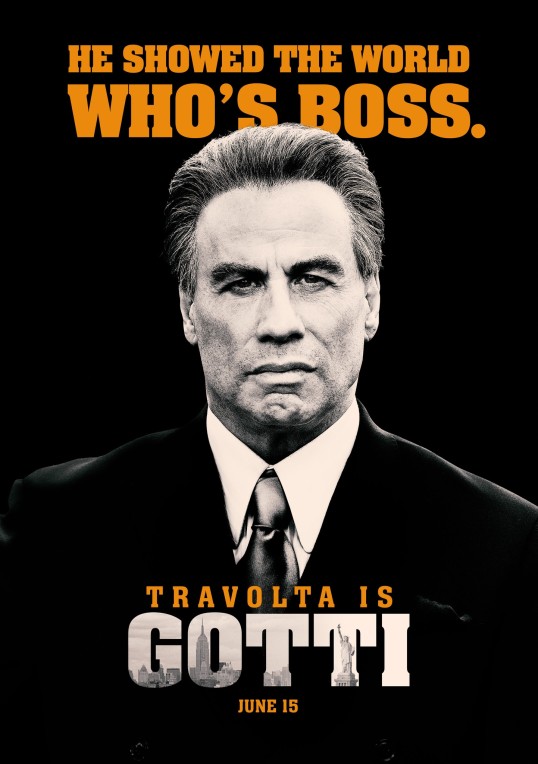
Few recent films have been as misunderstood as Gotti.
When this film was first released in 2018, it was slammed by critics and it flopped at the box office. On Rotten Tomatoes, it managed a score of 0% from the critics. At the same time, the opening day audience score was 80%. (Over subsequent days, the audience score would drop to 46%.) This disparity was blamed on studio employees inflating the audience score, though I think it’s more likely that, after months of negative press about the film’s troubled productions, critics were already looking forward to slamming the film before they even had a chance to see it. At the same time, the buzz on Gotti was so bad that the opening day audience was made up of a combination of John Travolta die-hards (whoever they may be) and people who were expecting such a trainwreck that all Gotti had to do to surpass their expectations was to occasionally be in focus.
Then again, it could be that some members of the audience understood what I instinctively understood when I first watched Gotti. Gotti is not really a film about John Gotti, the flamboyant New York mob boss who ruled the streets with an iron fist and who eventually ended up dying of cancer in prison. Instead, whether it was the filmmaker’s actual intention or not, Gotti is a film about the audience’s fascination with not only gangsters but also the movies that have been made about them.
It’s true that John Travolta may be playing someone namned John Gotti but the film goes out of its way to remind you that he’s not the real John Gotti. The film is full of archival news footage of the real John Gotti, either laughing it up with reporters or smirking while sitting in a courtroom. Every time that we’re shown footage of the real John Gotti, we’re reminded of the fact that, at not point during the film, does Travolta look anything like John Gotti. Add to that, the real Gotti is always smirking whereas Travolta always looks somewhat grim. At the time this film came out, many claimed that this was evidence of lazy filmmaking but I viewed it as being a Brechtian distancing device. Whenever the real Gotti makes an appearance, we’re reminded that we’re just watching a movie and then we’re encouraged to ask ourselves why we would want to watch a movie about such a disreputable figure.
The movie opens with John Travolta standing next to the Brooklyn Bridge and speaking directly to the camera. Though Travolta is meant to be speaking to us as John Gotti, the sight of him standing near a bridge in New York will automatically remind some viewers of a previous Travolta film, Saturday Night Fever. The character that Travolta played in Saturday Night Fever, Tony Manero, has come to epitomize New York in the 70s. The film suggests that, in much the same way, Gotti epitomized New York in the 80s and 90s. Gotti, the film is saying, is as much of an icon of the popular imagination as Tony Manero dancing in a white suit.
Why is Gotti speaking directly to us in that scene? It may seem like a framing device until, a few minutes later, we see a bald and sickly Gotti in a prison meeting room, telling his life story to his son, John, Jr. (Spencer LoFranco). Gotti talking in prison is then established as the narrative’s other framing device. So, why was Gotti speaking to us on the bridge and why did he look so healthy and have a full of head of hair when the film has made it clear that the newly bald Gotti is going to die in prison? When I first saw the film, my initial thought was that the Gotti who speaks directly to the audience was meant to be a ghost. But then it occurred to me that he’s actually not meant to be John Gotti at all. Instead, the Gotti who talks to us on the bridge is meant to be our popular conception of what gangsters like John Gotti as like. He’s what we imagine gangsters to be — i.e., tough-talking, well-dressed, and played by an iconic actor. As such, the film’s narration is not being provided by John Gotti. Instead, it’s being provided by the person that we imagine someone like Gotti to have been.
Is the imprisoned Gotti meant to be the real Gotti? Perhaps. However, it’s hard not to notice that, over the course of the film, Gotti’s son never ages. Though several decades pass, Gotti’s son always looks like he’s in his mid-twenties. When he visits his father in prison and talks about having teenage children of his own, it feels odd because he barely looks old enough to be out of high school. That may seem like lazy filmmaking but again, I would argue that this is a distancing device. It’s a reminder that we’re not watching reality. Instead, we’re choosing to watch actors pretending to be gangsters.
Once you accept that Gotti is a film not about John Gotti but instead about those of us in the audience who are watching, the film makes a lot more sense. The film’s cliches about life in the Mafia are revealed to be not so much the result of an uninspired script as they’re an homage to American folklore. Of course, there’s going to be a scene where Gotti tells his children never to rat on their friends. Of course, there’s going to be random shootings and burly men demanding respect. This is a gangster movie, after all. By populating the cast with people who you normally wouldn’t expect to see playing members of the Mafia — Stacy Keach, Chris Mulkey, Pruitt Taylor Vince — Gotti continually reminds you that you’re watching a movie. The real mafia isn’t like this, Gotti is saying, but the mafia of the popular imagination is. Why are we horrified by real-life crime and yet we flock to movies that claim to recreate it for our entertainment? This is the issue at the heart of Gotti.
Gotti’s flaws are there to remind us that we’re just watching a movie. They’re also there to make us wonder why we’re watching that particular movie. Gotti asks us why audience idolize killers like John Gotti. Why do we turn them into folk heroes? Is it because we imagine them to be characters in films as opposed to actual human beings? Whether or not one feels that the film succeeded in its goal, this is an offer that you cannot refuse.
 In New Orleans, a drug raid gone wrong leads to eleven cops being gunned down and then blown up. The disastrous raid was being filmed for a Cops-like reality show The show’s producer, Bill Knight (Jeffrey Combs) finds himself being pursued through New Orleans by a collection of rogue intelligence agents, cops, and gangsters, all of whom want the tape of the massacre.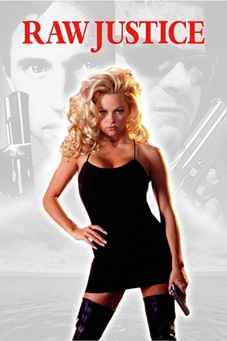
 Through the Shattered Lens