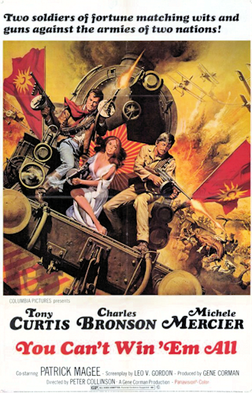
Two Americans meet up in Turkey in 1922. Josh Corey (Charles Bronson) is a cynical soldier-of-fortune who, along with his mercenary crew, is hoping to make money out of the ruins of the Ottoman Empire. Adam Dyer (Tony Curtis) is the heir to a shipping company and is hoping to get his last remaining boat out of the Turkish dock where it’s been interned since World War I. Osman Bey (Gregorie Aslan), one of the local powerbrokers who has risen to power since the Turkish Revolution, hires Josh and Adam to escort his daughters and their protector, Alia (Michele Mercier), to Mecca. Actually, the plan is for them to instead go to Cairo to recover a priceless treasure. The journey to Cairo is filled with action and betrayal as Josh and Adam try to navigate the upheaval of the post-war Middle East.
You Can’t Win ‘Em All is a mix of action and comedy, an adventure that owes more than a little to the other big budget heist films of the 60s and 70s. (Director Peter Collinson was hired due to his work on The Italian Job.) The film’s humor comes from the partnership of the stoic Bronson with the talkative Tony Curtis. In fact, the film’s main flaw is that Tony Curtis talks too much. Curtis simply will not shut up. After about fifteen minutes, I was tired of listening to him. Curtis’s acting limitations really come through the more that he talks and, as a result, Bronson walks away with the entire movie by saying next to nothing. Bronson keeps largely quiet because he doesn’t have to speak to make an impression. His stare says everything that needs to be said.
You Can’t Win ‘Em All is uneven but it has a few good action sequences and Bronson doing what Bronson did best. Watching this movie made me appreciate Charles Bronson all the more. Even when working with a less-than-great script and a miscast co-star, Bronson still had the undefinable quality that made him a star.
Tennesse (John Payne) is an old west gambler who co-owns a saloon (and bordello) with Elizabeth Farnham (Rhonda Fleming). When Tennessee is ambushed after a poker game, he’s saved by a local man who goes by the name of Cowpoke (Ronald Reagan). Tennessee and Cowpoke become fast friends but when Tennessee realizes that Cowpoke is about to marry a golddigger (Coleen Gray), Tennessee puts the woman on the next boat out of town. Cowpoke vows to get vengeance but Tennessee has bigger things to worry about. Rival businessman Turner (Tony Caruso) has framed Tennessee for the murder of a local prospector, Grubstake McNiven (Chubby Johnson).
Very loosely based on a short story by Bret Harte, Tennessee’s Partner has surprisingly high production values for a B-western. Director Allan Dwan started his career in the 1910s and directed over 200 westerns. He knew how to keep the action moving. Tennessee’s Partner is also the only film that old friends John Payne and Ronald Reagan made together. Reagan, whose days as a major studio leading man had ended by the time he made this film, gives one of his better performances in the role of the simple but honest Cowpoke and shows the likability that he was later able to translate into a political career. Reagan could be a stiff actor but his naturally amiable manner made him perfect for best friend and sidekick roles, like in this movie. Payne also gives a good performance as the gambler with a moral code. However, the best thing about the film is Rhonda Fleming, giving a tough and sexy performance as Elizabeth. Because this film came out in 1955, it couldn’t really come out and say that Elizabeth was a madam and the saloon was a bordello but Fleming’s performance and a few lines of innuendo left little doubt about what was actually going on upstairs from the bar. Keep an eye out for Angie Dickinson, playing one of Elizabeth’s girls.
The performance elevate Tennessee’s Partner, making it a B-western that can be enjoyed even by people who aren’t necessarily into westerns.
John Wayne is just one of those actors I love. He’s made so many great movies. My personal favorites are RIO BRAVO, TRUE GRIT, BIG JAKE, THE SONS OF KATIE ELDER, THE MAN WHO SHOT LIBERTY VALANCE, THE SEARCHERS, THE QUIET MAN, RED RIVER, THE SHEPHERD OF THE HILLS and STAGECOACH. But hell, there are so many great ones not listed above. He just knew how to play tough, honorable, flawed men in his uniquely John Wayne way. When I hit play on a John Wayne film, I know I’m in for a good time.
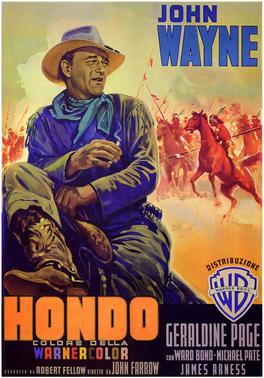
The 1953 John Wayne movie HONDO starts with a man and his dog walking through a dusty, rocky landscape on their way towards a pond and a rough looking farmhouse. He’s greeted by a woman and her young son. The man, Hondo Lane (Oscar winner John Wayne), is a scout for the U.S. Cavalry who’s just escaped from Apaches but lost his horse in the process. The woman, Angie Lowe (Oscar winner Geraldine Page), allows Hondo to stay at her ranch to rest and get something to eat. She tells him that her husband is away in the hills chasing wildcats for the day, and he asks her if he can buy a horse to get back to his cavalry post. Hondo ends up having to stay a few days at the ranch in order to break a wild, rambunctious horse before it can be ridden. While there, Hondo learns that Angie doesn’t really know where her husband is, as he left months ago and has never returned. Hondo and Angie share some nice conversation and even a kiss. Before he leaves, he tells her that she’s not safe at her remote ranch. It seems that the U.S. government has broken their treaty with the Apaches and no one is safe in the area. Angie refuses to leave her farm as the Apaches have always treated her well, using her spring for water. Hondo heads back to his post and is barely out of sight when the Apaches show up. Will they scalp Angie and her son, Johnny? Will Angie’s husband ever show back up? Will Hondo come back to the ranch and kiss her again in the moonlight? Will Hondo teach Johnny how to swim by throwing him into the pond? Will Hondo have to save a regiment of pony soldiers and settlers from marauding Apaches? It’s my guess that you probably know the answers to these questions, and that’s part of the fun of watching John Wayne movies.
It should come as no surprise that I enjoyed HONDO. John Wayne plays a variation of his normal tough, honorable, honest character, and I like that character. Geraldine Page was nominated for her first Oscar for her performance as Angie Lowe. It was the first of eight nominations she would receive in her career. She’s an interesting actress. She’s not conventional at all in this role yet she absolutely nails it. I haven’t watched much of her work so I need to check some more of her stuff out. Ward Bond shows up as fellow cavalry scout Buffalo Baker. It’s always fun to see Wayne and Bond work together. They go together like peas and carrots. Leo Gordon is effectively slimy as the deserter Ed Lowe, and James Arness shows up as cocky young man who’s humbled and then redeems himself through battle. It’s a fine cast that helps in the fun factor.
It’s not a perfect film, especially by the social standards of 2024, but it’s a fun and entertaining western. I liked it.
In the 18th century, the inhabitants of Arkham, Massachusetts yank Joseph Curwen (Vincent Price) out of his mansion and tie him to a tree. They accuse Curwen of being a warlock who is in league with the devil and who has been bringing young women to his “palace,” and putting them in a trance. They burn Curwen alive but, before the flames are lit, they also give Curwen a chance to speak and curse both them and their descendants.
You really do have to wonder about the logic behind witch (and warlock) burnings. They seem counter-productive because they always give the accused just enough time to cast one final curse before being burned to a crisp. Indeed, you have to wonder why witches and warlock were allowed any final words to begin with. I mean, at some point, you would think everyone would notice that the final words were always a curse.
Anyway. 110 years later, Joseph Curwen’s descendant, Charles Dexter Ward (Vincent Price, again) rides into town with his wife, Anne (Debra Paget). He is stunned to see that Arkham has apparently fallen on hard times, with many of the town’s people being horribly disfigured. It’s explain to him that the disfigurements and the poverty are all a result of his ancestor’s curse. That’s going to make things a bit awkward, considering that Charles Dexter Ward has not only inherited the Palace but he’s also inherited a copy of Necronomicon and a legacy of messing with Cthulhu. The townspeople don’t want Ward around but he and Anne decide to spend the night in the Place regardless.
Of course, it doesn’t take long for Curwen’s spirit to possess Charles. Soon, Charles is trying to resurrect Curwen’s mistress, Hester (Cathie Merchant) and pursuing Curwen’s goals of breeding a race of super humans by forcing the women of the town to mate with the fearsome Yog-Sothoth. Charles also seeks vengeance on the descendants of those who burned Curwen at the stake, as if all of the poverty and the deformities aren’t punishment enough. Again, this is why you don’t give warlocks and witches a chance to get out one last curse before being executed.
Though The Haunted Palace is usually considered to be a part of Roger Corman’s Edgar Allan Poe cycle, the story itself is actually based on H.P. Lovecraft’s The Case of Charles Dexter Ward. (In Lovecraft’s novella, Ward seeks out his evil ancestor whereas, in the film, Ward is more or less an innocent victim.) The film’s title comes from a Poe poem, which is recited at both the beginning and the end of the film. But the film itself, with its references to the Cthulhu mythos and its hideous New England setting, is definitely a work of Lovecraftian horror.
Fortunately, it’s an effective work of Lovecraftian horror, one that captures the feeling of people unwisely trying to control a force of evil that they cannot begin to comprehend. Roger Corman keeps the action moving quickly and creates a gothic atmosphere of impending doom. Vincent Price, toning down his usual theatrics, is chillingly evil as Curwen and sympathetic as Charles. The film’s strongest performance, however, comes from Debra Paget, who desperately tries to free her husband from Curwen’s control. Any woman who has suddenly felt as if she can no longer recognize the man who she once loved will be able to relate to Paget’s performance.
The Haunted Palace is a strong entry in the films of Roger Corman and Vincent Price and one of the better adaptations of the work of H.P. Lovecraft.
Welcome to Retro Television Reviews, a feature where we review some of our favorite and least favorite shows of the past! On Tuesdays, I will be reviewing the original Fantasy Island, which ran on ABC from 1977 to 1984. Almost the entire show is currently streaming on Daily Motion.
Oh my God, this week’s episode….
Episode 4.18 “The Searcher/The Way We Weren’t”
(Dir by Leslie H. Martinson, originally aired on March 7th, 1981)
This week’s episode was just silly and it’s going to be a struggle to even come up with the usual 500 words to say about it.
Fred Cooper (Jerry Van Dyke) is worried that married life is losing its spark so he wants to relive the early days of his marriage to Dottie (Laraine Stephens). After going through a magic time travel cloud, Fred and Dottie find themselves living in their old house, which they share with Fred’s aunt. Their neighbors are Vic (Jack Carter) and Myra Fletcher (Dawn Wells). Vic is Fred’s boss. He and Myra are also swingers! Apparently, Fred forgot about that but I have to wonder how anyone would forget that? Anyway, Vic offers Fred a promotion but only if Fred will allow Vic to sleep with Dottie. Fred responds by punching Vic out while Vic is hosting a Swingers Convention on Fantasy Island. (Tattoo must have been very happy this week.) Vic realizes that he was in the wrong and Fred still gets his promotion. But is it a real promotion or just a fantasy promotion? Seriously, what the Hell is going on here?
Meanwhile, young heiress Karen Saunders-Holmes (Laurette Spang) comes to the island with her husband, Brian (James Darren). Brian thinks that they’re just on their honeymoon but Karen actually has a fantasy. She wants to be reunited with her father, a man named Noah who supposedly abandoned her when she was an infant and whom she has never met. Mr. Roarke arranges for Noah (Paul Burke) to be released from prison for the weekend and….
PRISON!? Yep, Noah is a convicted murderer and has spent the last two decades in a prison camp. Noah claims that he was innocent of the crime. Anyway, Mr. Roarke introduces Noah to Karen and Brian and says that Noah will be their guide on the Island….
Brian freaks out! It turns out that Brian is actually the man who Noah was framed for murdering. Brian went off and got plastic surgery after faking his own murder, which is why Noah doesn’t recognize him. But Noah soon learns the truth when Brian tricks him into entering a bog of quicksand!
Does Noah survive the quicksand? He does but we’re never told how. Does Brian then freak out and run into the quicksand as well? Of course. Fantasy Island is such a dangerous place!
This was a silly episode. Brian apparently not only had plastic surgery to change his face but also to reduce his age because there was no way he was old enough to a contemporary of Noah’s. And for the swinger’s convention on Fantasy Island …. I mean, what? Mr. Roarke is suddenly okay with a big key party on his Island? How do you forget that you used to live next door to a swinging couple? Like I said, this was just silly. One fantasy features Jerry Van Dyke being way too goofy and the other features James Darren being way to obviously sinister. Neither worked.
So far, the fourth season has really been a mixed bag, hasn’t it? Hopefully, things will improve next week.
Welcome to Retro Television Reviews, a feature where we review some of our favorite and least favorite shows of the past! On Tuesdays, I will be reviewing the original Fantasy Island, which ran on ABC from 1977 to 1986. Almost the entire show is currently streaming is on Youtube, Daily Motion, and a few other sites.
This week, Roarke and Tattoo are still ignoring each other.
Episode 4.5 “The Love Doctor/The Pleasure Palace”
(Dir by Earl Bellamy and Cliff Bole, originally aired on November 22nd, 1980)
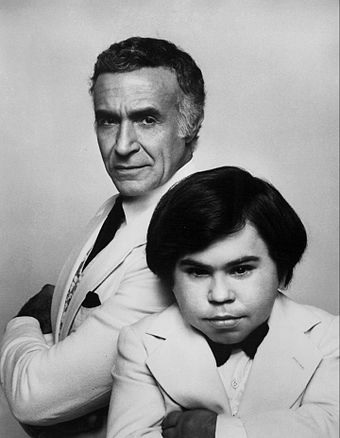
The plane has arrived and, once again, Mr. Roarke and Tattoo head down to the docks to meet their guests. And, as with the previous season four episodes, it’s hard not to notice that neither Ricardo Montalban nor Herve Villechaize are willing to look at each other while delivering their lines. I feel a little bit bad about having started almost every recent review by mentioning the obvious hostility between the two of them but it’s impossible not to notice. Previously, one of the show’s greatest strengths was the playful banter between Roarke and Tattoo and, when it’s gone, it’s impossible not to notice the absence.
Speaking of hostility, Gordon Hughes (Gary Burghoff) seem to have a lot resentment against the world. Thanks to the inheritance that he received from his grandmother, Gordon has graduated from law school and he is on the verge of joining a top law firm. But, before he does so, he wants to go back in the past and discover how his grandmother made all of her money. Mr. Roarke takes Gordon to a recreation of the saloon that his grandmother owned in turn-of-the-century San Francisco. Gordon takes a sip of brandy and is transported into the past. He quickly discovers that …. HIS GRANDMOTHER OWNED A BROTHEL!
At first, Gordon is upset about this discovery. But then he falls in love with one of his grandmother’s employees, a waitress named Molly (Barbie Benton). And then he stands up to a crooked cop (Dane Clark). And then he meets his grandmother (Ruta Lee) and discovers that she was tough and refused to let anyone push her around. Gordon realizes that he should be proud of his grandmother and his heritage and that he wants to be with Molly. But then the San Francisco earthquake hits and Gordon is abruptly transported to the present. Not to worry, though! It turns out Molly was also a guest having a fantasy and she and Gordon board the airplane home together.
This fantasy — which featured a lot of nice clothes and period detail — would have been effective if not for Gary Burghoff’s rather off-putting performance as Gordon. Seriously, Gordon came across as being such an uptight and self-righteous prig that it was difficult to have much sympathy for him. Of course, that was kind of the point. Gordon was supposed to be a snob but Burghoff made him such a convincing and such a committed snob that it was hard to believe that he could have changed his ways just over the course of a few days.
The second guest is actress Kim Holland (Loni Anderson), who is the biggest star in the world after appearing in only three movies. She wants a break from being a star so Mr. Roarke arranges for her to serve as a nurse in a remote clinic that is run by the gruff Dr. Greg Miller (Christopher George). Kim finds a purpose in life helping Dr. Miller but, when they’re kidnapped by a native tribe, Dr. Miller reveals that he has always known who Kim is. Dr. Miller plays one of her movies for the tribe, convincing them that Kim is a goddess. Miller goes on to explain that he’s been in love with Kim ever since he first saw her on screen. Seeing as Kim’s fantasy was to not be recognized for a few days, it would seem that Roarke failed to keep up his end of the bargain. But it doesn’t matter because Kim and Greg are in love. This fantasy could have worked with perhaps a different actress in the role of Kim. Loni Anderson gave such a blank performance as Kim that it was hard to really believe her either as a movie star or a nurse.
(Interestingly enough, the character of Kim Holland also appeared on the episode of The Love Boat that aired right before this episode. So, if nothing else, this is the first Love Boat/Fantasy Island cross-over. Incidentally, I’ll be reviewing that episode of The Love Boat in a few more months.)
This was a fairly forgettable episode. The island was lovely to look at and I’m glad that everyone found love but I just wish Mr. Roarke and Tattoo could be friends again.
Arizona rancher Wick Campbell (Richard Boone) is angered when he discovers that one of his servants, Maria (Donna Martell), would rather marry Howie Stewart (Skip Homeier) than be with Wick. Wick has had a long rivalry with Howie and his older brothers, John (Randolph Scott) and Adam (Lester Matthews). Determined to get rid of the Stewarts and to have Maria for himself, Wick hires notorious gunfighter Frank Scavo (Leo Gordon) to take over the town and defeat the Stewarts, one way or another.
Ten Wanted Men (the title refers to Scavo’s gang) is an above average Randolph Scott western. Scott was one of the best of the western heroes because he always seemed so authentic whenever he rode a horse, shot a gun, or even just put on a cowboy hat. Scott was also an underrated actor and, as he got older, he became Hollywood’s go-to choice whenever they needed a strong, silent lead for a western. That’s the role that he plays in Ten Wanted Men, as the patriarch of the Stewart family. He’s instinctively fair but he will do whatever has to be done to protect his brothers.
Wick Campbell is John Stewart’s opposite, an oily rancher who hires other men to bully his enemies and who abuses his servant in a way that the Stewarts never would consider. Though Richard Boone became best known for playing the hero on Have Gun–Will Travel, Wick is the type of cowardly villain who everyone will be happy to see get exactly what he deserves. As played by Leo Gordon, Frank Scavo is a brutish outlaw and, unlike Wick, he doesn’t pretend to be anything else.
Ten Wanted Men is a good western. The plot may not be surprising but the gunfights are exciting and Randolph Scott is as ideal a hero as always. Fans of the genre will enjoy it.
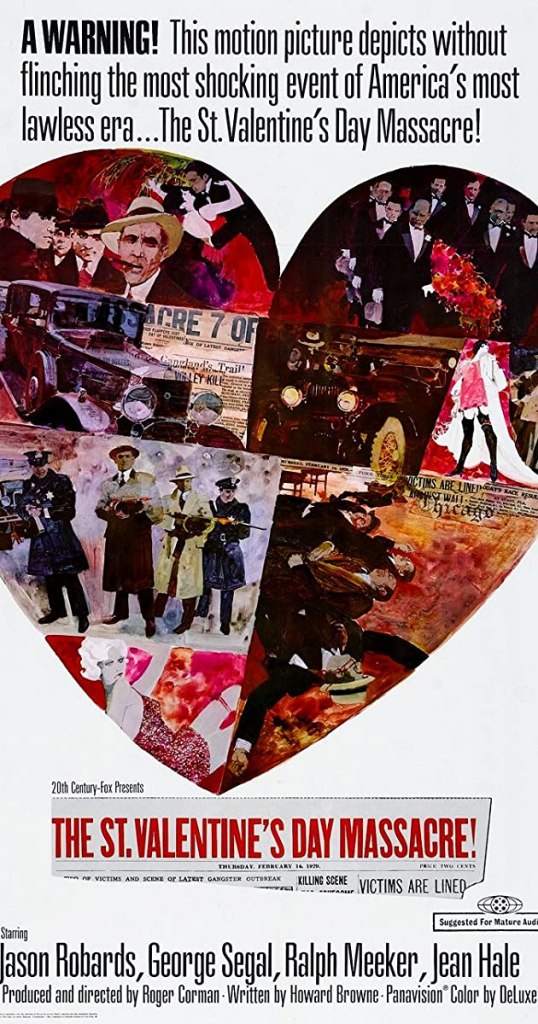
On February 14th, 1929, seven men were murdered in a garage in Chicago, Illinois. Five of the seven men were known to be associates of gangster George “Bugs” Moran. The other two men were considered to be innocent bystanders, a mechanic and a dry cleaner who just happened to enjoy hanging out with gangsters. Though no one was ever convicted of the crime, it was well-known that the murders were carried out on the orders of Al Capone.
In many ways, the St. Valentine’s Day Massacre was a turning point in America’s relationship with organized crime. Before the massacre, Capone had become a bit of a folk hero. He knew how to talk to the press and he was viewed as merely breaking a law (in this case, prohibition) that most people opposed in the first place. However, after the murders, public opinion soured on Capone.
Some of it was the brutality of the crime. It’s been said that over five hundred bullets were fired in that garage, all to kill seven defenseless men who were lined up against a wall. Grisly pictures of the victims were released to the press. Perhaps if the seven men had been carrying weapons and had been involved in a shootout with their murderers, the public’s reaction would have been different. But this was a cold-blooded execution.
Personally, I think the fact that the killers disguised themselves as cops also played a role in the public’s outrage. It was a very calculated move on the part of the killers and it highlighted just how much planning went into the St. Valentine’s Day Massacre. As well, it undoubtedly made people paranoid. If a bunch of killer could dress up like cops, who knew who else they could dress up as?
Finally, I think that Capone’s biggest mistake was carrying out the crime on Valentine’s Day. You don’t murder people on a holiday. Anyone should know that. If Capone had waited until February 20th, he probably could have gotten away with it.
The 1967 film, The St. Valentine’s Day Massacre, details the rivalry between Capone and Moran, starting with them fighting for control over the Chicago rackets and ending with the title event. Moran is played by Ralph Meeker while Jason Robards plays Capone.
Now I know what you’re probably thinking. Perennial WASP Jason Robards as Al Capone? That may sound like odd casting and, let’s just be honest here, it is. However, it actually kind of works. Robards may not be convincingly Italian but he is convincingly ruthless. Add to that, one of the major subplots of the St. Valentine’s Day Massacre is that, even as the head of the Chicago Outfit, Capone still feels like an outsider in the world of organized crime because, while he is Italian, he isn’t Sicilian. Capone feels as if Lucky Luciano and all of the major New York crime bosses look down on him and one reason why he’s so ruthless about taking over Chicago is that wants to show Luciano that he can be just as effective a crime lord as any Sicilian. Capone feeling out of place in the Mafia is reflected by Robards initially seeming to be out of place in a gangster film. By the end of the movie, of course, Capone has proven himself and so has Jason Robards.
Robards isn’t the only familiar face to be found in The St. Valentine’s Day Massacre. Though this film was released by 20th Century Fox, it was directed by Roger Corman and Corman fills the production with members of his stock company. Dick Miller, Jonathan Haze, and Jack Nicholson all have small roles as gunmen. Bruce Dern plays the unlucky mechanic who enjoys hanging out with gangsters. Buck Taylor, Leo Gordon, and Joe Turkel all have small roles. John Agar plays Dion O’Bannon and is gunned down in his flower store. Though not members of the Corman stock company, George Segal and David Canary plays brothers who work for Moran. There’s a lot of characters wandering through this film but Corman makes sure that everyone gets a chance to make an impression.
It’s a good gangster film. Though he was working with a larger budget than usual, Corman still brought his exploitation film aesthetic to the material and the end result is a violent, melodramatic gangster film that looks really impressive. The film’s recreation of 1920s Chicago is a visual delight and looking at the well-dressed and stylish gangsters walking and driving down the vibrant city streets, you can understand why organized crime would have such a draw for some people.
The St. Valentine’s Day Massacre is a classic gangster film and a classic Corman film. It’s an offer you can’t refuse.
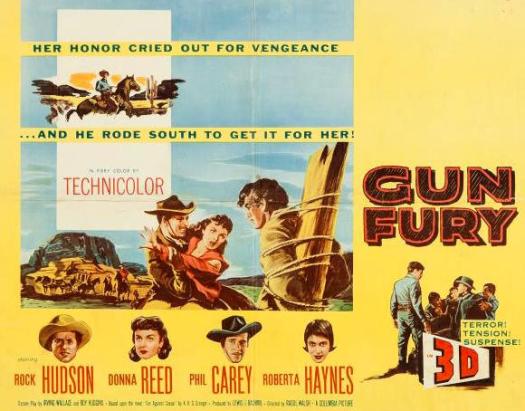
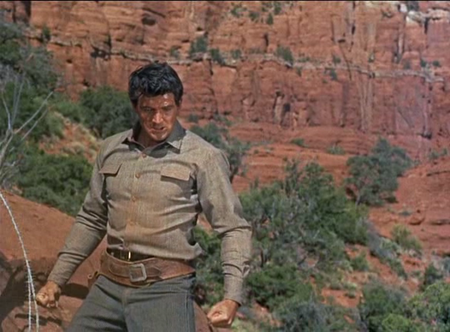
I watched GUN FURY expecting a surprise. What I got instead was a routine Western, not bad for its type, bolstered by a better-than-average cast, solid direction from veteran Raoul Walsh , and some lavish Technicolor location footage from Sedona, AZ. But I kept waiting and waiting for that “surprise” that never came. What am I talking about? Read on and find out, buckeroos!
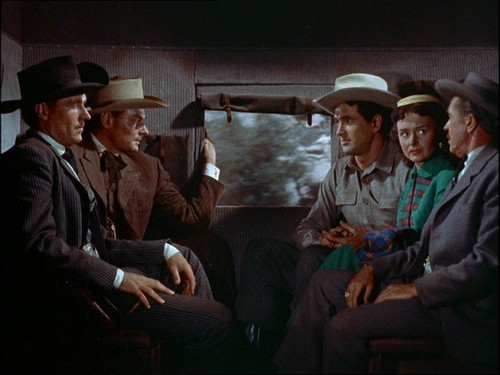
Ben Warren, a peaceful Civil War vet, meets his intended bride Jennifer Ballard at the stagecoach station. The two lovebirds intend to travel to the next stop and get hitched. Also onboard the stage is mean desperado Frank Slayton, an “unreconstructed Southerner” feared across the territory, and his partner-in-crime Jess Burgess. Frank’s gang, disguised as Cavalry soldiers, lie in wait and rob the stage of it’s shipment of gold, stealing the loot killing everyone except Jennifer, who Frank has designs on and kidnaps.
The place is Chicago. The time is the era of Prohibition. The head of the Chicago Outfit, Rocca (Ted de Corsia), has arranged for a career criminal named Lester Gillis (Mickey Rooney) to be released from prison. A crack shot and all-around tough customer, Gillis has only two insecurities: his diminutive height and his youthful appearance. Rocca wants to use Gillis as a hit man but Gillis prefers to rob banks. When Rocca attempts to frame Gillis for a murder, Gillis first guns down his former benefactor and then goes on the run with his girlfriend, Sue Nelson (Carolyn Jones). Because they are both patients of the same underworld doctor (played by Sir Cedric Hardwicke), Gillis eventually meets public enemy number one, John Dillinger (Leo Gordon). Joining Dillinger’s gang, Gillis becomes a famous bank robber and is saddled with a nickname that he hates: Baby Face Nelson.
While it is true that Lester “Baby Face Nelson” Gillis was an associate of John Dillinger’s and supposedly hated his nickname, the rest of this biopic is highly fictionalized. The real Baby Face Nelson was a family man who, when he went on the run, took his wife and two children with him. While he did get his start running with a Chicago street gang, there is also no evidence that Nelson was ever affiliated with the Chicago Outfit. (The film’s Rocca is an obvious stand-in for Al Capone.) In real life, it was Dillinger, having just recently escaped from jail, who hooked up with Nelson’s gang. The film Nelson is jealous of Dillinger and wants to take over the gang but, in reality, the gang had no leader. Because Nelson killed three FBI agents (more than any other criminal), he has developed a reputation for being one of the most dangerous of the Depression-era outlaws but, actually, he was no more violent than the typical 1930s bank robber. Among the era’s outlaws, Dillinger was more unique for only having committed one murder over the course of his career. In this film (and practically every other film that has featured Baby Face Nelson as a character), Nelson is a full on psychopath, one who even aims his gun at children.
Baby Face Nelson may be terrible history but it is still an excellent B-movie. Don Siegel directs in his usual no-nonsense style and Mickey Rooney does a great job, playing Baby Face Nelson as a ruthless but insecure criminal with a perpetual chip on his shoulder. As his fictional girlfriend, Carolyn Jones is both tough and sexy, a moll that any gangster would be lucky to have waiting for him back at the safe house. B-movie veterans like Thayer David, Jack Elam, Elisha Cook Jr., and John Hoyt all have colorful supporting roles but the most unexpected name in the cast is that of Cedric Hardwicke, playing an alcoholic surgeon with broken down dignity.
Don’t watch Baby Face Nelson for a history lesson. Watch it for an entertaining B-masterpiece.
 Two Americans meet up in Turkey in 1922. Josh Corey (Charles Bronson) is a cynical soldier-of-fortune who, along with his mercenary crew, is hoping to make money out of the ruins of the Ottoman Empire. Adam Dyer (Tony Curtis) is the heir to a shipping company and is hoping to get his last remaining boat out of the Turkish dock where it’s been interned since World War I. Osman Bey (Gregorie Aslan), one of the local powerbrokers who has risen to power since the Turkish Revolution, hires Josh and Adam to escort his daughters and their protector, Alia (Michele Mercier), to Mecca. Actually, the plan is for them to instead go to Cairo to recover a priceless treasure. The journey to Cairo is filled with action and betrayal as Josh and Adam try to navigate the upheaval of the post-war Middle East.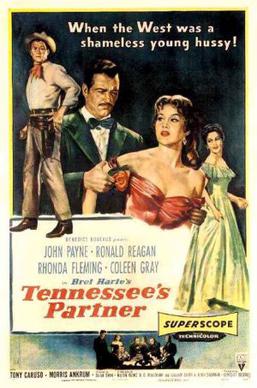


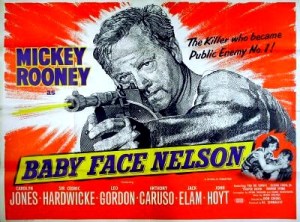 The place is Chicago. The time is the era of Prohibition. The head of the Chicago Outfit, Rocca (Ted de Corsia), has arranged for a career criminal named Lester Gillis (Mickey Rooney) to be released from prison. A crack shot and all-around tough customer, Gillis has only two insecurities: his diminutive height and his youthful appearance. Rocca wants to use Gillis as a hit man but Gillis prefers to rob banks. When Rocca attempts to frame Gillis for a murder, Gillis first guns down his former benefactor and then goes on the run with his girlfriend, Sue Nelson (Carolyn Jones). Because they are both patients of the same underworld doctor (played by Sir Cedric Hardwicke), Gillis eventually meets public enemy number one, John Dillinger (Leo Gordon). Joining Dillinger’s gang, Gillis becomes a famous bank robber and is saddled with a nickname that he hates: Baby Face Nelson.
 Through the Shattered Lens