October True Crime: Swearing Allegiance (dir by Richard Colla)


“Greenish brown female sheep,” the two lovers at the center of 1997’s Swearing Allegiance often tell each other.

It’s their code and only they understand what it means.  It’s not that hard to figure out.

Greenish Brown = Olive

Female Sheep = Ewe

Olive Ewe.

Say it out loud.

I love you.

That seems cute until you really think about it.  David Graham (David Lipper) and Diane Zamora (Holly Marie Combs) are high school sweethearts in Texas.  They go to different high schools but they’re totally in love (or they say).  David is planning on attending the Air Force Academy in Colorado.  Diane is entering the Naval Academy and she hopes to someday be an astronaut.  Diane is so convinced that she and David are going to be together forever that she loses her virginity to him.  David, for his part, seems to be a bit of a lunkhead but he leads the ROTC with an intense determination.  They’ll tell anyone who asks that they’re going to get married and be together forever.

And yet, neither one ever really tells the other, “I love you.”  Instead, they speak through code.  It’s cute.  It’s the sort of thing that I used to do when I was like 12.  But when you’re nearly an adult and you’re still saying, “Greenish Brown Female Sheep,” it suggests that you might not be as ready for life outside of high school as you think you are.

One night, after a teary David confesses to Diane that he cheated on her with one of his teammates on the school’s track team, Adrianne “A.J.” Jones (Cassidy Rae), Diane snaps.  Instead of dumping David, she tells him that the only way they can make things right is by murdering Adrianne, which is what they proceed to do.  They almost get away with it.  With the police focusing their attention on the wrong guy, David and Diane leave town for their respective colleges.  David and Diane swear to themselves that, from now on, they are going to live with honor and loyalty….

This made-for-TV movie was based on an actual crime that happened outside of Mansfield, Texas in 1995.  For years, the crime itself lived on as a cautionary tale that was told to teenage girls (including myself) in order to keep us from sneaking out and sneaking around.  Interestingly enough, in 2005, Zamora’s attorney said that the prosecution deliberately withheld evidence that David Graham had been lying about having sex with Adrianne Jones as a part of twisted scheme to keep Diane from breaking up with him.  I don’t know if that’s true or not but I do know that, whatever may have happened between Adrianne and David Graham, she deserved better than to be murdered and then turned into a cautionary tale.

One thing I do like about the film is that it is clearly on Adrianne’s side.  Cassidy Rae gives a sympathetic performance as Adrianne, playing her as a genuinely nice person who fell victim to David and Diane’s toxic relationship.  David Lipper is a bit blank-faced as David but Holly Marie Combs is appropriately intense as the obsessive Diane Zamora.  The film actually aired before the case went to trial, which shows that, even in the 90s, there was always a thin line between tragedy and entertainment.

Zamora and Graham are currently both in prison.  Zamora took a polygraph in 2007 but the results were tossed out when it was determined that she was trying to alter her breathing to fool the machine.  As Zamora now claims that Graham alone was responsible for killing Adrianne, I imagine they’re no longer speaking about greenish brown female sheep.
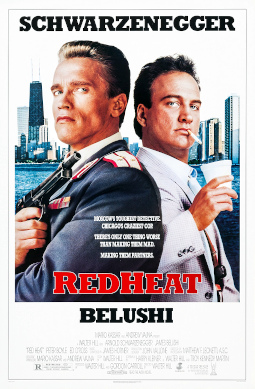
Red Heat (1988, directed by Walter Hill)


Ivan Danko (Arnold Schwarzenegger) is a Russian who lives in Moscow.  Art Ridzik (James Belushi) is an American who lives in Chicago.  They have two things in common.  They’re both cops and they both recently lost their partners while pursuing Russian drug lord Viktor Rostavali (Ed O’Ross).  When Danko comes to Chicago to bring the recently arrested Rostavali back to Moscow, Ridzik is assigned to be his handler.  When Rostavali escapes from custody, Ridzik and Danko team up to take him down.

Directed by Walter Hill, Red Heat may not be as well-remembered as some of Arnold Schwarzenegger’s other action films from the 80s but it’s still a good example of Schwarzenegger doing what Schwarzenegger did best.  Danko may not have been the quip machine that Schwarzenegger usually played but the movie gets a lot of comedic mileage out of his straight-to-the-point dialogue and the culture clash that Danko, a proud Soviet, experiences in Chicago.  It’s also an exciting action film, featuring a classic bus chase that perfectly complements Schwarzenegger’s bigger-than-life persona.

It gets a lot of mileage from the comedic chemistry of Arnold Schwarzenegger and James Belushi.  The always-talking Belushi provides a good comic foil to the steely Schwarzenegger.  Made in the waning years of the Cold War, Red Heat featured Belushi learning that the Russian cops didn’t worry about Miranda warnings and Schwarzenegger learning about “decadent” capitalism.  Belushi does a good job defending the honor of America.  Schwarzenegger, an anti-communist in real life, does an equally good job defending the Soviet Union.  Ultimately, they put aside their differences and show that even people on opposite sides can work together.

(We all know who won ultimately won the Cold War, though.)

Walter Hill specialized in buddy action movies.  Red Heat isn’t up to the level of 48 Hrs but it’s still an entertaining East-meets-West action film that packs a punch.

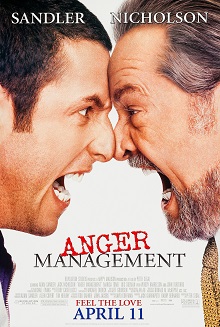
Anger Management (2003, directed by Peter Segal)


Dave (Adam Sandler), a timid man who has never gotten over being humiliated when he was a teenager, is sentenced to anger management after a slight argument on a plane is blown out of proportion by a taser-wielding shy marshal.  His therapist is Dr. Buddy Rydell (Jack Nicholson), whose techniques only seem to exacerbate Dave’s growing anger.  Among Dr. Rydell’s methods are giving Dave an unstable “anger buddy” named Chuck (John Turturro), ordering Dave to get revenge on the guy (John C. Reilly) who humiliated on his as a teenager, and also encouraging Dave to cheat on his girlfriend Linda (Maria Tomei) with a woman (Heather Graham) that they meet at bar.  Dave goes from timid to angry, Dr. Rydell starts dating Linda, and the whole thing is wrapped up with a totally implausible ending.

The idea of the star of Chinatown and Five Easy Pieces co-starring in an Adam Sandler comedy sounds like it should be exhibit #1 when it comes to talking about the decline of American cinema but I’ve always liked Anger Management.  Casting Jack Nicholson as the seemingly insane Dr. Rydell was an inspired choice and Nicholson gives a real performance in the film as opposed to just coasting on his already-established persona.  Anger Management came out a year after Adam Sandler’s first dramatic film, Punch-Drunk Love, and, even though Anger Management is a raunchy comedy from the start to finish, Sandler’s performance actually finds the reality in Dave’s situation.  Sandler plays Dave as being someone who is sincerely trying his best to get through his court-mandated anger management without losing control.  Nicholson and Sandler make for a surprisingly good team.

Of course, it’s an Adam Sandler comedy so it’s not for everyone.  The humor is often crude and the film’s final twist is so ridiculous that it can actually leave you feeling like you might need anger management.  But Anger Management does show how Jack Nicholson improves anything that he’s involved with and it also shows that Adam Sandler can act when he feels like it.  Anger Management also gave us the meme of Jack Nicholson nodding his approval, meaning the film and the performance will live forever.

No Holds Barred (1989, directed by Thomas J. Wright)


In No Holds Barred, Hulk Hogan plays a professional wrestler who is best-known for his mustache, his thinning blonde hair, and for ripping his shirt in half when he climbs in the ring.  Hulk Hogan is playing himself except that everyone in the movie calls him Rip Thomas.  Why is Hogan renamed Rip Thomas?  It seems strange because No Holds Barred features “Mean Gene” Okerlund and Jesse “The Body” Ventura as themselves and there’s nothing about Rip that’s any different from Hulk Hogan’s own wrestling persona.

Rip is the World Wrestling Federation Champion and is loved by fans across the globe.  Rip may be fierce in the ring but outside of the ring,  he loves children and is devoted to looking after his younger brother, Randy (Mark Pellegrino).  Tom Brell (Kurt Fuller), the evil owner of World Television Network, wants to harness the star power of Rip but, when Rip refuses to sign with WTN, Brell goes his own way and hires ex-convict Zeus (Tiny Lister) to star in The Battle Of The Tough Guys.

Rip still wants nothing to do with Brell, not even when Brell sends Samantha Moore (Joan Severance) to seduce him.  In fact, Rip is such a beacon of goodness that he brings Samantha over to his side.  But when Zeus puts Randy in the hospital, Rip has no choice but to seek revenge in the ring.

No Holds Barred is a movie with an identity crisis.  It’s a pro wrestling movie that was made to capitalize on Hulkamania and a lot of the humor was meant to appeal to the kids who were a huge part of Hogan’s fanbase but it’s also a movie in which people die, Samantha is nearly raped, and Randy is crippled by Zeus.  The movie lacks the sense of fun that has made professional wrestling a worldwide phenomena.  The most surprising thing about No Holds Barred is that Hulk Hogan has very little screen presence.  I don’t think anyone would expect him to be a great actor but he also shows little of the charisma that made him a phenomena back in the day.  Especially when compared to the ferocious Tiny Lister, Hogan is just boring.  Maybe that’s the difference between Rip Thomas and Hulk Hogan.

David Paymer has a small role in No Holds Barred, playing a nervous television executive.  Out of the cast, Paymer was the only one who later went on to be nominated for an Oscar and Jesse Ventura was the only one to later be elected governor of a state, at least so far.  Hulk Hogan’s only 71.  He’s still got time.

October True Crime: The Frozen Ground (dir by Scott Walker)


In the early 80s, Robert Hansen was a respected businessman in Anchorage, Alaska.  He owned a restaurant.  He was known for being a family man.  He held several local hunting records.  Almost everyone who met him described him as being friendly and good-natured.  In those days before the Internet, it wasn’t as if someone could do a Google search and discover that Hansen had a long criminal record in both Iowa and Alaska.  There was no way to know that Hansen had been a teenage arsonist and that had been arrested and charged with rape in the early 70s.  (The charges were ultimately plea bargained down to assault.)  Even those who did know about his background felt that Hansen had turned his life around and was now an upstanding member of society.

At the same time that Hansen was a respected member of the Anchorage community, he was abducting young women and, after holding them prisoner and raping him at his cabin, flying them into the Alaskan wilderness where he would then hunt them in his own version of The Most Dangerous Game.  It’s known, for sure, that Hansen murdered at least 18 women.  It’s felt that the number is much higher.  Along with his own good reputation, Hansen was protected by the fact that many of his victims were transients and sex workers.  Their disappearances were rarely reported to the police and, when they were, the police didn’t go out of their way to find them.  Much as happened with the Green River Killer in Washington State, Hansen was able to get away with his crimes for over 20 years not because he was particularly clever but because his victims were considered to be on the fringes of society.

The 2011 film, The Frozen Ground, is a fictionalized account of the investigation that led to Hansen’s arrest.  John Cusack plays Robert Hansen.  Nicolas Cage plays Jack Holcombe, a weary Alaskan state trooper who has to deal with uncooperative witnesses and beaurocratic indifference while investigating Hansen’s crimes.  Vanessa Hudgens plays Cindy Paulson, a 17 year-old sex worker who survives her encounter with Hansen but whose story is originally ignored by the police because of what Cindy does for a living.  Both Jack and Hansen comes to realize that Cindy is the only person who can positively identify the killer but Cindy has disappeared into the Anchorage underworld, working as a stripper and being manipulated by her pimp, Clate Johnson (50 Cent).

Taking full of advantage of the chilly atmosphere and the isolation of the Alaskan wilderness, The Frozen Ground is an effective journey into the heart of darkness, featuring excellent performances from Nicolas Cage and John Cusack.  Cusack smoothly alternates between being the arrogant hunter and the desperate prey while Cage’s weary expression captures the psychological toll of investigating the crimes of someone like Robert Hansen.  Of course, when the film came out, it received a lot of attention for featuring Vanessa Hudgens in a dramatic role.  Hudgens’s performance here continues the tradition of former Disney (and Nickelodeon) actresses trying to prove their range by playing an edgy role.  Though there’s a few scenes where she does seem to be trying too hard to make sure that we all know she’s capable of more than High School Musical, Hudgens is convincing for the most part.

As for the real-life Robert Hansen, he was sentenced to spend 461 years in prison for his crimes.  (Alaska has no death penalty.)  In 2014, three years after the release of this film, the 75 year-old Hansen died of natural causes while still incarcerated.

Icarus File No. 11: The Bonfire of the Vanities (dir by Brian De Palma)


In 2021, I finally saw the infamous film, The Bonfire of the Vanities.

I saw it when it premiered on TCM.  Now, I have to say that there were quite a few TCM fans who were not happy about The Bonfire of the Vanities showing up on TCM, feeling that the film had no place on a station that was supposed to be devoted to classic films.  While it’s true that TCM has shown “bad” films before, they were usually films that, at the very least, had a cult reputation.  And it is also true that TCM has frequently shown films that originally failed with audiences or critics or both.  However, those films had almost all been subsequently rediscovered by new audiences and often reevaluated by new critics.  The Bonfire of the Vanities is not a cult film.  It’s not a film about which one can claim that it’s “so bad that it’s good.”  As for the film being reevaluated, I’ll just say that there is no one more willing than me to embrace a film that was rejected by mainstream critics.  But, as I watched The Bonfire of the Vanities, I saw that everything negative that I had previously read about the film was true.

Released in 1990 and based on a novel by Tom Wolfe, Bonfire of the Vanities stars Tom Hanks as Sherman McCoy, a superficial Wall Street trader who has the perfect penthouse and a painfully thin, status-obsessed wife (Kim Cattrall).  Sherman also has a greedy mistress named Maria (Melanie Griffith).  It’s while driving with Maria that Sherman takes a wrong turn and ends up in the South Bronx.  When Sherman gets out of the car to move a tire that’s in the middle of the street, two black teenagers approach him.  Maria panics and, after Sherman jumps back in the car, she runs over one of the teens.  Maria talks Sherman into not calling the police.  The police, however, figure out that Sherman’s car was the one who ran over the teen.  Sherman is arrested and finds himself being prosecuted by a power-hungry district attorney (F. Murray Abraham).  The trial becomes the center of all of New York City’s racial and economic strife, with Sherman becoming “the great white defendant,” upon whom blame for all of New York’s problems can be placed.  Bruce Willis plays an alcoholic journalist who was British in the novel.  Morgan Freeman plays the judge, who was Jewish in the novel.  As well, in the novel, the judge was very much a New York character, profanely keeping order in the court and spitting at a criminal who spit at him first.  In the movie, the judge delivers a speech ordering everyone to “be decent to each other” like their mothers taught them to be.

Having read Wolfe’s very novel before watching the film, I knew that there was no way that the adaptation would be able to remain a 100% faithful to Wolfe’s lacerating satire.  Because the main character of Wolfe’s book was New York City, he was free to make almost all of the human characters as unlikable as possible.  In the book, Peter Fallow is a perpetually soused opportunist who doesn’t worry about who he hurts with his inflammatory articles.  Sherman McCoy is a haughty and out-of-touch WASP who never loses his elitist attitude.   In the film, Bruce Willis smirks in his wiseguy manner and mocks the other reporters for being so eager to destroy Sherman.  Hanks, meanwhile, attempts to play Sherman as an everyman who just happens to live in a luxury penthouse and spend his days on Wall Street.  Hanks is so miscast and so clueless as how to play a character like this that Sherman actually comes across as if he’s suffering from some sort of brain damage.  He feels less like a stockbroker and more like Forrest Gump without the Southern accent.  There’s a scene, written specifically for the film, in which Fallow and Sherman ride the subway together and it literally feels like a parody of one of those sentimental buddy films where a cynic ends up having to take a road trip with someone who has been left innocent and naïve as result of spending the first half of their life locked in basement or a bomb shelter.  It’s one thing to present Sherman as being wealthy and uncomfortable among those who are poor.  It’s another thing to leave us wondering how he’s ever been able to successfully cross a street in New York City without getting run over by an angry cab driver.

Because the film can’t duplicate Wolfe’s unique prose, it instead resorts to mixing cartoonish comedy and overwrought melodrama.  It doesn’t add up too much.  At one point, Sherman ends a dinner party by firing a rifle in his apartment but, after it happens, the incident is never mentioned again.  I mean, surely someone else in the apartment would have called the cops about someone firing a rifle in the building.  Someone in the press would undoubtedly want to write a story about Sherman McCoy, the center of the city’s trial of the century, firing a rifle in his own apartment.  If the novel ended with Sherman resigned to the fact that his legal problems are never going to end, the film ends with Sherman getting revenge on everyone who has persecuted him and he does so with a smirk that does not at all feel earned.  After two hours of being an idiot, Sherman suddenly outthinks everyone else.  Why?  Because the film needed the happy ending that the book refused to offer up.

Of course, the film’s biggest sin is that it’s just boring.  It’s a dull film, full of good actors who don’t really seem to care about the dialogue that they are reciting.  Director Brian De Palma tries to give the film a certain visual flair, resorting to his usual collection of odd camera angles and split screens, none of which feel at all necessary to the story.  In the end, De Palma is not at all the right director for the material.  Perhaps Sidney Lumet could have done something with it, though he would have still had to deal with the less than impressive script.  De Palma’s over-the-top, set piece-obsessed sensibilities just add to the film’s cartoonish feel.

The film flopped at the box office.  De Palma’s career never recovered.  Tom Hanks’s career as a leading man was momentarily derailed.  Bruce Willis would have to wait a few more years to establish himself as a serious actor.  Even the normally magnanimous Morgan Freeman has openly talked about how much he hated being involved with The Bonfire of the Vanities.  That said, the film lives on because  De Palma allowed journalist Julie Salomon to hang out on the set and the book she wrote about the production, The Devil’s Candy, is a classic of Hollywood non-fiction.  (TCM adapted the book into a podcast, which is how The Bonfire of the Vanities came to be featured on the station.)  Thanks to Salomon’s book, The Bonfire of the Vanities has gone to become the epitome of a certain type of flop, the literary adaptation that is fatally compromised by executives who don’t read.

Previous Icarus Files:

  1. Cloud Atlas
  2. Maximum Overdrive
  3. Glass
  4. Captive State
  5. Mother!
  6. The Man Who Killed Don Quixote
  7. Last Days
  8. Plan 9 From Outer Space
  9. The Last Movie
  10. 88

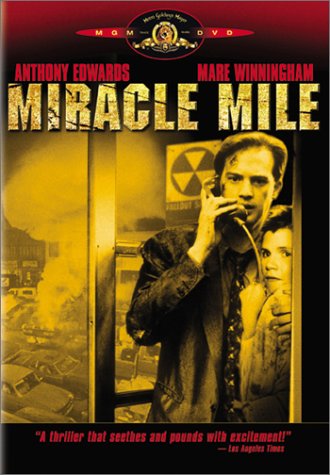
Film Review: Miracle Mile (dir by Steve De Jarnatt)


Last night, as I was watching the 1988 film, Miracle Mile, I found myself thinking about the fact that this film literally could not be made today.

No, it’s not because the film itself is about the treat of nuclear war.  Though nuclear war may no longer be as much of a cultural obsession as it apparently was back in the 80s, the fact of the matter is that the U.S., Russia, the UK, France, and China all still have nuclear weapons.  Pakistan, India, and North Korea all claim to have nuclear weapons.  It’s believed that Israel also has a few.  Iran is apparently working on developing an arsenal.  It’s estimated that there are currently 13,865 nuclear weapons in existence, 90% of which are divided between the U.S. and Russia.  That’s not even counting the threat of a terrorist group setting off a nuclear device.  In short, the threat of nuclear war is still very much a real one.

Instead, what truly makes Miracle Mile stand out as a film of its time, is the fact that almost the entire plot revolves around the character of Harry (played by Anthony Edwards) answering a Los Angeles pay phone at four in the morning.

Why is Harry answering a pay phone at 4 in the morning?  It’s because, earlier, he met Julie (Mare Winningham) at the La Brea Tar Pits and they fell instantly in love.  After spending most of the afternoon together, they made a date to meet at the local diner where Julie worked as a waitress.  Julie’s shift ended at midnight.  Harry went home to get a quick nap before picking her up.  Unfortunately, a power failure — one that was largely caused by Harry carelessly tossing away a cigarette — resulted in Harry’s alarm not going off.  At midnight, while Julie was standing outside the diner, Harry was asleep.

Harry doesn’t wake up until well-past 3 a.m.  After hastily getting dressed, Harry drives down to the diner.  When he arrives, he bumps into a tree and three rats fall off the branches and land on his car, which is a bit of an ominous omen.  (After watching the movie, I did a Google search and discovered that it’s actually not uncommon for rats to hang out in palm trees after dark.  I had no idea.  I’m glad I don’t live near any palm trees.)

By the time Harry arrives, Julie’s already gone.  From the payphone outside the diner, Harry calls Julie and leaves an apologetic message on her answering machine.  (Julie sleeps through it.)  Within minutes of Harry hanging up, the pay phone rings again.  Harry answers it, expecting to speak to Julie.  Instead, he finds himself talking to a panicked soldier who was trying to call his father but who dialed the wrong area code.  The soldier says that a war is about to break out and that everyone is going to die.  Suddenly, Harry hears what sounds like a gunshot.  Another voice gets on the phone and tells Harry to go back to sleep and forget about the call.

Of course, the reason why this story couldn’t take place in 2020 is pretty obvious to see.  No one uses pay phones anymore.  If the movie were made today. Harry would have just Julie on his own phone and then waited for her to call him back.  The soldier would never have misdialed his father’s area code.  Harry never would have gotten the message that the world was about to end and most of the subsequent events in Miracle Mile never would have happened.  Harry would have just sat in the diner and had a cup of coffee and waited for Julie to call until the inevitable happened.  In 2020, that would have been the movie.

So, let’s be happy that this film was made in 1988. during the time when pay phones were everywhere, because Miracle Mile is an excellent film.  Miracle Mile starts out as a romantic comedy, with Anthony Edwards and Mare Winningham making for an incredibly adorable couple.  Then, after Harry answers that pay phone, the movie grows increasingly grim as Harry desperately tries to make his way to Julie and arrange for the two of them to board a plane that a mysterious woman (Denise Crosby) has charted for Antarctica.  The problem, of course, is that in order to reach Julie, Harry is going to need the help of the type of people who are typically up and wandering around at 4 in the morning in Los Angeles.  Several people die as Harry tries to make it to Julie and, smartly, the film doesn’t just shrug off their deaths.  For the majority of the film, Harry isn’t even sure if there’s actually going to be an attack and it’s possible that he’s not only panicking over nothing but that he’s causing others to panic as well.  People are dying because of that phone call and Harry doesn’t even know whether it was real or not.  Even when full scale rioting breaks out, Harry doesn’t know if it’s because the world’s ending or because of a bad joke that he took seriously.  Transitioning from romantic comedy to dark comedy, Miracle Mile eventually becomes a nightmare as it becomes obvious that, even if Harry does reach Julie, escaping the city is not going to be easy.  The sun is rising and the truth is about that phone call is about to revealed….

Miracle Mile is a film that will get your heart racing.  On the one hand, Anthony Edwards and Mare Winningham have such a wonderful chemistry and they’re both just so damn likable that you want them to find each other and stay together.  Even if it means running the risk of being incinerated in a nuclear explosion, you want Harry and Julie to be with each other.  At the same time, you watch the movie with the knowledge that, even if they do manage to reunite, it might not matter because the world’s going to end.  Remarkably, almost everyone who Harry talks to about the phone call believes him when he says that a war is about break out.  Almost all of them have a plan to escape and, as a viewer, you get so wrapped up in the film that it’s only later that you realize that none of their plans made any sense.  Hiding out in Antarctica?  How exactly is that going to work?  Antarctica’s not exactly a place to which you impulsively move.  If there is truly no way to escape the inevitable, perhaps we should just be happy that Julie and Harry found love, even if it was right before the apocalypse.

Film Review: Midnight in Paris (dir. by Woody Allen)


Woody Allen’s latest film, Midnight in Paris, has an appealing premise behind it. 

Gil (Owen Wilson) is a Hollywood screenwriter who has come to Paris with his shallow fiancée Inez (Rachel McAdams) and her stuffy Republican parents (played by Kurt Fuller and Mimi Kennedy).  Disillusioned with American culture, Gil idealizes the Paris of the 1920s, the Paris that was home to Ernest Hemingway, F. Scott Fitzgerald, and James Joyce.  However, Inez and her parents are far less impressed with Paris and, as quickly become clear, with Gil himself.  While Inez spends her time with self-important “intellectual” Paul (a bearded Michael Sheen), Gil takes to wandering the streets of Paris at night.

One night, as Gil wanders around Paris, a vintage car approaches out of the shadows and the two well-dressed passengers in the back seat invite Gil to join them.  Gil does so and discovers that he’s been transported back to 1920s Paris.  He meets everyone from Hemingway (Corey Stoll) to Salvador Dali (Adrien Brody) to F. Scott and Zelda Fitzgerald (Tom Hiddleston and Alison Pill).  At the end of the night, Gil finds himself transported back to modern-day Paris.  Soon, Gil finds himself sneaking out at midnight every night so he can escape to the past, where he eventually meets and starts to romance an idealistic model named Adrianna (Marion Cotillard).  While Gil finds himself torn between his modern life and the past that he loves, he also begins to discover that the inhabitants of the 20s feel the same way about their present as he does about his.

The premise of the film itself is likable and one that I think anyone can relate to.  Who doesn’t wish that they could go back in the past and live with all the amazing people who they’ve only read about?  Myself, there are many eras that I often fantasize about finding myself in.  1920s Paris is definitely one of them but I’ve also occasionally dreamed of being in 1950s New York, having a threesome with Kerouac and Cassady or maybe being in Paris during the early days of the French new wave, appearing in movies directed by Rollin, Truffaut and Godard.  Ever since I read Peter Biskind’s Easy Riders and Raging Bulls, there’s been a part of me that wishes so much I could have been out in Hollywood or New York in the 1970s, hanging out on the beach with directors like Martin Scorsese, William Freidkin, Jon Milius, and even Peter Bogdonavich.  (But especially Freidkin, his terrible charisma just radiates from the page.) 

Still, Allen is smart enough as a screenwriter to know that everyone tends to idealizes the past, even those who we now idealize in the present.  Perhaps my favorite part of the film came when Wilson, while in the 1920s, sees a character getting into a horse-drawn carriage so that she can go back to the time that she idealizes as fiercely as he idealizes the 20s.

Midnight in Paris has a lot to recommend it.  Cotillard, despite the fact that she’s played the same idealized French mystery woman about a thousand times, gives a likeable performance and Rachel McAdams is hilariously shallow.  Michael Sheen, as well, makes a perfect stand-in for every pompous, self-important jerk who has ever talked down to you.  On the basis of his cameo appearance here as Dali, Adrien Brody really needs to consider doing more comedy.  He’s a lot more appealing when he’s being funny than when he’s trying to be a leading man.

At the same time, I have to admit that I wanted to like Midnight in Paris more than I actually did.  I like Owen Wilson as both an actor and a writer but he’s a little bit miscast here and the end result is that he occasionally seems like he’s trying too hard.  You just never buy him and McAdams as a couple and, as such, there’s really not much at stake as far as his romance with Cotillard is concerned. 

As well, I found it hard not to be a little bit disappointed with the way Allen presented 1920s Paris.  Though they were all well-cast and acted, Hemingway, the Fitzgeralds, Gertrude Stein (Kathy Bates), and all the rest just fell flat as actual characters.  Gil gets a chance to go into the past and essentially, he discovers that Hemingway was macho, the Fitzgeralds were neurotic and self-destructive, and that Dali didn’t make much sense.  Personally, I would be a bit let down if I got a chance to meet these icons and I discovered that essentially they just acted the exact same way that they acted in various PBS educational programs.

Despite this, Midnight in Paris is still a likable, frequently engaging comedy that works best as a tribute to a legendary and beautiful city that Allen (not to mention myself) obviously loves.  Flaws and all, this movie made me want to visit Paris once again (though Florence and Venice remains my favorite cities of all time) and, for that reason alone, it makes Midnight in Paris a film worth seeing.