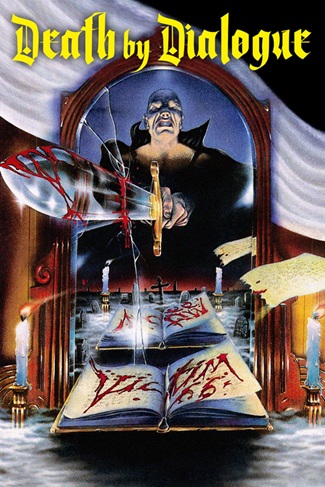
SOV Horror Review: Death by Dialogue (dir by Thomas DeWeir)


In this 1988 film, a group of college friends visit Uncle Ive (Theodore Lehmann), a crippled taxidermist who lives next door to a film set. (We never actually see this film set, but we are assured that it’s there.) Uncle Ive is taken care of by his devoted housekeeper, Ms. Camden (Judy Gordon). And he needs a lot of taking care of because, for some reason, there’s a haunted screenplay on his property. The title of the screenplay is constantly changing, but the one thing that remains consistent is the word “Victim.” The screenplay goes from being “Victim #69” to “Victim #70,” but what never changes is that there has to be a victim. The screenplay predicts how each person in the film is going to die. It’s not so much Death By Dialogue as it is Death By Rewrite.

Speaking of screenplays, this film has a strange one. It’s never really clear why the screenplay is on the property of Uncle Ive, but there are more than a few deaths that manage to be memorable. There’s a standard bursting into flames death. There’s a decapitation by scarf death. There’s a death by impalement on the blade of a bald demon. Strangest of all is the moment when one of the victims stumbles across an ’80s hair band that just happens to be performing behind some bushes. This leads to death by having one’s head smashed with a musical instrument. What’s odd is that we never really know where the band came from. Were they demons? Were they a legitimate band? What happened to them after the head smashing? How come no one heard them playing? Is this the sort of thing that regularly happens near film sets? I mean, I imagine that sort of thing happened at the Spahn Ranch on a daily basis, but I always figured that was the exception to the rule. Eventually, a big scary demon shows up and we’re left to wonder if he wrote the script and if he did so on spec. During WGA strikes, can the cursed screenplay still kill people, or do they have to hire a scab to write the death scenes until the strike is settled? Personally, if anyone wrote my death in a screenplay, I would hope that the studios would, at the very least, bring in an Oscar-winner to do an uncredited rewrite.

(Actually, now that I think about it, my best friend Evelyn and I wrote a pretty good slasher screenplay when we were in college. We gave the best death scenes to ourselves and the people we liked the most. The people we disliked just got dragged offscreen. I really should get it out of storage and do some work on it.)

Anyway, have I rambled enough? If this review seems a bit disjointed and random …. well, so does the film. But that’s not necessarily a bad thing. This is one of those films where the incoherent story actually works to the story’s advantage. It really does create the feeling of being at the mercy of beings that simply cannot be understood or reasoned with. Featuring a game cast and an intriguingly weird premise, Death by Dialogue is enjoyable almost despite itself. No rewrite was necessary!

Late Night Retro Television Review: Friday the 13th: The Series 3.11 “Year of the Monkey”


Welcome to Late Night Retro Television Reviews, a feature where we review some of our favorite and least favorite shows of the past! On Fridays, I will be reviewing Friday the 13th: The Series, a show which ran in syndication from 1987 to 1990. The entire series can be found on YouTube!

This week, Friday the 13th features an international adventure!

Episode 3.11 “Year of the Monkey”

(Dir by Rodney Charters, originally aired on January 15th, 1990)

Mushashi (John Fujioka) is a modern-day samurai who owns a cursed tea kettle.  When Jack, Micki, and Johnny come by his dojo in search of the kettle, Mushashi says that he will give it to them if they can prove that they are “honorable” by retrieving three cursed monkey statues that are currently in the possession an elderly businessman named Tanaka (Robert Ito).

Tanaka, however, has given the three wise monkey statues (“See No Evil,” “Hear No Evil,” and “Speak No Evil”) to his three children, Michiko (Tia Carrere), Koji (Leonard Chow), and Hitoshi (Von Flores).  Tanaka explains that each statue will challenge it’s owner.  Those who react in an honorable way will inherit Tanaka’s fortune.  Those who are dishonorable will get nothing.

Jack, Micki, and Johnny split up to retrieve the monkeys.  Johnny goes to New Yok to get Hear No Evil from Hitoshi.  Micki goes to Hong Kong to retrieve See No Evil from Koji.  Jack gets to stay in Canada (or Chicago or wherever this show is supposed to be taking place) so that he can retrieve Speak No Evil from Michiko.  What they don’t know is that Tanaka is several hundred years old.  Every time one of his children fails a monkey test, Tanaka gets a little bit younger.

It’s all about honor and dishonor and the code of the samurai in this week’s episode.  To be honest, it’s a bit of a mess.  First off, the title refers to the Chinese Zodiac but, other than our three regulars, all of the characters are meant to be Japanese.  Secondly, it’s never really clear how the cursed monkeys decide what is honorable and what is dishonorable.  Hitoshi uses his monkey to hear the thoughts of those around him and to take advantage of them.  That’s definitely dishonorable.  But then Koji is declared to be dishonorable even though his monkey did something on its own, without Koji telling it to.  Michiko refuses to use her monkey to her own advantage and is judged to be honorable.  She is told that it is now her duty to kill her father but instead, she commits suicide because killing her father would be dishonorable.  Then, Tanaka is eventually judged to be dishonorable because he stabs Musashi while Mushasi is not holding a weapon but that’s just because Mushashi dropped his sword at the very least minute.  It seems like Mushashi should be the dishonarable one for going out of his way to trick Tanaka.

My point is that this was a confusing episode.  The monkey were actually kind of cute but their powers made no sense.  I’m also not sure why experienced world traveler Jack decided to send Micki to Hong Kong instead of going himself.  In the end, this episode was pretty silly, despite the cool monkeys and the samurai-themed finale.

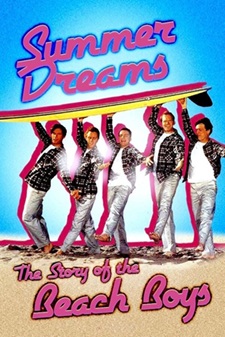
Summer Dreams: The Story of the Beach Boys (1990, directed by Michael Switzer)


Bruce Greenwood stars as Dennis Wilson and Greg Kean plays his brother Brian in this made-for-TV movie about the history of the Beach Boys.  The movie focuses on Dennis and his struggle with his abusive father (Arlen Dean Snyder) and his ultimately fatal addictions.  Bo Foxworth plays Carl Wilson, who doesn’t get a line until half an hour into the movie.  Andrew Myler plays Al Jardine and Casey Sanders plays Mike Love, both of whom are portrayed as being bystanders while Brian and Dennis create the Beach Boys sound.  (Jardine doesn’t get a single line in the movie.)  An actor named Michael Reid MacKay shows up briefly as Charles Manson, wearing a fake beard and crashing at Dennis’s pad in the 60s.  The movie portrays the Beach Boys transformation from being a clean-cut group of California teenagers to psychedelic pioneers by putting everyone in a wig once the late 60s arrive.

Summer Dreams claims to be The Story of the Beach Boys but next to no time is spent on the recording of Pet Sounds and Smile isn’t mentioned at all.  (Don’t go looking for Van Dyke Parks.)  Admittedly, this film was made before Brian Wilson made his touring comeback so I guess it would make sense that the story would focus on Dennis, who had died seven years previously.  (Brian is portrayed as being neurotic and sensitive but not mentally ill.)  Bruce Greenwood doesn’t do a bad job as Dennis and there definitely is a place for a movie that takes a real look at Dennis Wilson and his contributions to the group.  Dennis was, in many ways, as serious an artist as Brian but, due to his early death, he’s often overlooked.  But this film, mired as it is in biopic cliches and bland recreations of the 60s and 70s, doesn’t do justice to either Brian or Dennis or the group as a whole.

Watch Love & Mercy instead.