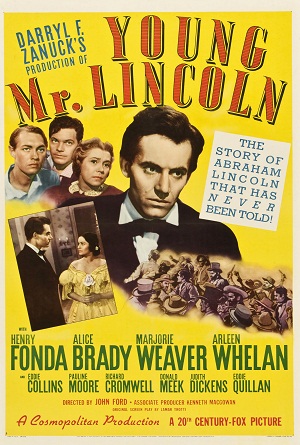
Shattered Politics #5: Young Mr. Lincoln (dir by John Ford)


YoungmrlincolnWay back in 1939, at the same time that Jimmy Stewart was conquering Washington in Frank Capra’s Mr. Smith Goes To Washington, the great director John Ford was making a film about another man who would eventually go to Washington.

In Young Mr. Lincoln, Henry Fonda plays the future 16th President.  Even though Fonda was probably far better looking than Abraham Lincoln ever was, he’s ideally cast in the role.  Along with being a very natural actor, Fonda personified a certain middle-of-the-country, stoic decency.  He played characters who were smart but never elitist and who were guided mostly by common decency.  In short, his screen persona was everything that people tend to think about when considering Abraham Lincoln.

As for the film itself, it begins with Lincoln as a simple storekeeper who accepts, as payment for groceries, a barrel of old books.  After reading the books and having a conversation with his doomed first love, Anne Rutledge (Pauline Moore), Lincoln decides to learn the law.

Years later, now a poor-but-honest lawyer, Abraham Lincoln arrives at Springfield, Illinois, sitting a top mule because he can’t afford a horse.  Lincoln opens a law office, awkwardly courts the rich and spoiled Mary Todd (Marjorie Weaver), and eventually defends two brothers who have been accused of murder.  While the case’s prosecutor (played by Donald Meek) may have a better education, he can’t compete with Lincoln’s common sense and ability to relate to the common people.

Obviously, the whole point behind Young Mr. Lincoln is that it’s about the early life of an American hero.  You watch the entire film with the knowledge that Lincoln is going to be the man who eventually leads the U.S. during the Civil War and who frees the slaves.  The viewer knows that Lincoln is going to be a great man, even if nobody else does and a good deal of the film’s effectiveness come from the moments when Fonda will strike an iconic pose or will casually deploy a familiar phase and you’re reminded of just who exactly it is he’s playing.

But, and this is why Young Mr. Lincoln remains a great film, the important thing is that the film is just effective when viewed as being a portrait of a dedicated lawyer trying to prove the innocence of his clients.  Fonda is compelling as both a future President and as an honest man trying to do the right thing.  Ultimately, the film would be just as compelling even if it was called Young Mr. Jones and didn’t open with soaring, patriotic music and end with a shot of the Lincoln Memorial.

It’s interesting to compare Young Mr. Lincoln to some of the other films made about Abraham Lincoln.  It’s a far more assured film than D.W. Griffith’s Abraham Lincoln and, needless to say, Henry Fonda makes for a better Lincoln than Walter Huston did.  At the same time, it’s far more naturalistic and less overly manipulative film than Steven Spielberg’s Lincoln.  In the end, it’s a good film and a great tribute to our 16th President.

And you can watch it below!

44 Days of Paranoia #24: The Informer (dir by John Ford)


For today’s entry in the 44 Days of Paranoia, I want to take a look at John Ford’s Oscar-winning 1935 film, The Informer.

The Informer takes place in Dublin in 1921, during the Irish War of Independence and shortly before the creation of the Irish Free State.  Friendly but stupid and irresponsible Gypo Nolan (Victor McLaglen) has been kicked out of the Irish Republican Army and is pretty much a pariah among his own people.  His prostitute girlfriend, meanwhile, only wants to raise enough money to book passage for America and start a new life.

Gypo sees an opportunity when he runs into his former IRA colleague Frankie (Wallace Ford), who is one of the few people to treat Gypo kindly.  Frankie is also fugitive who has a £20 bounty on his head.  Gypo impulsively turns informer and lets the British know where Frankie is hiding.

When Frankie is killed, the guilt-ridden Gypo uses the reward money to buy a bottle of whiskey and then spends the rest of the day drunk and trying to convince the IRA the Frankie was betrayed by a nonexistent man named Mulligan.

When it was initially released in 1935, The Informer did well with both audiences and critics.  It was nominated for Best Picture and won Oscars for John Ford, Victor McLaglen, and screenwriter Dudley Nichols.  However, when viewed today, it’s easy to see the flaws in The Informer.  The film feels stagey, heavy-handed, and rather melodramatic.

And yet, with all that in mind, I still like The Informer.

Some of that, of course, is because it’s a film about Ireland and, specifically, it’s a film about how the Irish Catholics were oppressed by British occupiers.  This is a topic that I find to be endlessly fascinating and, speaking a someone who still has family living in Ardglass, County Down, I have to admit that I have a weakness for films (like this one) which tend to take the Irish side of things.

On a technical level, John Ford’s direction holds up pretty well.  There’s a few scenes where the story’s theatricality gets the better of him but, for the most part, Ford does a good job of capturing Gypo’s dreary existence and maintaining a level of suspense, despite the fact that Gypo’s fate is obvious to the audience long before it’s obvious to anyone in the film.  In Ford’s hands, the fog-filled and shadowy streets of Dublin serve as a representation of Gypo’s increasingly desperate and paranoid mindset.  Ford’s Dublin is a world where danger can come out of nowhere and where there’s no place for a big and stupid target like Gypo to hide.

The film is dominated by Victor McLaglen’s theatrical performance.  Again, there a few moments where McLaglen’s performance is a bit too broad but, for the most part, his boisterous approach works will for his well-meaning but not too smart character.  One can see not only why the film’s characters are weary of Gypo  but also why they have a difficult time rejecting him all together.

The Informer may not be perfect but it’s still worth tracking down and seeing.

Other Entries In The 44 Days of Paranoia 

  1. Clonus
  2. Executive Action
  3. Winter Kills
  4. Interview With The Assassin
  5. The Trial of Lee Harvey Oswald
  6. JFK
  7. Beyond The Doors
  8. Three Days of the Condor
  9. They Saved Hitler’s Brain
  10. The Intruder
  11. Police, Adjective
  12. Burn After Reading
  13. Quiz Show
  14. Flying Blind
  15. God Told Me To
  16. Wag the Dog
  17. Cheaters
  18. Scream and Scream Again
  19. Capricorn One
  20. Seven Days In May
  21. Broken City
  22. Suddenly
  23. Pickup on South Street