Days of Paranoia: The Gauntlet (dir by Clint Eastwood)


In 1977’s The Gauntlet, Dirty Harry is sent….

Oh wait, sorry.  This is not a Dirty Harry movie.  It sure feels like a Dirty Harry movie but it’s not.  And really, the character that Clint Eastwood plays in this movie, Phoenix Detective Ben Shockley, is different from Dirty Harry Callahan.  Shockley is a cynical (and single) detective who does things his own way.  He’s got that in common with Callahan.  But Shockley is also an alcoholic and that’s something that Harry would never allow himself to become.  Harry may be unpredictable but he’s disciplined and he’s always in control.  The other big difference is that Shockley has a little more faith in his fellow cops than Harry does.  As a result, Shockley gets set-up in a trap that Harry would have seen coming from miles away.

Shockley is sent to Las Vegas to pick up a prostitute named Augustina and bring her back to Arizona.  Augustina — who goes by Gus — is played by Sondra Locke.  This was the second film that Eastwood and Locke made together.  As a result of preparing for today’s Eastwood marathon, I watched all of the Eastwood/Locke films.  The Gauntlet features Locke’s best performance opposite Eastwood.  (She was good in The Outlaw Josey Wales but her role was also fairly small and simple.)  As opposed to her later films, Locke actually has a good deal of romantic chemistry when Eastwood in this film and, even more importantly, she actually seems invested in the role.  She plays Gus as being a feisty asskicker.  It doesn’t matter that she’s in jail or that she’s handcuffed or that she’s been escorted to another state.  Gus isn’t going to let anyone tell her what to do.   It’s impossible not to root for both her and Shockley in this film.

Of course, it turns out that Shockley has been set up.  Phoenix Police Commissioner Blakelock (William Prince) and District Attorney John Feyderspiel (Michael Cavanaugh) both have their own reasons for not wanting Gus to make it to Phoenix and they’re both willing to sacrifice Shockley to get to her.  They assumed that Shockley, being an alcoholic, would be easy to defeat.  Did they not consider that, alcoholic or not, Ben Shockley is played by Clint Eastwood?  Every attempt that is made to stop him just makes Shockley all the more determined to get Gus to Phoenix.  The film becomes a particularly violent take on It Happened One Night, going as far as to have Gus and Shockley take over a bus on their way to Phoenix.

Ah, the bus.  The Gauntlet climaxes with a scene in which literally thousands of bullets are fired into a bus that Shockley and Gus are driving through Phoenix.  It’s an exciting sequence, one that’s so gloriously over-the-top that you can’t help but feel that Eastwood was poking fun at his own persona.  At the same time, the sequence also works as a commentary on the blind obedience necessary for an authoritarian to come to power.  The cops who have lined up to shoot at the bus open fire when they’re ordered to, without asking why a bus has to be riddled with bullets.  Eastwood manages to mix a healthy dose of paranoia with his satire.

Though the plot (much like the bus) is riddled with holes, The Gauntlet‘s an entertaining film.  Between Eastwood and Locke’s chemistry and the explosive action sequences, The Gauntlet is a film you can’t look away from.

Film Review: Kelly’s Heroes (dir by Brian G. Hutton)


1970’s Kelly’s Heroes takes place in France during the Second World War.  The American army is moving through the country, liberating it town-by-town.  Private Kelly (Clint Eastwood) is a former lieutenant who was busted down in rank after leading a disastrous raid on the wrong hill.  (It was the fault of the generals but Lt. Kelly was set up as a scapegoat.)  When Kelly learns that the Germans are hiding a huge amount of gold in an occupied town, he gathers together a team of weary soldiers, misfits all, and plans to go AWOL to steal the gold for themselves.

Kelly’s Heroes was one of the big budget studio films that Eastwood made after finding stardom in Europe with Sergio Leone’s Spaghetti westerns.  This is very much an ensemble film, in the vein of The Dirty Dozen.  Indeed, Eastwood’s co-star, Telly Savalas, was in The Dirty Dozen.  Here, Savalas plays Big Joe, the sergeant who isn’t sure that he wants to put his men in danger for gold that may or may not exist.  Don Rickles plays Crapshoot who is …. well, imagine Don Rickles in the middle of World War II and you have a pretty good idea of who Crapshoot is.  Stuart Margolin, Harry Dean Stanton, Perry Lopez, Gavin MacLeod shows up as soldiers.  Carroll O’Connor plays the bombastic general who mistakes Kelly’s attempts to go AWOL for a brilliant tactical maneuver,  Like all of the senior officers in this film, O’Connor’s general is a buffoon.  Kelly’s Heroes was made during the Vietnam War and, much like Patton (released the same year), it attempts to appeal to both the establishment and the counterculture by making the heroes soldiers but their bosses jerks.

And that brings us to Donald Sutherland, who plays a tank commander named Oddball.  You may not have know this but apparently, there were hippies in the 40s!  Actually, I don’t think that’s true but there’s really no other way to describe Oddball than as a Hollywood hippie.  He’s a blissed-out, spacey guy who thinks nothing of accidnetally driving his tank through a building.  The films ask us to believe that the long-haired and bearded Oddball is a World War II tank commander and Sutherland is such a likable presence that it’s temping to just go with it.  Oddball was obviously included to bring in “the kids” but he does generate some needed laughs.  This is a very long movie and the comedic moments are appreciated.

Kelly’s Heroes is two-and-a-half hours long and it definitely could have been shorter.  Director Brian Hutton allows some scenes to drag on for a bit too long and he sometimes struggles to balance the moments of comedy with the moments of violent drama (quite a few character dies) but he does get good performances from his ensemble.  Eastwood’s taciturn acting style is nicely matched with Savalas’s more expressive style and it’s hard not smile at Don Rickles, insulting everyone as if they were guests at Joe Gallo’s birthday party.  The film, at times, doesn’t seem to know if it wants to be a satire or a straight heist film but the cast keep things watchable.  Eastwood even gets to show a few hints of the dry sense of humor that always hid behind the perpetually bad mood that often seemed to hang over him in his early films.  Whatever flaws the film may have, it was a box office success.  One year after this release of Kelly’s Heroes, Eastwood would make history as Dirty Harry.

The Border (1982, directed by Tony Richardson)


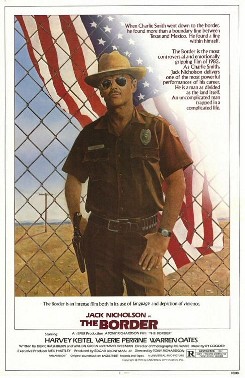
Charlie Smith (Jack Nicholson) gets a job with the Texas border patrol and goes from scrounging in a California trailer park to living the high life in a duplex in El Paso.  His wife (Valerie Perrine) is looking forward to spending all the money that he’ll be making as a border agent.  But then Charlie discovers that his bigoted superior (Warren Oates!) and his partner (Harvey Keitel) are running a human smuggling ring.  When the baby of a young Mexican woman (Elpidia Carrillo) is kidnapped and sold to an illegal adoption ring, Charlie is finally forced to take a stand.

The Border seems to be one of Jack Nicholson’s forgotten films and it really can’t compete with some of the other movies that Nicholson was making around the same time.  Compared to films like The Shining, Terms of Endearment, and The Postman Always Rings Twice, The Border really does feel and look like a poorly paced made-for-TV movie.  British director Tony Richardson doesn’t really seem to know what type of movie he wanted The Border to be or what he wanted to say about immigration.  This is the type neo-Western that Sam Peckinpah could have worked wonders with but Tony Richardson just doesn’t seem to have any feel for the material.

Still, Jack Nicholson is pretty good here, playing the type of weary character that he specialized in during the pre-Batman portion of his career.  I especially liked the scenes that he shared with Valerie Perrine, who gave a good performance as someone who viewed buying a waterbed as being the height of luxury.  Harvey Keitel’s performance sometimes felt too familiar.  He’s played a lot of similar villains but he and Nicholson act well together.

And finally, Warren Oates in this movie, bringing his rough-hewn authenticity to his role.  This was the last of Oates’s films to be released before his premature death.  Blue Thunder and Tough Enough were both released posthumously.  Warren Oates is an actor who was only 52 when he died.  Whenever I see him onscreen, I think of all the great performances he would have given if he had only made it through the 90s.

Late Night Retro Television Review: CHiPs 3.8 “Hot Wheels”


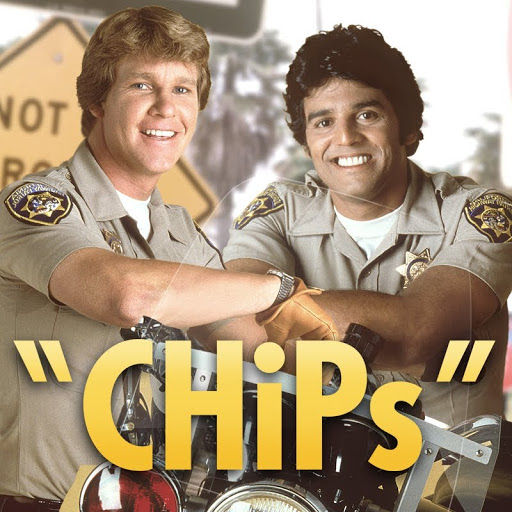
Welcome to Late Night Retro Television Reviews, a feature where we review some of our favorite and least favorite shows of the past!  On Mondays, I will be reviewing CHiPs, which ran on NBC from 1977 to 1983.  The entire show is currently streaming on Prime!

Last night’s review of CHiPs was pre-empted by a sudden storm.  Here it is now, in its entirety,

Episode 3.8 “Hot Wheels”

(Dir by John Florea, originally aired on November 3rd, 1979)

Ponch is still in the hospital, recovering from last week’s accident.  Still, because he’s Ponch, he’s the one who figures out that a bunch of disgruntled fireman are using city trucks to commit their jewelry thefts.  Hey, wait a minute.  Last week’s episode was also about jewelry thefts.  Admittedly, CHiPs was a show that tended to recycle plots but, even by CHiPs standards, this is one of those coincidences that leaves you wondering what exactly was going on in the writer’s room.

Actually, it’s easy to guess.  Erik Estrada really was injured while filming an episode.  The cast that he wears throughout this episode was real and, as easy as it can be to make fun of his overexpressive acting and his tendency to lose his shirt every other scene, you do have to respect that Estrada showed to film this episode at all.  With Estrada injured, one gets the feeling that this episode, just like last week’s, was quickly rewritten to cover the situation.

Baker gets a temporary partner in this episode.  It’s the return of his former motorcycle mate, John Clayton!  Clayton was apparently Baker’s partner before Ponch.  Clayton has a reputation for being a practical joker,  It’s all anyone can talk about.  Clayton is a legendary prankster!  They really want us to know that Clayton’s a fun guy before he shows up and we discover that he’s played by Andrew Robinson, the actor who is best-known for playing the Scorpio Killer in Dirty Harry.  Robinson wears a mustache as Clayton, probably in an attempt to keep 1979 audiences from looking at the screen and going, “Hey, I remember that guy hijacking a school bus!”

(I should mention that Andrew Robinson himself was a committed pacifist when he filmed Dirty Harry, to the extent that he actually flinched whenever he had to shoot the killer’s gun and he actually traumatized himself while filming the school bus hijack.  He actually sounds like a pretty nice guy who just happened to play one of the most loathsome screen villains of all time.)

Baker works with Clayton and it must be said that Larry Wilcox does seem to be noticeably happier when he’s acting opposite Robinson than he ever did when he was acting opposite Estrada.  The episode features Clayton performing a heroic and dangerous rescue at one point and it’s easy to see that that scene was originally conceived with Estrada in mind.  It’s also easy to imagine Estrada flashing his big grin at the end of the scene while Robinson, on the other hand, plays up the fact that anyone, even a dedicated cop, would be absolutely exhausted after all that.

Robinson does a good job as Clayton and it’s always fun to see Martin Kove play a villain on show like this.  This was a good episode.  Estrada, I assume, will be back on his bike next week.

The Long Rope (1961, directed by William Whitney)


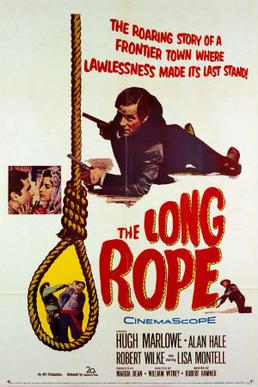
The time is the late 19th century and there’s been a murder in the territory of New Mexico.  Someone has gunned down Jim Matthews (Steve Welles) and store owner Manuel Alvarez (John Alonzo) has been arrested.  Everyone in town says that Jim was fooling around with Manuel’s beautiful wife, Alicia (Lisa Montell).  Manuel insists that he’s innocent but Jim was the brother of the town’s most powerful and richest land owner, Ben Matthews (Robert J. Wilke).  Ben is already having a gallows built so that Manuel can be hanged in the town square and it doesn’t look like there’s anything that Sheriff John Millard (Alan Hale, Jr. — yes, the Skipper) can do to stop him.

However, Federal Judge Jonas Stone (Hugh Marlowe) is determined to make sure that Manuel gets a fair trial.  When it becomes obvious that the Matthews family has no intention of letting that happen, Judge Stone launches his own investigation.  Believing Manuel to be innocent, Stone knows that he has to find the real killer before the gallows are built and Manuel is lynched by the mob.

A low-budget western with a 61-minute running time, The Long Rope is a surprisingly adult western, one that comes out strongly and directly against both lynching and the town’s racism.  With the Matthews family representing the brutal “old ways,” and Judge Stone representing a more enlightened and fair system of justice, it’s up to the town to decide who they will follow.  Hugh Marlowe brings a lot of gravitas to his role as the stern but compassionate Judge Stone while Lisa Montell makes a strong impression as Manuel’s rebellious wife.  Robert J. Wilke is an effective villain and even Alan Hale, Jr. gives a good performance once you stop thinking of him as being the Skipper.

One final note of interest: John A. Alonzo, who played Manuel in The Long Rope, went on to become an award-winning cinematographer.  Among Alonzo’s credits, as a cinematographer: Harold and Maude, Chinatown, The Bad News Bears, Black Sunday, Scarface, Norma Rae, and Close Encounters of Third Kind.

Goin’ South (1978, directed by Jack Nicholson)


Jack Nicholson was not an overnight success.

Nicholson was 17 years old when he first came to Hollywood in 1954.  Looking to become an actor, Nicholson toiled as an office worker at the MGM cartoon studio, took acting classes, and went to auditions.  It would be four years before he even landed his first role, the lead in the Roger Corman-produced The Cry Baby Killer.  When that film failed to become a hit, Nicholson spent the next ten years doing minor roles and occasionally starring in a B-picture.  He auditioned for some big parts, like Benjamin Braddock in The Graduate, Buck Barrow in Bonnie and Clyde, and Guy Woodhouse in Rosemary’s Baby, but his big break continued to allude him.  By 1969, Nicholson was so disillusioned with acting that he was planning to instead pursue a career as a director.  However, before Nicholson officially retired from the acting game, he received a call from the set of Easy Rider.  Depending on who you ask, Rip Torn, who had previously been cast in the role of alcoholic George Hanson, had either quit or been fired.  Bruce Dern, the first choice to replace Torn, was busy filming They Shoot Horses, Don’t They?  Nicholson agreed to step into the role and the rest is history.

Easy Rider may have made Jack Nicholson one of the world’s biggest film stars but he never lost his ambition to direct.  In 1971, he made his directorial debut with Drive, He Said, a film about campus unrest.  At the time, the film flopped at both the box office and with critics and quickly sunk into obscurity.  (It has subsequently been rediscovered and, in some cases, positively reevaluated.)  After the failure of Drive, He Said, it would be another seven years before Nicholson again got a chance to direct.

Nicholson’s second film as a director, Goin’ South, is a comedic western.  Nicholson plays Henry Lloyd Moon, an unsuccessful outlaw who used to ride with Quantrill’s Raiders.  When Moon is captured in Longhorn, Texas, he is sentenced to be hanged.  Fortunately, for Moon, Longhorn has a special ordinance.  Any man condemned for any crime other than murder can be saved from the gallows if a local woman agrees to marry him and take responsibility for his good behavior.  As a result of this ordinance, Longhorn is populated almost exclusively by single women and reformed outlaws.

While standing on the gallows, the cocky Moon is stunned to discover that none of the women want to marry him.  Finally, an old woman emerges from the crowd and announces that she’ll become Moon’s wife.  When Moon hops off the gallows and thanks her, the woman drops dead.  Fortunately, another, younger woman, Julia Tate (Mary Steenburgen, making her film debut), steps forward.

Once they’re married, the lecherous Moon discovers that Julia is a virgin and that the only reason she married him was so she could force him to work in the secret gold mine that’s hidden underneath her property.  The railroad will soon be taking over the land and Julia wants to get all of the gold before she leaves town for Philadelphia.  Though Julia, at first, wants nothing to do with Moon, he eventually wears her down through sheer persistence and the two fall in love.

Complicating matters is Deputy Towfield (Christopher Lloyd), who is upset because he feels that Julia was meant to be his wife.  Also, the members of Moon’s former gang (including Danny DeVito and Veronica Cartwright) show up at Julia’s house and discover the truth about the mine.

Goin’ South gets off to a good start.  The scene on the gallows, where Moon waits for someone to marry him and save his life, is genuinely funny and Nicholson and Steenburgen have a playful chemistry for the first hour of the movie.  Nicholson leers even more than usual in this film but the script is written so that the joke is always on Moon.  Much of the film’s humor comes from Moon always overestimating both his charm and his cleverness.  However, once Moon and Julia finally consummate their marriage, the movie loses whatever narrative momentum it may have had and gets bogged down with the subplots about Towfield and Moon’s gang.  There are funny moments throughout but the story gets away from Nicholson and the film is reduced to a series of set pieces, none of which build up to much.

Not surprisingly, Nicholson gets good performances from his cast, which is largely made up by the members of his 1970s entourage.  Along with Danny DeVito and Christopher Lloyd, longtime Nicholson associates like Tracey Walter, Ed Begley Jr., Richard Bradford, Jeff Morris, and Luana Anders all appear in small roles.  John Belushi plays the tiny role of Deputy Hector.  (Goin’ South was actually the first film in which Belushi was cast, though production didn’t actually begin until after Belushi had finished working on National Lampoon’s Animal House.)  Unfortunately, despite all of the good performances, the script doesn’t do much to develop any of the characters.  Belushi especially feels underused.  (Because Belushi had moved on to Animal House by the time the film went into post-production, Nicholson ended up dubbing several of Belushi’s lines himself.)

Drive, He Said was largely considered to have failed at the box office because Nicholson remained behind the camera so he took the opposite approach with Goin’ South.  Nicholson is in nearly every scene and he gives one of his broadest performances.  It works for the first half of the film, when Moon is constantly trying to get laid and failing every time.  But, during the second half of the movie, Nicholson’s failure to reign in his performance works to the film’s detriment.  When the movie needs Nicholson to be romantic, he’s still behaving like a horny cartoon. Whenever he looks at Mary Steenburgen, it seems as if his eyes should be popping out of his head, Tex Avery-style.  He’s an entertaining cartoon, but a cartoon nonetheless.  As a result, Goin’ South is often funny but it still feels very inconsequential.

Like Drive, He Said, Goin’ South was both a critical and a box office flop and it temporarily turned Nicholson off of directing.  It would be another 12 years before he would once again step behind the camera.  In 1990, Nicholson directed The Two Jakes, the sequel to one of his best films, Chinatown That would be Nicholson’s last film as a director.  Nicholson acted for another 20 years, following the release of The Two Jakes.  To date, he made his final screen appearance in 2010, with a supporting role in James L. Brooks’s How Do You Know.  Nicholson has disputed claims that he’s officially retired, saying that he’s instead just being more selective about his roles.  Even though it’s been ten years since we last saw him on screen, Jack Nicholson remains an American icon and a living legend.

Film Review: Payday (dir by Daryl Duke)


First released way back in 1972, Payday tells the story of Maury Dann (played by the late, great Texas actor, Rip Torn).

Maury is a country singer.  He sings songs about wholesome values and good country girls.  His music isn’t exactly ground-breaking but his fans still love him and it’s easy to see why.  The movie opens with Maury performing in a small, country club and his charisma is undeniable.  He has a good singing voice and he easily dominates the stage.  Between songs, he flashes a friendly but slightly mischievous smile.  After his performance, he is perfectly charming when he meets his older fans.  And, when he meets a younger fan, he takes her outside and has sex with her in the backseat of his Cadillac.  He does this while her boyfriend is wandering around the parking lot looking for her.

Maury is a man who is in control when he’s on stage.  However, when he’s off-stage, the real Muary comes out.  When he’s not singing and basking in the applause of his fans, Maury is …. well, he’s a total mess.  Actually, mess doesn’t quite do justice to just how screwed up Maury Dann is.  He cheats on his girlfriend.  He pops pills constantly.  He treats the members of his band with a casual cruelty.  When Maury’s off-stage, that charming smile changes into a rather demented smirk.  Just when you think Maury’s done the worst possible thing that he could do, he does something even worse.

Payday follows Maury as he is driven through the South, singing songs and ruining lives.  Along the way, he gets into a fight with his mother and then a fight with his ex-wife and eventually, a fight with the boyfriend of that younger fan from the start of the movie.  We watch as Maury drinks, bribes DJs, and frames his employees for all sorts of crimes.  It’s an episodic film about a man who seems to understand that he’s destined to self-destruct no matter what he does.

Payday is very much a film of the early 70s.  Though the film may be about a self-destructive country star, it’s hard not to suspect that — as with most of the films from that era — Maury and his adventures were meant to be a metaphor for America itself.  Country Western is a uniquely American genre and by showcasing the damage that Maury does to everyone around him, the film seems to be suggesting that Maury’s sins are also America’s sins.  The people who idolize Maury and make him a star despite all of his flaws are the same people who reelected Richard Nixon and supported sending young men to die in Vietnam.

It’s all a bit much for one film to carry on its shoulders and spending two hours with Maury Dann is not exactly a pleasant experience but the film works because of the performance of Rip Torn.  When Torn died earlier this week, there was a lot of discussion about which performance was his best.  Quite a few people on twitter cited his roles in Defending Your Life and The Larry Sanders Show.  I personally mentioned The Man Who Fell To Earth and Maidstone.  But if you really want to see what made Rip Torn such a great actor, you simply must watch Payday.  Maury is a jerk with little in the way of redeeming qualities but Torn gives such a fearless and cheerfully demented performance that it’s impossible not to get caught up in his story.  As much as you want to look away, you can’t because Rip Torn keeps you so off-balance that you cannot stop watching.  Torn is smart enough to play Maury with just enough self-awareness that the character becomes fascinatingly corrupt as opposed to just being a self-centered jerk.

Finally, Payday simply feels authentic.  The film was made way before my time but I’m a Southern girl who has spent enough time in the country to know that the backroads of rural America haven’t changed that much over the past few decades.  At times, while watching Payday, I felt like I was back on my granduncle’s farm in Arkansas, walking through high grass and listening to the cicadas while watching the sun go down.

Payday is definitely a film that’s worth the trouble to track down.  Watch it and appreciate the fearless genius of the great Rip Torn.

2014 in Review: The Best of Lifetime and SyFy


sharknado-2-poster

Hello there and welcome to January!

This is the time of year that the Shattered Lens usually takes one final look back at the best and worst of the previous year’s offerings in cinema, television, literature, and music!  Last year, I kicked things off by taking a look at the best that the SyFy network had to offer.

Unfortunately, SyFy didn’t produce as many original films in 2014 as they did in 2013.

However, my beloved Lifetime network remained a consistent showcase for some of the best and worst melodrama that one could hope for.

With that in mind, here are my nominees for the best films and performances that were featured on either the SyFy or the Lifetime network last year!  As always, winners are listed in bold.

LB_BLOODHANDS_081220#83509A.jpg

Best Film

Battle of the Damned

Flowers in the Attic

Grumpy Cat’s Worst Christmas Ever

*Lizzie Borden Took An Axe*

Sharknado 2

Starving in Suburbia

Best Actress

Kate Beckinsale in The Trials of Cate McCall

Maria Bello in Big Driver

Annie Heise in The Good Mistress

Tara Reid in Sharknado 2

*Christina Ricci in Lizzie Borden Took An Axe*

Kierna Shipka in Flowers in the Attic

Best Supporting Actress

Kendra Anderson in The Good Mistress

*Ellen Burstyn in Flowers in the Attic*

Clea DuVall in Lizzie Borden Took An Axe

Heather Graham in Petals on the Wind

Tina Ivlev in Death Clique

Izabella Miko in Starving in Suburbia

Best Actor

Trevor Donavon in Bermuda Tentacles

Mason Dye in Flowers in the Attic

Michael Keaton in Blindsided

Dolph Lundgren in Battle of the Damned

Patrick Muldoon in Finders Keepers

*Ian Ziering in Sharknado 2*

Best Supporting Actor

James Cromwell in The Trials of Cate McCall

David Field in Battle of the Damned

*Griff Furst in Status Unknown*

Judd Hirsch in Sharknado 2

Mark McGrath in Sharknado 2

John Savage in Bermuda Tentacles

Best Director

Doug Campbell for Death Clique

Deborah Chow for Flowers in the Attic

Anthony C. Ferrante for Sharknado 2

*Nick Gomez for Lizzie Borden Got An Axe*

Christopher Hutton for Battle of the Damned

Tara Miele for Starving in Suburbia

Best Screenplay

Kayla Alpert for Flowers in the Attic

Tim Hill and Jeff Morris for Grumpy Cat’s Worst Christmas Ever

Stephen Kay for Lizzie Borden Took An Axe

Thunder Levin for Sharknado 2

*Tara Miele for Starving in Suburbia*

Griff Furst and Marcy Holland for Status Unknown

Flowers in the Attic

Tomorrow, I’ll continue my look back at 2014 by revealing my picks for the 16 worst films of 2014!

Previous Entries in Our Look Back At 2014:

Things That I Dug In 2014 Off The Top Of My Head