Bonus Horror On The Lens: The Devil Bat (dir by Jean Yarborough)


Because today would have been Bela Lugosi’s birthday, it seems appropriate to showcase him in a bonus horror on the lens!

In the 1940 film, The Devil Bat, the owners of a company in the small town of Heathville are super-excited because they’re going to be given their head chemist, Dr. Paul Carruthers (Bela Lugosi), a bonus check of $5,000.  However, since Carruthers’s inventions have made millions for the company, he is offended by the small check and decides that the best way to handle this would be to sue in court and demand fair compensation …. just kidding!  Instead, Dr. Carruthers sends his army of giant bats to kill the families of his employers.

The Devil Bat was produced by Production Releasing Corporation, a poverty row studio that specialized in shooting quickly and cheaply.  Going from Universal to PRC was technically a step down for Lugosi but The Devil Bat is actually an excellent showcase for Lugosi and he gives one of his better non-Dracula performances as the embittered Dr. Carruthers.  Indeed, one can imagine that Lugosi, who played such a big role in putting Universal on the map, could relate to Carruthers and his bitterness over not being fairly rewarded for the work he did to make others wealthy.

Enjoy The Devil Bat, starring the great Bela Lugosi!

4 Shots From 4 Horror Films: The 1940s Part Three


This October, I’m going to be doing something a little bit different with my contribution to 4 Shots From 4 Films.  I’m going to be taking a little chronological tour of the history of horror cinema, moving from decade to decade.

Today, we look at the latter half of the 1940s.

4 Shots From 4 Horror Films

Strangler of the Swamp (1946, dir by Frank Wisbar)

Strangler of the Swamp (1946, dir by Frank Wisbar)

House of Horrors (1946, dir by Jean Yarbrough)

House of Horrors (1946, dir by Jean Yarbrough)

She-Wolf of London (1946, dir by Jean Yarbrough)

She-Wolf of London (1946, dir by Jean Yarbrough)

Scared To Death (1947, dir by Christy Cabanne)

Scared To Death (1947, dir by Christy Cabanne)

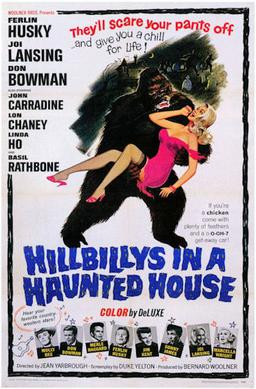
Horrific Insomnia File #63: Hillbillys in a Haunted House (dir by Jean Yarbrough)


What’s an Insomnia File? You know how some times you just can’t get any sleep and, at about three in the morning, you’ll find yourself watching whatever you can find on cable or streaming? This feature is all about those insomnia-inspired discoveries!

If you were having trouble getting to sleep last night, you could have jumped on Tubi and watched a film from 1967 called Hillbillys In A Haunted House and it would have put you right to sleep.

Hillbillys In A Haunted House has some big names in the cast but, unfortunately, none of them get to do much.  Instead, the main characters are country singer Woody Wetherby (Ferlin Husky), his partner Boots Malone (a very pointy Joi Lansing), and their road manager, Jeepers (Don Bowman).  When we first see them, they’re driving to Nashville and even worse, they’re singing about the fact that they’re driving to Nashville.  They’re scheduled to perform in “the Jamboree.”  However, after they’re delayed by a bunch of cops having a shoot out with two spies, Boots announces that Jeepers is a nervous wreck and that they really need to stop and rest for the night.

Unfortunately, they’re in the town of Sleepy Junction and there’s not much to Sleepy Junction because everyone in town recently moved to Acme City.  As a result, there are no hotels or motels in Sleepy Junction.  But there is a big, deserted mansion that is rumored to be haunted.  With a storm approaching and Jeepers’s nerves even more on edge then before, they head to the mansion.  At the mansion Woody sings a song and then some neighbors stop by and they all sing another song.  Are you getting the feeling that there’s a lot of singing in this movie?  You’re right, there is.  It’s all studio-perfect singing too.  Woody lip-syncs like a pro.

Anyway, the mansion is also being used by four spies, played by Basil Rathbone, John Carradine, a hulking Lon Chaney, Jr., and Linda Ho.  The four of them live in the surprisingly clean basement of the mansion.  Living with them is a gorilla.  The spies planning on stealing a formula for rocket fuel from Acme City but first they need to do something about the hillbillys that are currently in the haunted house.  Carradine and Rathbone try to scare them out with some remote control ghost action.  Jeepers may be a coward and Woody may be a redneck and Boots may have atrocious taste in clothes but all three of them are Americans and they’re not going to stand for any spy nonsense!

If you think it sounds like this was stupid, you’re right.  Carradine and Rathbone both struggle to maintain a straight face.  Poor Lon Chaney Jr. often appears to be out of breath.  There’s way too much singing.  Seriously, couldn’t the hillbillies have just driven another few miles to Acme City and found a hotel?

The film will put you to sleep, though.  It has its uses.

Previous Insomnia Files:

  1. Story of Mankind
  2. Stag
  3. Love Is A Gun
  4. Nina Takes A Lover
  5. Black Ice
  6. Frogs For Snakes
  7. Fair Game
  8. From The Hip
  9. Born Killers
  10. Eye For An Eye
  11. Summer Catch
  12. Beyond the Law
  13. Spring Broke
  14. Promise
  15. George Wallace
  16. Kill The Messenger
  17. The Suburbans
  18. Only The Strong
  19. Great Expectations
  20. Casual Sex?
  21. Truth
  22. Insomina
  23. Death Do Us Part
  24. A Star is Born
  25. The Winning Season
  26. Rabbit Run
  27. Remember My Name
  28. The Arrangement
  29. Day of the Animals
  30. Still of The Night
  31. Arsenal
  32. Smooth Talk
  33. The Comedian
  34. The Minus Man
  35. Donnie Brasco
  36. Punchline
  37. Evita
  38. Six: The Mark Unleashed
  39. Disclosure
  40. The Spanish Prisoner
  41. Elektra
  42. Revenge
  43. Legend
  44. Cat Run
  45. The Pyramid
  46. Enter the Ninja
  47. Downhill
  48. Malice
  49. Mystery Date
  50. Zola
  51. Ira & Abby
  52. The Next Karate Kid
  53. A Nightmare on Drug Street
  54. Jud
  55. FTA
  56. Exterminators of the Year 3000
  57. Boris Karloff: The Man Behind The Monster
  58. The Haunting of Helen Walker
  59. True Spirit
  60. Project Kill
  61. Replica
  62. Rollergator

Horror On The Lens: The Devil Bat (dir by Jean Yarborough)


In the 1940 film, The Devil Bat, the owners of a company in the small town of Heathville are super-excited because they’re going to be given their head chemist, Dr. Paul Carruthers (Bela Lugosi), a bonus check of $5,000.  However, since Carruthers’s inventions have made millions for the company, he is offended by the small check and decides that the best way to handle this would be to sue in court and demand fair compensation …. just kidding!  Instead, Dr. Carruthers sends his army of giant bats to kill the families of his employers.

The Devil Bat was produced by Production Releasing Corporation, a poverty row studio that specialized in shooting quickly and cheaply.  Going from Universal to PRC was technically a step down for Lugosi but The Devil Bat is actually an excellent showcase for Lugosi and he gives one of his better non-Dracula performances as the embittered Dr. Carruthers.  Indeed, one can imagine that Lugosi, who played such a big role in putting Universal on the map, could relate to Carruthers and his bitterness over not being fairly rewarded for the work he did to make others wealthy.

Enjoy The Devil Bat, starring the great Bela Lugosi!

8 Shots From 8 Horror Films: The 1940s


4 Or More Shots From 4 Or More Films is just what it says it is, 4 shots from 4 of our favorite films. As opposed to the reviews and recaps that we usually post, 4 Shots From 4 Films lets the visuals do the talking!

This October, I’m going to be doing something a little bit different with my contribution to 4 (or more) Shots From 4 (or more) Films.  I’m going to be taking a little chronological tour of the history of horror cinema, moving from decade to decade.

Today, we take a look at the 1940s.

8 Shots From 8 Horror Films: The 1940s

The Devil Bat (1940, dir by Jean Yarbrough, DP: Arthur Martinelli)

The Wolf Man (1941, dir by George Waggner, DP: Joseph Valentine)

Cat People (1942, dir by Jacques Tourneur, DP: Nicholas Musuraca)

I Walked With A Zombie (1943, dir by Jacques Tourneur, DP: J. Roy Hunt)

The Leopard Man (1943, dir by Jacques Tourneur, DP: Robert De Grasse)

House of Frankenstein (1944, dir by Erle C. Kenton, DP: George Robinson)

Spellbound (1945, dir by Alfred Hitchcock, DP: George Barnes)

The Picture of Dorain Gray (1945, dir by Albert Lewin, DP: Harry Stradling)

30 Days of Noir #3: Footsteps in the Night (dir by Jean Yarbough)


The 1957 film Footsteps in the Night opens in a small motel apartment in Los Angeles.

Jazz blares from a record player.  Playing cards are spread across a table.  A cigarette burns in an ashtray while a stack of poker chips sits undisturbed nearby.  When the apartment’s resident, Henry Johnson (Douglas Dick) steps into the room, he nearly stumbles over the dead body that’s lying in the middle of the floor.

Henry looks down at the body.  Is he shocked?  Is he scared?  Is he regretful?  Is he guilty?  It’s impossible to tell from his somewhat perturbed but mostly blank facial expression.  He takes in the scene and then promptly turns out the lights.

The dead man is Henry’s neighbor, Fred Horner (Robert Shaye).  When the police arrive, Detectives Andy Doyle (Bill Elliott) and Mike Duncan (Don Haggerty) immediately deduce that someone murdered Fred in the middle of a poker game.  Since everyone says that Henry was not only a degenerate gambler but that he also frequently got into arguments with Fred, Henry becomes the number one suspect.  Not helping Henry’s case is the fact that he’s disappeared and his girlfriend, Mary Raiken (Eleanore Train), won’t reveal where he’s hiding.

It seems like an open-and-shut case but Doyle has his doubts.  The case against Henry is almost too perfect and Doyle wonders if maybe they’re overlooking something.  As Doyle and Duncan continue to investigate, they discover that Fred Horner was an angry and misanthropic man.  They also discover that there’s a salesman named Bradbury (James Flavin) who is staying at an adjacent hotel and who bears a strong resemblance to the dead man….

Clocking in at just 62 minutes, Footsteps in the Night is a fast-paced police procedural with elements of film noir tossed in for good measure.  While I was doing some research for this review, I discovered that Footsteps in the Night was actually the fifth and final film in which Bill Elliott played Detective Andy Doyle.  Before taking on the role of Doyle, Elliott appeared in several westerns and he plays Doyle much like an ideal frontier sheriff.  He’s a no-nonsense lawman who solves cases with common sense and doesn’t have much time for wild speculation.  Dan Haggerty backs him up as the equally no-nonsense Mike Duncan.  As opposed to the modern tendency to celebrate cops who “break the rules,” Footsteps in the Night emphasizes the professional, by-the-book attitude of Doyle and Duncan.  If you were ever murdered, Duncan and Doyle are the type of cops that you would want assigned to the case.

As for their number one suspect, Henry may claim to have just been an innocent bystander but his gambling addiction makes him less than trustworthy in the eyes of many cops.  It’s only when Doyle and Duncan start to dig into the case that they discover just how cruelly Fred manipulated Henry’s addiction.  In the best tradition of many murder mysteries, Footsteps in the Night not only leaves you wondering who the murderer may have been but also whether or not the victim may have gotten what he deserved.

Footsteps in the Night is a good police procedural.  I look forward to watching and reviewing the other four films in which Bill Elliott played Detective Doyle as well.

http://www.youtube.com/watch?v=sTwVORuKuJ0

4 Shots From Horror History: Strangler Of The Swamp, House of Horrors, She-Wolf of London, Scared To Death


This October, I’m going to be doing something a little bit different with my contribution to 4 Shots From 4 Films.  I’m going to be taking a little chronological tour of the history of horror cinema, moving from decade to decade.

Today, we look at the latter half of the 1940s.

4 Shots From 4 Films

Strangler of the Swamp (1946, dir by Frank Wisbar)

Strangler of the Swamp (1946, dir by Frank Wisbar)

House of Horrors (1946, dir by Jean Yarbrough)

House of Horrors (1946, dir by Jean Yarbrough)

She-Wolf of London (1946, dir by Jean Yarbrough)

She-Wolf of London (1946, dir by Jean Yarbrough)

Scared To Death (1947, dir by Christy Cabanne)

Scared To Death (1947, dir by Christy Cabanne)

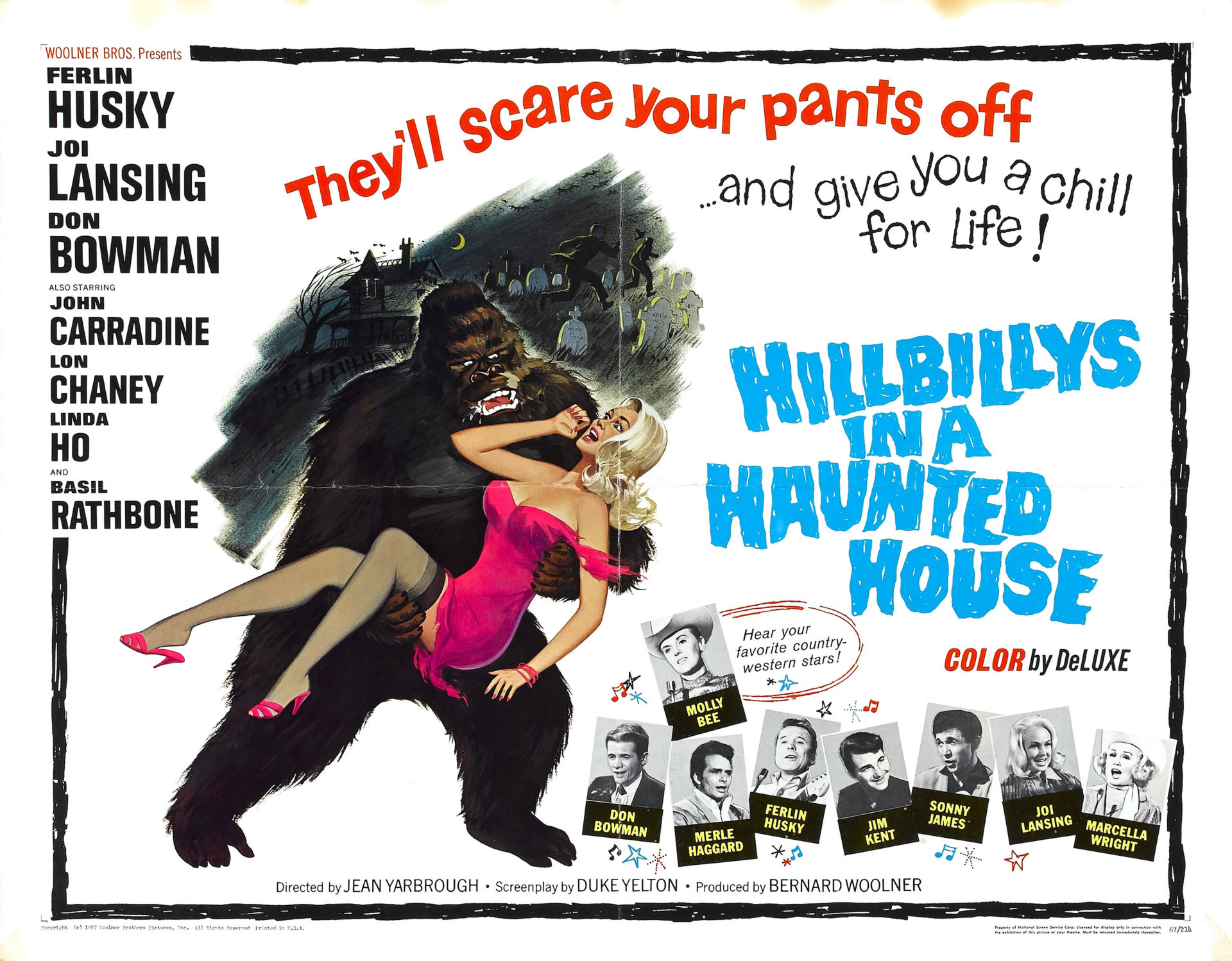
Twilight of the Gods: HILLBILLYS IN A HAUNTED HOUSE (Woolner Brothers 1967)


gary loggins's avatarcracked rear viewer

hillb1

Let’s face it, HILLBILLYS IN A HAUNTED HOUSE is a lousy excuse for a movie. The acting is atrocious, the script derivative and juvenile, and the direction nearly non-existent. It’s a scare comedy that’s neither scary nor funny, and if you’re not a fan of 60’s style Country & Western music you’ll absolutely hate it. The only reason this Woolner Brothers drive-in dreck is remembered today is the presence of horror icons Basil Rathbone , John Carradine, and Lon Chaney Jr as the villains. But even this trio of terror can’t save the movie.

hillb2

The plot (such as it is) concerns country entertainers Woody Weatherby (Ferlin Husky, a classic country singer who can’t act), Boots Malone (blonde bombshell Joi Lansing), and Jeepers (country comic Don Bowman) forced to spend the night in the eerie Beauregard Mansion. There put through the usual fright paces with ghosts (obvious sheets on strings), a “weird-woof” (as Jeepers…

View original post 515 more words

The Fabulous Forties #38: The Devil Bat (dir by Jean Yarbrough)


1940_devil_bat_012

The 37th film in Mill Creek’s Fabulous Forties box set was 1940’s The Devil Bat, which Gary Loggins reviewed on this site back in October.  Since, for the most part, I agree with Gary’s review, I’m going to recommend that you go read it and then I’ll just add a few thoughts of my own.

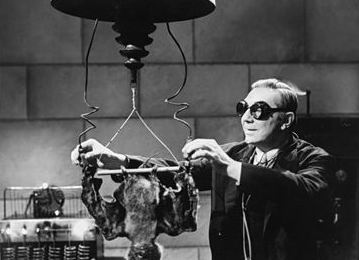
The Devil Bat is usually described as being one of the films that Bela Lugosi made during his decline, even though he made it just a year after appearing in a supporting role in the Oscar-nominated Ninotchka.  Lugosi plays Dr. Paul Carruthers, a small-town chemist who uses radiation to create a gigantic bat that he unleashes on everyone who he feels has wronged him.  The bat targets anyone who makes the mistake of wearing an aftershave lotion that Carruthers has created.

I would argue that there is a hint of genius to be found within The Devil Bat.

First off, there’s the fact that the giant bat is so clearly fake that it actually becomes rather charming.  Wisely, the film makes no effort to convince you that the bat is real.  Whenever that big, fake bat is lowered in on a bunch of often-visible wires, it works as almost a Brechtian alienation device.  In much the same way that Godard used jump cuts in Breathless, Devil Bat uses that big, fake bat to remind the audience that they are watching a film.  As a result, the audience has no choice but to think about the conventions of the horror genre and how their own world view has been shaped by watching movies like Devil Bat.

The other hint of genius is the satirical masterstroke of casting Bela Lugosi as a small town chemist.  Lugosi remains Lugosi, regardless of what role he plays.  When the film’s characters accept, without even a second glance, that Bela Lugosi, with his thick accent and his theatrical acting style, is a humble suburbanite, the film becomes a perhaps inadvertent satire of American conformity.

Needless to say, Lugosi was always a far better actor than he has ever been given credit for being.  In The Devil Bat, he plays Dr. Carruthers with a weary sense of resignation.  Carruthers never becomes a standard evil villain.  Instead, he’s a man who has been so beaten down by life that he now see no other option beyond using a giant bat to kill those who he feels has betrayed him.  Much as he would in Ed Wood’s Bride of the Monster, Lugosi brings an almost redemptive sadness to his mad scientist.

The end result is that poor, misunderstood and underestimated Bela elevates the entire film.

db

The Fabulous Forties #23: Freckles Comes Home (dir by Jean Yarbrough)


Freckles_Comes_Home_FilmPoster

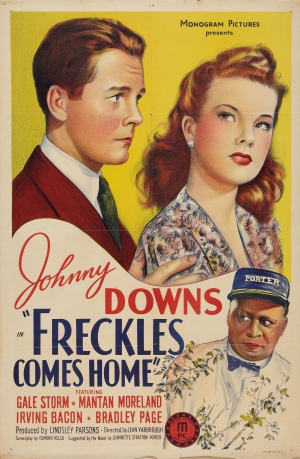
The 23rd film in Mill Creek’s Fabulous Forties box set was an hour-long “comedy” from 1942.  The name of the film was Freckles Comes Home and I have to admit that I’m struggling to come up with anything to say about it.  That’s the thing about these Mill Creek box sets.  Occasionally, you’ll come across a really good movie and, even more frequently, you’ll come across a really bad movie.  But often times, you find yourself watching filler.  If I had to guess, Freckles Comes Home was probably a movie that was made to act as the 2nd half of a double feature.  Not much money nor effort was put into it.  It’s not terrible and it’s certainly not good.  It’s just sort of there.

With a title like Freckles Comes Home, I was expecting this movie would be about a lost dog but it turns out that I was wrong.  Freckles (played by Johnny Downs) is a human being.  He’s returning home from college because a friend of his has inherited some real estate and isn’t sure what to do about it.  While sitting on the bus home, Freckles spends so much time talking about how much he loves his hometown that the man sitting next to him decides that maybe he’ll make that town his home as well.  Unfortunately, that man is Muggsy Dolan (Walter Sande).  As you would expect with a name like Muggsy, Dolan is a criminal on the run.

Back in town, Freckles attempts to convince his father not to build a road that will go through his friend’s property.  He also romantically pursues a childhood friend named Jane (Gale Storm), despite the fact that everyone insists that Jane can do better than Freckles.  (Personally, I was wondering why — in the year 1942 — a young man like Freckles wasn’t overseas, fighting for his country.  DON’T YOU KNOW THERE’S A WAR ON, FRECKLES!?)  Meanwhile, Muggsy is plotting to rob the town bank…

And then there’s Jeff (Mantan Moreland), who is the porter at the local hotel.  Jeff thinks that he has a machine that will allow him to find buried gold.  And since Jeff is an African-American in a 1940s film, it’s impossible to watch the way the movie treats him without cringing.  There’s a few scenes where Moreland, as an actor, subtly suggests that Jeff is smarter than the movie gives him credit for and certainly, Moreland’s performance is the most memorable in the film but that really doesn’t make the role any less demeaning.

Anyway, Freckles Comes Home was largely forgettable.  I assume that audiences in the 1940s may have enjoyed it (especially if it was included on a double bill with a more interesting movie) but, seen today, there’s just not that much to be said about it.  It exists, it’s something of a time capsule, and that’s pretty much all there is to say about it.

http://www.youtube.com/watch?v=GX4FzShQQ_I