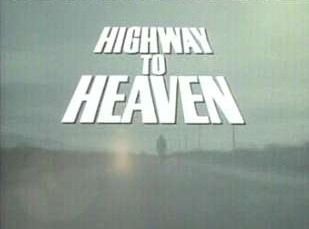
Welcome to Late Night Retro Television Reviews, a feature where we review some of our favorite and least favorite shows of the past! On Thursdays, I will be reviewing Highway to Heaven, which aired on NBC from 1984 to 1989. The entire show is currently streaming on Tubi and several other services!
This week, it’s time for yet another student protest.
Episode 5.8 “Goodbye, Mr. Zelinka”
(Dir by Michael Landon, originally aired on June 23rd, 1989)
The students at Lincoln High are upset to learn that beloved English teacher Mr. Zelinka (Lew Ayres) is going to have to retire because he’s reached the mandatory age of 70. The school’s new maintenance workers — Jonathan Smith and Mark Gordon — suggest that they should all conduct a walk-out to demand that Zelinka be allowed to keep his job. The evil school board president (James Karen) says that Zelinka can stay if he takes and passes an exam. However, the exam is rigged for Zelinka to fail. Jonathan uses “the stuff” to make sure that Zelinka not only passes but that he also gets the highest score ever. In the past, Jonathan always refused to use “the stuff” to help people cheat. Instead, Jonathan would have shown the school board president the error of his ways. But, for this episode, Jonathan rigs the rigged exam and the villain is left in power so that he can presumably continue to make Mr. Zelinka’s life miserable.
I did not like this episode. Yeah, it’s heart was in the right place but the entire school walking about in support of Mr, Zelinka just felt kind of silly. I mean, did every student at the school have Mr. Zelinka for English? What did everyone’s parents think about the protest? If Mr. Zelinka had been a compelling character, may be I would have felt differently but Mr. Zelinka was instead a pretty passive character and I have to admit that I wondered about all the other good teachers who had been forced to retire at 70. Why didn’t Jonathan show up to help any of them out? What made Mr. Zelinka so special? It didn’t help that Lew Ayres was 80 years old when he played Mr. Zelinka and that he looked and sounded even older. The obviously frail Ayres comes across as someone who maybe does need to retire.
I’ve sat through a lot of Highway to Heaven episodes about clean-cut teenagers walking out of class so that they can protest injustice. Highway to Heaven was a very earnest show and that was one of the things that made it likable. But, by the fifth season, Highway to Heaven‘s formula was a bit less effective than it had been in the past. This is an episode just just seems to be going through the motions. This is also the rare Highway to Heaven episode in which I wanted someone to tell Jonathan and Mark to just mind their own business.
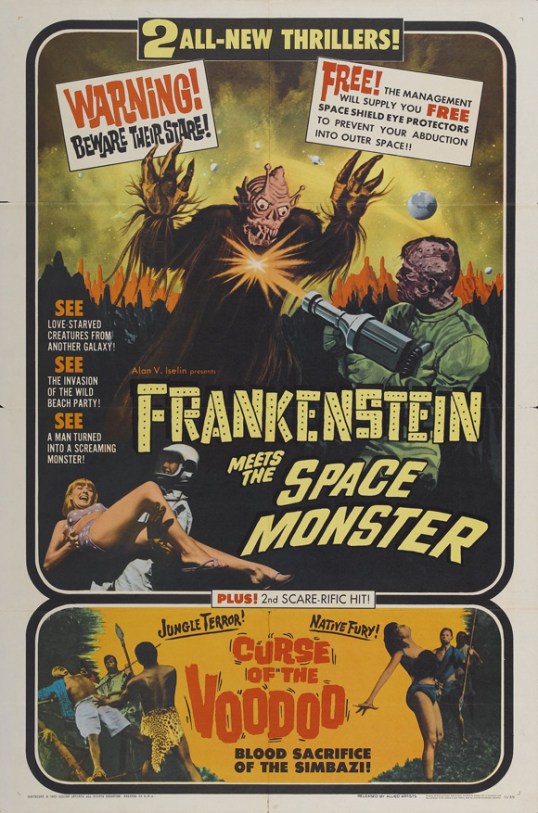
Despite the title, 1965’s Frankenstein Meets The Space Monster is not actually about Frankenstein or his monster.
Instead, the Frankenstein of the title is Frank Saunders (Robert Reilly), an astronaut who happens to be an android. Frank was created by Dr. Adam Steele (James Karen, in one of his first film roles). Frank is designed so that he can go into space without making any of the mistakes that a human astronaut might make. He’s the next stage in the space program! With Frank sitting in a rocket, America will have rightfully conquered the Moon in no-time flat!
(Don’t waste my time with any of the international treaty crap. I don’t care how many other countries go to the Moon, it belongs to America because we landed their first. It’s the 51st State and someday, we’ll probably end up moving the federal government to the moon. Hopefully, we’ll just leave it there.)
Unfortunately, no sooner has Frank gone into space then he gets shot down by the Martians. Frank crashes in Puerto Rico and, with his face horrifically disfigured, starts to malfunction, Soon, he’s creating chaos all over the island and it’s up to Dr. Adam Steele — what a name! — to put a stop to it. However, before Frank is deactivated, he needs to meet the Space Monster (a mutant named Mull) and defeat the Martians.
Why are the Martians on Earth? According to a short, pointy-eared dwarf Martian named Dr. Nadir (Lou Cutell), an atomic war has led to the death of all the women on Mars. Personally, I think Dr. Nadir is lying because he came to Earth with a Martian woman named Princess Marcuzan (Marilyn Hanold). I think it’s more a case of almost all of the Martian women faking their own deaths so that they could get out of having to talk to Dr. Nadir. Seriously, Dr. Nadir is a little creep. Add to that, his Martian name actually sounds like an insult in English. Personally, I think he should come up with a new name if he wants people to listen to him. I would suggest calling himself Adam Steele but that name is already taken.
Soon, Martians are abducting bikini-clad women off of beaches in Puerto Rico. Can the Martians be stopped? Can Frank be restored? Will James Karen go on to have a distinguished career as a beloved character actor? Spoiler alert: the answer to the third question is yes. Indeed, one of the joys of this film is getting to see James Karen in a rare leading role. He commits to giving as good performance, even though the film itself is pretty silly.
Another joy of this film is the soundtrack, which is surprisingly good for a film of this budget and caliber. Just try to get That’s The Way It’s Got To Be out of your head! (In the film, this song plays as Frank prepares to go into space.)
That’s the way it’s got to be!
As for Frankenstein Meets The Space Monster …. I just can’t help it. I like the damn thing. It’s just so ludicrous and silly that it’s impossible for me not to enjoy. The film’s producers decided that they didn’t just want a robot terrorizing an island. They also wanted Martians and a mutant, as well! And we’re all better off for it.
From the years 2007 to 2013, it’s hard to think of anyone who was as universally despised as Drew Peterson.
Drew Peterson was the Illinois cop who first came to national attention when his fourth wife, Stacy, went missing. Stacy had been on the verge of completing her nursing degree at the time of her disappearance. Though Drew was a cop, he wasn’t the one who reported her missing. Instead, it was her sister who called the police after she failed to hear from Stacy. When Drew was asked about Stacy, he seemed unconcerned and even cocky as he claimed Stacy had run off with another man. Few people believed him. It had only been three years since another Peterson had been convicted of murdering his wife and, like Drew, Scott Peterson also claimed that his wife left their home and vanished.
The investigation into Stacy’s disappearance led to authorities taking another look at the death of Drew Peterson’s third wife, Kathy Savio. Kathy death had originally been found to be an accidental drowning, though how one can drown in an empty bathtub was never really explained. A second autopsy revealed evidence of a struggle and, in 2013, Drew Peterson was convicted of her murder. Drew Peterson is currently in prison and Stacy is still listed as missing.
The thing that sticks out about Drew Peterson is how smug he always seemed. Like Dennis Rader (who was a serial killer by night and a neighborhood compliance officer by day), Drew Peterson was the ultimate nightmare authority figure. He had a uniform and he had a badge and he had an attitude that said, “I can do whatever I want and if you complain, nobody will believe you.” When we looked at Drew Peterson, we saw every cop who had ever pulled someone over for a busted taillight or he had ever tried to hit on someone after stopping them for speeding. Even when he had people accusing him of killing Kathy, Drew would appear on television and smirk and basically dare you to do anything about it. If you want to know what we mean when we use terms like “mansplaining,” go watch an interview with Drew Peterson.
Drew Peterson’s legal troubles were so drawn out that the 2012 Lifetime film, Drew Peterson: Untouchable, actually went into production before Peterson had even been convicted of anything. (Peterson actually filed a cease and desist letter demanding that production be halted.) The film ends not with Drew Peterson being convicted of killing Kathy but instead with Rob Lowe (playing the paunchy, middle-aged Peterson) doing a slow motion strip tease after being arrested. The film does a very good job of not outright accusing Peterson while, at the same time, reminding viewers of why so many of them instantly disliked him.
Of course, when the film was first aired, it received a lot of attention for casting the amiable and handsome Rob Lowe as Drew Peterson, a man who was neither of those things. Lowe gives an excellent performance as Peterson, capturing the somewhat desperate swagger of a man who doesn’t want to admit that he’s aging. Lowe captures Peterson’s cockiness and his manipulative nature and, even more importantly, he captures the arrogance of a man who believes that, because he wears a uniform, he can get away with anything. As his victimized wives, both Kaley Cuoco and Care Buono gave poignant performances.
I don’t know where Drew Peterson is but, wherever he’s serving his time, I hope he’s being forced to watch this movie at least once a day.
Subverting the Zombie Canon: Satire, Genre-Bending, and Decay in the Return of the Living Dead Series
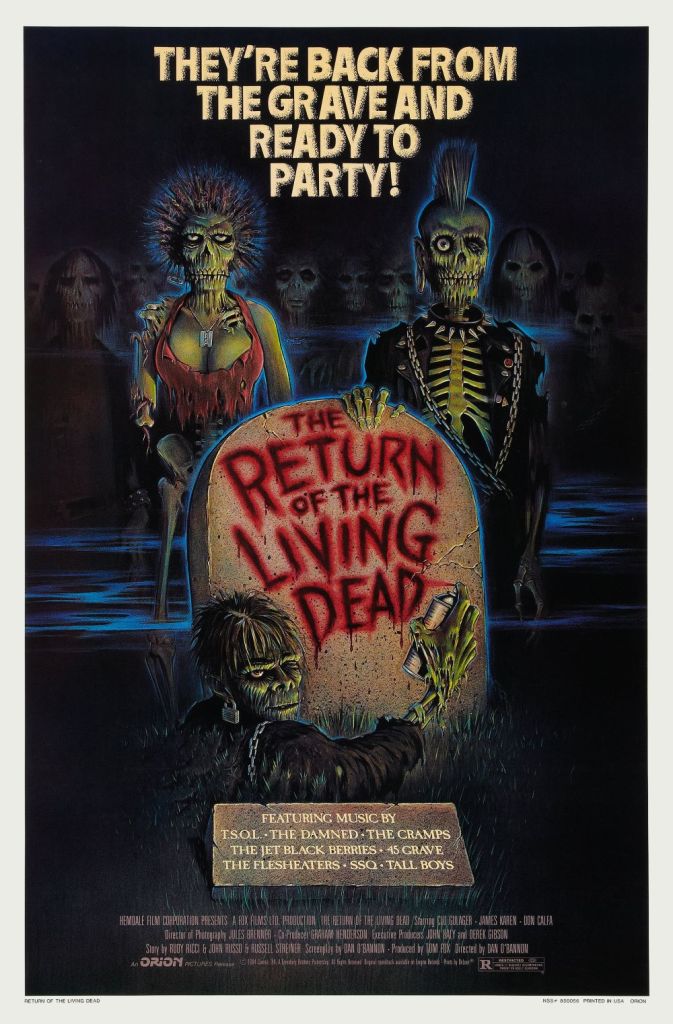
When talking about cult horror films, the Return of the Living Dead series holds a special place—not only as a spin-off from George A. Romero’s seminal Night of the Living Dead, but as a unique creative force in its own right. Thanks to a legal split between Romero and co-writer John Russo over rights to the “Living Dead” name, Russo and director Dan O’Bannon got to imagine a parallel zombie universe. This franchise quickly carved out its own identity, mixing horror, black comedy, and punk spirit in a way that both paid tribute to and upended zombie tropes.
Reinventing Zombie Lore with a Wink
The original Return of the Living Dead (1985) starts with a clever “what if” twist: what if Romero’s Night wasn’t just a movie, but a dramatized cover-up of a real government disaster? This meta idea instantly frames the film as self-referential and playful, setting a tone unlike anything out at the time.
Central to the film’s identity is the invention of 2-4-5 Trioxin, a fictional military chemical designed to clear marijuana crops which instead raises the dead—zombies with surprising new abilities. Unlike the slow, drooling zombies Romero popularized, these ghouls sprint, talk, and set traps. Their hunger is peculiar as well: they crave brains exclusively, as it eases the pain of being undead. And the old rules of zombie combat? Forget shooting them in the head. These zombies resist it, raising the stakes and scare factor.
This refreshing rewrite of zombie rules allowed the movie to be both frightening and fun. The zombies were smart but still monstrous, turning classic horror expectations on their head in a way that invited both laughter and fear—a tricky balance that few horror comedies manage.
Playing with Comedy, Panic, and Punk Rock
One of the greatest strengths of the original film is how it embraces horror-comedy so naturally. It doesn’t shy away from being funny while still delivering tension. James Karen and Thom Mathews excel as the main pair—Karen’s frantic, over-the-top panicked man paired with Mathews’ straight, slowly succumbing counterpart create a perfect comedic rhythm. Their slow transformation into zombies adds a tragic dimension to what could have been simple slapstick. Meanwhile, Don Calfa’s mortician character and Clu Gulager’s warehouse owner provide a grounded center amidst chaos.
The punk subculture flavor adds another unique texture. Linnea Quigley’s famous graveyard striptease encapsulates the 1980s’ blend of irreverence, sexuality, and horror obsession. The scene is shocking, hilarious, and iconic—one of those moments that encapsulates everything this film is about: having fun with taboos while not losing the darker undercurrents of mortality and decay.
Beyond laughs, there’s biting satire here. The film skewers the government and military’s hubris—scientists create a superweapon they can’t control, leading to chaos and destruction. This reflects 1980s American anxieties about bioweapons, government cover-ups, and nuclear fears. Horror and comedy collide to reflect cultural distrust and paranoia.
The Problem of the Sequel: Part II’s Familiar Ground
When Return of the Living Dead Part II came out in 1988, it felt like the franchise was stuck in a loop. With much of the original cast returning in near-identical roles, and lines and situations seemingly recycled, the film circles back to the same story. This self-copying invites a mix of amusement and disappointment: it seems the filmmakers didn’t believe they could improve on the original and decided to replicate it instead.
While it has its moments—good practical effects and a rollicking tone reminiscent of the first film—it leans harder into comedy, sometimes at the expense of the horror. The suburban setting and clearer military lockdown raise the action stakes, but the humor feels broader and less sharp, which can make the movie seem a bit cartoonish.
In a way, Part II comments on the pitfalls of horror franchises: once you’ve struck gold with an unexpected idea, sequels often struggle to regain that freshness. This installment is entertaining, but signals the beginning of the franchise’s creative plateau.
Much Darker Territory: Part III’s Horror and Romance
With Return of the Living Dead 3 in 1993, things take a major tonal shift. Brian Yuzna’s direction removes much of the comedy and replaces it with body horror, gore, and a genuinely tragic romance. The story centers on Curt and Julie, two teenagers tragically pulled into the military’s secret zombie experiments. After Julie is accidentally killed and resurrected, she becomes a zombie who feeds on brains but manages her hunger through extreme self-inflicted pain.
This grim take pushes the franchise into more serious, intense horror territory, with heavy themes of love, loss, and bodily autonomy threaded throughout. Julie’s tortured transformation is both tragic and unsettling, symbolizing not only the loss of life but also the torment of trying to hold onto humanity while losing it from within.
Yuzna’s effects are grisly in the finest tradition of ‘90s practical SFX. The film revives the franchise’s sense of danger and stakes by mixing romance with horror, delivering something emotionally resonant and viscerally impactful. While it diverges sharply from the earlier comedic tone, Part III proves the series’ flexibility and capacity for reinvention.
Creative Collapse: Parts IV and V’s Direct-to-Cable Downfall
Sadly, the wheels come off with Return of the Living Dead 4: Necropolis and 5: Rave to the Grave, both made in 2005 and directed by Ellory Elkayem. Shot back-to-back and released direct-to-cable, these films are pale shadows of the earlier entries.
They ditch the original’s clever mix of horror and humor entirely. Instead, we get generic corporate conspiracies, confusing Eastern European settings, weak scripts, and inconsistent zombie characterizations. The zombies lose their unique “brains only” horror and instead act like run-of-the-mill undead. Even the acting is amateurish, with only Peter Coyote standing out briefly as a sinister scientist.
Part 5 further muddies continuity by introducing Trioxin as a rave drug, leading to a chaotic rave/zombie apocalypse scenario that is both baffling and poorly paced. The low-budget effects and uneven pacing betray the exhaustion and lack of passion behind these entries.
These final two films underscore a common fate for franchises that outlive their creative spark—once inventive mythology becomes shallow cliché, and attempts to cash in feel uninspired. Instead of honoring their roots, they become muddled and forgettable.
Why the Series Matters
Despite its uneven legacy, Return of the Living Dead remains important for what it dared to do in horror cinema. The first film’s originality influenced countless horror comedies and redefined how zombies could be portrayed. Its self-awareness and invention paved the way for postmodern horror, where genre is as much about commentary as it is fear.
The third film’s daring shift to tragic body horror further demonstrated the potential for zombie films to explore complex emotional and societal themes beyond gore or giggles.
While the later sequels falter, their failure serves as a cautionary tale about the dangers of diluting distinct voices and creative risks in franchise filmmaking.
Ultimately, Return of the Living Dead survives in cultural memory as a zombie series that captured the spirit of its time—punk rebellion, Cold War paranoia, and genre self-mockery—with flashes of brilliance that continue to entertain and inspire.
Monsters will not be reviewed tonight so that we may bring you this very special presentation of 1983’s Have You Ever Been Ashamed Of Your Parents?
Yes, my retro television reviews will return next week but, until then, enjoy this blast from the past. In this hour-long presentation, Fran Davies (Kari Michaelson) is upset when her mother (Marion Ross) takes a summer job working as a maid for a rich family. At first, Fran thinks that Andrea (Jennifer Jason Leigh), the daughter of her mother’s employer, is a stuck-up snob but she soon learns that Andrea is instead painfully shy and that she has parents who are rich but unloving. Meanwhile, Fran’s parents are …. well, I wouldn’t call them poor. The film acts as if they’re poor but, from all indications, they appear to be comfortably middle class. The point is that they’re not rich but they are loving.
This is worth watching for Jennifer Jason Leigh’s performance as Andrea, a character to whom I could relate. It’s not easy being both shy and beautiful. Fans of great character actors will also be happy to see James Karen, playing Andrea’s father.
Now, without further ado, here is Have You Ever Been Ashamed Of Your Parents?
In the 1980 remake of The Jazz Singer, it only takes the film seven minutes to find an excuse to put Neil Diamond in blackface.
Of course, the film was a remake of the 1927 version of The Jazz Singer, which featured several scenes of Al Jolson performing in blackface. In fact, Al Jolson in blackface was such a key part of the film that it was even the image that was used to advertise the film when it was first released. Back in the 20s, Jolson said that wearing blackface was a way of honoring the black artists who created jazz. (As shocking as the image of Al Jolson wearing blackface is to modern sensibilities, Jolson was considered a strong advocate for civil rights and one of the few white singers to regularly appear on stage with black musicians.) Regardless of Jolson’s motives, less-progressively minded performers used blackface as a way to reinforce racial stereotypes and, to modern audiences, blackface is an abhorrent reminder of how black people were marginalized by a racist culture. You would think that, if there was any element of the original film that a remake would change, it would be the lead character performing in blackface.
But nope. Seven minutes into the remake, songwriter Jess Robin (Neil Diamond) puts on a fake afro and dons blackface so that he can perform on stage at a black club with the group that is performing his songs. The group’s name is the Four Brothers and, unfortunately, one of the Brothers was arrested the day of the performance. Jess performs with the group and the crowd loves it until they see his white hands. Ernie Hudson — yes, Ernie Hudson — stands up and yells, “That’s a white boy!” A riot breaks out. The police show up. Jess and the three remaining Brothers are arrested and taken to jail. Jess is eventually bailed out by his father, Cantor Rabinovitch (Laurence Olivier). The Cantor is shocked to discover that his son, Yussel Rabinovitch, has been performing under the name Jess Robin. He’s also stunned to learn that Yussel doesn’t want to be a cantor like his father. Instead, he wants to write and perform modern music. The Cantor tells Yussel that his voice is God’s instrument, not his own. Yussel returns home to his wife, Rivka (Caitlin Adams), and tries to put aside his dreams.
But when a recording artist named Keith Lennox (Paul Nicholas) wants to record one Yussel’s songs, Yussel flies out to Los Angeles. As Jess Robin, he is shocked to discover that Lennox wants to turn a ballad that he wrote into a hard rock number, Jess sings the song to show Lennox how it should sound. The arrogant Lennox is not impressed but his agent, Molly (Lucie Arnaz) is. Soon, Jess has a chance to become a star but what about the family he left behind in New York? “I have no son!” the Cantor wails when he learns about Jess’s new life in California.
I’ve often seen the 1980 version of The Jazz Singer referred to as being one of the worst films of all time. I watched it a few days ago and I wouldn’t go that far. It’s not really terrible as much as its just kind of bland. For someone who has had as long and successful a career as Neil Diamond, he gives a surprisingly charisma-free performance in the lead role. The most memorable thing about Diamond’s performance is that he refuses to maintain eye contact with any of the other performers, which makes Jess seem like kind of a sullen brat. It also doesn’t help that Diamond appears to be in his 40s in this film, playing a role that was clearly written for a much younger artist. Still, when it comes to bad acting, no one can beat a very miscast Laurence Olivier, delivering his lines with an overdone Yiddish accent and dramatically tearing at his clothes to indicate that Yussel is dead to him. Olivier was neither Jewish nor a New Yorker and that becomes very clear the more one watches this film. It takes a truly great actor to give a performance this bad. Diamond, at least, could point to the fact that he was a nonactor given a starring role in a major studio production. Olivier, on the other hand, really had no one to blame but himself.
Still, I have to admit that ending the film with a sparkly Neil Diamond performing America while Laurence Olivier nods in the audience was perhaps the best possible way to bring this film to a close. It’s a moment of beautiful kitsch. The Jazz Singer needed more of that.
Admittedly, this is a pretty short scene. It’s only 16 seconds, taking from the much longer climax of 1982’s Poltergeist.
That said, this is one of the greatest over-the-top moments in cinematic history. I defy anyone to watch Poltergiest without shouting “YOU LEFT THE BODIES!” afterwards. As an actor, Craig T. Nelson has never been one to worry about subtlety so, when you give him an excuse to yell about headstones and bodies….
(Also, give some praise to the great James Karen, heroically matching Nelson’s intensity throughout the scene.)
Welcome to Retro Television Reviews, a feature where we review some of our favorite and least favorite shows of the past! On Sundays, I will be reviewing the made-for-television movies that used to be a primetime mainstay. Today’s film is 1977’s Mary Jane Harper Cried Last Night! It can be viewed on YouTube.
Damn.
I mean, seriously! I have seen some depressing films before but nothing could have quite prepared me for Mary Jane Harper Cried Last Night.
Susan Dey stars as Rowena, a young single mother whose 3 year-old daughter, Mary Jane Harper (Natasha Ryan), is taken to the hospital with a broken arm. Dr. Angela Buccieri (Tricia O’Neil) doesn’t believe Rowena’s claim that Mary Jane is just accident prone and when she discovers what appears to be cigarette burns on the little girl, Dr. Buccieri goes to the head of pediatrics (played by veteran screen villain John Vernon) and requests a full set of X-rays to see if there are any previously healed injuries. Buccieri’s request is denied. It turns out that Rowena comes from a wealthy family and her father (Kevin McCarthy) is a trustee of the hospital. Even after Dr. Buccieri opens up about her own experiences as an abused child, she is told to drop the matter.
She doesn’t drop it. Instead, she goes to a social worker named Dave Williams (Bernie Casey). Dave does his own investigation but none of Rowena’s neighbors want to talk about all of the crying and the screaming that they hear coming from Rowena’s apartment. Rowena presents herself as being a stressed but loving mother. Dave suggests a support group that she can attend. When Rowena goes to the group, she opens up a little about how overwhelmed she feels. Unfortunately, she leaves Mary Jane in the apartment alone and, when a fire breaks out, Mary Jane is lucky to survive.
As intense as all of that is, it’s also only the first half of the movie. The second half is even more intense and emotionally draining and it all leads up to one of the most devastating final lines ever uttered in a movie. Throughout the film, the system fails both Rowena and Mary Jane. Mary Jane is failed when all of the evidence of the abuse that she has suffered is either ignored or shrugged away by the same people who are supposed to be looking out for her. Rowena is failed when no one pays attention to her obvious emotional instability. When she finally does have a breakthrough during a therapy session, her psychiatrist (played by James Karen) curtly tells her that they’ll have to talk about it next week because their hour is up.
Rowena is a character who I both hated and pitied. Like many abusers, she herself was a victim of abuse. Even when Rowena tries to get support, no one wants to admit that a mother is capable of abusing their own child. That said, Mary Jane Harper is at the center of the film. She’s a little girl who is desperate to be loved by a woman who often terrifies her. She is continually failed by the people who should be looking after her and it’s just devastating to watch. I’m sure I’m not the only person who was moved to tears by this film.
What a sad film. At the same time, it’s also an important one. If the film takes place at a time when no one wanted to admit to the abuse happening before their eyes, we now live in a time when people toss around allegations of abuse so casually that it’s led to a certain cynicism about the whole thing. Even when seen today, Mary Jane Harper Cried Last Night works as a powerful plea to watch out and care for one another.
The 1986 film, Invaders from Mars, opens with a dark and stormy night.
12 year-old David Gardner (Hunter Carson, son of actress Karen Black and filmmaker L.T. Kit Carson), who dreams of growing up to become an astronaut, witnesses something strange happening outside of his bedroom window. He watches as a spaceship lands on a nearby hill and apparently drills itself into the ground. The next morning, David convinces his father (Timothy Bottoms) to go out to the hill and see what he can find. When his father returns, he says that he didn’t see anything strange at the hill. However, he is now acting strangely, no longer showing emotion.
Soon, everyone in the small town is also acting strangely, from David’s mother (Laraine Newman) to his teacher (Louise Fletcher). David notices that everyone has a mysterious mark on the back of their neck. Even more alarmingly, he walks in on his teacher eating a mouse. Investigating the hill himself, David discovers that his father was lying about nothing being there. Instead, there’s a cavernous spaceship that is patrolled by aliens! A creature with a giant brain has taken control of almost everyone in David’s life. David discovers that the hill right outside of his house is now the headquarters of an intergalactic invasion. It’s a war of the worlds and David is stuck right in the middle.
Fortunately, David does have a few allies. The aliens have not managed to take control of everyone. The school nurse (Karen Black) believes David and helps him explore the spaceship. The surprisingly nice General Wilson (James Karen) is not only willing to launch a military operation on the advice of a 12 year-old but he also doesn’t have any problem allowing that 12 year-old to take de facto command of his soldiers. Can David save his community from the Martians?
A remake of the 1953 sci-fi classic, Invaders from Mars was directed by Tobe Hooper, the Texas-born director who was best known for The Texas Chainsaw Massacre and Poltergeist. At first, the deliberately campy Invaders from Mars might seem like an unexpected film from Hooper but actually, it has quite a bit in common with Hooper’s other credits. Like The Texas Chainsaw Massacre, it plays out like an increasingly surreal dream, one with an emphasis on isolation. Like Poltergeist, it’s ultimately a satire of suburban and small town conformity. (Indeed, one could argue that Invaders From Mars is Poltergeist without the interference of Steven Spielberg.) If the original Invaders From Mars was about the dangers of communism, the remake is about the danger of losing your childhood imagination and just becoming a mindless drone.
Invaders From Mars is often a deliberately silly film. Sometimes, it’s definitely a bit too silly for its own good, hence the guilty in guilty pleasure. That said, whenever I see it, I can’t help but smile at how quickly General Wilson starts taking orders from David. (James Karen plays the role with such earnestness that General Wilson seems to be less concerned with David’s age but instead just happy that he has someone around who can tell him what he needs to do.) But it makes sense when you consider that the film is meant to be a child’s fantasy of what would happen if there was an alien invasion. Who wouldn’t want to be the one telling the adults how to save the planet? For all the aliens and the mind control, this is a rather innocent film. Featuring entertaining performances from Hunter Carson, Timothy Bottoms, Karen Black, and the great James Karen, Invaders From Mars is an entertaining daydream of interstellar conquest.
Last night, I watched Poltergeist on TCM and I found myself thinking about how much I’ve always liked James Karen’s performance in that film. Karen plays Craig T. Nelson’s boss, the guy who moved the headstones but left the bodies. Karen also appeared in Return of the Living Dead and, up until his death a few years ago, he was a busy character actor. He almost always seemed to play slightly sinister executive types. If you saw him in a film, you knew he would probably be a crooked businessman, a corrupt lawyer, or a politician on the take. And yet, even though he often played less than savory characters, he always played them not as being evil but instead, at worst, merely misguided. Anyway, as I watched him get yelled at by Craig T. Nelson in Poltergeist, I decided that our next horror on the lens would be a James Karen film.
Today’s horror on the lens is the 1965 film, Frankenstein Meets The Space Monster. This film features not only the debut of James Karen but it also gave him a rare lead role. For once, james Karen gets to the hero! Though he’s much younger than he was when he appeared in films like Poltergeist and Return of the Living Dead, you’ll know James Karen as soon as you see him.
Despite the movie’s title, it’s not about Frankenstein. Instead, it’s about an astronaut named Frank who is actually an android. When his latest mission into space goes wrong, Frank ends up crashing in Puerto Rico. Now malfunctioning, Frank causes some major chaos. Can his creator, Dr. Adam Steele (James Karen), track Frank down and put an end to his reign of terror?
And what about the Martians? Android Frank isn’t the only threat in Puerto Rico. A group of Martians have landed and are determined to kidnap any girl wearing a bikini so that they can use them to repopulate their race. We’re told that every woman on Mars — with the apparent exception of Princess Marcuzan, played with evil haughtiness by Marilyn Hanold — has been killed as the result of an atomic war. Assisting Princess Marcuzan is Dr. Nadir (Lou Cutell), a short, bald Martian with pointy ears.
One of the oddest things about Frankenstein Meets The Space Monster is that, despite being a standard — if wonderfully nonsensical — low-budget B-movie, it features a great soundtrack! Just try to get “That’s The Way It’s Got To Be” out of your head.



 Through the Shattered Lens