Opening with a swarm of helicopters spaying for medflies and ending with an earthquake, 1993’s Short Cuts is a film about life in Los Angeles.
An ensemble piece, it follows several different characters as they go through their own personal dramas. Some of them are married and some of them are destined to be forever single but they’re all living in varying states of desperation. Occasionally, the actions of one character will effect the actions of another character in a different story but, for the most part, Short Cuts is a portrait of people who are connected only by the fact that they all live in the same city. There are 22 principal characters in Short Cuts and each one thinks that they are the star of the story.
Jerry Kaiser (Chris Penn) cleans the pools of rich people while, at home, his wife, Lois (Jennifer Jason Leigh), takes care of their baby and works as a phone sex operator. Jerry’s best friend is a makeup artist named Bill (Robert Downey, Jr.) who enjoys making his wife, Honey (Lili Taylor), looks like a corpse so that he can take her picture. One of her photographs is seen by a fisherman (Buck Henry) who has already discovered one actual corpse that weekend. He and his buddies, Vern (Huey Lewis) and Stuart (Fred Ward), discovered a dead girl floating in a river and didn’t report it until after they were finished fishing. (The sight of Vern unknowingly pissing on the dead body is one of the strongest in director Robert Altman’s filmography.)
Stuart’s wife, Claire (Anne Archer), is haunted by Stuart’s delay in reporting the dead body. A chance meeting Dr. Ralph Wyman (Matthew Modine) and his wife, artist Marian (Julianne Moore), leads to an awkward dinner between the two couples. Claire works as a professional clown and Ralph ends up wearing her clown makeup while his marriage falls apart.
Earlier, Claire was stopped and hit on by a smarmy policeman named Gene Shepard (Tim Robbins), who just happens to be married to Marian’s sister, Sherri (Madeleine Stowe). Gene is already having an affair with Betty Weathers (Frances McDormand), the wife of a helicopter pilot named Stormy (Peter Gallagher). When Stormy discovers that Betty has been cheating, he takes a creative revenge on her house.
Doreen Pigott (Lily Tomlin) lives in a trailer park with her alcoholic husband, Earl (Tom Waits). Driving home from her waitressing job, Doreen hits a young boy. The boy says he’s okay but when he gets home, he passes out. His parents, news anchorman Howard Finnegan (Bruce Davison) and his wife, Anne (Andie MacDowell), rush him to the hospital, where his doctor is Ralph Wyman. As Howard waits for his son to wake up, he has a revealing conversation with his long-estranged father (Jack Lemmon, showing up for one scene and delivering an amazing monologue). Meanwhile, a baker named Andy (Lyle Lovett) repeatedly calls the Finnegan household, wanting to know when they’re going to pick up their son’s birthday cake.
Based on the short stories of Raymond Carver and directed by Robert Altman, Short Cuts can sometimes feel like a spiritual descendent of Altman’s Nashville. The difference between this film and Nashville is that Short Cuts doesn’t have the previous film’s satiric bite. As good as Nashville is, it’s a film that can be rather snarky towards it character and the town in which it is set. Nashville is used as a metaphor for America coming apart at the seams. Short Cuts, on the other hand, is a far more humanistic film, featuring characters who are flawed but, with a few very notable exceptions, well-intentioned. If Nashville seem to be a portrait of a society on the verge of collapse, Short Cuts is a film about how that society ended up surviving.
It’s not a perfect film. There’s an entire storyline featuring Annie Ross and Lori Singer that I didn’t talk about because I just found it to be annoying to waste much time with. (The Ross/Singer storyline was the only one not to be based on a Carver short story.) The conclusion of Chris Penn’s storyline wasn’t quite as shocking as it was obviously meant to be. But, flaws and all, Altman and Carver’s portrait of humanity does hold our attention and it leaves us thinking about connections made and sometimes lost. Seen today, Short Cuts is a portrait of life before social media and iPhones and before humanity started living online. It’s a time capsule of a world that once was.
“Always be closing!” Alec Baldwin shouts at a group of seedy salesman in 1992’s Glengarry Glen Ross and, as tempting as it can be to be snarky about Alec Baldwin, I have to admit that he delivered that line so well that even I briefly worried about my job and I was just watching the movie!
Baldwin plays Blake, the top salesman at a company that sells worthless real estate to people who are dumb enough or trusting enough to believe what its salesmen tell them about always pursuing their dreams. Murray and Mitch, the never-seen but often-mentioned owners of the company, send Blake to the New York office to try to inspire its salesmen to stop whining about their terrible leads and to actually start selling. Blake inspires through bullying. Coffee isn’t for losers, he hisses. The salesman who makes the most money will win a car. The salesman who makes the second-most money will get a set of steak knives. (Blake even brings the knives with him.) Everyone else will get fired. Blake’s speech and Baldwin’s cameo are justifiably famous. Baldwin is only in the film briefly but he’s unforgettable, whether he’s bragging about how much his watch costs or if he’s holding up a pair of brass balls to tell the salesmen (and they are all men) what they’re lacking. He not only attacks them for not being good at their jobs. He also attacks their masculinity. It’s a totally ludicrous speech but it works because the film is taking place in a ludicrous world, one where desperate men try to appear confident as they sell worthless land.
The only salesman who misses Blake’s speech is Ricky Roma (Al Pacino), who is busy conning a friendly but nervous fellow named James Lingk (Jonathan Pryce) out of his money. Roma is probably the only salesman who could have stood up to Blake and that’s because Roma is the only one who has any confidence. Roma’s on a streak. Roma’s winning that car!
Dave Moss (Ed Harris) isn’t going to win that car. Moss is steak knife bound. Moss is bitter and angry and won’t stop talking about how he’s not being treated with enough respect by Murray and Mitch. When the hated office manager, John Williamson (Kevin Spacey), hands out a bunch of leads, Moss is quick to point out that the leads are worthless. When Williamson refuses to hand out the leads identifying prospective customers for the “Glengarry Heights Development,” Moss tells another salesman, the neurotic and weak-willed George Aaronow (Alan Arkin), that they should break into the office, steal them, and sell them to a competitor. Aaronow isn’t a thief but Moss insists that, just because he listened to Moss talk about it, Aaronow is now legally considered to be an accomplice.
And then there’s Shelley Levene (Jack Lemmon), who used to be the top salseman but who is now a desperate mess, begging people to listen to his pitch and insisting that he’s only hit a temporary dry spell. He has a sick daughter. He needs the job and he needs the money and he needs the good leads. Williamson offers to sell them to Levene but the two men then get caught up in arguing about the specifics.
Welcome to Mamet World. Glengarry Glen Ross is a film adaptation of a David Mamet play so it’s not surprising that the film is about a group of men who can argue about anything. The characters in this film talk a lot and the dialogue is so profane, angry, and desperate that it can be easy to overlook that it’s often very funny as well. Roma is having fun. He loves his job, even when he’s yelling at Williamson for ruining a possible sale. Even when the salesmen come to the office and discover that someone has robbed the place and that they’re now all suspects, they continue to try to outhustle everyone around them. Roma tries to sell Lingk on some worthless land. Aaronow, Levene, and Moss try to sell the cops on their innocence. Williamson tries to sell the salesmen on the idea that he’s a boss who is worthy of respect. They’re all born salesmen, even if some of them aren’t very good at it.
Glengarry Glen Ross is very much a filmed play, dialogue-heavy and largely confined to that office and the restaurant nearby. (Levene does visit one prospective investor at home but it doesn’t reduce the film’s staginess.) Fortunately, the combination of Mamet’s dialogue and the performances of the amazing cast holds our interest. Pacino was nominated for an Oscar for his performance. Jack Lemmon should have been as well. (Lemmon’s tendency to overact works well with Levene’s character.) Alec Baldwin and Kevin Spacey, problematic as they may be for modern audiences, both give outstanding supporting performances. You’ll want to hug Alan Arkin. You’ll want someone to punch Ed Harris. Glengarry Glen Ross holds up as a darkly humorous examination of desperate men.
1973’s Save The Tiger tells the story of Harry Stoner (Jack Lemmon).
When Harry was a young man, he loved baseball and he felt like he could conquer the world. He saw combat in World War II and spent the final part of the war on the Island of Capri, recuperating after being wounded in battle. Harry went on to partner up with Phil Greene (Jack Gilford) and they started a clothing company in Los Angeles, Capri Casuals.
Now, Harry is a middle-aged man who is still haunted by nightmares about the war. He’s married. He has a daughter attending school in Switzerland. He’s respected in the industry. He lives in a nice house in Beverly Hills. And he’s totally miserable. He wakes up every day and wonders what is happening to the country. He talks about witnessing a wild pitch at a baseball game, missing the days when something like that could seem like the most important thing in his life. He spends all of his time at work, cheating to balance the books and keeping clients happy by setting them up with a sophisticated prostitute named Margo (played, with a weary cynicism, by Lara Parker).
Save The Tiger covers just a few days in the life of Harry Stoner, as he searches for some sort of meaning in his life. He gives a ride to a free-spirited hippie (Laurie Heineman) who offers to have sex with him. (Harry replies that he’s late for work.) He accepts an award at an industry dinner and, as he tries to give his acceptance speech, he is haunted by the sight of dead soldiers sitting in the audience. With Phil, he debates whether or not to balance the books by setting fire to one of their warehouses in order to collect the insurance. Harry sees a poster imploring him to “Save the Tigers.” Who can save Harry as he finds himself increasingly overwhelmed by the realities of his life?
As I watched Save the Tiger, I found myself thinking about two other films of the era that featured a middle-aged man dealing with a midlife crisis while searching for meaning in the counterculture. In Petulia and Breezy, George C. Scott and William Holden each found meaning in a relationship with a younger woman. And while Petulia and Breezy are both good films, Save The Tiger is far more realistic in its portrayal of Harry’s ennui. There is no easy solution for Harry. Even if he accepted the hippie’s offer to “ball” or if he acted on the obvious attraction between himself and Margo, one gets the feeling that Harry would still feel lost. Harry’s problem isn’t that he’s merely bored with his life. Harry’s problem is that he yearns for a past that can never be recaptured and which may only exist in his imagination. If George C. Scott and William Holden were two actors who excelled at playing characters who refused to yield to the world’s demands, Jack Lemmon was an actor who played characters who often seemed to be desperate in their search for happiness. Save The Tiger features Lemmon at his most desperate, playing a character who has yielded so often and compromised so much that he now has nowhere left to go.
It’s not exactly a cheerful film but it is one that sticks with you. Jack Lemmon won his second Oscar for his performance as Harry and he certainly deserved it. Lemmon does a wonderful job generating some sympathy for a character who is not always particularly likable. Many of Harry’s problems are due to his own bad decisions. No one forced him to use “ballet with the books” to keep his business open and no one is forcing him to hire arsonist Charlie Robbins (Thayer David, giving a performance that is both witty and sinister at the same time) to burn down not only his warehouse but also an adjoining business that belongs to an acquaintance. Harry could admit the truth and shut down his business but then how would he afford the home in Beverly Hills and all the other symbols of his success? Harry yearns for a time when he was young and his decisions didn’t have consequences but that time has passed.
This isn’t exactly the type of film that many would expect from the director of Rocky but director John G. Avildsen does a good job of putting the viewer into Harry’s seedy world. I especially liked Avilden’s handling of the scene where Harry hallucinates a platoon of wounded soldiers listening to his awards speech. Instead of lingering on the soldiers, Avildsen instead uses a series of a quick cuts that initially leave the audience as confused as Harry as to what Harry is seeing. Both Rocky and Save The Tiger are about a man who refuses to give up. The difference is that perhaps Harry Stoner should.
“You can’t play with us, mister!” a kid yells at Harry when he attempts to recreate the wild pitch that so impressed him as a youth. In the end, Harry is a man trapped by his memories of the past and his dissatisfaction with the present. He’s made his decisions and he’ll have to live with the consequences but one is left with the knowledge that, no matter what happens, Harry will be never find the happiness or the satisfaction that he desires. The tigers can be saved but Harry might be a lost cause.
As a part of my continuing effort to get caught up with reviewing all of the movies that I’ve seen this year, here’s two courtroom dramas that I recently caught on This TV.
Suspect
Released in 1987
Directed by Peter Yates
Starring Cher, Dennis Quaid, Liam Neeson, John Mahoney, Joe Mantegna, Philip Bosco, Fred Melamed, Bernie McInerney, Bill Cobbs, Richard Gant, Jim Walton, Michael Beach, Ralph Cosham, Djanet Sears
Suspect is a hilariously dumb movie. How dumb is it? Let me count the ways.
First off, Cher plays a highly successful if rather stressed public defender. And don’t get me wrong. It’s not that Cher is a bad actress or anything. She’s actually pretty good when she’s playing Cher. But, in this movie, she’s playing someone who managed to graduate from law school and pass the DC bar.
Secondly, Cher is assigned to defend a homeless man when he’s accused of murdering a clerk who works for the Justice Department. The homeless man is deaf and mute, which isn’t funny. What is funny is when he gets a shave and a shower and he’s magically revealed to be a rather handsome and fresh-faced Liam Neeson. Liam doesn’t give a bad performance in the role. In fact, he probably gives the best performance in the film. But still, it’s hard to escape the fact that he’s Liam Neeson and he basically looks like he just arrived for a weekend at Cannes.
Third, during the trial, one of the jurors (Dennis Quaid) decides to investigate the case on his own. Cher even helps him do it, which is the type of thing that would get a real-life attorney disbarred. However, I guess Cher thinks that it’s worth the risk. I guess that’s the power of Dennis Quaid’s smile.
Fourth, the prosecuting attorney is played by Joe Mantegna and he gives such a good performance that you find yourself hoping that he wins the case.
Fifth, while it’s true that real-life attorneys are rarely as slick or well-dressed as they are portrayed in the movies, one would think that Cher would at least take off her leather jacket before cross-examining a witness.
Sixth, it’s not a spoiler to tell you that the homeless man is innocent. We know he’s innocent from the minute that we see he’s Liam Neeson. Liam only kills who people deserve it. The real murderer is revealed at the end of the film and it turns out to be the last person you would suspect, mostly because we haven’t been given any reason to suspect him. The ending is less of a twist and more an extended middle finger to any viewer actually trying to solve the damn mystery.
I usually enjoy a good courtroom drama but bad courtroom dramas put me to sleep. Guess which one Suspect was.
12 Angry Men
Released 1997
Directed by William Friedkin
Starring Courtney B. Vance, Ossie Davis, George C. Scott, Armin Mueller-Stahl, Dorian Harewood, James Gandolfini, Tony Danza, Jack Lemmon, Hume Cronyn, Mykelti Williamson, Edward James Olmos, William Petersen, Mary McDonnell, Tyrees Allen, Douglas Spain
The 12 Angry Men are back!
Well, no, not actually. This is a remake of the classic 1957 film and it was produced for Showtime. It’s updated in that not all of the jurors are white and bigoted Juror #10 (Mykelti Williamson) is now a member of the Nation of Islam. Otherwise, it’s the same script, with Juror #8 (Jack Lemmon) trying to convince the other jurors not to send a young man to Death Row while Juror #3 (George C. Scott) deals with his family issues.
I really wanted to like this production, as it had a strong cast and a strong director and it was a remake of one of my favorite films. Unfortunately, the remake just didn’t work for me. As good an actor as Jack Lemmon was, he just didn’t project the same moral authority as Henry Fonda did the original. If Fonda seemed to be the voice of truth and integrity, Lemmon just came across like an old man who had too much time on his hands. Without Fonda’s moral certitude, 12 Angry Men simply becomes a story about how 12 men acquitted a boy of murder because they assumed that a woman would be too vain to wear her glasses to court. The brilliance of the original is that it keeps you from dwelling on the fact that the accused was probably guilty. The remake, however, feels like almost an argument for abandoning the jury system.
The 1982 film Missing takes place in Chile, shortly after the American-backed military coup that took out that country’s democratically elected President, Salvador Allende.
Of course, the film itself never specifically states this. Instead, it opens with a narrator informing us that the story we’re about to see is true but that some names have been changed “to protect the innocent and the film.” The film takes place in an unnamed in South America, where the military has just taken over the government. Curfew is enforced by soldiers and the sound of gunfire is continually heard in the distance. Throughout the film, dead bodies pile up in the streets. Prisoners are held in the National Stadium, where they are tortured and eventually executed. Women wearing pants are pulled out of crowds and told that, from now on, women will wear skirts. The sky is full of helicopters and, when an earthquake hits, guests in a posh hotel are fired upon when they try to leave. About the only people who seem to be happy about the coup is the collection of brash CIA agents and military men who randomly pop up throughout the film.
Again, the location is never specifically identified as Chile. In fact, except for the picture of Richard Nixon hanging in the American embassy, the film never goes out of its way to point out that the film itself is taking place in the early 70s. If you know history, of course, it’s obviously meant to be Chile after Allende but the film itself is set up to suggest that the story its telling is not limited to one specific place or time.
Charlie Horman (John Shea) is an American who lives in the country with his wife, Beth (Sissy Spacek). Charlie is a writer who occasionally publishes articles in a local left-wing newspaper. In the aftermath of the coup, Charlie is one of the many people who go missing. All that’s known is that he was apparently arrested and then he vanished into the system. The authorities and the American ambassador insist that Charlie probably just got lost in the confusion of the coup and that he’ll turn up any day. Even though thousands have been executed, everyone assumes that Charlie’s status as an American would have kept him safe. As brutal as the new government may be, they surely wouldn’t execute an American….
Or, at least, that’s what Ed Horman (Jack Lemmon) believes. Ed is Charlie’s father, a businessman from New York who simply cannot understand what’s going on. He can’t understand why his son and his daughter-in-law went to South America in the first place. He can’t understand why his government is not doing more to find his son. And, when he eventually arrives in South America himself, Ed cannot understand the violence that he sees all around him.
Working with Beth, Ed investigates what happened to his son. At first, Ed blames Beth for Charlie’s disappearance and Beth can barely hide her annoyance with her conservative father-in-law. But, as their search progresses, Beth and Ed come to understand each other. Beth starts to see that, in his way, Ed is just as determined an idealist as Charlie. And Ed learns that Charlie and Beth had good reason to distrust the American government…
Costa-Gavras is not exactly a subtle director and it would be an understatement to say that Missing is a heavy-handed film. The Embassy staff is so villainous that you’re shocked they don’t all have mustaches to twirl while considering their evil plans. When, in a flashback, Charlie meets a shady American, it’s not enough for the man to be a CIA agent. Instead, he has to be a CIA agent from Texas who heartily laughs after everything he says and who brags on himself in the thickest accent imaginable. When Charlie talks to an American military officer, it’s not enough that the officer is happy about the coup. Instead, he has to start talking about how JFK sold everyone out during the Bay of Pigs.
As the same time, the film’s lack of subtlety also leads to its best moments. When Beth finds herself out after curfew, the city turns into a Hellish landscape of burning books and dead bodies. As Beth huddles in a corner, she watches as a magnificent white horse runs down a dark street, followed by a group of gun-toting soldiers in a jeep. When Ed and Beth explore a morgue, they walk through several rooms of the “identified” dead before they find themselves in a room containing the thousands of unidentified dead. It’s overwhelming and heavy-handed but it’s also crudely effective. While the film itself is a bit too heavy-handed to really be successful, those scenes do capture the horror of living under an authoritarian regime.
(Interestingly, Missing was a part of a mini-genre of films about Americans trapped in right-wing South American dictatorships. While you can’t deny the good intentions of these films, it’s hard not to notice the lack of films about life in Chavez’s Venezuela or the political dissidents who were lobotomized in Castro’s Cuba.)
Missing won the Palme d’Or at the 1982 Cannes Film Festival (an award that it shared, that year, with the Turkish film Yol) and it also received an Oscar nomination for best picture of the year. (It lost to Gandhi.)
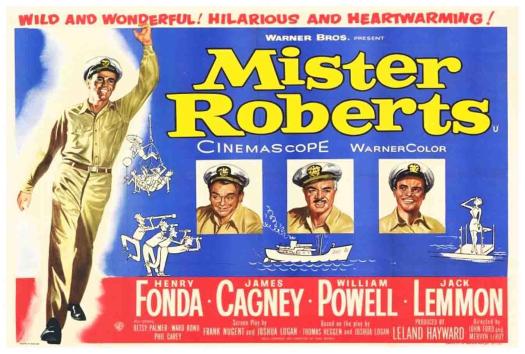
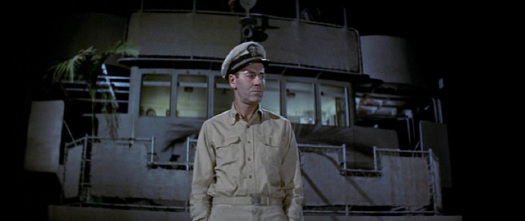
I grew up a “Navy brat”, often accompanying my dad to bases in Newport, RI. and Bethesda, MD. I’d hang out at the Enlisted Men’s Club he ran, watching Bugs Bunny and Road Runner cartoons with the sailors while dad did the books. I remember going aboard ship plenty of times, and saw one of my first movies with the crew on Family Night (the Cary Grant/Doris Day flick THAT TOUCH OF MINK). So naturally, I have a soft spot for nautical tales, and one of my favorites has always been MISTER ROBERTS.
The film marked Henry Fonda’s return to the screen after an eight year absence. Fonda had starred in the original Broadway production to great acclaim, and his performance is imbued with his own experiences during WWII. Douglas Roberts is a lieutenant (j.g.) assigned to the cargo ship Reluctant in the South Pacific, run by the vain…
To quote “Dirty” Harry Callahan, “I’m all broken up about his rights.”
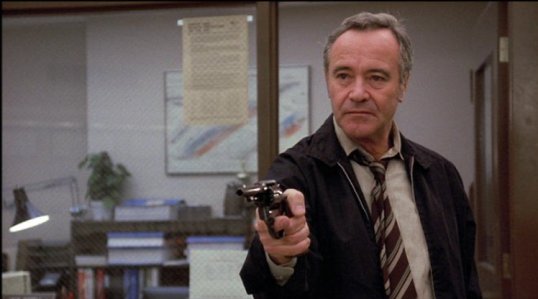
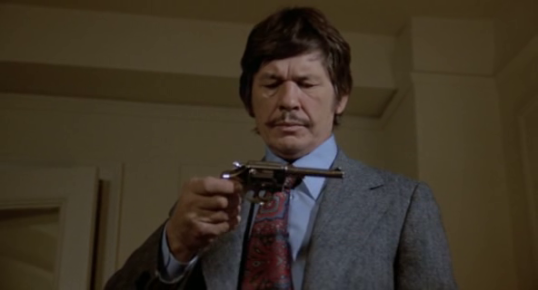
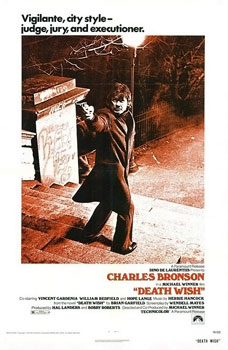
In 1972, a novel by Brian Garfield was published. The novel was about a meek New York City accountant named Paul Benjamin. After Paul’s wife is murdered and his daughter is raped, Paul suffers a nervous breakdown. A self-described bleeding heart liberal, Paul starts to stalk the streets at night while carrying a gun. He is hunting muggers. At first, he just kills the muggers who approach him but soon, he starts to deliberately set traps. Sinking into insanity, Paul becomes just as dangerous as the men he is hunting. Garfield later said that the book was inspired by two real-life incidents, one in which his wife’s purse was stolen and another in which his car was vandalized. Garfield said that his initial response was one of primitive anger. He wondered what would happen if a man had these rageful thoughts and could not escape them.
The title of that novel was Death Wish. Though it was never a best seller, it received respectful reviews and Garfield subsequently sold the film rights. At first, Sidney Lumet was attached to direct and, keeping with Garfield’s portrayal of Paul Benjamin, Jack Lemmon was cast as the unlikely vigilante.
Lumet, ultimately, left the project so that he could concentrate on another film about crime in New York City, Serpico. When Lumet left, Jack Lemmon also dropped out of the film. Lumet was replaced by Michael Winner, a director who may not have been as thoughtful as Lumet but who had a solid box office record and a reputation for making tough and gritty action films.
Winner immediately realized that audiences would not be interested in seeing an anti-vigilante film. Instead of casting an actor with an intellectual image, like Jack Lemmon, Winner instead offered the lead role (now named Paul Kersey and no longer an accountant but an architect) to Charles Bronson. When Winner told Bronson that the script was about a man who shot muggers, Bronson replied, “I’d like to do that.”
“The script?” Winner asked.
“No, shoot muggers.”
At the time that he was cast, Charles Bronson was 52 years old. He was the biggest star in the world, except for in America where he was still viewed as being a B-talent at best. Bronson was known for playing tough, violent men who were not afraid to use violence to accomplish their goals. (Ironically, in real life, Bronson was as much of an ardent liberal as Paul Kersey was meant to be at the beginning of the movie.) Among those complaining that Charles Bronson was all wrong for Paul Kersey was Brian Garfield. However, Bronson accepted the role and the huge box office success of Death Wish finally made him a star in America.
To an extent, Brian Garfield was right. Charles Bronson was a better actor than he is often given credit for but, in the early scenes of Death Wish, he does seem miscast. When Paul is first seen frolicking with his wife (Hope Lange) in Hawaii, Bronson seems stiff and awkward. In New York City, when Paul tells his right-wing colleague (William Redfield) that “my heart does bleed for the less fortunate,” it doesn’t sound natural. But once Paul finds out that his wife has been murdered and his daughter, Carol (Kathleen Tolan), has been raped, Paul gets mad and Bronson finally seems comfortable in the role.
In both the book and the original screenplay, both the murder and the rape happened off-screen. Never a subtle director, Winner instead opted to show them in a brutal and ugly scene designed to get the audience as eager to shoot muggers as Bronson was. Today, the power of the scene is diluted by the presence of Jeff Goldblum, making his screen debut as a very unlikely street thug. Everyone has to start somewhere and Goldblum got his start kicking Hope Lange while wearing a hat that made him look like he belonged in an Archie comic.
With his wife dead and his daughter traumatized, Paul discovers that no one can help him get justice. The police have no leads. His son-in-law (Steven Keats) is a weak and emotional mess. (As an actor, some of Bronson’s best moments are when Paul makes no effort to hide how much he loathes his son-in-law.) When a mugger approaches Paul shortly after his wife’s funeral, Paul shocks himself by punching the mugger in the face.
When Paul is sent down to Arizona on business, he meets Ames Jainchill (Stuart Margolin), a land developer who calls New York a “toilet” and who takes Paul to see a wild west show. Later at a gun club, Paul explains that he was a conscientious objects during the Korean War but he knows how to shoot. His father was a hunter and Paul grew up around guns. When Paul returns to New York, Ames gives him a present, a revolver. Paul is soon using that revolver to bring old west justice to the streets of New York City.
As muggers start to show up dead, the NYPD is outraged that a vigilante is stalking the street. Detective Frank Ochoa (Vincent Gardenia) is assigned to bring the vigilante in. But the citizens of New York love the vigilante. Witnesses refuse to give an accurate description of Paul. When Paul is wounded, a young patrolman (Christopher Guest, making almost as unlikely a film debut as Jeff Goldblum) conspires to keep Paul’s revolver from being turned over as evidence.
The critics hated Death Wish, with many of them calling it an “immoral” film. Brian Garfield was so disgusted by how Winner changed his story that he wrote a follow-up novel in which Paul is confronted by an even more dangerous vigilante who claims to have been inspired by him. Audiences, however, loved it. Death Wish was one of the top films at the box office and it spawned a whole host of other vigilante films.
Death Wish is a crude movie, without any hint of subtlety and nuance. It is also brutally effective, as anyone who has ever felt as if they were the victim of a crime can attest. In a complicated and often unfair world, Kersey’s approach may not be realistic or ideal but it is emotionally cathartic. Watching Death Wish, it is easy to see why critics hated it and why audiences loved it.
It is also to see why the movie made Bronson a star. Miscast in the role or not, Bronson exudes a quiet authority and determination that suggests that if anyone could single-handedly clean-up New York City, it’s him. An underrated actor, Bronson’s best moment comes after he punches his first mugger and he triumphantly reenters his apartment. After he commits his first killing, Bronson gets another good scene where he is so keyed up that he collapses to the floor and then staggers into the bathroom and throws up. Garfield may have complained that the Death Wish made his madman into a hero but Bronson’s best moments are the ones the suggest Paul has gone mad. The real difference between the book and the movie is that the movie portrays madness as a necessary survival skill.
This Friday, a new version of Death Wish will be playing in theaters. Directed by Eli Roth, this version starts Bruce Willis as Dr. Paul Kersey. Will the new Death Wish be as effective as the original? Judging from the trailer, I doubt it. Bruce Willis or Charles Bronson? I’ll pick Bronson every time.
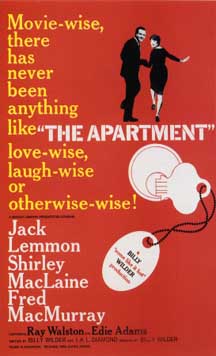
After the Nun’s Story, I continued to experience TCM’s 31 Days of Oscar by watching the 1960 best picture winner, The Apartment. The Apartment is unique among Oscar winners in that it’s one of the few comedies to win best picture. (Though, in all honesty, it would probably be more appropriate to call The Apartment a dramedy.) It was also, until the victory of The Artist, the last completely black-and-white film to win best picture.
(And, as long as we’re sharing trivia, it was also the first best picture winner to feature a character watching a previous best picture winner. At the start of the film, Jack Lemmon deals with insomnia by watching Grand Hotel.)
The Apartment tells the story of C.C. “Bud” Baxter (Jack Lemmon), an anonymous officer worker who is determined to climb the corporate ladder despite not being very good at his job. However, Baxter does have one advantage over his co-workers. He’s single and therefore, his apartment has become the place to go for corporate executives who need a place where they can safely cheat on their wives. Bud spends his day trying to coordinate who is going to be in his apartment and when. Meanwhile, he spends his nights exiled from his own home and wandering around New York. In fact, the only beneficial thing about this arrangement is that all of Bud’s supervisors have been giving him good evaluations in return for using his apartment. (Well, that and Bud’s neighbor, played by Jack Kruschen, is convinced, based on the thinness of the apartment walls, that Bud must be a great lover.)
When Bud finally does get his promotion, it’s only because the personnel director, Jeff D. Sheldrake (an amazingly sleazy Fred MacMurray), wants to use Bud’s apartment. Bud celebrates his promotion by finally working up the courage to ask out Fran (Shirley MacClaine), an elevator operator who works in the office. What Bud doesn’t realize is that Fran is also the woman who Sheldrake wants to bring to the apartment….
Fran is convinced that Sheldrake is going to leave his wife for her. What she doesn’t realize — and what Fred MacMurray’s performance makes disturbingly clear — is that Jeff Sheldrake is basically just a guy having a midlife crisis. He’s the type of middle-aged guy that every woman has had to deal with at some point, the guy who pulls up next to you in a red convertible and stares at you from behind his sunglasses, attempting his best to entice you into helping him relive the youth that he never had. When Fran eventually learns the truth about Sheldrake, it leads both to near tragedy and to Bud having to decide whether he wants to be a decent human being or if he wants to keep climbing the corporate ladder.
When one looks over a chronological list of all of the best picture winners, it’s a bit strange to see The Apartment listed in between Ben-Hurand West Side Story. As opposed to those two grandly produced and vibrantly colorful films, The Apartment is a rather low-key film, one that devotes far more time to characterization than to spectacle. And while both Ben-Hur and West Side Story are ultimately very idealistic films, The Apartment is about as cynical as a film can get. The Apartment may be a comedy but the laughs come from a place of profound sadness.
Because it’s more interested in people than in spectacle, The Apartment holds up better than many past best picture winners. We’ve all known someone like Bud. We’ve all had to deal with men like Sheldrake. And, in one way or another, we all know what it’s like to be someone like Fran. The Apartment remains a truly poignant and relevant film.
When I first decided to do this series of reviews of conspiracy-themed films, I knew that I would eventually have to review the 1991 Oliver Stone film JFK.
JFK is one of those films that continues to divide audiences. Those who think that John F. Kennedy was killed by a conspiracy tend to love this film and are given to describing JFK as being “one of the most important films ever made.” Those who believe that Lee Harvey Oswald was the lone assassin dismiss Stone’s film as being left-wing propaganda. Just check out the message board at the imdb if you need evidence of just how worked up people get over this film and its subject matter.
It seems that very few of the people who criticize or praise JFK ever review it as a work of cinema. Instead, they focus on the film’s politics. If I criticize the film for wasting the talents of Sissy Spacek or featuring one of Kevin Costner’s least interesting performances then I’m running the risk of having to deal with angry conspiracy theorists telling me that I need to open my eyes to the reality of American history. On the other hand, if I praise Tommy Lee Jones’s wonderfully decadent turn as one of the film’s conspirators, chances are that someone is going to accuse me of being a naive leftist.
Then again, perhaps that reaction is to be expected. Oliver Stone is one of our most political and least subtle filmmakers. His movies are specifically designed to challenge the status quo. For that reason, it’s not surprising to discover that Stone considers JFK to be the best of all of his films.
JFK is based (rather loosely, some claim) on the true story of New Orleans District Attorney Jim Garrison (played by Kevin Costner) and how, in 1967, he charged businessman Clay Shaw (played by Tommy Lee Jones) with being a part of a conspiracy to kill John F. Kennedy. Shaw was eventually acquitted and both Jim Garrison and his investigation remain controversial to this day.
JFK courts controversy immediately with its portrayal of Jim Garrison. I’ve read several accounts of the Garrison investigation and the one thing that they all seem to agree on is that Jim Garrison was a flamboyant, bigger-than-life figure who enjoyed publicity. Even among those who believe that Garrison uncovered some valuable evidence as a result of his investigation, there is a good deal of ambiguity about Garrison’s motives. However, in Stone’s film, Jim Garrison is played by Kevin Costner and is portrayed as being an incorruptible, all-American idealist. It’s not that Costner gives a bad performance. Instead, it’s just a rather uninteresting one, especially when one compares Costner’s Garrison to some of the stories about the real-life Garrison.
However, as the film unfolds, it becomes obvious that Stone is using Costner’s blandness to the film’s advantage. Over the course of three hours, JFK slowly peels back layers of secrecy and cover-ups and reveals the shadow world that, according to Stone, lurks underneath everyday reality. Costner’s Garrison might not be interesting but he is a stable presence. He anchors the film, giving us someone to relate to while the film itself grows more and more bizarre.
While Costner’s might give the least interesting performance of his career in this film, the same cannot be said of the rest of the cast. JFK is full of familiar faces, many of whom are only on-screen for a few minutes but all of which play an important role in creating Stone’s shadow universe. Kevin Bacon, Gary Oldman, Joe Pesci, Michael Rooker, Donald Sutherland, and Tommy Lee Jones; they all have small roles but every single one of them makes an undeniable impression. Whether you agree with the film’s conclusions are not, it’s impossible not to enjoy JFK for the chance to spot a bunch of familiar faces giving memorably bizarre performances.
But ultimately, its impossible to review JFK without considering the film’s conclusions. JFK makes the case that John F. Kennedy was killed as the result of a massive right-wing conspiracy that involved the military, business interests, the CIA, the FBI, anti-Castro Cubans, and the mafia. By the end of the film, the question becomes less who killed JFK and more who didn’t kill JFK.
Myself, I’m not going to claim to be enough of an expert on the Kennedy assassination to argue whether JFK is accurate or if it’s just propaganda. However, as a film reviewer, I can say that it’s a very well-made and powerful film but it’s also one of those films that works better the first time you see it than the second time.
The first time you see it, the film overwhelms you. It leaves you convinced that yes, there was a conspiracy and yes, everyone was involved and yes, Jim Garrison was right! It convinces you so thoroughly that you end up using exclamation points, just to make sure everyone knows how convinced you are.
However, with each subsequent time that you view JFK, you became a bit more aware of just how manipulative and one-sided it truly is. You become a bit more aware of the technique underneath the outrage and, if you’re a smart film watcher, you remember that JFK is a recreation as opposed to being a historical document. You become more and more aware that Stone approached the material with a destination in mind and, like any good director, he has specifically shaped the material to make sure that you reach that destination at the end of the journey.
That was certainly my experience with JFK. I first saw it in high school and it convinced me that JFK was the victim of a conspiracy. Then, when I was in college, I watched it for a second time and, though I still believed the film’s conclusions, I also found myself much more aware of how the film’s length and Stone’s direction were designed to beat the audience into submission. When I saw the film a third time, I found myself resenting the film’s manipulative nature and, as a result, I found it a lot more difficult to accept Stone’s conclusions.
However, when I rewatched the film last night for this review, I was surprised to discover that JFK actually holds up pretty well. It’s still way too long (and, unlike a lot of other reviewers, I am not impressed by the droning speech that Costner delivers at the end of film) and Stone’s lack of subtlety does backfire on a few occasions. However, perhaps because I was finally watching the film as entertainment as opposed to judging the film on its political or historical merits, I discovered that JFK is a watchable and entertaining film, one that does a pretty good job of making Stone’s case. If nothing else, it’s worth watching just for the chance to see the wonderfully snarky performances of Tommy Lee Jones, Kevin Bacon, and Gary Oldman.
Perhaps the best thing that I can say about JFK is that its the type of film that will inspire smart people to do their own research and come to their own conclusions, which may or may not be the same conclusions that Oliver Stone reaches.
And, honestly, isn’t that the most that we can ask of any film?
Sometimes, you have to be careful which films you choose to watch over the course of the day.
Such as, last Friday night, I heard the news that Jill Clayburgh had died and I ended up watching An Unmarried Woman. This, along with the fact that I also watched the Black Swan trailer, led to me dancing around the house in my underwear, en pointe in bare feet, and doing a half-assed pirouette in the living room. And I felt pretty proud of myself until I woke up Saturday morning and my ankle (which I don’t think has ever properly healed from the day, seven years ago, that I fell down a flight of stairs and broke it in two places) literally felt like it was on fire. That was my body’s way of saying, “You ain’t living in a movie, bitch. Deal with it.”
So, come Sunday, I decided to play it safe by watching something that I was sure wouldn’t lead to any imitative behavior on my part. Since I had previously reviewed Earthquake on this site, I decided that I would devote some time to the movies that started the entire 1970s disaster movie genre — Airport. Watching Airport led to me watching Airport’s three sequels.
I was able to do this largely because I own the Airport Terminal Pack, a two-disk DVD collection that contains all four of the Airport films and nothing else. There’s no special features or commentary tracks. That’s probably a good thing because these films are so extremely mainstream that I doubt the commentary tracks would be all that interesting except to people who love “Me and Jennings Lang had the same lawyer…” style stories.
The movies are a mixed bag of ’70s sexism, mainstream greed, and casts that were described as being “all-star” despite the fact that they featured very few stars. They’re all worth watching as time capsules of a past time. Some of them are just more worthy than others.
Below are my thoughts on each individual film in the collection…
Airport (directed by George Seaton)
First released in 1970, Airport was nominated for 10 Academy Awards (including best picture), broke box office records, and started the whole 70s disaster movie trend. It also has to be one of the most boring, borderline unwatchable movies ever made. The fact that I managed to sit through the whole thing should be taken as proof that I’m either truly dedicated to watching movies or I’m just insane. Take your pick.
Anyway, the film is painstakingly detailed account of the every day operations of an airport. Yeah, sounds like a lot of fun, doesn’t it? Burt Lancaster runs the airport. His brother-in-law Dean Martin flies airplanes. Both of them have mistresses but we’re told that’s okay because Lancaster’s wife expects him to talk to her and Martin’s wife is cool with him fucking around as long as he comes home at night. I would be tempted to say that this is a result of the film having been made in 1969 and released in 1970 but actually, it’s just an introduction to the sexual politics of the typical disaster film. Men save the day while women get in the way. And if you think things have changed, I’d suggest you watch a little film calledf 2012…
The only interesting thing about the film is that Lancaster’s mistress is played by Jean Seberg who, ten years earlier, had helped change film history by co-starring in Jean-Luc Godard’s classic film Breathless. Nine years later, after years of being hounded by the American press and the FBI for her radical politics, Seberg committed suicide.
Airport 1975 (directed by Jack Smight)
As opposed to its predecessor, Airport 1975 is actually a lot of fun in its campy, silly way. This is the one where a small private plane (flown by Dana Andrews, the star of the wonderful film noir Laura) collides with a commercial airliner. The entire flight crew is taken out and head stewardess Karen Black has to pilot the plane despite the fact that she’s obviously cross-eyed. Luckily, since Black is a stewardess, she has a pilot boyfriend who is played by Charlton Heston. Heston talks her through the entire flight despite the fact that she was earlier seen trying to pressure him into not treating her like an idiot. Anyway, Heston does his usual clench-jaw thing and if you need a drinking game to go with your bad movie, just take a shot every time Heston calls Black “honey.” You’ll be drunk before the plane lands.
There’s some other stuff going on in this movie (for instance, Gloria Swanson appears as “herself” and doesn’t mention Sunset Boulevard or Joseph Kennedy once!) but really, all you need to know is that this is the film where Karen Black acts up a storm and random characters keep saying, “The stewardess is flying the plane!?”
Odd trivia fact: Airport 1975 was released in 1974.
Airport ’77 (directed by Jerry Jameson)
In Airport ’77, a group of art thieves attempt to hijack an airplane which, of course, leads to the airplane crashing into the ocean and somehow sinking down to the ocean’s floor without splitting apart. The crash survivors have to try to figure out how to get to the surface of the water before they run out of oxygen.
In this case, our resident sexist pilot is Jack Lemmon who has a really ugly mustache. He wants to marry head stewardess Brenda Vaccarro. Vaccarro doesn’t understand why they have to get married to which Lemmon responds, “Because I want a wife and kids!” The film also gives us Lee Grant as a woman who is married to Christopher Lee but who is having an affair with another man. She also drinks a lot and dares to get angry when she realizes that the airplane is underwater. While this sort of behavior is acceptable from Dean Martin, Charlton Heston, and Jack Lemmon, the film punishes Lee Grant by drowning her in the final minutes.
Technically, Airport ’77 is probably the best of the Airport films. The cast does a pretty good job with all the melodrama, the film doesn’t drag, and a few of the scenes manage to generate something resembling human emotion. (For instance, when the blind piano player died, I had a tear in one of my freaky, mismatched eyes.) Unfortunately, the movie’s almost too good. It’s not a lot of fun. Everyone plays their roles straight so the silly plot never quite descends into camp and the key to a good disaster film is always camp. This film also has the largest body count of the series, with most of the cast dead by the end of the movie. (And, incidentally, this film did nothing to help me with my fear of water…)
The Concorde: Airport ’79 (directed by David Lowell Rich)
The last Airport movie is also the strangest. Some people have claimed that this film was meant to be a satire of the previous Airport films. I can understand the argument because you look at film like Concorde and you say, “This must be a joke!” However, the problem with this theory is that there are moments of obvious “intentional” humor in this film (i.e., J.J. from Good Times smokes weed in the plane’s bathroom, another passenger has to go to the bathroom whenever she gets nervous) and none of them show any evidence of the type of wit and outlook necessary to come up with anything this silly on purpose. Add to that, the film’s story is credited to Jennings Lang, a studio executive. Studio execs do not take chances. (Plus, the actual script was written by Eric Roth, who went on to write the amazingly humorless The Curious Case of Benjamin Button).
No, this film is meant to be taken seriously and oh my God, where do I start?
Our pilots are George Kennedy and Alain Delon. The head stewardess (and naturally, Delon’s girlfiend) is played by Sylvia “Emanuelle” Kristel who, at one point, says, “You pilots are such men!” “Hey, they don’t call it a cockpit for nothing, honey,” Kennedy replies.
Meanwhile, Robert Wagner is trying to destroy the Concorde because one of the passengers is his girlfriend who has proof that Wagner has been selling weapons to America’s enemies. So, he attempts to blow the plane up with a guided missile and when that fails, he sends a couple of fighter planes after them. Kennedy responds by opening up the cockpit window — while breaking the sound barrier mind you — and firing a flare gun at their pursuers.
After this, there’s stop over in Paris where Delon arranges for Kennedy to sleep with a prostitute who assures Kennedy that he made love “just like a happy fish.”
The next day, everyone returns to the exact same Concorde — despite the fact that just a day earlier they’d nearly been blown up by a squadron of fighter planes — and take off on the second leg of the flight. Let me repeat that just to make sure that we all understand what this film is asking us to believe. After nearly getting blown up by a mysterious squad of fighter planes, everybody shows up the next morning to get on the exact same plane.
Oh, and it never occurs to Wagner’s ex-girlfriend that Wagner might have something to do with all of this.
Now sad to say, Concorde is the one of those films that’s a lot more fun to talk about than to actually watch. It should be a lot more fun in its badness than it actually is. Still, the movie has just enough camp appeal to make it fun in a “what the fuck…” sorta way.
And that’s how the Airport series comes to an end.