Insomnia Files #71 and #72: Dallas Cowboys Cheerleaders (dir by Bruce Bilson) and Dallas Cowboys Cheerleaders II (dir by Michael O’Herlihy)


What’s an Insomnia File? You know how some times you just can’t get any sleep and, at about three in the morning, you’ll find yourself watching whatever you can find on cable or streaming? This feature is all about those insomnia-inspired discoveries!
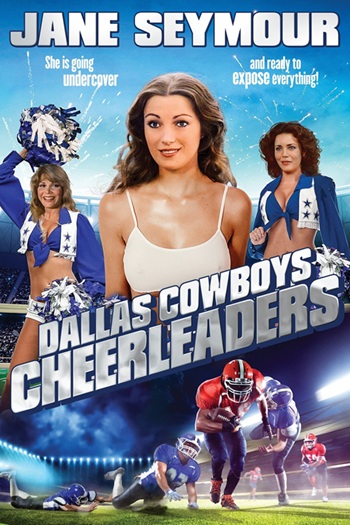
If you were having trouble getting to sleep last night, you could have gone over to YouTube and watched 1979’s Dallas Cowboys Cheerleaders!  And then, if you were still having trouble getting to sleep, you could have followed it up with 1980’s Dallas Cowboys Cheerleaders II!  And then if you were somehow still not able to get any rest …. well, sorry.  There’s only two of them.  I guess you could watch that Making the Team show.  I don’t know.

Anyway, back to the movies!

The first Dallas Cowboys Cheerleaders stars Jane Seymour as a serious journalist who at first scoffs at the idea of going undercover as a Dallas Cowboys Cheerleader.  But her ex-boyfriend and editor (Bert Convy) insists that she take the assignment.  Jane goes undercover and even makes the squad!  (It’s never mentioned whether she has any sort of dance or cheerleading experience so I find it a bit odd that she actually made it onto a professional cheerleading squad but whatever….)  Seymour gets to know the other members of the Squad, including the Love Boat’s Lauren Tewes.  She comes to realize that she doesn’t want to write up a tabloid story about the cheerleaders.  These are “good, down home girls,” she tells Convy.  Convy doesn’t care.  He wants scandal!

He’s not going to get it, though.  The main message of this film is that the Dallas Cowboys Cheerleaders are basically saints with pom poms.  Sure, one of them has a loser ex-boyfriend.  And another one of them struggles a bit with the routines.  It’s not an easy job but, in the end, everyone does their bit to support the team!

It’s all pretty silly but I’m from Dallas and I’m surrounded by Cowboy fans who have been complaining nonstop about the team for as long as I can remember so I enjoyed watching a movie that portrayed the Cowboys organization as being the greatest group of people on the planet.  (No drug or gun problems here!)  It’s very much a film of the 70s, made for television and straddling the line between being exploitive and being wholesome.  Yes, the costumes are skimpy but no one smokes, drinks, or curses.  The film features soapy drama, actual Dallas locations, 70s fashion, a great disco soundtrack, and dorky Bert Convy as a womanizer.  Plus, like me, Jane Seymour has mismatched eyes.  How can you not love this film!?

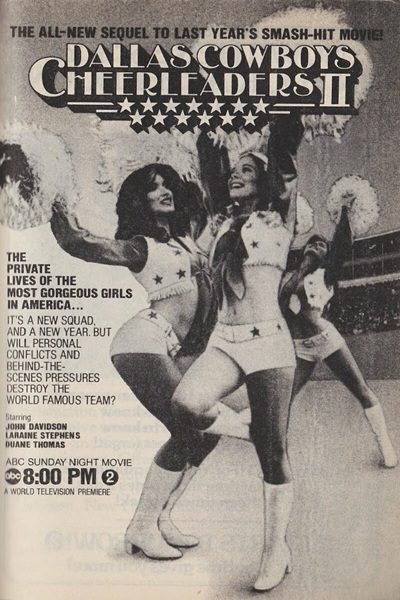
As for the sequel, it ditches almost everyone from the first film.  Only Laraine Stephens, as the squad’s no-nonsense coach, returns.  She’s got a whole new squad to deal with and only a limited amount of time to perfect the cheer that will win the Cowboys the Super….sorry, I mean to say the playoff game.  Whenever anyone in the film says, “playoff game,” their lips read “Super Bowl,” so I guess there was some last-minute tinkering after shooting was completed.  The squad also has to get ready to tour with the USO and to perform at a children’s hospital.  (Ray Wise appears as a doctor at the children’s hospital.)  The Cheerleaders are not only going to bring peace to the world but they’re also going to give those children the inspiration they need to get better.  Yay!

This one isn’t as much fun, largely because Laraine Stephens’s character isn’t that much fun.  The first film featured the very British Jane Seymour in Texas, somehow becoming a member of an all-American football team’s cheerleading squad and it was impossible not to enjoy the implausibility of it all.  The second film is just Laraine Stephens getting mad at people for not having the routine down to perfection.  No thanks, movie, I’m done with dealing with demanding choreographers.  There’s a reason why I turned down all of those offers to join the cheer squad in high school.  (For the record, my sister was the greatest cheerleader our high school ever had or ever will have!  Erin watched the first movie with me a few weeks ago.  She said it was okay but she didn’t think Jane Seymour was a convincing cheerleader.)

According to what I’ve read online, the first Dallas Cowboy Cheerleaders film was a huge rating success.  The second film was less so, which I guess is why there was never a third.
Previous Insomnia Files:

  1. Story of Mankind
  2. Stag
  3. Love Is A Gun
  4. Nina Takes A Lover
  5. Black Ice
  6. Frogs For Snakes
  7. Fair Game
  8. From The Hip
  9. Born Killers
  10. Eye For An Eye
  11. Summer Catch
  12. Beyond the Law
  13. Spring Broke
  14. Promise
  15. George Wallace
  16. Kill The Messenger
  17. The Suburbans
  18. Only The Strong
  19. Great Expectations
  20. Casual Sex?
  21. Truth
  22. Insomina
  23. Death Do Us Part
  24. A Star is Born
  25. The Winning Season
  26. Rabbit Run
  27. Remember My Name
  28. The Arrangement
  29. Day of the Animals
  30. Still of The Night
  31. Arsenal
  32. Smooth Talk
  33. The Comedian
  34. The Minus Man
  35. Donnie Brasco
  36. Punchline
  37. Evita
  38. Six: The Mark Unleashed
  39. Disclosure
  40. The Spanish Prisoner
  41. Elektra
  42. Revenge
  43. Legend
  44. Cat Run
  45. The Pyramid
  46. Enter the Ninja
  47. Downhill
  48. Malice
  49. Mystery Date
  50. Zola
  51. Ira & Abby
  52. The Next Karate Kid
  53. A Nightmare on Drug Street
  54. Jud
  55. FTA
  56. Exterminators of the Year 3000
  57. Boris Karloff: The Man Behind The Monster
  58. The Haunting of Helen Walker
  59. True Spirit
  60. Project Kill
  61. Replica
  62. Rollergator
  63. Hillbillys In A Haunted House
  64. Once Upon A Midnight Scary
  65. Girl Lost
  66. Ghosts Can’t Do It
  67. Heist
  68. Mind, Body & Soul
  69. Candy
  70. Shortcut to Happiness

April Noir: Collateral (dir by Michael Mann)


In 2004’s Collateral, Jamie Foxx stars as Max, a taxicab driver who is hoping, in those days before Uber, to start his own limousine company.  When we first see him, he’s giving a ride to a federal prosecutor named Annie (Jada Pinkett Smith) and he’s even getting her phone number after he drops her off at work.  Unfortunately, for Max, his next passenger is a bit less friendly.

Vincent (Tom Cruise), with his gray hair that matches his suit, is polite, quiet, and direct when he speaks.  He carries a briefcase with him everywhere that he goes and anyone who tries to take the briefcase soon discovers just how far Vincent will go to hold onto it.  Vincent pays Max $600 to drive him around Los Angeles for the night.  Vincent has a lot of business that he needs to attend to.  Max agrees, not realizing until it’s too late that Vincent is a hired assassin and that his business is killing people.  Vincent has been hired to wipe out a collection of crooks and lawyers and, though Vincent is careful not to reveal his emotions, it’s obvious that he’s looking forward to the challenge.

To his credit, Max doesn’t really have any interest in being a part of Max’s killing spree but he soon finds himself unable to escape from Vincent and being forced to drive from location to location.  Along the way, Vincent and Max engage in debates of both morality and philosophy.  Vincent sees death as just being a part of the job.  Max is horrified, especially when people who haven’t done anything wrong end up as collateral damage in Vincent’s killing spree.  The truth of the matter is that, even if Max hadn’t picked up Vincent, there’s no guarantee that he wouldn’t have picked up some other madman.  As a taxi driver, Max surrenders his control once he unlocks the door and allows someone to get in the backseat.  Sometimes, he gets a passenger like Annie.  Other times, he’s going to get a passenger like Vincent.  Somewhat improbably, Vincent and Annie turns out to be connected and Max’s chance encounter with her becomes even more important.

Because this is a Michael Mann film, Los Angeles is as much a character in this film as Max and Vincent.  Mann captures the shadowy darkness of the city at the night and the feeling that both opportunity and danger could lurk around every corner.  Claustrophobic scenes in the taxi cab are mixed with scenes in an equally claustrophobic (though for different reasons) club.  The film’s haunting final image takes place not in the cab but instead on a train.  Everyone is heading somewhere and, at some point during the film, both Vincent and Max deal with the feeling of having no control over where they’ll end up.

When Collateral first came out in 2004, I remember that a lot of people were shocked to see Cruise playing a villain.  Cruise does give one of his best performances here, playing yet another one of Mann’s cool and efficient professionals.  Strangely enough, Jamie Foxx is the one who was nominated for an Oscar, even though he’s actually a little on the boring side as Max.  (In all fairness, Max is meant to be the conventional member of the film’s involuntary partnership.)  The film is dominated by Cruise and his performance is still powerful to this day.

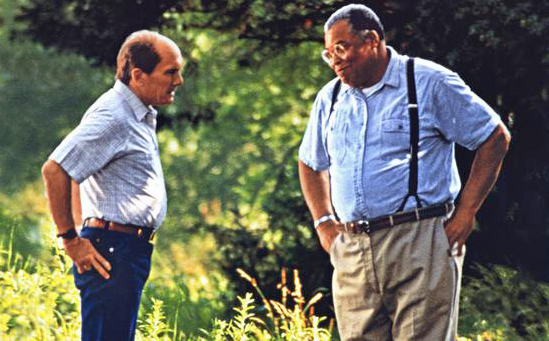
A FAMILY THING (1996) – Robert Duvall & James Earl Jones are brothers!


Just for the hell of it, I went on a little Robert Duvall marathon for his birthday on January 5th. I started the marathon off with his superior western with Kevin Costner, OPEN RANGE (2003). Next up was Duvall’s excellent crime film with Joe Don Baker and Robert Ryan, THE OUTFIT (1973). Duvall was in badass mode in this one. Based on one of Richard Stark’s “Parker” books, this was my first time to watch the film and damn, it was excellent. After that, I watched the bleak THE ROAD (2009), starring Viggo Mortensen, where Duvall just had a small part. It was a downer. I finished off the marathon late in the evening with A FAMILY THING (1996). I remember when this movie came out in the 1990’s because it was co-written by Billy Bob Thornton. Thornton was still a year away from his massive success with the movie SLING BLADE, but I knew him from his writing and co-starring in the superior crime film ONE FALSE MOVE (1991), as well as his small role in TOMBSTONE (1993). As an Arkansan, I knew Thornton was from Arkansas so I had taken a particular interest in him. But I was only 22 years old when A FAMILY THING was released, and a movie about a couple of old guys resolving family issues didn’t seem that appealing to me. As a guy into his 50’s, the entire concept seems more interesting to me now, so I gave it a spin for the first time to close out the marathon.

The story opens up in rural Arkansas with Earl Pilcher Jr. (Robert Duvall) getting the shock of his life when his beloved mother writes a final letter to him and instructs her local pastor to deliver it a few days after her death. The letter tells Earl that his biological mother was a black woman named Willa Mae who died in childbirth. It seems that Earl’s dad had gotten Willa Mae pregnant, and since he came out white, his “mother” was able to raise him as her own without having to tell him the truth. The letter also tells him that he has a half-brother named Ray Murdock (James Earl Jones) living in Chicago. It’s her dying wish that he meet Ray and get to know him as family. Pissed at his dad, and wanting to honor his mom, Earl heads to Chicago to meet Ray. Earl knows that Ray is a cop so he’s able to track him down. They immediately don’t like each other, but through a variety of circumstances, Earl ends up staying at Ray’s house for a couple of days. While there, he meets Ray’s wise, old Aunt T., Willa Mae’s sister (Irma P. Hall) and his sullen son Virgil (Michael Beach). Will the two men continue to push each other away, or will they eventually find the family connection that exists under all that messy past? 

I was surprised how deeply I was affected by A FAMILY THING. I’d be lying if I said I didn’t get teary-eyed a couple of times. The movie may use issues of adultery and racism to get the ball rolling, but more than anything else, it seems to understand that life is messy and that people are messy. We’ll disappoint ourselves, we’ll disappoint other people, and other people will disappoint us. There’s a reason that many people find their love in dogs and cats instead of people, because real relationships can be tough. The truth about my own life is that I could not have appreciated this film in 1996 at only 22 years of age. I was too naive. That’s no longer the case in 2025, and I can now truly relate to this story of two men who share a painful history, find common ground, and decide it’s worth moving forward together because family really does matter.

A movie like A FAMILY THING has no chance of working without a great cast, and this movie is a thespian jackpot. Robert Duvall is spot on perfect as the good ole guy from Arkansas, with a little bit of a racism engrained down deep into his soul, who now has to deal with the fact that he is half black. The scene where he confronts his dad about the lies that had been told to him all his life is as good as it gets. James Earl Jones matches Duvall in the even trickier role as the man who has always known about his “white” half brother Earl. This man has buried his hatred away for Earl’s father for decades, who he blames for the death of his own mother, and now has to deal with those feelings being dredged back up to the surface when Earl shows up in Chicago. Jones perfectly balances his character’s desire to keep the past in the past, with his decency as a man who doesn’t want to just throw Earl out on the street. He eventually softens towards him no matter how much bitterness he has for Earl’s dad. And neither Duvall or Jones even give the best performance in the film. That honor goes to Irma P. Hall as the blind, but extremely perceptive Aunt T. She sees through all of their bullshit, as she states to each of them on different occasions, and encourages them to get to know each other because they’re family. As they play games of racism and bitterness, she reminds them they are brothers no matter the color of their skin. It’s the performance of a lifetime and was at least worthy of an Oscar nomination in my opinion. 

Overall, A FAMILY THING may compress the amount of time and potential therapy it would take to resolve the type of family history presented here, but it does find a certain truth in the power of relationships. Earl and Ray don’t have to recognize the fact that they are brothers. As a matter of fact their lives are just fine without each other. But it’s their willingness to embrace the messy truth and find a way to connect with each other that makes the movie meaningful to me! 

Here’s the trailer for A FAMILY THING.

Embracing the Melodrama Part II #67: Split Image (dir by Ted Kotcheff)


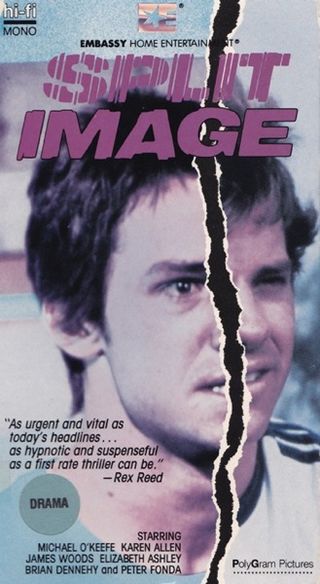
Split_Image_VHS_coverUnlike Desperate Lives, the 1982 melodrama Split Image is available to be viewed on YouTube.  In fact, you can watch it below and I suggest that you do so.  It’s a pretty good film and, apparently, it’s never been released on DVD or Blu-ray and it’ll probably never be available on Netflix either. So, if you’ve ever wanted to see Peter Fonda play a cult leader, your best bet is to watch the video below.

But before you watch the video, here’s a little information on Split Image, one of the best films that you’ve never heard of.

Essentially, the film follows the same plot as the Canadian film Ticket To Heaven.  A college athlete (played by Michael O’Keefe) starts dating a girl (Karen Allen) who is a member of a sinister religious cult.  Soon, O’Keefe is a brainwashed member of the cult and only answering to the name of Joshua.  (The head of the cult is played, in an appropriately spaced-out manner, by Peter Fonda.)  His parents (Brian Dennehy and Elizabeth Ashley) hire a cult deprogrammer (James Woods) to kidnap their son and break Fonda’s hold on him.  However, it turns out that Woods’ methods are almost as psychologically destructive as Fonda’s manipulation.

Even if it’s not quite as memorably creepy as Ticket To Heaven, Split Image is still a well-made film, featuring excellent performances from Dennehy, Woods, O’Keefe, and Fonda.  However, for me, the most interesting thing about Split Image is that it was largely filmed and set down here in Dallas.  Just watch the scene where Woods and his men attempt to kidnap Michael O’Keefe.  It was shot on the campus of Richland Community College, which is one of the places where I regularly go to run.

(Interestingly enough, 33 years after the release of Split Image, Richland still looks exactly the same!)

You can watch Split Image below!

http://www.youtube.com/watch?v=DKWYuJyZ9X8